Latest News and Comment from Education

Thursday, April 16, 2015

Who's most excited for Hillary Clinton to replace Obama? Teachers unions. - Vox

Who's most excited for Hillary Clinton to replace Obama? Teachers unions. - Vox:

Who's most excited for Hillary Clinton to replace Obama? Teachers unions.
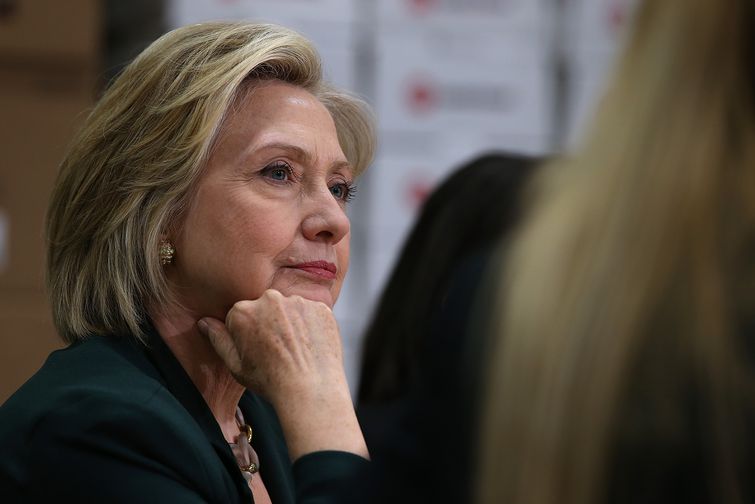


 Hillary Clinton is unlikely to offer a meaningfully different domestic policy agenda than Barack Obama. But if you're looking for an exception to the rule, look at K-12 education.

Obama has picked fights with teachers unions by promoting the Common Core, charter schools, and merit pay for teachers. Clinton has a better relationship with unions who either oppose those policies or are concerned about how they're being implemented.
"I think she’s going to be different," said Randi Weingarten, president of the American Federation of Teachers union. "It doesn’t mean she’s going to agree or disagree." But she suggested Clinton's point of view on some issues might align more closely with her own: "What we’ve learned about her in all these years is she understands teachers are really important to kids."
So while Clinton will lay out themes and messages that sound a lot like Obama's on many issues, there is room for substantive difference on education. A Clinton presidency could mean a significant shift in policy away from the Obama administration's aggressive reforms.

How the Obama administration embraced education reform and alienated unions


For the past seven years, Education Secretary Arne Duncan has wielded more power than his predecessors — and he's used it to promote policies opposed by teachers unions.
The most controversial among them requires states to evaluate teachers based in part on their students' test scores. If states wanted their schools to escape penalties under No Child Left Behind, the federal education law that required all students to be proficient in reading and math in 2014, the Education Department required them to overhaul teacher evaluation.
When the Obama administration took office, only three states used students' test scores as a factor in their evaluation systems. Now more than 40 have designed systems to do so. Those systems usually rely on value-added scores, which try to estimate the impact of an individual teacher on the progress students make during an academic year, as well as classroom observations and other factors.
Economic research has found that the students of teachers with higher value-added scores are more likely to attend college and earn higher salaries later in life. But teachers unions arguethat value-added systems are at best too narrow in their definition of good teaching, and at worst fatally flawed. The new systems have led some states to create assessments for less academic subjects like art and gym. And a study of value-added scores found they're only weakly linked to teachers' performance in the classroom.
This isn't the only reason for the rift between Obama and teachers unions. The Education Department has encouraged states to make it easier to open charter schools, schools that are publicly funded but privately run and that are typically not unionized. And Duncan praised the verdict in a California lawsuit that overturned teacher tenure in the state.
The Obama administration's education agenda is controversial even within the Democratic party — and it's in force not due to legislation, but due to how Obama and Duncan have wielded executive power. They've pushed states to make changes with competitive grants and waivers from No Child Left Behind. The lack of underlying legislation makes Obama's education agenda particularly vulnerable to the whims of the next administration, Democratic or Republican.

Clinton has historically been closer to unions
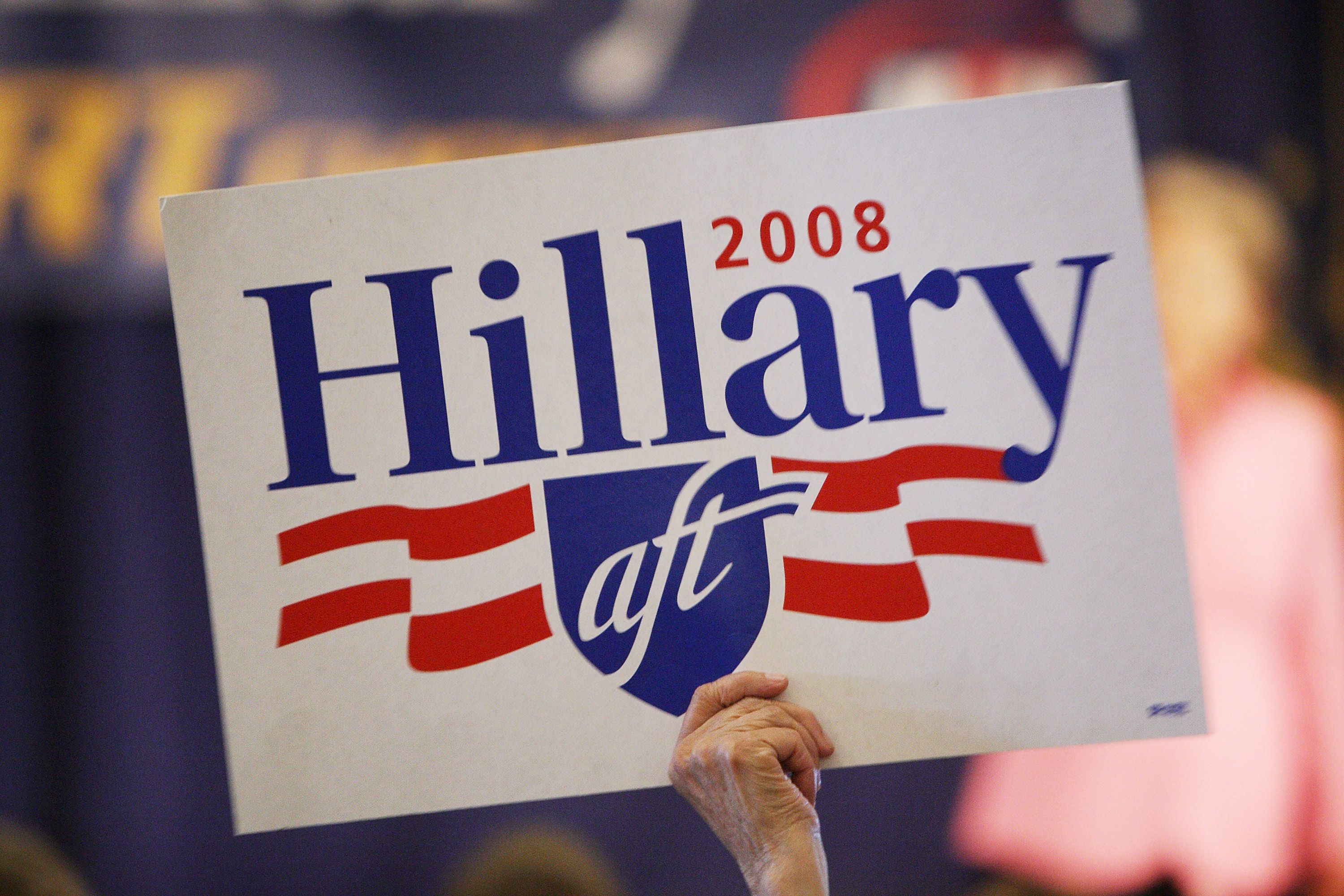

At least for now, Clinton has preserved traditional Democratic ties with unions — a contrast with Obama that was most obvious in a small dispute in the 2008 Democratic primary over merit pay.
Obama supported merit pay for individual teachers. Clinton wanted entire schools to be rewarded, arguing that merit pay for individual teachers was "demeaning" and would lead to unhealthy competition between educators. She eventually won the AFT's endorsement. (The NEA, the other major teachers union, sat out the primary endorsement process before endorsing Obama in the general election.)
"She’s passionate about children, and she’ll follow the evidence, and she’ll talk to people and give people their due, instead of thinking about things ideologically, as you’ve seen in the last 10 years," Weingarten said.
But where Clinton will be in 2016 is difficult to predict. She is best known for her support of early childhood education, a priority for Obama and Duncan that could become a focus of the next Democratic administration. She hasn't dealt with the more contentious world of K-12 policy since leaving the Senate.
The Clinton campaign did not respond to an email asking about her education plans. At a roundtable conversation in Iowa on Monday, Clinton focused on education and its role in the economy and said the "really unfortunate argument that's been going on around Common Core" has been "really painful."
But there are early signs that she might work with unions. The Center for American Progress, a think tank now closely allied with Clinton, worked with the American Federation of Teachers onrecommendations for overhauling No Child Left Behind. They recommended testing students every year, as under current law. But states would only be required to include one test from elementary school, one from middle school, and one from high school in their systems for evaluating schools, rather than using annual test results.
Education reformers criticized the joint AFT-CAP approach as being less stringent on accountability. The framework suggests that after the Obama administration, Democrats and teachers unions might align more closely on policy than they have in the past six years.
A board member of Democrats for Education Reform told the New York Times's Maggie Haberman in March that he was concerned about Clinton's "longstanding ties" with unions. The group said in a statement Sunday that it celebrated her candidacy and is "hopeful that she … carries on President Obama's legacy of promoting quality teachers and benchmarks that give every student a chance to succeed no matter their background."

Why the Obama administration's brand of reform might not survive


Clinton wouldn't have to pursue more union-friendly policies in order to break with the past. She'd simply have to abandon some of the more controversial parts of the Obama administration's approach.
It's possible that she won't even get the option: a compromise draft for overhauling No Child Left Behind proposed by Democratic Sen. Patty Murray and Republican Sen. Lamar Alexander would tie the Education Department's hands, cutting back on the amount of influence the secretary could exert over state policy. If that bill becomes law, it would significantly limit how much influence Clinton could have on K-12 education.
The waivers from No Child Left Behind's penalties have been a powerful inducement for states to do what the administration wants. But they have also created a complicated interplay between states and the federal government, where states are constantly monitored to see if they're living up to their side of the deal.
If No Child Left Behind limps on into a Clinton administration, when it would be a decade late for an overhaul, the next Education Department could simply create waivers with fewer conditions.
Stepping back slightly from reform wouldn't require a broad array of new policy proposals. It would just require doing slightly less.
The federal government didn't write the standards, but it has promoted them. The stimulus bill included $4.4 billion in Education Department grants for states that adopted "college- and career-ready standards."
States weren't explicitly required to adopt the Common Core in order to compete for the federal money; they could have used their own standards if they proved to the Education Department that those standards prepared students for college. Nearly all of them adopted Common Core instead, and all of the states who eventually won the grants were Common Core states. Another grant program was created to help develop tests based on Common Core standards.
The federal government has other levers to promote Common Core, too. It waives some requirements of No Child Left Behind, the 2002 education reform law, for states that (among other things) adopt "college and career-ready standards" and assessments based on those standards. But Texas, Virginia, and Minnesota got waivers from the law without adopting the Common Core by proving that that their standards could prepare kids for college and careers.

BIPARTISAN NCLB FIX PASSES SENATE COMMITTEE: Murray Calls for Continued Bipartisan Work

US Senate Committee on Health, Education, Labor, & Pensions: Newsroom - Press Releases:
BIPARTISAN NCLB FIX PASSES SENATE COMMITTEE: Murray Calls for Continued Bipartisan Work to Move Bill Through Senate, Get Signed into Law


Image result for Patty Murray

Thursday, April 16, 2015
Murray: “I am hopeful that we can keep this momentum going and get this done.” 
Bipartisan agreement unanimously passes HELP Committee, moves to Senate floor 
Murray amendments passed through committee with strong bipartisan support
(Washington, D.C.) – Today, the Senate Health, Education, Labor, and Pensions (HELP) Committee passed the Every Child Achieves Act of 2015, the bipartisan compromise reached by Ranking Member Patty Murray (D-WA) and Chairman Lamar Alexander (R-TN) to rewrite the broken No Child Left Behind law. The legislation passed unanimously through the HELP Committee and now moves to the Senate floor. Following the vote, Senator Murray released the following statement:
“Today’s vote was another positive step toward fixing the badly broken No Child Left Behind law and ensuring that all students have the opportunity to learn, no matter where they live, how they learn, or how much money their parents make—and now I am hopeful that we can keep this momentum going and get this done.
“I am very pleased with the bipartisan process in committee, which allowed us to build on and improve the starting point that Chairman Alexander and I agreed to work from.  I am looking forward to working with my colleagues to continue to strengthen and improve this legislation on the Senate floor and as we work toward getting this signed into law.
“Working through this process in a bipartisan way from start to finish is the best chance we have to fix this broken law, so I appreciate Chairman Alexander’s hard work, dedication,  and willingness to work with me—and I look forward to continuing our bipartisan work to get this across the finish line.”
During the markup, three amendments offered by Senator Murray passed with strong bipartisan support: an amendment to help ensure that military-connected children are succeeding in school, an amendment to help schools and communities in the aftermath of violent or traumatic events, and an amendment to improve and expand early learning programs.


Alexander: Unanimous Committee Passage of Bipartisan Agreement to Fix No Child Left Behind Shows Consensus on Urgent Need to Fix the Law and How to Fix It
Says “if senators were students in a classroom, none of us would expect to receive a passing grade for unfinished work—7 years is long enough to consider how to fix No Child Left Behind”
Thursday, April 16, 2015Margaret Atkinson / Jim Jeffries 202-224-2465
* * *
 “The consensus that the committee found is the same that Senator Murray and I found. That consensus is this: Continue the law’s important measurements of academic progress of students but restore to states, school districts, classroom teachers and parents the responsibility for deciding what to do about improving student achievement.” – Lamar Alexander 

WASHINGTON, D.C., April 16 – Senate education committee chairman Lamar Alexander(R-Tenn.) today praised the work of the committee in acting on the bipartisan agreement to fix No Child Left Behind. After three days of amendment and debate, the committee voted unanimously to send the bill to the full Senate.   
Alexander said: “If senators were students in a classroom, none of us would expect to receive a passing grade for unfinished work. Seven years is long enough to consider how to fix No Child Left Behind. The committee considered 57 amendments, approved 29, and improved the bipartisan agreement Ranking Member Murray and I reached—but the consensus that the committee found is the same that Senator Murray and I found. That consensus is this: Continue the law’s important measurements of academic progress of students but restore to states, school districts, classroom teachers and parents the responsibility for deciding what to do about improving student achievement.  
“I thank Ranking Member Murray for her hard work and her commitment to getting a result, and I look forward to working with her as this moves to the Senate floor. Now the bill is ready to be taken up by the full Senate with the same opportunity for amendment, discussion, and debate.” 
Last week Chairman Alexander and Ranking Member Patty Murray (D-Wash.) announced a bipartisan agreement on fixing “No Child Left Behind.” The senators’ legislative agreement, the Every Child Achieves Act of 2015, would reauthorize the Elementary and Secondary Education Act (ESEA), the chief law governing the federal role in K-12 education. The most recent reauthorization of ESEA was the “No Child Left Behind Act,” which was enacted in 2001 and expired in 2007. 
Click here to read Senator Alexander’s opening statement at the start of Tuesday’s committee action on the agreement.   

Executive Session - S.___ Every Child Achieves Act of 2015, S.___ WIOA Technical Amendments Act, and Nominations

Date:

Thursday, April 16 2015, 12:30 PM

Place:

216 Hart Senate Office Building

Agendareturn to top

• S. ____   Every Child Achieves Act of 2015
• S. ____  WIOA Technical Amendments Act
• Nomination of Ericka Miller, Assistant Secretary for Postsecondary Education, Department of Education.
• Nomination of Michael Yudin, Assistant Secretary for Special Education and Rehabilitative Services, Department of Education.
• Any additional nominations cleared for action
Archive video
April 14: Click Here
April 15 Morning Session: Click Here
April 15 Afternoon Session: Click Here

Senate panel approves bipartisan K-12 education bill

Senate panel approves bipartisan K-12 education bill:

Senate panel approves bipartisan K-12 education bill


WASHINGTON — A bipartisan education bill to replace the controversial No Child Left Behind law and reduce the federal government's power over schools cleared its first big hurdle Thursday.
The Every Child Succeeds Act, from Sens. Lamar Alexander, R-Tenn., and Patty Murray, D-Wash., was approved by a vote of 22-0 by the Health, Education, Labor and Pensions Committee after three days of debate and the adoption of nearly 30 amendments.
Supporters said the bill would "fix" the No Child Left Behind law that governs the nation's approximately 100,000 K-12 public schools.
Critics say that law - signed by President George W. Bush in 2002 - placed too much emphasis on judging and punishing schools based on student test scores and gave the federal government too big a role in deciding how best to improve local schools. The law expired in 2007, but states still have to abide by its requirements until a new law replaces it.
"I believe that working through this process in a bipartisan way from the start is the best chance we've got at fixing this broken law," said Murray, the senior Democrat on the education committee. "It helps make sure that all students get the opportunity to learn, no matter where they live, how they learn, or how much money their parents make."
The Every Child Achieves Act would still require students to take standardized tests, including two per year in reading and math in grades 3 through 8 and one during high school. It also would require students to take a total of three science tests between grades 3 and 12.
However, the federal government could no longer use those test scores to punish "failing" schools that do not meet achievement goals. Failing schools that receive federal funds for low-income children are required by No Child Left Behind to offer students the option of attending a different school and must pay for students' transportation therel. Escalating sanctions include replacing a school's entire faculty or having a private company take over and run the school.
The Alexander-Murray bill would allow states to decide how much weight to give test scores as they create their own state accountability systems. States would be allowed to include other measures of student and school performance to give teachers, parents and the public a more accurate picture of how well a school is doing.
"That consensus is this: continue the law's important measurements of academic progress of students but restore to states, school districts, classroom teachers and parents the responsibility for deciding what to do about improving student achievement," said Alexander, chairman of the education committee. "This change should produce fewer tests and more appropriate ways to measure student achievement."
 The House Committee on Education and the Workforce passed its own rewrite of the No Child Left Behind law earlier this year but House leaders pulled it from the floor in late February before members had a chance to vote on it. Conservatives said theStudent Success Act did not go far enough to limit the federal government's role in education, and House leaders were worried they didn't have enough votes to pass the bill.

The White House said it was encouraged by the Alexander-Murray bill, but stopped short of endorsing it.
"(The) announcement from Senator Alexander and Senator Murray is an important step in their bipartisan effort to replace the No Child Left Behind Act," White House Press Secretary Josh Earnest said last week. "As Congress continues its work, President Obama will continue to insist on providing our schools with greater flexibility to invest in what works, making sure that teachers aren't confined to teaching to the test, putting resources behind innovation in our education system, and expanding opportunities for America's children to attend high-quality preschools."
The National School Boards Association called the bill "a welcome sign of progress."
"The (bill) acknowledges and reaffirms local-level decision making in public education," Executive Director Thomas Gentzel wrote Monday in a letter to Alexander and Murray. 
American Federation of Teachers President Randi Weingarten called the bill an "important first step."
"It moves away from the increasingly counterproductive focus on sanctions, high-stakes tests, federalized teacher evaluations and school closings," she said. "And it will help return the joy of teaching and learning that's been missing as a result of testing and test-prep fixation in too many classrooms."
The National Education Association, the nation's largest teachers' union, was more cautious.
"We will review the bill with a fine-tooth comb looking for language that ushers in a new vision for our nation's students and public schools; a vision that promotes equity and excellence for all students regardless of the zip code in which they live," said NEA President Lily Eskelsen GarcĆ­a.Senate panel approves bipartisan K-12 education bill: