The fix is in folks. We need a war against the ultra wealthy who believe they have a right control everything our government does in education and elsewhere.
At the Cambridge Forum lecture that I gave in Harvard Square at the First Parish (Unitarian Universalist) on March 8, 2015 I discussed the role of wealthy in education reform and the privatization of education (See the post Julian Vasquez Heilig @CamForum to Discuss The Health of Democracy and Privatizing Education). The Director of the Cambridge Forum let me know that the radio program which will be syndicated on NPR across the nation will go to stations via satellite on April 17. Here in Sacramento, KQED airs the Cambridge Forum at 6:30 p.m. on Sundays. Thus it is likely the lecture will air either Sunday April 19 or the next Sunday.
The Cambridge Forum Lecture:
First, I want to thank you for inviting me here today for the Cambridge Forum. If you haven’t had a chance yet, you should go to YouTube and check out the archive of past lectures on the Cambridge Forum feed. As I was preparing for this talk, I watched several previous lectures on YouTube and was inspired by Professor Lessig, Garrison Keillor,the Onion, several MacArthur Genius award winners and many others who have given this lecture in the past.
Thank you again for having me.
Also, I am glad to be here in Boston. I spent a summer here in Massachusetts in the 1990s when I was a fellow at theEducation Development Center. I fell in love with the New England summer. So much so that I did end up applying to Harvard for my masters and doctorate. Even though I was admitted, I decided not to come to Cambridge for three reasons: a) it was about 70 degrees colder than Stanford California b) Myplane coming into Logan took enemy RPG fire and c) because Boston was awar zone at the time. Now to be honest, only one of those three was a reason I never ended up at Harvard, but it seems these days that public speakers have been exaggerating a little— so I went with it.
If you are here in the audience or listening at home or elsewhere I hope that you will Tweet from today’s conversation to @ProfessorJVH. My Twitter profile is Professor then my three initials J-V-H. I would like to write a post for my popular education blog Cloaking Inequity by integrating your Tweets and audience thoughts at a future date. I’d also like to publicly thank the hundreds of thousands Cloaking Inequity readers who hail from 181 countries around the world.
I’ll begin with a story about the US Constitution
As young children, Americans are inculcated with an admiration of democracy— a “manifest destiny” to see democratic systems spread throughout the world. However, in preparation for this lecture, I pondered the anti-democratic direction of education reform today. I began to ponder the aristocratic forces seeking to invade and pervade public policy when I read an editorial published in a Michigan newspaper that argued that the power to elect U.S. Senators should given back to politicians in state legislatures— as originally stipulated in the Constitution.
As you are probably well aware, the U.S. has not always directly elected Senators. Let me share a bit of history from the U.S. Senate Website.
The framers of the Constitution did not intend senators to be directly elected, and included in Article I, section 3, “The Senate of the United States shall be composed of two Senators from each state, chosen by the legislature thereof for six Years; and each Senator shall have one Vote.”
However, the election of US Senators by politicians in the state legislatures got out of hand. Again, from the US Senate Website:
Intimidation and bribery marked some of the states’ selection of senators. Nine bribery cases were brought before the Senate between 1866 and 1906. In addition, forty-five deadlocks occurred in twenty states between 1891 and 1905, resulting in numerous delays in seating senators. In 1899, problems in electing a senator in Delaware were so acute that the state legislature did not send a senator to Washington for four years.
Muckraker journalist, the bloggers of the early 20th century, (I actually just recently changed the tag line of Cloaking Inequity to “Muckraking since 2012”) Muckraker journalist pushed for direct democracy for the election of U.S. Senators in late 19th century. Again from the US Senate:
After the turn of the century, momentum for reform grew rapidly. William Randolph Hearst hired a veteran reporter, David Graham Phillips, who wrote scathing pieces on senators, portraying them as pawns of industrialists and financiers. As the pressure built from muckrakers and the public, the Senate and then the House advanced the 17th Amendment. The states ratified and the Will you stink up the privatization garden party with me? | Cloaking Inequity:
Eight California school districts individually* (see note below) will receive the first district waivers from penalties under the No Child Left Behind law, U.S. Secretary of Education Arne Duncan announced Tuesday.
Duncan praised the districts’ “creative, thoughtful, innovative proposal.” He said that 1 million students willbenefit from the districts’ “rigorous expectations” and that other states will learn from the collaborative strategies that the districts are pledging to carry out. “Frankly, working directly with districts wasn’t an easy decision,” Duncan said. “We’re not taking this up because it was simple, but because it was the right thing to do.”
The one-year waiver, issued after weeks of intense negotiations between federal officials and superintendents in the CORE districts, will free the districts from key sanctions of NCLB and provide them with flexibility to use about $110 million in Title I money for school improvement, including training teachers in Common Core standards. The districts will stop NCLB’s accountability clock, in which additional schools would be labeled as failing, and instead be able to create broader measures of student achievement beyond standardized test scores.
The CORE districts are spread out geographically and represent 1.1 million California students. More than half of those students are from two southern California districts, Los Angeles Unified and Long Beach Unified. Clovis Unified, which is included in the charts, withdrew its application late in the process.
The eight unified districts applying through their umbrella organization, the California Office to Reform Education, or CORE, serve more than one in six students in the state; the districts are Los Angeles, Long Beach, San Francisco, Oakland, Santa Ana, Sanger, Sacramento City and Fresno. Clovis Unified, an original applicant that concluded the waiver was similar to its accountability system, has dropped out.
The waiver comes in the nick of time to take effect this school year. Duncan has issued waivers to 39 states so far and is reviewing applications for five more. An additional six states either have not applied or, like California, had their applications denied.
The waiver, the first that was not issued to a state department of education, has been strongly opposed by state chiefs of education, teachers unions and some advocacy groups that see a district waiver as a potential end run around federal accountability rules. Duncan said in a press conference that the law authorizes him to grant waivers to districts, as previous education secretaries have done for specific provisions. But Chris Minnich, executive director of the Council of Chief State School Officers, characterized the CORE waiver Tuesday as “an unprecedented shift in the federal role in education — clearly usurping state leadership.” California Department of Education officials expressed skepticism as well. In a statement Tuesday, California Teachers Association President Dean Vogel reiterated criticism of the waiver, though primarily for the districts’ failure to consult with local teachers unions in crafting the application, which he termed “counterproductive and divisive.”
The CORE superintendents argued to Duncan that they were seeking a stronger, “holistic” alternative to a narrowly focused and unworkable federal system. Districts, the application said, “have been too often chasing success in a system that does not define success in a comprehensive or rigorous manner.”
U.S. Secretary of Education Arne Duncan granted the CORE districts’ waiver Tuesday.
Duncan agreed and singled out CORE’s commitment to significantly expand the accountability system to include more minority and special education students than currently required under federal law. CORE’s proposal calls for significantly lowering the number of students represented in a subgroup as part of a school’s accountability measure. The waiver requires any subgroup of 20 or more children in a school to be included, instead of a minimum of 100 students, a threshold that Duncan said left 153,000 children “invisible” in the CORE districts under NCLB. Dozens of elementary schools, for example, in which students with disabilities, Hispanic children or African American children account for between 20 and 99 students will now track the progress of those student groups.
“These students face the same issues of poverty and should be treated with the same notions of accountability,” said Los Angeles Unified Superintendent John Deasy.
Liz Guillen, the legislative director of Public Advocates, a civil rights law firm, said that what the CORE superintendents didn’t say was that this year, under the Local Control Funding Formula, the Legislature lowered the statewide subgroup number to 30 students anyway.
The students will now be measured not only on standardized test results but by broader dimensions of student engagement and performance in a new School Quality Improvement System.
Scores on state tests, high school graduation rates and persistence rates – the percentage of 8th graders that go on to enroll in 10th grade — will comprise 60 percent of the index;
Factors of school performance, based on parent, teacher and student surveys, rates of redesignating English learners and identifying special education students, with an eye to over-identifying minority students, will comprise 20 percent;
CORE will pilot a new domain, making up another 20 percent, of social and emotional factors including rates of chronic absenteeism, suspensions and expulsions and difficult-to-quantify measures of grit and determination that are predictive of success in college or work.
The state also is transitioning to a broader accountability system, although the pieces aren’t in place. The state’s Academic Accountability Index, or API, currently based solely on standardized tests, will incorporate graduation rates and other factors. Legislation establishing the Local Control Funding Formula requires that districts start tracking a range of academic performance metrics, parent involvement and school climate.
Long Beach Superintendent Christopher Steinhauser said that measures under the CORE waiver are “in total alignment” with the new state funding formula. Fresno Unified Superintendent Michael Hanson said that CORE wanted to press forward now to reduce academic disparities affecting low-income and minority students but that CORE’s accountability index would prove valuable to the state. Members of the State Board of Education, in strongly endorsing the waiver earlier this year, agreed.
But in statements on Tuesday, neither Gov. Jerry Brown nor Superintendent of Public Instruction Torlakson was particularly complimentary or pointed to any benefit from the waiver.
“Several local school districts have now received a one-year waiver of the proficiency goals of the No Child Left Behind law,” said Evan Westrup, the governor’s press secretary. “From our perspective, however, the primary challenge is to implement vigorously the landmark Local Control Funding Formula and the Common CORE curriculum.”
“All California schools deserve relief from the unworkable mandates of No Child Left Behind, so it’s noteworthy that a few districts have — temporarily at least — managed to navigate the complex waiver requirements imposed by the Administration,” Torlakson said. “I continue to believe … that relief from the failings of federal policy should not be reserved only for those prepared to provide Washington an ever-expanding role in the operation of California’s public schools.”
A collaborative model
The CORE superintendents based their plan on the work of Canadian author Michael Fullan, who introduced in Ontario a collaborative model of school improvement that he contrasts with the top-down “blame and shame” interventions in which low-performing schools have been closed or their teachers replaced under NCLB.
Instead, CORE will identify highly successful schools and place them as partners with low performers. Fullan emphasizes “non-judgmental” efforts to improve instruction based on a collective “moral imperative” to do right by all children: Only if there is little improvement after several years of work will stronger actions be required.
Fullan, who described this process to 450 CORE district teachers and administrators last week in San Francisco, will likely be hired as an adviser during the waiver’s roll-out. He already has worked in several CORE districts.
CORE’s superintendents, however, can expect initial resistance.
Vogel and union leaders in the CORE districts blasted the superintendents for paying lip service to Fullan while ignoring them in the creation of a waiver that includes commitments for new teacher evaluations.
“I’m extremely disappointed,” said Susan Mercer, president of the Santa Ana Teachers Association. The wavier “takes away the voice of the teachers. It’s top-down and a step backward. Reform only happens when everyone works together to make change.”
While acknowledging that unions were not involved in developing the waiver, Deasy said “they must be involved as we start our journey today.” And he said that nothing in the waiver superseded teachers’ bargaining rights.
Two evaluation options
To qualify for a waiver, the CORE districts had to commit to use growth in student achievement as a factor in teacher and principal evaluations. Most teachers unions oppose this, although the Stull Act, the state law on evaluations, also requires it.
CORE’s application offered two options.
The Massachusetts alternative: Based on that state’s NCLB waiver, results from standardized and other tests would be used indirectly, as a check. If test scores didn’t agree with an evaluation based on classroom observations and other criteria, the district would take a second look to identify the discrepancy and could create a one-year improvement plan for the teacher.
The 20 percent minimum: Growth in student achievement, based a model that the CORE districts will develop, will comprise a minimum of 20 percent of a teacher’s or principal’s evaluation. Districts with their own models, like Los Angeles Unified, could seek approval to use their variations from the CORE board of directors.
This year, the districts will consult with unions on the criteria for an evaluation; bargaining would occur after the first year of a waiver. A new system would take effect in the third year of a waiver, assuming there is one. If teachers did not agree to one of the options, the district would no longer qualify for a waiver.
Cross-section of outside monitors
The approved waiver has several key changes from what CORE had proposed in May:
The waiver is for one year, not three. Duncan said he had imposed the same limitation on several other states and implied the CORE waiver could be folded into a future state waiver or extended if the state did not obtain one next year.
The waiver applies to only the eight districts this year. CORE had proposed to offer the waiver to any district that met the federal criteria and agreed to the rules of the consortium.
CORE created a 14-member School Quality Improvement System Oversight Panel to add teeth to the accountability system. CORE had proposed a decentralized system based on peer review and a board of directors. The oversight panel, meeting twice a year, will review the districts’ data and school improvement plans. For districts disregarding data requirements or chronically failing to show student improvement, the panel can recommend that the federal Department of Education yank their waivers.
Its biannual meetings will be subject to the state’s open meeting law. Among those who will appoint one representative are the governor, the State Board of Education, the California Teachers Association, the California School Boards Association, the State Board of Education, the Association of California School Administrators Association, the state PTA, the California County Superintendents Education Services Association, Education Trust-West (an advocate for minority students), the California Collaborative on District Reform and groups representing students with disabilities, English learners and higher education research organizations.
Staff writers Susan Frey and Kathryn Baron contributed to this report. Check back for updates to this story.
*Note: Previous versions incorrectly characterized the approval as a collective waiver for the CORE districts. The Department of Education is granting individual waivers to the eight districts in the CORE network. The distinction is important, because the feds will monitor each district separately for compliance, not through CORE.
GOING DEEPER
Summary of the CORE Districts’ approved wavier application, August 2013
Letter from CORE district unions opposing the waiver, June 2013
Letter from State Board President Michael Kirst and State Superintendent Tom Torlakson to the U.S. Department of Education on CORE’s waiver application, March 22, 2013
PDF (4522K) Request for waivers from 9 local educational agencies WORD (645K) Secretary's approval letters for request for waiver
from local educational agencies (August 6, 2013)
Big Education Ape: CORE Districts are "Fronts" for Gates, Waltons, Broad et al http://bit.ly/1O5fbhw
Obama Administration Approves NCLB Waiver Request for California CORE Districts
The Obama administration today approved eight California school districts (Fresno Unified, Long Beach Unified, Los Angeles Unified, Oakland Unified, Sacramento City Unified, San Francisco Unified, Sanger Unified, and Santa Ana Unified) for a one year district waiver from No Child Left Behind (NCLB), in exchange for locally developed plans to prepare all students for college and career, focus aid on the neediest students, and support effective teaching and leadership. These eight districts submitted a joint request for waivers as part of the California Office to Reform Education (CORE).
Earlier this year, California notified the Department that the state did not plan to request Elementary and Secondary Education Act (ESEA) flexibility for the 2013-2014 school year and instead will focus on implementing its new college- and career-ready standards. As a result, the Department considered a separate request for waivers from the CORE districts, which together serve over one million students - more students than most states. These districts are leading the way for their state in moving forward with higher standards for all students, particularly English Learners, students with disabilities, and low-achieving students. Since California adopted new standards in 2010, these districts have created shared plans for implementation, systems to improve instruction and promote continuous learning, and joint professional development and supports for teachers. With their new accountability system, the districts will hold themselves and their schools accountable for the performance of thousands more students in underserved subgroups than under NCLB, including approximately 23,000 additional African American students, 15,000 Hispanic students, 20,000 English Learners, 10,000 low-income students, and 46,000 students with disabilities. Teachers and leaders in these districts will also receive more meaningful feedback on their practice through new evaluation systems designed to support improved instruction and increase student learning. As a result of these rigorous plans, the Department is granting the eight districts flexibility from some of NCLB's restrictive mandates to allow them to better focus on key reforms to improve student achievement and increase the quality of instruction.
"The CORE districts have been engaged in collaboration and innovation designed to promote deep student learning and effective implementation of new standards that will prepare students for college and a career," said U.S. Education Secretary Arne Duncan. "The districts' approved plan includes key accountability components that when implemented will surpass the rigor of the current NCLB system and provide an opportunity to expand innovative interventions and practices that can improve student achievement, rather than spending time and resources implementing NCLB's one-size-fits-all mandates. The significance of their willingness to step up, and for the first time, hold themselves accountable for literally tens of thousands of children who were invisible under NCLB cannot be overstated."
The Department is approving the CORE districts for a one-year waiver from six ESEA requirements and their associated regulatory, administrative and reporting requirements. These waivers are authorized under ESEA section 9401, and are being granted directly to the districts participating in CORE, and not to the CORE organization itself.
The Department will closely monitor the districts' implementation of their plans, and will work with the California Department of Education, the California State Board of Education, and the CORE districts to develop an integrated monitoring strategy.
When Tennessee accepted the millions of dollars and grant-writing help from the corporate foundations to get their state application in shape to win the $501 million grant from Race to the Top in 2010, Tennessee accepted the role as poster state for corporate education reform, along with all the visibility that comes with it. In doing so, a deal was made that cost the state that tiny part of its educational soul and integrity that had not already sucked away by 25 years of value-added testing.
Arne Duncan has visited Tennessee a number of times (with and without his boss) since 2010, and even now Duncan and Obama continue to tout the "Tennessee miracle" as a model for the nation. On MSNBC last week, Duncan told Chis Hayes that Tennessee took the tough steps in 2009 to do what was needed (adopt tougher tests) and that, as a result, on 2013 NAEP tests, the state showed the greatest growth of any state in the nation. What Duncan did not say, of course, is that the ranking he attributes to TN is based on big doses of dissembling, spin, and outright lying. See this Brookings analysis for details, but here is the gist of why Haslam and Duncan are not be believed:
Governor Haslam’s chart is based on a very crude statistic. Tennessee’s gains on all four NAEP tests add up to 21.80 points—and DC’s to 22.22—but the tests have different scales. A one-point gain on NAEP’s 4th grade math test is not the same as a one-point gain on the 8th grade reading test. The NAEP website warns users, “Since these scales are calculated independently from each other, we cannot compare scale scores across subjects and grades.” The same goes for adding scale score gains from the different tests. If you search the NAEP website for a statistic like the one on Governor Haslam’s chart—combining gains on all four tests—you won’t find one.
And:
To conclude the discussion of TN’s gains, here is a summary of its statistically significant gains relative to the other 49 states and the District of Columbia:
4th Grade Math: Greater than 42 states. Not significantly greater than 8 states.
8th Grade Math: Greater than 15 states. Not significantly greater than 35 states.
4th Grade Reading: Greater than 22 states. Not significantly greater than 28 states.
8th Grade Reading: Greater than 34 states. Not significantly greater than 16 states.
Pop! goes the balloon. But these are not the only facts that weigh heavily on Duncan and Haslam's gas bags that are quickly descending. When we look at Tennessee's NAEP performance just two years earlier from 2011, we see plenty of room for Tennessee to improve in 2013, since 2011 represented a free fall in the rankings and a further opening of the achievement gaps, two facts that neither Duncan or Haslam will never mention:
Tennessee’s results also show that economically disadvantaged students in neighboring states such as Kentucky, Georgia, Missouri, Arkansas and North Carolina now score higher in every tested area than do poor students in Tennessee. “We have an educational emergency. These results underline the urgency of pressing forward with the necessary reforms,” Ralph Schulz of the Nashville Chamber of Commerce said. “If we’re going to ensure the future economic prosperity of our state, we can’t go back — we have to step up.”
The state dropped from 45 to 46 in the nation in fourth-grade math; 39 to 41 in fourth-grade reading; 43 to 45 in eighth-grade math; and 34 to 41 in eighth-grade reading. Twenty-six percent of fourth-grade students are proficient in reading, and 30 percent are proficient in math. Twenty-seven percent of eighth-grade students are proficient in reading, and 24 percent are proficient in math.
There's an interesting point of view in the Daily News. Apparently, the issue with the "Renewal" schools in New York City is that they have an inordinate percentage of "lower quality" teachers. This assumption, of course, is based on the research of reformy Chalkbeat NY, nee Gotham Schools, which finds it noteworthy when E4E can muster 100 signatures on a petition demanding more work for less pay, but can't be bothered to cover a massive demonstration against Cuomo's policies.
First, let's look at the definition of a "lower quality" teachers. This particular person is someone who scores developing or ineffective on a rating system even Andrew Cuomo labels "baloney" (notwithstanding his enthusiastic support for it at its inception). Unlike Cuomo, those of us who actually believe in science and research called it junk science from the start. That includes people like Diane Ravitch. In fact, even Randi Weingarten, who ran around the country helping to negotiate crap evaluation systems eventually admitted "VAM is a sham."
These systems are all a result of the Gates MET study, a convoluted piece of crap that set out to prove yet another theory emanating from Mr. Gates' fruitful hind quarters--that we need to replicate whatever teachers do in classrooms in which students receive high test grades. This, of course, is the central theory behind reforminess. Public schools, Gates theorizes, are no good because kids don't score well enough on standardized tests.
The fact is, though, that every so-called failing school contains high concentrations of high-needs students. There are kids who live in poverty, kids who have special needs and kids who don't speak English. And please, before some preachy moron gets the notion I'm giving up on those kids, the fact is I spend every day of my working life trying to help those kids. And what my kids need is help learning English, not help passing a test.
I spent a few years teaching ELLs how to pass a test. Some genius in Albany declared that it didn't matter whether or not kids knew English, and in order to graduate high school they needed to pass the English Regents exam anyway. I was drafted. I made kids pass and didn't teach them fundamentals of English language because it wasn't necessary for the test. Kids who passed may have assumed it meant they knew English, but I can assure you they did not. It meant they knew a highly formulaic four paragraph essay good for nothing but that version of the test, and it meant they knew how to look for correct A, B, C, D answers in Regents texts. It meant absolutely nothing more.
I was happy for kids who passed, but I did not fool myself for a moment that it was because I was a great teacher. It was because I made them write until their hands fell off. It was because I made them rewrite everything, no matter how tedious, and it was because I read and critiqued every word they wrote. It was no fun, neither the kids nor I liked it, but they tended to pass the stupid test in higher numbers than they would have without it. Of course their actual writing was no better than before, and they surely failed college writing tests in droves.
Here's the thing--if you are the principal, charged with running a so-called failing school, are you gonna say yes, the school is failing, and all the teachers are excellent. It is therefore an anomaly, a veritable miracle of nature. Are you gonna say the students are no good? Are you gonna tell the truth, that you in fact have high concentrations of high needs kids and there is really nothing you can do about it? Is that gonna get you that NYC Educator: Do "Failing" Schools Mean Failing Teachers?:
Are Camden's Renaissance Schools Really Serving ALL the Children?
One of the big promises of the Camden "Renaissance Schools" was that they would be open to all of the children within a "catchment" area. This was a necessary precondition for the TEAM/KIPP charter chain to take over Lanning Square, which was supposed to be reserved for a district school. From the Philadelphia Inquirer of 2013:
Camden's first privately run and publicly financed Renaissance school project, the KIPP Cooper Norcross Academy, intends to build its first school at the site the state had reserved for the Lanning Square Elementary School and then expand from there.
[...]
KIPP plans to open in fall 2014 with prekindergarten and kindergarten, and add a grade each year, with about 100 students in each grade. A middle school is expected to open in the same building for fall 2017.
All students living within the catchment area would qualify for admission to the charterlike school.
Keep this in mind as we explore the latest controversy over the Renaissance Schools:
Last month, the Education Law Center released data -- obtained from the Camden City School District and well in advance of the regular release of enrollment data by the NJDOE -- that shows that the Renaissance Schools are not enrolling demographically similar populations of students compared to CCSD schools:
⦁ KIPP enrolled 105 students, one above projected enrollment.
⦁ Mastery enrolled 37 English language learners (ELL), one above projected enrollment and comparable to the district’s ELL enrollment.
⦁ Uncommon enrolled no ELLs, and KIPP enrolled five ELLs, well below the district’s 8% ELL enrollment.
⦁ Mastery enrolled 59 special education students, 20 below projection and 3% below the district’s 19% classification rate.
⦁ Uncommon enrolled six and KIPP enrolled seven special education students, below projections and far below the district’s enrollment of students with disabilities.
All of the charter schools’ enrollments exceed the district’s 92% rate of students who qualify for free and reduced priced lunch. However, data from the Camden district does not break out those students who qualify for free lunch, with household incomes below 130% of the federal poverty level, and those who qualify for reduced priced lunch, below 185% of the poverty level or a household income of $44,800 for a family of four. The data does not provide special education enrollment by disability classification, so it is not possible to determine the severity of the disability of those students enrolled in the new charters as compared to students enrolled in the district. [emphasis mine]
Now, there's actually a fair response to this disparity in numbers. That response was released, as reformy talking points in New Jersey usually are these days, through the charters' reliable cheerleaders, Laura Waters and Janellen Duffy. Here's what Duffy, director of JerseyCAN, had to say:
Also, according to the latest data, the renaissance schools are serving rates
It is the position of the Seattle King County Branch of the NAACP to come out against the Smarter Balanced Assessment Tests. Commonly referred to as SBAC.
Seattle and Washington State public schools are not supplied with proper resources and a lack of equity within our schools continue to exist.
The State of Washington cannot hold teachers responsible for the outcome of students test results; when these very students are attending schools in a State that ranks 47th out of 50 States in the Nation when it comes to funding education. That is the 3rd lowest in the U.S. Furthermore, Washington State cannot expect for the majority of students to perform well on increased targeted performance assessments; while the State continues to underfund education in direct violation of a Washington State Supreme Court Order.
In this Epsode of the BustED Pencils podcast, Jed and Tim will be talking to Florida State Senate candidate Rick Roach. You might be thinking, "hey I know that name, isn't he the school board member that had some problems taking the FCAT?" http://www.washingtonpost.com/blogs/answer-sheet/post/revealed-school-board-member-who-took-standardized-test/2011/12/06/gIQAbIcxZO_blog.html Since then Rick has become an advocate for quality schools and jumped into the Florida state Senate race. Listen tonight as we talk to Rick about his journey from school board member who took the FCAT to Florida State Senate candidate. https://rickroachforsenate.com/



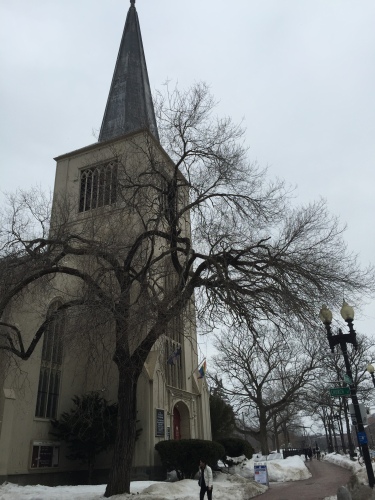 First, I want to thank you for inviting me here today for the Cambridge Forum. If you haven’t had a chance yet, you should go to YouTube and check out the archive of past lectures on the Cambridge Forum feed. As I was preparing for this talk, I watched several previous lectures on YouTube and was inspired by Professor Lessig, Garrison Keillor, the Onion, several MacArthur Genius award winners and many others who have given this lecture in the past.
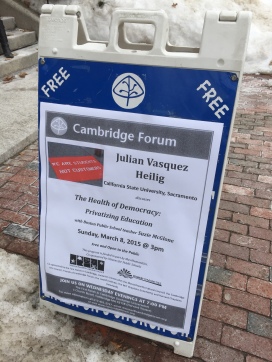 Muckraker journalist, the bloggers of the early 20th century, (I actually just recently changed the tag line of Cloaking Inequity to “Muckraking since 2012”) Muckraker journalist pushed for direct democracy for the election of U.S. Senators in late 19th century. Again from the US Senate:


