Latest News and Comment from Education

Thursday, February 26, 2015

Garcia condemns CPS legal attack on pregnant teachers - Jesus "Chuy" Garcia for Mayor of Chicago #Chuy2015

Garcia condemns CPS legal attack on pregnant teachers - Jesus "Chuy" Garcia for Mayor of Chicago:


Garcia condemns CPS legal attack on pregnant teachers

Wednesday, February 25, 2015 | Press 

Emanuel Administration’s defense of discrimination underscores need for accountability, ethics and an elected school board, says Garcia
FOR IMMEDIATE RELEASE
Chicago — Cook County Commissioner Jesus 'Chuy' Garcia blasted Mayor Emanuel’s school administration today for claiming that discrimination against pregnant teachers was “consistent with business necessity.”
“Discrimination may be business as usual for the Emanuel Administration, but it’s never a business 'necessity' -- and it’s always wrong,” said Garcia.
CPS has defended the discriminatory practices of Scammon Elementary School’s principal, who targeted pregnant teachers and teachers with newborns for discipline and dismissal with the tacit blessing of top CPS administrators, despite years of complaints and documentation of the discrimination.
“The CPS legal assault on these teachers speaks volumes about who the Emanuel Administration really cares about,” says Garcia. “Emanuel has gone to the wall to defend a wealthy venture capitalist whose companies profit from the schools she oversees -- while he’s defending discrimination against working mothers.”
The federal government filed a discrimination lawsuit against the Emanuel administration’s hand-picked school leadership team in December asserting that the CPS engaged in a pattern of discrimination and targeted pregnant teachers at the grade school.
“We need an elected school board that will root out unethical administrative practices -- rather than cover them up and defend their consequences,” said Garcia. “Emanuel’s school bureaucrats have chosen to attack victims of discrimination instead of ending that wrongdoing. An elected school board builds the ground for a school administration grounded in best practices, ethical governance, basic workers rights -- and accountability to neighborhood residents, rather than the special interests who’ve robbed kids and parents of quality neighborhood public schools,” says Garcia.
Contact: Monica Trevino press@chicagoforchuy.com


Women's rights

Well-being, success, and safety

Unable to repeal Common Core, foes try sabotage - Stephanie Simon - POLITICO

Unable to repeal Common Core, foes try sabotage - Stephanie Simon - POLITICO:


Unable to repeal Common Core, foes try sabotage

Conservative lawmakers in state after state are having difficulty rounding up votes to revoke the standards outright


 The red-meat speeches at this week’s Conservative Political Action Conference are likely to thunder with calls to repeal the Common Core. But out in the trenches, conservative lawmakers in state after state are running into difficulty rounding up votes to revoke the academic standards outright.

So, aided at times by unlikely allies in the teachers unions, Republican lawmakers are trying a new tactic: sabotaging, in incremental steps, the academic guidelines and the new Common Core exams rolling out this spring.
Story Continued Below
Bills to repeal the Common Core have been introduced in 19 states so far this year, down slightly from the 22 states that considered such a step last year, according to the National Conference of State Legislatures. So far, they’ve fared poorly.
Common Core opponents had high hopes for rooting out the standards from Mississippi and Arizona. But in both cases, the state senates rejected repeal bills. North Dakota lawmakers killed a repeal bill earlier this month; on Tuesday, their counterparts in South Dakota did the same.

Kansas state Rep. Ron Highland, a Republican, said he’s not even sure a repeal bill will come to the floor in his deep-red state this session, much as he would like it to: “I’m not sure we have the votes, quite frankly.”
Refusing to concede defeat, Highland said he’s considering drafting a bill to curb state funding for textbooks and tests aligned to the Common Core and for the computer equipment that schools need to administer those tests online.
And the Common Core tests developed by two federally funded consortia, Partnership for Assessment of Readiness for College and Careers and Smarter Balanced, have become a popular target in other states.
Wisconsin lawmakers are considering an effort to strip funding for the Smarter Balanced exam from the state budget and let districts pick their own assessments from a state-approved list. The New Jersey General Assembly this week overwhelmingly passed a bill to prevent the PARCC test from being used to evaluate students or teachers until 2019.
And in Colorado, where Democrats repeatedly have shot down attempts at outright repeal, Republican state Rep. Gordon Klingenschmitt is pushing a bill to withdraw the state from the federally funded PARCC testing consortium in what he sees as the first step toward reclaiming local control over education.

“I’m not trying to hit a home run,” Klingenschmitt said. “I’m trying to lay down a bunt single.”
Meanwhile, teachers unions in New Jersey, Rhode Island, Illinois, Washington and elsewhere are encouraging members to support parents who want to opt their children out of the Common Core tests. The New Jersey Education Association has even launched a six-week TV and online ad campaign featuring videos of parents expressing concern — to the point of breaking down in tears — about the PARCC exam.
Yet another creative approach to undermine the Common Core has emerged in


Read more: http://www.politico.com/story/2015/02/unable-to-repeal-common-core-foes-try-sabotage-115522.html#ixzz3SrTc6euz

5 Lessons Education Research Taught Us In 2014 : NPR Ed : NPR

5 Lessons Education Research Taught Us In 2014 : NPR Ed : NPR:


5 Lessons Education Research Taught Us In 2014

How To Measure Learning


 Studies, research papers, doctoral dissertations, conference presentations — each year academia churns out thousands of pieces of research on education. And for many of them, that's the end of it — they gather dust in the university library or languish in some forgotten corner of the Internet.

A few, though, find their way into the hands of teachers, principals and policymakers. Each year the American Educational Research Association — a 99-year-old national research society — puts out a list of its 10 most-read articles.
We've looked over that list and compiled a summary of some of what we learned from the ivory tower in 2014.
1) What's The Best Way To Teach Math To Struggling First Graders? The Old-Fashioned Way.
Math teachers will often try to get creative with their lesson plans if their students are struggling to grasp concepts. But in "Which Instructional Practices Most Help First-Grade Students With and Without Mathematics Difficulties?," the researchers found that plain, old-fashioned practice and drills — directed by the teacher — were far more effective than "creative" methods such as music, math toys and student-directed learning.
The researchers from the University of California, Irvine, and Penn State examined more than 13,000 first-grade math students in 1,300 different schools nationally.
They found that first graders who scored in the bottom 15 percent on math tests were more often subject to activities that have no evidence of fostering retention or improving performance. For example, teachers with lots of struggling students often sought to liven up their lessons by adding movement or music. But the researchers found little evidence that those methods worked.
Instead, they found that that the only activity associated with gains in performance on an adaptive, un-timed, one-one-one administered test is what we think of as traditional instruction. Namely, a teacher demonstrating how to solve a problem, followed by repeated opportunities for students to work by themselves, replicating the procedure with worksheets and drills.
These results run contrary to some interpretations of the Common Core, where students collaborate, talk through a problem, and dissect the different ways to reach a solution. The researchers found that while this kind of learning can work for some students, those already struggling in math failed to grasp concepts as easily as they did under more traditional lessons.
2) The Effectiveness Of Alignment
When a teacher's curriculum is perfectly aligned with a set of standards, meaning they're teaching exactly what they're told to, will students' test scores rise? That's the question a group of researchers set out to answer in "Instructional Alignment as a Measure of Teaching Quality."
Finding an answer to this is critical since better instructional alignment is a driving component of the Common Core.
Researchers at the University of Southern California and the University of Pennsylvania looked at 324 teachers in six large school districts (New York City; Dallas; Denver; Charlotte-Mecklenburg, N.C.; Memphis; and Hillsborough County, Fla.) in 2010.
Once the researchers created a measure for how closely aligned a teacher's curriculum was with standards, they examined the correlation of that alignment with teachers' ability to raise test scores (as measured by value-added models, which granted, have their own complications).
The results did not show a meaningful relationship between the two. Meaning, perfectly aligned curriculum is no more likely to be associated with gains in tests scores as is perfectly unaligned curriculum.
3 and 4) On The Higher-Ed Front
The big story in higher education in 2015 so far has been President Obama's proposal for two free years of community college. Two of the most-read education research articles of 2014 were focused on different aspects of community college.
In "Labor Market Returns to Sub-Baccalaureate Credentials", researchers from the Career Ladders Project and Columbia University spent seven years tracking more than 5 Lessons Education Research Taught Us In 2014 : NPR Ed : NPR:

Mayor Rahm Emanuel and Chuy Garcia face different personality challenges - #Chuy2015

Mayor Rahm Emanuel and Chuy Garcia face different personality challenges - Chicago Tribune:


Emanuel and Garcia face different personality challenges


 Mayor Rahm Emanuel has long nurtured a national reputation as a short-fused political savant, but with his re-election unexpectedly on the bubble, he finds himself trying to convince voters those defining personality traits are a positive.

Jesus "Chuy" Garcia, the Cook County commissioner hoping to unseat Emanuel in an April 7 runoff, faces the opposite problem. He is possessed of an earnest, nice-guy demeanor but now has to demonstrate to a wide pool of voters he has the vision and backbone to lead a city facing deep and difficult troubles.

And both rivals face a tight deadline to pull off those sales jobs.

In an era when political campaigns often drag on for months or years, the race for Chicago's next mayor has been compressed into a six-week sprint bound to test the savvy and resources of Emanuel and Garcia. They were the top vote-getters among five candidates in an initial round of balloting Tuesday that produced no outright winner.

As the campaign resets, the edge for Garcia lies in momentum. For Emanuel, it's money.

Emanuel underperformed in Tuesday's vote despite an enormous fundraising advantage that allowed him to dominate the airwaves with his message. That advantage is almost sure to continue into the runoff, affording Emanuel an effective mechanism to try to define the lesser-known Garcia in the minds of voters before Garcia can define himself.

At the same time, by simply surviving to fight another day, Garcia's up-to-now low-budget campaign is almost sure to gain energy, money and a fresh look from voters. "I've largely represented districts on the Southwest Side, so my name recognition isn't where a mayoral contender needs to have it," Garcia acknowledged Mayor Rahm Emanuel and Chuy Garcia face different personality challenges - Chicago Tribune:

New Jersey Parents Opting Out: Gates-funded Ed Trust Wants You to Stay In | deutsch29

New Jersey Parents Opting Out: Gates-funded Ed Trust Wants You to Stay In | deutsch29:


New Jersey Parents Opting Out: Gates-funded Ed Trust Wants You to Stay In


 PARCC testing in New Jersey is scheduled to begin March 2, 2015. The NJ PARCC testing “window” will not end in March, but will continue into April, May, and June, depending upon the grade level and whether the test is part of the PBA (performance-based assessment), which is given 75% of the way through a school year, or EOY (end of year), which comes 90% of the way into a school year.

For third grade, New Jersey schools must schedule 4.75 hours for the English language arts (ELA) PBA and EOY PARCC and 5 hours for the math PBA and EOY PARCC.
Just shy of 10 hours of schedules testing time for a third grader.
For fourth and fifth graders it is a full 10 hours.
For sixth through eighth graders, almost 11 hours.
Note that the PBA and EOY PARCC tests are summative assessments. The US Department of Education (USDOE) wanted much more testing from PARCC and its sister consortium, Smarter Balanced (SBAC).
Even the summative assessments alone are too much testing.
Too much.
Many New Jersey parents agree. They do not want their children (or their children’s schools) subjected to and driven by PARCC.
New Jersey parents are opting out of PARCC testing, and the pro-testing set is taking New Jersey parents seriously.
Consider test-score-driven reformer, Kati Haycock, founder and president of Education Trust.
New Jersey parents, Haycock has landed in your op/eds. According to NJSpotlight editor John Mooney, Ed Trust was not invited to write. It asked to do so.
New Jersey parents, Haycock isn’t liking your opt-out decisions.
She wants you to submit your children to those ten hours of PARCC testing. She is “in support of annual testing of every child” as the means to *close achievement New Jersey Parents Opting Out: Gates-funded Ed Trust Wants You to Stay In | deutsch29:

Big Education Ape: Breaking News: Court Rules Smarter Balanced Assessment Violates The U.S. Constitution http://bit.ly/1Fv8ylk

Wednesday, February 25, 2015

Should Low Performing Charter Schools Be Closed? Are Charter Schools in Violation of Federal Regulations and State Law? Creating an Even Playing Field | Ed In The Apple

Should Low Performing Charter Schools Be Closed? Are Charter Schools in Violation of Federal Regulations and State Law? Creating an Even Playing Field | Ed In The Apple:


Should Low Performing Charter Schools Be Closed? Are Charter Schools in Violation of Federal Regulations and State Law? Creating an Even Playing Field

This year, by happenstance, an unusually large number of charter schools are up for renewal.
A little background: the law sets a cap on the number of charter schools, a cap for NYC and one for the remainder of the state, the NYC cap has about 25 slots left and over 100 slots for the rest of the state. There are three charter authorizers, SUNY, the Board of Regents and the NYC Department of Education. The charter is the equivalent of a permit to operate a school; the charter must be renewed every five years. In the fourth year the charter authorizer examines the school; in the original application the proposed school established goals; the authorizer examines the schools data in considerable detail and determines the length of the charter renewal; from another five years down to a low of 1.5 years.
In December charter renewal recommendations from NYC came before the Regents, usually pro forma. This time, Regent members had questions, lots of questions, and asked the Department to attend the January meeting and explain their renewal criteria.
There is no question that there are many charter schools that are struggling, with little hope of improvement. Single entrepreneur charter schools have no place to go for help; maybe they can purchase a professional development package, hire a consultant, change the principal, with no guarantee that results will change. If they struggle for the first five years, what will change in the ensuing years?
The Department and the State have also identified 94 struggling public schools in NYC, about a dozen are referred to as “out of time” schools, they have not shown any progress over a number of years. The Department is closely monitoring the schools, each school has a detailed plan, and many of the schools are receiving State Incentive Grant (SIG) dollars which bring outside resources into the school. Chancellor Farina says the schools need time.
The former administration crowed that they closed over 150 schools; I believe the Regents have closed something like seventeen charter schools.
At the February Regents meeting three schools from Buffalo were up for renewal and the recommendations were: one school, 3.5 years, another 4 years and the third the full 5 years. Regent Bennett, who represents Buffalo, objected, he claimed the Regents either extended for 3 or 5 years, nothing else (He’s wrong) and urged the Regents to extend all for five years. The committee chair, Regent Should Low Performing Charter Schools Be Closed? Are Charter Schools in Violation of Federal Regulations and State Law? Creating an Even Playing Field | Ed In The Apple:

Breaking News: Court Rules Smarter Balanced Assessment Violates The U.S. Constitution | Exceptional Delaware

Breaking News: Court Rules Smarter Balanced Assessment Violates The U.S. Constitution | Exceptional Delaware:


Breaking News: Court Rules Smarter Balanced Assessment Violates The U.S. Constitution

“The Court finds that the Smarter Balanced Assessment Consortium is an unlawful interstate compact to which the U.S. Congress has never consented, whose existence and operation violate the Compact Clause of the U.S. Constitution”
The Smarter Balanced Assessment Consortium has been ruled to be breaking many laws in our country according to Judge Daniel R. Green of the Circuit Court of Cole County in Missouri.  The most important of which is the fact that it was never passed by Congress.  The Court also found that taxpayer money must not be given to this unlawful compact.
The Missouri Coalition Against Common Core, led by Frank Sauer, filed suit against Missouri Governor Jay Nixon last year.  Judge Green, on November 26th, ordered a two week restraining order against any taxpayer dollars going to the SBAC.  Yesterday, he gave his final ruling against Governor Nixon and essentially invalidated the very premise of the Smarter Balanced Assessment Consortium.
For my own state of Delaware, I will be forwarding this case to our Attorney General Matt Denn for an official legal opinion on this type of arrangement within our own state.
Special thanks to the awesome Delaware blog Minding My Matters for bringing this to my attention.
Updated, 11:33am, 2/25/15: Diane Ravitch has written a post on this as well based on an article in the Missouri News Tribune which can be read here and gives more details on the case:

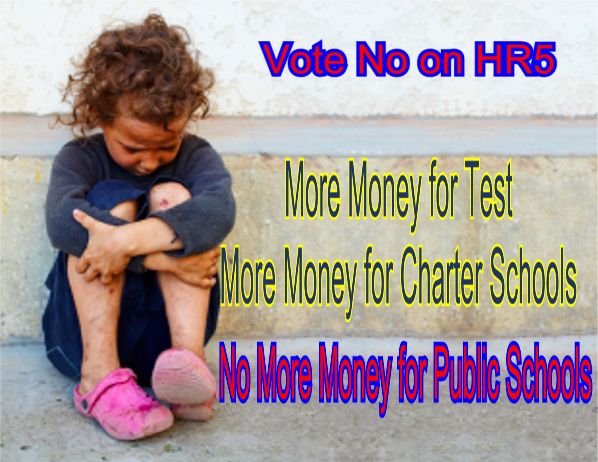
No ESEA Bill Is Better Than One That Fails to Protect the Poorest Children | Marian Wright Edelman #NOonHR5

No ESEA Bill Is Better Than One That Fails to Protect the Poorest Children | Marian Wright Edelman:

No ESEA Bill Is Better Than One That Fails to Protect the Poorest Children

Embedded image permalink


 #NOonHR5

#STOPHR5 #NOonHR5 US Representatives on Twitter Find your Member Hit them with a Vote No on HR5 Tweet http://bit.ly/17s6O1b


 For fifty years Title I of the Elementary and Secondary Education Act of 1965 (ESEA)has been the primary source of federal funding targeted to schools to serve poor children. Its purpose has been to raise achievement for poor children through extra support to their schools to help meet their greater educational needs. Sadly, from the beginning states didn’t keep their end of the bargain.

In 1969, the Washington Research Project (the Children’s Defense Fund’s parent organization) and the NAACP Legal Defense and Education Fund, Inc. partnered with others and examined federal audit reports on how Title I funds were being used and talked to numerous federal, state, and local officials and community leaders and parents about how those critical funds were being spent. Our report, Title I: Is It Helping Poor Children?, found the answer to our question was a resounding “No.” Rather than serving the special needs of poor and disadvantaged children, many of the millions of dollars Congress appropriated had been wasted, diverted, or otherwise misused by state and local education agencies. Title I funding was often being used as general aid and to supplant -- rather than supplement -- state and local education funds, including for construction and equipment unrelated to Title I goals. For example, Fayette County, Tennessee used 90 percent of its Title I funds for construction of a predominantly Black school despite a recent federal court order that the school system desegregate, and Memphis, Tennessee used Title I funds to purchase 18 portable swimming pools in the summer of 1966.
The Children’s Defense Fund (CDF) subsequently conducted several other major studies that reinforced the importance of federal accountability for money targeted to help children most in need, especially poor children and children of color. In CDF’s first report, Children Out of School in America (1974), after knocking on thousands of doors in census tracts across the nation and interviewing many state and local school officials, we found that if a child was not White, or was White but not middle class, did not speak English, was poor, needed special help with seeing, hearing, walking, reading, learning, adjusting, or growing up, was pregnant at age 15, was not smart enough, or was too smart, then in too many places school officials decided school was not the place for that child.
We should learn from and correct our mistakes and stop repeating them over and over again for our children’s sake. It is crucial that a strong Title I program reach the children in areas of concentrated poverty if and when ESEA is reauthorized. Unfortunately the House Education and Workforce Committee, charged to lead in moving an ESEA reauthorization bill in the House of Representatives, just approved abill (H.R. 5) in a party line vote that fails to target the needs of the poorest children by adding a “portability” provision assuring these children less help. AASA, The School Superintendents Association, and many others join us in opposing the portability provision.
The portability provision in H.R. 5 would move us backwards by distributing the same amount for a poor child regardless of the wealth of the district or school she attends. This will unravel the intent of Title I by taking resources away from children in areas of concentrated poverty and offering extra resources to schools and districts with a few poor children who may not need them. The poorest students in schools with the No ESEA Bill Is Better Than One That Fails to Protect the Poorest Children | Marian Wright Edelman: 

Chicago Charter School Teachers Demand a Union - Working In These Times

Chicago Charter School Teachers Demand a Union - Working In These Times:


Chicago Charter School Teachers Demand a Union

BY ARIELLE ZIONTS


At a press conference on Friday, Charter teachers were joined by progressive mayoral hopeful Jesus "Chuy" García, who called Mayor Rahm Emanuel's pledged support for the teachers "hypocritical." (Arielle Zionts)  
Teachers and staff at Chicago’s Urban Prep Academies and North Lawndale College Prep (NLCP) announced on Friday they are seeking to form a union, joining the growing movement to organize charter school teachers in Chicago and around the country. Friday’s announcement follows other charter school unionization efforts in Chicago including the United Neighborhood Organization network and several Chicago International Charter Schools, and came just days before the city’s mayoral race.
On Friday morning at City Hall, Urban Prep and NLCP teachers announced their desire to unionize and join the Chicago Alliance of Charter Teachers and Staff (Chicago ACTS). Chicago ACTS is a joint program of the Chicago Teachers Union (CTU), the Illinois Federation of Teachers and the American Federation of Teachers. According to the Sun-Times, Chicago ACTS “already represents 800 teachers and staff at 29 of Chicago’s 130 or so charter schools.”
Later that day, several dozen people rallied outside Urban Prep’s Bronzeville campus in 10-degree weather. Speakers and supporters included teachers, staff, parents, students and union and community members, who overwhelmingly cited concern with what they say is frequent teacher turnover and a resulting instability for teachers and students.
NLCP teacher Kiel Smith said constant teacher turnover means spending time and money on new teacher training rather than on teacher development. “I have watched great teacher after great teacher leave,” Smith said. “Many of these teachers didn’t just leave NLCP, but they left teaching altogether.”
Travis Ryan, another NLCP teacher, said, “There is nothing sadder than when we see a student who has returned home from college who has lived a dream and comes to speak about it. They’re so excited to speak with their teachers—who are no longer there.” Ryan called the turnover crisis “a terrible stain on the charter school system” and believes unionizing can deliver better compensation, clearer expectations and the security of due process.
As hostility to teachers unions by some education reformers and government officials has risen in recent years, the number of charter schools—schools which are largely publicly funded but privately run—has seen a dramatic increase. As the New York Times reports, many charter school backers see teacher unions as incompatible with charters, as they say the schools “are more effective because they are free from the regulations and bureaucracies that govern traditional public schools.” Supporters of charter school unionization say collective bargaining allows teachers to secure the resources and conditions that create quality teachers and stable schools.
“I get that charter schools have great flexibility to innovate,” said union supporter Valerie Leonard of the Lawndale Alliance, a community organization. “However, this flexibility should not come at the cost of equal pay and decent work conditions.”
According to Catalyst Chicago, if Urban Prep and NLCP’s unions are recognized, “it would mean nearly one in four Chicago charter schools would be unionized, likely the highest union density of charter schools in any major school district in the country.”
Mayoral candidate Jesus “Chuy” García attended Friday’s announcement to support the unionization effort. When teachers asked for Mayor Rahm Emanuel’s support, Emanuel spokesperson Steve Mayberry said in a statement, “Just as he was Chicago Charter School Teachers Demand a Union - Working In These Times:

Strange History of the SBAC Test Monster

Strange History of the SBAC Test Monster:


Many parents and teachers have been asking how the SBAC test monster was adopted here in Washington state - with little public awareness that such a radical change was being made. The following is the extremely strange history of the creation of the SBAC test monster. 

The corporate press likes to say that Common Core and SBAC were adopted in Washington state in 2010 or 2011. This is to make it seem that Common Core and SBAC were adopted a long time ago. Common Core was adopted by the Washington State Superintendent of Public Instruction, Randy Dorn, in 2010 who signed some kind of informal agreement in the summer of 2010. However, Randy does not have the authority to change Washington state laws. So the actual bill to adopt Common Core and SBAC was voted on by the legislature during the last week of June 2013. The bill that actually changed Washington state law to adopt Common Core and the SBAC test in Washington state was House Bill 1450 which passed during the last week of June 2013. Here is a link to the bill: http://app.leg.wa.gov/billinfo/summary.aspx?bill=1450&year=2013

2013 House Bill 1450 formally authorized both CCSS and SBAC. I used HB 1450 to write 2015 Senate bill 6030 to repeal CCSS and SBAC. If you look at 2015 SB 6030 and compare it to 2013 HB 1450, you will see that every place HB 1450 added new language (to more than one dozen laws), I deleted the new language and returned it to the old language. In other words, 2015 SB 6030 would repeal 2013 HB 1450. HB 1450 was written by Randy Dorn and he requested that the legislature pass HB 1450 in January 2013. 

To understand how this really happened, I interviewed several Washington state Senators and Representatives about HB 1450 and the vote to pass it. The bill was passed with little objection from either political party. No one knew what was in the bill because it was a “striker amendment” meaning the entire bill was replaced at the last minute and no one even had time to read it. The vote was done as a last minute "midnight" bill which was part of a package of bills to pass the budget (which was more than two months late that year).Without this passage, the State of Washington was facing a government shutdown on July 1, 2013. 

At the original public hearing for HB 1450, in February 2013, the bill was sold by OSPI staff as simply “stream lining” the assessment process by eliminating the algebra and geometry end of course assessments and the MSP math test - replacing all three of them with the SBAC test. Also the MSP Reading and Writing tests were combined into a single SBAC English test. So five tests would be replaced with two tests. This selling pitch was echoed in the House Bill Report from February 2013 which stated The purpose of the bill is to reduce the number and reduce testing time.” Who could be against that?

See the original House Bill Analysis at this link:
http://lawfilesext.leg.wa.gov/biennium/2013-14/Pdf/Bill%20Reports/House/1450%20HBA%20ED%2013.pdf

The February 2013 version of House Bill 1450 bill was supported by Randy Dorn but opposed by Wendy Rader Konofalski and Katie Carper of the Washington Education Association and Marie Sullivan, of the Washington State School Directors' Association. These three wise opponents of the bill noted that the bill might reduce some testing but would increase other tests. They urged moving away from high stakes testing to the greatest extent possible. These were the only three people to speak in opposition to this “test consolidation” bill. Here is a link to this report for the original HB 1450: 
http://lawfilesext.leg.wa.gov/biennium/2013-14/Pdf/Bill%20Reports/House/1450%20HBR%202ND%2013%20E2.pdf

Also see the handout that was created by OSPI for the public hearing on February 8 2013 which specifically stated that the CCR test (which would later be called SBAC) would not be a graduation requirement. Here is the link to this handout. https://app.leg.wa.gov/CMD/Handler.ashx?MethodName=getdocumentcontent&documentId=Ef4i3KDm8sE&att=false

Here is an image of this handout showing the consolidation of tests. I have placed a red box around the sentence confirming that CCR would NOT be a graduation requirement: 

strange history
In February, 2013, Representative McCoy successfully added an “appeal process” allowing parents and students to claim that the new test was culturally biased. This amendment was later removed from the final “striker version” of the bill. 

After this, despite the fact that the bill was requested by Randy Dorn, there never was a vote in the House Education committee in 2013. Instead, the bill seemed to die after the public hearing on February 8 2013. On May 13, like all other dead bills, it was “reintroduced and retained in its present state.” But then on June 21, 2013, suddenly this zombie bill came back to life. The Education Committee was “relieved of further consideration.” (I did not know this was even possible). 

A week later, on June 27, 2013, the House “rules were suspended” and the last minute striker amendment turned HB 1450 into a SBAC test monster. Suddenly, the SBAC test would be a graduation requirement and a mandatory test which all students were required to take at least once. A vote was taken on the striker bill which passed 81 to 8. The only No votes in the House were Appleton, Strange History of the SBAC Test Monster: