Latest News and Comment from Education

Sunday, February 22, 2015

Do PARCC Reading Passages Exceed Tested Grade Levels?

Do PARCC Reading Passages Exceed Tested Grade Levels?:


The apparent answer is a resounding YES.
We’ve had numerous readers contact us to share what they have discovered while looking at the publicly available PARCC practice reading tests, and the information is appalling.  Using an online tool — Readability-Score.com — we followed-up on readers’ tips and have independently analyzed the reading levels of every single passage on all of the PARCC practice reading tests.  Our analysis reveals that the majority of the passages are above the grade level for which the test is designed.  With the actual PARCC assessments hidden from public view, this analysis is all that can be performed objectively and we must assume that these tests are an accurate representation of the those that students will be taking that will determine their “ability” and be used to assign grades to Ohio’s teachers, schools, and districts.
Each grade level (3-8) has two practice tests available.  The first is the Performance-Based Assessment (PBA) that is to be given in February, and an End Of Year (EOY) test that is given in April.  The results you’ll see are reported by a number where the whole number represents the grade and the decimal represents the month.  For example, a reading level of 5.4 means that the reading selection is appropriate for the fifth grade, fourth month (i.e., approximately December of Grade 5).
It’s one thing to provide enough “stretch” on the assessments to allow advanced students to demonstrate higher ability, but when more than half of the test questions are based on these higher-level passages, even the “average” student is likely going to obtain a result that is not reflective of their true knowledge or ability (specifically see EOY assessments for grades 4-7).
The results for all of the practice test passages are below (Title of Passage, followed by reading-level analyses).
3rd Grade PBA:
3rd PBA 1 Johnny Chuck
3rd PBA 2 Me First
3rd PBA 3 A Once-in-a-Lifetime Experience

Mark Ferrulo: Education community overwhelmingly opposes punitive testing - SaintPetersBlog

Mark Ferrulo: Education community overwhelmingly opposes punitive testing - SaintPetersBlog:


Mark Ferrulo: Education community overwhelmingly opposes punitive testing

By  on February 22, 2015
florida testing
Do you think Florida’s school accountability system, with punitive high-stakes testing and unreasonable mandates, is out of control? To teachers and other folks on the front lines in the fight to improve our public schools, it most definitely is.
Last week, more than 6,000 teachers, parents, education advocates and other concerned Floridians participated in the “Speaking Up for Students” tele-town hall sponsored by Progress Florida. The overwhelming sentiment of participants – expressed both through online polling and the town hall discussion itself – is that it’s time to reclaim Florida’s public schools from toxic high-stakes testing.
More than 63 percent who attended the tele-town hall were teachers, while 23 percent said their main connection to education was as a parent. During the event, participants were asked if our schools were on the right track and only 13 percent thought so. More than 69 percent said our schools are headed in the wrong direction.
When asked to name their greatest concern regarding Florida’s public schools, nearly 50 percent of respondents cited too much standardized testing. Vouchers taking away public school resources and lack of funding for essential services were the primary concern of 18 percent and 16 percent of those polled, respectively.
Similarly, when asked what would most strengthen our education system, the runaway winner was reducing standardized tests at 43.5 percent. Greater parental involvement (25 percent), increased school funding (10 percent) and better technology in the classroom (9 percent) were also mentioned. But clearly, to the people that are closest to our schools, the one-size-fits-all testing regimen that has hamstrung public education in Florida desperately needs fixing.
The pushback against out-of-control testing has extended beyond teachers and parents. Some school districts such as Miami-Dade have opted out of certain standardized tests. Meanwhile, state lawmakers are finally realizing that Florida’s rash of accountability mandates have created a cynical environment where teachers, students and parents are distrusting of a system that wastes valuable classroom instruction time.
The 2015 legislative session offers lawmakers a chance to change course and implement a less intrusive system of assessment that gives educators and school districts needed flexibility, rather than the testing mandates the Legislature has imposed on our schools. A bill has been introduced to limit student testing times, but some districts do not have adequate mechanisms in place to track this information and there are concerns it will not have the desired effect.
What is clear from the growing furor over high-stakes testing is that the current system needMark Ferrulo: Education community overwhelmingly opposes punitive testing - SaintPetersBlog:

New Analysis Shatters Narrative of Charter School Success

New Analysis Shatters Narrative of Charter School Success:


New Analysis Shatters Narrative of Charter School Success


Public schools are outperforming charter schools in Minnesota, in some cases "dramatically," according to a new analysis by the state's Star-Tribune newspaper.
In addition, many charter schools fail to adequately support minority students, close examination of the data revealed.
Journalist Kim McGuire looked at 128 of the state's 157 charter schools and found "that the gulfbetween the academic success of its white and minority students widened at nearly two-thirds of those schools last year. Slightly more than half of charter schools students were proficient in reading, dramatically worse than traditional public schools, where 72 percent were proficient."
Between 2011 and 2014, McGuire reported, 20 charter schools failed to meet the state’s expectations for academic growth each year, "signaling that some of Minnesota’s most vulnerable students had stagnated academically."
Charlene Briner, the Minnesota Department of Education’s chief of staff, told the newspaper that she was troubled by the information, "which runs counter to 'the public narrative' that charter schools are generally superior to public schools."
"Minnesota is the birthplace of the charter school movement and a handful of schools have received national acclaim for their accomplishments, particularly when it comes to making strong academic gains with low-income students of color," the Star-Tribune claims. "But the new information is fueling critics who say the charter school experiment has failed to deliver on teaching innovation."
Education analyst Diane Ravitch notes: "Minnesota was the home of the charter movement, which began with high expectations as a progressive experiment but has turned into a favorite mechanism in many states to promote privatization of public education and to generate profits for charter corporations like Imagine, Charter Schools USA, and K12. Today, charter advocates claim that their privately managed charters will 'save low-income students from failing public schools,' but the Minnesota experience suggests that charters face the same challenges as public schools, which is magnified by high teacher turnover in charter schools."
The findings back up a report (pdf) put out last fall by the Institute on Metropolitan Opportunity at the University of Minnesota Law School, which examined the success and failures of the charter school system in Chicago, Illinois.
That study concluded:
Sadly the charters schools, which on average score lower that the Chicago public schools, have not improved the Chicago school system, but perhaps made it even weaker. Further 
New Analysis Shatters Narrative of Charter School Success:

Scott Walker Loses Education Control Fight in Court

Scott Walker Loses Education Control Fight in Court:


Still just as dumb as he looks.
Wisconsin Governor Scott Walker (R-DonateBigMoneyToMeAndI'llDoYourBidding) has a sad today.
A unanimous state appeals court on Thursday deemed unconstitutional a portion of a 2011 law that gave Gov. Scott Walker the ability to halt administrative rules by Schools Superintendent Tony Evers, who is independently elected.
The ruling by the Madison-based District 4 Court of Appeals upholds a 2012 decision by Dane County Circuit Judge Amy Smith.
Walker signed the law in May 2011, which gave his administration a greater say in writing administrative rules, which are used to implement state laws. Administrative rules include more specifics than state statutes and carry the force of law.
Looks like Scott Walker got caught ignoring the State Constitution:
The state constitution says that "the supervision of public instruction shall be vested in a state superintendent and such other officers as the Legislature shall direct." In a 1996 case that the appeals court repeatedly cited, the state Supreme Court held that lawmakers and the governor cannot give "equal or superior authority" over public education to any other official.
The Supreme Court's ruling found that the state constitution prevented then-Gov. Tommy Thompson from transferring powers from the Department of Public Instruction to a new Department of Education overseen by the governor's administration.
"In sum, the Legislature has the authority to give, to not give, or to take away (the school superintendent's) supervisory powers, including rule-making power. What the Legislature may not do is give the (superintendent) a supervisory power relating to education and then fail to maintain the (superintendent's) supremacy with respect to that power," Appeals Judge Gary Sherman wrote for the court in Thursday's decision.

No, Scott Walker, you can't control state education. You've defunded K-12 education by $2 billion and you're stripping $300 million from our previously wonderful State University system. You've made taxpayers fund the private education of rich kids, too.
You have already done more than enough damage.
Since his 2011 inauguration, he's taken complete control of virtually ALL state agencies and has been hard at work on legislation giving him complete control over Scott Walker Loses Education Control Fight in Court:

TODAY on The War Report on Public Education - School to Prison Pipeline and how it affects our youth of color

The War Report on Public Education with Dr James Avington Miller Jr | BBS Radio:


 Black History Month continues on The War Report on Public Education as Dr. James Avington Miller Jr. and Arash Daneshzadeh ( ELA teacher at San Quentin Prison ) discuss the School to Prison Pipeline and how it affects our youth of color. Don't miss this conversation.

Show Times: 
2 PM Pacific
4 PM Central
5 PM Eastern

UPDATE! War Report will have a 2nd hour tomorrow and our guest host will be Tanaisa Brown reporting to us on the Newark Students Union's occupation in Newark this week! Hold on to your hats - this is going to be one awesome show!


Everyone is invited to listen, call in, and become part of the conversation:
http://bbsradio.com/thewarreport
A direct listen-in line only
Station 1 - 716-748-0150
To call-in and interact live
Station 1 - 888-627-6008


at 2:00pm - 3:00pm
Starts in about 4 hours 

Unbridled school choice a race to the bottom

Unbridled school choice a race to the bottom:


Unbridled school choice a race to the bottom


Does mainstream public education in Arizona have a viable future under the current governor and the Republican majority at the State House?
And if the answer is “No” – as some are beginning to believe – does education in general and even Arizona as a state have much of a future?
And is it time for the education grassroots – teachers and parents with children in mainstream public schools – to mobilize politically before it is too late?
We ask those questions not for strategic reasons, such as leveraging more funds for schools or building momentum behind the Common Core curriculum. Those are goals worth achieving, but they are only part of what should be a larger debate over individual school choice vs. the shared responsibility of a community to educate all of its children.

RIGGED IN FAVOR OF CHOICE

So far, though, there has been little debate because Republicans have rigged the school finance and accountability game so much that the outcome in favor of choice – that is, charter and private schools -- is nearly predetermined. From classroom spending quotas to hiring only certified teachers, providing buses and making room for any local child who walks through the door, the exclusive mandates on mainstream public schools make it nearly certain they will have higher costs and more varied outcomes than charters and privates.
Yet Gov. Ducey and legislative Republicans want equal outcomes while not holding the charters and privates accountable to the same standards or sending more funds to high-need schools. One Senate panel even wants to take money away from the mainstream publics for not spending more money in the classroom – after the Legislature itself cut school subsidies during the recession and forced teacher layoffs, thus reducing classroom spending.
To rub salt in the wound, charters and private schools are not included in the bill, and there is no counterproposal to raise the proportion of classroom spending by simply giving schools more funds for teachers. With Arizona wallowing among the bottom five states in the nation on spending per pupil, it’s not as if such a move would label the Republicans as spendthrifts.

WHICH SCHOOLS REALLY BEST?

Or take another example: the proposal by Ducey to make sure all students have access to the “best” schools, no matter which type, by providing more state funds for their expansion. To date, high test scores have made up the bulk of Arizona’s school rating system, and the college prep charter schools have come out on top. But it doesn’t take a math major to see that withdrawing top-scoring students from mainstream publics and concentrating them in charters will lower the median scores of the former. We challenge Ducey to come up with a definition of “best” that measures improvement and a value-added education, not how many high-scoring students enroll in a charter school.
Then there is Ducey’s objection to Common Core based on a conspiracy theory that, against all evidence, says it was the federal government that developed and imposed the new, more rigorous curriculum. In fact, Arizona’s former school superintendent along with educators from this state and others developed Common Core. The business community certainly sees the value in it, but a common curriculum doesn’t square with individual choice, so the federal government is the default bogeyman when all other arguments fail.
The game is rigged not only by blind allegiance to individual choice over community but to a tax-cutting, trickle-down theory of economics that by definition means public disinvestment when revenues fail to keep up with rising costs. Even shifting state spending, such as from prisons to schools, is off the table, so wedded are Republicans to a choice mantra that is a code word for dismantling the mainstream public schools and their communitarian ethos.

SOCIODEMOGRAPHIC SEGREGATION

And where does all this lead public education and Arizona itself? The trend is already clear: Parental choice means academic tracking as early as the fifth grade. That might be justified in a mainstream public school, where the gifted and talented rub shoulders at lunchtime, recess and band practice with those students less well-off academically and financially. But at the charters and privates, which can cap enrollment and, at the latter, pick and choose among applicants, choice has meant a socio-demographic segregation that utterly frustrates the ideals of a democratically educated society.
And, ultimately, unbridled choice and public disinvestment will fail the private economy, too. As mainstream schools see their funds siphoned off to lower-cost charters and privates while the Unbridled school choice a race to the bottom:

Why Don't Kids Walk to School Anymore? - The Atlantic

Why Don't Kids Walk to School Anymore? - The Atlantic:


Why Don't Kids Walk to School Anymore?

Feb 04, 2015 | 159-part series 
Video by CityWalk

In the late 1960s, nearly 50 percent of American children walked to and from school each day. In this short film produced by City Walk, experts discuss the decline of a once-common activity—and why it would still benefit children today. "Kids need to walk to school so they learn about active transportation," says University of Utah professor Elizabeth Joy. "When you have to go two, three, or four blocks, that doesn't mean you get in the car. You can actually walk."

Author: CityLab

Take Action Against the Governor's Anti-Public Education Agenda | NYSUT.org

Take Action Against the Governor's Anti-Public Education Agenda | NYSUT.org:


cuomo


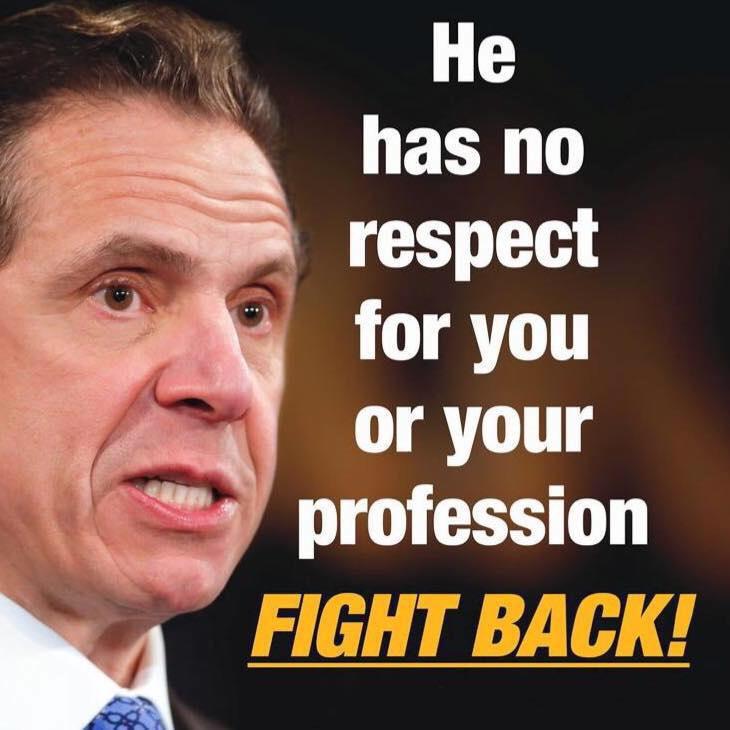
13 things you can do right now to fight back.


Every NYSUT member is needed to defend public education and the teaching profession from Gov. Cuomo's Billionaires' Agenda.
Tell the governor to stop scapegoating... stop teacher bashing and focus on what #AllKidsNeed.
Here's your to-do list.

1. Take action on this week's campaigns.

The latest actions will always be right here in the No. 1 spot.
UPDATE: Feb. 20

    2. Call your state senator. Now.

    • Stop what you're doing and call your state senator with this message: stand up to the Governor's "Bigfoot" tactics and defend our outstanding New York public schools!
    • You can look up the number at the NYSUT Member Action Center.

    Sign up for MAC text alerts!

    mac appTake 10 seconds and sign up for MAC text alerts on your phone!
    Here's how:
    STEP 1: Text the word "NYSUT" to the contact number 38470.
    STEP 2: That's it! There is no Step 2!

    3. Sign the petitions.

    4. Sign up for the in-district lobby day on Feb. 12.

    • Take part in a face-to-face meeting at your state legislator's local office.
    • For information, email pcaruso@nysutmail.org. Please include the number of your Senate district. (Not sure? Look it up at the MAC.)

    5. Call out the governor.

    • Invite the governor to visit your class to learn what #AllKidsNeed. Tweet out an invite directly at him and be sure to include his Twitter handle @NYGovCuomo and the hashtag #InviteCuomo if you want your tweet to be seen and heard.
    • Not on Twitter? See step 8.

    6. Get connected to the MAC.

    • BY TEXT. Get real-time text messages about urgent news and actions by texting the word NYSUT to the number 38470.
    • BY EMAIL. Subscribe to the NYSUT Member Action Center email alerts for updates on this campaign. If you're registered via email as a NYSUT MAC e-activist you'll also be the first to know about upcoming rallies, protests and more.
    • BY APP. Download the NYSUT MAC App for your iPhone or for your Android phone. Be sure notifications are enabled to receive alerts on new action items.

    7. Get connected on Facebook.

    8. Get connected on Twitter.

    • Join Twitter and follow @NYSUT to be part of the social media army.
    • Once a day (or as often as possible) tweet your thoughts on what #AllKidsNeed - more science labs, music and art classes, school libraries, smaller class sizes and more. We're reminding the governor to focus on what matters! Follow the conversation in real-time for some great examples from parents and educators.

    9. Share the poster.

    10. Wear the button.

    11. Take part in community forums.

    • Keep an eye on nysut.org/allkidsneed for information on upcoming NYSUT-sponsored Community Forums to Save Public Education in every region of the state.

    12. Talk it up.

    • Get the conversation going - online and offline. Read "Where We Stand" and use it to craft social media messages, send letters to the editor, and brief friends and colleagues.
    • Circulate and share print materials and videos.

    13. Support "Take Action Tuesday."

    • Mark your calendar to support NYSUT's "Take Action Tuesday" every week. Be on the lookout for updates.

    And finally... check back.


    Learn more at www.nysut.org/allkidsneed.

    Teachers Alone Can’t Fix the “Accumulated Hurt” | Portside

    Teachers Alone Can’t Fix the “Accumulated Hurt” | Portside:


    Teachers Alone Can’t Fix the “Accumulated Hurt”


    The issue is violence against children, particularly low income and minority children. But all violence doesn’t come at the end of a gun. Keeping public schools defunded and dysfunctional is also a form of violence. Promoting privatization and competition when kids really need resources is also cruelty. And when society’s evils are visited upon innocent children, teachers alone can’t protect them.
    Steven Singer
    February 16, 2015
    Public school teachers are being called upon to address all forms of violence against children, with few and fewer tools.
    Steven Singer
    She was smiling and laughing, but her eyes were terrified.
    Sitting in class among her fellow middle school students, her words were all bravado. But her gestures were wild and frightened. Tears were close.
    So as the morning bell rang and the conversation continued unabated, I held myself in check. I stopped the loud rebuke forming in my teacher’s throat and just listened.
    “You know that shooting at Monroeville Mall Saturday night, Mr. Singer? I was there!”
    I swallowed. “My gosh, Paulette. Are you okay?”
    She acts street smart and unbreakable, but I can still see the little girl in her. She’s only thirteen.
    She slowed down and told us what happened; a story framed as bragging but really a desperate plea for safety and love.
    She went to the mall with her mother. When they separated so she could go to the restroom, the gunfire began. She ran out and Mom was gone. She was ushered into a nearby store where the customers were kept in lockdown. She stayed there until the police cleared the mall, and it was safe to find her mother and go home.
    A seventeen-year-old boy had gunned down three people. One was his target. The others were bystanders—parents who had gotten in the way. Now they were all in the hospital, two in critical condition.
    And my student—my beautiful, precious, pain-in-the-butt, braggadocious, darling little child—was stuck in the mix.
    I could imagine how scared she must have been separated from her mother, hiding with strangers as police swept the shops, food court, and children’s play center.
    Here she was telling the class her story and getting more upset with each word.
    I gave her a meaningful look and told her we’d talk more later. Then I began class.
    But I kept my eye on her. Was that relief I saw as the talk turned from bullets and bloodshed to similes and metaphors? Did the flush leave her cheeks as we crafted multi-paragraph theses? I hope so.
    I think I know her pretty well by now. She’s been mine for two years—in both 7th and 8th grades. I even taught her older brother when he was in middle school.
    I know she’s rarely going to do her homework—and if she does, it will be finished in the last twenty minutes. I know she’d rather be out playing volleyball or cheerleading than in school writing or
    - See more at: http://portside.org/2015-02-21/teachers-alone-can%E2%80%99t-fix-%E2%80%9Caccumulated-hurt%E2%80%9D#sthash.ROOBF3PD.yZlJVCEj.dpuf