Tuesday, October 23, 2012

The next day the debate made me angry. « Fred Klonsky

The next day the debate made me angry. « Fred Klonsky:


The next day the debate made me angry.

I laughed at Obama’s line about horses and bayonets.
I chuckled at some of the clever Romney-bashing tweets that I followed simultaneously while watching the two of them.
At one point I turned to Anne and asked if she thought Romney actually looked ill, as if he were about to throw up?
I watched about a half hour of the post-debate spin on MSNBC and CNN.
I agreed that Obama won on points.
Then I went to bed.
But this morning I woke up

Jersey Jazzman: Fact: Some Newark Merit Pay Will Go To the Wrong Teachers

Jersey Jazzman: Fact: Some Newark Merit Pay Will Go To the Wrong Teachers:


Fact: Some Newark Merit Pay Will Go To the Wrong Teachers

 but only if they adhere to a merit pay program.
The teachers of Newark have a decision to make: they can accept a large sum of private money and settle their contract... but only if they adhere to a merit pay program.

I am not about to tell anyone what to do, but I do feel compelled to lay out the facts. And one fact is for certain:

If the merit pay bonuses are based on the state-mandated four-tier evaluation system, at least some of the merit pay will go to the wrong teachers.

How can I be so sure of this? Because the state law requires "student achievement" - in other words, 

How to Balance the Art & Science of Teaching

How to Balance the Art & Science of Teaching:


How to Balance the Art & Science of Teaching

Recently, I gave a TED talk outlining why I think we’re in the midst of the most exciting and difficult time to be a teacher in American history. These sorts of things are always an imperfect effort to inject new ideas into the stratosphere, but I received lots of nice comments and feedback, including some observations that only a mom – my mom – would share (“Your posture was very relaxed, and you never even said ‘um’!”).
It was another thing my mother said that struck me, though. “Do you feel sure that your audience knows what todo with all you’ve said?” she wrote.
Popout
Great point, and I’m not sure. So here, as simply as I can say it, are three specific things – some big, some small – we need to do to help teachers get better at helping children learn and grow.
1. Follow the Med School Model – As any M.D. knows, different medical schools have different strengths and weaknesses. But one thing every medical school shares is the belief that a strong medical training is built on a 

Schooling in the Ownership Society: Consulting companies the bain of public space, schools...

Schooling in the Ownership Society: Consulting companies the bain of public space, schools...:


Consulting companies the bain of public space, schools...

BSG
Daniel Denvir has a great post over at The Atlantic Cities blog, "As Local Governments Shrink, Private Consultants Reap Rewards."

Denvir describes the trend of supplanting public space and decision making with corporate consulting companies. One of the main proponents of this strategy is Mitt Romney, who started in business with the Boston Consulting Company. After leaving BCG, Mitt Romney went on to work at Bain and Company consultants, from where he launched the controversial private-equity firm Bain Capital. For decades, consulting has been a top choice for MBA graduates like Romney.

In 2010, the Gates Foundation gave 15 cash-desperate states $250,000 to hire consultants to write applications for Obama's Race to the Top competitive education grant. The grants, which encourage districts to tie teacher evaluations to standardized tests and loosen restrictions on charter schools, draws heavily from the corporate-education reform model funded by the big three foundations.

Denver writes,
Consultants, like Romney, have the appeal of "real-world" experience which, in early 21st-century 


Sarah Silverman: Corporations are people

But are people people?


Popout

Why Do Some of America's Wealthiest Individuals Have Fingers in Louisiana's Education System? | The Nation

Why Do Some of America's Wealthiest Individuals Have Fingers in Louisiana's Education System? | The Nation:


Why Do Some of America's Wealthiest Individuals Have Fingers in Louisiana's Education System?

Louisiana school board elections

Last fall, a coterie of extremely wealthy billionaires, among them New York City Mayor Michael Bloomberg, turned the races for unpaid positions on the Louisiana Board of Elementary and Secondary Education (BESE) into some of the most expensive in the state’s history. Seven pro-education “reform” candidates for the BESE outraised eight candidates endorsed by the teacher’s unions by $2,386,768 to $199,878, a ratio of nearly twelve to one. In just one of these races, the executive director of Teach for America Greater New Orleans-Louisiana Delta, Kira Orange Jones, outspent attorney Louella Givens, who was endorsed by the state’s main teacher’s unions, by more than thirty-four to one: $472,382 to $13,815.

To support Orange Jones’s campaign against Givens, Eli Broad,
 

The California Majority Report // STATE'S TOP EDUCATION LEADERS TORLAKSON AND O’CONNELL SAY NO ON PROPOSITION 31

The California Majority Report // STATE'S TOP EDUCATION LEADERS TORLAKSON AND O’CONNELL SAY NO ON PROPOSITION 31:


NO ON PROPOSITION 31

California State Sen. Superintendent of Public Instruction Tom Torlakson and his predecessor in that position, former State Sen. Jack O’Connell, today announced their opposition to Prop 31, a ballot measure that would cap state spending on education.

“With our schools in the midst of a financial emergency, the last thing California needs is to shift millions of dollars away from education – yet that’s exactly what Prop. 31 does,” said Torklason. “And this initiative could even prevent California from investing new funds in our schools when our economy turns around. That’s why I’m joining teachers across California in saying ‘no’ on Prop. 31.”

“Under the guise of ‘reform,’ this stealth ballot measure that would mean less funding for education now and in the long run,” said O’Connell, a former high school teacher and member of the Santa Barbara School Board. “Prop 31 is a poorly drafted, unworkable measure that will harm our ability to properly fund our schools.”

Proposition 31 includes a provision for “pay-as-you-go” budgeting, which essentially caps state funding for schools. Even if the state was flush with revenue, those funds could not be used to boost educating funding. In addition, because it conflicts with Proposition 98, the voter-approved initiative that guarantees increases in education funding, it would likely spur lawsuits and/or require devastating cuts in other state programs.
Proposition 31 is also opposed by the California Teachers Association, California Federation of Teachers, and the California Faculty Association.

For more information, visit www.Prop31Facts.com


The changing blame game in U.S. education

The changing blame game in U.S. education:


The changing blame game in U.S. education

Teachers have felt under such heavy assault for the past several years by school reformers intent on using assessment methods that experts say are invalid, reducing their collective bargaining rights and other actions that it may be hard to remember that it wasn’t always this way. In the following post, Larry Cuban, a former superintendent of Arlington Public Schools, writes about the changing “blame game” in American education. Cuban was superintendent for seven years, a former high school social studies teacher for 14 years and professor emeritus of education at Stanford University, where he has taught for more than 20 years. This first appeared on his blog.
By Larry Cuban
The shame that many teachers and principals feel at being made responsible for a school’s low academic performance is a recent phenomenon. Historically, policy elites and educators explained poor academic performance of groups and individual students by pointing to ethnic and racial discrimination, poverty, immigrants’ cultures, family deficits, and 

Like Romney, Obama Admin Has Supported Larger Class Sizes. Parents and Teachers Don’t Like It - Dana Goldstein

Like Romney, Obama Admin Has Supported Larger Class Sizes. Parents and Teachers Don’t Like It - Dana Goldstein:


Like Romney, Obama Admin Has Supported Larger Class Sizes. Parents and Teachers Don’t Like It

Despite moderator Bob Schieffer’s wrongheaded assertion that education isn’t a foreign policy issue, class size emerged as a flash point at Monday night’s debate. President Obama boasted about his administration’s record on saving teaching positions and spoke about his plan to hire more math and science educators in particular, which he argued would help American students compete with their international peers for high-skill jobs.
“Now, Governor Romney, when you were asked by teachers whether or not this would help the economy grow, you said, this isn’t going to help the economy grow,” Obama said. “When you were asked about reduced class sizes, you said class sizes don’t make a difference. But I tell you, if you talk to teachers, they will tell you it does make a difference.”
Romney certainly has a record of claiming smaller class sizes don’t help students learn. But what Obama didn’t say is that while it’s true his stimulus funding saved hundreds of thousands of teaching jobs, his own secretary 

Miami-Dade Crowned Most Improved Urban School District - US News and World Report

Miami-Dade Crowned Most Improved Urban School District - US News and World Report:


Miami-Dade Crowned Most Improved Urban School District

Gains in college readiness and student achievement helped the five-time finalist win the Broad Prize.

October 23, 2012 RSS Feed Print
Gains in graduation rates and college readiness helped Miami-Dade win the 2012 Broad Prize for Urban Education.


Strong and steady won the race for Miami-Dade County Public Schools, winner of the 2012 Broad Prize for Urban Education, which recognizes large, urban school districts making gains in student achievement. The district, a five-time finalist for the coveted award, will receive $550,000 in collegescholarships to dole out to high school students graduating in 2013.
The fourth largest school district in the country, Miami-Dade serves nearly 350,000 students—with more than 100,000 students attending one of the district's 107 high schools. Ninety percent of students in the district are either black or 

Program Improvement, Corrective Action and/or Restructuring With new AYP data comes corrective action and restructuring demands SI&A Cabinet Report.

SI&A Cabinet Report – News & Resources:

With new AYP data comes corrective action and restructuring demands 
By Rick Carder
Tuesday, October 23, 2012


With the California Department of Education’s release of 2012 Adequate Yearly Progress data some of your schools may have been identified for advanced stages of Program Improvement, Corrective Action and/or Restructuring. Additionally, you may have some schools exiting PI identification.
Last week “Categorical Connection” provided information regarding the CDE waiver request for the current year 14-day parental notification mandate. However, approval of this waiver is not expected for some time.
If your school has been newly-identified as Program Improvement, you must provide the mandatory parental notifications within 14-days. The good news is that if you have schools that are no longer identified for PI, notification is not necessary.  However, this provides a great opportunity to notify parents of the outstanding efforts that have allowed this school to exit PI.
Schools moving into Corrective Action and Restructuring must still offer paid transportation for public school choice and/or supplemental educational tutoring services to eligible students, in addition to corrective action and restructuring requirements.
Parental notifications are required to inform parents of the school’s PI identification (Year 3, 4 or 5) requirements in 

HechingerEd Blog | Survey: Today’s teaching force is less experienced, more open to change

HechingerEd Blog | Survey: Today’s teaching force is less experienced, more open to change:


Survey: Today’s teaching force is less experienced, more open to change

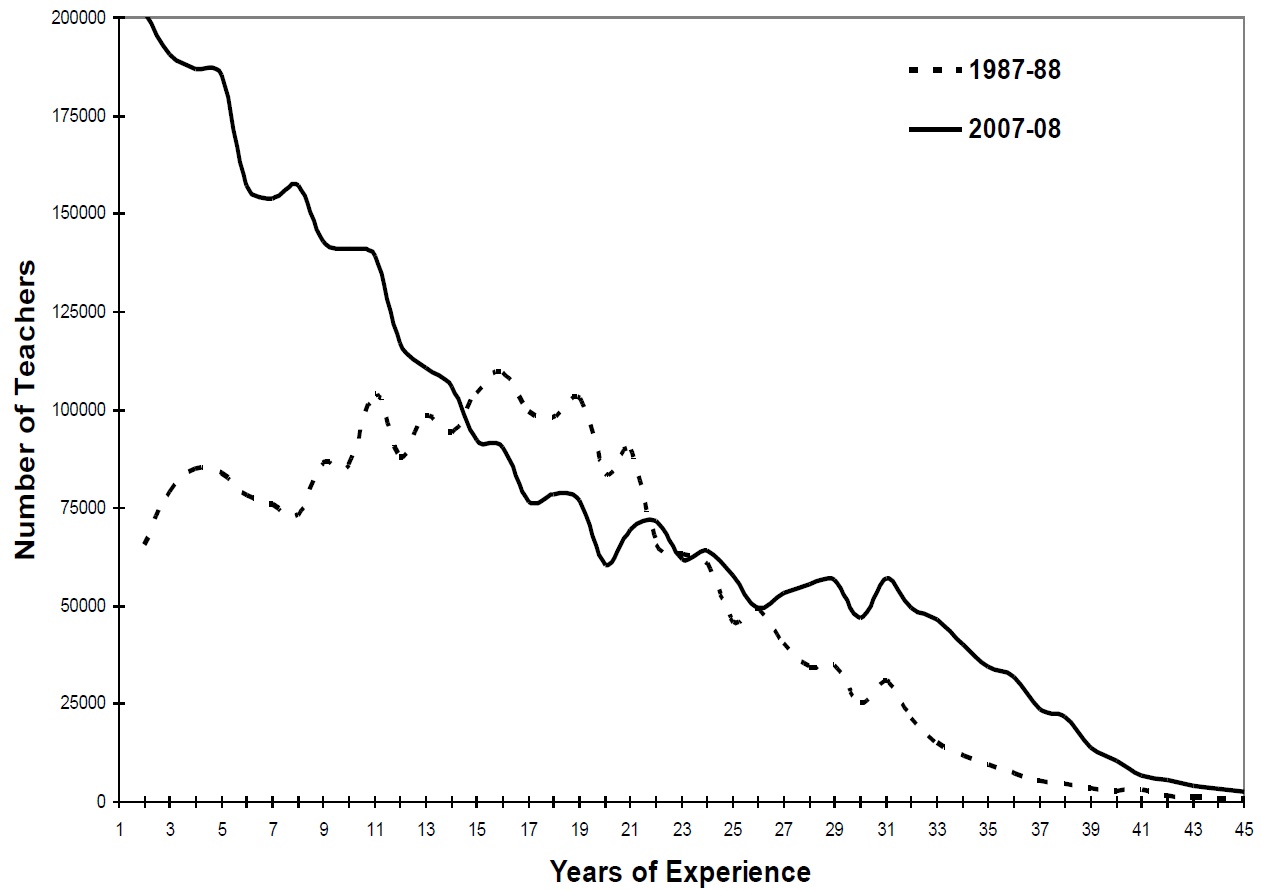
More inexperienced teachers are in today’s classrooms than ever before and they are more open than their veteran colleagues to performance-driven options for how they’re evaluated and paid, according to the results of a new survey conducted by the Boston-based nonprofit Teach Plus.
For the first time in decades, more than 50 percent of the nation’s teaching force is comprised of teachers who have been in the classroom under 10 years, Teach Plus found in “Great Expectations: Teachers’ Views on Elevating the Teaching Profession,” which looks at the changing demographics of U.S. teachers.
From “Seven Trends: The Transformation of the Teaching Force,” by Richard Ingersoll and Lisa Merrill (May 2012)
The national survey asked 1,015 new and veteran teachers their views on some of the most contentious issues in U.S. public education, like teacher evaluations and class size, to see if attitudes are shifting with an influx of 

The Passions of Ann Romney: Horses, Charter Schools | EduShyster

The Passions of Ann Romney: Horses, Charter Schools | EduShyster


The Passion of Ann Romney: Horses, Charter Schools

In a new interview with Good Housekeeping Ann Romney reveals that her major passions include horses and charter schools. 
Reader, I have been so worried about what will happen to the most vulnerable among us should Mitt Romney win the election: children Democrats for Education Reform. What if, even though DFER’s positions on education are straight out of the ALEC playbook, these scrappy ascot wearing advocates for reform should find themselves without a seat at the table after the election—and all because of a pesky little symbol after their name: IV ‘D.’
So what a relief it is to find out that Ann Romney has so much in common with the hedge fund men of DFER, not to mention their striving little siblings, the prep school contingent that is Students for Education Reform. Ann likes horses, DFER and SFER both grew up riding, even though mummy and daddy made them leave Foxy at 

PSAT for 10-23-12: Why wait to vote on an elected school board in Chicago? Parents United for Responsible Education

Parents United for Responsible Education » Blog Archive » PSAT for 10-23-12: Why wait to vote on an elected school board in Chicago?


PSAT for 10-23-12: Why wait to vote on an elected school board in Chicago?

Early voting started yesterday and most Chicagoans have a special opportunity this fall to make our voices heard on the issue of an elected school board, thanks to the determined hard work of a group of Chicago Public School parents and others who collected thousands of signatures on petitions, enough to get a referendum on the ballot in about half of Chicago’s voting precincts in 35 of the 50 wards.
Communities Organized for Democracy in Education (CODE), of which PURE is a member, will sponsor a forum on the issue tonight at 7 pm at the Logan Square Auditorium,  2539 N. Kedzie featuring Karen Lewis, Ben Joravsky, and Paul Lipman of UIC and Teachers for Social Justice (CPS and DFER were invited but declined to participate). This forum will also be broadcast live on CAN-TV 27.
Please read Curtis Black’s excellent report on the issue, including details of a recent public forum hosted by State Rep LeShawn Ford, who will host a similar forum Monday, October 29 at 6 p.m. at Carey AME Church, 1448 S. Homan.
A Chicago Tribune poll taken during the 2011 mayoral election showed 77% of Chicagoans in favor of an elected school board, with only 17% favoring mayoral appointment of the board.
As a 501c3 organization, PURE cannot advise you how to vote on any specific referendum, but we are pretty sure that you know what to do. Why wait?


A memory of Russell Means, who I never met. « Fred Klonsky

A memory of Russell Means, who I never met. « Fred Klonsky


A memory of Russell Means, who I never met.


Russell Means died yesterday at the age of 72.
Means was a leader of the American Indian Movement that led the upraising at Wounded Knee in 1973.
I never met him. I would have liked to.
In 1973 I drove my 1968 little green Volkswagon in my move from LA to Chicago.
All across the western part of the US I followed the events at Wounded Knee on the radio.
At a stop in Gallup, New Mexico local Native people were protesting the shooting of a young Native teenager by the local police.
It was just a few years after the seizure of Alcatraz Island in San Francisco Bay by Native Americans. That was in 1969. America was revealing its history and its diversity. Or rather America was having its history and diversity


The in box. We’re beyond the point of reasonable persuasion.

Fred,
I’ve waited until 2 weeks out from the elections to voice my decision to my so-called democratic representatives in the Illinois House and Senate.  Put simply, I’ve shared the following with Biss and Gabel:
-They will not get my vote in the upcoming elections.  
-I will encourage all teachers, family, and friends to refrain from giving these two a pass based upon their party affiliation.
We’re beyond the point of reasonable persuasion.  These two, and many of their democratic colleagues, have betrayed the middle class.  Whether they’ve been duped or pressured is irrelevant.  They have joined the Civic Committee, Conservatives, and union-haters in their 


Ten minute drawing. Foreign policy.


Click on drawing to enlarge.

NYC Public School Parents: Vote on eliminating reporting on class size and TCUs postponed

NYC Public School Parents: Vote on eliminating reporting on class size and TCUs postponed


Vote on eliminating reporting on class size and TCUs postponed


The mayor has established a Report & Advisory Board Review Commission through a charter amendment, which is supposed to decide which legally-mandated reporting requirements should be eliminated.  The Commission has a majority of mayoral appointees and has the authority to override city law.

DOE proposed the elimination of the  November class size report and the annual report on TCUs or school trailers, making claims about how the later class size report in February was more “accurate” (which registers lower class sizes esp. in HS, after thousands of students have dropped out or been discharged from school) and  how the TCU data is  replicated in the Blue Book, or that somehow this data was not “useful”.  I refuted these bogus claims in my comments to the Commission here and here.

Elizabeth Weinstein, the Mayor’s head of the Office of Operations and the Chair of the Commission, was 

Early UPDATE: Diane in the Afternoon 10-23-12 Diane Ravitch's blog

Diane Ravitch's blog


Paul Tough’s How Children Succeed

While I was traveling in the Midwest, visiting states like Ohio and Michigan where public education is under attack, I read Paul Tough’s new book How Children Succeed: Grit, Curiosity, and the Hidden Power of Character. I read it the way I like to read when a book is important, with frequent underlining and occasional stars and asterisks.
I found much to like in it. For one thing, Tough directly refutes the privatizers’ claim that poverty doesn’t matter. The book makes clear through the personal stories of young people he interviews that poverty has a devastating impact on their lives. Some can pick themselves up and move on, but others are destroyed by the events in their lives over which they have no control. His book is a rebuke to people like Joel Klein, Michelle Rhee, and Arne Duncan who repeatedly claim that poverty is an excuse for bad teachers. When you meet these young people 


Education in Last Night’s Debate

My first impulse was not to write about the debate last night. But then a reader contacted me to ask why I hadn’t written anything. I oblige.
The debate was about foreign policy, supposedly, but the candidates still managed to restate their talking points about education.
I was hoping they wouldn’t mention education because neither of them says anything that is accurate. They are out of touch with what is happening in the schools and seem to have no clue about what is needed.
Mitt Romney still claims credit for the Massachusetts reforms, even though they were enacted 10 years before he was elected, and even though his own education platform today rejects the Massachusetts reform strategy of more funding, higher standards for teachers, and improved standards and assessments. His reform strategy 


Should Vouchers Take Money Away from Desegregation?

A federal judge in Louisiana called on TFA State Commissioner of Education John White to explain why his voucher program should be allowed to take public funds from a school district that is using its funding to comply with desegregation orders. The judge wants to know why he should not enjoin the implementation of the voucher program.
As we have seen in other states, vouchers and charters intensify segregation, but that is not a concern to Governor Bobby Jindal and Commissioner White.
This should be interesting.


Parent Trigger Hoax

Parent Revolution, the organization handsomely funded by the Gates Foundation, the Broad Foundation, and the Walton Foundation, has finally gotten a charter conversion in the state of California, nearly two years after the law was passed.
Some victory: In a school with 600 plus students and 400 families, only 286 parents voted for the charter; when some changed their mind and tried to rescind their vote, they were told by a judge that they could not take their signature off the petition.
Only those who supported the charter were allowed to vote on which charter operator would run the new charter. 

FCMAT » Cali Education Headlines Tuesday, October 23, 2012

FCMAT » Fiscal Crisis & Management Assistance Team


Education Headlines

Tuesday, October 23, 2012

Hanson asks community to help Fresno Unified

Fresno Unified Superintendent Michael Hanson gave a personal and sometimes emotional state-of-the district address Monday, calling on education, community and business leaders to stay connected for the future of the city's children.

Measure E tax plan figures into Davis school board race

The candidates voters choose for the two open seats this November will have a daunting task ahead of them: how to preserve programs, maintain class sizes and keep the school day intact under a cloud of budgetary uncertainty.

Davis school board accused of illegally pushing Measure E

In a complaint filed with the Fair Political Practices Commission, a Davis political action committee contends that the city's school board and its president are illegally using taxpayer dollars to stump for a school funding measure on the November ballot.

Walters: Is Jerry Brown worried about Proposition 30?

As Election Day – and Halloween – approach, Jerry Brown may be getting spooked that his tax increase, Proposition 30, won't make it.

Modesto enrollment dip puts funds in jeopardy

Modesto City Schools trustees got an early report on the district's enrollment Monday. School population declined only slightly, comparing the end of last year with the first month of this year.

Survey: Drinking water compliance eludes some California schools

Recently passed state and federal laws require free, fresh water to be served at schools wherever meals are served or eaten. But a soon-to-be-published survey of California public schools found that while all of the campuses had at least one free water source, 1 in 4 schools did not comply with the law.

Frey: Elk Grove sharply reduces suspensions of foster youth

Elk Grove Unified has dramatically reduced suspensions and expulsions of foster youth by applying the principles of the recently passed law, Assembly Bill 1909, long before the bill was written.

More than 2 dozen L.A. Unified magnet schools are under-enrolled

Although Los Angeles magnet schools have long been seen as an elusive and exclusive club, more than two dozen of them are under-enrolled and actively looking to fill classroom seats.

Funding fight on if Prop. 30 fails

Long before political ads dominated the airwaves and arguments erupted over which Nov. 6 tax initiative best serves schools, Gov. Jerry Brown sought crucial support from county officials in a cramped conference room one block from the Capitol. County leaders in January had one priority – to ensure the state would continue sending them several billion dollars to assume former state responsibilities such as housing lower-level inmates and watching parolees.
Monday, October 22, 2012

Rowland Unified voters to decide on $158.8 million bond measure

The Rowland Unified School District is hoping voters in November will approve Measure R, a $158.8 million school bond that would fund a performing arts center at Rowland High School and replace portable classrooms at Oswalt Academy, a technology school.

Schools look to boost use of computers, other gadgets without breaking the budget

Inexpensive tablets, the rise of smart phones and the development of online textbooks and educational applications have combined to increase the feasibility of putting an Internet-connected device in front of every student. But an era of budget-tightening that has included teacher layoffs, increased class sizes and transportation cuts has led districts to seek out ways to provide this technology without draining education funds.

Anti-tax group seeks limits on pay for union presidents

Organizers with a local anti-tax group said they hope to lobby state legislators and ask them to end the practice of school districts paying the salary of teachers union presidents while they aren’t working in the classroom.

SOCIAL JUSTICE MAN is Here! | EduSanity

SOCIAL JUSTICE MAN is Here! | EduSanity:


SOCIAL JUSTICE MAN is Here!

Last week I had the pleasure of listening to a talk by Dr. P.L. Thomas, an Associate Professor at Furman University and author of Ignoring Poverty In the U.S.: The Corporate Takeover of Public Education. Dr. Thomas had much to say about the problems that childhood poverty causes in the United States in regards to education. For example, while many European countries that we compare ourselves to with the almighty test score have childhood poverty rates below 10%, the United States has a poverty rate of over 23%. That’s right, 23% of our children live in poverty. We shouldn’t be comparing ourselves to Finland 5%, the U.K. 12% or Japan 14%, because we are closer to the industrialized powerhouses of Latvia 19% and Romania 25%.
According to Dr. Thomas:
“The central problems we are facing in schools are historical patterns(emphasis in original) – student achievement being strongly correlated with out-of school factors, such as poverty; disproportionate drop-out rates among marginalized populations of