Latest News and Comment from Education

Thursday, April 26, 2018

Diane Ravitch: What The Teachers Are Asking For | HuffPost #RedForEd

What The Teachers Are Asking For | HuffPost:

What The Teachers Are Asking For

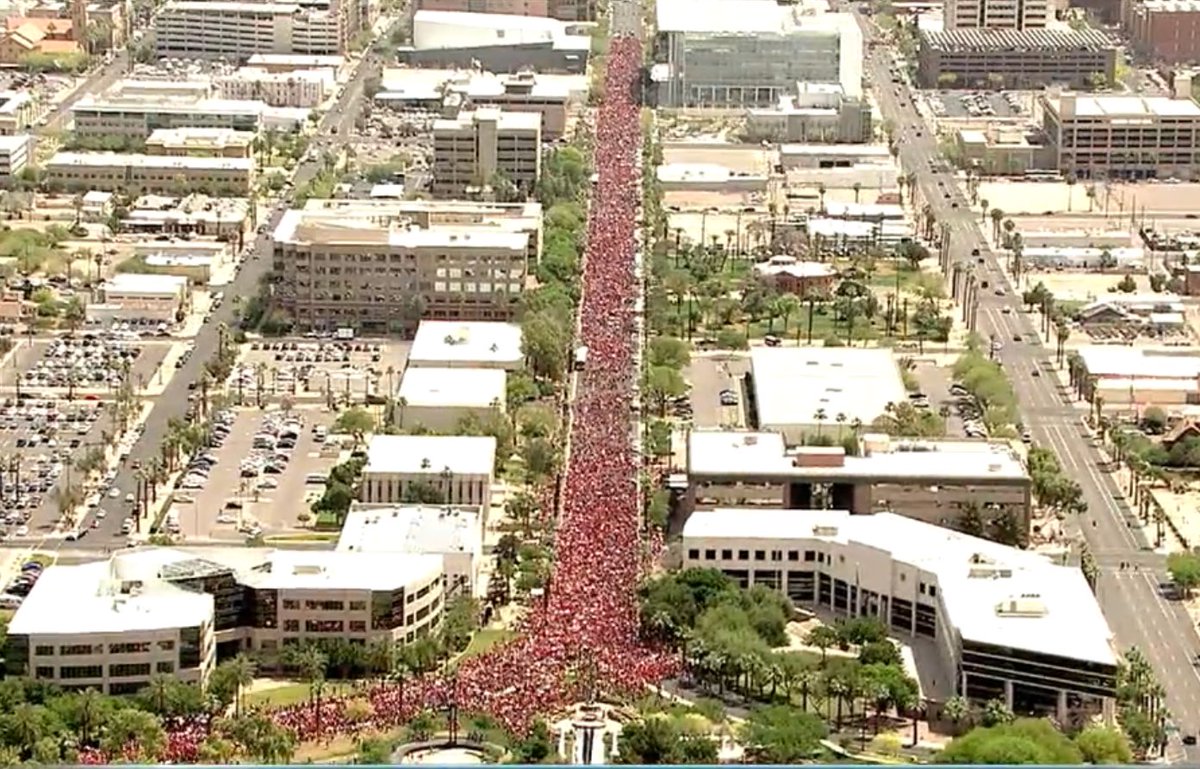
A stunning image of just how many teachers are marching to the Arizona State Capitol. 

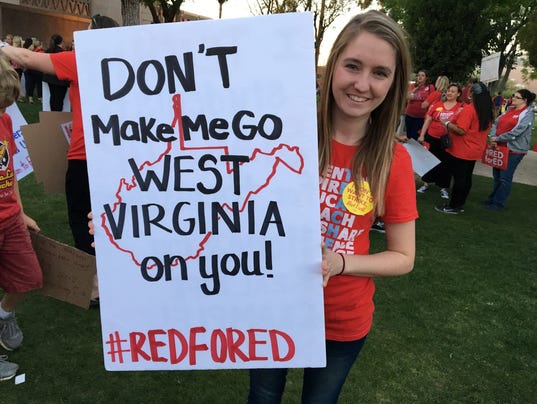
The teacher walkouts began in West Virginia, where public school employees were woefully underpaid and faced spiraling health care costs. They stayed out for nine days and won a 5 percent salary increase. Oklahoma teachers soon followed suit, seeking a raise and increased education funding for their schools and students. They too won concessions. Then came Kentucky teachers, angry because the state planned to restructure their pensions for the worse. Starting Thursday, public school teachers in Arizona will walk out. On Friday several districts in Colorado will be closed.
What is happening? Almost all these states are red states, controlled by Republicans. Almost all are right-to-work states, with weak unions. Yet in these states, teachers have said enough is enough. Typically, it has not been their unions that spurred the walkouts. Time and again, the uprisings were from the grass roots, beginning with a page on social media calling other teachers to get together and protest working conditions.
As educators often say, teachers’ working conditions are students’ learning conditions. It is not merely low pay that is sending the teachers into the streets: It is also large class sizes, obsolete textbooks, crumbling buildings and the fact that many teachers — already underpaid — are shelling out $1,000 or more each year to pay for classroom supplies that their schools no longer provide.
In short, teachers are calling on their legislatures to fund their schools and their students adequately.
For years, the red states have been working from a common playbook: low taxes for corporations and budget cuts for schools, universities and other public services.
The result? Many teachers have to work two or three jobs — sometimes even more ― to feed their families, pay their mortgages and make their car payments. Some move in with continue reading: What The Teachers Are Asking For | HuffPost:

Wednesday, April 25, 2018

School Climate and Safety. Civil Rights Data Collection | U.S. Department of Education

U.S. Department of Education Releases 2015-16 Civil Rights Data Collection | U.S. Department of Education:

School Climate and Safety. Civil Rights Data Collection


Washington — The U.S. Department of Education's Office for Civil Rights (OCR) today released the 2015-16 Civil Rights Data Collection (CRDC). This data, which is self-reported by 17,300 public school districts and 96,400 public schools and educational programs, is collected and published biennially by OCR.
Since 1968, the federal government has collected civil rights data about schools. For the first time, the 2015-16 CRDC report includes comprehensive data regarding incidents of criminal offenses in our nation's public schools. It also includes several new categories of data on Science, Technology, Engineering and Mathematics (STEM) course taking.
"Protecting all students' civil rights is at the core of the Department's mission," said U.S. Secretary of Education Betsy DeVos. "We are pleased to produce the CRDC in a way that it can be reviewed, analyzed and utilized by local, state and federal education leaders. I want to commend the many educators, school leaders and OCR staff who put in countless hours to produce this data and who work tirelessly to ensure all students are able to learn in a safe and nurturing environment free from discrimination."
The Department used CRDC data to produce topic-specific data briefs on two major topics: STEM Course Taking and School Climate and Safety.
The full CRDC data set is available at: https://www2.ed.gov/ocr/docs/crdc-2015-16.html

 U.S. Department of Education Releases 2015-16 Civil Rights Data Collection | U.S. Department of Education:


School attendance: A building block of student achievement

School attendance: A building block of student achievement:

School attendance: A building block of student achievement


Although most schools have daily attendance rates of well over 90 percent, according to the newly released U.S. Department of Education Civil Rights Data Collection (CRDC),  about 8 million students in the United States missed more than three weeks of school during the 2015–16 school year (CRDC 2015–16). This represents an increase over the 6.8 million students who missed more than three weeks of school during the 2013–14 school year. These students were chronically absent.
The building block that must be in place to meet student achievement and high school graduation goals is attendance. Physically being present in school is one of the most basic conditions for a student’s success – if students are not in school, they are not learning what is being taught and could be falling behind in earning the course credits needed to graduate.
In a new video, I use building blocks to illustrate the ways in which poor attendance impacts both chronically absent students and their classmates with better attendance.


What should schools focus on to improve student outcomes?
As background, in the past two decades of school accountability, policies have directed schools to improve on key indicators of student success. No Child Left Behind (NCLB; 2002) required schools to improve student achievement on reading and math as well as increase high school graduation rates. The Every Student Succeeds Act (ESSA; 2015) changed the national structure of NCLB by empowering states to design and implement their own accountability systems. In addition to test-based academic metrics, and, for high schools, graduation rates, ESSA requires states to hold schools accountable for at least one measure of “school quality or student success (SQSS).”
In a 2016 Hamilton Project strategy paper, we recommended that states choose to hold schools accountable for reducing rates of chronic absenteeism as a state’s SQSS metric under ESSA. Since then, 36 states, the District of Columbia, and Puerto Rico have chosen to hold schools accountable for reducing rates of chronic absenteeism through their state-led accountability plans.School attendance: A building block of student achievement:


 School attendance: A building block of student achievement:

Tuesday, April 24, 2018

Teacher strikes poll: most Republicans and Democrats agree that American teachers need a raise - Vox

Teacher strikes poll: most Republicans and Democrats agree that American teachers need a raise - Vox:

Most Republicans and Democrats agree that American teachers need a raise

And a majority of Americans are even willing to pay more taxes for it.

Image result for American teachers need a raise


Teachers across the United States who are protesting years of school funding cuts have the American public on their side.
Most Americans agree that teachers are underpaid, and slightly more than half of adults support striking as a strategy to change that, according to a new AP-NORC poll. Half of Americans also said they are willing to pay more taxes to fund schools and pay teachers more.
Support for raising teachers’ salaries cuts across party lines. Nearly 90 percent of Democrats, 78 percent of independents, and 66 percent of Republicans think teachers don’t get paid enough.
The survey of 1,140 adults, conducted April 11 through 16, gauged public opinion on the wave of teachers strikes sweeping through the nation. Teachers in West VirginiaOklahoma, and Kentucky all walked out of class in recent months to pressure state lawmakers to spend more money on schools or teachers (or both). Their success has inspired teachers in Arizona and Colorado to prepare their own work stoppage.
The AP-NORC poll shows that these teachers have a lot of support, though not everyone agrees with their strategy. About 78 percent of adults surveyed said schools don’t pay teachers enough, and 52 percent said they support educators who are going on strike to demand higher salaries. (25 percent disapprove of strikes.) Adults who knew about the recent teacher walkouts were more likely to support the idea of teachers striking — 80 percent of them did.
On Thursday, a majority of teachers Arizona plan to go on strike, despite Gov. Doug Ducey’s promise to give them a 20 percent pay raise to avert a shutdown. The teachers group, Arizona Educators United, said they want to see a bill passed, and that it should include more school funding and raises for all school staff.
Teachers in Arizona are among the lowest-paid in the country, and lawmakers have cut education spending per student more than any other state since 2008 — by 36.5 percent. Meanwhile, state lawmakers have been on a tax-cutting spree, slashing taxes on a host of businesses in 2016, from insurance companies to charter plane operators. Last year, Ducey signed a bill with more tax breaks for businesses as well as a 1 percent raise for teachers.
In the AP-NORC poll, half of respondents said they would be willing to pay higher taxes to improve education funding. The view was equally shared by parents and adults without Teacher strikes poll: most Republicans and Democrats agree that American teachers need a raise - Vox:
 Image result for American teachers need a raise

Image result for American teachers need a raise
Related image

Charter schools boom in California. Here's where they grew | The Sacramento Bee

Charter schools boom in California. Here's where they grew | The Sacramento Bee:

Charter schools are booming in California. Here’s where they are growing fastest


California’s charter school enrollment continues to skyrocket, growing by more than 25,000 students during each of the past 10 years.
Almost 630,000 students attended California public charter schools at the start of this school year — about one in every 10 students, according to new data from the California Department of Education. California charter school enrollment has increased 150 percent in the last 10 years.
Charter schools operate independently from public school districts. Proponents of charter schools say this freedom benefits teachers and students by encouraging innovation. Opponents say they take away funds from traditional public schools, increasing educational disparities.
The fight between charter schools and traditional schools is a major issue in California politics. Charter school proponents, for instance, are pouring millions into the gubernatorial campaign of former Los Angeles Mayor Antonio Villaraigosa.

During the past five years, charter school enrollment grew by at least 30 percent in 26 California counties. Among urban counties, growth was fastest in Contra Costa, San Francisco and Los Angeles counties.
Charter school enrollment grew by 34 percent in Sacramento County. Enrollment in Placer and Yolo counties grew by about 27 percent. El Dorado County’s charter school enrollment declined because a statewide charter, Aspire, moved the charter for six schools from there to other counties.
More than one in 10 public school students attends a charter school in 24 California counties. Sonoma, San Diego and Los Angeles have the greatest proportion of charter school students among urban counties.
About 13 percent of public school students in Sacramento County attend charter schools. In neighboring Placer County, that number is 14 percent.
Phillip Reese is The Bee’s data specialist and teaches at Sacramento State: 916-321-1137.
Charter schools boom in California. Here's where they grew | The Sacramento Bee:


Monday, April 23, 2018

Betsy DeVos Is Making It Easier for Schools to Send Black Kids—Like This 13-Year-Old Girl—to Jail – Mother Jones

Betsy DeVos Is Making It Easier for Schools to Send Black Kids—Like This 13-Year-Old Girl—to Jail – Mother Jones:

Betsy DeVos Is Making It Easier for Schools to Send Black Kids—Like This 13-Year-Old Girl—to Jail

“They want to give this harsh punishment for something that we could’ve easily resolved at the schoolhouse.”

Beside a highway in Bryan, Texas, tucked between a motorcycle bar and the county jail, stands a low-slung, sprawling complex with tinted windows, sandstone walls, and barbed wire lining parts of its roof. A roadside sign identifies it as the Brazos County Juvenile Justice Center.
One Friday afternoon last October, after an incident at nearby Arthur L. Davila Middle School, a police officer arrested 13-year-old Trah’Vaeziah Jackson and brought her to the juvenile detention facility. She cried as employees patted her down, cut off her hair extensions, and took her photo and fingerprints. She was served dinner—chicken nuggets, mashed potatoes, and an apple in a styrofoam box with a carton of milk—but had no appetite.
In the shower room, guards applied thick anti-lice shampoo to Trah’Vaeziah’s hair. As she washed and combed it, clumps fell out. Afterwards, she reluctantly changed from her school clothes, a T-shirt and jeans, into the detention uniform, an orange shirt with matching shorts. Then she was locked in her cell, which contained a sink, a toilet, and, instead of a bed, a stuffed blue mat atop a brick base. High on the wall was a sliver of a window, but she wasn’t tall enough to see outside.
Only after 8pm was she permitted a phone call. She called her mother, and sobbed into the receiver. How could this accident have turned into a jail sentence?
Three decades ago, schools across the country began bolstering discipline to deter juvenile crime. Zero-tolerance policies were introduced, school law enforcement budgets swelled and suspensions, expulsions, and student arrests multiplied.
These punishments, though, are applied unequally. Across the country, hundreds of thousands of students of color, like Trah’Vaeziah, bear the brunt. Black students are almost four times as likely to receive an out-of-school suspension and twice as likelyto be arrested as their white peers, according to federal data. The pattern starts early: Even black preschool students are more than three times as likely as their white peers to be suspended from school.
Harsh discipline can backfire, especially when meted out arbitrarily. It may reinforce bad behavior, or encourage students to drop out, creating what sociologists call the “school-to-prison-pipeline.” A suspension increases the Continue reading: Betsy DeVos Is Making It Easier for Schools to Send Black Kids—Like This 13-Year-Old Girl—to Jail – Mother Jones:


Whistleblower: ECOT used software to get more state money

Whistleblower: ECOT used software to get more state money:

Whistleblower: ECOT used software to get more state money


COLUMBUS: Education regulators are reviewing a whistleblower’s claim that Ohio’s then-largest online charter school intentionally inflated attendance figures tied to its state funding using software it purchased after previous allegations of attendance inflation, the Associated Press has learned.
A former technology employee of the now-shuttered Electronic Classroom for Tomorrow said he told the Ohio Department of Education last year that school officials ordered staff to manipulate student data with software obtained following the state’s demand that it return $60 million in overpayments for the 2015-2016 school year.
The employee spoke to the AP on condition of anonymity for fear of professional repercussions for speaking out. His concerns were first raised in an Aug. 3 email to the state a month before it released its 2017 attendance review of ECOT.
The state challenged ECOT over how it claimed student time using the new software, called ActivTrak, after finding that it duplicated learning hours, according to Education Department spokeswoman Brittany Halpin.
Neil Clark, ECOT’s lobbyist and spokesman throughout last year’s review, dismissed the whistleblower’s allegations.
“I think most of this is made-up, ridiculous attempts to abuse a corpse,” he said. Clark said he no longer works for the school that abruptly closed in January.
Marion Little, the school’s attorney, said Monday that he was unaware of the man’s claims or that the Education Department had interviewed him. Messages were left with other school leaders seeking comment.
The whistleblower email and other department records, obtained by the AP through a public records request, show state officials waited until December to meet with the man about his concerns with the ActivTrak software.
Halpin said, “We appreciated hearing from this individual and will be taking into consideration the information for ECOT’s [next attendance] review.” That review will take place this summer.
In an interview, the whistleblower said that before he left the school last July he was in meetings where officials ordered staff to manipulate student data to reach desired outcomes.
“They would put a model in place, they would look at what it produced, then continue reading: Whistleblower: ECOT used software to get more state money:

Sunday, April 22, 2018

What the Teacher Strikes Mean

What the Teacher Strikes Mean:

What the Teacher Strikes Mean

Image result for What the Teacher Strikes Mean


Around seven years ago, I had a standard wisecrack to explain the standing of workers in the world’s two dominant economies: “China has strikes but no unions; America has unions but no strikes.”
Seven years later, it’s clear we’re becoming more like China every day.
The remarkable upsurge of teachers in Republic-run, largely non-union states that has swept through West Virginia and is now sweeping through Oklahoma and Kentucky, and is poised to descend on Arizona, has returned the mass strike to the United States after decades of relegation to the history books. In each of these states, the teachers unions have something between limited and no legal rights to bargain collectively, and, correspondingly, represent just a hard core of members whose commitment to their union is more a matter of belief than of anticipated reward. And yet, able to mobilize even in non-union terrains through the use of social media, and outraged at their states’ continued opposition to funding public education, the teachers have leapt beyond law and formal organization to press their case.
Union leaders and members have played a key role in these actions, which have ballooned into statewide strikes. But so have rank-and-file teachers who haven’t been members, some of whom established the Facebook pages that they and their co-workers have used to develop their demands, organize their actions, and mobilize their peers. The fact that West Virginia’s teachers refused to go back to work after a preliminary deal was struck, persuading their leaders and colleagues to stay out until the deal was sealed, and then won their demands has clearly prompted their fellow teachers in other states to turn their righteous indignation at their state government’s decade-long starvation of public education into solidaristic militancy.
These actions signal a sea change in more than just labor relations.
These actions signal a sea change in more than just labor relations. They are of a piece with the revolt of the parents in Kansas, where the regressive tax cuts of the Republican governor and legislature had led to nearly a decade of inadequate funding of the state’s schools. Over the past 18 months, the good Republican parents of Kansas ousted so many trickle-down right-wingers in the legislature that the new legislature, overcoming the governor’s vetoes, raised taxes to restore school funding.

Indeed, what the Republican governors and legislators of Oklahoma, Kentucky, and Arizona are now discovering is that, contra the GOP’s Grover Norquist nostrums, their constituents actually don’t want a government so small it can be drowned in a bathtub. They at least want their kids to get an adequate education and want a government that helps them afford medical care and old age.
That’s why the teachers have found their communities supporting them, scaring the bejesus out of their Republican legislators to the point that those legislators have  continue reading: What the Teacher Strikes Mean:

Saturday, April 21, 2018

Why Textbooks Are a Symbol of Teacher Frustration | Oklahoma Watch

Why Textbooks Are a Symbol of Teacher Frustration | Oklahoma Watch:

Why Textbooks Are a Symbol of Teacher Frustration


One of the most iconic images of the teacher walkout and the cuts to education funding that drove the movement was of tattered, duct-taped, antiquated textbooks.
There was the viral image of an Ada girl holding a class reader that apparently was once assigned to country music star Blake Shelton, now 41. And the photo of a crumbling history book from Owasso in which George W. Bush is the current president (the district later said that particular book wasn’t in use).
These images grabbed headlines, likes and retweets, but are not the whole story. There are new textbooks in Oklahoma classrooms. There are also old textbooks in Oklahoma classrooms. Some school districts can more readily invest in new textbooks than others.
But statewide, textbooks have become a symbol of teachers’ frustration.
“Textbooks are tangible,” said Steve Lindley, a spokesman for Putnam City Schools in Oklahoma City. “You can take pictures of them. It’s hard to take pictures of things schools no longer have because there’s no longer money for them.”
A two-year hiatus in textbook funding from the state, in the 2016-17 and 2017-18 school years, led many districts to delay buying new textbooks. While lawmakers said the money was still there, state Superintendent of Public Instruction Joy Hofmeister said the funds were eliminated.
“At a time when educators are implementing new, stronger standards for English language arts and mathematics, districts will be scrambling,” she said in a 2016 written statement.
Updating Textbooks
Schools typically follow a six-year adoption cycle for new textbook purchases, which is set by the Oklahoma State Textbook Committee, a group of parents, teachers and community members appointed by the governor.
The committee reviews all materials and approves the ones that align with state standards. Those titles are placed on a centralized list for districts to use. The committee is reviewing math books and will begin updating language arts and instructional technology later this year. Districts aren’t required to update on the schedule.
The state textbook allocation is distributed to districts based on their student counts.
The funds can only be spent on textbooks and instructional materials. The state has allocated $33 million for textbooks each year since at least 2002, except for the last two years when the line item was “zeroed out,” according to the state Education Department.
Overall spending on textbooks dropped significantly in 2016-17, the latest year for which school spending data is available, from $38 million to $22.7 million. But prior to that year, schools received a dedicated $33 million a year to purchase new textbooks and instructional materials. So how can textbooks in the state be in such poor shape?
Let’s look at the math.
Divide $33 million by the nearly 695,000 public school students in Oklahoma, and it’s an average of $47.50 per student. Textbook costs vary, but most are in the $90 to $100 range.
So $33 million is about one new textbook for every other student.
Districts can, and do, spend other dollars on textbooks, but their ability to do so varies. For instance, many districts sought local bonds during the two-year hiatus, and district leaders said that helped keep pace with textbook replacements.
Of the $22.7 million total spent by schools on textbooks in 2016-17, Tulsa Public Schools accounted for nearly a quarter of that, investing $5.6 million on textbooks that year, compared to $1.2 million the year before. That money came from Tulsa’s 2015 bond, which included $12.5 million for textbooks and materials over six years.
That’s $50 per student per year, which still doesn’t buy a new book for every student.
“Fifty dollars is not enough, just like the amount the state gives us is not enough for each child for all the content areas, so we work really hard to be really responsible with those funds,” said Danielle Neves, executive director of teaching and learning for Tulsa Public Schools.
Tulsa high school student Brianna Davis said she purchased five of her own books this year —one as a graded assignment. Using old textbooks in her advanced classes puts students at a disadvantage.
“It’s especially devastating when you’re taking advanced classes, taking International Baccalaureate classes, and you don’t have the newest version of the books,” Davis said. “We’re usually behind, and it hurts our test scores.”
Oklahoma City Public Schools spent less than $79,000 on textbooks in 2016-17 for continue reading:  Why Textbooks Are a Symbol of Teacher Frustration | Oklahoma Watch:

Why Teachers Are Adopting a More Militant Politics | The New Republic

Why Teachers Are Adopting a More Militant Politics | The New Republic:

A True Labor of Love
Why teachers are adopting a more militant politics

Teachers are expected to do their jobs for the love of it.

For years now, that has meant getting by with tattered, aged textbooks, in buildings that are falling apart, and spending their own money on toilet paper, food, hygiene items, and socks for students, even as their own wages fall and their health insurance premiums spike and pensions are carved away.

It has meant, too, that any action by teachers to improve their working conditions—which, they have stressed since the 2012 Chicago Teachers Union strike, are their students’ learning conditions—is immediately depicted as selfish, uncaring, improper. There is no amount of money that bankers must be happy with, but our culture tells us that workers whose job is not the production of widgets (or toxic financial products) but the care and education of others must accept any sort of misery out of their devotion to their work.

The teacher revolts rippling across the country in the past couple months have seemed out of the blue to many, yet they are only the latest and perhaps unruliest actions taken by educators in the past eight years. What those of us who follow labor closely have been tracking is an ongoing reorientation of teacher unions, away from a myth of professionalism that no longer works when roaches are running over their feet, their students’ bellies are empty, and politicians from both parties are blaming teachers for not being able to be “Superman,” and toward a renewed militancy from the rank-and-file. In doing so, they are turning the myth of the labor of love on its head.

Around the country, reformers have run for office in their unions—most famously in Chicago, with the Caucus of Rank and File Educators (CORE) taking power and precipitating the 2012 strike, but also in Seattle, Los Angeles, Portland, St. Paul, New York, Massachusetts, Puerto Rico, and North Carolina, among others. Teachers have refused to administer standardized tests, built coalitions for street protests and to defeat legislation, held sick-outs, and both threatened to and actually gone on strike. They have pushed back on testing, school closings, charter schools, merit pay, insurance and pension cuts, and won reforms including social services, restorative justice initiatives, and increased funding.

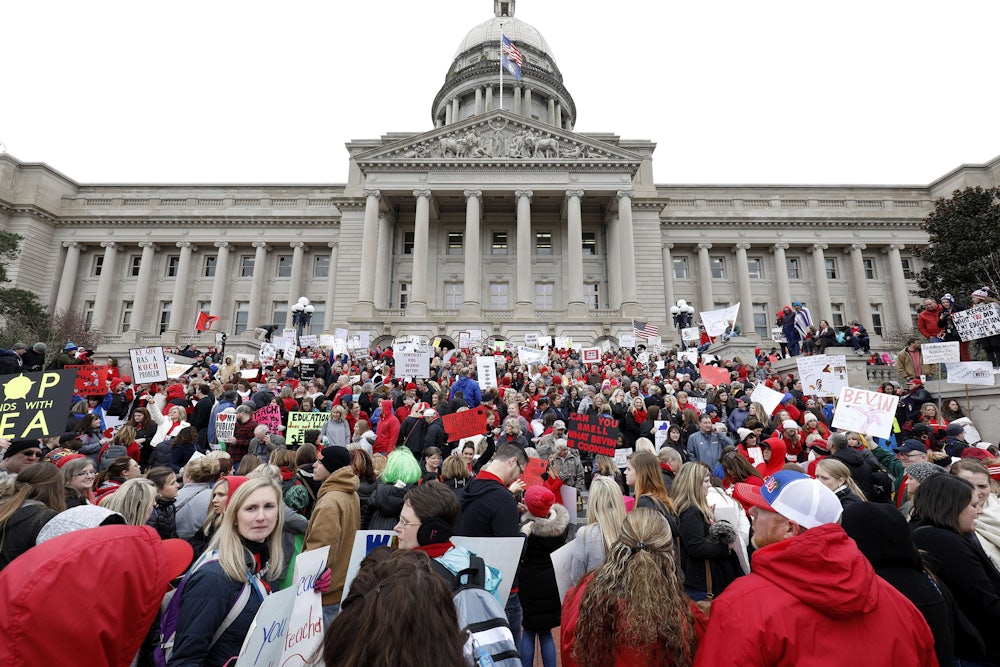
What has been happening in so-called Trump Country—West Virginia, Oklahoma, Kentucky, and Arizona, specifically—in recent months is then deeply connected to the shifts that have come before. Indeed, the visuals of red-clad teachers in capitol  continue reading: Why Teachers Are Adopting a More Militant Politics | The New Republic: