Latest News and Comment from Education

Sunday, March 29, 2015

#HedgePapers No.7: Rahm Emanuel and his Hedge Fund Flash Boys — Hedge Clippers

#HedgePapers No.7: Rahm Emanuel and his Hedge Fund Flash Boys — Hedge Clippers:


#HEDGEPAPERS NO.7: RAHM EMANUEL AND HIS HEDGE FUND FLASH BOYS


RAHM’S TOP BACKERS — HIGH-FREQUENCY TRADERS CRITIQUED IN THE NEW YORK TIMES BESTSELLER “FLASH BOYS”

When looking at the top donors to Rahm Emanuel’s campaign, a theme eventually emerges out of the dark pools of campaign cash.
Many of Rahm’s top contributors are heads of “high-frequency trading” funds—a murky and controversial trading strategy that is currently the subject of several class-action lawsuits.
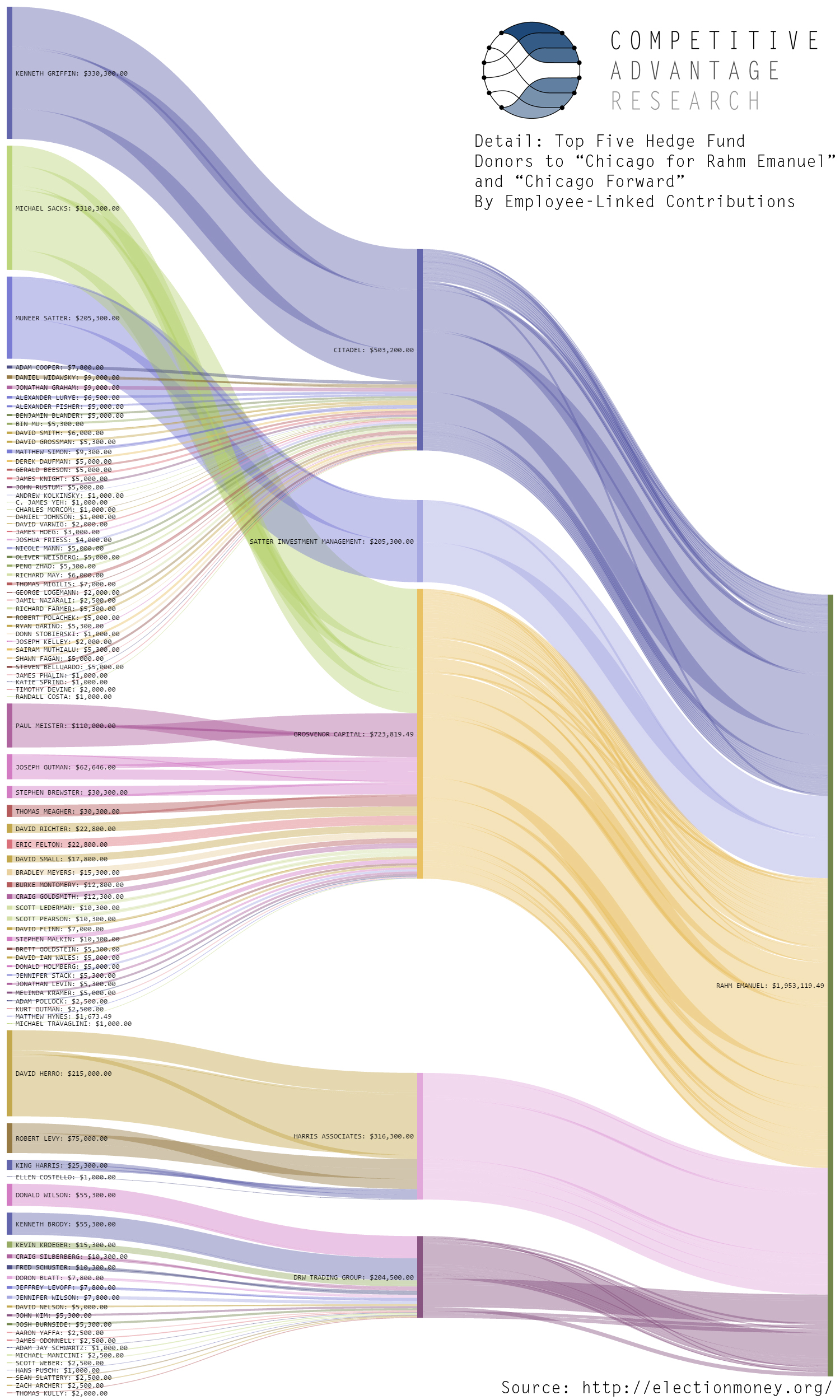
Two of the largest high-frequency trading funds in Chicago—Ken Griffin’s Citadel LLC and Donald Wilson’s DRW Trading Group— have poured over a million dollars into Rahm’s campaign.
But their combined contributions pale in comparison to what these funds have gotten from Rahm: a mayor who has (a) lobbied for loosening regulations on high-frequency traders, (b) landed a $55 million TIF subsidy for a high-end convention center hotel managed by a company in which Griffin has a major investment, and (c) secured a huge tax break for a major trading partner.[1] read more » 
clipper next

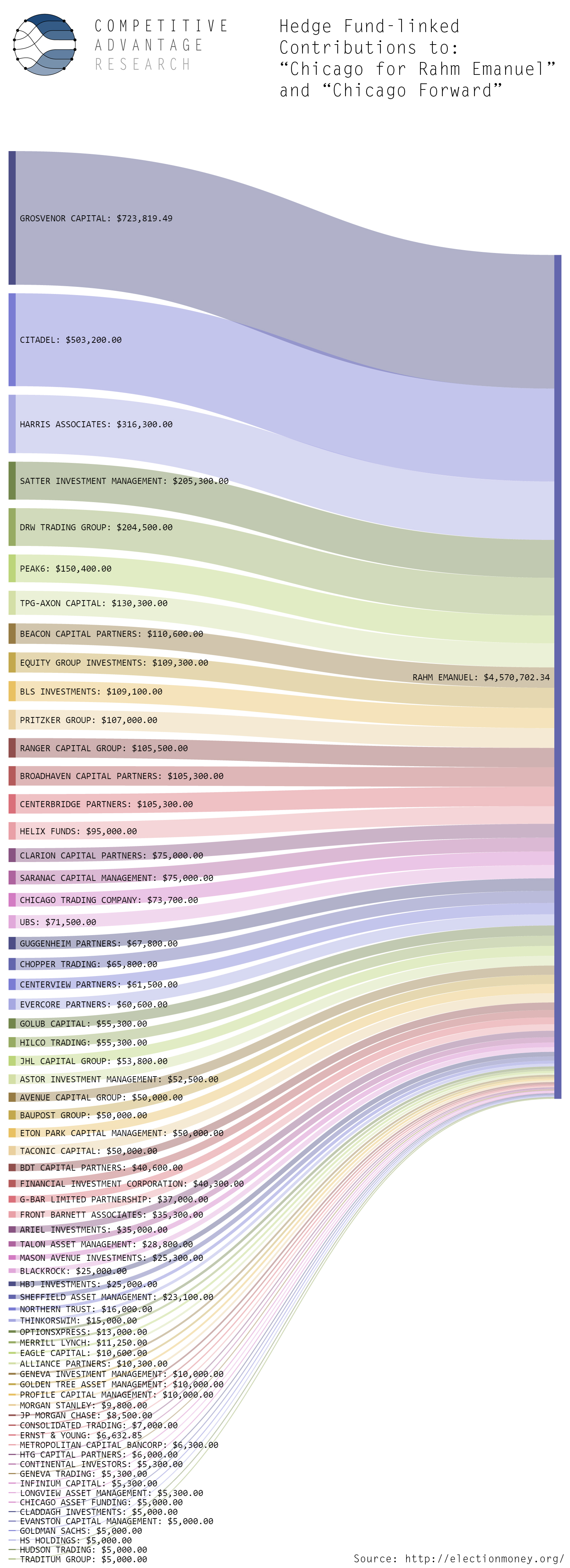
RAHM’S HEDGE FUND HAUL:  $4,623,716.63 AND COUNTING

Rahm Emanuel and political funds backing his campaign have raked in millions of dollars from high-frequency traders, including $900,000 from Ken Griffin, the CEO of Chicago’s largest high-frequency trading firm, Citadel LLC.[2]
rahm_top5

Rahm has also taken $270,300 from employees and principals of DRW Trading, another high-frequency trading firm with a big Chicago footprint.
rahm_hedge
An analysis of contributions to Rahm and Chicago Forward shows that Rahm has raised at least $4,623,716.63 from hedge fund managers, with much of that cash coming from high-frequency traders.


clipper nextONE HAND WASHES THE OTHER — HEDGE FUND MANAGERS SUPPORT THE RAHM AGENDA ON SCHOOLS & FISCAL POLICY

Besides the hundreds of thousands in campaign cash these high-frequency traders have lavished on Rahm’s campaign, they have also spent untold millions backing components of Rahm’s agenda, particularly in the areas of education and finance.
140428-schools-sl-1320_6caa245750bc64bab729b6ad6c7511bf

Donald Wilson’s name is emblazoned on a Nobel Street campus, a network of schools often touted by Rahm despite controversial disciplinary practices.[3] [4]
Griffin and Donald Wilson are both major funders of Stand for Children, which is strongly aligned with the mayor’s education platform, and has lobbied to limit the right of Chicago teachers to strike.[5]
By his own admission, Griffin is “one of the largest contributors” to DFER in Chicago,[6] the organization that gave Rahm political cover during the 2012 Chicago teachers strike.[7]
In the municipal finance arena, Citadel’s Ken Griffin bankrolled the creation of a fiscally conservative website, Reboot Illinois, in 2012.[8] Less than a year later, Rahm installed Citadel’s Dan Widawsky as the city’s comptroller.[9]#HedgePapers No.7: Rahm Emanuel and his Hedge Fund Flash Boys — Hedge Clippers:


What Oklahoma Schools Need | Oklahoma Observer

What Oklahoma Schools Need | Oklahoma Observer:

WHAT OKLAHOMA SCHOOLS NEED


 BY JOHN THOMPSON

In advance of Monday’s pro-public schools rally at the state Capitol, Oklahoma education bloggers have been challenged to articulate what we would do about schooling if we were a Queen or King for a Day. The first 10 of the 600-word posts are here. My contribution can be read by clicking here or you can read it in its entirety later in this post.
Moore Public School administrator Rick Cobb introduced the series in his Blogging from a Prompt: If I Were King. Cobb speaks for virtually all of the educators who I know when he explains the mess created by test-driven school reform:
I’ve seen great teachers reduced to a shell of themselves. Even worse, I’ve seen them leave the profession. Our federal waiver is only better in the same way that draining pus provides slight relief from an infected wound. High-stakes testing is a constant shell game. The design ensures that there will be winners and losers. Losers become the targets of corporate education reform.
Then, elementary school teachers protested the damage done by test, sort, and punish to our youngest children. Fifth grade teacher Tegan Sexton, in Queen for a Day!, calls for education to become a team effort. She then explains, “Some of the moves made by the governor’s office and the legislature make me a further believer that public education, in the political sphere at least, is nothing but a power grab with extraordinary amounts of money available to be exploited. And all of this is on the backs of our children.”
Shanna Mellott, in Choosing the Road Not Taken: Another Brick in the Wall, challenges an essential component of the bubble-in mania by citing Pink Floyd’s song, “Another Brick in the Wall.” We teachers “don’t need no thought control,” but the purpose of top-down school reform is to create a compliant teaching profession that stops resisting the teach-to-the-test dictates. When educators push back, defending the exchange of ideas in engaging classrooms, accountability-driven reformers double down on their micromanaging.
Mellott affirms, “It’s time to tear down this wall and design a different plan for schools. If I was Queen for a day, I would relate curriculum to the interests of the students, show teachers that they are appreciated, and get rid of testing in favor of portfolios.” Only after she speaks up for her students does she add, “The last brick that should be obliterated is using just a test to show the growth of students. A test only gives a brief look at what has been learned, not the complete picture that a portfolio would show.
Retired educator Claudia Swisher, in Fourth Generation Teacher, and Nicole Shobert, in her Thoughts and Ramblings, both embraced state Superintendent Joy Hofmeister’s reminder: “Every mandate ends up on a teacher’s desk.”
Swisher has long authored pithy and wise observations about schooling, such as “Standardized Testing tells us about learning as much as Reality TV tells us about reality.” She presented the science-based alternative route to school improvement: “Schools would provide wrap-around services for families – medical and dental clinics, social services would be housed in neighborhood schools.”
After performing her Queen for a Day role, she then demanded her tiara and scepter.
Shobert also concluded with humor; after protesting the effects of testing on children as young as kindergarteners, she added “Give every child a pony … [totally kidding …]”
This parent’s affirmation of holistic education concluded that we must “dismantle and delete TLE, ACEWhat Oklahoma Schools Need | Oklahoma Observer:

Common Core tests ignore grade level

Common Core tests ignore grade level:

View: State testing and parental choice


Parents Can Opt Out - United Opt Out National

Click Here to go to United Opt Out National: 


Click Here to go to the WebsiteUnited Opt Out Team
Home
Click Here to go to the Website FairTest


 Testing. It has become a dirty word. Last year, between 55,000 and 65,000 families refused to have their children take the New York State Common Core assessments. Those numbers are likely to increase in the coming weeks.

Parents and educators continue to voice their concerns regarding the vagueness of questions, a lack of transparency, the sheer length of the exams, and the recent monitoring of students' social media accounts by Pearson. However, one of my major concerns is text complexity.
The best example of this can be found on the EngageNY website. "The Gray Hare," by Leo Tolstoy, is included as a third grade sample reading passage. According to the Fry Readability Formula, this short story is written on a 7th grade reading level. As a teacher who has administered the last two Common Core ELA assessments, I can tell you that the passages presented to my students were just as difficult.
In addition to being unfair to students, the inclusion of these passages is in complete violation of Common Core Standard RL.3.10, which states that students should be reading material on their grade level. As a teacher and a parent, I know this is unjust.
Gov. Andrew Cuomo will tell you the scores can be used by educators to improve instruction. But when the reading passages are this far above grade level, the scores become invalid. The only thing these tests tell me is that my third-graders cannot read on a seventh-grade level. I don't need a test to tell me that.
This situation is not unique to third grade, either. All students in grades 3-8 have been placed in a similar situation for the past two years.
The U.S. Supreme Court has consistently upheld the rights of parents to direct the education of their children. As parents, this means we can choose to have our children Common Core tests ignore grade level:

Op-ed: Education is not a business - StamfordAdvocate

Op-ed: Education is not a business - StamfordAdvocate:

Op-ed: Education is not a business


Another school year is almost over. Instead of celebrating a move forward in educational success, our schools have been fundamentally transformed into rigid testing centers where our youngest children's imaginations have been stifled. Budget time is coming and districts have a lot to worry about. Common Core is changing what more than 200 years of education in our country stands for. It is dismantling our public school system piece by piece. It is diminishing the rights of every student to learn and excel in the best way -- through discovery, interaction, exploration, questioning and problem-solving. It is creating an environment that is not conducive to individual learning. Common Core's dependence on a one-sided, dictated, computer data-based approach is locking our students into an inferior education, and has handed over control of curriculum by local districts to the federal government. The unreasonable amount of testing, retesting, redoing, recording, desire for uniformity, and the link of all this to teacher evaluation and student outcomes are punishing our once outstanding high-performing school districts, and not addressing the needs in districts with an achievement gap. Parents and legislators are beginning to connect the dots as to how bad this is for their children. The talking points of Common Core's rigorous standards and evidence-based results are false and untested.
Education is not a business. The forced, federal Common Core standards, rushed implementation, evaluation tools, computer formats and heavy-handed federal tests, are a single model that does not work in Connecticut schools. Having a one-size fits all national computer-generated task system from kindergarten through high school defies the purpose of public schools which must educate diversified learners. We taxpayers have to pay increased costs for publishing company materials and technology in towns that already had high performing schools before Common Core was jammed in. Districts now must hire more administrators, assistant principals, and coaches for testing and evaluating teachers to insure uniformity of instruction. The teachers are overwhelmed with unnecessary, constant data-recording and block-scheduling which limits classroom flexibility. Parents and students are experiencing the impact. Schools are being reduced to nothing but collectors of a mandated, national data spreadsheet system. It is a waste of taxpayer money, and will not achieve the desired goal for higher scores in low-performing districts and their students to make them competitive in the global world. Common Core is an attempt to level the playing field across districts and dismantle school systems' local control.
We see in the classrooms, an early childhood education that is developmentally inappropriate, with no flexibility in its structure. Common Core content testing puts students who are minors Op-ed: Education is not a business - StamfordAdvocate:

Chicago Principal Troy LaRaviere stops by to Bust some Pencils. 03/29 #‎Chuy2015‬ ‪#‎imwithchuy‬

Chicago Principal Troy LaRaviere stops by to Bust some Pencils. 03/29 by Busted Pencils | Education Podcasts:


Chicago Principal Troy LaRaviere stops by to Bust some Pencils

Emanuel and Bennett-small


BustED Pencils hosts Jed and Tim talk to Chicago principal Troy LaRaviere about the difference between being a school leader and simply a policy compliance officer.  We will also dive into the opt out movement and ask Troy to speak about his letter to Barbara Byrd-Bennett, CEO of Chicago Public SchoolsChicago Principal Troy LaRaviere stops by to Bust some Pencils. 03/29 by Busted Pencils | Education Podcasts:


Organized Confusion: PARCC Hypocrisy, Bullying, and Fear-Mongering in CPS

An Open Letter to Barbara Byrd-Bennett, CEO of Chicago Public Schools
Cc: Rahm Emanuel, Mayor
Ms. Byrd-Bennett,
In response to parent and teacher support for opting children out of the PARCC Test, you sent amessage to all CPS principals. It states:
Please be advised that ISBE does not recognize a parent’s right to opt a child out of required student assessments, as there is no law in Illinois allowing this.  While a parent cannot “opt a child out,” there may be students who refuse to participate in required state assessments.
There are numerous faults and inconsistencies in your letter. I attempt to address a few of them here.
“Choice” Hypocrisy
It is pitifully ironic that you, Mr. Emanuel, and ISBE Chairman James Meeks—self-professed proponents of what you call “parental school choice”—would fight so vigorously to deny parents the choice of opting their children out of testing.
Posturing, Bullying and Wasting Learning Time
Your letter states that even if the parent states, in writing, not to test the child, school officials still must present each child with each one of the five sections of the PARCC tests and force the child to refuse each section separately. In April—when the second half of the PARCC is administered—you have directed us to repeat this process with up to 3 sessions. In total we have been directed to force students to verbally or physically refuse the PARCC on up to eight distinct occasions.
Your letter goes on to state:
It is unfortunate that ISBE’s limited guidance on this matter has placed the burden of refusing the test on students. I believe this is unfair to our students, families, principals and staff. However, we are obligated to follow ISBE’s limited direction to avoid sanctions that would have a devastating impact on our district.
If you believe it is “unfortunate,” and “unfair” then why are CPS officials alleged to be forcing children in some schools to refuse not only to the teacher, but to the principal and the network chief? If you believe it’s “unfair,” why was a network chief sent to Mollison School—my elementary alma mater—where the chief is said to have made students refuse directly to her; in one case allegedly forcing a fourth grade autistic child to articulate his desire to opt out despite the fact that he’d already made his desire clear when he himself submitted a signed note from his mother?
Then there’s what is alleged to have happened at Taylor school on the far southeast side, where a teacher reported an administrator, “got within a few inches of the face of one young man in the [opt-out] line, and asked him loudly, “DID SHE PUT A TICKET IN YOUR HAND?!!!”, then ordered the teacher to “PUT A TESTING TICKET IN EVERY STUDENT’S HAND AND PUT THEM IN FRONT OF A COMPUTER!”
Although the facts behind both of the above incidents are in dispute, it is noteworthy that the people making the above claims are all parents of low-income minority children—the children our mayor said would “never amount to anything”; the children whose schools he shut down; and the children who he funnels to charter schools where they experience less academic growth than in the public system they came from. Why has CPS added PARCC bullying to the long list of offenses it has committed against these children and their families?
Deception and Confusion Part 1: Repressive Framing of the Law
Your letter is deceptive in how it frames parental rights. The letter does not state that parentsdon’t have a right to opt their children out. It states that ISBE does not recognize a parent’s right to opt their children out. In other words, despite the fact that parents do have that right, ISBE has chosen not to acknowledge it.
There is a sentence on which the logic of everything in your letter rests. The sentence is as follows:
Please be advised that ISBE does not recognize a parent’s right to opt a child out of required student assessments, as there is no law in Illinois allowing this.
The statement, “There is no law in Illinois allowing this” is particularly disturbing. There is no law in Illinois allowing us to teach with “smart boards,” pull our children from school for family vacations, or assign homework on Fridays. Yet people do all of these things with regularity without consequence. We are not a society that curtails its actions based on the absence of a law allowing us to do a particular thing. We curtail our behavior based on the presence of an explicit law or rule prohibiting us from engaging in a particular act.
The fact that ISBE and CPS expects this kind of ominous and unsettling totalitarian logic to hold water is insulting to the principles of liberty and a seemingly desperate and pathetic attempt to inject confusion into a matter which is utterly clear: In a situation in which students are distressingly over-tested, parents have the right to opt their students out of standardized testing.
Deception and Confusion Part 2: Funding
Third, you cite a letter from ISBE that threatens to withhold funding should CPS not test “100%” of students. These threats violate ISBE’s own precedents in terms of how it has dealt with opt-outs in past years, and would subject ISBE to a massive class-action lawsuit should it be foolish and vindictive enough to follow through on its threats to withhold money from bilingual students, students with disabilities, and students from low-income households simply because students and their parents chose not to take a test. This threat has no merit; yet you continue to spread ISBE’s false doomsday pronouncements in an effort to frighten parents, teachers, and principals into subjecting our students to the failed practice of over-testing them.
A couple months ago you stated it was not in our students’ best interested to take the PARCC. If you sincerely believed this, you could have done what the New York City Department of Education advised its principals to do when parents opt their children out of similar state tests. They instructed their principals to “respect the parents’ decision and let them know that the school will work to the best of their ability to provide the child with an alternate educational activity.”
Instead you changed your tune and began praising the PARCC, calling it the “truest measure of the Common Core” in your letter to principals. Your implausible flip-flop on the issue gives some measure of believability to those who felt CPS’s request to have only 10% of students take the PARCC was an insincere election season ruse.
Summary and Conclusion
CPS has exhibited intense hypocrisy in regard to parental choice. It has bullied children and their families, been deceptive in its repressive framing of the law in regard to opt out rights, and parroted dubious claims about losing funds in relationship to opting out.
As a result, I will be taking the following course of action and call on you to advise all CPS principals to do the same:
Our school will meet its responsibility to administer the PARCC to all students who want to take it. Nearly 80% of our students have already expressed their decision to refuse the PARCC by submitting letters from their parents opting them out of the test. When students handed that opt-out letter to their teachers, that act was an expression of their refusal to take the test. That is enough for me, and it should be enough for CPS and ISBE. No child under my watch, who has expressed his or her decision to refuse the PARCC, will be sat in front of any computer to take it, nor presented with any materials. We will not waste even more learning time by subjecting our students to ISBE’s deceptive fear-mongering and CPS’s hypocritical test-driven political theater.
Respectfully,
Troy LaRaviere
  • CPS Graduate
  • Former CPS Teacher
  • CPS Parent
  • CPS Principal
  • Email: TroyLaRaviere@gmail.com
  • Twitter: @TroyLaRaviere
Next Week: ISBE’s Version of Stand Your Ground – An Open Letter to James Meeks, Chairman of the Illinois State Board of Education (ISBE) http://troylaraviere.net/2015/03/15/parcc-hypocrisy-bullying-and-fear-mongering/

If the Money Belongs to the Student... | Peter Greene

If the Money Belongs to the Student... | Peter Greene:

If the Money Belongs to the Student...

STUDENTS


One of the foundational assertions of the charter movement is that public school tax dollars, once collected, should be attached to the child, maybe in a backpack, or perhaps surgically. "This public money... belongs to the student, not the failing school," wrote a commenter on one of my HuffPost pieces. And I've heard variations on that over and over from charter advocates.
The money belongs to the student.
I've resisted this notion for a long time. The money, I liked to say, belongs to the taxpayers, who have used it to create a school system that serves the entire community by filling that community with well-educated adults who make better employees, customers, voters, neighbors, parents and citizens. But hey-- maybe I've been wrong. Maybe that money, once collected, really does belong to the student. In which case, let's really do this.
Let's let the student spend his voucher money (and let's stop pussyfooting around this -- when we talk about the money following the students, we're talking about vouchers) on the education of his dreams.
Does she want to go to the shiny new charter school? Let her go (as long as they'll take her, of course). But why stop there? Travel has long been considered a broadening experience -- what if she wants to take the voucher and spend it on a world cruise? Why not? It's her money. Perhaps she wants to become a champion basketball player -- would her time not be well spent hiring a coach and shooting hoops all day? Maybe she would like to develop her skills playing PS4 games, pursuant to a career in video-game tournaments. That's educational. In fact, as I recall the misspent youth of many of my cohort, I seem to recall that many found smoking weed and contemplating the universe to be highly educational. I bet a voucher would buy a lot of weed.
What's that, charter advocate? Do I hear you saying that's an unfair comparison, that obviously a high quality charter school is way different from smoking a lot of weed? I agree, but that's beside the point.
The money belongs to the student.
You didn't say that the money was the student's to be used on educational experiences that met with the approval of some overseeing government body. You didn't say that the money was the student's on the condition that the student got somebody's If the Money Belongs to the Student... | Peter Greene:

The Growing Progressive Movement to Save Public Education | The Progressive

The Growing Progressive Movement to Save Public Education | The Progressive:

The Growing Progressive Movement to Save Public Education 


 All over the country, a growing movement of parents, teachers, and students is rising up against over-testing, school closings, and shady schemes that channel public funds into private schools.

Saving public education is shaping up to be a key issue in the 2016 Presidential campaign.
In a front-page article this week, The New York Times described Hillary Clinton’s dilemma on so-called education reform.
On one side, charter school operators and hedge fund managers are urging Hillary to adopt their teachers-union-bashing, pro-privatization agenda.
On the other side, communities all over the country are experiencing education “reform” as a major threat to their local public schools.
 “Mrs. Clinton is re-entering the fray like a Rip Van Winkle for whom the terrain on education standards has shifted markedly, with deep new fissures in the Democratic Party,” Times reporter Maggie Haberman writes.
The pressure Haberman notes, however, is mostly coming from one side—Wall Street hedge fund managers and “wealthy Democrats who favor sweeping changes to education—including a more business-like approach, and tying teacher tenure to performance as measured by student test scores.”
But there is more to the story than what Wall Street wants.
I attended a local forum in tiny Reedsburg, Wisconsin, recently, where community members packed an elementary school gym to talk about school budget cuts and the expansion of voucher and charter school programs that will drain even more money away from their local public schools.
As state officials hold budget hearings around Wisconsin, they are hearing over and over from citizens who are alarmed about the dismantling of the local public schools.
It’s an issue that puts Republicans as well as Democrats in a difficult position.
School choice lobbyists have spent enormous sums of money—as much as the lobby group for all other business interests combined—to promote the idea that public schools have “failed” and to support Republicans who want to privatize public schools.
But small-town constituents like those who gathered the other night in Reedsburg do not want to see their local public schools destroyed, nor do they want to see their tax dollars go to pay private-school tuition for families who have never even sent their kids to the local public school, which has happened under Scott Walker’s school-voucher expansion in Wisconsin.
Parents in Altoona  and Eau Claire were so outraged by the school funding cuts related to a puny $13 savings in their property taxes, they started a campaign called Project 13 and collected checks for $13 and dumped them on the desks of their local school boards, demanding that the school board use the money to fund their schools.
In Illinois, outrage about school closures has fueled the insurgent campaign of Chuey Garcia against “Mayor 1 percent” Rahm Emanuel.
Hillary should take a close look at what has happened to Rahm, a chief proponent of the corporate school reform agenda supported by those hedge fund managers mentioned in The New York Times.
As Anthony Cody wrote in an open letter to the Progressive Change Campaign Committee that attracted a lot of attention this week on our website, saving public schools is a key issue for progressives, and should be on the “Bold Progressives” list of issues on which Hillary Clinton needs to respond to the base.
The PCCC responded promptly, Cody reports, saying it will look into sending a representative to a major conference in April, organized by Cody and Diane Ravich.
Appropriately, that Network for Public Education conference will be held in Chicago, where the battle between local progressive activists and Mayor 1 percent shows just how much progressives care about saving our schools.
Ruth Conniff is editor of  The Progressive.
- See more at: http://www.progressive.org/news/2015/03/188068/growing-progressive-movement-save-public-education#sthash.MuXrCZdS.dpuf

What I’m really thinking: the GCSE student | Life and style | The Guardian

What I’m really thinking: the GCSE student | Life and style | The Guardian:

What I’m really thinking: the GCSE student

‘A regimented curriculum geared towards preparing students for impersonal, memory-based exams is as depressing as it is uninteresting’


What I'm really thinking: GCSE student.


 I press my Oyster card against the machine, and the kindly bus driver asks how my day was. I mumble something about it being fine. It’s not an unfair description of another mind-numbing day, filled with my teachers giving lessons they didn’t want to teach to students who didn’t want to learn.

I’m at a London comprehensive, and it’s filled with good people in a bad system. Students want to learn and teachers want to teach. But a regimented curriculum geared towards preparing students for impersonal, memory-based exams is as depressing as it is uninteresting.
When I was 10, in year five, my teacher was eccentric and inspirational. He showed complete disregard for what he was meant to teach and how he was meant to teach it – he was the best teacher I’ve had. Year five wasn’t just the year I enjoyed the most, but also the year I learned the most (according to standardised tests). His students thought he was fantastic – the school had him sacked.
I get home and slump on the nearest sofa. The effort required to make it through a school day and to complete my homework and revision is immense. Combine it with trying to lead something vaguely resembling a social life while making it through puberty, and you rapidly become exhausted. There are only two kinds of GCSE students: tired ones and liars.
I read education-related news articles. They often seem to be about exam reform. Conspicuously absent are the opinions of actual students. I’m not saying I have all the answers, just that occasionally it could help to listen to a teenager.What I’m really thinking: the GCSE student | Life and style | The Guardian:

When will teacher evaluations make the grade? - Newsday

When will teacher evaluations make the grade? - Newsday:


When will teacher evaluations make the grade?


A new plan for teacher evaluations that was furiously negotiated this weekend in Albany may offer a real chance at progress. It's hard to say without knowing the full details. In truth, it will be hard to say even after we know the full details.

Gov. Andrew M. Cuomo has been demanding evaluations that culminate in some meaningful percentage of New York's public school teachers being identified as ineffective. Teachers unions and the state legislators they support have been fighting him. Meanwhile, districts and parents are being misled into battling Common Core curricula and the standardized tests on behalf of teachers, who often don't oppose the tests or the lesson plans. The teachers simply resist being evaluated on student mastery of those tests.

But whether this iteration does the trick won't alter the long-term reality: New York will eventually get an evaluation system that identifies and rewards the best teachers, provides training for those who need it and flushes out the worst. It's not going to happen because Albany deems it so, but because the courts, parents and stark facts of student failure demand it.

The state budget is due Wednesday, and Cuomo has made this issue central to this year's negotiations. Evaluations of educators in New York's schools for the past two years found very few teachers ineffective or developing. On Long Island, 104 of the 124 districts didn't find a single teacher or principal ineffective, and 54 districts evaluated every educator as "highly effective" or "effective."

The system has been gamed. The 80 percent of each evaluation not based strictly on student test results is slanted to favor educators, with even some teachers classed as "developing" getting as many as 76 of those 80 available points.

The unions have proved they knew a lot more about how to finesse an evaluation system than the reformers. The unions may, with this new plan, do so again. It's difficult to believe they and their political supporters will accept a system that is, in fact, acceptable.

And it's important to remember that the current, skewed evaluation results aren't the fundamental reasons the system must change. It's the number of students getting to Long Island's community colleges in need of remedial help, 60 percent to 70 percent. It's the mere 38 percent of the state's high school graduates who are ready for college or careers.

This isn't just about poor kids or minorities. The Board of Regents says that even in districts with good graduation rates, graduates are often unprepared for the next level.

This year's standardized testing for Long Island students in grades 3 through 8 begins on April 14. Calls to opt children out of the tests are again mounting. But parents will eventually realize that their kids aren't getting the education they need, or that we're paying for.

The courts are figuring that out. In California and Pennsylvania, judges recently came down against both teacher tenure and layoffs by seniority. In New York, a lawsuit has been filed in pursuit of similar goals. Teacher tenure and difficult firing mechanisms are an equity issue: Underprivileged students suffer the most when bad teachers are retained. But affluent children are not well-served by such a system either.

Teachers absolutely can be evaluated in a meaningful way, with student achievement as part of the equation. Washington, D.C.; New Haven, Connecticut; Massachusetts and other places offer vaunted models of teacher evaluation to look at. We know it would help to add components of parent and student evaluations and classroom observers who aren't employed by the same school. Better standardized tests that tell us more about each student's needs and triumphs would be When will teacher evaluations make the grade? - Newsday: