Latest News and Comment from Education

Sunday, March 29, 2015

Finland and the Common Core | John M. Eger

Finland and the Common Core | John M. Eger:


Finland and the Common Core

Source: iStock


 All right, it's not the Common Core per se, but it sure looks like it. And it helps confirm what most people in the U.S. are saying about the Common Core: "This could be the holy grail of education reform."

Finland changes its National Core Curriculum (NCC) every few years. While teachers and even students and their parents may want to see other changes made, the process is coming to a close.
For a nation that ranks at the top of the so-called PISA tests (for Program for International Student Assessment) administered by the Organization for Economic and Cooperative Development (OECD) to 15-year-olds every three years, the changes Finland proposes are confusing to many but seen as absolutely necessary by administrators and government executives in the education ministry.

2015-03-22-1427064540-5515540-TottijrvenkouluNokiaiPadhanke091112.jpg
According to Liisa Pohjolainen, who is in charge of youth and adult education in Helsinki, the capital city at the forefront of the reform program, "This is going to be a big change in education in Finland that we're just beginning."
What they propose is scrapping traditional "teaching by subject" in favor of "teaching by topic." There is no math, history or biology per se. Instead of teaching specific disciplines, teaching will be interdisciplinary and real-world. Richard Garner, the education editor of the Independent in England, put it this way:
Pupils would be taught cross-subject topics such as the European Union -- which would merge elements of economics, history (of the countries involved), languages and geography... [Or using] a map of continental Europe on the whiteboard ... the children must combine weather conditions with the different countries displayed on the board. For instance, today it is sunny in Finland and foggy in Denmark. This means the pupils combine the learning of English with geography.
The reason that Finland is moving in this radical direction is why so many states have adopted the Common Core, also known as the "state standards initiative." While we have been watching Finland, which produces what author Amanda Ripley calls "The Smartest Kids in the World," maybe the Finns have been watching us. The Common Core, for example, "proposes that educators engage students in inquiry and exploration of real world problems and interdisciplinary performance tasks." That's exactly what Finland wants too.
2015-03-22-1427064621-8817380-20140725creativepracticesthumb.jpg
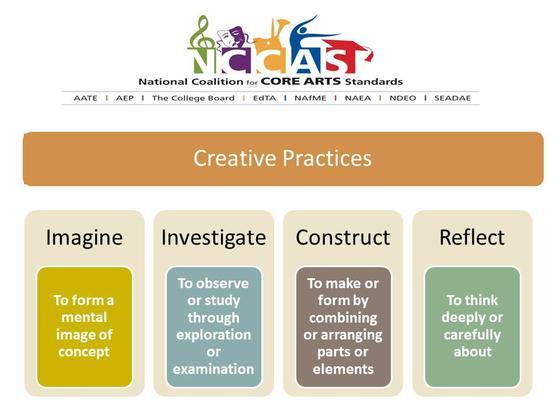
The Common Core is like Finland's National Curriculum Core (NCC) plan. It opens the door to integrating all the disciplines, merging art and science, and fashioning an interdisciplinary curriculum that enhances the thinking skills young people most need.
Clearly, this effort here and there is not going to be easy. Most teachers have been teaching single subjects for many years. This new methodology requires collaboration in course planning, team teaching and individual assessment of student outcomes.
The students will need to work in groups, participate in the problem solving, and be ready and accountable for what they contribute to their learning. They will be assessed individually too.
It is critical that we look at "how students learn." As Howard Gardner has written, some people are more verbal-linguistic, some more spatial, and some more logical, and the list continues. And now, after 30 or so years, this is more widely accepted. Under the Common Core approach to teaching and learning, it will be commonplace.

2015-03-22-1427064753-1532358-20140725multipleintelligencethumb.jpg
To date this has not yet been widely applied in the schools. There is simply no longer any reason to deny Gardiner's assertion that we all have "multiple intelligences" and, for our students, begin to craft learning methods that recognize the different learning styles and the need for more tailored individual learning methods.
The Common Core also eliminates the silos in education by requiring interdisciplinary, real-word problems to solve.
The new global, knowledge economy is calling for radical change in education. This is radical indeed. But as the National Governors Association (NGA) Center and the Council of Chief State School Officers (CCSSO) have pointed out, "Today's students are preparing to enter a world in which colleges and businesses are demanding more than ever before."

How a Finnish Experiment Could Mean Better Education in America

The U.S. education system is fast beginning to resemble a decrepit (and worthless) financial derivative.
Noted venture capitalist Peter Thiel referred to the higher education system as the next bubble. And student loans are expected to be the next big default in the financial markets.
Part of the problem with the system’s returns is its emphasis on academic rigor at the expense of practical training. This approach does not necessarily translate into financial or career success later in life.
The American education industry could learn a few things from its Finnish counterpart. The Nordic state, which is regularly among the top scorers in student assessment indexes, is transforming its educational pedagogy from a subject-based curriculum to a topic-based one.
The new system, which is currently being tested, combines vocational training with humanities to ready children for the job market. According to capital city Helsinki’s development manager, the changes are “necessary for industry and modern society.”
The new Finnish education system emphasizes an interdisciplinary approach to education. For example, students in the catering service industry are taught a mix of subjects such as English and math along with vocational skills related to catering. Similarly, English and geography are combined into a single subject.
Thus, it combines the practicality of a vocational approach with cross-functional expertise. According to Finnish authorities, outcomes for students in the new system have improved.
It is not hard to see why.
The system has multiple benefits. For starters, student grades will be a true reflection of their soft skills and hard skills. As an example, students who graduate from the catering service course will have a mix of communication and vocational skills (such as culinary expertise) necessary for their job.
Source: Thinkstock
 Your Reaction?
Source: Thinkstock
This is unlike a subject-based approach, which emphasizes academic rigor over practical experience. In this case, academic grades determine the all-too-important internships, which are seen as gateways to the good jobs. This adds to the time and resources spent by a society to hone productive citizens. The new system enables graduates of the new system to become productive immediately after joining the workforce.
This will have a positive impact on the nation’s economy, because a country’s economy is only as good as its citizen’s productivity and skill sets. For example, a focus on humanities-centered education in American academia has reduced the value of a humanities degree. At the other end of spectrum, it has created a mismatch in the supply and demand for technology workers.
More conclusive proof about the effect of worker skill sets can be found in a European Union study, which evaluated the effect of vocational skill sets on an economy. According to the study, better-skilled employees at intermediate and lower levels of organization allow senior managers and professional staff to think strategically and do their own jobs well rather than engage in “fire-fighting.”
In simple words, a good employee is a productive employee. The study further states that the context in which skills are developed is important in determining the ultimate effect of skills on productivity. Thus, academic study of a subject — such as catering services — is useless without practical experience in a workplace setting. With their emphasis on academic rigor, current education systems are not suited for a productive economy.

Philosophy and practice

Indeed, the case for a good education system is as much a philosophical one as a business one. An educated workforce is important for scientific progress and is important to construct a tolerant, civilized, and humane society.
Estimated to be worth approximately $1.3 trillion, the American education industry is a complex network of personal tutoring agencies, public institutions, and a thriving textbook market. The entire juggernaut is founded on preparing youngsters for viable jobs in a nation’s economy.
But there has been a disconnect between its promised and actual returns in recent times. Education is an investment made by individuals. A good degree gets you a good job and, consequently, a good income. Similarly, graduation from a top-tier university multiplies networking opportunities.
spiral of high fees coupled with rising unemployment among millennials and structural changes in the economy have made that investment unsustainable, however.
That is only part of the problem.
Other problems, such as individual statewide initiatives and standards to measure academic performance, further complicate matters. While the common core standards unify individual frameworks under a single umbrella, they are still focused on piecemeal subject-based academic rigor.
As societies become a complex mesh of economic and global factors, a subject-specific approach is not well-suited to preparing students for a labor market that is increasingly international and interdisciplinary rather than local or limited to a single field.
For example, the career prospects for technology workers are already bright. But an increasingly technology-obsessed society makes context necessary for development of products and services using technology.
If successful, the Finnish education reform might provide pointers to America’s education czars on how to make the financial investment worth it.http://www.cheatsheet.com/business/how-a-finnish-experiment-could-mean-better-education-in-america.html/?a=viewall

Vouchers still vouchers by any other name - San Antonio Express-News

Vouchers still vouchers by any other name - San Antonio Express-News:


Vouchers still vouchers by any other name


 Do we want a system of education that is good for all our children or one that is good for a only a few?

Several school voucher bills have been filed in the current legislative session. This is not the first session where we have seen vouchers proposed, and it likely won’t be the last.
The so-called “Taxpayer Savings Grant” concept in one of the bills is to take public funds and allow parents to use them where they choose. The bill could give roughly 60 percent of the cost of educating a student directly to the parent, and the other 40 percent is counted as “savings” to the state, which would supposedly generate a windfall of $1.7 billion over five years. Not surprisingly, the bills are supported by some groups who are regular critics of traditional public schools.
There are significant problems with legislators’ calculations.
First, the cost of running a school does not decline in a linear fashion if small numbers of students choose to leave. In other words, a class with 24 students costs essentially the same as a class with 25 students. These “savings” also ignore the negative impact to the students who remain in the public school.
Second, for most Texas districts, a loss of enrollment increases the district’s wealth per student, which translates to a decline in state per-pupil funding. The “Taxpayer Savings Grant” bill specifically excludes the institutions where this “grant” money would go from the financial or student performance accountability that traditional public schools operate under. This would be a startling example of a fiscally conservative state giving away public funds without any oversight.
We also see school choice advocates, especially those who would promote vouchers, speaking of the issue in terms that invoke the civil rights movement in our country. It is ironic that some of the earliest school voucher programs were created in the Southern states in the 1960s for the express purpose of perpetuating segregation.
A recent article in the Huffington Post speaks to the notion of school choice when it is used to encourage an exodus from public schools. The author makes the point that school choice actually disenfranchises the public. He states, “School choice treats parents as if they are the only stakeholders in education. They are not. We all depend on a society in which people are reasonably well-educated. This is why everybody votes for school board members — not just the people who have kids in school.”
Traditional public schools exist to serve the entire public. A system heavily influenced by choice indicates that only parents have a voice as they are the only people who control student enrollment or, perhaps better stated, market share. This message that the general public should have no interest or say in the schools is a dangerous one and seems to support a notion that Vouchers still vouchers by any other name - San Antonio Express-News:

Charter schools not performing as planned in Pennsylvania; should we scrap them? - Times Leader - timesleader.com

Joseph Rogan: Charter schools not performing as planned in Pennsylvania; should we scrap them? - Times Leader - timesleader.com:

Joseph Rogan: Charter schools not performing as planned in Pennsylvania; should we scrap them?


 The Pennsylvania House of Representatives recently voted to “improve” charter schools. House Bill 530 requires academic performance measures and expects charter schools to implement truancy regulations. It also reduces lunch money payments by $27 million since cyber charter schools do not provide lunches.


Gov. Tom Wolf moved in a different direction. He axed the Philadelphia School Reform Commission chairman who approved new charters and installed a commissioner who opposed them. He proposed changes that would save districts $162 million, primarily by establishing a $5,950 base tuition rate, eliminating double-dipping that allowed charter schools to receive reimbursements for pension costs already funded by districts, partially resuming the state’s tuition reimbursements to districts, requiring annual audits and requiring charter schools to return money they do not spend on students.

Taken together, the Keystone Alliance for Public Charter Schools says the governor’s budget would “shut down charter schools across Pennsylvania.”

Since the House and the governor seem to be heading in opposite directions, maybe this is a good time to wonder whether and why we need charter schools at all.

In 1988, the American Federation of Teachers proposed charter schools to serve as “educational laboratories” to discover better teaching methods. Charter schools have had plenty of time, but have not developed new approaches to improve education. The National Alliance for Public Charter Schools only lists methods commonly used in Traditional Public Schools (TPSs).

Innovation in teaching has been replaced by top-heavy management and anti-union sentiments that result in fewer job protections which silence teachers’ voices and cause high staff turnover. Instead of fostering collaboration, they have aggravated the antipathy toward TPSs.

In part, America’s greatness is due to our system of universal public education that is under attack today. The goal of the Independence Hall Tea Party Association, for example, is to “shut down public schools.” Instead of accepting responsibility to educate all children, it wants to educate only some.

School choice was based on the assumption that competitive market forces – including allowing parents to make decisions – will solve problems. Real choice has been reduced as private schools have closed or became too expensive. For anti-government types, charter schools are the next best thing. Privately operated, they are free from most of the rules and regulations that control TPSs, but are fully funded by their students’ districts. In Pennsylvania, 119,465 students attend charter schools: 84,373 in traditional schoolhouses and 35,092 in cyber schools. In 2012-13, they cost districts about $1.3 billion, according to the Pennsylvania School Boards Association.

Many districts are tasked with educating economically disadvantaged students, which creates serious challenges to understaffed and underfunded schools. For example, 80 percent of the students in our state’s largest district come from poverty – twice the state’s average. In 2012-13, Philadelphia spent $14,361 per pupil – a lot of money – but still $256 below the state’s average. Instead of helping Philadelphia, our previous governor cut more than $1,300 per student. Starving Philadelphia created deficits that necessitated program cuts, layoffs and increased class sizes. Not surprisingly, families moved their children. Now, more than 30 percent of the district’s budget – $750 million – is earmarked annually for charter schools.

Paying for charter schools requires that we take money from underfinanced districts, like Philadelphia. Moody’s Investors Service noted that charter schools even negatively affect districts’ credit ratings. Such financial problems put the ability of districts to provide quality universal public education in peril. This outcome begs the question: If we are having problems funding one system of public education, why do we think we can fund two?

Public schools accept all students, while many charter schools do not. The Washington Post reported that some use admission barriers, and therefore serve far fewer students with disabilities. In the 2013 national charter school study, the Center for Research on Education Outcomes (CREDO) at Stanford University found that 13 percent of TPS students in the nation are special education students, but charters only served 8 percent.

Furthermore, a 2014 analysis by The Notebook, a media outlet that covers education, found that Pennsylvania charter schools received $350 million for special education students, but spent only $156 million – a fact underscored by the U.S. Government Accounting Office. The National Center for Special Education in Charter Schools suggests the discrepancy undermines the sector’s overall credibility. Additionally, Public Citizens for Children and Youth reported that across the nation charter schools have fewer minority, low-income and English-as-a-second-language learners on their rosters.

Charter schools also expel students at a far higher rate. In the nation’s capital, for example, charter schools expelled 30 times more students than TPS schools over a three-year period. Furthermore, when a TPS school expels a student, it must still provide that student with an education – often at a higher cost. Charters can just move on.

Just as there are good TPSs, there are also good charter schools. On average, though, are charter schools better than traditional public schools? Since the 2009 CREDO report, charters have improved mainly because low-scoring schools closed and were removed from calibrations. If they were still operating, there would have been no gains. Joseph Rogan: Charter schools not performing as planned in Pennsylvania; should we scrap them? - Times Leader - timesleader.com:

Why my children opt out of standardized testing—and yours should too - Quartz

Why my children opt out of standardized testing—and yours should too - Quartz:

Why my children opt out of standardized testing—and yours should too

Parents Can Opt Out - United Opt Out National

Click Here to go to United Opt Out National: 


Click Here to go to the WebsiteUnited Opt Out Team
Home
Click Here to go to the Website FairTest

 As children around the US embark on spring break, they do so knowing they will soon be required to gear up once more for standardized-testing season. Or rather, I should say most of our nation’s children will be gearing up. This year, like the year before it, my three children will not be among this cohort of national test takers, nor will the growing thousands of other children from families who have chosen to opt out of standardized tests.

Why opt out?


I admit that my main reason for opting out of standardized testing is not data-driven, but instead based on emotional and philosophical beliefs. I am not opting out because I think tests unfairly force children to sit for long periods, nor because they might cause stress, are cruel to special-needs children, punish teachers for students’ low scores, steal valuable instructional time, divert loads of money to businesses that create the tests, or include poorly worded questions. No, while all those reasons hold merit for other like-minded parents, my main reasons can be traced all the way back to The Star-Spangled Banner.

The story of how Francis Scott Key penned the lyrics to the US national anthem in 1814 while watching the bombardment of Baltimore is riveting. When Key, a prisoner on board a British ship of war, saw that first hint of unfurled color waving in the early morning light, a thrill went through him. When I consider his lyrics, trying to imagine what Key was thinking in the midst of that battle, three words come to mind: independence, community, and—bear with me—booyah! Together, these words represent what is missing in our schools today.

Our students’ independence is slowly but surely being crushed by an endless scholastic bombardment of carrots and sticks, reminders to stay on the state-mandated track and learn the state-mandated information. No zig, no zag, no time to stop and enjoy the view. Students are to be compliant and obedient. They are not to question the authority of leaders in the system. Students are inculcated, from a very early age, with the sense that they do not own their education.
At the same time, their sense of community is being damaged by the very system designed to educate them. Grouped according to age, students are relentlessly rewarded (with treats, good grades, smiley faces, extra recess minutes) or punished (with bad grades, class rankings, less recess) based on slight differences in development and abilities. Everything possible is given a score. Those who score well learn a sense of superiority and condescension, while those who score poorly learn self-hatred. At the same time, this ranking system makes it very clear that one student’s climbing rank is tied to another’s falling one.


Together, these strategies and others are silencing the exhilarated yawps and hoorahs, woohoos and booyahs of our nation’s students. Meek and fearful, they have forgotten how to seek out challenging and exciting tasks. A generation of children are growing up with an “Is it going to be on the test?” mentality. All that is left is to try to make education palatable by adding silly rewards, candy, pep rallies, and in-classroom movies.

I’m opting my children out of standardized testing because sometimes when you’re a prisoner on a ship, you need to glimpse a flag on a hill—to see someone, somewhere, reaffirming your almost forgotten sense of independence and community.

I want my children to value independence. I want them to look at systems of state control with a wary eye, to demand and revere control over their own lives as their birthright. The joy and mystery of living, learning, growing, and loving isWhy my children opt out of standardized testing—and yours should too - Quartz:

Saturday, March 28, 2015

A Prof Debunks Standardized Testing & Pearson Strikes Back

A Prof Debunks Standardized Testing & Pearson Strikes Back:

Mute the Messenger

When Dr. Walter Stroup showed that Texas’ standardized testing regime is flawed, the testing company struck back.


Rebellions sometimes begin slowly, and Walter Stroup had to wait almost seven hours to start his. The setting was a legislative hearing at the Texas Capitol in the summer of 2012 at which the growing opposition to high-stakes standardized testing in Texas public schools was about to come to a head. Stroup, a University of Texas professor, was there to testify, but there was a long line of witnesses ahead of him. For hours he waited patiently, listening to everyone else struggle to explain why 15 years of standardized testing hadn’t improved schools. Stroup believed he had the answer.
Using standardized testing as the yardstick to measure our children’s educational growth wasn’t new in Texas. But in the summer of 2012 people had discovered a brand-new reason to be pissed off about it. “Rigor” was the new watchword in education policy. Testing advocates believed that more rigorous curricula and tests would boost student achievement—the “rising tide lifts all boats” theory. But that’s not how it worked out. In fact, more than a few sank. More than one-third of the statewide high school class of 2015 has already failed at least one of the newly implemented STAAR tests, disqualifying them from graduation without a successful re-test. As often happens, moms got mad. As happens less often, they got organized, and they got results.
Texas Education Commissioner Robert Scott, long an advocate of using tests to hold schools accountable, broke from orthodoxy when he called the STAAR test a “perversion of its original intent.” Almost every school board in Texas passed resolutions against over-testing, prompting Bill Hammond, a business lobbyist and leading testing advocate, to accuse school officials of “scaring” mothers. State legislators could barely step outside without hearing demands for testing relief. So in June 2012, the Texas House Public Education Committee did what elected officials do when they don’t know what to say. They held a hearing. To his credit, Committee Chair Rob Eissler began the hearing by posing a question that someone should have asked a generation ago: What exactly are we getting from these tests? And for six hours and 45 minutes, his committee couldn’t get a straight answer. Witness after witness attacked the latest standardized-testing regime that the Legislature had imposed. Everyone knew the system was broken, but no one knew exactly why.
Except for one person. Stroup, a bookishly handsome associate professor in the University of Texas College of Education, sat patiently until it was his turn to testify. Then Stroup sat down at the witness table and offered the scientific basis behind the widely held suspicion that what the tests measured was not what students have learned but how well students take tests. Every other witness got three minutes; it is a rough measure of the size of the rock that Stroup dropped into this pond that he was allowed to talk and answer lawmakers’ questions for 20 minutes. 
A tenured professor at UT with a doctorate in education from Harvard University, Stroup isn’t frequently let out of the lab to address politicians in front of cameras. He talks with no evident concern that he might upset the powerful, and he speaks so quickly that his sentences have to hurry to keep up as he darts down tangents without warning. He taught in classrooms for almost a decade—it must have been a nightmare for his students.
But his testimony to the committee broke through the usual assumption that equated standardized testing with high standards. He reframed the debate over accountability by questioning whether the tests were the right tool for the job. The question wasn’t whether to test or not to test, but whether the tests measured what we thought they did.
Stroup argued that the tests were working exactly as designed, but that the politicians who mandated that schools use them didn’t understand this. In effect, Stroup had caught the government using a bathroom scale to measure a student’s height. The scale wasn’t broken or badly made. The scale was working exactly as designed. It was just the wrong tool for the job. The tests, Stroup said, simply couldn’t measure how much students learned in school.
Stroup testified that for $468 million the Legislature had bought a pile of stress and wasted time from Pearson Education,the biggest player in the standardized-testing industry. Lest anyone miss that Stroup’s message threatened Pearson’s hegemony in the accountability industry, Rep. Jimmie Don Aycock (R-Killeen) brought Stroup’s testimony to a close with a joke that made it perfectly clear. “I’d like to have you and someone from Pearson have a little debate,” Aycock said. “Would you be willing to come back?”
 “Sure,” Stroup said. “I’ll come back and mud wrestle.” 
But that never happened. Stroup had picked a fight with a special interest in front of politicians. The winner wouldn’t be determined by reason and science but by politics and power. Pearson’s real counterattack took place largely out of public view, where the company attempted to discredit Stroup’s research. Instead of a public debate, Pearson used its money A Prof Debunks Standardized Testing & Pearson Strikes Back:

Illinois law allows schools to demand students' Facebook passwords - CNET

Illinois law allows schools to demand students' Facebook passwords - CNET:

Illinois law allows schools to demand students' Facebook passwords

Technically Incorrect: Conceived to combat cyberbullying, a new law in Illinois may result in schools demanding social media passwords, even if the posting was not done at school or on school computers


Illinois can't seem to decide whether it's the home of midwestern gentlefolk or of the most draconian humans this side of Moscow.
One of the state's newest laws, for example, may have goodness at its heart. However, it may have something else in various of its extremities.
The law, which went into effect on January 1, is designed to curb cyberbullying, but it also could encourage schools to pry into students' personal lives.
KTVI-TV reported that the law was already making some parents deeply uncomfortable. That's because one of its stipulations is troubling.

ndeed, this week Illinois parents began receiving a letter from school authorities informing them that their children's social media passwords may now have to be handed over, as part of school discipline.Motherboard reports that it obtained one of these letters. It reads, in part:
School authorities may require a student or his or her parent/guardian to provide a password or other related account information in order to gain access to his/her account or profile on a social networking website if school authorities have reasonable cause to believe that a student's account on a social networking site contains evidence that a student has violated a school disciplinary rule or procedure.
You might imagine that this stipulation only applies to school computers and activity on school premises. It does not. The schools may ask for passwords and search on the basis of any posting by a student at any time and in any place.
And who will decide what is reasonable cause? Leigh Lewis, superintendent of Triad Community Schools Unit District 2, told Motherboard that if someone didn't cooperate, there might be trouble. Not detention, criminal charges.
Those of sharp eyes and, perhaps, parenting experience, will wonder just what private information the schools might encounter as they search for their alleged evidence.
As one parent who had received the latter, Sarah Bozarth, told KTVI: "It's one thing for me to take my child's social media account in there and open it up for the teacher to look at (...) but to have to hand over your passport and personal information to your accounts to the school is just not acceptable."
Image result for Illinois public schools can now demand students’ social networking accounts and passwords at will.
I have contacted Illinois' Board of Education to ask how educators justify what seems like the potential for a considerable invasion of privacy. I will update, should I hear.
What if, in performing a search, the school discovers that a student is involved in, say, criminal activity or a sexual relationship? What if it discovers that the student has a particular medical problem?
Will it pinkie promise not to tell? I contacted Lewis to ask her views and will update, should she reply.
The whole idea of an authority being able to demand social media passwords has undergone some challenges over the last couple of years. This year, Oregon became the latest state to decide that colleges and employers would be forbidden from demanding social media usernames and passwords.
It's one thing for authorities to observe what employees, students or suspects are posting on social media. It's surely another to think that they have the automatic right to simply demand what is quite obviously personal information. In Illinois, it will all likely come down to the idea of reasonable cause. (No case has yet emerged of a school exercising its alleged right to ask for a password.)
Three years ago, however, 12-year-old Riley Stratton sued her Minnesota schools district after she claimed she'd been coerced into revealing her Facebook password. Last year, the case was settledIllinois law allows schools to demand students' Facebook passwords - CNET:

Florida House approves controversial bill to divert district funds to charter schools | Tampa Bay Times

Florida House approves controversial bill to divert district funds to charter schools | Tampa Bay Times:

Florida House approves controversial bill to divert district funds to charter schools


TALLAHASSEE — Without a word of debate Friday, the Florida House approved a controversial proposal that could require school districts to share tens of millions of dollars in construction funds with rival charter schools.


The bill was one of four high-profile education proposals that won the support of the Republican-dominated House to end the week. The others would:
•Ease the penalties for schools that fail to comply with the constitutionally mandated limits on class size.
•Create a pilot program to give principals more control over hiring and budget decisions.
•Encourage school districts to adopt mandatory school uniform policies for children in grades K-8 by offering incentive money.
All of the Democrats in attendance voted against the charter school bill, HB 7037. But none debated the measure on the floor.
Democratic leader Mark Pafford of West Palm Beach said the 75-35 vote spoke for itself.
"I think that sends a pretty clear message that there's a major problem with the bill," Pafford said. "It directs dollars away from public schools."
The proposal would create the Florida Institute for Charter School Innovation to help new charter schools. It would also make it easier for top-performing charter schools to replicate themselves in high-need areas and specify that charter schools receiving back-to-back Fs would be automatically closed.
The bill found little opposition at first — until House Education Appropriations Subcommittee Chairman Erik Fresen, R-Miami, added the contentious provision about construction funding.
Charter schools, which are publicly funded but privately managed, have long sought a stable revenue stream for construction and maintenance. Unlike traditional public schools, they cannot levy property taxes for that purpose. But school districts oppose sharing their tax dollars because most of the money is earmarked for debt service. What's more, they point out that many charter schools are housed in privately owned facilities that do not revert to the public if the school closes.
The bill that passed Friday would ensure charter schools receive about 40 percent of the amount traditional public schools can raise for construction and maintenance, Fresen said.
If the state does not provide enough money in the budget, as it has done in recent years, the school districts would have to make up the difference with their tax revenue.
That Fresen sponsored the amendment was controversial. His firm has helped build several charter schools, and his brother-in-law runs Academica, the state's largest charter school management company.
Fresen said he did not consider the amendment to be a conflict of interest because it would not increase funding for charter schools.
"There's already money for capital outlay," he told the Times/Herald. "All this does is create a predictable framework for this capital outlay money to be expended."
Democrats also raised problems with the measure itself. Several voiced their concerns during a caucus meeting earlier Friday.
"The deal with charter schools was supposed to be that they operate on a shoestring budget," said state Rep. Richard Stark, D-Weston. "They didn't need the capital outlay funding."
Still, the proposal won over all but one member of the Republican caucus, which strongly supports school Florida House approves controversial bill to divert district funds to charter schools | Tampa Bay Times:

Teacher Talks Truth - Badass Teachers Association

Badass Teachers Association:

Teacher Talks Truth
By:  Kathleen Jeskey

Originally posted on her blog  http://www.teachertalkstruth.com/

This is my first blog post and kind of the reason I decided to create my own blog: to keep people updated on what is going on with my request, as a teacher, to be allowed to opt out of administering the flawed Smarter Balanced Assessment. Last month, my local association stood before our school board to say that as a group, we are opposed to the Smarter Balanced Assessment. I spoke at that meeting and stated that I object to administering it and asked to be excused from administering based on my professional and personal objections.

On March 9th, I had not yet heard a response to my request and sent this email to the school board, our superintendent, and my principal. 


“As you all know, at the February 19 school board meeting I declared my strong objections to the Smarter Balanced Assessment and asked to be excused from administering the assessment based on those objections. The statement I made to the school board is attached.

I have objected to this system of test and punish since it's original implementation in 2001 with NCLB. I knew at that time that a requirement of 100% proficiency by 2014 would result in exactly what has happened in Washington state, where their legislature turned down the Race to the Top waiver and they remain under NCLB: 100% of schools are in "failing" status. There is virtually no goal or standard that can be set, including breathing without assistance, that every child in the nation can meet on the same day at the same time. 

I attended a presentation by ODE and saw how their representatives are misleading parents about the SBAC. It made me sick and angry. I feel horrible about trying to put a smiley face on this for parents, and most of all for my students. I know that some of them will be okay. I know that most of them will be frustrated and feel stupid. Even in the best case scenario described by ODE, only 30% will do well. In the case of my students, I feel that will be much lower. ELL students who have taken similar Common Core tests in English around the country have passed at a rate of 3% to 4%, and this is taking away an entire week of instruction that those students would benefit from. If we consider that Migrant Summer School is only 3 weeks long, that puts the significance of that week in stark perspective.

I have not yet received an answer as to whether I will be excused from administering SBAC based on my strong philosophical objections. When I stated in my original letter that this was weighing heavily on my conscience, I was very serious. It keeps me up at night sometimes.

I am scheduled to administer on April 6th through 10th. I would truly appreciate an answer to my question about whether I will be required to administer or not. I would also like to know, if I were to refuse to do so, what the consequences would be for me. I'm not trying to be difficult, I'm just trying 
Badass Teachers Association:

BAT