Latest News and Comment from Education

Wednesday, September 12, 2018

We ALL Deserve a Vote | Schott Foundation for Public Education

We ALL Deserve a Vote | Schott Foundation for Public Education
We ALL Deserve a Vote


It’s election season again. And with that comes a barrage of PSA’s and famous people reiterating that the most important thing you can do is vote. Yet, in the 2016 presidential election only 58% of eligible voters went to the polls. ONLY 58 PERCENT! Almost half of people that could vote, either were not able to or chose not to.
Voter turnout is a critical indicator of how well our local systems are working to provide all children with love and support. Research by Jan Leighley and Jonathan Nagler highlights that the people who are not turning out to vote tend to be more supportive of unions and government spending on health insurance and public schools compared to the population that is voting. In fact, research has shown that disparities in voter turnout directly predicts minimum wages, children’s health insurance spending and anti-predatory lending policies.
To increase access to livable wages, affordable healthcare and quality public schools, we must address the barriers to voting so we elect representatives committed to ensuring that all children have the opportunities to learn and thrive. The Schott Foundation’s Loving Cities Index outlines the deep and growing body of research on the direct connection between cross-sector supports and a child’s success in high school and post-secondary degree attainment. Addressing massive gaps in voter registration and voter turnout is critical to ensuring all economically marginalized voters are represented, not just the white, blue-collar class, and when everyone’s voice is represented at the polls, policies are put in place that actually lead to lower levels of income inequality.
How can we remove barriers to voting?
People do not vote for one of two reasons: 1) they can’t or 2) they choose not to.
There are numerous reasons why people can’t vote. Many of those barriers to voting are created by state laws and practices that determine how difficult or easy it will be to register to vote, who is eligible, what you need to bring with you when you vote, how long the voting period will be, wait times at voting stations, and what options residents have to mail in or vote-at-home. The Center for American Progress compiled a great resourcesummarizing how localities and states can set up policies and practices to encourage voting and ensure our democracy works effectively, and sharing examples of ways different states are working to increase turnout. If legislators cared about every person’s right to vote, they would ensure that those policies and practices were in place and hold themselves accountable to high turnout rates, including:
  1. Remove or reduce the burden of registration with automatic voter registration, same-day registration, and online voter registration
  2. Create larger windows for voting with options for in-person early voting, no-excuse absentee voting andvote-at-home systems
  3. Restore voting rights for formerly incarcerated
  4. Introduce voting rights and civic responsibility in school curriculum
  5. Broaden the options for voter identification, for those facing barriers to gaining identification cards or drivers licenses but have other forms of government-issued identification
  6. Ensure every school provides voting-age students with an option to register on-campus to vote, including pre-registration for 16- and 17-year-olds
While localities and states are responsible for setting their own policies and approaches to voting, there are important steps that the Federal government must take to provide a check and balance on states to protect our sacred right to vote. Unfortunately, in 2014 the supreme court struck down Section 4 of the Voting Rights Act, which had previously kept specific jurisdictions with a history of race-based voter discrimination from changing election rules without preclearance from the federal government. This ruling opened the floodgates to laws that suppress voter turnout in states across the country, which likely had a detrimental effect on voter turnout and a real impact on election outcomes. The people affected by voter suppression tactics are most often those that have been most impacted by policies rooted in racism and hate, and it’s critical that their voices are heard in order to replace those systems with policies and practices that create healthy living and learning environments where everyone can thrive. Therefore, federal laws that create pre-emptive protections against laws that suppress voting participation are essential to protect every person’s right to vote and to uphold a functioning democracy.
Even with great systems for registration and voting that are designed to promote turnout, there are still many people that are able to vote but choose not to. The reasons people choose not to vote can differ by person, but typically stem back to either a belief that the system doesn’t work, that their vote doesn’t matter, or that they do not have a candidate that they support. The Love Vote is one project aiming to motivate non-voters by creating a platform to connect them with those that can’t vote (including teens, immigrants and disenfranchised citizens) who share their stories and ask their family, friends and neighbors to make a promise to vote on their behalf. Other efforts to increase representation of women and people of color running for office and innovate on the voting system promise to chip away at the issue of having candidates in the running that people will be excited to turnout to vote for. Some of those innovations include efforts to limit campaign spending and Maine’s ranked-choice system, both of which highlight ways to encourage more people of diverse backgrounds and political thought to run for office, and as a result gain more interest in participation in the voting process.
The right to vote has become politicized in the past decade, with the debate being framed as a choice betweensafe-guarding our elections or letting anyone who shows up vote. This narrative has lost sight of the ultimate outcome we should all care about: voter participation. Our democracy rests upon every one of us having the opportunity to vote and feeling compelled to do so. Current rates reflect an epidemic of under-representation of the interests of people of color, low income individuals, and young people, and as a result our systems and policies are being shaped in ways that the majority do not agree with. Without a vote, that dissent has no power. Without a vote, we lose access to the supports that give every child the opportunity to learn and thrive.


Like what you've read?

Then don't miss a thing. Join the thousands of students, parents, educators, and activists who already receive our latest updates and resources!


We ALL Deserve a Vote | Schott Foundation for Public Education

Teacher strikes: Teachers of the world, unite. You have nothing to lose but your pain!

Teacher strikes: Teachers of the world, unite. You have nothing to lose but your pain!

Teachers of the world, unite. You have nothing to lose but your pain!
Strikes can help ensure class cabinets are fully stocked

n the run-up to a new school year, I was proud to contribute $100 to the parent teacher association at my son’s school for classroom supplies. It seemed an uncontroversial ask — of course I wanted his class to have the supplies they needed for the year. And for those who can easily afford it, this sort of donation, or, at some schools, the purchase of the supplies themselves, can seem entirely innocuous.
But why exactly are parents paying for paper and pencils? You know, those things schools should have in their supply cabinets. Unfortunately, school cupboards across the country are bare — or at least underfunded.
“Between 2005 and 2017, public schools in the U.S. were underfunded by $580 billion in federal dollars alone — money that was specifically targeted to support 30 million of our most vulnerable students,” says a new report published by the education advocacy nonprofit, the Alliance to Reclaim Our Schools. The research report, “Confronting the Education Debt,” provides an overview of how state and federal governments subvert programs designed to address poverty; reduce revenues through tax breaks; and divert fiscal resources from public schools, burdening black and brown children who make up the majority of public school students.

The adage that you can do less with more doesn’t hold up when it comes to education. There are bigger budgetary issues behind school supply drives. If districts don’t have enough money for pencils, teachers’ salaries will eventually join glue sticks and permanent markers on the need-to-buy list.
“It’s increasingly clear that the school district has a very different set of priorities than you do,” said Tacoma Education Association president Angel Morton, speaking to a crowd of mostly teachers at a rally on September 5 in the high school’s gymnasium, according tolocal newspaper The News Tribune. Teachers in Tacoma and Puyallup, Washington, went on strike on the scheduled first day of school to increase the pressure on the district to agree to their terms Continue reading: Teacher strikes: Teachers of the world, unite. You have nothing to lose but your pain!


Tuesday, September 11, 2018

New York’s Democratic Primary is a Showdown for Charter School Politics - Progressive.org

New York’s Democratic Primary is a Showdown for Charter School Politics - Progressive.org

New York’s Democratic Primary is a Showdown for Charter School Politics
The upcoming New York primary could redefine the Democratic party in the state—and could mean drastic change for the charter school industry.


The upcoming September 13 primary in New York could re-energize and redefine the Democratic party in the state. It also might mean drastic change for the charter school industry.
Across the U.S., billionaire hedge fund managers have routinely secured support for charter schools through direct campaign donations to candidates, or the simple act of “loading” charter school PACs with millions of dollars, which frightens potential critics into silence.
But public support for charters is waning. The industry took an unexpected beating in a 2016 Massachusetts ballot referendum when voters rejected a proposal to lift a cap on the number of charters allowed each year. Recent pollshave shown declining public support for charter schools, and a litany of scandals surrounding charters have prompted a number of progressive candidates to offer fresh criticism of the industry.
The political friction surrounding charters has dramatically increased in New York, where for years the most visible avatar for the industry has been Success Academy, the largest charter school network in the state. Widely credited by corporate media outlets for raising test scores for traditionally low-performing students, the New York City-based charter chain and its CEO Eva Moskowitz have also been deluged by negative press about heavy-handed discipline and abusive instructional practices.
This summer, things truly went off the rails for Success.

In June, a bill that would have added 100 new charter schools to the statewide cap was declared dead-on-arrival, even though it included an extremely popular repeal for a teacher evaluation law that uses standardized test scores to evaluate teachers.
Just days later, a judge struck down an audacious proposal to allow Success Academy and other charter schools authorized under SUNY’s Charter Committee to train and certify their own teachers. As The Progressive reportedin March, this violated clear legal requirements for minimal training standards and bypassed critical input by the public.

Soon after, there was a “mass exodus” of teachers leaving a Success Academy high school in Manhattan where forty-seven of sixty-seven educators will not return. At least twenty-five quit, nine were dismissed, and the rest were reassigned within the charter network. Some teachers mentioned inappropriate disciplinary policies and lack of respect for teachers, while others cited draconian policies that force students to repeat grades for failing classes.
And news of the charter network’s first graduating senior class brought new criticisms to light. Of the seventy-two first graders who comprised Success Continue reading: New York’s Democratic Primary is a Showdown for Charter School Politics - Progressive.org

Defiant DeVos Ignores Judge's Order, Ends Union Release Time | News of the Week | thechiefleader.com

Defiant DeVos Ignores Judge's Order, Ends Union Release Time | News of the Week | thechiefleader.com
Defiant DeVos Ignores Judge's Order, Ends Union Release Time
Plans to Unilaterally Ban Telecommuting Option For Employees


Despite the ruling last month by U.S. District Judge Ketanji Brown Jackson that struck down President Trump’s May Executive Orders seeking to force Federal unions out of the workplace, Secretary of Education Betsy DeVos is doubling down in her effort to make the Department of Education a “no-union” zone, according to officials with the American Federation of Government Employees.
As a result, the union said, by Oct. 1 its 4,000 members employed by the U.S. Department of Education in Washington, D.C. and 10 satellite offices will lose the option of telecommuting that’s been available for years.
A Do-It-Herself Pact
Ms. DeVos in March unilaterally declared an impasse and imposed what her agency called “a collective-bargaining agreement” that covered the unionized workers in her agency without negotiating with the union.
The AFGE filed a complaint with the Federal Labor Relations Authority and prevailed in July. The FLRA Regional Director agreed with the union that Ms. DeVos had engaged in an unfair labor practice when her management team walked away from the bargaining table and imposed its “contract.”
But the FLRA currently lack enforcement powers because President Trump has not appointed its General Counsel, who is required to present the FLRA findings to the agency’s full board for final approval.
‘DOE More Recalcitrant’
“Despite the FLRA finding, and now Judge Jackson’s ruling, there’s been no change Continue reading: Defiant DeVos Ignores Judge's Order, Ends Union Release Time | News of the Week | thechiefleader.com

Brett Kavanaugh White House emails released by Cory Booker cite Cleveland voucher case | cleveland.com

Brett Kavanaugh White House emails released by Cory Booker cite Cleveland voucher case | cleveland.com
Brett Kavanaugh White House emails released by Cory Booker cite Cleveland voucher case
Image result for education against Brett Kavanaugh


WASHINGTON, D.C. - A landmark U.S. Supreme Court decision that upheld the legality of Cleveland's school voucher system was cited in emails to and from current Supreme Court nominee Brett Kavanaugh released Thursday by New Jersey Sen. Cory Booker.
Booker, a potential Democratic presidential candidate who is a member of the Senate Judiciary Committee, said the committee's Republicans improperly designated the documents he released as "confidential," when they illuminate Kavanaugh's thinking on hot-button issues like racial profiling and affirmative action.
"The public has a right to access documents about a Supreme Court nominee's views on issues that are profoundly important, such as race and the law," Booker said as he released the emails. "This process has demonstrated an unprecedented level of secrecy and opaqueness that undermines the Senate's Constitutional duty to advice and consent."
A few of the emails that Booker released referred to a 2002 Supreme Court decision that allowed public money to be spent on tuition vouchers that Cleveland students were using to attend religious schools The decision said Cleveland's voucher program didn't violate a constitutional prohibition against promoting religion because religious schools were among a variety of secular and religious options available to parents who were frustrated with the city's public schools.


Current U.S. Solicitor General Noel J. Francisco - who was then an Continue reading: Brett Kavanaugh White House emails released by Cory Booker cite Cleveland voucher case | cleveland.com


Geofeedia Touted Surveillance Of Students To Sell Services To Police

Geofeedia Touted Surveillance Of Students To Sell Services To Police

CIA-BACKED FIRM TOUTED SOCIAL MEDIA SURVEILLANCE OF STUDENTS TO SELL SERVICES TO EVANSTON POLICE


Emails obtained by Lucy Parsons Labs reveal that Geofeedia touted social media surveillance of middle and high school students by its suburban Chicago police customers in an effort to sell their services to Evanston police.
Geofeedia provides law enforcement with tools to monitor social media use by mapping location and other data. It has received funding from the investment arm of the CIA, In-Q-Tel.
The company became infamous after the American Civil Liberties Union (ACLU) published a report in 2016 on the use of their products by police to monitor demonstrations against police violence.
Geofeedia’s courting of the Evanston Police Department (EPD) goes back to 2013, and as emails show, the company developed a relationship with police at a time when the sale of surveillance technology to law enforcement became ubiquitous.
“Skokie Police has been very successful in identifying drug related crimes as well as monitoring local middle and high schools 24/7,” wrote Jon Newman of Geofeedia in an email to EPD Commander Jay Parrott sent on October 23, 2013.
Parrott responded to that email by writing, “Thanks for the email, and I will speak with our analyst and intelligence officers about setting up a time to look over your product.”
The Skokie Police Department previously denied the existence of any emails between them and Geofeedia for the years 2012 through 2014.
The social media surveillance company was founded in 2011 and moved to Evanston in 2012.
In October 2013, Parrott spoke with Newman at the International Association of Chiefs of Police conference in Philadelphia. Parrott received a follow-up email from Newman  after the conference.
“Thank you for taking the time to speak with me during IACP. Sorry I grabbed you out of nowhere,” wrote Newman. “I just noticed the Evanston on your badge.” He hoped to visit the department to show off his  Continue reading: Geofeedia Touted Surveillance Of Students To Sell Services To Police


A Measure of This Teacher | The Jose Vilson

A Measure of This Teacher | The Jose Vilson
A MEASURE OF THIS TEACHER


This is how it had to be.
90° weather permeated a musty classroom, untouched since mid-summer when custodians and school aides moved furniture away then into the center to wax the floors. My old room’s furniture found its way into this room as well. The first two days of setting up my classroom involved lifting bookshelves, setting up student desks, the teacher area, and textbook collections (because calling them “libraries” would be an insult to libraries). I wore a dark polo, jeans, and Jordans while dumping curricula older than my teaching career. Shakira and the Carters pushed me through the eight-foot wooden apparatuses in need of tender loving construction and screws. I repaired shelves and mirrors, cleaned out lockers, fixed a quick bulletin board, put up a few posters, and took inventory of the supplies I needed. I folded boxes with the contents of my old desks, dusted every piece of lumber in the place, Lysol’ed the desks, and shook the chairs to see which ones would wobble if and when my students got anxious in class.
This is my fifth classroom in five years. Each time, I’m asked to process, sort, and discard of what was left behind. Each time, I oblige because the kids need an environment where the person in charge of it looks like they care. This time was different. Last year, I walked into work with business attire. This year, I wore sunglasses and a t-shirt. Last year, I was given a room with a broken air conditioner. This year, I had an air conditioner. Last year, I had a teacher improvement plan. This year, I didn’t.
No sweat.
I have every intention of shedding the gripes, too. Teacher improvement plans are as anonymous as they sound, and usually just as capricious. I won’t bother you with the minutiae of every sharp Do Now / warm-up, every activity I presented, every student response, every missed opportunity for deeper questioning, every minutes of lost time due to having a broken clock in my classroom, and every moment of wit and anxiety while children and adults take furious notes with different implications. Each time, I never felt I had to prove my pedagogy, but I had to convince others that the dubious measures of evaluation from the year before weren’t a reflection of my classroom. We use an evaluative rubric that provided plenty of appropriate examples in its dimensions, and plenty of wiggle room for folks to mis- and re-interpret.
But it never tells me why students got love for me. Danielson got nothin’ on that. Or me.
Doubt stung my skin and made welts all over it, and, rather than seeking the appropriate ointment, I let it sting so I could empathize with the hundreds of others I’d watch in the news, the Internet, and the grievance offices down at my union. I had a hard time blaming the people in my building because I knew the numbers were out of their control, but Continue reading: A Measure of This Teacher | The Jose Vilson


Monday, September 10, 2018

Teacher Pay: What Teachers Want Americans to Understand | Money

Teacher Pay: What Teachers Want Americans to Understand | Money

7 Big Things You Should Understand About Teacher Pay, According to Teachers


Chances are you’ve witnessed a teacher at work. They taught you in your childhood and adolescence; they graded your tests and essays. Perhaps they also served as your high school soccer coach or drove the bus you took to school each day. They may now be shepherding your children through the same educational system, helping them strengthen basic skills and uncover their passions.
But as a student — or even a parent — you’ve probably only observed the basics. “People think they know what it’s about because they went to school,” says Randi Weingarten, president of the American Federation of Teachers, a union that represents more than 1 million teachers nationwide. “But going to school and being a school teacher are the difference of night and day.”
Over the last year, educators in a number of states have launched protests, strikes, and walkouts to draw attention to what they say is unfair pay and work conditions. Teachers have detailed the financial difficulties that come as the result of years-long pay freezes and growing pensions that dig deeper into their paychecks. Many of them work second or third jobs to make ends meet and pick up extra responsibilities in the school district for extra cash.
And that long-sought-after summer break, which corporate employees can only dream of? A lot of educators work then, too — teaching summer school, picking up more restaurant shifts than during the school year, or spending weeks in training and preparing new lessons plans.
Teaching in America now appears to have reached a tipping point. Low wages have driven some teachers out of the profession entirely, and fewer people want to become educators — heightening a teacher shortage crisis as class sizes grow larger and educators take on extra roles. Educators who spoke with MONEY believe they are undervalued, underpaid and underappreciated. They cited countless stories of peers who denigrated their careers and friends who misunderstood all that it takes to be a teacher.
“It’s an extreme amount of pressure. It’s like running a sprint that’s the length of a marathon; it’s just constant,” says Emily James, a high school English teacher in Brooklyn, N.Y. “You can’t mess up because you have kids right in front of you. You can’t mess up because they’ll break down. You have to be there physically, emotionally and academically at all times.”
MONEY asked more than 10 current and former teachers from around the country what they wished Americans understood about their jobs, their work conditions, and their pay. Here’s what we learned.

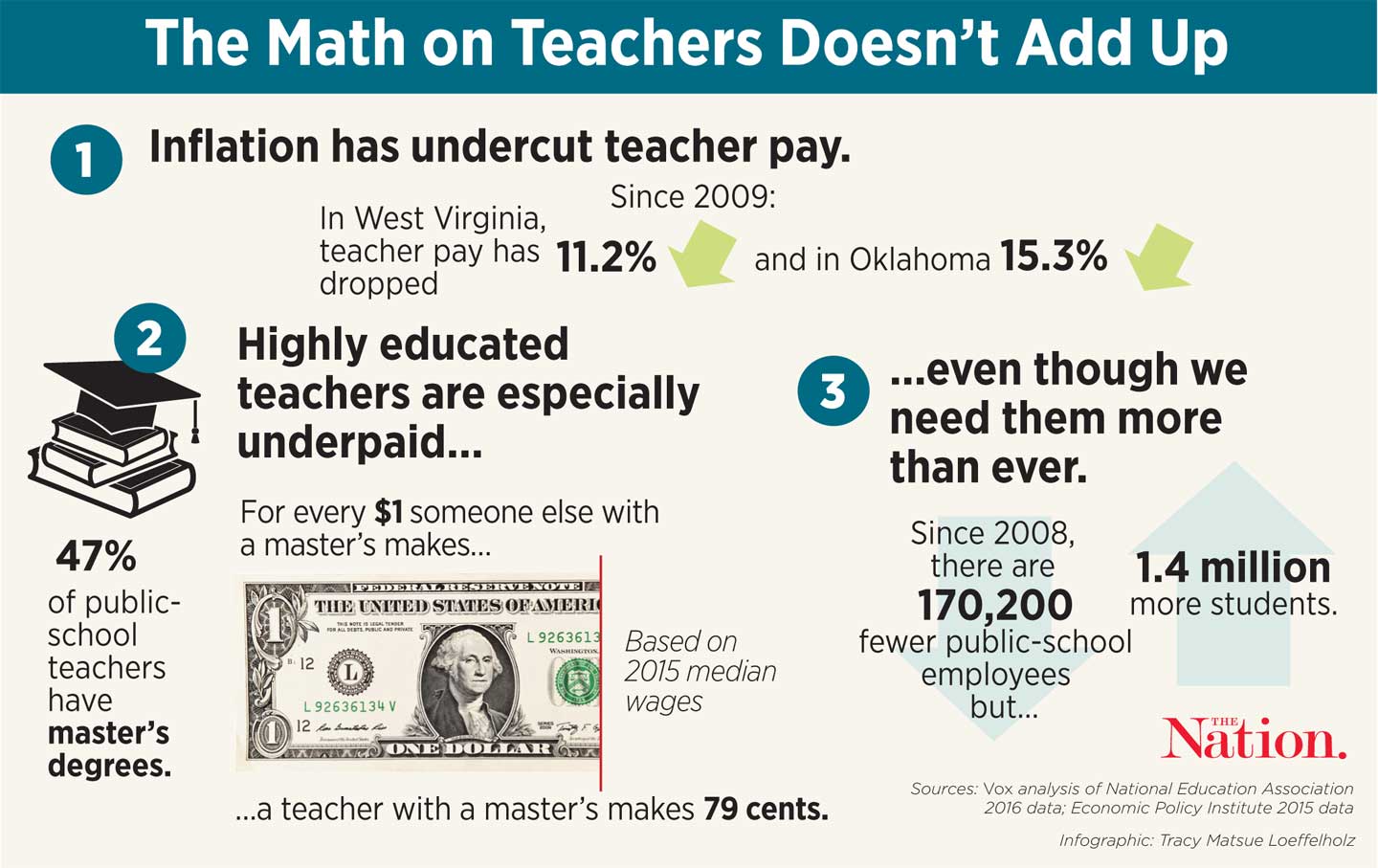
Teachers make less even than workers with similar qualifications.

Teachers have faced stifled wages and pay freezes for years. And a recent report from the Economic Policy Institute, a left-leaning organization, found that Continue reading: Teacher Pay: What Teachers Want Americans to Understand | Money
Image result for Teacher Pay


LADY LIBERTY: Why is Murphy covering up Christie’s $10 million loan to failing charter school? |

LADY LIBERTY: Why is Murphy covering up Christie’s $10 million loan to failing charter school? |

LADY LIBERTY: Why is Murphy covering up Christie’s $10 million loan to failing charter school?


The New Jersey state education department has refused to release public documents that might  shed light on former Gov. Chris Christie’s loan of $10 million in state funds to a failing Newark charter school and its partner, a private, for-profit real estate developer that was receiving more than $800,000 in public funds as annual rent from the school.
The state’s  action, in response to a demand filed under the Open Public Records Act (OPRA), contributes to a stifling veil of silence covering up the details of the unusual $10 million loan—a loan granted by the New Jersey Economic Development Authority (NJEDA) despite the lack of any collateral that could be used to repay the loan if the school defaulted.
The school, Lady Liberty Academy Charter School, did close and no longer receives the state aid it needs  to pay its rent to the developer, BWP School Partners, LLC.  Under the unusual terms of the loan agreement between the NJEDA and BWP,  the state has limited its ability to recoup the loan from the developer  to finding a new charter school to take the place of Lady Liberty. The school is now boarded up and so, this year at least, that won’t happen.
The existence of the unusual $10 million loan was first disclosed by this site last month but the continued refusal by the NJEDA, the state education department, the Newark school district and private sources to discuss details has added to the mystery of why the state would loan $10 million to a charter school that faced problems since 2003, when it was opened as part of Newark’s New Community Corporation’s social outreach efforts. Lady Liberty was placed on probation by the state three times and finally closed this year after  Christie left office.
So that’s the first question that no one at the  state or elsewhere wants to answer:
Why would the NJEDA invest $10 million in a school that its state Continue reading: LADY LIBERTY: Why is Murphy covering up Christie’s $10 million loan to failing charter school?


Education Research Report:Quality Counts 2018: Grading the States

Education Research Report: Quality Counts

Quality Counts 2018: Grading the States

Image result for Quality Counts


First Installment:

Quality Counts 2018: Grading the States

Quality Counts 2018: Grading the StatesThis 22nd edition of Quality Counts, an annual state-by-state assessment of public education, paints a portrait of middling performance overall with patches of high achievement, along with perennial struggles to improve on the part of states mired at the bottom. This is the first of three data-driven Quality Countspackages this year exploring distinct aspects of the performance of America's public schools.

Second Installment:

Quality Counts 2018: School Finance

Education Week puts the nation's K-12 finance performance under the microscope in this second installment of Quality Counts 2018, looking at how much gets spent state by state, and how fairly it's divvied up.

Third Installment:

Quality Counts 2018: K-12 Achievement and Chance for Success

The third and final installment of Quality Counts 2018 digs deeply into the data behind how states rank on academic achievement and on students' chance for success in a complex, ever-changing society.

From the report:

Education Research Report: Quality Counts

Big Education Ape: NPE and Schott Issue a 50 State Report Card on School Privatization - Network For Public Education - https://bigeducationape.blogspot.com/2018/06/npe-and-schott-issue-50-state-report.html


Does Teacher Diversity Matter for Students’ Learning? - The New York Times

Does Teacher Diversity Matter for Students’ Learning? - The New York Times
Does Teacher Diversity Matter for Students’ Learning?
Research shows that students, especially boys, benefit when teachers share their race or gender. Yet most teachers are white women.


As students have returned to school, they have been greeted by teachers who, more likely than not, are white women. That means many students will be continuing to see teachers who are a different gender than they are, and a different skin color.
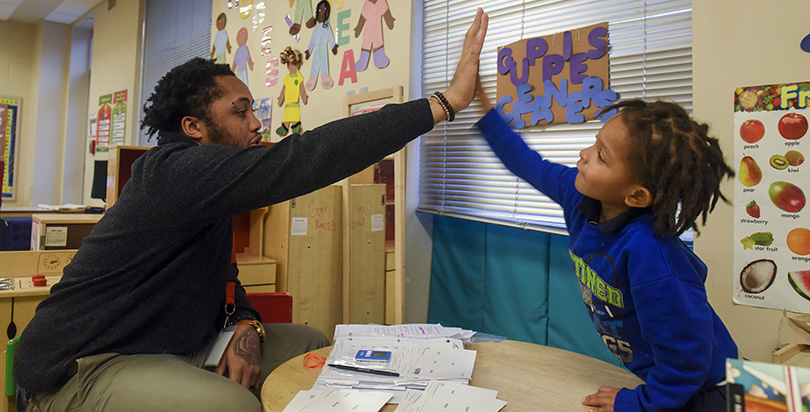
Does it matter? Yes, according to a significant body of research: Students tend to benefit from having teachers who look like them, especially nonwhite students.
The homogeneity of teachers is probably one of the contributors, the research suggests, to the stubborn gender and race gaps in student achievement: Over all, girls outperform boys (with an exception in math in certain districts), and white students outperform those who are black and Hispanic.

Yet the teacher work force is becoming more female: 77 percent of teachers in public and private elementary and high schools are women, up from 71 percent three decades ago. The teaching force has grown more racially diverse in that period, but it’s still 80 percent white, down from 87 percent.

There are many things that contribute to children’s academic achievement, including teachers’ experience and training; school funding and zoning; and families’ incomes and home environment. But studies have shown that teacher diversity can also make a difference in students’ performance and their interest in school.

It’s particularly true for boys, and black boys. Research has found that they are more affected than girls by disadvantages, like poverty and racism, and by positive influences, like high-quality schools and role models. Yet they are least likely to have had a teacher that looks like them.
Image result for Teacher Diversity
“We find that the effect is really driven by boys,” said Seth Gershenson, an economist studying education policy at American University. “In the elementary school setting, for black children and especially Continue reading: Does Teacher Diversity Matter for Students’ Learning? - The New York Times