Latest News and Comment from Education

Wednesday, June 1, 2016

Gates Foundation Apologizes Once Again for “Learning Organization” Missteps

Gates Foundation Apologizes Once Again for “Learning Organization” Missteps | Non Profit News For Nonprofit Organizations | Nonprofit Quarterly:
Gates Foundation Apologizes Once Again for “Learning Organization” Missteps


Sue Desmond-Hellmann, marking two years as the CEO of the Bill and Melinda Gates Foundation (BMGF), recently posted her vision of the kind of organization its founders wished the Foundation to become: “From the beginning, Bill and Melinda wanted their foundation to be a learning organization; one that evolves and course corrects based on evidence. We want to get continually smarter.” In one of their areas of major interest and investment, education, they seem to be widely missing this mark.
Desmond-Hellman asks, “What if all children—especially the poorest—had an equal opportunity to reach their full potential?” The Gates Foundation’s answer to this important question lies in in the failures of public education; for them, it’s the root cause of our growing societal inequity.
The Gates Foundation’s leadership believes firmly “that education is a bridge to opportunity in America.” In 2009, Bill Gates wrote:
Within the United States, there is a big gap between people who get the chance to make the most of their talents and those who don’t. Melinda and I believe that providing everyone with a great education is the key to closing this gap. If your parents are poor, you need a good education in order to have the equal opportunity that our founders promoted for every citizen.
The huge resources of the BMGF have been marshaled in support of a series of initiatives that ignore other possible reasons for our societal inequity as they seek to radically change how we teach our children and provide public education. Billions of dollars later, their results are marginal.
After more than five years of foundation support, in 2009, Bill Gates reported on the failure of their investment in “small schools”: “Many of the small schools that we invested in did not improve students’ achievement in any significant way.” The foundation’s lessons learned from this experience did not result in any questioning of their core belief that the answer to building a more equitable society would be found within our public schools. They just shifted their focus to increasing the number of charter schools, creating test-based teacher evaluation systems, improving school and student data management, and setting universal standards through the common core curriculum. Each has struggled, and none appear to have been effective.
In 2014, the BMGF supported InBloom, an effort to create a national educational data management system, shut down after parents protested the collection and storage in the cloud of data on their children. Various states withdrew their support, and NPQ reported last September on the failure of one of these Gates-funded initiatives, Empowering Effective Teachers.
Desmond-Hellman has led the foundation as it has invested heavily in the effort to create a national set of learning standards, the Common Core Curriculum. Despite over $300 million in foundation funding, alliances with other large foundations, and strong support from the U.S. Department of Education, the effort has drawn bitter opposition and decreasing support. The strong push that the DoE gave states to implement the Common Core was seen as an unwanted intrusion of federal power into local schools. The use of Gates Foundation Apologizes Once Again for “Learning Organization” Missteps | Non Profit News For Nonprofit Organizations | Nonprofit Quarterly:


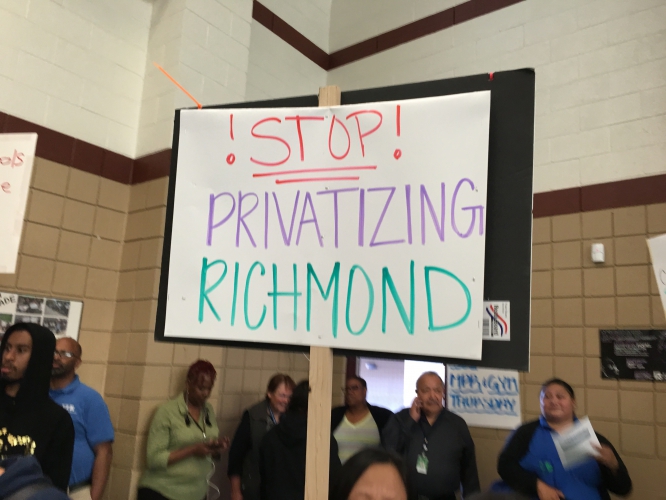
"Power Couple" Are Out To Make A Killing On Charters & Privatization of California Education.

"Doing Good" In California After Helping To Blow Up The World Economy? Beller & Moses : Indybay:

"Doing Good" In California After Helping To Blow Up The World Economy? 

sm_utr_stop_privatizing.jpg original image (4032x3024)


"Power Couple" Beller and Moses Who Helped Bust The World Economy In 2008 Are Out To Make A Killing On Charters & Privatization of California Education. Their Caliber Charter Chain wants land in Richmond to build a non-union school and stick the taxpayers with the costs of privatization


"Doing Good" In California After Helping To Blow Up The World Economy? 
"Power Couple" Beller and Moses Who Helped Bust The World Economy In 2008 Are Out To Make A Killing On Charters & Privatization of California Education 
by Steve Zeltzer 
KPFA WorkWeek Radio 
5/31/16 

Some of the same people who helped wreck the world economy in 2008 are now in California using the deregulation of education, charters and testing scams to make a killing in California public education. 

They are also running up against angry parents, teachers and advocates of public education in Richmond, California 

Ron E Beller, his wife Jennifer Moses and Scott Mead were leading stars as speculative traders at Goldman Sachs in London in the 1980's before the collapse. They left Goldman Sachs in 2001 to set up their own hedge fund which was called Peloton and a it was run by Beller , Moses and Scott Mead 

Peloton initially made huge profits from the subprime mortgage debacle in the US. Peloton's top manager described proudly how it had gambled on a "'world coming to an end' trade that debt linked to subprime loans would tumble and higher quality securities would rise". 
As a result the firm's ABS investment fund rose 87 percent in 2007. EuroHedge magazine awarded the fund best new fixed-income fund. Now, despite investing in high quality mortgages, it's worthless. 

Beller and Moses early claim to notoriety in the UK was a secretary at Peloton who stole millions of dollars that he and his wife did not know was missing. "Not all Goldmanites avoid the headlines. An abiding tale of the boom years is how three London executives, Jennifer Moses and her husband, Ron Beller, and Scott Mead, had so much cash they did not notice when an assistant, Joyti De-Laurey, stole more than £4m from their accounts." 

In the case it also came out that Ron and Jennifer had spent £500,000 on her 40th birthday weekend in Italy. According to trial records, Mrs. Moses took trips with personal shoppers around Bergdorf Goodman, a high end exclusive department store in New York. Two house keepers and a firm of landscape gardeners looked after their home outside New York as they spent most of their time in London. 

Political Aspirations 

Jennifer Moses also had big political aspirations. She had become an education advisor to UK Labor Party Prime Minister Gordon Brown. Her job was to “fix” the crisis in the British school system with US capitalist enterprise schemes and enterprise social policies. She was one of the US Clintonite neo-liberals who wanted to give “tough love” to the poor and children. According to reports she was even so hardliner in cutting benefits that even labor party leader Tony Blair was put off according to reports. According to one of her supporters, Moses took a “strictly pragmatic view of education supporting city academies and private money in the state education” which was opposed by many Labour MPs. "Her view is very American," says one leading Lib-Dem who knows her. "It is that if you can solve a problem with private money, just get on with it. It would have shaken up the brethren around Gordonif she had joined the team." As an American with, according to colleagues, a "formidable intellect", it is understood the Prime Minister was convinced Moses, a libertarian with a social conscience, was the woman to help "get things done" and show that he was not relying on a what new rightwing Labour party officials called “old” labour. 
She and her husband were also supporters of the private charter school in the UK called the ARK schools. ARK advertises itself as an American and British educational charity sponsored and run by a group of millionaire merchant bankers and currency speculators. According to the UK National Teachers of Union NUT although it adverstises itself as an operator of ‘non-selective inner city schools.' it is not. 
“ARK,advertises itss a specialism in maths. It has been revealed that one proposal considered by ARK is to develop a maths curriculum and sell it "Doing Good" In California After Helping To Blow Up The World Economy? Beller & Moses : Indybay:

4 Better Ways to Allocate Federal Funding for Poor Children | US News

4 Better Ways to Allocate Federal Funding for Poor Children | US News:

Is There a Better Way to Allocate Federal Funding for Poor Children?

The Title I formula has proven near impossible to change.


After a monthslong investigation into federal education funding, U.S. News concluded that much of the $14.5 billion meant to provide poor children with an education comparable to rich children's is in fact flowing to school districts with lower-than-average poverty rates.
The why has to do with a complicated formula based on sometimes outdated data that inflates money going to school districts in small states, large school districts and localities that can devote more money to K-12 education. Read more in our investigation: Rich School Districts Get Millions in Federal Money Meant for Poor Kids.
In education policy circles, the formula's shortcomings are common knowledge, and have been the subject of much discussion.


The Alliance for Excellent Education has explored how to better address the needs of high school students with Title I (funds are often prioritized for elementary or middle school instead). The Brookings Institution has looked at how funds are spent, saying simply that the program "doesn't work."
Some have also proposed new formulas. The Center of American Progress has run analyses of a formula it says "is much better than the current formulas at targeting Title I dollars to settings of concentrations of poverty." An analysis from Nora Gordon published by The Hamilton Project called for Congress to remove state-level spending per pupil from the formula, to eliminate two of the four sub-formulas used to calculate a school's funding, and to raise the minimum requirement to receive funds from a 2 percent poverty rate (or 10 poor children) to a 5 percent poverty rate. Gordon, an associate professor at the McCourt School of Public Policy at Georgetown University, has provided her data to U.S. News.
Despite the clear problems with the formula and the available options for change, Congress has dragged its feet on an overhaul. This won't come as a surprise given recent criticisms of the "do-nothing" Congress that suffered from low productivity rates and low approval ratings. But the problem actually spans decades.
While the fight for forumla change has founds some advocates, they've found it impossible4 Better Ways to Allocate Federal Funding for Poor Children | US News: 

Tuesday, May 31, 2016

'Everyone's Job to Help': Addressing Student Poverty Beyond the Schoolhouse

'Everyone's Job to Help': Addressing Student Poverty Beyond the Schoolhouse:

‘Everyone’s Job to Help’: Addressing Student Poverty Beyond the Schoolhouse

student poverty

Conversations around student poverty took center stage last week in Washington, D.C. when leading experts gathered at a symposium, hosted by the National Education Association, to examine poverty’s effects on child development, promising practices, and policy recommendations beyond the schoolhouse.
The statistics on child poverty are alarming: 15.5 million U.S. children live in poverty, one in five children receive food stamp assistance, and more than 50 percent of public school students qualify for free or reduced-price lunches.
“Poverty is a tragedy,” said NEA President Lily Eskelsen García during her keynote, “…and their only hope is what they find in that public school,” referring to schools that integrate academics with community services, such as health and social services, youth and community development, and community engagement.
“Why aren’t we making every public school like our best public school?” Why aren’t we improving the community as we improve our public schools? Make the case that every public school should look like the best public school,” Eskelsen García said.

Policies Working Together

Three different panels led the day’s conversation, which ranged from poverty’s effect on brain development and how some early returns have found structural differences in the brains of children to dispelling the myths and negative perceptions of poor people. The narrative of “black and brown kids don’t care about their education” must change, said Zakiyah Ansari, advocacy director of the New York State Alliance for Quality Education. “It’s a narrative we’re pushing back on.”
While educators were on hand to discuss the disconnect between policy and 'Everyone's Job to Help': Addressing Student Poverty Beyond the Schoolhouse:

AVERAGE DAILY ATTENDANCE (ADA)- THE ENGINE DRIVING FAILURE AND FRAUD AT LAUSD AND ELSEWHERE AROUND THE COUNTRY

AVERAGE DAILY ATTENDANCE (ADA)- THE ENGINE DRIVING FAILURE AND FRAUD AT

AVERAGE DAILY ATTENDANCE (ADA)- THE ENGINE DRIVING FAILURE AND FRAUD AT LAUSD AND ELSEWHERE AROUND THE COUNTRY

ADA.png


(Mensaje se repite en Español)

If you sat down and tried to think of the worst possible system for funding public education, I don't think you could come up with anything worse or more problematic than Average Daily Attendance (ADA), which is a public school funding model exclusively based on how many warm butts there are in public school seats on any given day. So why is this system of public school funding so bad? Let me count some of the ways:

For starters, ADA is based on the false assumption that the now old school K-12 grade-level model of public schools is still a fair representation of the abilities of the students in these respective grades. This is clearly not only no longer the case, it hasn't been so for generations, since the majority of Whites with the social capital necessary to hold public school administration accountable abandon inner city public schools to its present inferior and de facto segregated status. What now has existed for a long time is a reality where predominantly minority students without grade-level mastery or competence are socially promoted with their age group grade after grade, whether or not they have mastered prior grade-level standards, which most students have not.

When a school's financial well-being is solely dependant on an ADA model of how many students are in class on any given day, it sets off a predictable sequence of too often illegal events that could be avoided, if the school was not so AVERAGE DAILY ATTENDANCE (ADA)- THE ENGINE DRIVING FAILURE AND FRAUD AT 

How California's Charter Schools Are Failing The Test

How California's Charter Schools Are Failing The Test:
How California’s Charter Schools Are Failing The Test
Charter schools’ overall report cards have not been so stellar.


This story originally appeared in Capital & Main.

Sign up for email alerts from Capital & Main.
When the Great Public Schools Now Initiative, the $490 million blueprint to turn half of Los Angeles’ public school system into charter schools, was first leaked to Los Angeles Times reporter Howard Blume, it triggered an uproar among the city’s education community. The Los Angeles Unified School District already has more charter seats than any school system in the country, though at a lower percentage (about 16 percent) of total enrollment than Oakland’s — which, at roughly 25 percent, is proportionally the state leader. And like Oakland, and many other urban school systems in the U.S., LAUSD is teetering on the brink of bankruptcy.

See More Stories in Capital & Main’s Charter School Series

This comes at a time when charter-supporting philanthropists, led by the Broad, Walton Family and the Bill and Melinda Gates foundations, have been aggressively pushing charter schools across the country under the banner of “parent choice.” The initiative, which originally surfaced with a cover letter signed by Eli Broad and is often referred to as the Broad Plan, argues its case by charging that the country’s “urban school districts are not serving students. This failure is particularly acute for low-income and minority students who are in the greatest need of a quality education.” But contrary to the plan’s claims, the charters’ overall report card has not been so stellar.
According to University of Colorado, Boulder professor Kevin G. Welner and others, charters have been shown to offer no tangible academic advantages over traditional public schools. Welner, who is director of the National Education Policy Center, told Capital & Main, “If we’re talking about test scores, we’re not seeing any real meaningful differences between charter schools as a whole and noncharter public schools.”
Today there are about 1,230 charter schools statewide (or seven percent of the state’s K-12 enrollment), with 80 new schools opening in the 2015-16 school year alone, 21 of which were in Northern California. The 27 that opened in Los Angeles put it first in the state for growth. The Great Public Schools Now Initiative calls for 260 more charters to be created in the city by 2023. Capital & Main has since How California's Charter Schools Are Failing The Test:

Native Voices Rising: Critical Leadership in Institutional Philanthropy | Schott Foundation for Public Education

Native Voices Rising: Critical Leadership in Institutional Philanthropy | Schott Foundation for Public Education:

Native Voices Rising: Critical Leadership in Institutional Philanthropy

Edgar Villanueva
Earlier this year, I received news that Valorie Johnson, a program officer at the W.K. Kellogg Foundation, was planning to retire. As one of the few Native Americans working at a foundation, I celebrated her many accomplishments in the philanthropic sector. But I also grieved the impending loss of one the few Native influencers in philanthropy.

Why are there so few of us working in philanthropy? Who's addressing the issue? And, most importantly, why is the inclusion of Native voices so critical to effective philanthropic leadership?
A recent article in the Nonprofit Quarterly described philanthropy's disappointing attempts at diversity: "[N]either the numbers in terms of diversity of staffing and governance nor the dynamics of this landscape has changed much since 2008. The pipeline is still not working to move people of color into philanthropy, or to move women and people of color up in hierarchies, as quickly as white men…."
Philanthropy has invested millions of dollars in various initiatives to increase diversity in the field, including the D5 Coalition, a five-year effort to advance diversity, equity, and inclusion in the philanthropic sector. Eighteen affinity groups and organizations, including Native Americans in Philanthropy (NAP), founded the coalition in 2010, and while there has been progress in tracking much-needed data and advocating for increased Native representation in philanthropy, a significant amount of work remains to be done.
It's true that the small number of Native Americans working at foundations is related to the broader barriers to diversity in the field. But I would like to offer a few additional insights for your consideration:
  • When foundations seek to diversify their staffs, they often look to hire talent from the populations that benefit from their funding. Very few foundations focus their giving on Native American populations, so hiring Native staff may not be seen as a priority.
  • Native Americans are still dogged by stereotypes and myths. For example, some of you might be thinking: "Wow! I didn't know Edgar was Native American. Does he live on a reservation?" A foundation leader even confessed to me her fear of hiring Natives because she believed Natives were incapable of getting along with members of other minority groups.
  • Philanthropy is hardly a new concept for Native communities, many of which embrace a culture of reciprocity (as opposed to professionalized giving). As a result, Natives may not seek out foundation jobs. And many Natives prioritize working within our own tribes or communities instead of large, mainstream, and mostly white-led organizations.
  • Institutional philanthropy for the most part is the product of affluent white men, some of whom earned their wealth through business practices and/or policies that were harmful to Native populations. The lasting impact of colonization has resulted in the majority of Native families in the United States living in dire poverty far from the ivory towers of philanthropy.
The ugly cycle of philanthropic divestment has been compounded by the lack of Native representation in the field, which only Native Voices Rising: Critical Leadership in Institutional Philanthropy | Schott Foundation for Public Education:

Ashby vs. Steinberg - Sacramento Magazine - June 2016 - Sacramento, California

Ashby vs. Steinberg - Sacramento Magazine - June 2016 - Sacramento, California:

Ashby vs. Steinberg


Illustrations by Charlie Powell

Darrell Steinberg, with his back to the window, hunched over a latte at Café a Côte on K Street, is tearing a yellow sweetener packet into tiny squares. His fingers move lazily, without obvious intent. Maybe he’s bored. Maybe he’s nervous. Bored is the best guess, because Steinberg is talking about something that should be very familiar to him. He’s talking about himself, about why he wants to become the next mayor of Sacramento, about why people should vote for him.


 “It’s my reach,” he says. “I can connect the dots across a very wide spectrum, statewide, to benefit the city.”

Five blocks away on the fifth floor at City Hall on I Street, Angelique Ashby is preparing for another city council meeting. She studies the agenda and perhaps wonders how she can top her performance from a previous week, when she publicly tore apart a superficially righteous proposal by fellow council member Jay Schenirer—a proposal to let voters fund children’s services by taxing medical marijuana cultivators and manufacturers. With skepticism giving way to sarcasm, Ashby described why the cannabis tax would be a bad deal for children, bad for parents, homeless people, police, taxpayers and the city. One point she didn’t mention is that she, like Steinberg, wants to become Sacramento’s next mayor.
“I fear this will be misconstrued at the ballot box,” she says of the cultivation tax. “It’s pretty easy to say, ‘Do you want to tax marijuana and help kids?’ The answer is easy. It’s simple. ‘Yes.’ But there are a lot of layers to this dialogue that are not being considered, including what else can we use that money for? And who is going to use that money?” She calls the tax “disingenuous.”
Steinberg and Ashby are two professional politicians with histories of public service in Sacramento. But it would be difficult to imagine two more different people in pursuit of the city’s highest office. Sacramento has become accustomed to starkly unique choices for mayor. Eight years ago, Kevin Johnson ran as an outsider. He was a former basketball star who enjoyed celebrity status. And he had a business-friendly background as a real estate investor and charter school organizer. In a runoff election, he trounced Heather Fargo, a two-term incumbent who worked her way up through local Democratic Party ranks as a neighborhood activist.
This year, there is no incumbent. But there are immense distinctions between the two leading candidates. Start with their ages. Steinberg is 56, Ashby 41. Consider their experience. Steinberg held Ashby’s current job as a city council member 24 years ago. He won his first city council election in 1992, when Ashby was a student at Sacramento High School. And consider their personalities, the ethos that will deliver new leadership or squander the opportunities that await Sacramento’s 56th mayor.
Steinberg, endorsed by seven city council members, promises to work in unison with his fellow elected officials. He is patient and methodical and relies on relationships built across three decades of public life. His best moves 

CURMUDGUCATION: Is There a Civil War in Education

CURMUDGUCATION: Is There a Civil War in Education:

Is There a Civil War in Education


I've been following tweets from the big Third Way confabulation in Massachusetts today, and apparently one of the recurring themes is a certain amount pearl clutching over the Civil War between charter and public school advocates. And I had some thoughts...

First, kudos to whatever PR flack came up with that rhetoric, because it's kind of genius. 

Once upon a time, charter operators portrayed themselves as scrappy trendsetters, rebels who were going to Fight The Power and disrupt the hell out of that stodgy old education sector. They were going to fight the status quo.

Well, there comes a time in the life of every rugged scrappy entrepreneur when you put on a suit and instead of settling for scraps, grab yourself a seat at the gown-up table and start enjoying the perks of being rather status quo-y yourself. (This is also a handy perch from which to keep your eye on any other scrappy trendsetters who show up to queer your pitch, because once you are the status quo, protecting the status quo starts to make so much more sense.)

The "Civil War" construct is elegant because it assumes all sorts of things that charter folks would like to assume without actually having to discuss. A Civil War occurs between equals, brothers who have been torn apart by a foolish disagreement and who should really be learning to live in harmony, as equals, with equal claim to all the bounty the status quo provides.

If you can't quite see what I'm getting at, imagine how it would change the conversation is, say, we characterized public education as a beautiful home that had become infested with charter termites. Or public education as a big expansive oak tree, with some branches withering from charter school blight. Or public education a robust, vigorous group of athletic young men and women, some of whom had to be benched because they were combating a charter school tapeworm. Or public 
CURMUDGUCATION: Is There a Civil War in Education:


California: Unbridled Charter Expansion Threatens Public Schools | Diane Ravitch's blog

California: Unbridled Charter Expansion Threatens Public Schools | Diane Ravitch's blog:

California: Unbridled Charter Expansion Threatens Public Schools


Thomas Ultican, teacher of physics and mathematics in San Diego, California, writes about the disastrous impact of charter schools on public schools. According to a study commissioned by the United Teachers of Los Angeles, the district loses $500 million annually to charters.
The charter lobby in the state–led by the California Charter School Association– is wealthy and politically powerful.
Ultican points to Prop 39, passed into law in 2000, as the mechanism that allows privately managed, lightly regulated charters to expand into public space and gobble up resources and the students they want.
“The MGT study illustrates how charter school law in California is fashioned to favor privately operated charter schools over public schools. If a local community passed a bond measure in the 1980’s to build a new public school, it is the law in California that the members of that local community – who still might be paying for that public school – will have no choice but to allow a private operator move into the facility. In addition, the charter school law requires the local school district to incur many direct and indirect costs to support charter schools.
“In California, since its statehood, a super-majority (67%) was required to pass a school bond measure. In 2000, after losing an effort that March to mitigate the super-majority rules and the infamous proposition 13 limitations, supporters brought forward proposition 39 that would reduce school-bond super-majorities to 55% and did not seriously threaten proposition 13 protections enacted in 1978. It passed 53% to 47% in November.
“In the official ballot summary for proposition 39 in the November 7, 2000 election the support message was signed by Lavonne Mcbroom, President California State PTA; Jacqueline N. Antee, AARP State President; and Allan Zaremerg, President California Chamber of Commerce. The statement against the proposition was signed by Jon Coupal, Chairman Save Our Homes Committee, Vote No on Proposition 39, a Project of the Howard Jarvis Taxpayers Association; Dean Andal, Chairman Board of Equalization, State of California; and Felicia Elkinson, Past President Council of Sacramento Senior Organizations.
“This proposition was a battle royal with every media source and elected official bloviating endlessly about the righteousness of their side. However, like in the official ballot measure statements, there was no California: Unbridled Charter Expansion Threatens Public Schools | Diane Ravitch's blog:
 

Jersey Jazzman: Charter Schools and the De-Professionalization of Teaching

Jersey Jazzman: Charter Schools and the De-Professionalization of Teaching:

Charter Schools and the De-Professionalization of Teaching


Hey, New Jersey -- and especially all of you "conservatives": Did you know Chris Christie is using your tax dollars to make what essentially are commercials for charter schools that are linked to a Turkish, Muslim cleric? 


Bergen Arts & Science Charter School and Thomas Edison EnergySmart Charter School, lauded by Christie in this taxpayer-financed video, have both been linked by the Gulen Charter Schools website to the Gulenist movement.

No, this isn't a conspiracy theory: the Gulenist charter school phenomenon has been reported by CBS NewsThe AtlanticThe New York Times, and The Wall St. Journal. These schools, all linked to Fethullah Gulen, have been popping up all over the country and are the subject of concerns expressed by the federal State Department due to their use of H1B visas to admit Turkish nationals into the US.

You'd think that someone in the NJ press would find it notable that Chris Christie, now Donald Trump's transition chair, was using taxpayer funds to promote charter schools tied to a Muslim cleric. But no, that's not news for them -- and neither, apparently, is what I'm going to document below:

Last week, I told the story of Thomas Edison EnergySmart, a school that enrolls far fewer special education and economically disadvantaged students than Franklin Township, its host public school district. Christie sings the charter's praises, even as it drains funds from Franklin's public schools, which educate the kids the Gulen-linked charter does not take in.


Let me quickly show that Bergen A&S is following the same playbook before I get to the heart of the matter. This charter gets most of its students from Garfield, but Hackensack and Lodi are also sending districts. How do these districts compare to the charters in - See more at: http://jerseyjazzman.blogspot.com/2016/05/charter-schools-and-de.html#sthash.9M7ypClU.dpuf

New Education Law: Bipartisan No More | US News

New Education Law: Bipartisan No More | US News:

New Education Law: Bipartisan No More
Republicans are fuming over what they perceive as complete disregard for the intent of the reform law.


Republicans on Capitol Hill and conservative education policymakers are accusing the Obama administration of breaking its promises on education reform, saying recently released federal guidelines for how states and school districts should implement the bipartisan law are overreaching and encroach on local authority.
“The administration has decided that rather than try to find a middle ground or to work in a spirit of cooperation that they are going to push their own policy preferences to the max,” says Michael Petrilli, president of the Thomas B. Fordham Institute, a conservative education think tank. “Many administrations have done the same, but to do this on the heels of a bipartisan compromise, it’s left a bitter taste in a lot of people’s mouths.”
The White House was quick to push back on that assessment.
“This bill is a result of consensus that this law needed to be reformed and refined,” said Cecilia Munoz, assistant to the president and director of the Domestic Policy Council, to a group of reporters Thursday. “We needed to get away from the one-size-fits-all approach, and I’m quite confident that that coalition is not going to break up.”
She continued: “The details matter a lot, but the consensus around what we needed to accomplish, what we in fact accomplished by passing the law and what we believe we are accomplishing with these regulations is quite strong.”
The Education Department released on Thursday a series of proposed regulations to the new education law aimed at providing more specificity for how states and school districts should design their accountability systems. The proposals were met with criticism from GOP lawmakers, who were quick to warn that they were not in line with the foundation of the law – namely to provide more flexibility to states and school districts.
“I am disappointed that the draft regulation seems to include provisions that the Congress considered – and expressly rejected,” said Sen. Lamar Alexander, R-Tenn., a key architect of the law. “If the final regulation does not implement the law the way Congress wrote it, I will introduce a resolution under the Congressional Review Act to overturn it.”
While Alexander’s staff is still going through the 192-page package of regulations, one of the major proposals conservative policymakers have complained about is a tightening of the indicators states and districts are allowed to use – in addition to test scores – to show student success and school quality.New Education Law: Bipartisan No More | US News:

Success Academy Charter Schools Plans to Share Curriculum Online - WSJ

Success Academy Charter Schools Plans to Share Curriculum Online - WSJ:
Success Academy Charter Schools Plans to Share Curriculum Online
Push to present the charter school network as a national model comes after months of increased scrutiny


 Success Academy Charter Schools intends to start posting its lesson plans online this summer, going so far as to specify what type of snail is the best for kindergartners’ science experiments.

Eva Moskowitz, founder of the growing charter network, said she hopes sharing her curriculum and teacher training resources at no charge will help shift the focus of debates on education from politics to the nitty-gritty of what children need to know, how they learn best and how to pace instruction.
“These are all really important questions if America is going to find its way out of the educational quagmire it’s in,” she said in an interview. “It’s not only our disadvantaged students who are suffering terribly. Even our affluent students are not doing so well internationally.”
This push to present Success Academy as a national model comes after months of increased scrutiny of the network, which consistently racks up high scores on state exams, far outpacing city and state averages. Most of its students are poor children of color.
Critics say the organization systemically nudges out the hardest-to-serve students, an accusation Ms. Moskowitz denies. It was sued this year by several families who said their struggling children were harassed into leaving through harsh discipline, excessive suspensions and other means. The network’s oversight body at the State University of New York is also investigating the allegations.
Amid the criticism, the network has garnered support as well, including a $25 million grant in April from the Robertson Foundation to expand its influence. Success Academy was named one of three finalists for the Broad Prize for Public Charter Schools, a national award for charter-management organizations.
Ms. Moskowitz said she has long planned an online trove of literacy lessons, science experiments and math problems that her staff has developed.
Educators around the U.S. often ask for Success Academy’s materials and workshops for teachers and principals, she said. “It made sense, given the volume of requests, to just share it all as soon as we can.”
With 34 schools in New York City, Success Academy aims to have 50 sites in two years and 100 in a decade in the city. Charters are publicly funded and independently operated, and usually aren’t unionized. Opponents say they drain precious money and space from traditional public schools.
Other networks have also sought to fulfill one of the original missions of charters, to innovate and share what works. Uncommon Schools, for example, has released eight books on its methods. The national nonprofit has held free training sessions with host districts, and sells videos and workshops as well.
A frequent critic of Mayor Bill de Blasio and the city’s teachers union, Ms. Moskowitz often presents her network as a refuge for students escaping low-performing public schools and their bureaucracy. The mayor campaigned promising to curb charter schools’ growth and has clashed with Ms. Moskowitz over the city’s obligation toSuccess Academy Charter Schools Plans to Share Curriculum Online - WSJ:

ESSA Regulations: Disappointment or Denial? Guest post by Peggy Robertson | BustED Pencils

ESSA Regulations: Disappointment or Denial? Guest post by Peggy Robertson | BustED Pencils:

ESSA Regulations: Disappointment or Denial? Guest post by Peggy Robertson

regulations


 Back in Denver after 29 days MIA and finally back in the saddle. So it appears during my hiatus they finally released the 192 pages of ESSA regulations.

Damn that ESSA opportunity that just keeps on giving. And the same old players are quoted saying the same old crap while ESSA takes the lead in privatizing public schools and destroying our profession.
Randi Weingarten is supposedly concerned about the proposed regulations. And Fairtest continues to be the “go to” for commentary regarding ESSA. What we need to understand is that the unfortunate result will be the maintaining of the status quo.  They want the public to continue to think something is happening that favors the public—the common good. There ain’t nothing happening!
I was on the War Report radio show during my hiatus in MO and more or less unleashed my wrath on this BS about the opt out glory days, ESSA, and the unions. Hey, I was cooped up in MO for 29 days so it’s probably a good thing I had a minute to explode versus implode. But this is the deal. Opt Out is child’s play – pure child’s play compared to what ESSA has unleashed – not sure you can remember what child’s play looks like these days, but I can assure you it was much easier and carefree compared to where we are headed with the wrath of ESSA .
Now all of a sudden everybody and their mother loves opt out. They f$%&ing love it— for good reason—because they know that opt out alone will be the perfect ploy to distract everyone from the venom ESSA is just dying to spew very very soon. If you put your cards in opt out alone expect to lose and lose fast – ESSA has the royal flush.
So once again, when someone says ESSA is an  “opportunity” know that this person is brainwashed or somehow benefiting from ESSA. Also, when someone is quoted in an article about ESSA and they spew a lot of words that say absolutely nothing. You can come to the same conclusion.
There’s money to be made off of commiserating around ESSA while pretending to support it, not support it, understand it, reason with it, while spitting weak words that pretend to have some sort of fake influence in shaping it to meet the needs of children and our society—there’s a helluva lot of status, money, and ego stroking to be made off of parading those ESSA Regulations: Disappointment or Denial? Guest post by Peggy Robertson | BustED Pencils: