Latest News and Comment from Education

Wednesday, May 13, 2015

Lack of Oversight of Charter Schools Designed as a Plus; $3.3+ Billion Spent (Part 2) | PR Watch

Lack of Oversight of Charter Schools Designed as a Plus; $3.3+ Billion Spent (Part 2) | PR Watch:

Lack of Oversight of Charter Schools Designed as a Plus; $3.3+ Billion Spent (Part 2)


“The waste of taxpayer money—none of us can feel good about,” Education Secretary Arne Duncan told the Appropriations Subcommittee on Labor, Health & Human Services and Education just last month.
Yet, he is calling for a 48% increase in the U.S. Department of Education’s (ED) quarter-billion-dollar-a-year ($253.2 million) program designed to create, expand, and replicate charter schools—an initiative repeatedly criticized by the Office of the Inspector General (OIG) for suspected waste and inadequate financial controls.

New Finding: What ED Doesn't Know About Charter School Spending is Stunning

In late 2014, CMD submitted a total of 33 Freedom of Information Act requests to ED for information about how taxpayer money was being spent and monitored since 2007, covering some of the expenditures under both Republican and Democratic presidencies and congresses.
Only a handful of those FOIA requests have been fully responded to by ED, but those responses shed new light on how widespread the problems are with how charter school money is being managed—or, more accurately, mismanaged and not adequately monitored by federal and state government oversight agencies.
Notably, ED could not provide the public with a current list of all the state authorizers of charters, and it has never published a record of which charter schools received federal tax dollars, because it does not track that information at all, apparently. Its charter school rep urged CMD to contact a private organization, the National Association of Charter School Authorizers (NACSA)—which has no obligation to provide such information—to obtain a list of the authorizers approved to redirect American taxes.
But NACSA is a private association that only oversees around “half of the nation’s 6,000 charter schools.” It has no governmental authority over charter school authorizers in the states that operate largely outside of control by State Education Agencies (SEAs). And many of those “authorizers” in the states would likely say they are not required to disclose details of how federal dollars flow.
Even if all those entities were required to provide the official names of all charter schools ever authorized (and who was legally responsible for each of them), they appear to have no legal requirement to promptly disclose to the public any charters de-authorized or privately sanctioned by them and the reason why. And, the authorizers in states are apparently not obligated to tell the American people how much money each charter school received from federal and state tax dollars or how that money was really spent.

A Recipe for Distaster

Little is known about how tax dollars are spent with the black-box funding for all charters, including:
  • how much tax money each charter received each school year;
  • how much was spent on executive compensation at each charter school;
  • how much was spent on teachers or on salaries relative to experience or credentials;
  • how much money went directly into the classroom; and
  • how much was spent on for-profit contracts (outsourcing accounting, cleaning, or food services etc.)
The bottom line is that no one actually tracks the list list of charter schools that received federal tax dollars to open, expand and/or replicate charter schools, how much they received, or how they spent the people's monies. Each link in the chain can point to someone else who may have parts of that data but who likely has no obligation to publish that information for the public to understand, although what can be gleaned varies by state. That is, there is no systematic public accounting for how the federal budget allocated to charters is actually being spent, and not even a reliable per-pupil/per capita figure. And the devil really is in the details.

What Is Known About How Some Charters Spend U.S. Tax Dollars is Deeply Troubling

What is known about the resource allocation in charter schools vis-à-vis traditional public schools paints a very troubling picture, as demonstrated most starkly by CPD’s report on criminal fraud in charter schools.
However, fraud is just one of the major problems in the lack of adequate controls over how Americans’ taxes are being spent in the charter industry. A 2012 study by the National Center for the Study of Privatization in Education at Columbia University found that charter schools spent “nearly $800 more per pupil per year on administration and $1100 less on instruction.”
Beyond “administration,” how much is being spent converting public money into private assets through purchasing real estate or using Real Estate Investment Trusts (REITs), or in other ways that benefit private parties rather than the students, is not known.
And, money that should be spent on America’s school children is being spent on other “priorities.” CMD obtained a 2014 draft audit of federal charter school money in New York State, for example, that found that “[o]ne subgrantee used funds to represent the school in lawsuit proceedings related to its sister campus.”
These are just a handful of items that go to the heart of basic accountability, beyond educational performance, that the American people should have a right to know.
The reality is that the patchwork system that has been created to allow such a massive influx of cash to be spent ostensibly on educating America’s children is riddled with black holes where Americans’ taxpayers are being unaccountable lost—even short of criminal fraud—and which leaves American school kids shortchanged in the education they need to thrive.
Many of the gaps through which millions have passed unaccountably have been intentional, resulting from ideological opposition to state oversight over charters that operate like private, not public, schools.

New Finding: Lack of Accountability a Boon rather than a Burden

CMD’s review of FOIA responses to date has identified an array of specific serious problems that would cause any responsible policymaker or concerned citizen of any political party to call for a moratorium on any new funding for expanding charters until these problems are genuinely redressed.
In fact, in 2010, following President Obama’s reauthorization of ESEA, ED published a blueprint, pledging that charter schools receiving funding under the CSP program would be held to even higher standards of accountability than traditional public schools.
But this statement is flatly at odds with one of the main criteria used when ED evaluates applications from state departments of education: "flexibility offered by state law." As CMD's review of grant documents shows, this rubric actually awards states that exempt schools and authorizers from state law. Case in point: when Indiana applied for a charter school grant in 2010, one reviewer gave it the highest score on that rubric precisely because the state does not hold charter schools accountable:
"Strengths: The applicant described the administrative relationship between the charter schools and authorizers in which schools are held accountable solely by their authorizer per Indiana state law. [Score] 30/30"
Thanks in no small part to the no-accountability bona fides, Indiana was awarded a $10,852,838 grant.
This is the second installment in a CMD special report on waste and lack of accountability in the quarter-million-a-year federal chart schools program. You can read the full report here.
- See more at: http://www.prwatch.org/news/2015/05/12831/feds-spent-33-billion-charter-schools-few-controls-part-2#sthash.f3xhtfRz.dpuf

Does High-Stakes Testing & Accountability= Social Justice & Civil Rights? | Cloaking Inequity

Does High-Stakes Testing & Accountability= Social Justice & Civil Rights? | Cloaking Inequity:

Does High-Stakes Testing & Accountability= Social Justice & Civil Rights?

Screen Shot 2015-05-13 at 11.26.05 AM
Last week I had the opportunity to give the Social Justice Keynote for The California Association of Latino Superintendents and Administrators (CALSA) at the University of San Diego for their Sixth Annual Research to Practice Academic Conclave on May 8, 2015. CALSA is:
A community of diverse educational leaders skilled in addressing the needs of Latino/a students and dedicated to increasing the number of highly effective Latino/a administrators.
Screen Shot 2015-05-13 at 11.02.29 AM
Here is the transcription of the lecture focusing on high-stakes testing and local accountability:
I have the unenviable position of being your after lunch speaker.
Looks like that gentleman in the back is already ready for his afternoon nap.
First, I want to thank each and everyone one of you for dedicating your life to our state’s children.
Second I’d like to invite you to tweet quotes and photos at me during this talk to @ProfessorJVH.
Third, this new lecture represents the advancement, evolution, and application of my thinking about high-stakes testing.
I’d like to begin thousands of miles on the other side of the planet. That place where we were always trying to dig to as a young child— China.
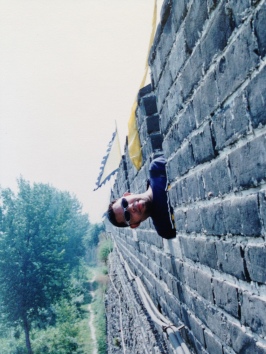
Julian Vasquez Heilig at Great Wall of China in 1996
I have visited China three times, once in each of the past three decades.
What really struck me during the time that I lived in China— and my subsequent visits— was the severe integration of high-stakes testing into Chinese society to sort and stratify.
I recently authored a policy brief with DongMei Li, a Chinese graduate student at the University of Texas at Austin (See After Thousand of Years, #China Changing Mind on #Testing ? #edreform). We wrote that Chinese society has been driven by testing for thousands of years, dating back to ancient times when civil servants and leaders were selected based solely on the imperial service examinations given in the Forbidden City and elsewhere.
While this old exam system was terminated after more than a thousand years in 1906, the high-stakes testing culture persisted— and has played a critical role in selecting “talent” in Chinese society.
Currently, the public school environment in China is testing-oriented because the sole mechanism enabling college access for the vast majority of high school students is the national higher education entrance examination.
Also, for many years, entrance into high schools was determined by high school entrance exams. If you scored well, you would attend an academic or vocation school— score poorly and your journey ended with only an 8th grade education.
Thus, high-stakes testing is not a new educational reform. China has used tests to sort their society for more than 1500 years!!
Closer to home, for about 100 years, high-stakes tests have been used to sort and track students in the United States.
Tests were first spurred on by the racist Eugenics movement (See Film Review: Defies Measurement weaves together problematic purposes of ed reform) and also IQ exams that were used to sort soldiers during the world wars.
High-stakes tests were created to sort, they were not created for civil rights and social justice purposes.
However, now that the federal government is requiring and monitoring high-stakes testing, they have 
Does High-Stakes Testing & Accountability= Social Justice & Civil Rights? | Cloaking Inequity:


How Testing is Driving More Oklahoma Teachers, and Other Educators Across the Nation, Out of the Classroom | John Thompson

How Testing is Driving More Oklahoma Teachers, and Other Educators Across the Nation, Out of the Classroom | John Thompson:

How Testing is Driving More Oklahoma Teachers, and Other Educators Across the Nation, Out of the Classroom


KOSU's Emily Wendler reports that Robyn Venable taught for 31 years. She is one of the wave of Oklahoma teachers who are reluctantly leaving the profession. Ms. Venable loved teaching but she is retiring because, "The testing is just ridiculous, the paper work is growing by leaps and bounds. The stuff that you're expected to do just gets added on and added on and added on..."
Wendler cites State Superintendent Joy Hofmeister who says that the state began the school year with a shortage of 1,000 teachers, and despite those efforts, it still ended with 1,000 openings. Hofmeister describes the resulting harm of using substitutes and she also says that 800 classes were canceled because teachers weren't available.
NPR reports that "school administrators have scrambled throughout the year to fill the gaps by utilizing emergency certifications. ... The State Board of Education issued 500 of them this year. Five times more than normal." Moreover, the Oklahoma City Public Schools has hired hundreds of TFA teachers, which is one reason why 36% of the district's teachers are inexperienced, with less than three years under their belts. The OKCPS has also been "recruiting around the nation, in Puerto Rico and Spain because they are having trouble finding teachers here."
Wendler then cites Sand Springs Superintendent Lloyd Snow who links the problem to the No Child Left Behind Act of 2001. NCLB "dumped too much testing on students and has irked many teachers for years." The problems grew worse with the Achieving Classroom Excellence (ACE) law which "spread on even more layers testing and a teacher evaluation system (TLE) that leaves educators feeling unappreciated." Snow concludes, "Now we sit 10-15 years later and where do we find ourselves? Very little progress. A lot of discouraged teachers. A teacher shortage of which I have never seen in my career."
Wendler's NPR report follows the release of the "Listening Tour" report by the reform group Stand for Children. As Nora Habib explained in the Tulsa World, Stand learned that "testing was the issue of greatest concern for teachers." The section of the report on testing began with representative teachers' statements such as,"So much time has been consumed with testing, over testing, to the point kids have lost all motivation for the test that really matters." It closed with the protest,"The whole focus is on testing and not learning... there's no passion for learning."
Stand's findings follow an analysis by the Oklahoma Policy Institute of the testing portion of the new teacher evaluation law (TLE), which the state adopted in order to compete for Arne Duncan's Race to the Top. The OPI's Gene Perry concluded that the test-driven portion of the TLE could be Oklahoma's next big education crisis:
As Oklahoma already struggles with a dire teacher shortage, we can't afford to reduce teachers' morale even more by evaluating their work using an arbitrary and unreliable formula. Test scores may be one piece of evidence used to evaluate educators, but over-reliance on the formula could drive even some of our best teachers away from the profession.
Oklahoma teachers echo the veteran teachers interviewed by the Teachers College Record on why they left the classroom. It reported:
The teachers in this study, who taught prior to and following the enactment of No Child Left Behind, argued that teaching had changed for the worse. The far-reaching accountability measures, which in high-poverty schools often take the form of scripted curricula, lock-step scope and sequence of units, and mandated test preparation that narrows the curriculum, squeezed out all protected institutional space.
Our state's teachers are repulsed by the same dynamics reported by 30,000 teachers polled by the American Federation of Teachers. The survey discovered, "89 percent said they were strongly enthusiastic about teaching when they began their careers but just 15 percent felt the same way today. Most said that drop in enthusiasm has How Testing is Driving More Oklahoma Teachers, and Other Educators Across the Nation, Out of the Classroom | John Thompson:

A parent’s guide to K-12 school success


A parent’s guide to K-12 school success


Stop the Blame Game Over Achievement Gap | Al Jazeera America

Stop the Blame Game Over Achievement Gap | Al Jazeera America:

Stop the blame game over achievement gap

We need to invest in programs that help students learn and succeed, not argue about who's responsible for failure


Debates about the shortcomings of K–12 education in the United States typically focus on identifying who or what is to blame for the achievement gap — the lower standardized test scores and high school graduation rates among students of color and those living in poverty. Often these discussions are not only misguided but also ignore strategies that lead to success in school, even for children who are living in poverty, discouraged by racism and inequality and stressed by family and community dysfunction. We need to learn from and replicate these initiatives instead of blame and shame schools, teachers and communities for gaps in achievement.
Students from low-income and minority backgrounds live with stress that affects individual learning and classroom behavior. For example, a study designed to identify stress in New York schoolchildren after 9/11 found that “the students’ sense of threat or insecurity stemmed not so much from terrorism as from exposure to violence, inadequate housing, sudden family loss, parents with depression or addictions and so forth.”
Similarly, researchers recently screened students at four high-poverty schools in Los Angeles and found that 8 in 10 experienced at least three traumatic stressors — such as shootings, food insecurity and fights in the family — in the previous year. About 40 percent of students reported symptoms that school counselors said required treatment.
Stress bubbles up in schools in emotional reactions ranging from explosive rage to tuned-out depression. One disruptive child can derail an entire classroom. What’s a teacher to do with a whole classroom of stressed children?
Turnaround for Children, a nonprofit that addresses students’ social, emotional and behavioral needs in high-poverty schools, offers two strategies: Connecting high-risk students to the individual help they need and changing the school climate by training educators.
Connecting students to resources is not a radically new idea. It’s key to the community school concept, which links students and families to resources ranging from counseling to in-school dental clinics to help for parents in finding jobs. Despite its successes, this concept has not been widely implemented. The vast majority of children with mental health needs do not get support and services.
Turnaround for Children works with schools in New York City; Newark, New Jersey; and Washington, D.C. In these schools, connection to mental health resources and social services happens quickly, usually within three weeks of initial screening. Getting help quickly allows students turn their attention back to learning.  
At the same time, Turnaround trains teachers and school administrators to recognize stressed and disturbed children and provides educators with the tools to respond to students’ needs. A full-time Turnaround coach helps teachers plan and learn strategies to de-escalate and redirect student misbehavior. This has made schools withTurnaround programs “calmer and more productive, with fewer problem behaviors,” according to the organization’s website.
Arguing about whether poverty and the economic system are more to blame than teachers and the school system only diverts attention from helping students learn and succeed.
Mentoring is another effective strategy. Friends of the Children, a national charity that provides early intervention, stands out among the thousands of mentoring programs because of its successes helping vulnerable kids.
Freddie’s story shows the effectiveness of mentorship. At 6 years old, she lived in a New York City housing project, fought with classmates, dissed her teachers and had trouble focusing in school. Then a mentor from Friends of the Children entered her life. For the next 12 years, mentors spent time with her every week. They supported her through the death of her mother when she was in seventh grade and through graduation, with honors, from the Manhattan Center for Science and Mathematics. She is now a successful student at Syracuse University.
Half of the kids mentored by Friends of the Children have a parent in jail. About 85 percent were born to a teen Stop the Blame Game Over Achievement Gap | Al Jazeera America:

Should teachers be evaluated on how ‘gritty’ their students are? - The Washington Post

Should teachers be evaluated on how ‘gritty’ their students are? - The Washington Post:

Should teachers be evaluated on how ‘gritty’ their students are?


This story has been updated.
A growing number of education policymakers are interested in judging schools and teachers in part on whether they contribute to the growth of children’s character, pointing to research that shows a solid link between success and the strength of traits such as self-
control and resilience.
But now two of the researchers who helped establish that link are sounding a note of caution, arguing in an essay published Wednesday that existing measures of children’s character traits aren’t ­sophisticated enough to be used for decisions that would affect the lives of teachers and students.
“We have a simple scientific recommendation regarding the use of currently available personal quality measures for most forms of accountability: not yet,” the researchers wrote in the journal Educational Researcher.
One of the authors is Angela Lee Duckworth, a University of Pennsylvania researcher who won a 2013 MacArthur “Genius” award after establishing the notion that a student’s success in and after school is correlated to that student’s level of self-control and “grittiness,” or ability to keep working toward long-term goals.
“School districts and state legislators are in some cases so enthusiastic about grit and mind-set that they want to tell people to measure it, to make salaries dependent on it,” Duckworth said in an interview.
Duckworth outlined her view with fellow researcher David Scott Yeager of the University of Texas. Yeager studies how a child’s mind-set — his or her belief in whether abilities are fixed or can be improved — affects outcomes.
Character traits, such as tenacity or emotional intelligence, can be measured accurately enough for research, the professors argue, but not accurately enough to hold schools accountable or evaluating teachers and principals.
For example, student questionnaires are a common way to measure a student’s “non-cognitive skills,” such as persistence and hard work. But there’s a paradox: The lower a school’s standard for any one quality, the more likely a student is to rate him or herself highly. As school standards rise, students are more likely to give themselves low ratings.
“It’s basically a statistical law,” said Yeager, pointing out that on international exams, students in countries with low performance tend to rate themselves highly on measures of conscientiousness. “Anyone who becomes an expert at something becomes better at assessing their flaws in that thing.”
Duckworth, a former middle school teacher, is known for helping to popularize the notion that a student’s success is correlated to that student’s level of self-control and “grittiness,” or ability to keep working toward goals.
Her research has shown that grittier students are more likely to graduate from high school, score higher on SAT and ACT exams and be more physically fit. Grittier students also are less likely to get divorced, and they typically experience fewer career changes.
KIPP charter schools have become known for their approach in this area, called social-emotional learning or character education. But it has become more common around the nation as schools seek ways to improve outcomes, especially for struggling students.
The researchers argue that if schools are judged according to the results of student self-ratings, schools that are worst at teaching social-emotional learning are ­going to appear to be the best and are going to be asked to share their tactics with other schools that are actually doing better. Teacher questionnaires are another measurement tool that shouldn’t be used for judging teachers or students, the researchers say. Teachers’ definitions of “self-control” at one school might be different from the accepted standards at another.
Some researchers assess a child’s traits via a task such as the “marshmallow test,” which measures how long a young child can withstand the temptation of a marshmallow when alone in a room. Such tasks have promise, the researchers said, but they are still too weak to serve as the foundation of Should teachers be evaluated on how ‘gritty’ their students are? - The Washington Post:

Arne Duncan Fouls Out on Common Core

Arne Duncan Common Core:
Arne Duncan Fouls Out on Common Core


The Failure of Coercion in Public Education

Opposition to the Common Core Standards and the tests tied to them is rising, as a recentWall Street Journal article (May 6) underlined. Approval for Common Core is now languishing at a mere 17 percent while disapproval has shot up to 40 percent. The article continues: “This year hundreds of thousands of students across the country are boycotting Common Core aligned state exams, and this so-called opt-out movement has been growing. Preliminary estimates are that between 150,000 and 200,000 students skipped New York state’s mandatory English exams last month, up from the 49,000 in 2014.”
The concept of Common Core standards should not be rejected outright. The positive intention behind them is to set the same high standards across the country in order to inspire both teachers and students to attain higher proficiency. Unfortunately, this undertaking has been corrupted each step of the way.
Excellent teaching is surely an art, requiring not only a love of rationality in general, but the love of a particular field of expertise more specifically, and an ability to communicate clearly. Even more, however, it requires a love of one’s students. Excellent teaching only emerges when all these elements are properly mixed together. Like some magic brew, good teaching percolates up as the result of some unanticipated interaction between teacher, students, and the learning process. It does not lend itself to mechanization, nor can it be coerced. Yet these are exactly the preferred weapons of Secretary of Education Arne Duncan when introducing policies into our public schools.
In launching the Common Core, for example, Duncan did not give inspiring speeches with compelling rationality in favor of the high Common Core standards in order to win the enthusiastic approval of school administrators and teachers across the country. There was no love lost here. Instead, the introduction of the Common Core took the form of blackmail: If states do not adopt the Common Core, they lose out on desperately needed federal funding. Accordingly, 45 states initially signed on, although now many are having second thoughts.
Consistently on a campaign of coercion, Duncan insisted that the Common Core be tied to high-stakes standardized tests that would purportedly measure the students’ mastery of these standards. Teachers’ continued employment and salary would then be largely based on their students’ scores, while students would be held back if they lacked acceptable proficiency.

Consistently on a campaign of coercion, Duncan insisted that the Common Core be tied to high-stakes standardized tests that would purportedly measure the students’ mastery of these standards.

Admittedly, test scores might provide some helpful information about the students’ level of achievement. But basing teachers’ employment and salary on student test scores defies rationality. As Joe Nocera noted inThe New York Times, “Going back to the famous Coleman report in the 1960s, social scientists have contended – and unquestionably proved – that students’ socioeconomic backgrounds vastly outweigh what goes on in the school as factors in determining how much they learn.” Basing teachers’ continued employment on their students’ test scores amounts to blaming the teacher for their students’ poverty and blaming the teachers for their under-funded schools and overcrowded classrooms. But lacking convincing arguments in favor of the significance of test scores, Arne Duncan once again turns to coercion and threatens to withhold funding if schools fail to link teachers’ terms of employment to them.
It is no wonder that Arne Duncan is also aggressively pushing charter schools – they seem to embrace the same perverted educational philosophy as Duncan himself. The New York Times(April 6, 2015), for example, conducted an investigation into New York City charter schools run by Eva Moskowitz – the darling of hedge-fund managers – where students seem to be performing well on standardized tests. But the pedagogic techniques were horrific. Students who performed poorly were publicly humiliated, all students were required to sit with military-style posture, students were routinely bribed with candy and prizes, and the teaching was overwhelmingly aimed at preparing students to take the tests. Not surprisingly, teacher turnover is quite high.
Yet this kind of regimen will not create critically thinking students who draw their own conclusions and who become life-long learners prepared to meet life’s complicated challenges. In fact, there is little evidence that the “skills” students learn in this way will aid them in any way in their academic or vocational pursuits.
While the Wall Street Journal article naively regards these standardized tests as “objective measures” of a student’s performance, no test can claim objectivity. First, the questions selected on the test are a reflection of the values of those who create the test, and this includes their cultural biases as well. Secondly, some of the questions are poorly formulated. One parent who got a glimpse of a test described one of the questions, undoubtedly with some exaggeration, in this way: “Tommy had 5 goldfish; he gave 3 away. How many dogs are in Paris?”
The SAT exam is a good example of the value-based nature of the questions. The exam is notorious for testing students on arcane vocabulary, it incorporates trick questions that can only be deciphered by those who have been trained in SAT test-taking, and the scoring is skewed in the direction of exaggerating the differences among students, when in fact differences are miniscule (The New York Times, May 4, 2015 ). In other words, it deviates from testing the skills that will be relevant to a student’s academic career and life vocation and instead veers in the direction of creating a self-serving appearance that the exam significantly distinguishes among students’ abilities.
With parents gaining increasing awareness that high-stakes testing is not in their child’s interests and choosing to boycott the test instead, Arne Duncan is once again challenged to respond. And like a dullard who keeps repeating the wrong answer, Duncan once again is turning to coercion. According to the Wall Street Journal article, “Mr. Duncan told an education conference in April that if the boycott numbers continue to rise, ‘then we have an obligation to step in.’” This was later clarified to indicate that the Obama administration might “withhold federal funding for districts with test-participation rates below 95%.”
As long as the people in charge of public education are incapable of promoting their policies by means of rational argumentation but resort to tactics of coercion, our schools will continue to be pushed in the wrong direction, unfortunately at the expense of students and teachers. Undoubtedly, politicians will eventually be compelled by the evidence and growing opposition from students, parents and teacher unions to concede that their tactics have failed, just like they have been compelled to concede that the policy of mass incarceration that they have pursued for decades has been a massive failure.
Ann Robertson and Bill Leumer Arne Duncan Common Core:

Seattle Council PTSA supports the Seattle Education Association teacher walk-out, well, sort of | Seattle Education

Seattle Council PTSA supports the Seattle Education Association teacher walk-out, well, sort of | Seattle Education:

Seattle Council PTSA supports the Seattle Education Association teacher walk-out, well, sort of

SCPTSA.logo.white_on_blue

Whereas, these are unprecedented times in Washington state’s history as the State is in contempt of court for failing to comply with the Supreme Court’s orders in the McCleary decision and meet the constitutional mandate of amply funding basic education;
Whereas, the Seattle Education Association (SEA) has called a one day walk out on May 19, 2015 “to strike for one day to protest the state legislature’s failure to fund 1351 and McCleary, it’s attempt to take away our right to bargain over our wages and healthcare, and to insert test scores into our evaluations;”
Whereas, the Seattle Council of Parent, Teachers and Student Associations (SCPTSA) counts teachers as valued and important members and voices of our PTAs and education system.
Whereas, the Seattle Council of Parent Teachers and students holds as its #1 legislative priority “Ample funding of K-12 basic education per the McCleary decision; with increases in revenue orchestrated in a progressive, equitable, and sustainable manner;”
Whereas, SCPTSA is guided by Washington State Parent Teacher Association’s (WSPTA) legislative platform and resolutions:
Whereas, WSPTA Resolution 18.6 states that WSPTA “will not support work stoppages and/or strikes which interrupt or disrupt the educational day;”
Whereas, WSPTA’s #1 legislative priority is: “In the 2015-16 Legislative Biennium, the Washington State PTA shall initiate and / or support legislation / policies that fulfill the promise of ample funding basic education as defined by the legislature in HB 2261 and 2776. Legislation and policies should not divest funding for health and human services, higher education or early learning programs, nor should it simply redistribute existing education funding sources. After years of cuts that have diminished opportunities forSeattle Council PTSA supports the Seattle Education Association teacher walk-out, well, sort of | Seattle Education: 

Stevie Wonder knew: The Real Problem With How People View America’s Inner City Public Education | DCGEducator: Doing The Right Thing

Stevie Wonder knew: The Real Problem With How People View America’s Inner City Public Education | DCGEducator: Doing The Right Thing:

Stevie Wonder knew: The Real Problem With How People View America’s Inner City Public Education


“Wow, new york, just like I pictured it

Skyscrapers and everything

 [Verse 5] Hey hey brother, hey come here slick
Hey you look, you look hip man

Hey you wanna make yourself five bucks man

You look hip

Run this across the street for me right quick
Okay, run this across the street for me

 [Verse 6] What? Huh? I didn’t know!

Put your hands up you punk!

I’m just going across the street

Lay down, shut your mouth

Hell no, what did i do?

Okay, turn around, turn around, put your hands behind your back, let’s go, let’s go….

A jury of your peers having found you guilty, ten years.
What?”

– Living for The City, Stevie Wonder (1973)


I have read more than my share of books, blog posts, essays, social network comments, and tweets about public education. Some of them are by people who have done extensive research on how the history of public education differs from place to place. Unfortunately though, too many are from those who choose to ignore or are ignorant of the wide range of variables that affect both the students and the schools in socioeconomic and ethnically diverse areas regardless of geographic location.

Suburban districts tend to be less diverse than urban. Some are very homogeneous both socioeconomically and ethnically, but most are also more diverse than stereotypes note. If we also add special education needs as a factor, the results are even more uneven.

Most suburban commenters are aware of that, but many also look at other suburban districts through a lens colored based on where they live or grew up. But, since they live in suburban districts, they generally believe they have a better idea of the truths that exist in most suburban districts.

We can say exactly the same about rural districts. Here too there are some consistencies and variations. What happens, for example in “hyphenated” districts made up of two or more rural localities that may or may not be similar to each other?

Let’s face it. The real issues in education revolve around the urban poor. When you take poverty out of the equation when comparing American students to those of other countries taking the PISA exams, we are at the top. For example notes The National Association of Secondary School Principals, when you look at the number of US schools with < 10% of their students receiving free lunch (the poverty factor) the US overall average is 551, and betters #2 Finland by 15 points. When you look at the number of US schools with Stevie Wonder knew: The Real Problem With How People View America’s Inner City Public Education | DCGEducator: Doing The Right Thing:

Kooyenga and Darling’s plan to kill the Milwaukee Public Schools | Larry Miller's Blog: Educate All Students!

Kooyenga and Darling’s plan to kill the Milwaukee Public Schools | Larry Miller's Blog: Educate All Students!:

Kooyenga and Darling’s plan to kill the Milwaukee Public Schools


Jay Bullock 5/13/2015 Blog
It’s out there now, the Republican plan to start peeling off Milwaukee Public Schools and handing them over to private operators. And it’s awful.
Sponsored by suburban Republicans Rep. Dale Kooyega and Sen. Alberta Darling, it is full of bad ideas and presents a possible future for MPS that is bleaker than you can possibly imagine. It’s hard to know where to start, so I’ll start at the beginning.
In January, Kooyenga and Darling released a shiny booklet (pdf) about their plan, called “New Opportunities for Milwaukee.” The book opened with an outright lie, claiming in its opening paragraph that the “War on Poverty” launched by President Johnson in 1964 resulted in “little, if any, progress,” in their words.
A careful study by Columbia University released last year showed that government progams, even though they are constantly under attack by Kooyenga and Darling’s Republican colleagues, “are cutting poverty nearly in half (from 29% to 16%).” They’re just wrong, and it’s hard to take seriously any plan that is premised on a falsehood that bold.
The “new opportunities” that followed in their book represented not opportunities for Milwaukeeans, but rather opportunities for private charter school organizations, anti-union out-of-state corporations, and interior designers. (You think I am joking; I am not.)
So now the suburban pair is circulating a set of “talking points” before releasing the full bill that would implement their schools plan, and it, too, begins with a lie. They write, “The consequences of these failing schools are a significant factor in contributing to Milwaukee’s declining economic and social health.”
It may be difficult to quantitatively measure whatever it is they call the city’s “social health,” and it’s probably equally difficult to prove or disprove the causal relationship between our public schools—several of which are consistently rated among the best in the state—and any specific economic measures. In fact, the research usually suggests that it’s neighborhood quality that has a long-term effect on school achievement, not school achievement affecting neighborhood quality.
But there are pretty clear data out there on Milwaukee’s economy, and it is not, in fact, “declining.” While this city is far from perfect—no one is making that argument, and this city has repeatedly been singled out as among the nation’s worst for African Americans, something city legislators have been talking about for years—the city of Milwaukee is in a period of growth and revitalization.
Milwaukee is growing in population—indeed, downtown, the Third Ward, and Bay View are booming—and in employment, with a recent City Observatory report noting that Milwaukee’s jobs grew faster than those of its suburbs. The city is reclaiming its dead housing stock and revitalizing many neighborhoods in all parts of the city. Private and public investments in infrastructure and construction are literally remaking vast swaths of the city, from Century City to the Menominee Valley to the lakefront.
So, twice the Kooyenga-Darling duo have introduced their plans with questionable, if not completely bogus, premises. It should come as no surprise, then, that the bill itself is full of questionable, if not completely bogus, solutions to the problems facing Milwaukee’s failing schools.
For one, the plan places authority over these schools, dubbed “opportunity schools,” in a single commissioner, appointed by Milwaukee County Executive Chris Abele. Theoretically, Abele could provide some oversight of that person, and to a certain extent that commissioner will have to follow state and federal laws.
But unlike in MPS, there is no democratically-elected governance board; the proposal does not allow the elected Milwaukee County Board any oversight, despite putting the commissioner directly under the county executive (who is elected only once every four years; there are school board—and county board—elections every two years). All power to evaluate and close failing MPS schools lies with this one individual, as does the power to authorize, fund, and monitor the success or failure of these new opportunity schools.
Let me repeat part of that again: A single, unelected, unknown “commissioner” will absolutely have the authority to close public schools operated by the democratically-elected Milwaukee Board of School Directors, confiscate the buildings, material, and students (maybe? see below) within those schools, and turn them over to private, possibly religious, possibly for-profit operators.
The proposal suggests in at least two ways that the problem with failing schools is teachers, though thinking only about teachers is stupidly reductive. Any staff in the schools selected to be closed and handed off can reapply for their jobs, but they have to sign a contract that they will not seek representation by a union. Teachers unions, of course, had their authority gutted by 2011’s Act 10, so I am unsure why Kooyenga and Darling fear unions in their “opportunity schools.”
They also seem to fear fully licensed teachers. The plan allows the commissioner to grant licenses to whoever wants one to teach in these schools. Let’s be clear: the Wisconsin Department of Public Instruction makes no provision for such a thing to happen. The federal law governing schools makes no provision for such a thing to happen.
There are well-established emergency licenses and even alternative certification programs available, sure. But this power, residing in a single individual with, potentially, no expertise or qualification in education, to unilaterally grant licenses to any random person is unprecedented. A quick googling turns up no other program anywhere in the country—even in the “recovery zones” in New Orleans or Detroit on which this program is modeled—that allows a commissioner like this one to license teachers on his own.
And, really, does anyone believe that the problem in these schools is that the teachers there are licensed and represented by the union? If that is the problem, then why are the top schools in the state full of licensed, qualified teachers? Would Kooyenga and Darling have the nerve to walk into MPS’s Reagan or Fernwood Montessori, or for that matter, Brookfield East or Maple Dale in their home districts, and demand they discharge all the licensed teachers in their employ? Of course not.
The plan also makes no mention of students. At this moment, there are five different education sectors in Milwaukee. Students can and do move freely within and among those sectors. The failing students—for, after all, when we talk about failing schools we’re talking about students with poor outcomes in those schools—from the schools targeted for closure by this commissioner are not, as far as I can tell, required to remain in those schools. If I were a cynical man, I’d worry that without safeguards, the operators of these schools, once they’re Kooyenga and Darling’s plan to kill the Milwaukee Public Schools | Larry Miller's Blog: Educate All Students!:

Mike Klonsky's SmallTalk Blog: Rahm's 'fear Detroit' campaign worked. But then there's this...

Mike Klonsky's SmallTalk Blog: Rahm's 'fear Detroit' campaign worked. But then there's this...:

Rahm's 'fear Detroit' campaign worked. But then there's this...


Remember Rahm Emanuel's fear campaign, the one that -- along with $20 million -- helped get him re-elected?

John Kass ridiculed it in the Tribune:

...what if Chuy wins?How long will it take Chicago to become Detroit, as threatened by the Rahmulans? Not the real Detroit, but more like a cinematic post-apocalyptic Detroit. Just imagine Chicagoans dressed as the extras from "The Book of Eli," in a parched wasteland Chicago of the future as promised by the Rahmulan politicos should Rahm not win.
FOX News was all too happy to pick on on David Axelrod's fear campaign associating Chuy with Destroit. Here's John Stossel on March 23rd:

Emanuel’s opponent in the run-off, Garcia, vocally supports the unions and joins them in opposing both pension reform and competition from charter schools at all costs. Garcia also wants a "moratorium on charter schools." But charters are a rare bright spot in the failing city. Chicago is the next Detroit.
Well, they all can relax now. Rahm won the election. There's no Latino mayor sitting on the 5th floor ready to blow up LaSalle St. And the plan to transform Chicago into the Silicon Valley of the Midwest, rather than Motown, is in full swing. You know about Silicon Valley right? Privatization Mecca with white-only gated communities and where even millionaires don't feel rich.


But then, yesterday there's this...Moody's drops Chicago's credit rating to 'junk' (Reuters)

Moody's Investors Service on Tuesday pushed Chicago's credit rating into the "junk" category, potentially triggering $2.2 billion in accelerated debt payment and increasing the fiscal challenges facing the nation's third-largest city...The only big U.S. city with a lower Moody's rating is Detroit, which exited bankruptcy in December.
I guess the city's creditors aren't buying the Rahm as Mike Klonsky's SmallTalk Blog: Rahm's 'fear Detroit' campaign worked. But then there's this...:


Russ on Reading: Chris Christie’s Lessons for School Children

Russ on Reading: Chris Christie’s Lessons for School Children:

Chris Christie’s Lessons for School Children


By definition a leader is “one who shows the way.” Citizens, including school children, look to their leaders for lessons in terms of character, doing the right thing, behavior in public and how to treat those less powerful. Since the moment that he entered office, New Jersey Governor Chris Christie has provided lessons that no parent or teacher would wish on school children. Here is a sampling.

Lesson 1: Be a bully

In a recent Rutgers Eagleton poll, New Jersey residents used the terms bully, arrogant, selfish and aggressive to describe the Governor. Apparently, Chris Christie flunked kindergarten. These are hardly the words one would hope people used to describe a leader and role model for children. The Washington Post, noting that Christie has a video crew follow him around to capture moments in meetings when he bullies a New Jersey citizen so that his bullying reputation can be bolstered by You Tube videos, says simply, “The reason Chris Christie is so good at this is that Chris Christie is actually a bully… He's someone who uses his office to intimidate people and punish or humiliate perceived enemies.”

Bridgegate is, of course, the most famous bullying incident, but bullying tactics have been central to Christie’s leadership style from the beginning. These incidents include stripping a former governor of his police security at public events, taking funding away from a Rutgers professor who had somehow offended him, disinviting a state senator from an event in the man’s own district, stalling another state senator’s judicial appointment and of course, berating citizens at town hall meetings and even chasing one down the boardwalk yelling, “Keep walking, Keep walking.”

It is ironic that the man who signed the Anti-Bullying Act in New Jersey in the wake of the Tyler Clementi suicide, embodies the characteristics of a bully that that legislation was designed to address in and around schools. Here is the definition of bullying in that act:

"Harassment, intimidation or bullying" means any gesture, any written, verbal or physical act, or any electronic communication, whether it be a single incident or a series of incidents, that is reasonably perceived as being motivated either by any actual or perceived characteristic, such as race, color, religion, ancestry, national origin, gender, sexual orientation, gender identity and expression, or a mental, physical or sensory disability, or by any other distinguishing characteristic…
·         [an act] a reasonable person should know, under the circumstances, will have the effect of physically or emotionally harming a student…
·         [an act that] has the effect of insulting or demeaning any student or group of students…
·         [any act that] creates a hostile educational environment

By this or any other definition, Chris Christie shows the school children of New Jersey it is good to be a bully.

Lesson 2. Talk back to your teachers

Teachers are a favorite target of Christie’s bullying. He has been videoed angrily berating teachers on several occasions. New Jersey teachers Marie Corfield and Melissa Tomlinson have both felt the steam of Chris the Bully. Both women, both teachers, both asking the Governor simple questions Russ on Reading: Chris Christie’s Lessons for School Children: