Latest News and Comment from Education

Tuesday, May 9, 2023

THE PROJECT VERITAS DICKS ARE BACK


THE PROJECT VERITAS DICKS ARE BACK

Ah, Project Veritas. The gift that keeps on giving. If you're not familiar, Project Veritas is a right-wing organization that specializes in undercover "stings" that are supposed to expose liberal bias and corruption. Of course, they're mostly just a bunch of nonsense, but every once in a while they manage to hit on something that's actually worth talking about. Case in point: a recent video they released that shows educators in New York discussing their approach to diversity, equity, and inclusion.

Now, I know what you're thinking. "Educators? Diversity? Equity? Inclusion? This sounds like a snoozefest." And normally, you'd be right. But trust me, this video is worth watching. Not because it's some smoking gun that proves that the liberal agenda is taking over our schools (spoiler alert: it's not), but because it's just so damn funny.

First of all, let's talk about the video itself. It's shot in classic Project Veritas style, which means it's grainy, poorly lit, and has that weird "hidden camera" effect where everything looks like it was filmed through a peephole. It's also heavily edited, so you never really get a sense of what the educators are actually saying. But that's not really the point. The point is to create the impression that these educators are up to something nefarious.

So what are they up to? Well, according to Project Veritas, they're trying to indoctrinate children with liberal propaganda. Specifically, they're pushing an agenda of "diversity, equity, and inclusion," which apparently means brainwashing kids into thinking that it's okay to be gay or transgender or whatever. Shocking stuff, I know.

Of course, if you actually watch the video, you'll see that the educators aren't really doing anything wrong. They're just talking about how they try to create a welcoming environment for all students, regardless of their background or identity. They talk about how they try to incorporate diverse perspectives into their curriculum, and how they try to make sure that all students feel valued and respected. It's all pretty basic stuff, really.

But that doesn't stop Project Veritas from trying to spin it into some kind of scandal. They interview a bunch of outraged parents and conservative activists who are convinced that the educators are trying to turn their kids into social justice warriors. They even manage to get a few soundbites from some of the educators themselves, who are understandably defensive about being secretly recorded and edited to make it look like they're doing something wrong.

So what's the takeaway from all of this? Well, for one thing, it's a reminder that you can't always trust what you see on the internet. Just because something looks like a smoking gun doesn't mean it actually is. And for another thing, it's a reminder that the conservative outrage machine is always looking for something to get worked up about. Even if it's just a bunch of educators trying to create a more inclusive learning environment.

But most importantly, it's a reminder that sometimes the best way to deal with nonsense is to just laugh at it. So go ahead and watch the video. Laugh at the ridiculousness of it all. And then go back to your life, secure in the knowledge that the liberal agenda isn't going to brainwash your kids anytime soon. Unless, of course, you count Sesame Street. Those puppets are definitely up to something.

Educators in New York are facing backlash after videos released by Project Veritas showed them discussing their approach to diversity, equity and inclusion. https://www.huffpost.com/entry/project-veritas-long-island-lgbtq-teachers_n_64592f67e4b018d846b86e8c?

Texas mall shooter’s ‘RWDS’ patch linked to far-right extremists | PBS NewsHour https://www.pbs.org/newshour/nation/texas-mall-shooters-rwds-patch-linked-to-far-right-extremists

"Ha! Who knew that calling someone a 'dick' could actually be a compliment in the detective world? Apparently, it comes from the Romani word 'dik', meaning 'to look'. So, the next time someone calls you a dick, just take it as a sign that you have great observation skills. Detective skills, even. Keep on dikking, my friends!"

E. JEAN CARROLL TO TRUMP: YOU DON'T GET AWAY WITH IT THIS TIME


E. JEAN CARROLL TO TRUMP: YOU DON'T GET AWAY WITH IT THIS TIME

The news of the US jury finding President Trump guilty of sexually abusing writer E. Jean Carroll has sent shockwaves through the country. The trial, which has been ongoing for months, has finally come to a close, and the verdict is in: Trump is guilty.

Now, before we get into the nitty-gritty of the trial and the evidence presented, let's take a moment to appreciate the sheer irony of this situation. Here we have a man who has been accused of sexual misconduct by dozens of women, who has been caught on tape bragging about grabbing women "by the pussy," and who has been accused of paying hush money to adult film stars. And yet, he still managed to become the President of the United States. It's almost too perfect.

But let's get back to the trial. E. Jean Carroll, a well-known writer and advice columnist, accused Trump of raping her in a dressing room at a high-end department store in the mid-1990s. Trump denied the allegations, claiming that he had never even met Carroll. However, Carroll had a photograph of herself with Trump from that time period, which seemed to contradict his story.

During the trial, Carroll's lawyers presented other evidence as well, including statements from friends who she had confided in about the alleged rape shortly after it happened. They also pointed out that Trump had a history of making inappropriate comments about women and had been accused of sexual misconduct by numerous other women.

Trump's defense team, on the other hand, tried to discredit Carroll's story by pointing out inconsistencies in her account and suggesting that she was trying to profit from the allegations. They also argued that Trump was immune from lawsuits while serving as President.

In the end, the jury sided with Carroll, finding Trump guilty of sexual abuse. The verdict was met with cheers from those who had been following the trial closely and with outrage from Trump's supporters.

So what does this all mean? Well, for starters, it's a huge blow to Trump's already tarnished reputation. It also sets a precedent for future cases involving sitting Presidents and their immunity from lawsuits. And it sends a message to women everywhere that their voices matter and that they will be heard.

But perhaps the most important takeaway from this trial is that we need to hold our leaders accountable for their actions. We cannot continue to turn a blind eye to sexual misconduct and abuse of power, no matter how powerful the person in question may be.

So let's raise a glass to E. Jean Carroll and all the brave women who have come forward with their stories. Let's continue to fight for justice and equality, and let's never forget that the truth will always come out in the end.

The terms "guilty" and "liable" are often used interchangeably, but they have distinct legal meanings. "Guilty" refers to being responsible for a crime and facing punishment, while "liable" refers to being responsible for something, either legally or financially, such as damages or injuries.

FROM REUTERS: 

In a recent civil lawsuit, former U.S. President Donald Trump was found to have sexually abused magazine writer E. Jean Carroll in the mid-1990s. The nine-member jury in Manhattan federal court awarded Carroll $5 million in compensatory and punitive damages, dealing a legal setback to Trump as he campaigns to retake office in 2024. Although the jury did not find that Trump raped her, the finding of sexual abuse was enough to establish his liability for battery. The jury deliberated for just under three hours before unanimously rejecting Trump's denial that he assaulted Carroll. This verdict serves as a reminder that sexual assault and harassment will not be tolerated, regardless of one's position or status.

Jury finds Trump sexually abused writer E. Jean Carroll, awards her $5 mln https://www.reuters.com/legal/jurors-set-deliberate-civil-rape-case-against-donald-trump-2023-05-09/ 

FROM NPR

 Trump found liable for battery, defamation against E. Jean Carroll : NPR https://www.npr.org/2023/05/09/1174975870/trump-carroll-verdict 


DR PAUL THOMAS VS NYC DEPT. OF ED


DR PAUL THOMAS VS NYC DEPT. OF ED

As a lover of all things hilarious, I couldn't help but chuckle when I heard about the latest initiative in New York City - "New York City Reads". Mayor Adams and Chancellor Banks have come up with a plan to improve literacy rates amongst children in the city, and it involves a heavy dose of the "science of reading" approach. Now, don't get me wrong, I'm all for kids learning how to read. But when I heard about this plan, I couldn't help but think of my old pal Professor Dr. Paul Thomas.

You see, Dr. Thomas has been championing a different approach to reading for years now. He believes that reading should be a joyful, meaningful experience, not just a series of skills to be mastered. And let me tell you, this guy knows what he's talking about. I mean, have you ever seen someone get as excited about books as Dr. Thomas? It's like he's a kid in a candy store, except the candy is knowledge and the store is the library.

So when I heard about "New York City Reads", I couldn't help but compare it to Dr. Thomas's approach. On the one hand, you have Mayor Adams and Chancellor Banks, who seem to think that reading is all about phonics and decoding and sight words. They want to drill these skills into kids' heads until they can read at a certain level, no matter how much they hate it.

On the other hand, you have Dr. Thomas, who believes that reading should be a pleasurable experience that kids want to engage in. He thinks that if you give kids books that they're interested in and let them read at their own pace, they'll naturally develop the skills they need to be successful readers. And you know what? I think he's right.

I mean, think about it - when was the last time you learned something because someone forced you to? Probably not very often. But when you're genuinely interested in something, you'll go out of your way to learn more about it. That's the kind of attitude that Dr. Thomas wants to foster in kids when it comes to reading.

Now, I'm not saying that phonics and decoding and sight words aren't important. Of course they are. But they're not the be-all and end-all of reading. Reading is about so much more than just being able to sound out words on a page. It's about understanding ideas, making connections, and expanding your worldview.

And that's where Dr. Thomas's approach really shines. By focusing on the joy of reading, he's able to get kids excited about books and learning. He's able to show them that reading isn't just a chore to be endured, but a lifelong pursuit that can bring them endless joy and fulfillment.

So while Mayor Adams and Chancellor Banks may have good intentions with their "New York City Reads" plan, I can't help but feel like they're missing the mark. If they really want to improve literacy rates amongst children in the city, they should listen to Dr. Thomas and focus on making reading a fun, engaging experience. Because when it comes down to it, isn't that what learning should be all about?

FOLLOW DR. THOMAS 

Paul Thomas @plthomasEdD

Science of Reading | dr. p.l. (paul) thomas https://radicalscholarship.com/category/science-of-reading/

Oakland Teachers Strike Day 4: Negotiations at a Standstill, but the Picketing Continues!


Oakland Teachers Strike Day 4: Negotiations at a Standstill, but the Picketing Continues!

It's Day 4 of the Oakland teachers strike, and the negotiations between the Oakland School District and its teachers are still at a standstill. The teachers are asking for what are called "common good goals" in their contracts, which revolve around resources for students in need. But it seems like the district is only interested in bargaining over wages and working conditions.

Meanwhile, 3,000 members of the Oakland Education Association are picketing outside schools, asking for better pay, more resources for students, and better working environments. And they're not backing down anytime soon.

The district has offered a historic pay raise totaling around $70 million, which gives teachers up to a 22 percent pay raise and a $5,000 bonus. But the group said it really wants resources for unhoused students, including places for them to stay.

This is all happening just two weeks before summer vacation and impacting almost 35,000 kids. And it's not just the students who are affected. Parents and the entire community of Oakland are feeling the ripple effects of this fight.

The School District's board president Mike Hutchinson said he hopes an agreement is made before the district has to decide to extend the school year or call an early end to it. But it seems like both sides are standing firm in their views.

Teachers are saying the district is bargaining in bad faith, while the District is saying it has given a good offer. It's a classic case of he said, she said. But one thing is for sure: this fight is a domino effect that hits everyone.

The teachers are fighting for what they believe is right, and they're not going to give up until they get it. They're not just fighting for themselves; they're fighting for the students who need those resources and support.

And let's be real, teachers deserve better pay and better working conditions. They're the ones who are shaping the minds of the next generation, and they should be compensated accordingly.

So let's hope that the negotiations start moving forward, and an agreement is made soon. In the meantime, let's support our teachers and show them that we appreciate everything they do for our kids. After all, they're the ones who are shaping the future.

Big Education Ape: NOT QUITE A CIRCLE JERK: OAKLAND STRIKE DAY 3 http://bigeducationape.blogspot.com/2023/05/not-quite-circle-jerk-oakland-strike.html

Big Education Ape: Common Good Demands Take Center Stage in Oakland Teacher Strike Negotiations http://bigeducationape.blogspot.com/2023/05/common-good-demands-take-center-stage.html

Big Education Ape: Oakland Teachers on Strike DAY 2: Fighting for Better Pay and Services, Billionaires Fight for Profitable Charter Schools http://bigeducationape.blogspot.com/2023/05/oakland-teachers-on-strike-day-2.html

Big Education Ape: Oakland Teachers Strike Again, Demand Better Pay and Protection from Billionaires Hellbent on Destroying Public Education! http://bigeducationape.blogspot.com/2023/05/oakland-teachers-strike-again-demand.html


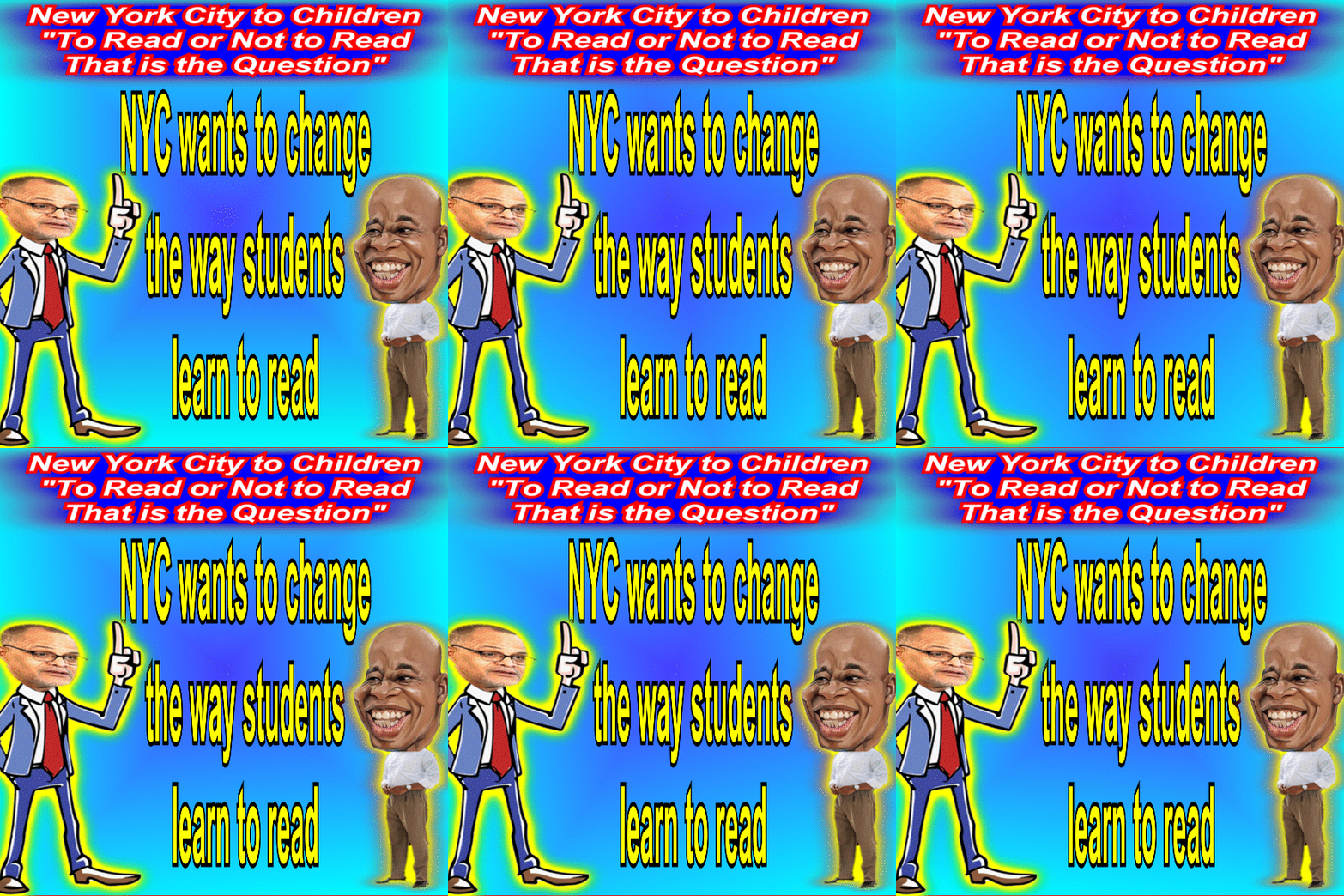
New York City to Children: "To Read or Not to Read, That is the Question"

New York City to Children: "To Read or Not to Read, That is the Question"

New York City is known for many things, but one thing it's not known for is its ability to teach children how to read. According to recent data, half of the children in grades three to eight fail reading tests. That's right, half. It's a staggering number that has left many educators scratching their heads and wondering what they can do to turn the tide.

Enter the city's schools chancellor, who has decided that it's time for a change. He's faulted the current approach and is rolling out new curriculums next year. But will they work? That's the million-dollar question.

Now, I'm no expert on education, but I do know a thing or two about reading. And let me tell you, there's nothing more frustrating than not being able to read. It's like being stuck in a foreign country where no one speaks your language. You feel lost, confused, and utterly helpless.

But here's the thing: learning to read isn't rocket science. It's not like trying to understand quantum physics or deciphering hieroglyphics. It's a skill that can be taught, and it's a skill that should be taught.

So why are so many kids failing? Well, there are a lot of reasons. Some blame the teachers, others blame the parents, and still others blame the kids themselves. But the truth is, it's probably a combination of all three.

Teachers are underpaid, overworked, and often underappreciated. They're expected to be miracle workers, turning out students who can read at a college level by the time they're in third grade. And while some teachers are able to do just that, others struggle to keep their heads above water.

Parents are also part of the equation. Some are too busy working multiple jobs to pay the bills to sit down and read with their kids. Others simply don't value education and don't see the importance of reading. And then there are the parents who are just plain lazy, letting their kids watch TV or play video games instead of cracking open a book.

And let's not forget about the kids themselves. Some are dealing with learning disabilities or other issues that make reading a challenge. Others simply don't have the motivation to learn. And then there are those who are dealing with issues at home, like poverty or abuse, that make it difficult to focus on anything else.

But here's the thing: none of these excuses should be acceptable. Every child deserves the opportunity to learn how to read, and it's up to all of us to make sure that happens.

So what can we do? Well, for starters, we can support our teachers. We can pay them what they're worth, give them the resources they need to succeed, and show them that we appreciate all that they do.

We can also encourage parents to get involved in their child's education. We can provide them with the tools they need to help their kids learn, and we can show them that reading is important.

And finally, we can support our kids. We can show them that learning is fun, that reading is exciting, and that anything is possible if they put their minds to it.

Will these new curriculums work? Who knows. But one thing is for sure: if we all work together, we can make sure that every child in New York City learns how to read. And that's something worth fighting for.

New York City Schools Will Introduce ‘Massive’ Changes to Reading Curriculum - The New York Times https://www.nytimes.com/2023/05/09/nyregion/reading-nyc-schools.html

Monday, May 8, 2023

ELI BROAD: GONE BUT NOT FORGOTTEN


ELI BROAD: GONE BUT NOT FORGOTTEN 

In the world of education, there's one name that strikes fear into the hearts of public school advocates everywhere: Eli Broad. Or, at least, it used to. You see, Eli Broad recently passed away, leaving behind a legacy of charter school promotion and a trail of destruction in his wake. But don't worry, folks - we're here to pick up the pieces and take a deep dive into the Broad Center at Yale.

First things first: what is the Broad Center? Well, it's a training ground for what some have dubbed "Manchurian candidates" - over 900 individuals who have been brainwashed into believing that charter schools are the way to go, and that public education is a thing of the past. These candidates are then unleashed upon school districts across the country, armed with the tools to dismantle public schools and replace them with privately-run charters.

It's a scary thought, but luckily for us, we have a secret weapon: humor. That's right, folks, we're going to take on Eli Broad and his cronies with the power of satire. So sit back, relax, and get ready to laugh (and cry) as we explore the twisted world of charter school promotion.

Let's start with Eli himself. Now, we don't want to speak ill of the dead, but let's be real - this guy was a piece of work. He made his fortune in the world of real estate, and apparently decided that education was his next target. He poured millions of dollars into promoting charter schools, all while ignoring the fact that these schools often cherry-pick their students and leave the most vulnerable behind.

But hey, who needs facts when you've got money? Eli certainly didn't. He was all about that sweet, sweet privatization, baby. And he wasn't afraid to throw his weight around to get what he wanted. In fact, he once threatened to withhold donations to the Los Angeles County Museum of Art if they didn't name a building after him. Talk about ego.

But let's get back to the Broad Center. This place is like a cult, folks. They take these "Manchurian candidates" and put them through a rigorous training program that's designed to turn them into charter school zealots. They learn how to manipulate data to make charters look good, how to spin negative stories in the media, and how to cozy up to politicians in order to get their way.

And it's all for what? So that Eli Broad and his buddies can make a profit off of our kids' education. It's sickening, really. But at least we can laugh about it, right?

So here's a joke for you: why did Eli Broad cross the road? To get to the charter school on the other side! Okay, okay, we know it's not the funniest joke in the world. But it's hard to make jokes about something as serious as the destruction of public education. It's a topic that makes us angry, frustrated, and sad all at once.

But maybe that's why we need humor now more than ever. We need to be able to laugh at the absurdity of it all, to find some levity in a world that can often feel dark and hopeless. And who knows - maybe if we can get enough people laughing, we can start to make some real change.

So here's to you, Eli Broad. May you rest in peace, but may your legacy of charter school promotion be forever mocked and ridiculed. And to all the "Manchurian candidates" out there: we see you, we know what you're up to, and we're not going to let you destroy our public schools without a fight.


NOT QUITE A CIRCLE JERK: OAKLAND STRIKE DAY 3

NOT QUITE A CIRCLE JERK

OAKLAND STRIKE DAY 3 

The Oakland teachers' strike has caused quite a stir, with parents, teachers, and the school board all taking sides. But let's be real, who wouldn't want to support our hardworking educators? They're the ones who spend countless hours molding the minds of our future generations and yet, they're not getting the support they need.

The district officials and union negotiators have been in talks since the strike started on Thursday, but it seems like they're still far apart on some issues. The union is demanding increased resources and policies outside the state-mandated bargaining topics, such as using district property for homeless families, increasing mental health staffing, reparations for Black students, water filtration units for every 300 students, subsidized transportation for all 34,000 students, and a formal role in deciding how to spend state grant money for community schools. 

I mean, come on, these are all common sense demands. It's not like they're asking for a private jet or a yacht. They're asking for basic resources that will help them do their jobs better and improve the lives of their students. And yet, the district officials seem to be dragging their feet on these issues.

The school board president, Mike Hutchinson, said that the board has limited bargaining to required items, including compensation and working conditions. But isn't it in the best interest of everyone to address these common good demands as well? It's not just about a livable wage for teachers; it's about creating a better learning environment for students.

The strike comes at a critical time in the school year, with less than three weeks left and the district's students still struggling with the academic and mental health fallout from the pandemic. But instead of supporting the teachers who are trying to make a difference, the Oakland chapter of the NAACP has condemned the strike. While they support fair compensation for teachers and their right to organize, they're calling on the Oakland Education Association to end the walkout.

I'm sorry, but that's just not good enough. We can't just brush aside the demands of our educators and expect them to continue working under these conditions. It's time for the district officials to step up and do what's right for the students and teachers of Oakland.

In the meantime, the teachers and their supporters will continue to march and picket, demanding the resources and support they need to do their jobs effectively. And we should all be standing with them, because at the end of the day, it's our children's futures that are at stake.

SPECIAL THANKS TO: Voices Against Privatizing Public Education | Facebook https://www.facebook.com/CitizensForEducationRestoration FOR PROVIDING THIS NEWS TIP!!!!!

OUSD strike: School board splits over walkout demands https://www.sfchronicle.com/bayarea/article/ousd-strike-oakland-walkout-demands-teachers-18085750.php?

A LITTLE WOKE HISTORY ABOUT OKLAHOMA GOV. STITT AND SSPI. WALTERS WANT TO HIDE


A LITTLE WOKE HISTORY ABOUT OKLAHOMA GOV. STITT AND SSPI. WALTERS WANT TO HIDE  

As Oklahoma became a state in 1907, it also became subject to the infamous Jim Crow laws. These laws, which enforced racial segregation and discrimination against black Americans, were a reflection of the deeply ingrained racism in the southern states. But what about the Native American population in Oklahoma, many of whom had adopted southern values? How did they fit into this complex and discriminatory system?

To understand this, we need to take a deep dive into history. The Five Civilized Tribes – the Cherokee, Chickasaw, Choctaw, Creek, and Seminole – had been forcibly relocated to Oklahoma from their ancestral lands in the Southeastern United States in the 1830s. Over time, they had adopted many aspects of southern culture, including slavery and plantation agriculture. They even owned black slaves themselves.

When Oklahoma became a state, the Five Civilized Tribes were granted a significant degree of autonomy. However, they were still subject to the same Jim Crow laws as the rest of the state. This created a complex situation where Native Americans who had adopted southern values were both victims and perpetrators of racism.

Fast forward to today, and we see a different kind of discrimination being promoted by Oklahoma's governor Kevin Stitt and State Superintendent of Public Instruction Ryan Walters. They are pushing for policies that would severely limit the teaching of critical race theory in Oklahoma schools.

Critical race theory is an academic framework that examines how racism is embedded in laws, policies, and institutions. It is not about blaming individuals for being racist, but rather about understanding how systemic racism operates. However, Stitt and Walters have framed it as an attack on American values and an attempt to indoctrinate children with Marxist ideology.

So, what is the difference between Jim Crow laws and the anti-critical race theory policies being promoted by Stitt and Walters? Both are attempts to maintain a status quo that benefits those in power. Jim Crow laws were explicitly racist, while anti-critical race theory policies are more subtle. However, both are designed to silence voices that challenge the dominant narrative.

The similarities are also striking. Both Jim Crow laws and anti-critical race theory policies are based on fear – fear of change, fear of losing power, and fear of the other. They both perpetuate a false narrative that America is a meritocracy where everyone has an equal opportunity to succeed. And they both ignore the fact that systemic racism is still very much alive in this country.

In conclusion, the complex history of Native Americans in Oklahoma highlights the insidious nature of racism and discrimination. The Jim Crow laws that were imposed upon them were a reflection of the deeply ingrained racism in the southern states, and the anti-critical race theory policies being promoted by Stitt and Walters are a reflection of the same fear and ignorance. As we move forward, it is important to acknowledge our past and work towards a more equitable future. And if we can do so with a little bit of wit and humor, all the better.

 HERE IS SOME OF THE WOKE HISTORY STITT AND WATERS WANT TO HIDE 

Oklahoma, the land of the red dirt, the Sooner State, where the wind comes sweeping down the plain, and where Jim Crow laws once thrived. Yes, you heard it right. Oklahoma was not immune to the segregationist policies that plagued the South. In fact, the state was a shining example of how to keep the races separate and unequal.

When Oklahoma became a state in 1907, it adopted a constitution that allowed for racial segregation and discrimination. The state legislature passed 18 Jim Crow laws between 1890 and 1957 that enforced separation of the races in education, voting rights, public accommodations, transportation, entertainment, and marriage12. These laws were similar to those in the former Confederate states and were challenged by civil rights activists and organizations.

Between 1890 and 1957, Oklahoma passed 18 Jim Crow laws that reinforced racial segregation in every aspect of life. From education to voting rights, from public accommodations to miscegenation, every area of society was affected by these laws. Let's take a deep dive into some of these laws and see how they shaped Oklahoma's history.

In 1890, Oklahoma passed a law that required an election for school electors to be held every three years. The purpose of this election was to vote for or against separate schools for white and colored children. This law laid the foundation for future segregationist policies in education.

Seven years later, in 1897, Oklahoma passed another education law that established a separate district for colored children wherever there were at least eight black children. It was unlawful for any white child to attend a school for black children (or vice versa). This law effectively segregated schools based on race.

In 1907, Oklahoma became a state and passed a new constitution that mandated separate schools for white and colored children to be provided by the Legislature. This law made segregation in education a constitutional requirement.

But education was not the only area affected by Jim Crow laws. Voting rights were also curtailed by these policies. In 1907, Oklahoma passed a law that excluded indigent persons housed in a poorhouse at public expense from voting. An exception was made for Federal, Confederate, and Spanish American veterans. This law effectively disenfranchised poor people who could not afford to live outside of a poorhouse.

Another voting law passed in 1907 required electors to read and write any section of the state Constitution. This law exempted those who were enfranchised on January 1, 1866, and lineal descendants of such persons. However, it was declared unconstitutional in 1915, but the provision for literacy was upheld.

Segregation in education continued to be a priority for Oklahoma lawmakers. In 1908, a new education law was passed that required public schools within Oklahoma to be operated under a plan of separation between the white and colored races. Teachers who violated the law could be fined between $10 and $50, and their certificate could be cancelled for one year. Corporations that operated schools that did not comply with the law were guilty of a misdemeanor and could be fined between $100 and $500. White students who attended a colored school could be fined between $5 and $20 daily.

The transportation sector was not immune to segregationist policies either. In 1908, Oklahoma passed a law that required all railroad and streetcar companies to provide separate coaches for white and black passengers, "equal in all points of comfort and convenience." Railway companies that violated the law were fined $100 to $1,000. Passengers who failed to comply could be charged with a misdemeanor punishable by a fine from $5 to $25. Conductors could be fined $50 to $500 for failing to enforce the law.

Miscegenation, or interracial marriage, was also outlawed in Oklahoma. In 1908, it became unlawful for a person of African descent to marry any person not of African descent. This law was punishable by a felony that carried a fine of up to $500 and imprisonment from one to five years in the penitentiary.

In 1915, Oklahoma passed a law that required telephone companies to maintain separate booths for white and colored patrons in public accommodations. This law extended segregation to the telecommunications industry.

In 1921, Oklahoma passed a law that prohibited marriage between Indians and Negroes. This law further entrenched racial segregation and discrimination.

The education sector continued to be a battleground for segregationist policies. In 1921, it became a misdemeanor for a teacher to teach white and colored children in the same school. The penalty was cancellation of the teaching certificate without renewal for one year.

Public libraries in cities with a Negro population of 1,000 or more were also affected by segregationist policies. In 1921, it became mandatory to maintain separate accommodations for colored persons in public libraries.

Entertainment was not exempt from segregationist policies either. In 1925, a city ordinance in Oklahoma City prohibited black bands from marching with white bands in parades. Additionally, white Golden Gloves boxers were prohibited from sparring against black boxers.

In 1937, public carriers were required to be segregated. This law extended segregation to public transportation.

In 1949, Oklahoma passed a law that called for a consolidated Negro institution to care for blind, deaf, and orphans. This law effectively segregated healthcare based on race.

In 1954, a law was passed that required separate restrooms in mines. This law extended segregation to the mining industry.

Finally, in 1955, Oklahoma passed a law that prohibited marriage between anyone of African descent and one who is white. The penalty was up to $500 and one to five years imprisonment.

These 18 Jim Crow laws shaped Oklahoma's history and reinforced racial segregation in every aspect of life. While some of these laws have been overturned or declared unconstitutional, their legacy still lingers. It is important to remember these laws and their impact on society so that we can continue to strive for equality and justice for all.

Jim Crow Laws in Oklahoma https://www.oklahoman.com/story/news/2005/02/13/jim-crow-laws-in-oklahoma/61955074007/ via @theoklahoman_

THE SYMBOL OF TEACHERS: THE HISTORY OF APPLES IN SCHOOLS


THE SYMBOL OF TEACHERS THE HISTORY OF APPLES IN SCHOOLS

As you prepare to send your little ones off to school for the first time, you may notice a familiar sight in their classrooms - bright red apples. But have you ever stopped to wonder why this little fruit has become such a ubiquitous symbol of education?

Well, fear not, dear reader, for I have delved deep into the annals of history to uncover the truth behind the apple's association with schools and teachers.

It all started back in the 1700s, when governments around the world weren't exactly throwing money at education. Instead, poor families in Denmark and Sweden would give their children's teachers baskets of apples and potatoes as payment for their services.

Fast forward to America in the 1800s, and things weren't much different for the lower classes. Children were taught by apprentices or by church-funded schools, and families in remote areas would often exchange produce from their farms for lessons. And what was the most popular produce of all? You guessed it - apples.

But it wasn't just any old apple that teachers were receiving as payment. Oh no, these apples were commonly used to make hard apple cider, which was regarded at the time as a safer beverage than water. So not only were teachers getting paid, they were also getting a little buzz on the side.

Of course, times have changed since then. Prohibition put an end to the hard cider trade, and schools are now publicly funded (at least in most parts of the world). But the tradition of giving apples to teachers lives on.

These days, students and parents often give apples as a healthy snack option for hardworking teachers. But let's be real - plain old apples can be a bit boring. So why not upgrade to something a little more exciting, like a caramel apple?

Yes, my friends, the caramel apple is the perfect back-to-school treat. Not only is it delicious, but it also has a long and storied history. And with so many different styles to choose from (chocolate-covered, sprinkled with nuts, drizzled with caramel sauce...the possibilities are endless), your child's teacher is sure to appreciate the extra effort.

So there you have it - the fascinating history of the apple's association with schools and teachers. Who knew that a simple piece of fruit could have such a rich backstory? And who knows - maybe one day, we'll be giving our children's teachers something even more exciting than a caramel apple. Perhaps a basket of avocados, or a bouquet of kale. The possibilities are endless, my friends.

Why Do Teachers Get Apples? A Back-To-School Tradition, Explained | HuffPost Parents https://www.huffpost.com/archive/ca/entry/giving-apples-teachers-explained_ca_5d7180cae4b06d55b970d92b


THE SHOCKLEY EFFECT: REALLY SMART PEOPLE DRIVING IN THE WRONG LANE


THE SHOCKLEY EFFECT: REALLY SMART PEOPLE DRIVING IN THE WRONG LANE

Ah, really smart people. The ones who excel in their respective fields and are often hailed as geniuses. But what happens when they step outside their area of expertise and start commenting on things they know nothing about? Well, let's just say the results can be disastrous. Ignorantly spouting half-truths and alternate facts based on political beliefs and prejudice can do great harm, especially when these statements are repeated by news outlets, politicians, and pundits. Take the case of William Shockley, for example. He may have been a brilliant physicist, but his views on race and intelligence were nothing short of abhorrent. And yet, his misguided theories were given a platform and even influenced public policy. It just goes to show that being really smart in one field doesn't make you an expert on everything else.

William Shockley was a man of many talents. He was a physicist, inventor, and Nobel Prize winner who contributed greatly to modern electronics. However, his legacy is also tainted by his controversial views on eugenics, which have been widely criticized as racist and misguided. In other words, he was a brilliant mind with terrible ideas.

Shockley believed in the idea of eugenics, which is the practice of improving the genetic quality of the human population through selective breeding. He argued that certain races were genetically inferior to others and that people with low IQs should be discouraged from having children. Shockley's views on eugenics were not only controversial but also scientifically flawed. His belief in the genetic superiority of certain races was based on faulty assumptions and biased data. In reality, there is no scientific evidence to support the idea that certain races are genetically superior or inferior to others.

Shockley's views on eugenics highlight the danger of smart people going wrong when they get into someone else's lane. Shockley was a brilliant physicist and inventor, but he was not an expert in genetics or social policy. Yet he felt entitled to make sweeping statements about the genetic quality of entire populations based on his own limited understanding of the field.

This is a common problem among smart people – they often feel that their intelligence and expertise in one area gives them the right to comment on other areas where they have little knowledge or experience. This can lead to disastrous consequences, as we have seen with Shockley's misguided views on eugenics.

The lesson here is that intelligence and expertise are not enough – we also need humility, open-mindedness, and a willingness to learn from others. Smart people need to recognize their own limitations and be willing to defer to experts in other fields. They also need to be aware of the potential dangers of overstepping their bounds and making pronouncements on topics they know little about.

In the case of Shockley, his views on eugenics have rightly been condemned as racist and unscientific. But we should also remember his contributions to modern electronics, which have had a profound impact on our lives. We can appreciate his brilliance as a physicist and inventor, while also acknowledging his flaws as a human being.

In conclusion, William Shockley was a brilliant mind with terrible ideas. His legacy serves as a cautionary tale for all of us – no matter how smart we may be, we must always be willing to learn from others and recognize our own limitations. Let's strive to be more humble, open-minded, and willing to learn from others – and leave the terrible ideas to the history books.

Broken Genius: The Rise and Fall of William Shockley, Creator of the Electronic Age | Physics Today | AIP Publishing https://pubs.aip.org/physicstoday/article/60/2/64/400453/Broken-Genius-The-Rise-and-Fall-of-William


WAR ON WOKE: WHO YOU GONNA CALL - WOKEBUSTERS


WAR ON WOKE: WHO YOU GONNA CALL - WOKEBUSTERS

As the battle for control of American classrooms heats up, conservatives are crying foul over what they see as a left-wing indoctrination of our youth. According to a recent article in New York Magazine, these concerned citizens are convinced that schools are brainwashing kids to be card-carrying members of the Democratic Party.

But is this really the case? Are our schools really a hotbed of liberal propaganda, as conservatives would have us believe? Or are they simply teaching our children the facts, as any good educator should?

The answer, of course, is somewhere in between. While it's true that some teachers may have a political bias, the vast majority of educators are simply trying to give their students the tools they need to succeed in life. And that means teaching them about the world around them, including politics.

But for conservatives, this is simply unacceptable. They see any mention of progressive values as an attempt to brainwash young minds and turn them against their parents' beliefs. And so they've launched a full-scale assault on education, pushing for laws that would ban the teaching of critical race theory and other topics that they deem too "woke."

But here's the thing: banning these topics won't make them go away. If anything, it will only make them more appealing to young people who are naturally curious about the world around them. And it will rob them of the opportunity to engage with these ideas in a safe and supportive environment.

So what's the solution? It's simple, really. We need to trust our educators to do their jobs. We need to give them the resources they need to teach our children about the world around them, including its many complexities and contradictions. And we need to recognize that education is not a political football to be kicked around by politicians and pundits, but a vital tool for shaping the future of our society.

In short, we need to stop worrying about indoctrination and start focusing on education. Because when it comes to preparing our children for the challenges of the 21st century, there's simply no substitute for a good education.

The Republican Takeover of American Education https://nymag.com/intelligencer/article/desantis-florida-trump-education-politics.html?utm_source=tw via @intelligencer

OKLAHOMA ANTI WOKE ACTIVIST SSPI RYAN WALTERS DUMBER THAN STITT

OKLAHOMA ANTI WOKE ACTIVIST SSPI RYAN WALTERS DUMBER THAN STITT

As the debate over critical race theory and woke ideology continues to rage across the country, one state has emerged as a battleground in the fight over education: Oklahoma. At the center of this battle is Ryan Walters, the state's Superintendent of Public Instruction, and his ally, Governor Kevin Stitt. Together, these two men have been pushing an anti-woke, anti-progressive agenda that has sparked controversy and outrage among educators, parents, and activists alike.

So what exactly is this agenda, and why has it caused such a stir? To answer that question, we need to take a deep dive into the world of Oklahoma politics and education.

At its core, the anti-woke movement is about pushing back against what its proponents see as a dangerous and divisive ideology that seeks to undermine traditional values and promote a radical leftist agenda. According to Walters and Stitt, this ideology has infiltrated Oklahoma's schools and is threatening to brainwash young students with its toxic ideas.

To combat this threat, Walters and Stitt have proposed a series of extreme measures that would fundamentally reshape the state's education system. These measures include banning critical race theory from being taught in schools, requiring teachers to undergo ideological screening before being hired, and even allowing parents to sue schools that they believe are promoting woke ideology.

Critics of these proposals argue that they are an attack on academic freedom and free speech. They point out that critical race theory is a legitimate academic discipline that has been studied and debated by scholars for decades, and that banning it from classrooms would be a violation of students' right to a well-rounded education.

They also argue that requiring teachers to undergo ideological screening is a form of political discrimination that could lead to the exclusion of qualified educators simply because they hold different views than those in power. And allowing parents to sue schools over ideological disagreements could lead to a flood of frivolous lawsuits that would drain resources away from actual education.

But for Walters and Stitt, these concerns are simply a smokescreen for the real issue at hand: the need to protect Oklahoma's children from the pernicious influence of woke ideology. They argue that the state has a duty to ensure that students are taught traditional values and American exceptionalism, and that any deviation from this norm is a threat to the country's future.

Of course, not everyone agrees with this view. Many educators and activists see the anti-woke movement as a thinly veiled attempt to silence dissent and promote a narrow, conservative agenda. They argue that students should be exposed to a wide range of ideas and perspectives, even if those ideas are uncomfortable or challenging.

So where does this leave us? As with many political debates, there are no easy answers. But one thing is clear: the battle over education in Oklahoma is far from over. Whether you see the anti-woke movement as a necessary defense against radicalism or a dangerous attack on academic freedom, one thing is certain: the stakes are high, and the outcome will have profound implications for the future of education in America.

Historical and rhetorical: A conversation with Ryan Walters about ‘woke’ https://nondoc.com/2023/05/08/ryan-walters-woke-impromptu-interview/ via @nondocmedia

Sunday, May 7, 2023

ONCE UPON A TIME IN A GALAXY FAR AWAY THERE WAS A PLANET CALLED CITIZENS UNITED


ONCE UPON A TIME IN A GALAXY FAR AWAY THERE WAS A PLANET CALLED  CITIZENS UNITED

Once upon a time, in a galaxy far far away, there was a planet called Citizens United. It was a planet filled with billionaires who had everything they could ever want. They had palaces made of gold, spaceships that could travel at the speed of light, and robots that did their every bidding.

But one day, the billionaires of Citizens United got bored. They had conquered everything on their planet and were looking for a new challenge. So, they set their sights on the planet Earth.

They arrived on Earth in their spaceships and immediately started buying up everything in sight. They bought the government, the media, and even the local Starbucks. They were determined to privatize every public service on Earth.

The people of Earth were shocked and outraged. They had never seen anything like this before. The billionaires of Citizens United were like nothing they had ever encountered. They were ruthless, cunning, and had more money than anyone could ever imagine.

But the people of Earth were not going to take this lying down. They organized protests, rallies, and even started a hashtag on Twitter. They were determined to fight back against the billionaires from Citizens United.

The billionaires of Citizens United were not amused. They saw the people of Earth as nothing more than ants to be crushed under their feet. They sent their robots to break up the protests and silence anyone who dared to speak out against them.

But the people of Earth were not going to be silenced. They fought back with everything they had. They used their creativity, their humor, and their wit to mock the billionaires from Citizens United.

They created memes, videos, and even wrote funny fairy tales about the billionaires from Citizens United. They showed the world that even though the billionaires had all the money in the world, they could never buy the spirit of the people of Earth.

In the end, the billionaires from Citizens United realized that they had underestimated the people of Earth. They realized that money could not buy everything, and that the spirit of the people was stronger than any amount of wealth.

So, they packed up their spaceships and left Earth, never to return again. The people of Earth cheered as they watched the billionaires from Citizens United disappear into the vastness of space.

And so, the people of Earth learned a valuable lesson. They learned that even in the face of overwhelming odds, they could still fight back with humor, wit, and creativity. They learned that the spirit of the people was stronger than any amount of money.

And they lived happily ever after.

Moms for Liberty and John Birch Society join forces to ban books and make the world safe for ignorance!


Moms for Liberty and John Birch Society join forces to ban books and make the world safe for ignorance!

Ladies and gentlemen, we live in a world where some people believe that banning books is a good idea. Yes, you heard that right. Banning books. In 2023. I mean, what's next? Banning oxygen because it's too liberal?

But let's not get ahead of ourselves. The recent trend of right-wing groups pushing for book bans in US public schools is a serious issue. These groups, like Moms for Liberty, are campaigning against teaching sex education, LGBTQ+ rights, and racism in American history. Because why teach kids about the world when you can just keep them in the dark and hope they don't turn out to be decent human beings?

But this isn't a new phenomenon. Book banning efforts in the US can be traced back to the John Birch Society in the 1960s. According to the author of a new book on the Birchers, they were likely the most visible group promoting book bans at the time. And while they may not be the only group promoting these bans today, they certainly seem to be leading the charge.

So, what are their tactics? Well, it seems that branding certain ideas as "pornographic" or "communistic" is a surefire way to mobilize supporters. Because nothing gets people riled up like a good old-fashioned scare tactic. And who needs facts when you have fear?

But let's not forget about the impact of these bans. Book bans in US public schools have increased by 28% in just six months. That's not just a statistic, that's a problem. When we limit what our children can learn, we limit their ability to grow and understand the world around them.

So, what can we do about it? For starters, we can stop treating education like it's a political football. We can stop using scare tactics to push our agenda. And we can start trusting our children to learn and grow in a safe and open environment.

Because at the end of the day, banning books doesn't just limit what our children can learn, it limits what they can become. And that's no laughing matter.

Moms for Liberty, meet John Birch: the roots of US rightwing book bans https://www.theguardian.com/books/2023/may/06/moms-for-liberty-john-birch-society-far-right-book-bans?CMP=share_btn_tw