Strategies to Address Pandemic’s Impact on Student Learning Focus of State Superintendent’s “Pathways to Recovery” Event
SACRAMENTO—State Superintendent of Public Instruction Tony Thurmond invites all California educators to join a special live professional development session hosted by the California Department of Education (CDE) on Thursday—an event designed to explore proven strategies for addressing learning gaps that have widened during the COVID-19 crisis and innovative ways schools can accelerate students’ academic growth as communities recover from the pandemic.
Already, roughly 1,500 educators have registered for the “Pathways to Recovery” virtual event, scheduled for Thursday, January 21, at 4 p.m. Educators, parents, and community members can still register in advance or watch the webinar on the CDE Facebook page.
“There is no question that many underserved students were already starting at a disadvantage when our schools made the shift to remote learning, and this prolonged public health crisis has only worsened those inequities,” Thurmond said. “Our educators have been nothing short of heroic this school year—finding more and more creative ways to engage students amid incredible challenges—and I am proud to continue offering the tools and resources they’re seeking as we work together to help students triumph moving forward.”
The “Pathways to Recovery” webinar will feature researchers and practitioners presenting evidence-based strategies to help students accelerate learning within a distance-learning environment. CDE Chief Deputy Superintendent of Public Instruction Stephanie Gregson, Ed. D, will facilitate the event. Featured speakers include:
Linda Darling-Hammond, renowned education researcher and President of the California State Board of Education, will present research on how to reinvent schools and which strategies have a beneficial impact on student learning.
Anaheim Union High School District Superintendent Michael Matsuda will talk about tutoring/mentoring programs.
Alisal Union School District Superintendent Jim Koenig and Assistant Superintendent of Educational Services Monica Anzo will discuss whole school/district interventions.
Oakland Unified School District Afterschool Programs Coordinator Martha Pena will discuss an expanded learning program.
A comprehensive listing of all past CDE webinars related to COVID-19, including those supporting students and distance learning, can be found on the CDE website.
# # # #
Tony Thurmond — State Superintendent of Public Instruction Communications Division, Room 5602, 916-319-0818, Fax 916-319-0100
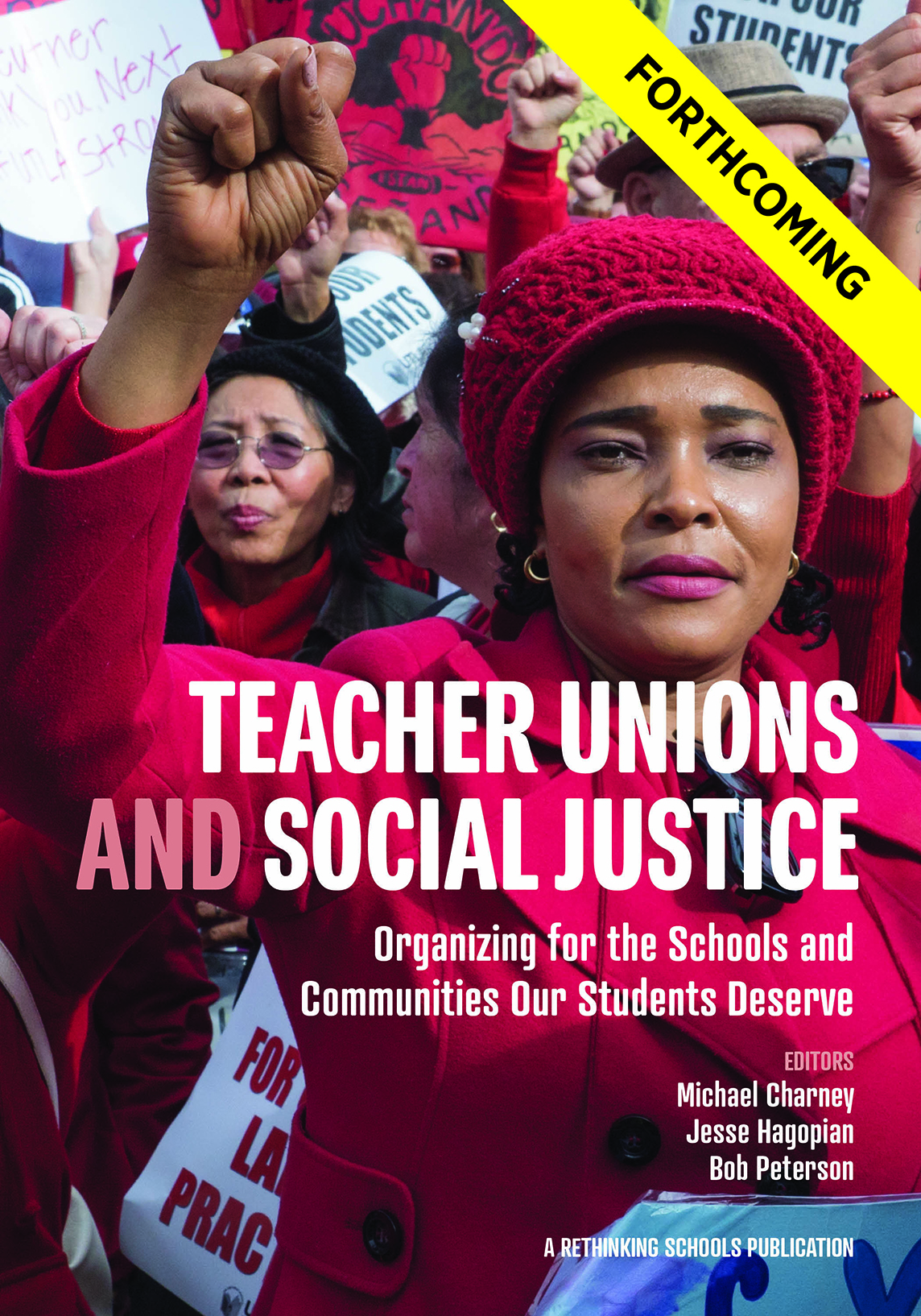
“Teacher Unions and Social Justice”–A New Book To Spur Rebellion From Rethinking Schools, With an Online Book Launch and Discussion January 21 at 6:00 pm – 7:15 pm CST
Register here today for the book launch event. You can order the book here.
When the epic story is told about how we finally built a society on true democracy and uprooted the last vestiges of systemic exploitation and oppression, there will undoubtedly be an important chapter about how organized workers in unions used their power to shut down segments of the economy and joined together with mass social movements in the streets to demand a better world. This is the power of social justice unionism and we desperately need to revive this tradition of struggle if we are going to achieve victories against white supremacy, undo record levels of wealth inequity, and challenge every other form of oppression in our society.
This beautiful new book includes lessons on reorganizing the labor movement and fusing it with social movements from many of the leading practitioners around the country. With historical lessons and first hand accounts from some of the most powerful educator strikes in the country, this book a contribution to arming educators with the understanding of their own power to change the world.
Included in the volume are the stories of how educator union organizers joined with parents and students around the country to build the movement to refuse to take or give high-stakes standardized tests; how union educators took up the struggle for Black lives by founding the Black Lives Matter at School movement; how they launched a strike in Los Angeles that included demands for immigrant rights and an end to the practice of police searching the belongings of mostly Black, Indigenous, and students of color in school; how educators in Chicago joined with parents and community organizers to win an anti racist reparations curriculum that would teach students the history of police torture in the city; how educators in Republican controlled states launched a wave of strikes that brought millions of more dollars to the school system; how educators have fought for and won community schools that provide wrap around services to students; how rank-and-file educators have built union caucuses that have helped to transform their local unions from a business model of unionism into a social justice union; and so much more.
On Thursday, January 21, the book’s editors will be joined by leading social justice union organizers Arlene Inouye and Michelle Gunderson to launch the book–and hopefully a new era of union power in the struggle for schools and society our children deserve (details about the book launch are below).
In solidarity,
Jesse Hagopian
Join Teacher Unions and Social Justice co-editors Jesse Hagopian, Michael Charney, and Bob Peterson along with contributors Michelle Gunderson and Arlene Inouye for the launch of a new Rethinking Schools book on the promise of social justice teacher unionism.
Editors and contributors will participate in a 75-minute conversation about building alliances with the community, the role of bargaining for the common good, the important roles of rank-and-file union caucuses, and how teachers can organize for racial and economic justice in our schools.
Arlene Inouye is UTLA secretary and co-chair of its bargaining team. She has been a speech and language specialist for 18 years in the Los Angeles Unified School District.
Michelle Gunderson is an educator and union activist from Chicago. She serves as a trustee for the Chicago Teachers Union and is the former co-chair of the Caucus of Rank and File Educators.
Bob Peterson is a founding editor of Rethinking Schools, a former president of the Milwaukee Teachers’ Education Association, and currently serves on the Milwaukee Board of School Directors. He is co-editor of several books, including The New Teacher Book, Rethinking Elementary Education, and Rethinking Columbus.
Michael Charney taught social studies in the Cleveland Public Schools for more than 30 years. He served as vice president of the Cleveland Teachers Union, where he led efforts to motivate teachers and paraprofessionals to change their schools.
The event is hosted by Rethinking Schools.
Participants will need access to Zoom. Register for the Zoom link, a free copy of the book’s introduction, and a 20% Rethinking Schools book/magazine discount code. The book is now available for pre-order. The estimated ship date is Feb 1, 2021.
Bishop Dr. William Barber: "We Must Have a Third Reconstruction"
Bishop Dr. William Barber’s homily at the Inaugural Prayer Service this morning was a powerful call to “break the chains of injustice,” to move America toward a Third Reconstruction. He proclaimed love is our salvation—love that must be proven in action.
Barber emphasized Nobel Prize-winning economist Joseph Stiglitz’s admonition: “We should not ask how much will it cost to address inequality, but how much has it cost us not to.” Schott has documented the deep disparities undergirded by systemic racism in our Loving Cities Index — and we know that the human and societal toll of denying opportunity to children of color and their families magnifies even further the egregious economic toll. As Bishop Barber put it this morning, as he called for a Third Reconstruction:
Trump’s 1776 Commission Releases a Literal Whitewash of U.S. History
On the day before the election, Donald Trump signed an executive order establishing a “1776 Commission” to rewrite American history. This commission was intended to refute the New York Times’ 1619 Project, which told the story of American history from the view of African Americans. It was also, allegedly, an answer to “critical race theory,” which you can be sure Trump could not define. I thought this was a bad idea, since history should be written by historians, not by presidential commissions packed with cronies and ideologues.
Para mejorar el rendimiento académico, un diminuto distrito escolar pidió a sus alumnos que volvieran a clases presenciales. También aumentaron los contagios del virus.
A diferencia de muchas comunidades del noreste de Estados Unidos, la mayoría de las familias de esta ciudad han vuelto a enviar a sus hijos a la escuela.
Un distrito escolar suburbano de Atlanta se rehusó a hacer obligatorio el uso de cubrebocas. Después, casi 11.000 personas tuvieron que ponerse en cuarentena este otoño.
Una pequeña localidad en Wisconsin decidió iniciar el año escolar a distancia pero la presión de la comunidad los obligó a abrir las aulas justo cuando los casos de coronavirus aumentaban,
Para evaluar cómo han sorteado la pandemia las escuelas públicas, así como el impacto para los estudiantes, el Times examinó siete distritos representativos. Los resultados fueron sorprendentemente distintos.
Para ayudar a los alumnos que no se conectan a las clases remotas, algunos maestros de una escuela autónoma con altos índices de pobreza en Washington hacen visitas a domicilio.
El segundo distrito escolar más numeroso de Estados Unidos cerró las aulas desde marzo. Las autoridades reconocen que la medida ha afectado más a “los estudiantes que menos tienen”.
Nearly 11,000 people were forced to quarantine this fall in a suburban Atlanta district that didn’t mandate masks, but it stayed the course, until a staffing shortage shut the doors.
At a charter school in a poor area of Washington, some teachers spend one day a week going door to door, tracking down students who aren’t logging on, and whose education is suffering.
While districts around it opened, a small Wisconsin city chose to start the school year remotely. Public pressure forced a return, just as virus cases were surging.
To assess how public schools have navigated the pandemic and the impact on students, The Times examined seven representative districts. The answers were strikingly different.
The nation’s second-largest district has kept classrooms closed since March. The superintendent acknowledges it is “disproportionately hurting students who can least afford it.”


 or watch the webinar on the CDE Facebook page