Tuesday, January 19, 2021

School choice lawsuit surge pushes possible high court fight

School choice lawsuit surge pushes possible high court fight


Vermont is facing at least its second lawsuit in four months over a voucher program that allows students in communities that don't have schools or are not part of supervisory unions to attend schools of their choice, including approved private institutions.

The Vermont system in which certain towns pay tuition for students to attend other schools is unconstitutional because it's not available to all students in the state, according to the Liberty Justice Center, a Chicago-based national nonprofit law firm that fights for school choice. If the lawsuit succeeds, officials at the nonprofit say they will file legal challenges in other states with similar school choice programs. But critics say the lawsuit is a veiled attempt to get a case to the U.S. Supreme Court, where conservative judges hold six of nine seats, to get more public funding into private education, including religious schools.

The Vermont suit comes six months after a divided U.S. Supreme Court ruled in a Montana case that states can't cut religious schools out of programs that send public money to private education. Following that decision, three Vermont families filed a lawsuit in September in federal court, saying that denying them the state tuition benefit to send their children to religious schools is unconstitutional.


A similar lawsuit challenging Maine’s exclusion of religious schools from a high school tuition voucher program was denied by the 1st U.S. Circuit Court of Appeals and the parents challenging the law and their attorneys have vowed to appeal the decision to the U.S. Supreme Court. Another lawsuit was filed in New Hampshire.

Maine and New Hampshire have similar programs for students who live in communities without schools to attend public or non-religious private schools of their choice.

In light of the U.S. Supreme Court decision in the Montana case, the federal appeals court granted an injunction on Friday to stop Vermont from excluding a high school student who attends a religious school from taking college classes under the state’s dual enrollment CONTINUE READING: School choice lawsuit surge pushes possible high court fight

Teacher Tom: Making Life Matter

Teacher Tom: Making Life Matter
Making Life Matter


The boy boasted that he knew "everything."

"That's pretty cool," I answered. "Everything?"

"Everything. Ask me any question."

"What is the meaning of life?"

Without missing a beat, he replied, "Ichiro."

Solid response. The second best answer to that question I've ever heard from a preschooler, second only to the five-year-old who laughed as she dismissed me, "That's silly. It doesn't mean anything."

I don't make a habit of asking young children about the meaning of life, but over the years, usually while goofing around, I've probably posed it a couple dozen times. Aside from these two responses, every other child has simply ignored me, not even shrugging and I don't blame them. It is, at bottom, an uninteresting question, despite its apparent popularity among philosophers and theologians.

While I'm certain there is someone out there who has experienced a child who has expressed an abiding interest, by and large children don't tend to concern themselves such philosophical pap as the meaning of life. They are generally too busy to naval gaze about any picture bigger than the one CONTINUE READING: Teacher Tom: Making Life Matter

WTF is Learning Loss? – Tennessee Education Report

WTF is Learning Loss? – Tennessee Education Report
WTF IS LEARNING LOSS?


Nashville education blogger TC Weber calls bullshit on the latest term meant to provide full employment for the edu-elite. In a post examining legislation Gov. Bill Lee wants in the upcoming special session on education, Weber lays bare the truth behind the bogus term and further exposes the dark side of the bills being considered.

Here’s how TC explains the issue:

The term “Learning Loss” is a made-up term, created primarily to retain and obtain funding.

We have no assessment that measures this hypothetical phenomenon. It is a tool utilized to prey upon the fears of parents as their children navigate unprecedented times and to make sure that companies who provide so-called student supports don’t lose money.

Kids may be learning at a slower pace, or they may be learning things differently than what current assessments measure, but they are still acquiring important knowledge and previously acquired skills are not fleeing their brains.

First of all, there is no data, historical or current, that can accurately support the supposition of a learning loss percentage. NWEA markets the MAP test, which does a fantastic job of measuring growth and proficiency. Both are very different than “learning loss”. 

Research supports the idea that as we regularly use a skill it stays at the forefront of CONTINUE READING: WTF is Learning Loss? – Tennessee Education Report

Trump’s ‘patriotic education’ report excuses Founding Fathers for owning slaves and likens progressives to Mussolini - The Washington Post

Trump’s ‘patriotic education’ report excuses Founding Fathers for owning slaves and likens progressives to Mussolini - The Washington Post
Trump’s ‘patriotic education’ report excuses Founding Fathers for owning slaves and likens progressives to Mussolini


President Trump’s “patriotic education” commission released a report on Martin Luther King Day that equates American progressives with European fascists and says it is “untrue” that the Founding Fathers were hypocrites for enslaving people while calling for equality in the nation’s founding documents.

The report is the product of the “1776 Commission” created by Trump late last year after nationwide Black Lives Matter protests against racial injustice. He tasked the 18-member panel with promoting a “pro-American curriculum” that celebrates “the miracle of American history.”

Posted on the White House website on Monday, the national holiday to honor the civil rights leader, the White House said the report was aimed at countering what it said were efforts “to reframe American history around the idea that the United States is not an exceptional country but an evil one.”

“It is very hard for people brought up in the comforts of modern America, in a time in which the idea that all human beings have inviolable rights and inherent dignity is almost taken for granted, to imagine the cruelties and enormities that were endemic in earlier times,” the report says. “But the unfortunate fact is that the institution of slavery has been more the rule than the exception throughout human history.”

The report was blasted by historian Ibram X. Kendi, author of the best-selling “Stamped From the Beginning: The Definitive History of Racist Ideas in America” and “How to Be an Anti-Racist,” and director of the Center for Antiracist Research at Boston University. He wrote on Twitter:

“It claims America is ‘the most just and glorious country in all of human history’ — the nation’s great founding truth. But anti-Americans are disregarding this great patriotic truth, the report argues. But it CONTINUE READING: Trump’s ‘patriotic education’ report excuses Founding Fathers for owning slaves and likens progressives to Mussolini - The Washington Post

Five Key Lessons I’ve Learned About Distance Learning This Semester | Larry Ferlazzo's Websites of the Day...

Five Key Lessons I’ve Learned About Distance Learning This Semester | Larry Ferlazzo's Websites of the Day...
FIVE KEY LESSONS I’VE LEARNED ABOUT DISTANCE LEARNING THIS SEMESTER


I have been regularly documenting what’s been working and what hasn’t been working, along with my fears and concerns for the future.

Now that the semester is ending next week, I thought it would be useful – for both readers and for me – to share some practical reflections.

Before I do that, however, here are some of my past pieces (that have appeared here, at the British Council, and in The Washington Post, in case you’re interested:

Distance learning and English Language Learners

A teacher’s deepest fears about 2021: Students who disappeared, covid-19 myopia and six more

First Quarter Report On What I’m Doing In Full-Time Distance Learning & How It’s Going

I’m Worried About My Students – Very Worried. And Here Is What I’m Planning To Do About It

Personal Reflections On My 2020 Professional Experiences


Okay, now for some key recent practical realizations and changes I’ve made related to teaching online:


1) Don’t require homework outside of Zoom classroom time.

This has been my policy all year with my English Language Learners classes since I teach them five days a week.  That’s because I voluntarily teach four extra classes each week for no pay.  I point that out not to demonstrate how “wonderful” I am, but to point out how empty much of the rhetoric from our district leadership is about equity and justice.  Our school’s ELLs are thriving with this extra support, and it’s CONTINUE READING: Five Key Lessons I’ve Learned About Distance Learning This Semester | Larry Ferlazzo's Websites of the Day...

John Thompson Reviews “A Wolf at the Schoolhouse Door”: A Frightening Future Ahead | Diane Ravitch's blog

John Thompson Reviews “A Wolf at the Schoolhouse Door”: A Frightening Future Ahead | Diane Ravitch's blog
John Thompson Reviews “A Wolf at the Schoolhouse Door”: A Frightening Future Ahead


John Thompson, historian and retired teacher in Oklahoma, reviews historian Jack Schneider and journalist Jennifer Berkshire’s A Wolf at the Schoolhouse Door. Schneider and Berkshire have collaborated on podcasts called “Have You Heard.”

Thompson writes:

The first 2/3rds of A Wolf at the Schoolhouse Door, by Jack Schneider and Jennifer Berkshire, is an excellent history of attacks on public education. It taught me a lot; the first lesson I learned is that I was too stuck in the 2010s and was wrong to accept the common view of Secretary of Education Betsy DeVos as a “joke” and a “political naif.” The last 1/3rd left me breathless as Schneider’s and Berkshire’s warnings sunk in.

A Wolf at the Schoolhouse Door starts with an acknowledgement that DeVos isn’t the architect of the emerging school privatization tactics. That “radical agenda” has been decades in the making. But she represents a new assault on public education values. As Schneider and Berkshire note, accountability-driven, charter-driven, corporate reform were bad enough but they wanted to transform, not destroy public education. They wanted “some form” of public schools. DeVos’ CONTINUE READING: John Thompson Reviews “A Wolf at the Schoolhouse Door”: A Frightening Future Ahead | Diane Ravitch's blog


Andrea Gabor: Now Is the Time to Revive Civics Education and Media Literacy | Diane Ravitch's blog

Andrea Gabor: Now Is the Time to Revive Civics Education and Media Literacy | Diane Ravitch's blog
Andrea Gabor: Now Is the Time to Revive Civics Education and Media Literacy


Andrea Gabor argues that the violent storming of Congress is reason to revive civics in schools. Clearly, she writes, many Americans do not understand the norms of a democratic government (including, I would add, Trump and most of the elected representatives of the Republican Party).

Last week’s attack on the U.S. Capitol may have been incited by President Donald Trump and right-wing politicians, but it was supported by millions of their followers. News reports and public opinion polls make it clear that many Americans believe evidence-free assertions by Trump and his allies of massive voter fraud in the November election and their lies about the power of public officials to overturn the result.

The riot was just the latest and most appalling evidence that a wide swath of the American public doesn’t understand democratic norms. That’s why it should serve as a sputnik moment for an ambitious revival of civics instruction along with expanded training in news literacy.

Nobody’s claiming that the violent extremism on display CONTINUE READING: Andrea Gabor: Now Is the Time to Revive Civics Education and Media Literacy | Diane Ravitch's blog

William Franz Public School: A Must-Read for Those Who Think They Know New Orleans | deutsch29: Mercedes Schneider's Blog

William Franz Public School: A Must-Read for Those Who Think They Know New Orleans | deutsch29: Mercedes Schneider's Blog
William Franz Public School: A Must-Read for Those Who Think They Know New Orleans


Anyone purporting to understand the challenges of K12 education in New Orleans absent knowledge of the disgraceful, entrenched history of Black oppression and White superiority in the city (and enabled by the layering of racist attitudes at the state level in multiple states) is only interfering with any genuine effort to address the problem.

It is convenient for would-be education reformers to begin their discussions with New Orleans public school test scores prior to Hurricane Katrina in 2005, or to issues with the Orleans Parish School Board prior to the storm, but such discussions only reveal the ignorance (willful or not) of the speaker.

Consider this a call to education, namely, to self-educate about New Orleans and the generations of intentional disenfranchisement of the Black community by entitled Whites.

To that end, I know of no book better to begin such self-education than William Franz Public School: A Story of Race, Resistance, Resiliency, and Recovery in New Orleans. In their primarily-archival investigation centered on a single school, William Franz Public School, authors Connie Shaffer, Meg White, and Martha Graham Viator pack an incredible amount of history in this 300-page, eye-opening, historical treasure.

Many might remember Willam Franz Public School as the once-all-White elementary school in the national spotlight when first-grader Ruby Bridges became the first Black student to enroll in November 1960. However, Shaffer et al. do not stop with November 1960. Indeed, they do not start with November 1960, and they do not stop with a narrow history of the CONTINUE READING: William Franz Public School: A Must-Read for Those Who Think They Know New Orleans | deutsch29: Mercedes Schneider's Blog

CURMUDGUCATION: The 1776 Commission On Authentic Education

CURMUDGUCATION: The 1776 Commission On Authentic Education
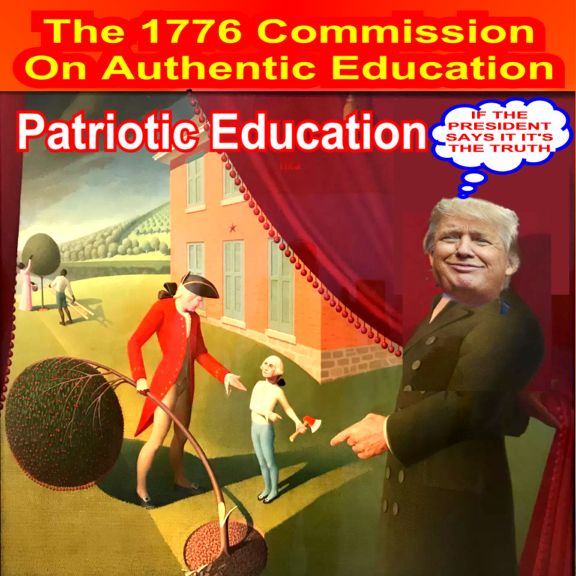
The 1776 Commission On Authentic Education


The 1776 Commission released their thing today, and pardon my French, Mom, but holy shit is it bad. You knew it was going to bad. It's really bad. You probably didn't know that Progressivism is on the same Challenges to American Principles list with slavery and fascism. Slavery, by the way, is addressed primarily through a massive whataboutism. 45 pages, and every one of them is filled with horrific, racist, dumb, awful awfulness (okay, pages 2 and 4 are blank). 43 pages of awful (without any footnotes or endnotes or citations or bibliography in sight for this work of ultimate scholarship). I don't have the time at the moment to pick apart all of it (I'll link to it, but you really shouldn't read it on a full stomach, and empty stomach, or at the end of a hard day).

I will note that the report came out remarkably quickly--the members of the commission were announced on December 18, which gave them a month, and a month full of holidays like that. It's almost as if someone had already pretty much written the report ahead of time (or, it turns out, as if someone had simply cut and pasted big chunks of it). 

At any rate, I'm going to focus on just one section, because it articulates so very clearly how terribly, dangerously wrong these folks are about education.

In Appendix IV: Teaching Americans About Their Country, after the section on the misuse of history, after the section about the decline of education (late 1800s, with the rise of progressivism), we CONTINUE READING:  CURMUDGUCATION: The 1776 Commission On Authentic Education

Education Matters: DCPS admits there is a sub problem, sort of...

Education Matters: DCPS admits there is a sub problem, sort of...
DCPS admits there is a sub problem, sort of...


 Last summer Superintendent Greene said having subs wasn't a problem and we had 2k ready to go, though almost immediately when the school year began we knew that wasn't true, and the school board admitted it, sort of, when they signed an MOU with the union, to increase teacher sub pay.

This MOU proves two things, the district completely disrespects elementary school teachers, and there has been a bog and persistent problem with getting subs.

We all know Greene wasn't honest last summer, or at the very least should have known better and in my mind, this just proves it.

Here is the MOU

COVID-19 has imposed a hardship upon us all. The Substitute System has not escaped that hardship as they have struggled in their responsibility to fill vacant teacher positions. Classroom teachers are often called upon to be used as substitutes in order to provide appropriate coverage for classes. To that end, DTU and the DCSB has reached an agreement to increase compensation for teachers who voluntarily agree to act as substitutes or who accept students from another class when a peer teacher is absent, and a substitute can’t be acquired.


A Memorandum of Understanding (MOU) has been signed to provide additional CONTINUE READING: Education Matters: DCPS admits there is a sub problem, sort of...

QUESTIONABLE ASSERTIONS – Dad Gone Wild

QUESTIONABLE ASSERTIONS – Dad Gone Wild
QUESTIONABLE ASSERTIONS


“Belief is a virus, and once it gets into you, its first order of business is to preserve itself, and the way it preserves itself is to keep you from having any doubts, and the way it keeps you from doubting is to blind you to the way things really are. Evidence contrary to the belief can be staring you straight in the face, and you won’t see it… True believers just don’t see things the way they are, because if they did, they wouldn’t be true believers anymore.”
― Philip Caputo, Acts of Faith

My wife, a fifth-grade teacher, and I sat on the couch the other night, half watching a show on HGTV.  “You know,” she started, her voice tinged with sadness, “In another two months it’ll be a year. A year since I’ve been in my classroom. A year since I’ve spent time with my precious students.”

I said nothing and we continued watching in silence. What could I say? What was there to say? Her sadness was palpable and I no words to ease that sorrow.

For nearly a year, I’ve watched her struggle. Struggle to provide instruction through an unfamiliar vehicle? Struggle to master technology to better serve her students. Struggle over concerns for the well being of her students. Struggle with teaching a class to a screen filled with outdated pictures, because many students don’t turn on their cameras? Struggle with not seeing her parents, because they are older and highly at risk. Struggle to try and stay on top of her own children’s education, while trying to meet the needs of the students in her class. Struggle to try and meet the socio-economic needs of her students, many from families that live in poverty, despite lacking the ability or training to meet all of their needs. In short. Struggles that face all teachers to varying degrees.

Yet every day, she gets up and plunges in again. Teaching classes all day from the makeshift workspace created behind the door of our bedroom. Nights are filled with phone calls to teammates to plot strategies or to help each other navigate ever-shifting direction from building administrators who are struggling themselves. All in an effort to serve students in an unprecedented time. Everybody pulling together, brushing off the disappointments and heartaches to get it right tomorrow.

Despite the popular narrative, it hasn’t been all failure. There has been a lot of success along this difficult route. Technology skills for students have grown at an exponential rate. Many kids are CONTINUE READING: QUESTIONABLE ASSERTIONS – Dad Gone Wild

A VERY BUSY DAY Larry Ferlazzo's Websites of the Day... The latest news and resources in education since 2007

 Larry Ferlazzo's Websites of the Day... | The latest news and resources in education since 2007

Tuesday’s Must-Read Articles On School Reopenings
Pexels / Pixabay Here are new additions to THE BEST POSTS PREDICTING WHAT SCHOOLS WILL LOOK LIKE IN THE FALL : Pandemic Teacher Shortages Imperil In-Person Schooling is from The NY Times. ¿Quรฉ significa para las escuelas la nueva variante del coronavirus? is from The NY Times. I think the safest thing to say, is we’re still learning so much about COVID. Given uncertainty and arrival of vaccines,
Five Key Lessons I’ve Learned About Distance Learning This Semester
Wokandapix / Pixabay I have been regularly documenting what’s been working and what hasn’t been working, along with my fears and concerns for the future. Now that the semester is ending next week, I thought it would be useful – for both readers and for me – to share some practical reflections. Before I do that, however, here are some of my past pieces (that have appeared here, at the British Coun
New PBS NewsHour Video Segment: “Poet tapped for inauguration to spread a message of unity”
Lolame / Pixabay I’m adding this new PBS NewsHour segment to THE BEST SITES FOR LEARNING ABOUT THE PRESIDENTIAL INAUGURATION – 2021:
Video: Trevor Noah Interviews Dr. Mary Frances Berry – “The Power of Protest”
I’m adding this new and great interview on the Daily Show to
Must-Read NY Times Column On Miguel Cardona’s Experience As An ELL
The Potential Plus of Having a Former ‘English Learner’ as Education Secretary is a NY Times column that every teacher of English Language Learners – and every education policymaker and district leader – is going to want to read. Here’s another excerpt: As education secretary, Mr. Cardona could push for federal funding for programs that have lagged behind the growing English learner population, a
Six Important New Resources For Learning About Martin Luther King, Jr.
Here are new additions to The Best Websites For Learning About Martin Luther King,Jr: The Youthful Movement That Made Martin Luther King Jr. appeared in The NY Times. The Words of Martin Luther King Jr. Reverberate in a Tumultuous Time is from The NY Times. Don’t ask what Martin Luther King Jr. would do today and then ignore his real message is from Vox. Embrace These 4 Lessons From Dr. Martin Lu
‘We Can’t Wait Until People Feel Comfortable Talking About Race’
is the headline of my latest Education Week column. White Fragility and Pushout: The Criminalization of Black Girls in School are two of many books on race suggested by four educators. Here are some excerpts:

 Larry Ferlazzo's Websites of the Day... | The latest news and resources in education since 2007