Latest News and Comment from Education

Thursday, December 31, 2020

Calls growing for Biden to do what DeVos did: Let states skip annual standardized tests this spring - The Washington Post

Calls growing for Biden to do what DeVos did: Let states skip annual standardized tests this spring - The Washington Post
Calls are growing for Biden to do what DeVos did: Let states skip annual standardized tests this spring


There are growing calls from across the political spectrum for the federal government to allow states to skip giving students federally mandated standardized tests in spring 2021 — but the man that President-elect Joe Biden tapped to be education secretary has indicated support for giving them.

The issue will be an early test for Miguel Cardona, the state superintendent of education in Connecticut whom President-elect Joe Biden tapped to be education secretary, and his relationship with teachers and others critical of giving the exams during the coronavirus-caused chaos of the 2020-21 school year.

The current education secretary, Betsy DeVos, approved waivers to states allowing them not to administer the annual exams last spring as the coronavirus pandemic led schools to close. She said recently she wouldn’t do it again, but Biden’s triumph in November’s elections means the decision is no longer hers. It’s up to Cardona — assuming he is confirmed by the Senate, as expected — and the Biden administration to decide whether to provide states flexibility from the federal law.

The annual spring testing regime — complete with sometimes extensive test preparation in class and even testing “pep rallies” — has become a flash point in the two-decade-old school reform movement that has centered on using standardized tests to hold schools and teachers accountable. First under the 2002 No Child Left Behind law and now under its successor, the 2015 Every Student Succeeds Act, public schools are required to give most students each year in math and English Language Arts and to use the results in accountability formulas. Districts evaluate teachers and states evaluate schools and districts — at least in part — on test scores.

But just how much the scores from the spring tests ever reveal about student progress, even in a non-pandemic year, is a major source of contention in the education world.

Supporters say they are important to determine whether students are making progress, and that two straight years of having no data from these tests would stunt student academic progress because teachers would not have critical information on how well their students are doing. CONTINUE READING: Calls growing for Biden to do what DeVos did: Let states skip annual standardized tests this spring - The Washington Post

Vouchers and Market-Driven Schools in Sweden (Sara Hjelm) | Larry Cuban on School Reform and Classroom Practice

Vouchers and Market-Driven Schools in Sweden (Sara Hjelm) | Larry Cuban on School Reform and Classroom Practice
Vouchers and Market-Driven Schools in Sweden (Sara Hjelm)


Sara Hjelm is a reader of this blog. She wrote to me about the state of Swedish schools a few weeks ago and her deeply-felt concerns about the reforms now occurring in her country. As a retired teacher she sees the blending of school choice and vouchers as a reform strategy that, in her opinion, harms the nation’s schools.

Usually, I do not publish descriptions and critiques of schools in other countries but I was taken by Hjelm’s voice as a teacher, her critique of choice and vouchers, and an advocate for better schools.

As a preface for readers unfamiliar with the state system of schooling in Sweden, I begin with a description of earlier Parliamentary reforms aimed at improving the nation’s schools. Then I offer portions of what Sara Hjelm has written about these reforms. Hjelm gave me permission to use portions of her email.

Background of Swedish System

Sweden adopted a nationwide universal voucher program in 1992 as part of a series of reforms designed to give more control over education to towns and schools. Families can choose any school, public or private. Taxpayer money follows the student. This voucher system has led to a burgeoning industry of mostly for-profit, private schools, also called “free schools.” Two of the companies that run schools in Sweden are listed on the country’s stock exchange.*

In contrast to American private schools, “free schools” don’t charge tuition — they draw on government funds to operate — and are required to follow CONTINUE READING: Vouchers and Market-Driven Schools in Sweden (Sara Hjelm) | Larry Cuban on School Reform and Classroom Practice

Newsom offers $2 billion plan to bring back in-person instruction in elementary grades | EdSource

Newsom offers $2 billion plan to bring back in-person instruction in elementary grades | EdSource
Newsom offers $2 billion plan to bring back in-person instruction in elementary grades


Gov. Gavin Newsom presented a $2 billion proposal for financial incentives Wednesday to prod school districts to bring back elementary school students for in-person instruction, starting in mid-February.

School districts would receive extra funding — from $450 to about $700 per student — if they agreed to a timetable for reopening schools, a rigorous regimen of testing both students and staff for the virus, and a strict health and safety plan that teachers and employee unions would have to consent to. Newsom said more details would be available with the state budget next week.

Districts would receive a minimum of $450 for every student in the district, plus additional money per student, based on the Local Control Funding Formula. It provides extra money for English learners, homeless, foster and low-income students.

Districts would receive the funding if they offered in-person instruction from transitional kindergarten (TK) to second grade in the first phase, starting Feb. 15, and for third to sixth-graders in the second phase, a month later. Districts would get full funding, regardless of how many parents decided to continue with distance learning. They would also have to agree to bring back small cohorts of students of all ages with the most needs, including homeless and foster children and students with CONTINUE READING: Newsom offers $2 billion plan to bring back in-person instruction in elementary grades | EdSource

Teacher Tom: An Education That Emerges From Those Things That Most Affect Us

Teacher Tom: An Education That Emerges From Those Things That Most Affect Us
An Education That Emerges From Those Things That Most Affect Us


In 1675, French rationalist philosopher Nicholas Malebranche wrote, "The mind does not pay equal attention to everything it perceives. For it applies itself infinitely more to those things that affect it, that modify it, and that penetrate it, than to those that are present to it but do not affect it."

I don't know if this insight was groundbreaking at the time, but for most of us today it seems self-evident. I know that this is true of my own mind and from what I've read, modern scientists concur. It makes sense that our minds would have evolved like this. Or rather, it's rational to conclude, at least, that our senses have evolved to filter out the "noise" in our environment in order to focus on those things that have the greatest impact on our fitness. In a world of plant life, for instance, we're more likely to notice the ones that provide nutrition or the potential for shelter, but if a tiger prowls onto the scene, the plants fall to the background as our minds CONTINUE READING: Teacher Tom: An Education That Emerges From Those Things That Most Affect Us

Celebrating Kwanzaa: Day Six Gives Us Kuumba, Creativity

Celebrating Kwanzaa: Day Six Gives Us Kuumba, Creativity
Creativity and Craftsmanship: Celebrating Kuumba, the Sixth Night of Kwanzaa


Black-owned businesses breathe creativity. The sixth day of Kwanzaa, Kuumba, represents creativity and is a time for celebrating the radical Blackness that comes from multiple countries and cultures across different platforms. The following Black-owned businesses show their creative instincts in their hand-made and hand-picked products that represent the beauty of Blackness and cultural backgrounds.


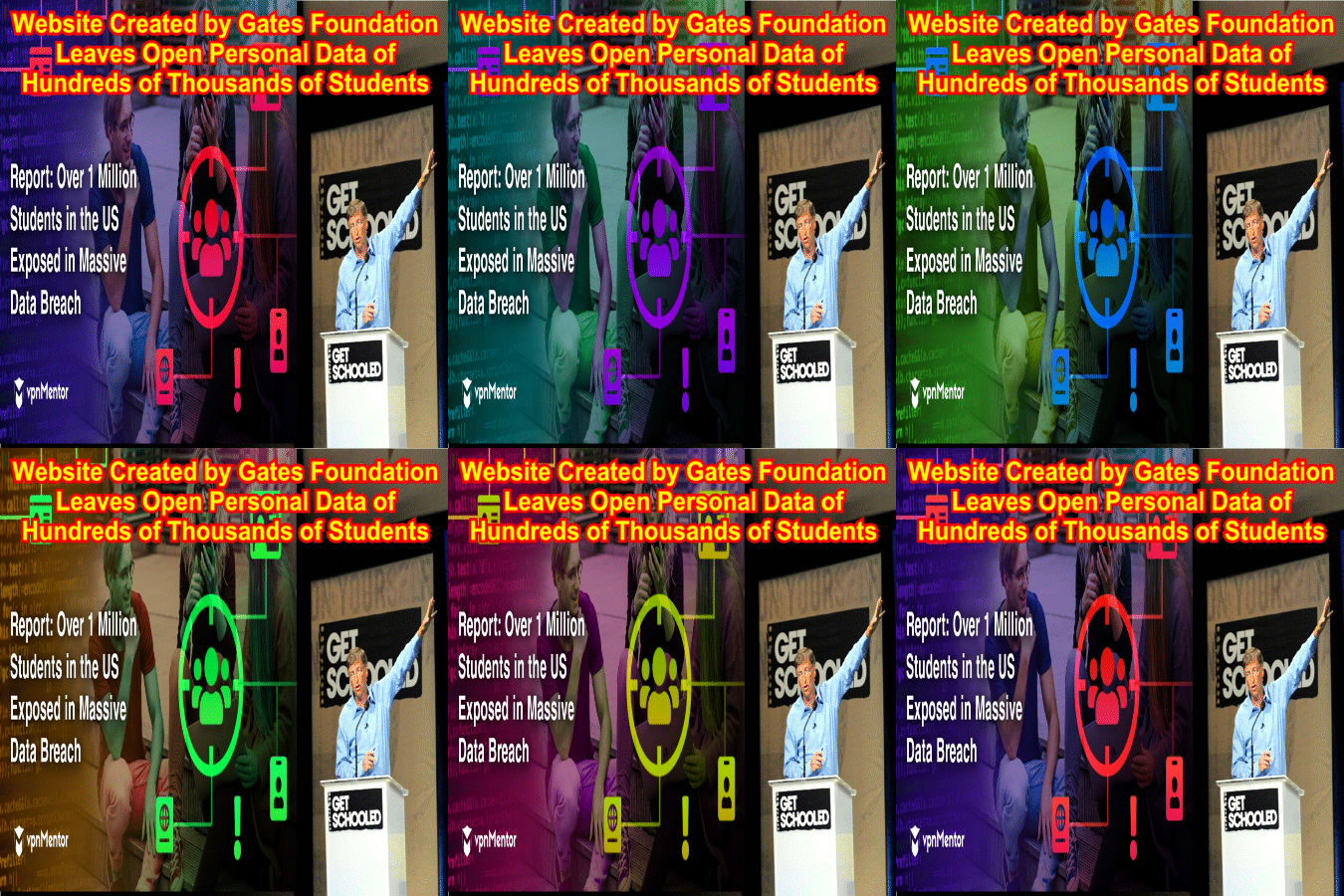
Website Created by Gates Foundation Leaves Open Personal Data of Hundreds of Thousands of Students | Diane Ravitch's blog

Website Created by Gates Foundation Leaves Open Personal Data of Hundreds of Thousands of Students | Diane Ravitch's blog
Website Created by Gates Foundation Leaves Open Personal Data of Hundreds of Thousands of Students


The Financial Times reported a major data breach of personally identifiable student data on a website funded by the Gates Foundation. Bill Gates, as we know, is a data aficionado. Several years ago, he created an ill-fated project called InBloom with the intent of gathering the personal data of millions of students. Fortunately it was killed off by parent activists Leonie Haimson and Rachel Stickland, who created the Parent Coalition for Student Privacy. The “cloud” is not secure.

The personal details of hundreds of thousands of US students were exposed to hackers after a database was left unsecured by Get Schooled, an education charity set up by the Bill & Melinda Gates Foundation and Viacom. Get Schooled was set up a decade ago to help students CONTINUE READING: Website Created by Gates Foundation Leaves Open Personal Data of Hundreds of Thousands of Students | Diane Ravitch's blog


Choosing Democracy: Ethnic Studies Model Curriculum

Choosing Democracy: Ethnic Studies Model Curriculum
Ethnic Studies Model Curriculum


Ethnic Studies Curriculum SBE

At its November 18–19, 2020, meeting, the Instructional Quality Commission (IQC) recommended the revised draft Ethnic Studies Model Curriculum to the State Board of Education (SBE) following a 45-day public comment period. The IQC incorporated edits, including those recommended by the California Department of Education (CDE), that strengthen the content and honor the four traditional disciplines of African American, Native American, Asian American, and Chicana/o/x and Latina/o/x studies and better reflect the diversity of experiences and contributions of groups that have been marginalized and understudied. Additionally, the IQC updated and expanded an existing set of resources—where all sample lessons are housed—to further explore communities and raise the voices of identities whose experiences intersect with the core disciplines of ethnic studies, such as Arab Americans, Armenian Americans, Jewish Americans, and Sikh Americans.

This revised draft of the Ethnic Studies Model Curriculum is in alignment with state law (Education Code Section 51226.7) and the State Board of Education-adopted guidelines, which can be found on the CDE’s Ethnic Studies Model Curriculum Guidelines web page.

The model curriculum draft has been posted for a final 45-day public review period. State law requires the SBE to take final action on the model curriculum by March 31, 2021.

More information on the Ethnic Studies Model Curriculum can be found on the CDE Model Curriculum Projects web page. Individuals or groups may submit public comment on the Ethnic Studies Model Curriculum 


Rick Hess Interviews Betsy DeVos As She Heads for the Exit | Diane Ravitch's blog

Rick Hess Interviews Betsy DeVos As She Heads for the Exit | Diane Ravitch's blog
Rick Hess Interviews Betsy DeVos As She Heads for the Exit


Rick Hess conducts an “exit interview” with Betsy DeVos, which was published at Education Week. Rick is a fellow at the conservative American Enterprise Institute, which is funded in part by DeVos.

DeVos came to Washington to destroy public education, and she failed. She bitterly dismisses the “entrenched interests” and bureaucrats who frustrated her ambitions to turn billions of public dollars over to religious and private schools and to extinguish teachers’ unions altogether. During her confirmation, she was unable to answer direct questions about education policy, and she was ultimately confirmed only when Vice-President Pence cast a tie-breaking vote. This had never happened before. In poll after poll, DeVos was characterized as the most unpopular member of Trump’s Cabinet. She did her best to skewer the Department’s Office of Civil Rights, to abandon college students who were defrauded by for-profit colleges, to divert COVID funding to elite private schools. Fortunately, most of the changes–maybe all of them–will be reversed by the Biden administration. Here CONTINUE READING: Rick Hess Interviews Betsy DeVos As She Heads for the Exit | Diane Ravitch's blog