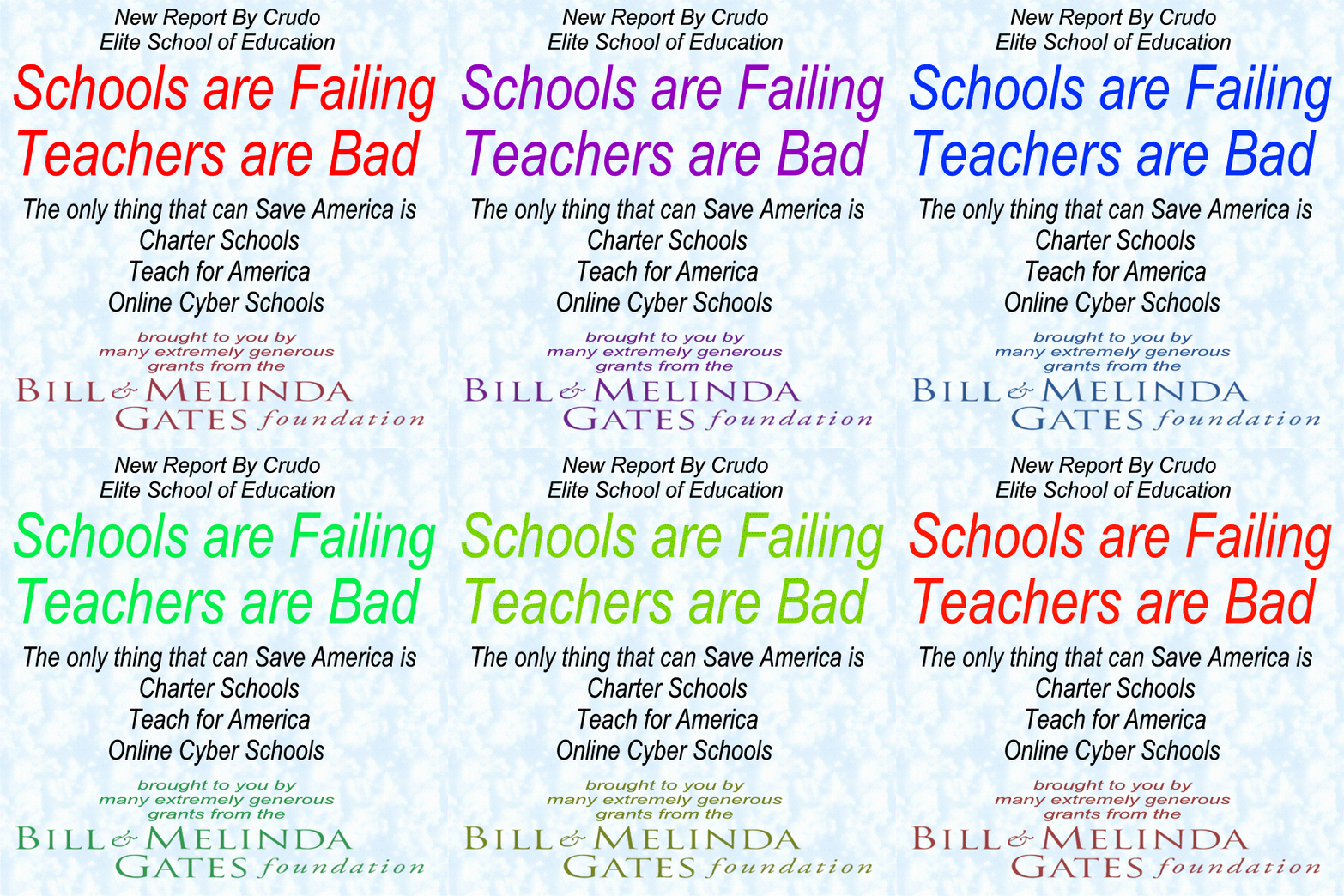
Latest News and Comment from Education

Saturday, February 16, 2019

Solidarity With Migrant Families: Join the February 17th teach-in at the border against Child Detention! – Black Lives Matter At School

Solidarity With Migrant Families: Join the February 17th teach-in at the border against Child Detention! – Black Lives Matter At School

Solidarity With Migrant Families: Join the February 17th teach-in at the border against Child Detention!


The Trump administration’s “zero tolerance” policy of separating migrant children from their families at the boarder is cruel and inhuman. The U.S. government has admitted to separating 2,700 children from their families and a recent Health and Human Services report indicates that there could even be thousands more.

This gross injustice has prompted the national Black Lives Matter at School coalition to stand in solidarity with the Teach-In for Freedom and their demands of the U.S. government for the immediate release of all immigrant children in U.S. Government custody and to shut down all immigrant detention centers housing immigrant children. On February 17, hundreds of educators from all over the country will raise their voices against the racist detention of refugee and immigrant children at the U.S. border and the separation of children from their parents.  We encourage all educators to join them on the border or teach lessons about the rights of immigrants and refugees in their own classrooms.
Educators will gather in the historic San Jacinto Plaza in El Paso, TX to teach lessons about the current impact and trauma of child detention as well as the history of immigration and child detention. We applaud the efforts of the state teachers of the year, spearheaded by Mandy Manning (the 2018 National Teacher of the Year), who have collaborated with other educators, their unions, faith-based organizations, and immigrant rights organizations to form Teachers Against Child Detention.

In addition, we believe their work in many ways overlaps with the struggles of the Black Lives Matter at School movement.  Trump’s rhetoric of “zero tolerance” on the boarder mirrors the “zero tolerance discipline” policies in schools that has lead to a spike in suspension and expulsion rates—disproportionately impacting Black and Brown students.  Zero tolerance discipline, then, contributes to the school-to-prison-pipeline, which fuels the racist system of mass incarceration.  The explosion in the prison population, or what Michelle Alexander calls “the New Jim Crow,” rips apart African-American families and separates Black children from their parents. In a June 2018 article entitled “Family Separation: It’s a Problem for U.S. Citizens Too”, The New York Times estimated that 250,000 American children have a single mother in jail with another 150,000 having a mother in prison.  One in four Black children will have their father incarcerated before they turn 14. And it’s not just Black parents that are incarcerated and then separated from their children—Black children are also over policed and jailed.  Some 30,000 youth are imprisoned in juvenile jails across the country and The Sentencing Project documents that “black children are incarcerated at a rate five times higher than white children.”
The movement for immigrant rights and the Black Lives Matter at School movement are both strengthened when we work together in common cause to stop the unjust detention and incarceration of all Black and Brown youth. We urge all educators around the country to support these movements and stand in solidarity with Teachers Against Child Detention when they say:  
“WE BELIEVE

All children deserve to be in school.

All children deserve to be free.

We demand the release of our children.”


Jersey Jazzman: Testing Chaos Continues in New Jersey

Jersey Jazzman: Testing Chaos Continues in New Jersey

Testing Chaos Continues in New Jersey


Here's an update from my last blog on the chaotic debate over New Jersey's high school exit exam:


Yesterday, after several delays, the state announced a settlement that at least clarifies the path to graduation for New Jersey's high school juniors and seniors:


New Jersey reached a settlement Friday that offers a clear path for juniors and seniors to graduate, after a court declared current public school standardized testing requirements illegal.
The settlement clears a path for about 170,000 juniors and seniors who had passed state exams and who the state said were "in limbo" after the court's decision.
Under the court-approved settlement, the state will allow high school juniors and seniors to graduate if they have passing scores on state PARCC exams or other approved standardized tests, such as the SAT, ACT or the military placement exam.
The agreement also provides the Department of Education with time to propose new graduation testing rules for the classes of 2021 and 2022, who are current freshman and sophomores. 
You'll recall that the appellate court declared that the PARCC Algebra I and English Language Arts (ELA) Grade 10 tests were, together, not an acceptable graduation test, because they're not a single test and they're not given in 11th grade, as the law says the graduation test should be.

But as I pointed out last time: a larger problem is that no one has ever shown these tests to be valid for the purpose laid out in the law. Psyshometricians will tell you this is a  CONTINUE READING: 
Jersey Jazzman: Testing Chaos Continues in New Jersey


2020 Democrats Eager for Teachers’ Backing | Education News | US News

2020 Democrats Eager for Teachers’ Backing | Education News | US News

2020 Democrats Eager for Teachers’ Backing
The president of one of the nation’s most powerful teachers unions says it’s far too early for an endorsement, but Democratic hopefuls are lining up to make their cases.


THE AMERICAN FEDERATION of Teachers is one of the two national teachers unions that represents millions of educators, has a war chest that plays a major role in Democratic primaries and is currently overseeing a wave of teacher unrest sweeping the country.
And the nearly dozen Democratic hopefuls running in the 2020 presidential election are taking note.
"Let's just say my phone has rung a lot," AFT president Randi Weingarten said Friday in an interview on C-SPAN.
Weingarten didn't name which candidates were directly reaching out but said her members are already energized, engaged and, in some cases, wary about the candidates with more than a year until Election Day.
"I think records really matter and what people have done in the past is important," she said. "It's so early now. It's different when there is one or two candidates. But this is not a race where there is going to be one or two candidates really early."
The union poured more than $12 million into the 2018 midterm election and it stands poised to contribute even more in 2020.
"We're always very candid about what we spend and also do the big reveal as soon as we know what it is," Weingarten said. "We will spend what our members want us to spend on elections."
The question for Weingarten and her union's educator members is, ultimately: Do you stand with public school teachers at a time when they're walking the picket lines to rebuke the last decade of education reforms?
"If, all of a sudden, there is only a dollar left, what do you do?" she asked. "Do you invest it in lower class sizes and mental health supports in public education, or do you give it to the private for-profit charter operator who doesn't have any accountability?"
"Frankly, teachers and nurses will be able to see the authenticity of those answers, whether somebody is pitting one against another, whether someone is just doing the bidding of some rich folks or whether someone is really authentically involved in helping all our children in America get an education," she said. CONTINUE READING: 2020 Democrats Eager for Teachers’ Backing | Education News | US News


Bill and Melinda Gates annual letter 2019: is their fortune justifiable? - Vox

Bill and Melinda Gates annual letter 2019: is their fortune justifiable? - Vox

Bill and Melinda Gates and the problem of the “good billionaire”
A new wave of critics say even the most generous billionaires are bad. Are they right?


Bill and Melinda Gates are odd billionaires.
The Gateses, who released their foundation’s annual letter this week, are not cartoonishly out-of-touch like Stephen Schwarzman, the private equity billionaire who gave Yale $150 million for a performing arts center; they’re not magnates attempting to use their money to swing elections like Charles and David Koch or Tom Steyer.
They’re also not self-hating plutocrats like Nick Hanauer who openly decry their station in society and constantly demand just economic policies. And they’re certainly not among the dozens of barely known billionaires who fill out the Forbes 400 list of America’s richest people (quick, tell me all your thoughts about, uh, Thomas Peterffy?).
But I think in some ways, the Gateses (and to a certain extent, Cari Tuna and Dustin Moskovitz as well) raise the hardest questions about the role billionaires and philanthropy play in our society. Which is to say: The Gates Foundation has the kind of money and power that there are very, very good reasons to not want a foundation controlled by a private individual (or, in this case, three individuals — Bill, Melinda, and Warren Buffett) to have.
It is able to spend vast sums of money to influence the lives of people around the globe with minimal accountability, without the discipline that consumers and competitors force on businesses and voters force on governments.
When I look at figures like Steyer or Schwarzman or the Kochs or Howard Schultz exercising the power derived from their wealth, my reaction is easy: You’re doing this wrong. You’re not living up to the responsibility inherent in having that kind of money and power. The money you’re spending would probably be better used in public coffers.
I think the Gates Foundation, by contrast, has mostly used that money and power well. And I’m CONTINUE READING: Bill and Melinda Gates annual letter 2019: is their fortune justifiable? - Vox


Why Donald Trump Jr.'s ‘loser teachers’ comment was 'a chilling moment’ for educators around the world - The Washington Post

Why Donald Trump Jr.'s ‘loser teachers’ comment was 'a chilling moment’ for educators around the world - The Washington Post

Why Donald Trump Jr.'s ‘loser teachers’ comment was 'a chilling moment’ for educators around the world


You may recall that President Trump held a pro-border wall rally on Feb. 11 in El Paso and his eldest child, Donald Trump Jr., made a speech that roused the crowd.
The president’s son drew cheers when he urged young conservatives to “bring it to your schools” (though he didn’t say exactly what “it” was) because “you don’t have to be indoctrinated by these loser teachers that are trying to sell you on socialism from birth.”
The comment drew response on social media from teachers and others who don’t see educators in the same way as he does, with the hashtag #loserteachers. For example:


In this post, three internationally respected teachers respond, explaining why his comment was more than simply mean.
They are Jelmer Evers of the Netherlands, Michael Soskil of the United States, and Armand Doucet of Canada. The three were featured authors in the 2018 book “Teaching in the Fourth Industrial Revolution: standing at the precipice.”
Evers (@helmerevers) is also the author of “Flip the System: changing education from the ground up.” Soskil (@msoskil) was the 2017-18 Pennsylvania Teacher of the Year. Doucet (@DoucetArmand) was the recipient of the Canada Teachers Award and is the author of “Teaching Life: Our Calling, Our Choices, Our Challenges.”
By Jelmer Evers, Michael Soskil and Armand Doucet
“You know what I love? I love seeing some young conservatives because I know it’s not easy. (Crowd applauds and shouts.) Keep up that fight. Bring it to your schools. You don’t have to be indoctrinated by these loser teachers that are trying to sell you on socialism from birth. You don’t have to do it. Because you can think for yourselves. They can’t.” (Crowd applauds and shouts again.) – Donald Trump Jr. in Texas on Feb. 11, 2019
For teachers around the globe this was a chilling moment.
In a stadium filled with people chanting “USA, USA!” the son of the president of the United States called for CONTINUE READING: Why Donald Trump Jr.'s ‘loser teachers’ comment was 'a chilling moment’ for educators around the world - The Washington Post


Ohio: Rightwing Think Tank Aide Attacks Hero of Public Education | Diane Ravitch's blog

Ohio: Rightwing Think Tank Aide Attacks Hero of Public Education | Diane Ravitch's blog

Ohio: Rightwing Think Tank Aide Attacks Hero of Public Education


Ohio has one of the worst charter sectors in the country.
In 2015, The Cleveland Plain Dealer and Valerie Strauss of the Washington Post agreed that Ohio’s Charters had become a national joke.  Margaret Raymond, leader of CREDO, which conducts studies of state charter sectors, said to Ohioans, “Be glad that you have Nevada, so you are not the worst,” referring to Ohio’s charters.
Two-thirds of Ohio’s charters are rated failing by the state. Enrollment in charters is falling. The number of charters is declining. Ohio’s failing  charter schools drain $1 billion a year from Ohio’s public schools.
Why is Ohio taking $1 Billion a year from public schools to sustain failing charter schools?
In short, Ohio’s charter sector is a disaster.

So now is exactly the time when Aaron Churchill of the Thomas B. Fordham Institute attacks Bill Phillis, the retired assistant superintendent of education, a courtly gentleman who has warned about the fiscal dangers of charters for Ohio public schools for years and whose warnings have been prophetic.
Bill Phillis is a hero of education in Ohio and in the nation. He is paid by no one to tell the truth.
Aaron Churchill works for a rightwing think tank that is funded by Gates, and a long list of foundations, whose purpose is to advance the cause of privatization. (I was a founding member of that organization at a time when its endowment of $40 million was considered adequate, and I opposed the pursuit of outside funding, then turned against TBF’s goal of privatization.) TBF sponsors charter schools in Ohio (another decision I opposed because I CONTINUE READING: Ohio: Rightwing Think Tank Aide Attacks Hero of Public Education | Diane Ravitch's blog


Chaz's School Daze: Comparing Our Contract Raises With Los Angeles And Denver

Chaz's School Daze: Comparing Our Contract Raises With Los Angeles And Denver

Comparing Our Contract Raises With Los Angeles And Denver


UFT members just received a 2% raise on Valentine's Day and the total 42 month contract (Feb 2018 -September 2022)  is 7.5% or 2% annually.  This contract was negotiated by New York City which has a multi billion dollar surplus.  How does our contract compare to the recently settled Los Angeles and Denver teacher contracts?

The Los Angeles teachers contract gave them a 6% raise for the two years, or 3% annually, despite a one billion dollar shortfall for the Los Angeles Board of Education.  Moreover, the City committed to have a full time guidance consular, librarian, and nurse for every public school. Additionally, the City will reduce class size by two students next school year.  Finally, the City agreed to a charter school moratorium for the next year.

The Denver teachers contract was all about raises.  The three year contract had an average raise of 9% or 3% annually.  Moreover, the contract increased and added steps, 20 in all, that guaranteed raises for every teacher.   Finally automatic cost of living raises, based on the local CPI will be included.

Comparing the three contracts, one can see that our annual raises are 1% lower than both Los Angeles and Denver for the length of the three contracts.  Furthermore, Denver has an improved salary step scale and a cost of living raises based on the local CPI.

The bottom line is our UFT leadership negotiated an inferior contract when it comes to annual raises.


Chaz's School Daze: Comparing Our Contract Raises With Los Angeles And Denver

Denver Teachers Strike Pays Off for Teachers | deutsch29 #DCTAstrong #RedforEd #edcolo #coleg #copolitics #FairPayForTeachers

Denver Teachers Strike Pays Off for Teachers | deutsch29

Denver Teachers Strike Pays Off for Teachers


On Monday, February 11, 2019, Denver teachers went on strike. Later that week, on Thursday, that decision apparently paid off.
More than 2,000 educators, who have been on strike since Monday, said they reached a tentative deal Thursday with the local school district.
Details are not yet available, but the deal includes an average 11.7 percent pay raise and annual cost of living increases, according to the school district and the Denver Classroom Teachers Association….
It also addresses the teachers’ biggest concern: the need to overhaul the merit-pay system, which relies heavily on annual bonuses that fluctuate from year to year. The new system will place more emphasis on education and training when considering promotions, while keeping some bonuses in place.
Where will they find the $23 million to pay for this? The district agreed to cut back on administrative costs, and will eliminate about 150 positions in the school’s central office. Five-figure bonuses for senior school administrators will also come to an end.
Some observations about career classroom teachers:
We want a livable salary, one that is stable, and not some unpredictable set of bonus dollars.
We want to be paid for our education and experience.
We do not want to be economically strained at the expense of overcompensated, top-heavy, central office administration.
We want to be able to afford to live in the districts where we teach– without CONTINUE READING:  Denver Teachers Strike Pays Off for Teachers | deutsch29


Sacramento City teachers union to hold vote by members to authorize potential strike #Unite4SACKids #WeAreSCTA #WeAreCTA #strikeready #REDFORED #SCTA #CTA

Sacramento City teachers union to hold vote by members to authorize potential strike


The teachers union took its long-running dispute with the Sacramento City Unified School District up a notch Thursday as union leaders voted to seek members’ authorization for a potential strike.

The move adds to the challenges faced by the district, which is under the threat of state takeover as it wrestles with a $35 million budget gap.
About 100 teacher representatives agreed unanimously Thursday night to give their union’s bargaining team the OK to collect strike authorization votes from teachers at each school. The SCTA has about 2,500 members.
“It doesn’t mean that a strike is certain, but rather it’s an option,” said SCTA President David Fisher in an interview with The Sacramento Bee.
In a statement to The Bee, Sacramento City Unified Superintendent Jorge Aguilar said, “We will continue inviting SCTA leaders to encourage their members to be part of a solution, not a strike.”
“A strike will not save our schools from a state takeover. It would only disrupt student learning and create more division in our District,” Aguilar said.
But Fisher claimed an ongoing, long-standing pattern of “bargaining in bad faith” by the district. He said if it continues, the union wants the option to strike.
“It grows out of frustration of the failure of the superintendent to honor a contract that he signed more than a year ago, and the continued treatment of our contract gets optional as opposed to something that’s binding on both parties,” Fisher said.
He said the union also was concerned about the status of arbitration efforts with the district, and follow-through if agreement is reached.
The district had filed a motion in Sacramento Superior Court in November that halted planned arbitration, asking the judge to determine whether there was an agreement over how to distribute a salary adjustment for early and mid-career teachers.
The judge last week ordered the district back to the arbitration table with the union to settle the contract dispute. The SCTA recommended scheduling arbitration meetings for early March.
But the union said the arbitration is just to negotiate the salary schedule, and that their list of grievances is much longer than that.
“It’s a pattern of things that are happening and continue to happen and then a lack of certainty into what the district might do next,” Fisher said.
Union site representatives will begin collecting member votes in person at each school site on Tuesday. It will take approximately three weeks to collect the votes, according to the union. The votes will then go through the union’s executive board, and if enough members vote yes, under its contract the union can then call for a strike date.
According to an online FAQ by the union, a simple majority vote is needed to authorize a strike.
“We hope that the district will engage lawfully with us,” Fisher said, adding that would prevent seeking a strike date. “That’s the idea behind the vote.”
District spokesman Alex Barrios said the district’s attorneys question whether there are legal grounds for teachers to go on strike.
“It will end up putting further strain on the relationship when we need to be working together,” he said.
In September 2017, about 80 percent of SCTA members turned out to vote in its last strike over contract negotiations. Nearly 97 percent voted for a strike, and while it was imminent, both reached an agreement on a new contract brokered by Sacramento Mayor Darrell Steinberg.
The SCTA also held a vote for a strike in 2015, with the majority of teachers favoring one.
The last teachers strike in the district was in 1989.

CA K-12 schools press Gavin Newsom for more funds | The Sacramento Bee - https://www.sacbee.com/news/politics-government/capitol-alert/article223799285.html on sacbee_news


Sac City Teachers Association: $60 million in SCUSD cuts | The Sacramento Bee - https://www.sacbee.com/news/local/education/article223065935.html on sacbee_news

Friday, February 15, 2019

What Will It Take to Get Equitable School Funding in Pennsylvania – a Statewide Teachers Strike!? | gadflyonthewallblog

What Will It Take to Get Equitable School Funding in Pennsylvania – a Statewide Teachers Strike!? | gadflyonthewallblog

What Will It Take to Get Equitable School Funding in Pennsylvania – a Statewide Teachers Strike!?


What if instead they took to the streets with signs and placards, bullhorns and chanted slogans.
Maybe:
“Hey! HEY! Ho! HO! This Unfair Funding Has to Go!”
Or:
“What do we want!? FAIR FUNDING! When do we want it? YESTERDAY!”
The problem is that from Pittsburgh to Philadelphia and all places in between, the Keystone state has the most unequal school funding system in the country. And no one in Harrisburg seems able and/or willing to do a damn thing about it.
Nor is anyone going to do much again this year.
Gov. Tom Wolf didn’t mention it once last week during the Democrat’s first budget speech to the legislature after being re-elected.
Don’t get me wrong. He’s not exactly ignoring the issue. His newly proposed budget asks for a $200 million increase in education funding.

Boston: Charter Schools Are Pushing Public Education to the Breaking Point | Schott Foundation for Public Education

Boston: Charter Schools Are Pushing Public Education to the Breaking Point | Schott Foundation for Public Education
Boston: Charter Schools Are Pushing Public Education to the Breaking Point

When striking Los Angeles teachers won their demand to call for a halt to charter school expansions in California, they set off a domino effect, and now teachers in other large urban districts are making the same demand.
Unchecked charter school growth is also bleeding into 2020 election campaigns. Recently, New York magazine columnist Jonathan Chait berated Democratic Massachusetts Senator and presidential candidate Elizabeth Warren for having opposed a ballot initiative in her home state in 2016 that would have raised a cap on the number of charter schools. “There may be no state in America that can more clearly showcase the clear success of charter schools than [Massachusetts],” declared Chait.
But while Chait and other charter school fans claim Massachusetts as a charter school model, the deeper reality is that charters are driving Boston’s public education system to the financial brink.
As the Boston Globe recently reported, the city is experiencing an economic boom, but its schools resemble “an economically depressed industrial center.” The state’s unfair funding formula is part of the problem, but an ever-expanding charter school industry also imposes a huge financial drain.
Charter school money suck
“Two decades ago, state educational aid covered almost a third of Boston’s school expenses,” writes Globe reporter James Vaznis. Today, “city officials anticipate that in just a few years every penny from the state will instead go toward charter-school costs of Boston students. Boston is slated to receive $220 million in state education aid; about $167 million will cover charter-school tuition for 10,000 students, leaving a little more than $50 million for the 55,000 students in the city school system.”
As charter schools suck students and their per-pupil funding from the public system, the impact on Boston’s schools are glaring: “Decades-old buildings plagued by leaks. Drinking fountains shut because of lead pipe contamination. Persistent shortages of guidance counselors, nurses, psychologists, textbooks — even soap in the bathrooms. All the while, many Boston schools are under state pressure to increase their standardized test scores and graduation rates.”
As funds for Boston schools dwindle due to the drain from charter schools, the district’s alternatives are painful any way you CONTINUE READING: Boston: Charter Schools Are Pushing Public Education to the Breaking Point | Schott Foundation for Public Education