Latest News and Comment from Education

Thursday, April 20, 2017

Mike Klonsky's SmallTalk Blog: TOMORROW'S SHOW

Mike Klonsky's SmallTalk Blog: TOMORROW'S SHOW:

TOMORROW'S SHOW


Eve Ewing (top) and Sarah Chambers.
Tomorrow on Hitting Left, our in-studio guest will be Eve Ewing. Eve is a sociologist of education whose research focuses on racism and the inequality of public school system. She's currently doing a post-doc at the University of Chicago.

Her first collection of poetry, essays, and visual art, Electric Arches, is forthcoming from Haymarket Books in fall 2017, and she co-edited the fiction anthology Beyond Ourselves.  Her work has appeared in venues such as Poetry, The New York Times, The New Yorker, The New Republic, The Atlantic, The Nation, The Washington Post, Union Station, the anthology The BreakBeat Poets: New American Poetry in the Age of Hip-Hop and many other outlets. Eve is proud to be one-half of the poetry duo Echo Hotel, alongside Hanif Willis-Abdurraqib. She is also the co-director of Crescendo Literary, a partnership that develops resources and events rooted in community-engaged art; with Crescendo she co-created the Emerging Poets Incubator and the Chicago Poetry Block Party. Eve has held residencies at the WordXWord Festival and AIR Serenbe, where she was a recipient of a Focus Fellowship. She is an editor emerita of Seven Scribes.

We will also be talking with Chicago special education teacher Sarah Chambers in her 8th year at Saucedo Academy, who's been suspended and could be fired by CPS for allegedly engaging in “misconduct” related to a standardized test.

“I received an email the day before spring break that I was suspended, with no explanation at all,” she told Chicago Tonight. “I was very shocked, very angry for not being able to be with my kids, for them harming my kids.”
Supporters met outside Saucedo on Tuesday afternoon in a show of solidarity with Chambers after more than 3,000 people signed an online petition calling for her reinstatement.
Marguerite Horberg, founder and director of the Hot House will tell us about the May Day cultural extravaganza she is planning following the massive march the afternoon of May 1st.

Tune in to hear the Klonsky Bros. Hitting Left on Friday at 11 a.m. CDT, on WLPN 105.5 F.M., streaming live at Lumpen Radio. If you have an IPhone, download the Lumpen Radio app.

If you miss the show live, you can always listen to the podcast 


Mike Klonsky's SmallTalk Blog: TOMORROW'S SHOW:

Louisiana Believes: Exclusion is the Best Policy – Educate Louisiana

Louisiana Believes: Exclusion is the Best Policy – Educate Louisiana:

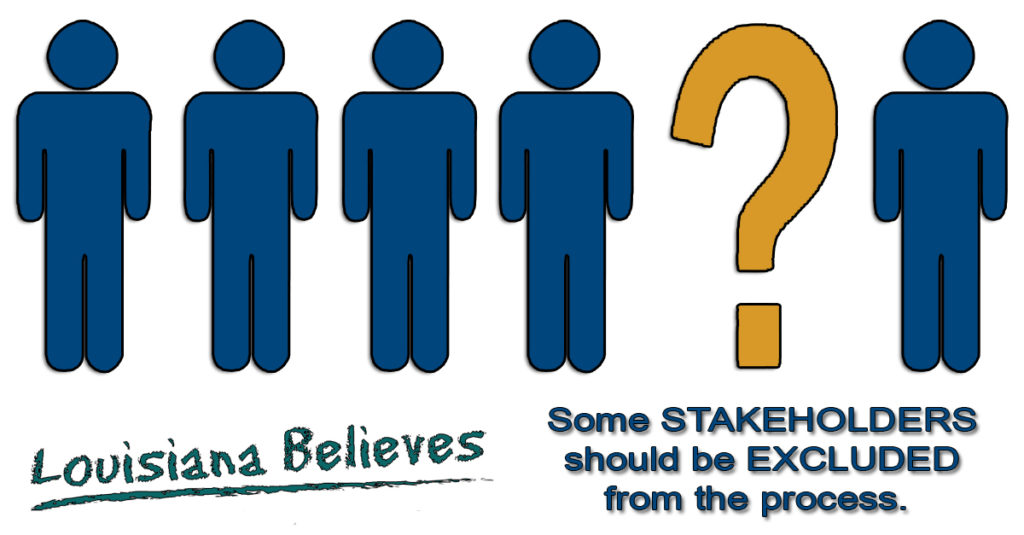
Louisiana Believes: Exclusion is the Best Policy


Do you remember your earliest years in school and receiving your first invitation from a classmate to attend their birthday party? What about the first time you discovered that a classmate had a birthday party and invited your classmates but didn’t invite you? It is generally the first experience that children have with exclusion. The older you get, the more you begin to recognize that the once collective group of your youth begins to splinter off into smaller groups with different levels of exclusivity, and some, inevitably become rivals. This is the exact scenario we see playing out in Louisiana’s education system.
For years now, public education and public educators, have endured the attacks of the education reformers who have formed their highly exclusive groups that dedicate their resources toward making villains out of teachers,  labeling schools as failing and weakening the powers of democratically elected school boards.  With the passage of the Every Student Succeeds Act, there is hope that the systematic exclusion can be a thing of the past, and locally designed accountability plans would be the first step toward improving our educational outcomes. It provides the opportunity for ALL stakeholders to participate in the development of an accountability plan; because, after all, people will support what they feel they had a part in creating. Based on what has transpired over the last few weeks, and the information I have been provided, Louisiana believes that exclusion is the best policy.
You may remember that the Board of Elementary and Secondary Education (BESE) held a special board meeting to approve the submission of Louisiana’s ESSA plan. After much push back from the Governor, school boards, superintendents, teachers and parents, BESE endured a 7+ hour meeting of testimony; all the while knowing the outcome because it had been determined before the meeting even started. If you’d like to read the full story, Click Here.
At the conclusion of this special meeting, a motion was made by BESE Vice President, Holly Boffy, instructing Supt. John White to meet with stakeholders to address a number of concerns which were listed on the motion. They also instructed him not to submit the plan prior to April 14th; despite USDOE allowing provisional submissions until May 4th.
Since I communicate regularly with the heads of the various organizations, I was Louisiana Believes: Exclusion is the Best Policy – Educate Louisiana:


CURMUDGUCATION: Personalization and the Outliers

CURMUDGUCATION: Personalization and the Outliers:

Personalization and the Outliers

Image result for hat on a watermelon


Henry Ford was an early proponent of personalization. "Any customer can have a car pained any color that he wants," said Ford in 1909, "so long as it is black."

There have always been limits to personalization. I like to wear hats, but my head is some sort of extra-large melon, so while hat manufacturers may offer choices to fit the personal size preferences of many customers, I'm an outlier. Many times I'm just SOL on a particular hat.

Imagine that all your potential customers are like a big bell curve. Aim too narrow, meeting the personal preferences of the fat part at the peak, and you will not capture as much of the market as you'd like. Or if you're up for it, imagine a line plot-- the sweet spot is in covering the cluster at the center while ignoring the outliers who are off in their own little corner. You can predict what the majority of your customers probably want-- to be sure of hitting the outliers, you would have to cover the entire charter, including areas that were completely empty. Spread out to offer every option that every customer on the diagram wants, and on the thin ends you'll be losing money. Burger King could offer pineapple and bananas as burger toppings, and somebody might even order it, but they would never sell enough to cover the cost of stocking those ingredients. Maybe nobody would ever choose banana at all, and BK would be out the money. They could advertise they were offering perfectly personalized burgers, but they'd be losing money to do it.


Personalization as a marketing strategy has to aim for the sweet spot where you are hitting maximum customers for minimum. You can only do that by recognizing that some customers have personal preferences that it will cost you too much to meet, and so those outliers must be cut loose. The 
CURMUDGUCATION: Personalization and the Outliers:


Truth in Edvertising – Have You Heard

Truth in Edvertising – Have You Heard:

Truth in Edvertising


Is $1,000 per student kind of a lot to be spending on marketing? That’s how much Success Academy spends, putting the charter network on par with a typical large corporation. In the latest episode of Have You Heard, Jack Schneider and I wade into the murky business of education marketing or *edvertising.* Fast growing and completely unregulated, edvertising is one byproduct of an education marketplace. We talk to researcher Sarah Butler Jessen about what happens when public schools must now compete against charter schools with lavish marketing budgets. And what happens to public education when schools define themselves as *brands.* We’ll be right back, after this commercial break! And if you want a complete transcript of the episode, we can help with that too. 


The Upside to Teacher Resignation Letters Going Viral

The Upside to Teacher Resignation Letters Going Viral:

The Upside to Teacher Resignation Letters Going Viral

teacher resignation letters

A few years ago, Alyssa Hadley Dunn noticed that some of her former students were sharing over social media resignation letters written and posted online by public school teachers. Dunn, assistant professor of teacher education at Michigan State University, was a bit rattled that these heartbreaking letters were having an impression on educators who were just beginning their careers in the classroom.
“They would also send them to me in an email,” Dunn recalls. “They were saying, ‘This is me. This is how I feel! This person is putting into words what I have been experiencing since I got in the classroom.'”
As more of the resignation letters went viral, (You can read them herehere, and here) Dunn came to view them as a new “genre” of teacher public discourse that deserved further study. She wanted to know more. Who were these educators?  Why did they feel compelled to explain their decision to leave the classroom in such a public manner? What do the letters reveal about the state of the U.S. public education system and the teaching profession?
Dunn, along with a team of colleagues and graduate students, examined 23 teacher resignation letters and interviewed eight of the former educators. The result is a trio of studies. The first, “With Regret: The Genre of Teachers’ Public Resignation Letters,” (co-written with MSU asst. professor of education Jennifer VanDerHeide and doctoral student MattheDeroo) focuses on the specific content and shared attributes of the letters. A second, “Activism Through Attrition?: An Exploration of Viral Resignation Letters and the Teachers who Wrote Them” (co-written by doctoral students Scott Farver, Amy Guenther, and Lindsay J. Wexler) takes a look at their utility as a social and political voice for educators. The third upcoming paper will examine how the letters provide an effective counter-narrative to prevailing misconceptions about The Upside to Teacher Resignation Letters Going Viral:

How to Handle Your Celebrity Status - Teacher Habits

How to Handle Your Celebrity Status - Teacher Habits:

How to Handle Your Celebrity Status


I went to Walmart the other day to pick up some adult beverages and help destroy local businesses. As I quickly weaved around an Easter display, I heard:
“Mr. Murphy!”
It was a student from my school. Not one of my students. I didn’t even know his name. But he quite obviously knew mine. He wanted his mom to know it was me.
“Mom! Mom! That’s Mr. Murphy! He’s a teacher at my school!” the boy shouted, just in case someone in the store didn’t know I was there.
Like it or not, we teachers are celebrities. Not huge ones. Not even on the level of a local weatherman. But celebrities nonetheless. Sure, my most rabid fans might be nine-year old kids, but so were Justin Bieber’s, Aaron Carter’s, and Miley Cyrus’s (and look how well they turned out).
If a student sees me anywhere outside of school, it is, for some odd reason, a cause to get very excited. It is as though they can’t wrap their heads around the fact that I have a life apart from work. I don’t really get it, but I bet real celebrities don’t quite understand people’s overreactions to them, either. I’m sure Katie Holmes has no idea why people want to take pictures of her walking out of a store holding a shoe bag.
I admit that, like many Hollywood stars, I do not always relish my celebrity. Sometimes, I just want to buy my six-pack and get out of How to Handle Your Celebrity Status - Teacher Habits:

What Betsy DeVos’s Emphasis on ‘Choice’ Means for School Segregation | The Nation

What Betsy DeVos’s Emphasis on ‘Choice’ Means for School Segregation | The Nation:

What Betsy DeVos’s Emphasis on ‘Choice’ Means for School Segregation
The education secretary’s policies stand to make divisions in our schools and neighborhoods worse, not better.


When questioned on her commitment to principles of diversity and equality in public education, Education Secretary Betsy DeVos keeps repeating one conservative mantra: “choice.”
When pressed during her confirmation process on school desegregation policies, her coy answer—“I do not support programs that would lead to increased segregation”—was laced again with that market-friendly code word: “Empirical evidence finds school choice programs lead to more integrated schools than their public school counterparts.”
The concept of “school choice,” which emphasizes individual family preferences in how students and funding are distributed, squares neatly with the neoliberal reform agenda of pushing public education into the realm of private business. Who could oppose self-determination for parents, after all? But in a “free market” built on an unjust system, not all choices are created equal.
Yet that seems to be DeVos’s vision of “diversity.” Her abrupt decision to cancel an Obama administration program designed to help communities desegregate schools, known as Opening Doors, Expanding Opportunity, has outraged education advocates, who fear Trump will aggravate social barriers in K–12 education. The program was relatively small-scalejust $12 million in seed grants issued to school districts across the country seeking to develop “locally driven strategies to increase socioeconomic diversity in schools.” The grants would barely dent the system-wide civil-rights crisis of school segregation, but DeVos claimed even this fledgling program was unworthy of taxpayer dollars because it was focused on planning and not “implementation,” The Washington Post reports.
Advocates say the cuts mark a setback for creative school-diversity programs that are trying to uphold the constitutional precepts established in Brown v. Board of Education, the precedent that commits the government to correcting institutionalized racial barriers in education by proactively desegregating schools.
DeVos argues the private sector should be trusted to help schools redistribute opportunity, by expanding corporate charter schools and giving families vouchers to finance private schooling, as a supposedly higher-quality alternative to neighborhood schools. But often, these programs end up slowing or reversing desegregation for the families who most need it.
Given the option to transfer to more affluent schools, parents typically make the “rational choice” to perpetuate “white flight” from poorer, blacker urban centers. The flip side of choice is the de facto exclusion of children of color, who get left behind with underfunded, understaffed “inner city” What Betsy DeVos’s Emphasis on ‘Choice’ Means for School Segregation | The Nation:

Chester Finn Jr. Calls for an End to Teacher Tenure | Diane Ravitch's blog

Chester Finn Jr. Calls for an End to Teacher Tenure | Diane Ravitch's blog:

Chester Finn Jr. Calls for an End to Teacher Tenure


In this post, Chester (Checker) Finn Jr. questions the need for teacher tenure. Getting rid of tenure, he says, will save money, as it has in higher education, where money is lavished on administrators’ salaries and facilities, but not faculty (except for the Big Names).
He thinks that teacher tenure is a relatively recent invention, copying tenure in higher education. Actually, this is not true. Teachers began fighting for some form of job protection in the early twentieth century, to avoid losing their jobs to the sister, cousin, or daughter of a politician or school board member. In my reading on the history of tenure, I never saw evidence that teachers wanted to copy higher education, which was then a rich man’s institution. They wanted a modicum of job security to protect them from political interference with their work.
Finn also makes the mistake of confusing teacher tenure with “lifetime employment.” That is a common error. Teacher tenure is NOT lifetime employment. It is a guarantee of due process. If a teacher is accused of an inappropriate action or failure to perform his or her duties, they are entitled to a hearing before an impartial arbitrator. Why is that so onerous? Finn likes the current business model, where a deputy of the boss arrives without notice and says clear out your personal possessions, locks your computer, and escorts you to the door.
He thinks it is a good idea that tenure in higher education is waning but never wonders how “contingent faculty” manage to scrape by on a per-course payment that might add up to only $20,000 a year–or less.
“Tenure arrived in K–12 education as a trickle-down from higher ed. Will the demise of tenure follow a similar sequence? Let us earnestly pray for it—for tenure’s negatives today outweigh its positives—but let us not count on it.
“Almost every time I’ve had an off-the-record conversation in recent years with a university provost, they’ve confided that their institutions are phasing tenure out. Sometimes it’s dramatic, especially when prompted by lawmakers, such as the changes underway at the University of Chester Finn Jr. Calls for an End to Teacher Tenure | Diane Ravitch's blog:

Boston Charter School Teacher Named ‘National Teacher Of The Year’ « CBS Boston

Boston Charter School Teacher Named ‘National Teacher Of The Year’ « CBS Boston:

Boston Charter School Teacher Named ‘National Teacher Of The Year’


BOSTON (CBS/AP) – The 2017 “National Teacher of the Year’ award has gone to a public charter school teacher in Dorchester.


Sydney Chaffee of the Codman Academy Charter Public School is the first National Teacher of the Year from Massachusetts since the inception of the award 65 years ago. She’s also believed to be the first from a charter school to win the award.
Chaffee is a ninth grade humanities teacher who has also taught English language arts and social studies at the school since 2007.
The Council of Chief State School Officers, which gives out the award, said Chaffee “focuses on the intersection of history and literature to help her students learn from lessons of the past to make change in the world.” She also “encourages her students to take risks by creating a safe environment in her classroom for diverse learners,” the organization said.
“I want my students to understand that they are powerful and that they can make change in the world,” Chaffee said Thursday on CBS This Morning. “This award is so humbling because I’m always thinking about how I can be better at this job.”
Chaffee leads the school’s partnership with the Huntington Theatre Company in Boston, which provides acting classes to all freshmen and sophomores at the school. It’s meant to help students find their voices and learn communication skills. It’s also a soft spot for Chaffee, who fondly remembers acting in her high-school plays and later performing as a stand-up comic and in improv comedy.
“Some of that training has helped me as a teacher because, being a teacher, you’re performing all the time in front of your kids, and figuring out how to hook them and how to get them engaged,” said Chaffee, who now spends most of her spare time raising her 2-year-old daughter with her husband.
She also talked to WBZ NewsRadio 1030’s Carl Stevens about what makes a good teacher.
“A good teacher is someone who wants to build relationships with students, who keeps students at the center of everything that they do, and who constantly works to get better,” Chaffee said.
Students said “Sydney” – the school encourages all pupils to call teachers by their first names – motives everyone in the classroom to do their best.


JUST ANNOUNCED: The 2017 National Teacher of the Year is..... @SydneyChaffee, a 9th grade humanities teacher in Massachusetts! pic.twitter.com/pjmPKlgYCU
WATCH: We asked some of @SydneyChaffee's students why they think she's so great. This is what they told us.  pic.twitter.com/TjrIZqem8n


“It’s weird, but she can relate to us,” one student told CBS This Morning. “She’s like a tall adult white lady talking to a bunch of black kids.”
“We are all incredibly proud of Ms. Chaffee and thrilled to see a member of Massachusetts’ strong teaching force represented at the national level,” Gov. Charlie Baker said in a statement. “Ms. Chaffee’s commitment to her students and relentless drive to continually improve her teaching is a model for all of us.”
As the National Teacher of the Year, Chaffee will spend a year advocating for teachers across the United States.
The winner of the national award is traditionally recognized by the president at a White House ceremony soon after being chosen. The Council of Chief State School Officers says no White House event has been confirmed, yet.
WBZ NewsRadio 1030’s Carl Stevens reports
 Boston Charter School Teacher Named ‘National Teacher Of The Year’ « CBS Boston:

Betsy DeVos Is Visiting A Public School This Week With One Of Her Famous Foes | The Huffington Post

Betsy DeVos Is Visiting A Public School This Week With One Of Her Famous Foes | The Huffington Post:

Betsy DeVos Is Visiting A Public School This Week With One Of Her Famous Foes
She and Randi Weingarten will be setting aside their differences on a trip to Ohio.


When President Donald Trump first nominated Betsy DeVos for U.S. secretary of education in November, labor leader Randi Weingarten did not mince words.
“The president-elect, in his selection of Betsy DeVos, has chosen the most ideological, anti-public education nominee put forward since President Carter created a Cabinet-level Department of Education,” stated Weingarten, who is president of the American Federation of Teachers, the nation’s second-largest teachers union. “DeVos is everything Donald Trump said is wrong in America.”
But on Thursday, DeVos and Weingarten are attempting to find common ground by visiting a public school together. In February, shortly after DeVos was confirmed, the pair decided they would travel to a school of the other’s choice.
The goal, according to the American Federation of Teachers, is to show DeVos the possibilities of great public schools, as opposed to charter schools and private schools. DeVos also invited Weingarten to visit a school with her ― such as a charter school ― although such a visit has not yet been announced. 
The pair will be touring Van Wert City Schools, a public school district in Ohio. While the school district has a mixed academic record, it has deeply invested in strategies that engage community members and serve the social and emotional needs of children. It is an example of a school district that would be hurt by the passage of Trump’s proposed education budget, which slashes federal funding for education by $9 billion, according to an op-ed Weingarten wrote in a local Ohio outlet, the Times Bulletin Media

Majority of Californians polled favor vouchers for private schools | EdSource

Majority of Californians polled favor vouchers for private schools | EdSource:

Majority of Californians polled favor vouchers for private schools


Rejecting President Donald Trump’s immigration crackdown, Californians overwhelmingly said in a poll released Wednesday that they favor designating their school districts “sanctuary safe zones” to protect undocumented students and their families from federal immigration enforcement efforts. And they support requiring staff to keep information about the immigration status of students and their families completely confidential.
But Californians appear in sync with one issue that Trump and his Secretary of Education Betsy DeVos are advocating: vouchers for private and religious schools. Vouchers are tax-funded payments that parents can apply toward tuition to private and, in some states, religious schools of their choice.
The nonprofit, non-partisan Public Policy Institute of California (PPIC) asked, “Do you favor or oppose providing parents with tax-funded vouchers to send their children to any public, private, or parochial school they choose?” Sixty percent of all adults and two-thirds of public school parents say they support them, while 37 percent of all adults and 32 percent of public school parents oppose them. For likely voters, the split is 50 percent for, 46 percent against.
Although Trump campaigned on establishing a $20 billion voucher program, he hasn’t yet put forth a plan. An alternative, which Education Week reports Trump may propose, is a program adopted by Florida and other states. It offers tax credits to businesses and individuals to encourage donations to scholarship funds for private or religious schools.
PPIC’s 13th annual K-12 survey would appear at odds with California voters’ strong past opposition to vouchers. Twice before, in 1993 and 2000, voters rejected voucher initiatives, with 70 percent voting against them each time. However, in 1998, two years before the last vote and the last time that PPIC polled Californians on the issue, 58 percent of adults favored vouchers while 36 percent opposed them.
That tells you that a single question on the concept of vouchers does not tell the whole story, said State Board of Education President Michael Kirst, who wrote analyses for both voucher initiatives. “Support eroded for vouchers the more that voters learned about the details and the implications,” he said. He said to accurately Majority of Californians polled favor vouchers for private schools | EdSource:
PPIC Statewide Survey: Californians and Education
Full Report[PDF, 671K]
A solid majority of Californians favor tax-funded vouchers that would allow parents to send their children to any school they choose. At the same time, most rate the quality of their local public schools positively and view state funding for public schools as inadequate. Many are concerned about the impact of increased federal immigration enforcement efforts on undocumented public school students and their families.
 Crosstabs:
All Adults [PDF]
Likely Voters [PDF]
 Time Trends:
All Adults [PDF]
Likely Voters [PDF]
This research was supported with funding from the Dirk and Charlene Kabcenell Foundation, the S. D. Bechtel, Jr. Foundation, the Silver Giving Foundation, and the Stuart Foundation.