Latest News and Comment from Education

Sunday, February 12, 2017

McCleary Crime Scene Find the Money Word Search | Seattle Education

McCleary Crime Scene Find the Money Word Search | Seattle Education:

McCleary Crime Scene Find the Money Word Search

Tax_The_Rich
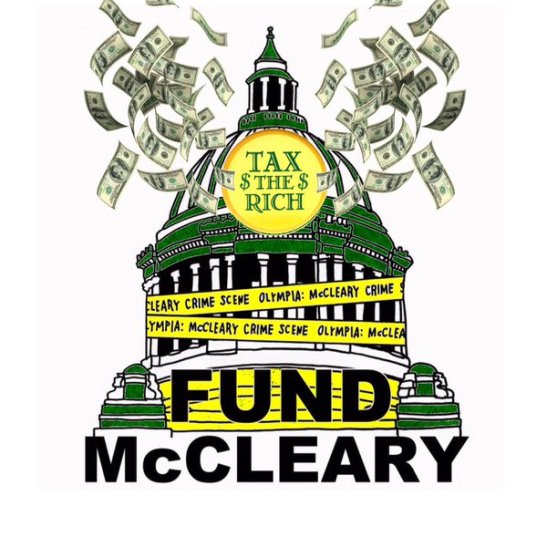
A year ago Teacher Retention Advocate Parents (TRAP)  hosted a coloring contest to draw attention to Washington State’s criminally under-funded public schools.
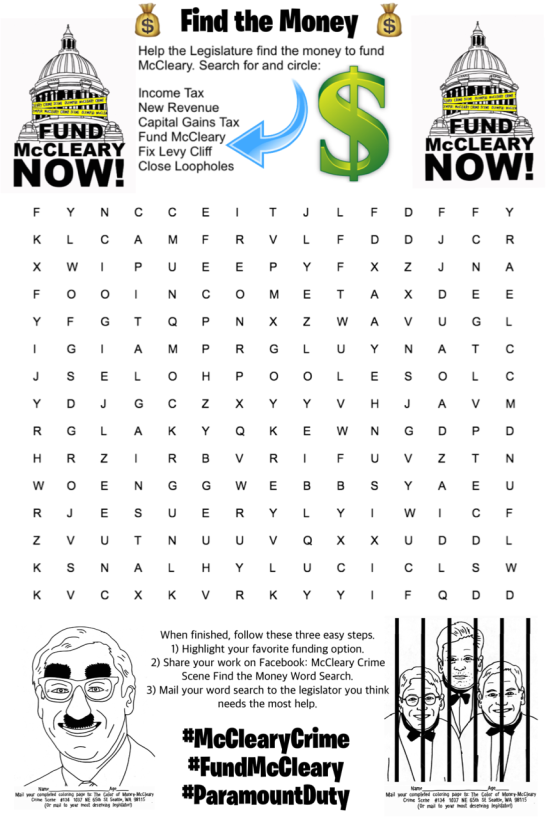
Today, TRAP is back – because the Legislature STILL can’t find the money. Let’s help them out.
Please print out your own copy of the word search, find the money for the Legislature, and then share your work on Facebook: McCleary Crime Scene Find the Money Word Search. (printable link at the bottom of the page)
Once you’ve done that, please mail your word search to the legislator you think needs the most help finding the money.
mccleary-word-search-2

Get your word search here:
More information available at:
Twitter: @McClearyCrime
hashtags: #McClearyCrime #FundMcCleary , #ParamountDuty
email: teacher.retention.advocates@gmail.com
-Carolyn Leith


 McCleary Crime Scene Find the Money Word Search | Seattle Education:

CURMUDGUCATION: Charter Schism Explainer

CURMUDGUCATION: Charter Schism Explainer:

Charter Schism Explainer

The charter world (which is mostly all that's to what we mean by "education reform") has been wrestling and fracturing and considering serious marital counseling over the past year or so. This bit of a crisis has been exacerbated since, oh, November. I've been drawn into conversations about this schism several times in the last week, which means it's time to write a simple explainer.

Feel free to grab some popcorn and watch


Warning: the goal here will be to make this issue simple, so I'm going to strip out all nuance and grossly oversimplify. I am also not going to get sidetracked into where I think they're wrong, misguided, or twisty-- you have the whole rest of the blog to read my thoughts on that. That's not the focus here today. Just so you know that going in. Let the questioning begin:

Aren't all education reformers on the same side of everything?

No. Lumping all reformsters together is a mistake, just like lumping all of their opponents together.

So what are the two camps when it comes to charters?

We can divide charter supporters into two groups.

The social justice crowd wants charters as an engine of equity and opportunity. They see non-wealthy non-white students, mostly in urban centers, as desperately in need of alternatives. Urban school, schools that serve the poor, schools that are tied up in institutional racism-- these schools should be helping students to rise, and instead are seen as part of the mechanism that holds those students down. So social justice charteristas want an alternative, a choice, a place that isn't the "failing public school" to send their child.

The free market crowd believes that a free market approach to education is just inherently better. They believe it will lead to quality through competition. They believe that businessmen will do a better job of running schools, better meaning both "producing better graduates" and "producing profitable outcomes and good ROI."

They worked essentially on two different problems. For social justice charteristas, the problem was that too many non-wealthy non-white families couldn't get into a good school. For free marketeers, the problem was that the education sector wasn't functioning on free market principles. They were 
CURMUDGUCATION: Charter Schism Explainer:


Moment of Silence - Bown v. Gwinnett County School District (1997) / Brown v. Gilmore (2001) | Blue Cereal Education

Moment of Silence - Bown v. Gwinnett County School District (1997) / Brown v. Gilmore (2001) | Blue Cereal Education:

Moment of Silence - Bown v. Gwinnett County School District (1997) / Brown v. Gilmore (2001)

Moment of Silence

Two cases in the early 1960s largely eliminated state-sponsored prayer from public schooling. Engel v. Vitale (1962) and Abington v. Schempp (1963) are to this day touted by the far right as responsible for having kicked God out of schools – leading inevitably to sex, drugs, violence, rock’n’roll, corduroy, divorce, the pill, AIDS, the Clintons, terrorism, and a Kenyan sleeper-cell Mooslim illegitimately seizing the White House for eight long, painful years. 
The solution, of course, is to get God back IN our schools by requiring regimented recitation of state-approved chants. He LOVES those! Do this, we are assured, and America’s problems will vanish faster than you can say “civil liberties!” 
Alabama led the way in the 1980s with a series of legislation which eventually led to Wallace v. Jaffree (1985), the only “Moment of Silence” case to reach the Supreme Court to date. The Court determined that the state could mandate a “moment of silence” during the school day, but could not lead or even encourage prayer during that time. 
The goals of Alabama’s legislation were no secret – state legislators ran on promises to get prayer back into schools, or as close as they could get it. That’s largely what stifled further establishment in Alabama – the Court refused to pretend the history and rhetoric associated with legislation didn’t exist while considering its constitutionality. 
Legislative leaders in other states took note and began exercising greater caution as they argued for moments of silence of their own. Suddenly this 60-second period would promote non-violence and academic reflection and gluten-free living and all sorts of things. 
A decade after Wallace, Georgia passed its own version of a “moment of silence.” It was challenged by a classroom teacher and ended up in the Eleventh Circuit Court of Appeals as Bown v. Gwinnett County School District (1997). The Court determined that the Moment of Quiet Reflection in Schools Act did NOT violate the Establishment Clause. 
The Court’s written opinion is unremarkable, but includes some details of note, such as this bit from what they call the Act’s “uncodified preamble”:
The General Assembly finds that in today's hectic society, all too few of our citizens are able to experience even a moment of quiet reflection before plunging headlong into the day's activities. Our young citizens are particularly affected by this absence of an opportunity for a moment of quiet reflection. The General Assembly finds that our young, and society as a whole, would be well served if students were afforded a moment of quiet reflection at the beginning of each day in the public schools.
It's an absurd bit of glossy nonsense, but it’s constitutional nonsense. We could all probably benefit from drinking more water as well, but I notice no one’s mandating a moment of refreshing hydration each morning. But whatever.  
Also in the ‘History of the Case’:
Senator David Scott, the primary sponsor of the Act… represented an urban district in Atlanta, Georgia. He was the Chairman of the Senate 
Moment of Silence - Bown v. Gwinnett County School District (1997) / Brown v. Gilmore (2001) | Blue Cereal Education:


Hitting Left with the Klonsky brothers. Coming up. Bill Ayers and Karen Lewis. | Fred Klonsky

Hitting Left with the Klonsky brothers. Coming up. Bill Ayers and Karen Lewis. | Fred Klonsky:

Hitting Left with the Klonsky brothers. Coming up. Bill Ayers and Karen Lewis.


Our weekly radio gig continues into week three.
Friday, February 17th we will be joined in-studio by our old friend and teaching colleague, Bill Ayers.
On Friday, March 3rd Chicago Teachers Union President Karen Lewis will be joining us. Another old friend. 
We broadcast live from Bridgeport on Chicago’s south side on 105.5FM at 11:00 with live streaming on Lumpenradio.com.
You can download the app to your smart phone from iTunes.
I post each show on this blog. And we are looking into getting a version done as a podcast.
Hitting Left with the Klonsky brothers. Coming up. Bill Ayers and Karen Lewis. | Fred Klonsky:


The endgame of corporate reform in public school education: Part 1, | Seattle Education

The endgame of corporate reform in public school education: Part 1, What do Betsy DeVos and Seattle Public School’s IT Lead John Krull have in common? | Seattle Education:

The endgame of corporate reform in public school education: Part 1, What do Betsy DeVos and Seattle Public School’s IT Lead John Krull have in common?

endgame
“It was terribly dangerous to let your thoughts wander when you were in any public place or within range of a telescreen. The smallest thing could give you away. A nervous tic, an unconscious look of anxiety, a habit of muttering to yourself – anything that carried with it the suggestion of abnormality, of having something to hide…There was even a word for it in Newspeak: facecrime, it was called. The Party’s surveillance tactics and technology are so advanced that even the smallest twitch can betray a rebellious spirit.”
George Orwell, 1984

The endgame of corporate reform of public school classrooms creates a clearly defined two-tier system:
  • Students in public schools will be taught the basics by way of the Common Core Standards on a computer and assessed the same way with student performance and psychological attributes stored and tracked.
  • Students in private schools will have well qualified and highly educated teachers offering various subjects in depth along with classroom discussion and learning experiences outside the classroom. Privacy is insured.
One tier is for future workers producing when and where the market demands. The second tier will be the professionals and leaders such as diagnosticians, diplomats, attorneys, scientists, writers, architects and doctors.

The endgame of corporate reform in public school education, Part 2 : Social Emotional Learning (SEL) and the Federal Government
In part 1 titled What do Betsy DeVos and Seattle Public School’s IT Lead John Krull have in common? The endgame of corporate reform in public school education, I described … Continue reading →
The Endgame of Corporate Reform, Part 3: Online Learning, Social, Emotional Learning and the Department of Defense
This is the third and final post in the series. Part 1: The endgame of corporate reform in public school education: What do Betsy DeVos and Seattle Public School’s IT Lead John … Continue reading →
Seattle Education | For the news and views you might have missed - http://wp.me/NbRQ 

Jersey Jazzman: Republicans Must Own Trump; "Reformers" Must Own DeVos

Jersey Jazzman: Republicans Must Own Trump; "Reformers" Must Own DeVos:

Republicans Must Own Trump; "Reformers" Must Own DeVos


One of the more amusing things to come out of the Trump presidency -- that is, as amusing as things can get during this horror show -- is watching "moderate" Republicans and other center-rightists try to distance themselves from The Donald. Here, for example, is Andrew Sullivan (the guy who tried to convince us racism could be part of a legitimate academic pursuit) now thoroughly vexed that a maniac like Trump is in the White House. And here's David Frum, scared that Trump will sail to an easy reelection because Reaganomics always works, and therefore people will be so happy with the booming economy that they will readily overlook Trump's fascist tendencies.

The problem with Sullivan's and Frum's arguments, of course, is that they desperately want to believe Trump is an anomaly; that this corrupt, intemperate, freak of a man just happened to be in the right place at the right time, up against the wrong opponent. It's only through some strange confluence of circumstances and some overlooked back door in America's political code that Trump was able to worm his way in and take power.

The hard truth, however, is that Donald Trump was inevitable. That he is a product of a political and media system in which Sullivan and Frum have held positions of influence for years. That the conservative/neo-liberal framing of the issues (what Atrios calls the "Free Republic to New Republic" range of acceptable discourse) set up the rise of a nationalist like Trump.

Plenty of others have taken down Frum and Sullivan from this angle (hereherehere), and I'm not about to dive into their complete bodies of work without a substantial paycheck and a gas mask. So I won't contribute any more to this debate; I only wish to point out this ongoing attempt by the "reasonable" right to distance themselves from Trump as a way to explain what is already happening in my little universe of education policy:

Some of the center-right is disavowing Trump, even though they were instrumental in creating him -- just like some of the neoliberal school "reformers" are disavowing Betsy DeVos, even though they were instrumental in creating her.

Here's a good example of this, courtesy of (you guessed it) The New Republic:

Perhaps the most nebulous term in these discussions—aside from “school reform” itself—is the simple phrase “school Jersey Jazzman: Republicans Must Own Trump; "Reformers" Must Own DeVos:


A Thank You Letter to Betsy DeVos From a Public School Teacher

Teacher's Response to Betsy DeVos | POPSUGAR News:

A Thank You Letter to Betsy DeVos From a Public School Teacher


Thank you, Betsy.
That sounds strange coming from a public school teacher of 15 years. Indeed, after a day of teaching fourth graders, who are diverse in every way and whose future is now in your control, saying thank you is the last thing I thought I'd say today. But thanks. On Tuesday, 50 Republican senators voted for you, you who would not have made the cut to be hired as a tutor for their own children. Thank you, Betsy, for showing me money has power, but not over all.
I don't know if I feel worse for the senators who sold out because of the money you gave them or for the ones who sold out for free. But not everybody let their vote be bought, and that gives me hope.
Thanks, Betsy, for by showing me my fears, you clarified my beliefs. Yes, you inspire a lot of fears in me . . . will class size grow? Will Title I be cut? Will English For Speakers of Other Languages (ESOL) services disappear? Will special education be decimated? How will my job change? Will my students have the same opportunities for college as my generation?
Error loading media: File could not be played
Through clarifying my beliefs, you triggered my actions. Thank you for giving me more solidarity with my co-workers, friends, family, and world. In our mutual sorrow at your lack of credentials, we came together. On Tuesday, I did not eat while grading papers or planning lessons. I sat with my co-workers as we mourned the loss of our voice. During the fight to block your confirmation, so many teachers, students, and parents spoke up while calls and letters to senators were ignored and protests delegitimized.
My union never lit a fire beneath me — but you did. Thank you.
Thank you, Betsy, for inflaming my disappointment in our government. Mr. Rogers taught us to look for the helpers in any time of darkness. But it was you who made it dark enough for me to look.
I watched hours of CSPAN listening to thoughtful testimony of so many education advocates and became obsessed with ordering a bound copy of Monday night's incredible congressional record. I have never before felt so political or so united behind my party. Now I want to donate money, support the candidates I believe in, organize . . . the sky is the limit. My union never taught me this, never lit a fire beneath me — but you did. Thank you.
More than anything, I want to teach. I want to continue to teach my fourth graders that citizenship means respect for all and a responsibility for each other, to read critically, to value being informed. I want to teach them that a million small efforts will eventually be more powerful than one large campaign check. And I want to teach them that America will always return to freedom, no matter how much corruption tries to reign.
So, thank you, and good luck to you. You have no clue what you just signed up for.
Teacher's Response to Betsy DeVos | POPSUGAR News:

CURMUDGUCATION: ICYMI: This Week's Reading + Catch up with CURMUDGUCATION

CURMUDGUCATION: ICYMI: This Week's Reading (2/12):

ICYMI: This Week's Reading 


The list is long this week, but at least it's not all politics. At least, I'm pretty sure it's not all politics. 

I Never Cared Much About Politics; The Trump Nominated Betsy DeVos

A guest at the Washington Post. The title is self-explanatory

Holy Warrior Against the Welfare State

Jennifer Berkshire's trip to Michigan yielded a lot of good writing. This piece appeared in the Baffler and explains a bit more about DeVos's Amway roots, among other holy things.

Charter School Killed Crook County Grad Rate

From Oregon, the story of hos cyber-charter results made a mess out of a district.

I Was Trained for the Culture Wars

A defector from the world of ultra-conservative Christianity gives us a picture of what education looks like in the world of Mike Pence and Betsy DeVos

The Rise of Crony Appointees and the Inexpert Ruling Class

Paul Thomas connects the dots between Arne Duncan and Betsy DeVos

You Don't Want DeVos Style Charter Schools

What the DeVos approach to charters looks like on the ground

Unexpected Consequences of Test Based Accountability

Reformster Robert Pondiscio at Education Next explaining how much of a mess high stakes testing makes out of schools. I don't agree with his solution, but it's a pretty good explanation of the problem.

Betsy DeVos Christian School Vouchers

From Mother Jones, another well-researched in-depth look at how DeVos made a mess out of Michigan

Ten Year Old Applies to be Cambridge Professor of Legos

A short case study in how to properly handle a small child with big dreams.

Can a Universal Voucher Program Succeed

A good look at the ins and outs of such a system

The Best Writing Teachers Are Writers Themselves

Yes. This.

A Visit to the For-Profit Edu-Mall

A comic strip series from Mr. Fitz. Great explainer to share with people who aren't up for reading whole paragraphs.


CURMUDGUCATION: ICYMI: This Week's Reading (2/12):


Catch up with CURMUDGUCATION: The Wealth Gap: Worse Than You Think + Impersonal Personalization


CURMUDGUCATION: Reformsters Contemplate Race (Part 2)

CURMUDGUCATION: Reformsters Contemplate Race (Part 2):

Reformsters Contemplate Race (Part 2)

Image result for Contemplate Race segregation

I've worked my way slowly through two panel discussions held at the American Enterprise Institute a couple of weeks ago. They're interesting and mostly thoughtful discussions among reformsters about how reformsterism (by which, mostly, they mean the charter movement) can navigate this new era and the fissures that it has opened up in reformland. You can read about the first panel here, but I'm going to walk you through the second one now.

This conversation is a bit broader than the first one, and I'm going to give you broad strokes of broad strokes. If you want to watch yourself, the second panel starts around the 1:10:00 mark on the video below.

Who's here?

The panel moderator is Stacy Childress (New Schools Venture Fund), and participants are Andy Smarick and his winter beard (AEI, Bellwether), Chris Stewart (EdPost), Marilyn Rhames (Teachers Who Pray, EdPost), Jason Crye (Hispanics for School Choice) and Derrell Bradford (NYCAN). Interesting assortment.

So, we can't assume that we can do the work of school reform without discussing race equity etc. Our charge is to stay in dialogue even across our disagreements. Childress is saying that the goal here is to hash out differences without "permanently alienating potential allies" There was apparently a conversation about all this earlier, so Childress is asking for a sort of reflection-recap of that.

Note: There's a lot of discussion in this panel about disagreements and dialogue. They mean disagreements and dialogue within the reformy community. Nobody here is going to talk about how to achieve dialogue with their "opponents" or the "enemy" or, as someone will put it later, the "bad guys." This is about dealing with internal discord.

What was one thing you heard today from a colleague that helped you have a clearer 
CURMUDGUCATION: Reformsters Contemplate Race (Part 2):


Are charters the answer for ed? Testifying @NAACP charter school hearing – Cloaking Inequity

Are charters the answer for ed? Testifying @NAACP charter school hearing – Cloaking Inequity:

Are charters the answer for ed? Testifying @NAACP charter school hearing


Are charters the answer for a nation’s long history of underserving the needs of poor children?
The NAACP’s most recent national resolution on charter schools has elicited a vigorous discourse about charter schools in the United States. The nation’s largest and oldest civil right organization is also a democratic, community-based organization. As a result, the National Board of the NAACP after its vote to support a charter moratorium, announced the National Task Force for Quality Education on October 15. This new group is charged with studying education quality, “until safeguards are in place to provide better transparency regarding accountability, and to prevent cases of fraud and mismanagement.” See the post Updated: @NAACP Holding Charter School Hearings Across Nation
Here are my remarks as prepared for the testimony (but necessarily as delivered). The written remarks are followed by a video of the remarks taken by Lauren Steiner. I believe that professional video of all seven hearings will be available from the NAACP at some point soon.
My Confession is that I am a former charter Volunteer (MN), Educator (CA), Parent (TX) and Donor (CA) I’ve also publish peer reviewed research on charters.
I am a scholar. We are in pursuit and convinced by evidence. So I’d like to talk about evidence today.
Here are 10 things to consider about the market-based charter schools debate:
  • Where did market-based school choice come from? Writing in the 1960s, academics such as the libertarian economist Milton Friedman, followed by John Chubb and Terry Moe in the 1990s, argued for a profit-based education system where resources are controlled by private entities rather than by democratically elected governments. They recommended a system of public education built around parent-student choice, school competition, and school autonomy as a solution to what they saw as the problem of direct democratic control of public schools.
  • School “choice” does not cure the inequality created by markets. Not surprisingly, the academics neglected to mention that market-based mechanisms are the very system that created the inequities in American public schools today. Along with other public policies, including redlining, market forces created racial and economic segregation. Instead of making this situation better, school choice made this situation worse. Research by the UCLA Civil Rights project has demonstrated this fact. I have included this report and other resources in your green folders. I have a few extra packets that I can give to folks after my presentation.
  • What does the research tell us that happens when everyone has choice? Also known as Universal choice? A group of economists mentored by Friedman, the Chicago Boys, took Friedman’s theories about education back to their home country and to push an education system with universal choice and relaxed regulation and oversight. Over the past several decades, Chile simultaneously became one of the richest countries in South America and the most unequal developed country in the world. In markets there are winners and losers.s I also recommend you check out Linda Darling-Hammond’s, a Stanford Professor, new book Global Education Reform Movement. This book examines countries around the world and finds that market-based reforms have failed spectacularly when compared with equity-based reforms.
  • The position of the NAACP and Black Lives Matter on privatization is consistent with the views of past civil rights leaders. NAACP co-founder E.B. Du Bois, in his essay Negroes and the Crisis of Capitalism in the U.S., extolled the virtues of collaborative social and government action. He railed against the role of businesses and capitalistic control that “usurp government” and made the “throttling of democracy and distortion of education and failure of justice widespread.” Malcolm X characterized market-based public policy  as “vulturistic” and “bloodsucking.” He advocated for collaborative social systems to solve problems. Martin Luther King Jr. argued that we often have socialism in public policy for the rich and rugged free market capitalism for the poor. White academics pressing for market-based school choice in the name of “civil rights” ignore this history of African American civil rights leaders advocating for collaborative systems of social support and distrusting “free market” policies.
  • Is the NAACP and Black Lives Matter position on schools out of touch with civil rights? A barrage of criticism has come from market-based school choice proponents and charter operators about the NAACP and Black Lives Matter resolutions. However, the NAACP has for years been consistent in its critique of charters schools. At the 2010 convention, the NAACP national board and members supported a resolution saying that state charter schools create “separate and unequal conditions.” A review of ten years of research supports their statement. I have included the review of research in your packets. More recently, in 2014, the NAACP connected school choice with the private control of public education. More recently, the 2016 resolution includes a variety of civil rights-based critiques such as a lack of accountability, increased segregation, and disparate punitive and exclusionary discipline for African Americans.
  • Do families actually choose charter schools? Probably the most prominent argument heard from market-based education proponents is that school choice means that families can choose their own schools. Proponents of market-based school choice have argued that charter schools were designed to have both more freedom and more accountability. Critics of privately-managed schools point out that charters are actually afforded less accountability. Mr. Ungar in his remarks cited a recent report released by the ACLU and Public Advocates found a variety of illegal exclusionary policies in more than 20 percent of charter schools they examined. In New Orleans, parents now only have charters to choose from in the Recovery School District. The New York Times has described the reality of school choice for parents in Detroit as “no good choice.” Jonathan Williams did speak to Special Education. Our new study in the Stanford Law and Policy Review (you can find a copy in the green folder)s that was released a few weeks ago used geospatial analyses to examined charter schools and public schools nearby. While statewide number in Texas suggested similar proportion, when you conduct analyses at the local level, the disparities in access were statistically apparent.
  • Why is more oversight and accountability needed for charters? Proponents of more accountability for charter schools want parents to be able to choose from high-quality public schools. Instead, charter schools have the power to selectively choose students who will perform well. Charter supporters blame a few bad apple charters for limiting access and expelling too many students. But charter school supporters and their lobbyists consistently support laws that promote lax oversight and regulation. For example, the California Charter School Association has actively lobbied against data collection and accountability for charter schools. The pastor asked the Lord for opportunities for us to collaborate. I was recently asked during a conversation with Howard Fuller where we those could disagree could collaborate with the charter industry. Since that time, I have come to the belief that accountability and transparency is one such place.
  • Are teachers’ unions leading the opposition to school choice? Another common argument from supporters of privately-managed schools is that the teachers’ unions are the primary opponents of market-based school choice. But as Cristina De Jesus, from Green Dot mentioned, there are tens of thousands of unionized charter school teachers. The attacks on unions from charter supporters is misplaced. In fact, we can thank unions for the charter school idea. Albert Shanker, former president of the American Federation of Teachers, first proposed the charter school idea in 1988. But his perspective became that his idea was being misappropriated in the creation of anti-democratic, privately managed public schools. He realized that charters were increasingly going to a group of people who were “eager for public funds but could care less about public education.” Considering peer reviewed research and reports from the Detroit Free Press— the charter agenda pressed by Betsy Devos in Michigan may be the worst example with the vast majority of charters being for profit and have some the lowest accountability and transparency standards.
  • Who is supporting charters schools behind the scenes? The hundreds of millions of dollars spent to promote privately managed schools is coming from the non-democratic foundations of billionaires such as Bill and Melinda Gates Foundation, Broad Foundation and the Walton Family Foundation. Smaller organizations including the Black Alliance for Education Options and the Libre initiative and the Democrats for Education Reform have accepted tens of millions of dollars over the years from billionaires and their foundations to press for market-based school choice. It is very clear that civil rights organizations, academics, parents, students, media and stakeholders that have brought critiques to our democratic discourse about private control and privatization are the underdogs in this conversation.
  • Do charters perform better than public schools? Charter proponents often cite studies produced by The Center for Research on Education Outcomes (CREDO) at Stanford University. CREDO studies are not peer reviewed. But charter school supporters and the media point to CREDO’s 2015 urban charter study to say that African American and Latino students have more success in charter schools. Leaving aside the integrity of the study, what charter proponents don’t mention is that the performance impact is .008 and .05 for Latinos and African Americans in charter schools, respectively. These numbers are larger than zero, but you need a magnifying glass to see them. Contrast that outcome with policies such as pre-K and class size reduction with far more unequivocal measures of success than charter schools. Also, CREDO doesn’t usually compare schools in their studies. Instead, researchers use statistics to compare a real charter school student to a virtual (imaginary) student based on many students attending traditional public schools. In spite of criticism of CREDO’s methods and lack of peer review, charter proponents and the media continue to cite the CREDO studies as important evidence demonstrating charter school success. 
Considering the election of Donald Trump, we may have reached a watershed moment for market-based school choice and the privatization and private control of education. I probably don’t have to tell you that Donald Trump loves charter schools. The recent appointment of Betsy Devos has made this conversation more salient than ever. Donald Trump has promised to spend 20 billion on school choice in his first 100 days. Considering his recent executive orders, he appears to be determined to implement his private control and privatization agenda regardless of the consequences of his actions on schools and communities…
In conclusion,
I have talked about ten of the more contentious points in the debate about charter schools, but there is one major point of agreement: Poor students in the United States have less opportunity for a high quality education than students living in wealthy areas.
It is the shame of our nation.
We must NOT, MUST NOT, do nothing… because African Americans, Latinos and other poor students continue to be underserved in our society on purpose.
But there is an alternative, historical and emerging research supports the expansion of community-based, democratically controlled education approaches instead of private control privatization as the best course of action for families and communities of color. Community schools in one such approach as raised by Cecily. Communities of color, unions, school board members, teachers and parents should be seen as the solution and not the problem.


Are charters the answer for ed? Testifying @NAACP charter school hearing – Cloaking Inequity:

For more on Betsy Devos click here.

Check out and follow my YouTube channel here.
Please Facebook Like, Tweet, etc below and/or reblog to share this discussion with others.
Want to know about Cloaking Inequity’s freshly pressed conversations about educational policy? Click the “Follow blog by email” button on the home page.
Twitter: @ProfessorJVH