Thursday, January 19, 2017

Obama administration spent billions to fix failing schools, and it didn’t work - The Washington Post

Obama administration spent billions to fix failing schools, and it didn’t work - The Washington Post:

Obama administration spent billions to fix failing schools, and it didn’t work


One of the Obama administration’s signature efforts in education, which pumped billions of federal dollars into overhauling the nation’s worst schools, failed to produce meaningful results, according to a federal analysis.
Test scores, graduation rates and college enrollment were no different in schools that received money through the School Improvement Grants program — the largest federal investment ever targeted to failing schools — than in schools that did not.
The Education Department quietly published the findings on the website of its research division on Wednesday, hours before Obama’s political appointees walked out the door.
“We’re talking about millions of kids who are assigned to these failing schools, and we just spent several billion dollars promising them things were going to get better,” said Andy Smarick, a resident fellow at the American Enterprise Institute who has long been skeptical that the Obama administration’s strategy would work. “Think of what all that money could have been spent on instead.”
The School Improvement Grants program has been around since the administration of President George W. Bush, but it received an enormous boost under Obama. The administration funneled $7 billion into the program between 2010 and 2015 — far exceeding the $4 billion it spent on Race to the Top grants.
The money went to states to distribute to their poorest-performing schools — those with exceedingly low graduation rates, and poor math and reading test scores, or both. Individual schools could receive up to $2 million per year for three years, on the condition that they adopt one of the Obama administration’s four preferred reforms: replacing the principal and at least half the teachers, converting into a charter school, closing altogether, or undergoing a “transformation,” including hiring a new principal and adopting new instructional strategies, new teacher evaluations and a longer school day.
The Education Department did not track how the money was spent, other than to note which of the four strategies schools chose.
Arne Duncan, Obama’s education secretary from 2009 to 2016, said his aim was to turn around 1,000 schools every year for five years. “We could really move the needle, lift the bottom and Obama administration spent billions to fix failing schools, and it didn’t work - The Washington Post:


Our Next Secretary of Education Should Know Education | Schott Foundation for Public Education

Our Next Secretary of Education Should Know Education | Schott Foundation for Public Education:

Our Next Secretary of Education Should Know Education

As Americans we celebrate the ideal that a freely elected president may appoint, with the advice and consent of the Senate, anyone capable of carrying out his or her vision for the future of our nation. To the victor go the spoils. However, in this week’s first hearing of Betsy DeVos, President Trump’s nominee for Secretary of Education, it became immediately clear DeVos lacks even the most basic knowledge and capabilities required for the responsibility of U.S. Secretary of Education.
The DeVos Senate confirmation hearing did little to inspire confidence that she can competently serve as the chief of our nation’s public education system. In fact, the hearing laid bare astonishing deficits in DeVos’s understanding of the obligations and authority of the Department of Education. She appeared troublingly unversed in significant education issues and ill-prepared on current realities including:
  • Confusion around the responsibilities of schools to comply with the Individuals with Disabilities Education Act and the penalties the law applies for failing to meet the needs of students with special needs;
  • No clear understanding of and stance on standards of competency—also known as the proficiency vs. growth debate;
  • An insensitive approach to issues surrounding guns in schools;
  • A lack of clarity on the need to hold for-profit charter schools to the same level of accountability as traditional schools; and
  • A lack of clarity on the need to enforce rules that require private career academies to offer students real, marketable skills.
Her inability to assemble the team and dedicate the time necessary to adequately prepare for one of the most predictable parts of the process and the job—the Senate Confirmation Hearing—should be alarming and offensive to Senate members on both sides of the aisle.
DeVos is a well-heeled philanthropist who has championed the expansion of charter schools, school vouchers, and tuition tax Our Next Secretary of Education Should Know Education | Schott Foundation for Public Education:


UnBEARable: Reflections on the DeVos Hearing Marla Kilfoyle, Badass Teachers Association BATs

Badass Teachers Association:

UnBEARable:  Reflections on the DeVos Hearing

Marla Kilfoyle, Executive Director The Badass Teachers Association (BATs)

I would like to begin this piece with the following:


Shame on you Sen. Alexander for attempting to protect Betsy DeVos, a grossly unqualified candidate, for Secretary of Education.


Shame on you Sen. Alexander for putting politics over the children of this nation.  


Now many would argue that Arne Duncan and John King were no better in this office.  I wholeheartedly agree but…..


Duncan and King did not “buy” their way into this office and BOTH knew that IDEA was a federal law that all states have to follow.   Neither of them, to my knowledge, supported having guns in schools as Betsy Devos did last night, just in case you need to shoot a grizzly bear!  


Perhaps the most disgusting thing to come out of this hearing, other than the testimony of  Betsy DeVos, was the fact that a national grassroots group of parents called The Journey for Justice Alliance bussed over 100 parents from Detroit to attend this hearing.  The parents bussed to DC were, and still are, victims of the DeVos agenda for school privatization. The Network for Public Education reports, “Detroit parents are (were) rightfully outraged that they traveled from Michigan by bus, leaving at midnight to arrive the morning of the hearing, only to be unable to gain entrance to the hearing room. Who did make it into the hearing room? School choice advocates in yellow scarves who replaced line waiters from what appeared to be a paid service to stand in line since 7 am. The folks in the yellow scarves then arrived at 3:30 to take their place in the front of the line.” They were front and center on camera behind DeVos!'  National Director of  The Journey for Justice Alliance Jitu Brown, voiced his opinion clearly and was told he would be arrested in Badass Teachers Association:


Pittsburgh Public Schools Advised to Repeat Same Mistakes Over and Over and Over… | gadflyonthewallblog

Pittsburgh Public Schools Advised to Repeat Same Mistakes Over and Over and Over… | gadflyonthewallblog:

Pittsburgh Public Schools Advised to Repeat Same Mistakes Over and Over and Over…

screen-shot-2017-01-19-at-8-18-55-am

“Insanity: doing the same thing over and over again and expecting different results.”
-Albert Einstein (attributed)

“AAAUUURGH!”
-Charlie Brown
If I crash my car right into a wall, the worst thing to do would be to get into another car and crash it right into the same wall!
But that’s what the Pittsburgh Post Gazette thinks city school administrators should do.
A new comprehensive report about Pittsburgh Public Schools concludes that standardization and Common Core have produced zero progress in the district over the last decade.
And the editorial board of the city’s largest remaining newspaper says this means administrators should stay the course – indeed, double down on test prep and uniformity.


Charters and Consequences - Network For Public Education

Charters and Consequences - Network For Public Education:

Charters and Consequences


Pennsylvania Charters:

Read how Pennsylvania charter schools, with few quality controls are defunding public school districts. You’ll find that story here.

The Charter Chains:

Charter chains are unregulated businesses at taxpayers expense. Learn more here.

California Charters Gone Wild:

A four part series on how lack of regulation has resulted in profiteering, fraud and some pretty awful charter schools Click the image below to read the whole series.
Image result for Charters and Consequences

Betsy DeVos embarrassed herself and should be rejected by the Senate - LA Times

Betsy DeVos embarrassed herself and should be rejected by the Senate - LA Times:

Betsy DeVos embarrassed herself and should be rejected by the Senate


The Times Editorial Board
Betsy DeVos’ love of private school vouchers didn’t disqualify her for the role of U.S. Education secretary, even though vouchers are a bad idea. Nor did her lack of experience in public schools. 
What did render her unacceptable was her abysmal performance at her confirmation hearing Tuesday, during which she displayed an astonishing ignorance about basic education issues, an extraordinary lack of thoughtfulness about ongoing debates in the field and an unwillingness to respond to important questions.
She was so unprepared that she sounded like a schoolchild who hadn’t done her homework. She frankly embarrassed herself and should be rejected by the Senate. Better yet, President-elect Donald Trump should withdraw her name and find someone who at least meets the basic qualifications for the post.
The hearing probably will be remembered for the grizzly-bear moment, when DeVos suggested that a public school in Wyoming might need to have guns on campus to protect against trespassing grizzlies. But her important bloopers were on more substantive ground.


DeVos said, reasonably enough, that all kinds of schools — traditional public, charter, private — could expect her support if they did a good job of educating students. But then she contradicted herself by refusing to say that she would hold charter and private schools just as accountable as conventional public schools. Doing a good job matters only for some schools, apparently. 
And how would schools be measured — based on whether they meet a certain standard of proficiency, or how much they improve over time? DeVos floundered trying to address this issue raised by Sen. Al Franken (D-Minn.), clearly unfamiliar with one of the central questions in school reform. As Franken said in a deserved rebuke, “This is a subject that has been debated in the education community for years.”
DeVos apparently didn’t even realize that there’s a federal law protecting the educational rights of students with disabilities, saying it should be up to states to make decisions about disabled students. Told that this was a matter of federal law, she stumbled yet again, saying, well, then, the law should be followed, and suggesting that she might have been confused earlier. In addition, she was wildly off in her figures on student debt.
Add to this her failure to answer questions about her home state of Michigan’s underperforming charter schools, whose growth she advocated; about existing laws to protect adults from predatory for-profit colleges; or whether she would honor the Obama administration’s rules regarding sexual abuse on campus.
DeVos is entitled and expected to disagree with Obama administration policies; what disqualifies her is her lack of understanding of existing law and policy, and her inability to address them thoughtfully.Betsy DeVos embarrassed herself and should be rejected by the Senate - LA Times:

Bridgeport Charter Schools Discriminate Against Connecticut Children - Wait What?

Bridgeport Charter Schools Discriminate Against Connecticut Children - Wait What?:

Bridgeport Charter Schools Discriminate Against Connecticut Children


As is the case elsewhere in Connecticut and across the country, charter schools generally refuse to accept and educate their fair share of children who require special education services, children who need help learning the English language, as well as, children with disciplinary issues.
While siphoning off scarce public funds, these privately owned and operated schools fail to educate the range of students who live in their communities.
Rather than provide open door policies were all are welcome, charter schools “cream” off those students who they believe will score higher on standardized tests, thereby setting up the false narrative that the narrow, teaching to the test methodology used by charter schools make them more successful than real public schools.
In Bridgeport, Connecticut, the charter school industry’s discriminatory approach is in full view.
In a community in which nearly one in six students are not fluent in the English Language and many require additional English language services, two Bridgeport charter schools report that they have no ELL students and none of the six charter schools in the city educate an appropriate share of students who need help learning the English Language.
Failing to educate English language learners is an “effective” way in which charter schools artificially inflate their test scores.  No ESL students mean they needn’t worry about those children bringing down their average scores.
A similar story is evident when looking at the charter school industry’s Bridgeport Charter Schools Discriminate Against Connecticut Children - Wait What?:


Vouchers, and Growth Scores, and Bears, Oh My! | Daniel Katz, Ph.D.

Vouchers, and Growth Scores, and Bears, Oh My! | Daniel Katz, Ph.D.:

Vouchers, and Growth Scores, and Bears, Oh My!

 Betsy DeVos, Donald Trump’s designated nominee for Secretary of Education, appeared before the Senate committee on Health, Education, Labor, and Pensions late Tuesday afternoon.  Before I comment further, here is an obligatory picture of a grizzly bear:

grizzly-sow-101
This is inspired by one of the oddest interactions of her hearing when Senator Christopher Murphy of Connecticut asked DeVos if she believed that guns belonged in public schools, leading to this exchange:
This was her response to Chris Murphy.  Of Connecticut.  Whose constituents endured one of the most heart breaking and devastating attacks of violence visited upon a single school in American history.  Guns in school, as a matter of principle, should be left to locales because – grizzly bears.
Just as a matter of record: in testimony that was riddled with evasions and factual errors, DeVos’ supposition about guns and grizzly bears was also wrong.  According to Politifact, Wyoming bars guns from public schools, and wildlife experts note that anti-bear spray is most likely better than a gun for most people who might confront a bear.
the-more-you-know
While the Grizzly Bear Gun Hypothesis was a humorous head scratching moment Tuesday evening, it was nowhere near the only one.  As could be expected, Republican Senators opted for extreme softball questions, and, disappointingly, Committee Chair Senator Lamar Alexander, himself a former Secretary of Education, denied repeated requests for extending time or holding a follow up hearing.  Democrats used their limited time to grill the nominee on a variety of questions about education policy, her own background as a wealthy donor to conservative candidates, and whether or not she would commit to not gutting public schools and enforcing federal education law.  In all of these exchanges, DeVos had only two modes of response.  One was slippery as an eel trying to escape from a net.  The other was woefully unprepared to demonstrate the most basic knowledge of federal education policy and how it impacts schools.  On issue after issue, DeVos was unable to articulate cogent responses that she would have known if she had spent even three days on the job as a classroom teacher, as a Vouchers, and Growth Scores, and Bears, Oh My! | Daniel Katz, Ph.D.:


Supplement Not Supplant Is Dead | Truth in American Education

Supplement Not Supplant Is Dead | Truth in American Education:
Supplement Not Supplant Is Dead


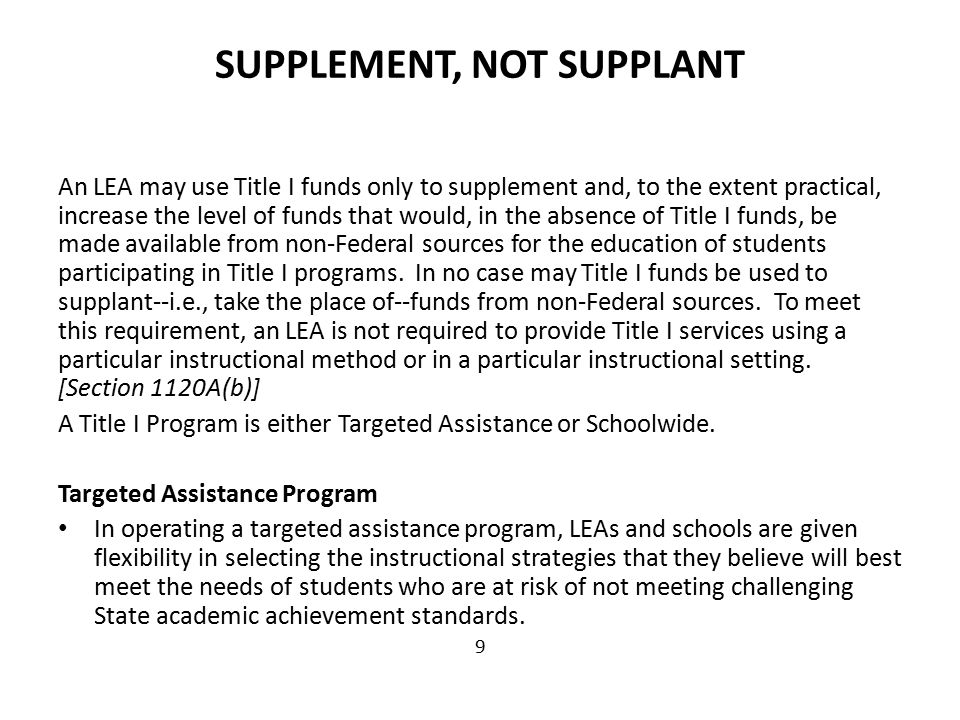
The U.S. Department of Education yesterday killed their draft rule for Title I funding in the Every Student Succeeds Act (ESSA) known as “Supplement, Not Supplant.” It’s not an issue that we’ve written a whole lot on here, but it highlighted one way that the Secretary of Education could gut any flexibility members of Congress thought they had when they passed ESSA.
If you were not familiar with the rule it basically said that  in Title I of the Elementary and Secondary Education Act (ESEA), as recently revised by the Every Student Succeeds Act (ESSA), that federal funds must supplement, and may not supplant, state and local funds. Civil rights activists and department bureaucrats were concerned that federal funding would replace state and local funding to the detriment of lower-income schools.
“For too long, the students who need the most have gotten the least,” said U.S. Secretary of Education John B. King Jr said in a released statement announcing the proposed rule last Summer. “The inequities in state and local funding that we see between schools within districts are inconsistent not only with the words ‘supplement-not-supplant’ but with the civil rights history of that provision and with the changes Congress made to the law last year. No single measure will erase generations of resource inequities, and there is much more work to do across states and Supplement Not Supplant Is Dead | Truth in American Education:
Image result for Supplement Not Supplant

Education Department Drops Fight Over School Money : NPR Ed : NPR

Education Department Drops Fight Over School Money : NPR Ed : NPR:

Education Department Drops Fight Over School Money


The U.S. Department of Education has withdrawn a proposal that could have fundamentally changed the flow of federal dollars to schools that serve low-income students.
"The law is clear that it is unacceptable to systematically underfund low-income schools and fill the hole with federal resources," explained Dorie Turner Nolt, a spokeswoman for the education department. "While we worked tirelessly to put forward a regulation that implements that simple requirement and to incorporate the extensive feedback we received, we ultimately did not have time to publish a strong final regulation that lives up to the promise of the law."
This brings to an end a long and bitter fight between the Education Department, led by Secretary John B. King, Jr., and Sen. Lamar Alexander, R-Tenn, himself a former education secretary and current chairman of the Senate committee that handles education.
"This is an intolerable situation," Alexander said of the Department's so-called "supplement-not-supplant" proposal back in May, in a heated speech on the Senate floor. "If the regulations are not consistent with the law, I don't believe [states] should follow them," he said. "If the department persists, then the state should go to court to sue the department."


Why was Alexander so angry?
The easy answer: Title I. That's the $15 billion the federal government sends to districts to help schools that serve lots of low-income students.
Alexander and King disagreed on how to enforce the new law governing Title I. It says that, to get federal money, districts have to prove a few things — among them, that Education Department Drops Fight Over School Money : NPR Ed : NPR:


Sorry, Betsy DeVos: Guns Aren't a Bear Necessity in Schools - The Atlantic

Sorry, Betsy DeVos: Guns Aren't a Bear Necessity in Schools - The Atlantic:

Sorry, Betsy DeVos: Guns Aren't a Bear Necessity in Schools
Donald Trump’s nominee for secretary of education is right that that animals sometimes menace schools, but her solution doesn’t seem to fit the problem.


The confirmation hearings for Donald Trump’s Cabinet nominees have had plenty of wild moments, but none seems to have captured the imagination of so many people as much as Betsy DeVos’s explanation for why it might be wise to allow guns in schools.
DeVos, Trump’s nominee for secretary of education, fielded a question from Senator Chris Murphy of Connecticut, an outspoken advocate for gun control, on the matter of gun-free school zones. She responded by citing an example she’d heard from Senator Mike Enzi about a school in Wapiti, Wyoming, Enzi’s home state, that had a fence to keep grizzly bears out.
“I think probably there, I would imagine that there’s probably a gun in the school to protect from potential grizzlies,” DeVos said. Thus was whelped a sleuth of bear jokes at DeVos’ expense.
But it turns out the bear-baiting was misplaced, or at least badly exaggerated. The backlash is perhaps unsurprising: From the Mama Grizzly to Barack Obama and Donald Trump’s divergent approaches to the Russian bear, Washington has become a den of polarized opinions. Yet encounters with bears at schools across the country turn out to be a somewhat common occurrence—and as bear populations bounce back, particularly in the east, more schools are joining the cub, so to speak.Sorry, Betsy DeVos: Guns Aren't a Bear Necessity in Schools - The Atlantic:

Tell Senators: Say "no" to DeVos and "yes" to students - Network For Public Education


From start to finish, the DeVos education confirmation hearing was rather remarkable - The Washington Post

From start to finish, the DeVos education confirmation hearing was rather remarkable - The Washington Post:

From start to finish, the DeVos education confirmation hearing was rather remarkable


Image result for From start to finish, the DeVos education confirmation hearing was rather remarkable

From start to finish, this week’s Senate confirmation hearing for Betsy DeVos, President-elect Donald Trump’s nominee for U.S. education secretary, was a remarkable affair — remarkable as in seriously unusual, uncomfortable to watch.
While many confirmation hearings have moments when somebody says or does something that raises eyebrows, the DeVos hearing on Tuesday was something of a spectacle throughout. (It’s no wonder stories about the hearing went viral on social media, something that doesn’t usually happen with education confirmation hearings.)
It wasn’t just that DeVos — who critics say supports policies that would privatize public education — seemed unable to answer basic questions and made some rather startling statements. Among them:
And she stuck to her talking points even past the silly point in a back-and-forth with Sen. Tim From start to finish, the DeVos education confirmation hearing was rather remarkable - The Washington Post:

On the Nature of Mass Demonstrations | Bill Ayers

On the Nature of Mass Demonstrations | Bill Ayers:

On the Nature of Mass Demonstrations

Image result for mass demonstrations against trump

On our way to demonstrate for several days in Washington, reading the brilliant John Berger who passed away this month. Here is “On the Nature of Mass Demonstrations,” from 1968:
 
Seventy years ago (on 6 May 1898) there was a massive demonstration of workers, men and women, in the centre of Milan. The events which led up to it involve too long a history to treat with here. The demonstration was attacked and broken up by the army under the command of General Beccaris. At noon the cavalry charged the crowd: the unarmed workers tried to make barricades: martial law was declared and for three days the army fought against the unarmed.
 
The official casualty figures were 100 workers killed and 450 wounded. One policeman was killed accidentally by a soldier. There were no army casualties. (Two years later Umberto I was assassinated because after the massacre he publicly congratulated General Beccaris, the “butcher of Milan.”)
 
I have been trying to understand certain aspects of the demonstration in the Corso Venezia on 6 May because of a story I am writing. In the process I came to a few conclusions about demonstrations which may perhaps be more widely applicable.
 
Mass demonstrations should be distinguished from riots or revolutionary uprisings although, under certain (now rare) circumstances, they may develop into either of the latter. The aims of a riot are usually immediate (the immediacy matching the desperation they express): the seizing of food, the release of prisoners, the destruction of property. The aims of a revolutionary uprising are long-term and comprehensive: they culminate in the taking over of State power. The aims of a demonstration, however, are symbolic: it demonstrates a force that is scarcely used.
 
A large number of people assemble together in an obvious and already announced public place. They are more or less unarmed. (On 6 May 1898, entirely unarmed.) They present themselves as a target to the forces of repression serving the State authority against whose policies they are protesting.
 
Theoretically demonstrations are meant to reveal the strength of popular opinion or feeling: theoretically they are an appeal to the democratic conscience of the State. But this presupposes a conscience which is very unlikely to exist.
 
If the State authority is open to democratic influence, the demonstration will hardly be necessary; if it is not, it is unlikely to be influenced by an empty show of force containing no real threat. (A demonstration in support of an already established alternative State authority – as when Garibaldi entered Naples in 1860 – is a special case and may be immediately effective.)
 
Demonstrations took place before the principle of democracy was even nominally admitted. The massive early Chartist demonstrations were part of the struggle to obtain such an admission. The crowds who gathered to present their petition to the Tsar in St. Petersburg in 1905 were appealing On the Nature of Mass Demonstrations | Bill Ayers:


 Image result for women march

DeVos Flunks Her Hearing … Choice Increases Segregation … Pivotal Year For Schools … Tribal Schools In Crisis … School Choice Divide?

1/19/2017 – Does Betsy DeVos Care About Racial Equity? We Still Don’t Know.:

THIS WEEK: DeVos Flunks Her Hearing … Choice Increases Segregation … Pivotal Year For Schools … Tribal Schools In Crisis … School Choice Divide?

TOP STORY

Does Betsy DeVos Care About Racial Equity? We Still Don’t Know.

By Jeff Bryant

“What are DeVos’ views on racial equity in education? … Race has historically played a much larger role in federal education policy than disputes over standardized testing … and what else tends to occupy education debates these days. It’s also an issue where DeVos has a very controversial track record … Much of what DeVos has worked for in her state of Michigan … is taking the state’s schools back to a segregationist past.”
Read more …

NEWS AND VIEWS

Betsy DeVos Just Flunked Her Senate Test

The Nation

“There were plenty of moments in Tuesday’s hearing that betrayed DeVos’s lack of preparation for the country’s top education post, but none more than her stumble over protections for disabled students … DeVos appeared unfamiliar with (or uncommitted to) the Individuals with Disabilities in Education Act, a major civil-rights law that requires publicly funded schools to accommodate disability … DeVos either could not or chose not to answer most serious policy questions, from inquiries about reporting standards for sexual assault on campus to regulations on for-profit colleges … When DeVos did speak specifically, it was to affirm her market-based vision for the education system. She included private schools in her description of what constitutes ‘today’s public education,’ and would not agree that private and charter schools receiving taxpayer money should face the same accountability standards as traditional public schools … Committee members could not fully evaluate any potential conflicts of interest, as an ethics review has not yet been completed for DeVos. And they had little time to dig into the religious motivations for her support of voucher systems.”
Read more …

Does Greater School Choice Lead To Less Segregation?

Christian Science Monitor

“Charter schools and vouchers … perpetuate the racial segregation of US schools … While minority parents are being given more choices … Choices for families in low-income, minority-dominated school districts are often between low-performing public schools and alternatives such as charters or voucher-dependent private schools with similar student bodies … Voucher programs rarely catapult low-income students into elite private schools with upper-income whites and Asians … More commonly they funnel students into less selective religious schools and spur the creation of new minority-dominated private schools.”
Read more …

K-12 Funding, ESSA Hot Topics As State Legislatures Convene

Education Week

“2017 could be a pivotal year for school funding formulas, accountability, teacher evaluations, and testing … Conservative lawmakers in many states have long been itching to make dramatic changes to how much money they provide to school districts and how districts spend that money … The Every Student Succeeds Act … goes into full effect … and fierce political tensions in a number of states … almost half the states are expected to have less money in their budgets this year due to shortfalls in sales tax revenue.”
Read more …

The Longstanding Crisis Facing Tribal Schools

The Atlantic

“Federal law requires that the Bureau of Indian Education provide education at least as good as that offered to non-Native students, but it’s well-established that that’s rarely the case. Graduation rates on reservations are among the lowest of all student subgroups … 8 in 10 Native students are not proficient in reading … and children at BIE schools perform significantly worse than their Native peers at regular public schools … Native Americans across the country are disciplined at disproportionate rates. Unsurprisingly, they’re also incarcerated at a rate 38% higher than the national average.”
Read more …

Will Betsy DeVos Divide The School Choice Movement?

Education Week

University professor Jeffrey Henig writes, “While voucher and charter school proponents have historically been allies linked by providing greater choice, the political alliance between them might be fraying … Voucher proponents have lost national debates about school choice in the past … Because of this resistance, voucher proponents jumped on the charter school bandwagon … to make inroads for market-based ideas in education … Charter proponents… welcomed the political and philanthropic support of the pro-voucher forces … but they may turn on one another if Trump and DeVos push to expand the voucher system.”
Read more …


A Failing Charter Gets a Pass

A Failing Charter Gets a Pass:

A Failing Charter Gets a Pass

Petersen_Endorsement.jpgBREAKING NEWS:


"Carl Petersen is a...strong supporter of public schools"

-Dr. Diane Ravitch
Former Asst. Secretary of Education
– California Charter School Association (CCSA)
According to the statistics provided by the CCSA, View Park Middle School (VPMS) appears to be accelerating towards failure. In 2015, the charter’s Similar Students Rank was a mediocre four out of ten. Last year, it dropped to a one out of ten. Included in a “Findings of Fact” dated January 10, 2017, the LAUSD Charter School Division (CSD) noted that, on the 2014-15 SBAC assessment, only 5% of VPMS’ students met or exceeded the performance standards in math. In 2015-2016, this dropped to 3%. In both years, 0% of students with disabilities met or exceeded these standards. These statistics are part of the reason that the CSD found that VPMS “has presented an unsound educational program” and recommended that the LAUSD Board deny its renewal petition. With a 4-3-0 vote, the Board ignored this recommendation and the charter will continue to operate.
With their votes, Mรณnica Garcรญa, Ref Rodriguez, George McKenna and Richard Vladovic showed that they cared so little about the students of VPMS that they will allow them to continue to receive an inferior education. They also caused the LAUSD to become complicit in an organization that has demonstratively ignored the needs of our most vulnerable students. Like large charters in the valley, VPMS is another organization where cherry-picking is an A Failing Charter Gets a Pass: