Latest News and Comment from Education

Tuesday, October 11, 2016

GULEN: Lawyer for Turkey Refers Ohio Charter Schools to Auditor - ABC News

Lawyer for Turkey Refers Ohio Charter Schools to Auditor - ABC News:

Lawyer for Turkey Refers Ohio Charter Schools to Auditor


A group of U.S. charter schools in Ohio started by the followers of a reclusive Muslim cleric engaged in improper business relationships, a lawyer for the Turkish government alleges in a complaint filed Tuesday seeking a state investigation.
Attorney Robert Amsterdam also asserts that the schools have ties to the cleric, Fethullah Gulen. The schools previously have denied direct ties to Gulen, who lives as a recluse in eastern Pennsylvania.
The cleric is a political foe of Turkish President Recep Erdogan, and Erdogan's government has accused Gulen of being the mastermind of a July 15 coup attempt.
Here's a look at the Ohio allegations:
NETWORK OF LINKED BUSINESSES
Amsterdam's 18-page complaint alleges a network of 17 Ohio charter schools managed by Chicago-based Concept Schools engaged in improper relationships with their management company and landlord, with their business subsidiaries and with each other.
The schools operate in Ohio as Horizon Science Academies and Noble Academies.
Specifically, the complaint says Concept has collected $19 million in excessive profits in Ohio through a real estate practice Amsterdam calls "closed-loop leasing."
"They do it by being on both sides — and sometimes three sides — of a transaction," he said.
Public documents cited in the complaint show a company called Breeze Inc. acquiring properties for Concept, and a nonprofit called New Plan Learning, which acts as an umbrella group for Breeze and several other affiliated subsidiaries, then buys, renovates, leases and sometimes sells the properties.
———
WHERE THE MONEY'S MADE
Leases and rental agreements the firm unearthed are often written to be non-cancellable, to include 2 percent to 4 percent escalation clauses and to make the taxpayer-funded charter school responsible for renovation and maintenance of the properties, Amsterdam said.
Lease payments have in some cases been doubled, tripled or quadrupled, he said, and extended to 30 years.
Members of the charter schools' boards who approve such agreements are often tied to one or more of the companies, the complaint alleges.
———
COMPANY CHALLENGES REPORT
Concept Schools spokesman Mark Weaver said the complaint contains "numerous false allegations." He did not specify what about the report was false.
Weaver said ProgressOhio, the liberal policy group that hosted Amsterdam's news conference, is affiliated with teachers unions whose earlier allegations against the schools couldn't be substantiated.
"The last time this group made such allegations about Concept Schools, state education officials and the Auditor of State's office found them to be incorrect and false. We expect the same will occur with these latest allegations," he said. "Sadly, these false allegations undermine the hard work and success of our students, many of whom already face serious challenges."
ProgressOhio says state officials failed to adequately investigate the earlier claims.
———
ADDS TO EARLIER CHARGES
Amsterdam says "closed-loop leasing" revelations come on top of other allegations his firm and others have leveled against Gulen-affiliated schools elsewhere.
Concept Schools has consistently rejected the charges, which include that the chain misuses the H1B work-visa process to employ large numbers of Turkish nationals at the schools who must return a portion of their paychecks to the Gulen movement and that it influences politicians into disregarding questionable actions by handing out free trips to Turkey.
Weaver called Amsterdam "a foreign agent." Amsterdam said he's from the Bronx in New York City.
An FBI investigation into some of the Ohio charter schools is ongoing.Lawyer for Turkey Refers Ohio Charter Schools to Auditor - ABC News:


Addressing Rape Culture in the Age of Trump - SF Public School Mom

Addressing Rape Culture in the Age of Trump - SF Public School MomSF Public School Mom:

Addressing Rape Culture in the Age of Trump

screen-shot-2016-10-11-at-10-55-12-am


So… Here we go!
This weekend has been a doozy for parents. Who would have thought a Trump candidacy would lead to political pundits arguing about p*ssy on TV! There seems to be no way to avoid the bile coming out of Trump’s mouth. Even when you don’t actively watch the news. The toxic sludge is everywhere.
Nonetheless, I’m doing what I always do and using these “opportunities” as teachable moments to talk with my now 11 year old girls about sexism and rape culture. I’ve decided, if Trump is going to be the poster child of how NOT to behave, I and other parents need to step up and talk about what’s right.
If I’m really honest though, I have to reflect on the fact that it has to take someone so awful to get us talking about stuff we should already be talking about. Social norms may teach us not to pick our noses in public, but they also keep structural racism, sexism, and homophobia firmly in place. We are taught not to talk about certain body parts, rape culture and misogyny for a reason. Societal taboos tell us what we CAN and CAN’T talk about and ensure we never begin addressing oppressive systems in the first place.

Addressing Rape Culture in the Age of Trump

With that in mind, I’m saying… “Thank you Donald Trump, for getting this conversation started!” (Yes, I’m saying it!) And now that we’re talking… let’s fight back agains rape culture and discuss some key points with our kids:

#1. It’s called a VAGINA

Look we all love the fun and funny names that folks come up with for various body parts, and especially those that comprise our reproductive systems. It’s important to talk about body parts and teach your kids the REAL names for all of them… Say it Addressing Rape Culture in the Age of Trump - SF Public School MomSF Public School Mom:

Read Across America: 20 years young! - Lily's Blackboard

Read Across America: 20 years young! - Lily's Blackboard:

Read Across America: 20 years young!

Image result for Read Across America: 20 years young!

Ok, so we’re all getting a little older.  But some things never go out of style. I recently picked up a book to read with my 20-month-old granddaughter.  “I’ll Love You Forever” always makes me laugh and cry and get a little creeped out  (if you haven’t read this book picture book you won’t know what I’m talking about. Get a copy).  I happen to flip to the title page and there was my handwritten note to my son when I gave him that same book as a Christmas present when he was 2.  My son, who is now 478-months-old and who can still recite it from memory.  
I have a feeling my granddaughter will love that book when she’s 20 years old as much as she does now that she only wants to eat the pages. Reading never grows old. And neither does the celebration of reading.
NEA’s Read Across America is 20 years old! And we’ve never felt better.
To mark the occasion, we have produced a fabulous Read Across America calendar that highlights the many diverse books available to students and the variety of cultural celebrations that make America the mosaic we are.
From the beginning, Read Across America has been an incredible vehicle for focusing attention on the literacy needs and successes of our children. But it takes much more than a one-day celebration. It’s the relationships built around reading, between students, teachers, librarians, parents, volunteers and other caring community members, that can have a long-term impact on our nation of diverse readers.
_kl15125
Good reading skills are the cornerstone to success. Developing these skills puts students on the pathway to a lifetime of learning and adventure, and providing a diverse array of book titles goes a long way toward cultivating their interests.
Our brand new literacy calendar is available! It features tons of suggestions of diverse books suitable for a wide range of readers.  The calendar also includes ideas for school activities and titles for older readers. 
The calendar also features books such as Going HomeComing Homeabout a girl who travels to Vietnam, where her parents were born, and discovers that you can “find yourself at home” even a very long way from your own.Pool, a picture book, wordlessly tells an elegant story of a young swimmer’s adventures in a crowded pool.
Collaborate with your colleagues on EdCommunities to brainstorm and share tips that will inspire a love of reading, at mynea360.org. Check out Read Across on Facebook,  browse our boards on Pinterest for ideas and inspiration and follow @NEAToday on Twitter. 
If you try out some of the activities suggested in the calendar, take photos, tag them #ReadAcrossAmerica and post on social media. Every month, winners will be selected for free copies of the books featured in the calendar.
And while we’re marking this special anniversary, let’s also celebrate the many educators and volunteers across the nation who make NEA’s Read Across America a success every year. Thank you!Read Across America: 20 years young! - Lily's Blackboard:


#BlackLivesMatterAtSchool: Hundreds of educators across Seattle to wear “Black Lives Matter” shirts to school on Oct. 19th | I AM AN EDUCATOR

#BlackLivesMatterAtSchool: Hundreds of educators across Seattle to wear “Black Lives Matter” shirts to school on Oct. 19th | I AM AN EDUCATOR:

#BlackLivesMatterAtSchool: Hundreds of educators across Seattle to wear “Black Lives Matter” shirts to school on Oct. 19th

blmshirt_2-jpgblmshirt_1-jpg
Educators in Seattle are starting off the school year dressed for success.
In the fist action of this scale, many hundreds of Seattle teachers, counselors, instructional assistants, paraprofessionals, custodians, nurses, and other educators, will wear shirts to school on Wednesday, October 19th, that read, “Black Lives Matter.” This action is part of a Seattle Education Association sponsored day to draw attention to the school-to-prison-pipeline and institutional racism our society. Already over 700 educators and supports have ordered their shirts!
Educators at Seattle’s John Muir Elementary first conceived of this action and announced they would wear shirts to school on September 16 that read, “Black Lives Matter. We Stand Together. John Muir Elementary.” This was to coincide with an event to celebrate Black students that was organized by Black Men United to Change the Narrative. As third grade teacher Marjorie Lamarre told King 5 News at the time, “To be silent would be almost unforgivable, and I think we have been silent for almost too long.” Yet the forces of hate tried their best to silence the John Muir community as a white supremacist issued a bomb threat on the school and the event was officially cancelled. However, in a truly stunning show of courage, dozens of Black community members heeded the call of Black Men United To Change the Narrative and showed up to high five the students that morning and the John Muir staff wore the shirts anyway!
This bold action prompted the Social Equality Educators (SEE) to introduce a resolution at the Seattle Education Association to support John Muir and make a call for educators across the city to also wear Black Lives Matter shirts. The resolution reads:
Whereas the SEA promotes equity and supports anti-racist work in our schools; and,
Whereas we want to act in solidarity with our members and the community at John Muir who received threats based on their decision to wear Black Lives Matter t-shirts as part of an event with “Black Men United to Change the Narrative”; and,
Whereas the SEA and SPS promote Race and Equity teams to address institutionalized racism in our schools and offer a space for dialogue among school staff; 
Therefore be it resolved that the SEA Representative Assembly endorse and participate in an action wearing Black Lives Matter t-shirts on Wednesday, October 19, 2016 with the intent of showing solidarity, promoting anti-racist practices in our schools, and creating dialogue in our schools and communities.
Many educators will also use the day to teach about the ways institutional racism impacts education, our nation, and our world.  There are also teachers around the country working to#BlackLivesMatterAtSchool: Hundreds of educators across Seattle to wear “Black Lives Matter” shirts to school on Oct. 19th | I AM AN EDUCATOR: 


Two Cheers for PBS's TED Education Talks | Huffington Post

Two Cheers for PBS's TED Education Talks | Huffington Post - Linkis.com:

Two Cheers for PBS’s TED Education Talk

Image result for TED Talks: The Education Revolution.
Two cheers for the Public Broadcast System’s TED Talks: The Education Revolution. The special report featured Nadia Lopez, the New York City principal who has recently authored The Bridge to Brilliance. Even better, several TED speakers proclaimed teaching as an act of love. We’ve endured twenty years of soul-killing corporate school reform and PBS, once again, contributes to the multi-media call for 21st century schools worthy of an American democracy. But, for some reason, it ignored the way that test-driven, competition-driven reform took all of the problems documented in the presentations and made them much worse.
Sal Kahn, a former hedge fund entrepreneur, kicked off the talks by explaining how technology could launch a future of joyful learning. In a rational era of school improvement, digital tools would promote learning for mastery and a growth mindset. Before No Child Left Untested, and before the Billionaires Boys Club’s public relations spin corrupted the language of education, adaptive technologies held great promise for nurturing real personalized learning. In an age of accountability-driven reform, however, those digital miracles degenerated into “credit recovery,” or the mindless charade of “passing kids on,” which my inner city students derided as “exercising the right click finger.”
Filmmaker Greg Whiteley then summarized the hundred-year history of schools performing as “factories of learning.” The next presentation could have tackled the question why Silicon Valley, paradoxically, has funded the data-driven reformers’ effort to turn schools back into a sped-up Model T assembly line. Ironically, it often was entrepreneurs and geeks like Bill Gates who drove creativity and individuality out of classrooms, replacing them with hi-tech versions of worksheet-driven, rote instruction. Inexplicably, PBS didn’t address the resulting dictates for nonstop remediation that drove holistic instruction out of so many schools.
The TED presenters also could have addressed the irony of billionaires, who made their money from innovation, but who drove the retrograde test-driven, competition-driven school reform movement. Top-down reformers essentially sought to impose the same accelerated educational conveyor belt on diverse classrooms across the nation - while calling it “personalized learning” for “rigor.” They often mandated educational monocultures where educators were required to be “all on the same page” in rushing skin-deep through a scripted curriculum designed to jack up primitive bubble-in tests scores.
The next presenters may have been very different than what I hoped for but they were excellent. Arizbeth, a 20-year-old undocumented immigrant expressed the Two Cheers for PBS's TED Education Talks | Huffington Post - Linkis.com:


Native American Colleges Have Abandoned The Student Loan System - BuzzFeed News

Native American Colleges Have Abandoned The Student Loan System - BuzzFeed News:

Native American Colleges Have Abandoned The Student Loan System

With graduates defaulting on their loans at sky-high rates, the vast majority of America’s 32 tribal colleges have stopped their students from borrowing.

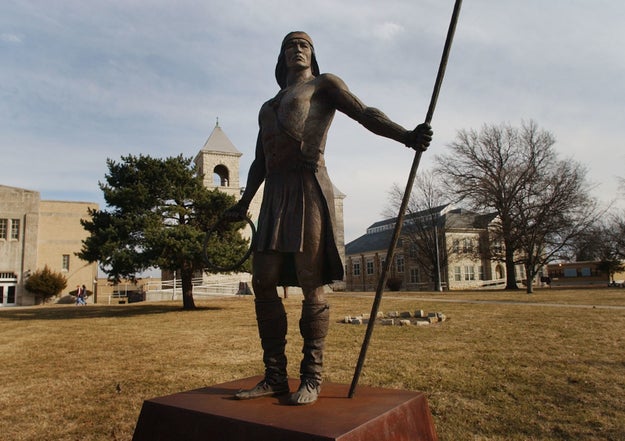
The campus of Haskell Indian Nations University in Lawrence, Kansas. Orlin Wagner / AP
By the time United Tribes Technical College was named the fourth-worst school in the country for student loan defaults last week, the tribal school had already made it impossible for students to borrow money from the federal government. For United Tribes Tech, cutting off the student loan spigot was a last resort — the only way to save itself from government penalties that would bring financial ruin.
But it also meant that of America’s 32 tribal colleges — schools controlled by Native American tribes — only three now allow federal loans for their students. It’s a particularly striking situation, because tribal colleges, which are funded by the federal government, serve some of the country’s neediest students.
Nationwide, 90% of community colleges offer federal student loans to students. And advocacy groups have decried the other 10% for denying their students the ability to borrow.
But the vast majority of tribal colleges have cut off access to the loans. That’s in part because colleges fear the consequences of too many students defaulting on their loans, said Carrie Billy, the president of the American Indian Higher Education Consortium, a lobbying group.
But Billy told BuzzFeed News that most tribal schools also firmly believe their students are better off without federal loans of any kind — so much so that they have decided not even to make them an option.
“We completely disagree with that idea that students are worse off without [access to] federal loans,” Billy said. “Particularly when you look at the demographics of our students — students who have lived with generational poverty, unemployment, who have no experience with credit — that’s a recipe for disaster when it comes to loans. Tribal colleges will do everything they can to make their students graduate debt-free.
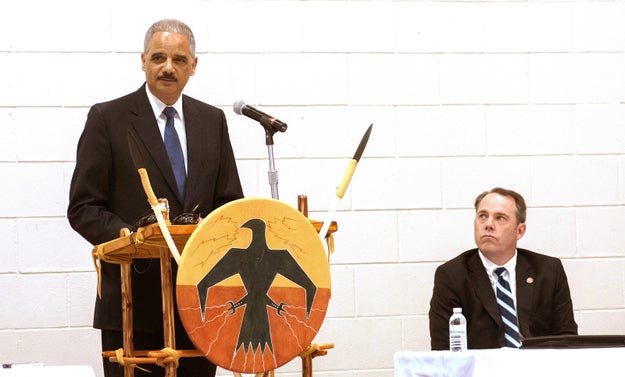
Former Attorney General Eric Holder speaking at United Tribes Technical College in 2014. Kevin Cederstrom / AP
Tribal colleges, like community colleges, are relatively inexpensive — around $6,000 a year, low enough that a $5,750 annual Pell Grant will cover most of the cost of tuition. But community college students sometimes borrow money to help pay for living costs and expenses like textbooks. That option isn’t available for tribal college students.
Those students often face staggering obstacles that make them more less likely to repay student debt, Billy said. Eighty-three percent of them are reliant on Pell Grants, which are only given to low-income students, compared to just 40% of college students nationally. Many tribal college students have little to no experience with borrowing money or credit. They’re also mostly first-generation college students.
Instead of offering loans, tribal colleges try to fill the gap themselves, by providing Native American Colleges Have Abandoned The Student Loan System - BuzzFeed News:


The Diane Silvers Ravitch ’60 Lecture: “The Inconvenient Truth About American Education Reform”

Wellesley College:

The Diane Silvers Ravitch ’60 Lecture

“The Inconvenient Truth About American Education Reform”

Thursday, October 13, 2016 - 7:30pm
Diana Chapman Walsh Alumnae Hall Auditorium (201)

Read more at http://www.wellesley.edu/event/node/92301#4qsPwTob4WiM5Tgi.99


Wellesley College’s Department of Education is proud to welcome Pasi Sahlberg for the Diane Silvers Ravitch Class of ’60 lecture on current issues in public education. His talk, entitled “The Inconvenient Truth About American Education Reform,” will address some of the problematic and unintended consequences of approaches to reform in the American education system.
Sahlberg is a Finnish educator and scholar. He worked as a teacher, teacher educator, and policy adviser in Finland and was actively engaged in planning and implementing education reforms in Finland in the 1990s. His research interests include international education policies, educational change, teacher education, and classroom teaching and learning. In this lecture, Sahlberg will discuss the critical importance of teacher professionalism, collective autonomy, and trust, and argue that the most important educational ideas behind Finland’s success are borrowed from American public schools.
In addition to his popular Finnish Lessons 2.0: What Can the World Learn from Educational Change in Finland? (2015), Finnish Lessons (2011), and other books, he has published more than one hundred articles in journals, research periodicals and magazines around the world. Some of the most read ones include “The Fourth Way of Finland” (2011), “Rethinking Accountability in a Knowledge Society” (2010), “Creativity and innovation through lifelong learning” (2009), and “Education Reform for Raising Economic Competitiveness” (2006).
Sahlberg received a Master of Science (Mathematics) in 1984 from University of Turku and PhD from the University of Jyvaskylä in 1996. He has served the World Bank in Washington, D.C., the European Commission and the OECD as an external expert advising foreign governments in more than 50 countries around the world.
Generously supported by The Diane Silvers Ravitch Fund for Public Education, this event is free and open to the public.

Read more at http://www.wellesley.edu/event/node/92301#4qsPwTob4WiM5Tgi.99


Why For-Profit Education Fails - The Atlantic

Why For-Profit Education Fails - The Atlantic:

Why For-Profit Education Fails
Moguls’ good intentions too often betray them.


Earlier this year, LeapFrog Enterprises, the educational-entertainment business, sold itself for $1 a share. The deal came several months after LeapFrog received a warning from the New York Stock Exchange that it would be delisted if the value of its stock did not improve, a disappointing end to the public life of a company that had the best-performing IPO of 2002.
LeapFrog was one of the very last remaining of the dozens of investments made by Michael Milken through his ambitiously named Knowledge Universe. Founded in 1996 by Milken and his brother, Lowell, with the software giant Oracle’s CEO, Larry Ellison, as a silent partner, Knowledge Universe aspired to transform education. Its founders intended it to become, in Milken’s phrase, “the pre-eminent for-profit education and training company,” serving the world’s needs “from cradle to grave.”

Knowledge Universe businesses included early-childhood learning centers, for-profit K–12 schools, online M.B.A. programs, IT-training services for working professionals, and more. Milken’s penchant for secrecy makes a comprehensive assessment impossible—most of the businesses were privately held and some were sold to private buyers for undisclosed sums. But of the companies about which there is public information, most, like LeapFrog, ended badly. Education remains untransformed.

Milken was far from alone in the belief that education could be revolutionized through radical new business models. In 2012, the media mogul Rupert Murdoch and the former New York City schools chancellor Joel Klein established the Amplify division within News Corp. At the time of his initial investment, Murdoch described K–12 education as “a $500 billion sector in the U.S. alone that is waiting desperately to be transformed.” Their idea was to overturn the way children were taught in public schools by integrating technology into the classroom. Although inspirational, the idea entailed competing with a series of multibillion-dollar global leaders in educational hardware, software, and curriculum development. After several years and more than $1 billion, with no serious prospect of ever turning a profit, Murdoch and Klein sold their venture for scrap value to Laurene Powell Jobs, Steve Jobs’s widow, last year.


Indeed, over the past couple of decades, a veritable who’s who of investors and entrepreneurs has seen an opportunity to apply market discipline or new technology to a sector that often seems to shun both on principle. Yet as attractive and intuitive as these opportunities seemed, those who pursued them have, with Why For-Profit Education Fails - The Atlantic:


How Racism Contributes to the Achievement Gap - The Atlantic

How Racism Contributes to the Achievement Gap - The Atlantic:

How the Stress of Racism Affects Learning

A new study shows that the pressures associated with discrimination contribute to the achievement gap.

The stress of discrimination can affect the achievement of students of color.


For 15-year-old Zion Agostini, the start of each school day is a new occasion to navigate a minefield of racial profiling. From an early age, walking home from elementary school with his older brother, Agostini took note of the differential treatment police gave to black people in his community: “I [saw] people get stopped … get harassed … get arrested for minor offenses.” Almost a decade later, Agostini said he now faces the same treatment as a sophomore at Nelson Mandela School for Social Justice in Brooklyn's Bedford-Stuyvesant neighborhood. “Me being a black male, I'm more likely to be stopped and frisked by a cop. Then, [I’m] going to school with more cops … [messing] with me at 7 in the morning.”

The strain of these interactions is heightened by the daily routine of passing through a metal detector, emptying pockets, and removing clothing that frequently makes him late to his first-period class. “The fact is now I’m [tardy] because I’m being scanned four times because of the metal in my necklace or my keys. I missed whatever [the teacher] was explaining … a lot goes on in [chemistry], and because of that I'm behind.” All of this combined takes a toll on his schoolwork, he said. “It does make it extremely hard to focus on the classwork … You're upset, or sad, or just emotional about what just happened. It takes a while to settle.”
recent study from Northwestern University corroborates Agostini’s experience, suggesting that the stress of racial discrimination may partly explain the persistent gaps in academic performance between some nonwhite students, mainly black and Latino youth, and their white counterparts. The team of researchers found that the physiological response to race-based stressors—be it perceived racial prejudice, or the drive to outperform negative stereotypes—leads the body to pump out more stress hormones in adolescents from traditionally marginalized groups. This biological reaction to race-based stress is compounded by the psychological response to discrimination or the coping mechanisms youngsters develop to lessen the distress. What emerges is a picture of black and Latino students whose concentration, motivation, and, ultimately, learning is impaired by unintended and overt racism.

Emma Adam, a professor of human development and social policy at Northwestern and the study’s senior author, said prior research had established racial differences in levels of cortisol—a hormone that increases when the body is stressed—between black and white youth, and linked this to the impact of discrimination. In the current research review, she and her co-authors set out to connect the dots. “We had observed these [dissimilarities] and knew that sleep and stress hormones have strong implications for cognition … we also knew that there was a strong racial gap in academic attainment.”
Two sources of stress encountered by black and Latino students and examined in the report are perceived discrimination—the perception that you will be treated differently or unfairly because of your race—and stereotype threat, the stress of confirming negative expectations about your racial or ethnic group. According to the paper, among this population of students, perceived discrimination from teachers was “related to lower grades, less academic motivation … and less How Racism Contributes to the Achievement Gap - The Atlantic:

Literacy lawsuit draws questions, call for investment

Literacy lawsuit draws questions, call for investment:

Literacy lawsuit draws questions, call for investment


The U.S. Constitution does not explicitly guarantee the right to education, and the nation’s highest court so far has not weighed in.
But U.S. District Judge Stephen J. Murphy III in Detroit is being asked to open the door to the concept of a constitutional right to literacy — which could one day put the matter before the U.S. Supreme Court for the first time.
Legal and academic opinions differ over the central argument in the case of seven Detroit schoolchildren who are suing the state.
The lawsuit, filed last month, alleges decades of state disinvestment in the city’s schools have denied schoolchildren access to the most basic building block of education: literacy.
U.S. Secretary of Education John King Jr. says Michigan has not properly invested in Detroit’s schoolchildren but declined to tell The Detroit News whether he thinks literacy is a federal right.
“It is clear that the state over the years has not made any of the kind of investment and commitment to the kids of Detroit that’s needed,” said King, who was in Detroit on Friday. “And that is our responsibility across levels of government — local, state and federal. And the future of our economy and our democracy depend on that.”
King noted federal law is designed to focus federal resources on closing those gaps between urban students and others.
“We’ve got to do a much better job as adults to ensure that every child in Detroit is getting that kind of quality education that they should,” he said.
Richard Primus, a constitutional law expert and professor at University of Michigan Law School, said the federal case in Detroit has a chance to change the law and the Literacy lawsuit draws questions, call for investment:


More Evidence that State School Ratings Don’t Reflect School Quality | janresseger

More Evidence that State School Ratings Don’t Reflect School Quality | janresseger:

More Evidence that State School Ratings Don’t Reflect School Quality

Image result for school ratings the scarlet letter
In Ohio, school districts are on the ballot with local property tax levies in this turbulent November election season. Here are the conditions under which our school districts—including the Cleveland school district this fall—find themselves on the ballot:
  • Ohio has a statewide tax rollback embedded in the state constitution.  When property values appreciate, the state effectively rolls back the local millage to keep the district’s revenue collection from any levy equal to the amount generated on the date the levy first passed. Even in these times when values are not appreciating significantly, our tax freeze ensures that school districts have to be on the ballot every few years just to stay even.
  • The state has also imposed a test-based accountability system that generates school district grades—the state report cards that copy Jeb Bush’s plan in Florida and that award letter grades to school districts based on standardized test scores.
  • These grades essentially force school superintendents to promise that test scores will rise—a sort of quid pro quo for citizens’ willingness to invest in the levies. While some voters will always support school taxes as a public obligation, the school districts that cannot quickly raise scores are perceived as reneging on these promises—encouraging some voters to vote against school levies as a punishment for superintendents, principals and teachers who can’t seem to raise the test scores.
  • There are also the state tax cuts—to business taxes and estate taxes and income taxes over the past decade—that increase every school district’s reliance on local property taxes.
  • And finally, in Cleveland, the public schools—individually graded by the state with the same letter grades—compete actively with charter schools that now receive some of the local levy dollars under a so-called “portfolio school reform” plan. The stakes are high because the closure of so-called “failing” schools hangs as a looming threat.
It is in this context that in Sunday’s Plain Dealer, Patrick O’Donnell reported extensively on Sean Reardon’s recent research that correlates standardized test scores with the aggregate family income of the students in a school district. (See Reardon’s papers here and here.)  O’Donnell summarizes Reardon’s findings: “Students in the affluent Aurora and Bay Village schools are typically two years ahead of students from across the country. Meanwhile, students in the Cleveland and East Cleveland schools are about two years behind.  Just don’t pat yourself on the back for high scores or hurl insults at the struggling urban districts. You’re all just fitting, almost exactly, a national pattern.” O’Donnell continues: “Just within Cuyahoga County, there is a 5.1-grade learning gap in between the lowest-scoring district for the years More Evidence that State School Ratings Don’t Reflect School Quality | janresseger:


In illegal move, Malloy administration misleads public (again) on budget deficit - Wait What?

In illegal move, Malloy administration misleads public (again) on budget deficit - Wait What?:

In illegal move, Malloy administration misleads public (again) on budget deficit


State law requires that on the 20th of every month, the Governor’s administration MUST inform the State Comptroller about any known budget deficit.  The State Comptroller, in turn, uses that information to help guide his mandated monthly report that is issued on the first of each month.
In October, Malloy’s budget division told State Comptroller Kevin Lembo that the budget was in balance, but as it turns out, that was a lie.
As Keith Phaneuf at the CT Mirror is reporting today;
Gov. Dannel P. Malloy’s administration last month warned dozens of state agency heads of a significant shortfall in the current budget — but continues to officially report that finances remain in balance.
The $133 million revenue shortfall disclosed to agency heads on Sept. 6 was excluded 14 days later from the last official monthly budget forecast submitted to Comptroller Kevin P. Lembo.
Malloy’s top budget chief told Malloy’s commissioners that there was a deficit, yet day later, sought to mislead Lembo about the problem.  Lembo, in turn, provided the public with a report that wasn’t accurate.
Early last summer Governor Malloy and the Democratic members of the ConnecticutIn illegal move, Malloy administration misleads public (again) on budget deficit - Wait What?: 

Why Are Education Activists Walking to Albany? | Daniel Katz, Ph.D.

Why Are Education Activists Walking to Albany? | Daniel Katz, Ph.D.:

Why Are Education Activists Walking to Albany?

Image result for Why Are Education Activists Walking to Albany?

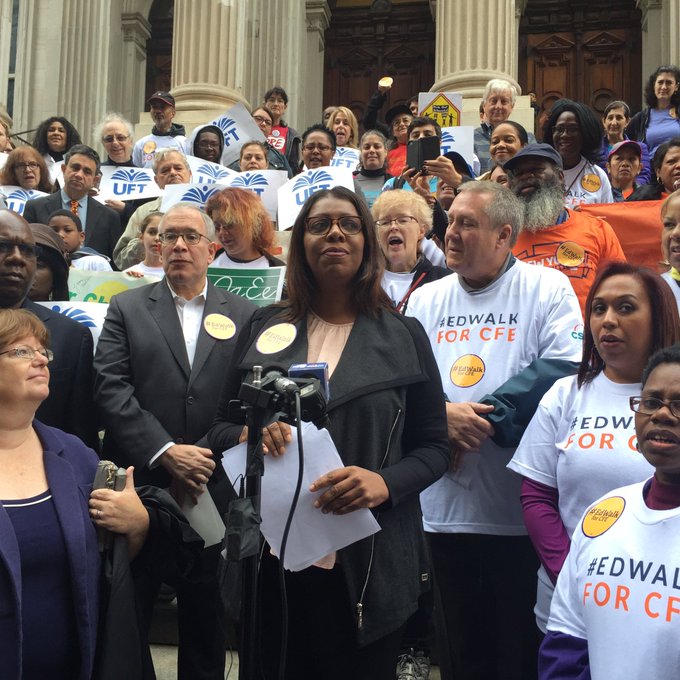
For more than a week, a small but determined group of public school advocates, have undertaken an ambitious and heartfelt journey: a walk of 150 miles from New York City to Albany to deliver a message.  That message?  Pay up.  After ten years of delays, excuses, cuts, and broken promises, it is past time for lawmakers and the governor to fully fund the Campaign for Fiscal Equity settlement that was decided in 2006.  That landmark ruling, itself the result of 13 years of advocacy and litigation, found that the state was failing its obligation to provide schools with the resources they needed for all children to have a “sound basic education.”  Between 2007 and 2009, the state worked out a new foundational aid formula and committed to increasing school aid across the state by 5.5 billion dollars a year.
Today, Albany remains $3.9 billion short of that goal.  Every year.  Ten years after the court ruled that increased aid was necessary.  So activists are walking from the steps of Tweed Courthouse in New York City to Albany to deliver the bill:
Albany has not always been so stubbornly unwilling to pay the Campaign for Fiscal Equity (CFE) settlement.  In fact, immediately after the settlement, Albany rewrote the aid formula and began to phase in the additional money, increasing state aid to schools by 2.3 billion dollars.  Unfortunately, twin crises for education in the Empire State struck nearly simultaneously.  The first was the Great Recession which narrowed state tax revenues and threw the budget out of balance.  This was unavoidable given the nature of the fiscal crisis across the entire country.  The second crisis was the election of Governor Andrew Cuomo in 2010.  This was probably avoidable although it was an open question at the time about just how horrible the governor would be.
Beginning with Governor Cuomo’s predecessor, Governor David Patterson, New York embarked on a two year budget overhaul aimed at reducing state spending by $5 billion in only two years without considering tax increases.  State aid to education took an immediate hit both in the total amount allocated and in the form of an accounting gimmick called the Gap Elimination Adjustment.  Using the GEA, Albany could announce a school aid budget but then take some of that money back from communities if state revenues were too low.  According to theNew York State School Boards Association, by the 2014 school year, this policy, continued by Governor Andrew Cuomo, had cost the state’s schools over $8.5 billion of total aid, or more than $3 million per district per year.  Additionally, Governor Cuomo pushed through a property tax cap early in his first term that has squeezed districts from the other side,  limiting the revenue they can raise locally.  While state aid to school has crept up over time, it was only in this year’s budget address that he suggested ending the GEA by increasing state aid over a Why Are Education Activists Walking to Albany? | Daniel Katz, Ph.D.: