Latest News and Comment from Education

Saturday, October 3, 2015

What Has Happened to Teacher Evaluations? We Need Your Help - Living in Dialogue

What Has Happened to Teacher Evaluations? We Need Your Help - Living in Dialogue:

What Has Happened to Teacher Evaluations? We Need Your Help


By Anthony Cody.
Under President Obama, the federal Department of Education offered several billion dollars in Race to the Top money and waivers from NCLB to states and school districts across the country in exchange for redesigning teacher evaluation processes. The feds required that a significant portion of teacher evaluations be based on student test scores, which was interpreted to mean anything from a low of 20% to a high of 50% of the weight of an evaluation. Some states used complex formulas to calculate “value added,” while others adopted frameworks from Charlotte Danielson or Robert Marzano.
These evaluations were designed to strengthen teaching – to provide teachers with feedback, to identify those in need of support, or those who should be dismissed. But it is unclear what the real impact has been. It is unclear what the impact of these policies (link) has been. Furthermore, there seems to be very little data being collected regarding the impact of these processes on working teachers – and the administrators who must evaluate them. We hear that more teachers are leaving the profession, and that morale What Has Happened to Teacher Evaluations? We Need Your Help - Living in Dialogue:

CURMUDGUCATION: An Open Letter to Jerry Oleksiak (PSEA President)

CURMUDGUCATION: An Open Letter to Jerry Oleksiak (PSEA President):

An Open Letter to Jerry Oleksiak (PSEA President)


Dear Jerry:

It has been a disappointing couple of days, what with the announcement of the announcement that the terrible Arne Duncan with the even-worse John King. On top of that, we get the NEA's announcement of the early endorsement of Hillary Clinton. Now, today, on Facebook, I find your rationalized spin for that endorsement. I am beyond disappointed, but rather than simply stomp off angrily without saying anything except, "Cancel my membership," I want to address your comments, despite the fact that this endorsement fiasco drives home the fact that nobody in the state or local union is paying the slightest damn attention to the members. I am in my thirty seventh year of teaching in a classroom. I'm a registered Democrat who votes in every single election, and I'm a past local president of my union. So understand that I am not just some random crank, but an experienced and long-involved crank.

After presenting the background of your involvement in NEA's decision, you ask this question. 

As you make your own decisions about whom you will support, I would encourage you to ask yourself this question: "Does this candidate support public education, our schools, and our students?"

It is an excellent question to ask, and one that I have asked myself. In fact, it's in asking this question that I arrive at my personal decision not to support Clinton. But before I talk about my own data on the issue, I want to see how that question leads you and NEA to an endorsement of Hillary Clinton. So let's look at what you've got.

I have spoken to many PSEA members over the past year, and one concern I hear again and again is that public education in the United States is at a crossroads. Our colleagues you elected to the NEA board have heard similar sentiments, as have their NEA Board colleagues in other states. That is why 
CURMUDGUCATION: An Open Letter to Jerry Oleksiak (PSEA President):

Teachers union endorses Clinton for 2016 Democratic nomination - The Washington Post

Teachers union endorses Clinton for 2016 Democratic nomination - The Washington Post:

Teachers union endorses Clinton for 2016 Democratic nomination


The National Education Association, the nation’s largest labor union, endorsed Hillary Rodham Clinton on Saturday for the 2016 Democratic presidential nomination.
“We recommended Hillary Clinton on the incredible and lengthy track record she has, that is just wrapped around children, working families and education, from preschool to graduate school,” NEA president Lily Eskelsen Garcia said.
Seventy-five percent of the union’s 170-member board backed Clinton.
The nod from the NEA gives Clinton a much-needed boost, after the International Association of Firefighters earlier this week backed away from plans to endorse her.
Before the vote Clinton appeared before the board — at NEA’s Washington headquarters, five blocks from the White House — to make the case for their endorsement. She spoke and answered questions in a town-hall style setting for about 90 minutes, addressing topics ranging from special education to standardized testing to historically black colleges.
“She knew what she was talking about,” Eskelsen Garcia said. “You could see people sit up straighter and think ‘Oh my gosh, she understands our world’. I think they were simply blown away.”
But the endorsement triggered an immediate backlash among some of the union’s three-million members. Some argued that an endorsement was premature, while others said Sen. Bernie Sanders (I-Vt.) was a better choice.
“I’m very disappointed,” said Marie Corfield, an art teacher from New Jersey, who had organized a lobbying effort against the Clinton endorsement. “I think the NEA is going to get a lot of pushback from its members over this.”
The Massachusetts state chapter was among several that either abstained from voting or voted against endorsement of any candidate. Barbara Madeloni, president of the Massachusetts Teachers Association, said her members want a “real conversation about the candidates and the issues. We want to talk about the corporate reform movement that is looking to privatize education and a chance to educate the candidates about what is happening.”
In June, the Vermont NEA chapter endorsed Sanders in his bid for the Democratic nomination.
“I am proud to have the support of many hundreds of thousands of members of the National Education Association and trade unionists all across America,” Sanders said in a statement Saturday. “We are going to win this Teachers union endorses Clinton for 2016 Democratic nomination - The Washington Post:

Jersey Jazzman: The Faith-Based Education Policies of @ArneDuncan

Jersey Jazzman: The Faith-Based Education Policies of @ArneDuncan:

The Faith-Based Education Policies of @ArneDuncan


Arne Duncan is Barack Obama's worst appointment. Worse than Tim Geithner, worse than Penny Pritzker, worse than Eric Shinseki -- even worse than Rahm Emanuel (OK, maybe that's open to debate...).


The havoc Duncan has wreaked upon America's schools will likely take decades to undo:
And, perhaps worst of all, Duncan has denigrated the real concerns of parents, teachers,
- See more at: http://jerseyjazzman.blogspot.com/2015/10/the-faith-based-education-policies-of.html#sthash.bNkP1KB8.dpuf

Alfie Kohn: The back-to-school-night speech we’d love to hear* - The Washington Post

The back-to-school-night speech we’d love to hear* - The Washington Post:

The back-to-school-night speech we’d love to hear*


*This was inspired by an occasional feature in Mad magazine called “Scenes We’d Like to See” — and counter-inspired by some back-to-school talks we’ve actually heard. It was written by Alfie Kohn, author of 14 books on education, parenting, and human behavior, including, most recently, The Myth of the Spoiled Child and Schooling Beyond Measure.
Here’s the speech by Kohn:
Is this working? [taps microphone] I do believe it is!
OK, if everyone can please find a seat, we’d like to get started. Thanks so much for coming out tonight! We’ve reserved plenty of time for discussion — obviously I’m not going to talk at you all evening, just as our teachers don’t spend most of class time talking at your kids — but as the principal I did want to try to give you a sense of what _________ School stands for, and what your student, and you, can expect this year.
Our top priority here — and I mean a real, honest-to-goodness commitment, not just a slogan on the website or in a mission statement — is to learn about and support each student’s interests. What questions do they have about the world? How can we help them build on and find answers to those questions? When we meet as a staff, it’s usually to think together about how best to do that, how to create a school that’s not just academic but intellectual.
We don’t want to write a detailed curriculum or devise a bunch of rules in advance and then spend the year demanding that kids conform to them. Our main concern is that what students are learning, and how they’re helped to learn it, make sense for the particular kids in a given room. That’s why our teachers spend a lot more time asking than telling — and even more time listening to what the kids wonder about. The plan for learning is created withyour kids, not just for them.
Take Ms. _______ and Mr. ________, who are both standing in the back of the room, over there near the fire alarm. (Say hello!) They teach the same grade and the same subjects, but do they have the same curriculum — the same topics in the same order with the same reading list and assignments? Well, of course not! They teach different kids! And I happen to know that much of what each of them is teaching this year is different from what they were teaching last year. For the same reason.
A good way to tell how successful we are is how excited the students are about figuring stuff out and playing with ideas. Nurturing their desire to learn is The back-to-school-night speech we’d love to hear* - The Washington Post:

Louisiana Educator: BESE Forum Tuesday in Baton Rouge

Louisiana Educator: BESE Forum Tuesday in Baton Rouge:

Come One, Come All to Leaders With Vision BESE Board Candidates Forum


Parents, Teachers, and Citizens concerned about our schools are invited to attend L W Vision's BESE Forum

on Tuesday, October 6th, 2015 at 6:00 PM.

October 24, 2015 is a crucial election for Education in Louisiana.  The course which public schools will 
take in the future will be decided by the votes you cast on October 24, 2015.

On Tuesday, October 6th, the doors will open at 5:30 p.m. for the Leaders With Vision BESE Board 

Candidates Forum at the Baton Rouge Community College, Louisiana Bldg (#3 on BRCC map),Board room.
 

The forum will begin promptly at 6 p.m.     
Candidates for District 6 & 8 will be in attendance.

Candidates attending in District 6 are:  
Kathy Edmonston, 
Jason Engen, 
Jason France, 
Luree LeJeune Taylor

Candidates attending in District 8 are:
Carolyn Hill, 
Jada Lewis

Questioning the candidates will be a knowledge panel of people with hands on experience 
in the Elementary and Secondary Education field.

Representing the various perspectives as identified are:

1) for Parents: Belinda Davis;                    
2) for Teachers: Michael Deshotel;          
3) School Boards: Dr Jacqueline Mims;
4) Charter Schools: Nancy Roberts.  
     
The forum is free and open to the public.

For more information about the forum and/or the
Leaders With Vision organization, go to LWVision.org  or call 225/927-2255

Kindly share this with your family, friends, and business associates.  LA needs informed voters.

What Arne Duncan did to American education and whether it will last - The Hechinger Report

What Arne Duncan did to American education and whether it will last - The Hechinger Report:

What Arne Duncan did to American education and whether it will last


We can’t wait” was Education Secretary Arne Duncan’s frequent refrain. But as he leaves his post this December, his forceful strategy to push dramatic changes to the U.S education system is being tested.

The aggressiveness and urgency that defined his efforts to transform American schools alienated friends and could, in the end, be what derails his reforms.

During his tenure, one of the longest in President Barack Obama’s cabinet, Duncan made a deep mark on U.S. schools with a series of major efforts stretching from early education to college. The administration promised $1 billion in new spending on preschool; spurred states to adopt controversial K-12 reforms such as performance-based teacher evaluations and the adoption of the Common Core State Standards through its Race to the Top grant program and waivers to the No Child Left Behind law; significantly expanded the federal School Improvement Grant program to turn around low-performing schools; targeted for-profit colleges and attempted to increase accountability in the higher education sector; and pushed a proposal by the president to make community college free.

But Duncan’s resignation comes as Congress is deliberating over reauthorization of the No Child Left Behind law and considering rewrites that would limit the ability of the education department to get involved in state policy, leaving many wondering whether Duncan’s seven years of intense reforms will stick. Politico reported that “just this week, Duncan said he thought the forthcoming resignation of House Speaker John Boehner would make it more difficult to get the law updated.”

“I can only think that our odds of having it pass now are worse, not better, which is really disappointing,” he was quoted as saying.

He’s also leaving as a bipartisan Senate bill and Republican-backed House bill seeks to limit the federal government’s role in public education, and takes aim at policies Duncan pushed, such as teacher evaluations based partly on test scores and aggressive school turnaround strategies.

At the same time, many states are facing growing backlash over the increased emphasis on standardized testing and are slowing down plans to revamp teacher evaluation systems or retreating on Common Core (although some have adopted near replicas to replace it). And the data on the effectiveness of some strategies, including the School Improvement Grant program and new teacher evaluation policies, has been What Arne Duncan did to American education and whether it will last - The Hechinger Report:


New boss, same as the old boss. | stopcommoncorenys

New boss, same as the old boss. | stopcommoncorenys:

New boss, same as the old boss.

image


The USDOE shuffles the worst people around that are the biggest failures locally. Elia from her failure in Florida, now King, promoted not once but twice, after his failure in New York. Each day you think it can’t get more bizarre, worse, more insulting, and yet you read the morning paper and sit in slack jawed disbelief. This bureaucratic educational whack a mole is exhausting. Every time you think you’ve seen the last of those who have failed on a local level, they pop back up somewhere else! And for a higher salary and with reign and responsibility over more innocent children.


image


This total disregard for the will and word of the people is an outrage.

The current running bet is that the first thing John King does in his new position to tamper the refusal movement, is to claim opt outs and the fight againstNew boss, same as the old boss. | stopcommoncorenys:

U.S. Secretary Arne Duncan Resigning in December | VAMboozled!

U.S. Secretary Arne Duncan Resigning in December | VAMboozled!:

U.S. Secretary Arne Duncan Resigning in December


In case you have not yet heard, U.S. “Education Secretary Arne Duncan [is] stepping down” from his President Obama-appointed post. As per an article in CNN: “President Barack Obama praised Arne Duncan’s service as secretary of education on Friday [October 2, 2015], hours after Duncan said he would step down in December. “He’s done more to bring our education system — sometimes kicking and screaming — into the 21st century more than anybody else…America is going to be better off for what he’s done.”
Is that a fact…
Obama continued that Duncan’s record is one “that I truly believe that no other education secretary can match…Arne bleeds this stuff. He cares so much about our kids. And he’s been so passionate about this work.”
See also other another article on Duncan’s resignation in The New York Times in which Duncan was positioned as “the subject of criticism from both parties, angering Democrats by challenging teachers’ unions and infuriating Republicans by promoting national academic standards.” See also other another article in The Washington Post.
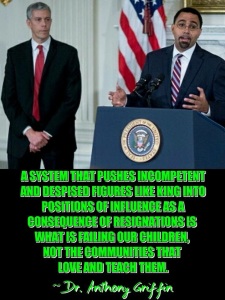
Obama has selected Deputy Secretary of Education John B. King, Jr. to replace him. As per The Washington Post, “King is a Brooklyn native who often credits teachers with guiding him toward a successful path after he was orphaned at age 12. A former charter school leader in Boston and New York, he joined the Education Department in January after a turbulent tenure as commissioner of education for the state of New York. In that role, he was a key architect of new teacher evaluations tied to test scores and played a key role in pushing New York to adopt new tests aligned to the Common Core State Standards years before other states did the same.
The Network for Public Education (NPE) announced their reaction to both Arne Duncan’s resignation and John King as Duncan’s replacement. “The Network for Public Education U.S. Secretary Arne Duncan Resigning in December | VAMboozled!:

The departure of Arne Duncan is irrelevant; the appointment of John King is irrelevant | @ THE CHALKFACE

The departure of Arne Duncan is irrelevant; the appointment of John King is irrelevant | @ THE CHALKFACE:

The departure of Arne Duncan is irrelevant; the appointment of John King is irrelevant


The most important thing that teachers must remember is that they have the power, not middle managers or secretaries of education.

Despite mandates, there are countless ways individual classroom teachers can subvert the status quo and teach precisely how they want to teach. As a white male with a PhD, I recognize that I am not the average public school teacher, let alone a traditional Kindergarten teacher. I have certain privileges. But because of those privileges, I neither let them go to waste nor do I expect other teachers to have the same latitude that I do.

I’ve taken a lot of heat over the years asking tough questions and looking critically at every new initiative. I’ve tried to act as cover for other teachers who have been less willing to stand up for themselves, promising to have their backs.

Whomever is the Secretary of Education, teachers are the gatekeepers. Education reform has and continues to do whatever it can to demolish that wall of protection. Almost like a positive affirmation, I remind myself everyday that I am in control of all the influence that the Secretary has over my practice.

I am fortunate to be teaching Kindergarten because I am not subject to an excessive amount of The departure of Arne Duncan is irrelevant; the appointment of John King is irrelevant | @ THE CHALKFACE:


What to do when a colleague refers to students as bank robbers and murderers?


If you don’t know, I’m a white guy teaching Kindergarten in a school that is 100% Black and 100% free-meals. I am one of three white persons on a staff of roughly 30 that, other than the three, is all Black and majority women. A colleague, who is a person of color, has recently shown such incredible disdain for their students that I was speechless, and that says a lot. This disdain and frustration has been revealed in person to students.

I have been told in recent years that, as a white male with privilege, I have very little say or place in the conversations about teachers or youth of color. I need to sit down, shut up, and listen. I ask my activist colleagues out there in the ether: what are the protocols in this instance? As a white male, can I challenge and reply with equal disdain with my perspective on this colleague’s treatment of their students? Do I sit down, shut up, and listen to this person call their students “bank robbers” or “murderers,” call them “evil” to their faces?

Classroom climate and the overall happiness of students is typically front and center of conversations at a school in a high-poverty community. There are frequent instances of, for instance, students threatening teachers with both words and gestures, community members threatening teachers, throwing furniture, leaving classrooms, bullying other students, bringing knives or cap-guns to school, and going on tirades What to do when a colleague refers to students as bank robbers and murderers?

With A Brooklyn Accent: The Silver Lining in the Appointment of John King

With A Brooklyn Accent: The Silver Lining in the Appointment of John King:

The Silver Lining in the Appointment of John King


These are perfect conditions for revolt!

Education Activists! What are you waiting for?


It is hard to applaud John King's appointment as Interim Secretary of Education to replace the much hated Arne Duncan. In New York, he was legendary for openly displaying boredom, even contempt, when teachers, parents and students spoke out at open hearings held around the state on the newly unveiled Common Core Curriculum and the tests aligned to it. Moreover, his experience with public education was almost as limited as Duncan's consisting of three years as a charter school administrator before he moved in the New York State Education Department.
However, there is one positive aspect to this appointment. Because Dr King never had to go through confirmation hearings by Congress to get appointed to his position, and because he left his Commissioner position in New York at a time of With A Brooklyn Accent: The Silver Lining in the Appointment of John King:

Education in NY Headed for an Iceberg | lacetothetop

Education in NY Headed for an Iceberg | lacetothetop:

Education in NY Headed for an Iceberg


John King had no intentions of leaving NY. While he deserves the credit for creating some of the worst education reforms in NY history, he should also be applauded for attempting to slow Cuomo’s teacher evaluation plan.
As John King was leaving his office in NY, Governor Cuomo sent him a letter.  The letter was meant to serve as a slap on the wrist and called King’s work in NY “unacceptable.”  John was crowned King Botched Implementer by Cuomo and was sent on his merry way.  During his farewell, King took credit for the standards and the curriculum in NY, but he stopped short of taking credit for the teacher evaluation system.  He correctly stated, that the evaluation issue belongs to Cuomo and Cuomo alone.  It was Cuomo’s evaluation plan that drove not only King, but John’s merry men, out of Dodge.  At first, we cheered King’s departure.  Now it has become clear why he left and the future isn’t as bright as we had hoped.
Working in tandem- AFT, NYSUT, Board of Regents, and Cuomo installed a new Commissioner in NY.  They needed a Commissioner that wouldn’t waiver from Cuomo’s evaluation plan.  Commissioner Elia has been battled tested.  Her evaluation plan took her former district into the brinks of financial despair and she didn’t even blink an eye. She was the perfect fit.  At least King had the sense to leave, the rest of the folks are working together. This is the reason NYSUT never fought this plan until it was cemented into law.  Instead of fighting a draconian evaluation system that poses a threat to every teacher and student in NY, NYSUT’s President Magee was leading the Education in NY Headed for an Iceberg | lacetothetop:

Text of Obama’s Farewell Speech to Duncan, and Duncan’s Response | deutsch29

Text of Obama’s Farewell Speech to Duncan, and Duncan’s Response | deutsch29:

Text of Obama’s Farewell Speech to Duncan, and Duncan’s Response


The following is my transcription of the October 02, 2015, announcement of US Secretary of Education Arne Duncan’s resignation, offered by President Obama and followed by a response from Duncan. The transcription is of this 9 1/2-minute video clip provided by Fox News. (Note that Fox News ends the clip before John King speaks.)

[Obama speaking] Arne Duncan is one of my longest serving Cabinet secretaries, and he’s been a friend for a lot longer than that. So, it’s with some regret and sorrow that I’ve accepted his decision to return home to our hometown of Chicago.
After more than six years of living in Washington, Arne’s wonderful wife, Karen, and their excellent kids, Claire and Ryan, who are also buddies of mine, wanted to move back home, and that’s meant in the interim a lot of time apart. So, I’ll be honest, I pushed Arne to stay– sorry guys. Uh, but, I also know from personal experience how hard it is to be away from your family on a sustained basis. So, while I will miss Arne deeply, he has more than earned the right to return home.
Take a look at what Arne’s accomplished over the last six and a half years: He’s one of the longest-serving secretaries of education in our history– and one of the more consequential. In just a few years, Arne and his team have delivered some incredible results at every stage of the educational experience. More than 30 states have upped their investment in early childhood education. Nearly every state in American has raised standards for teaching and learning and expectations for what our kids can learn. And our high school graduation rate is at an all-time high.
We helped millions more families afford college. More Americans are graduating from college than ever before. And that’s just scratching the surface. Arne’s done more to bring our educational system– sometimes kicking and screaming– into the 21st century than anyone else. America’s going to be better off for what he has done. It’s going to be more competitive and more prosperous. It is going to be more equal and more upwardly-mobile. It’s a record I truly believe no other education secretary can match.
Um. Arne bleeds this stuff. He cares so much about our kids, and he has been so passionate about this work. And everybody who interacts with him, including people who disagree with him on some issues never questions, uh, the genuineness and heart that he has brought to this job. So, I couldn’t be more proud of him, and for good measure, Arne also holds the record for most points scored in an NBA All-star game. [mild laughter and applause]
[Duncan’s expression is somber]
And he is my favorite partner in pick-up basket. Uh, the smartest player I know. Even though he’s very slow. [Laughter; Duncan smiles.] And he has no hops. [Duncan say something, inaudible.] He knows it’s true. I will say, watching Ryan, by the way, that the son will soon be surpassing the father because this young man has got game.
Now keep in mind, none of this change has been easy. And we still have a 
Text of Obama’s Farewell Speech to Duncan, and Duncan’s Response | deutsch29:

empathyeducates - The Curse of Market Place Fundamentalism and the Challenge of an Insurrectional Pedagogy

empathyeducates - The Curse of Market Place Fundamentalism and the Challenge of an Insurrectional Pedagogy:

The Curse of Market Place Fundamentalism and the Challenge of an Insurrectional Pedagogy


By Henry Giroux | Originally Published at Counter Punch. September 29, 2015 | Pierre Andrieu/Getty Images

Introduction

The forces of free-market fundamentalism are on the march ushering in a terrifying horizon of what Hannah Arendt once called “dark times.” Across the globe, the tension between democratic values and market fundamentalism has reached a breaking point. [1] The social contract is under assault, neo-Nazism is on the rise, right wing populism is propelling extremist political candidates and social movements into the forefront of political life, anti-immigrant sentiment is now wrapped in the poisonous logic of nationalism and exceptionalism, racism has become a mark of celebrated audacity, and a politics of disposability comes dangerously close to its endgame of extermination for those considered excess. Under such circumstances, it becomes frightfully clear that the conditions for totalitarianism and state violence are still with us smothering critical thought, social responsibility, the ethical imagination, and politics itself. As Bill Dixon observes:
T]he totalitarian form is still with us because the all too protean origins of totalitarianism are still with us: loneliness as the normal register of social life, the frenzied lawfulness of ideological certitude, mass poverty and mass homelessness, the routine use of terror as a political instrument, and the ever growing speeds and scales of media, economics, and warfare. [2]
In the United States, the extreme right in both political parties no longer needs the comfort of a counterfeit ideology in which appeals are made to the common good, human decency, and democratic values. On the contrary, power is now concentrated in the hands of relatively few people and corporations while power is global and free from the limited politics of the democratic state. In fact, the state for all intent and purposes has become the corporate state. Dominant power is now all too visible and the policies, practices, and wrecking ball it has imposed on society appear to be largely unchecked. Any compromising notion of ideology has been replaced by a discourse of command and certainty backed up by the militarization of local police forces, the surveillance state, and all of the resources brought to bear by a culture of fear and a punishing state aligned with the permanent war on terror. Informed judgment has given way to a corporate controlled media apparatus that celebrates the banality of balance and the spectacle of violence, all the while reinforcing the politics and value systems of the financial elite.[3]
Following Arendt, a dark cloud of political and ethical ignorance has descended on the United States creating both a crisis of memory and agency.[4] Thoughtlessness has become something that now occupies a privileged, if not celebrated, place in the political landscape and the mainstream cultural apparatuses. A new kind of infantilism and culture of ignorance now shapes daily life as agency devolves into a kind of anti-intellectual cretinism evident in the babble of banality produced by Fox News, celebrity culture, schools empathyeducates - The Curse of Market Place Fundamentalism and the Challenge of an Insurrectional Pedagogy:

Here Is What We Know About John King, The Next Secretary Of Education

Here Is What We Know About John King, The Next Secretary Of Education:

Here Is What We Know About John King, The Next Secretary Of Education

For one thing, he's a big fan of the Common Core.


U.S. Secretary of Education Arne Duncan is stepping down from his post in December to spend more time with his family, he announced Friday. President Barack Obama has already tapped John King Jr., former New York State education commissioner, to take Duncan's place.  
King will serve in an acting capacity, meaning he was able to forgo a formal nomination process in the Senate. 
King most famously served as the New York State education commissioner from 2011 until 2014. Last year, he moved over to the Department of Education, where he's currently a senior official. 
Here are a few other important things we know about the next acting secretary of education:

1. He Is A Fierce Supporter Of The Common Core


As commissioner, King made it a priority to quickly implement the Common Core State Standards.
These standards, developed by a group of governors, state education chiefs and education experts, are designed to make sure kids around the country are being held to the same rigorous math and literacy benchmarks. The Department of Education incentivized states to adopt the standards via federal grant money. New York adopted them before King's tenure, but he was the one to align the state's classroom curriculum and high-stakes tests with the benchmarks.  

 2. His Tenure As New York State Education Commissioner Was Riddled With Controversy

As a result of his dedication to the Common Core, King became a polarizing figure in New York.
Standardized tests associated with the Common Core are notably more rigorous than the ones previously given to the state's children. Parents decried the new system as their children's scores plummeted, and shared anecdotes about their newly anxious children. Many complained the state moved too quickly in its implementation of the standards, saying teachers and schools didn't have adequate time to prepare for the switch.
A coalition of education and parent groups called on King to resign. When he spoke to students and parents in forums around the state, thousands poured in and often criticized his policies
At the time, King said he understood parents' concerns, but stood steadfast in his commitment to the Common Core.
We understand that implementation of the Common Core and teacher/principal evaluation in a time of limited resources has come with significant challenges,” King wrote in a 2014 letter to state education leaders. “The Board of Regents and I knew we would encounter a good amount of concern in the public forums. We want -- and need -- to hear from teachers, parents, and students as these important changes in practice occur in classrooms, schools, and communities across the State." 

3. He Is Committed To Diversity In The Classroom

 At a recent National Coalition on School Diversity conference, King emphasized the importance of integrated, racially diverse schools, according to Chalkbeat New York.
“Schools that are integrated better reflect our values as a country,” King said.
Under Duncan, the Education Department did not take action to desegregate the nation's increasingly racially segregated schools. But King told Chalkbeat that integration “has a long history and substantial evidence” of success.

4. He Has Experience In The Classroom

King, whose father was the first African-American school principal in Brooklyn, spent three years teaching social studies before he helped start a charter school in Boston. Later, he became one of the founders of Uncommon Schools, a charter school network that now has 24 institutions, according to the New York Times. 
Both of King's parents died by the time King was 12, and he attributes his success to the help of teachers.
"I grew up in Brooklyn, I lost my mom when I was 8, my dad when I was 12," King said Friday at a press conference. "New York City public school teachers are the reason that I am alive." 
"John was one of those kids that probably shouldn’t be in a room like this," Duncan  Here Is What We Know About John King, The Next Secretary Of Education:

Obama vs. teachers unions: It's still on

Obama vs. teachers unions: It's still on:

Obama vs. teachers unions: It's still on


John B. King Jr. might sound like the kind of Secretary of Education who could help repair the Obama administration’s fractured relationship with reliably Democratic teachers unions. Not only is he a child of a teacher and a former teacher himself, he credits his Brooklyn public school teachers with turning his life around.

King’s mother, a school guidance counselor, died when he was in fourth grade at P.S. 276 in Canarsie. His father, a retired teacher and school administrator, died a few years later. In a recent interview, King credited his teachers with steering a troubled orphan away from jail or death. “They made school a refuge for me,” King told me. They encouraged his talents, whether he was memorizing world capitals or acting in A Midsummer Night’s Dream, and they inspired him to pursue a career in education.

But as deputy education secretary under Arne Duncan, whom he will replace in December, and before that as the top education official in New York state, King’s relations with unions have been as rocky as Duncan’s—and for that matter Obama’s. The unions often argue that the deep problems of urban education have their roots outside the school, with impoverished and crime-ridden neighborhoods stripped of hope. King worries about those problems, but like Duncan and President Obama, he worries even more about using them as excuses for problems inside the schools.

“Yes, we should have better health care and housing and criminal justice reform,” King told me. “But school can save kids’ lives. It saved mine.”

With the possible exception of trade, education is the issue where Obama has veered farthest from his liberal base. It’s historically a local issue, but Obama and Duncan, his pickup basketball pal from Chicago, have reshaped the national landscape, using carrots (like the Race to the Top competition for stimulus dollars) and sticks (like the threat of sanctions under the No Child Left Behind Law) to nudge states into adopting reforms that unions hate.

By choosing King to succeed Duncan, the president is signaling that he cares more about continuing those fights—for higher standards, for charter schools, for standardized testing—than healing wounds or papering over differences within his party before the 2016 election.        

Duncan has been the public face of those differences; the National Education Association called for his resignation, while the American Federation of Teachers put him on an “improvement plan” like the ones school reformers have endorsed for incompetent teachers. He is leaving with U.S. graduation rates at an all-time high and dropout rates at an all-time low, but there has been a growing bipartisan backlash over some of his favored reforms, like the Common Core math and reading standards (derided as “Obamacore” by many conservatives) or the use of student test scores in teacher evaluations (derided as “test-and-punish” by unions). I recently mentioned to Duncan that it seems like the main theme uniting his reforms has been the idea that adults in the education system should be held accountable for making sure kids learn. "Just a little bit!" he responded.

Like King, Duncan is the child of educators—he teared up today while discussing  his late father, a professor at the University of Chicago, and his mother, who founded an after-school tutoring program in the downtrodden south side of Chicago—and he has sided with unions on issues like universal pre-K and increased school funding. But their anger over testing has overshadowed every other issue.

“He’s destroying what it means to teach, what it means to learn,” Lily Eskelsen Garcia, the head of the NEA, told me in a recent interview.

The backlash has been especially fierce in New York, where King helped implement the Common Core as well as a rigorous testing regime; this year, one in five students opted out of the statewide tests. Unlike Duncan, King is a former educator who used to teach high school social studies, but like Duncan, he got his start in management when he launched a charter school. And like Duncan, King was the subject of a vote of no confidence by the teachers union in New York.

Yesterday, a group of outspoken educators known as the Badass Teachers Association accused him of “dismantling public education by using corporate education reform tactics.”

“Sadly, at the same time we rejoice at the resignation of Arne Duncan, a man who has done more destruction to public education than any other secretary, we are horrified that President Obama has chosen to replace him with John King,” the BTA said.

But Obama has always taken the reform side of the public education wars; in The Audacity of Hope, he criticized liberals who “defend an indefensible status quo, insisting that more spending alone will improve educational outcomes.” His legacy in education isn’t as obvious as in health care or energy, but thanks to Race to the Top and his No Child Left Behind waivers, nearly every state has embraced higher standards. Most states have also adopted more aggressive testing regimes and ditched restrictions on charter schools. The House and Senate have both passed bills to roll back the federal role in education, but for now it has never been stronger.

Liberal critics often refer to the education reform movement as a “billionaire boys club,” noting its support from hedge fund managers as well as philanthropists like Bill Gates, the Walton family and Mark Zuckerberg. Its emphasis on tough standards and market-based competition does have a conservative pedigree; current Republican politicians don’t say nice things about Obama appointees, but former Republican Governor Mitch Daniels of Indiana yesterday gushed about Duncan’s “valiant service…challenging the most intransigent and powerful special Obama vs. teachers unions: It's still on: