Sunday, September 13, 2015

APS proposes ‘kit’ to opt out of testing | Albuquerque Journal News

APS proposes ‘kit’ to opt out of testing | Albuquerque Journal News:

APS proposes ‘kit’ to opt out of testing


Albuquerque Public Schools is working to create a uniform process for parents who want to remove their children from standardized testing – an effort aimed at combating widespread confusion about “opting out.”
During the APS Board of Education’s policy and instruction committee meeting Wednesday afternoon, administrators outlined a proposal to provide a “tool kit” for schools and parents, which would include an opt-out form, frequently asked questions sheet and calendar of tests by grade level.
The kit would be available on the APS website and in the schools, according to Rose-Ann McKernan, executive director of the APS office of accountability and reporting.
In a presentation on the proposed process – which was only up for discussion Wednesday – she explained that parents who want their kids to skip one or more standardized tests would complete the form and return it to the APS central office or their child’s school.
The central office would keep track of the forms and create a report for each school, listing students who have opted out. Principals would come up with ideas for alternative assignments for nontesting students and submit them to APS administrators.
The goal is to provide parents with “some very straightforward direction,” McKernan said.
She added that she hopes to avoid the uncertainty that arose during the 2014-2015 school year, when the controversial Partnership for Assessment of Readiness for College and Careers test was administered for the first time. Critics have said that PARCC reduces children to statistics, and is too long and difficult.
Last year, parents requested testing opt-outs for about 4,000 students by communicating with principalsAPS proposes ‘kit’ to opt out of testing | Albuquerque Journal News:


Caucus of Working Educators plans to challenge PFT leadership | Philadelphia Public School Notebook

Caucus of Working Educators plans to challenge PFT leadership | Philadelphia Public School Notebook:

Caucus of Working Educators plans to challenge PFT leadership

The caucus, which has been organizing since 2013, plans a "listening campaign" in advance of next year's vote.


Photo: Caucus of Working Educators
From Left: Amy Roat, Yaasiyn Muhammad, Ismael Jimenez, Kelley Collings


The Caucus of Working Educators (WE), a group of mostly younger teachers committed to social justice unionism, announced plans Thursday to put up a slate in next year's election against Jerry Jordan and the current leadership of the Philadelphia Federation of Teachers.
The challenge is the most robust and coordinated effort since the 1980s to unseat the dominant Collective Bargaining Team that has run the PFT for more than 30 years.
WE's mission -- to put stark focus on educational inequality and the damage it does to teachers, students, and society -- is in the spirit of internal dissent that has ousted long-term union leadership in cities including Chicago, Los Angeles, San Francisco, and Milwaukee. Its action has the potential to shake up the historically dysfunctional PFT-District relationship, although whether it would become more or less adversarial under WE is still not clear. 
"We are a diverse group of rank and file members who felt disconnected from the PFT leadership," said Larissa Pahomov, an English teacher at Science Leadership Academy and co-chair of the caucus. "We don't believe essentially that a one-party union is good for the teachers of Philadelphia."
The group, which formed 18 months ago and claims about 200 members, has been emphasizing issues not usually on the front burner in union elections, such as the school-to-prison pipeline, racial injustice, and, most visibly, students' right to opt out of standardized tests. 

Active in opt-out

Two of the four teachers who will be vying for the top union posts as caucus candidates, Amy Roat and Kelley Collings, have been frontline activists in the "opt-out" movement, Caucus of Working Educators plans to challenge PFT leadership | Philadelphia Public School Notebook:

Flawed FSA shouldn’t be used for grading anyone | The Edvocate Blog

Flawed FSA shouldn’t be used for grading anyone | The Edvocate Blog:

Flawed FSA shouldn’t be used for grading anyone

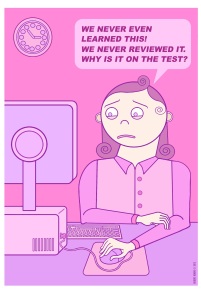
WE NEVER LEARNED THIS ROBERT RENDO
Illustration: Robert Rendo


No one is surprised that the Florida Standards Assessment (FSA) was deemedvalid by the EdCount/Alpine study. What’s odd is that the equally important factor of reliability was not considered. Finding the FSA psychometrically valid does not address the terrible conditions under which the test was administered, nor does it resolve significant concerns about psychometric reliability. Ignoring this, Education Commissioner Pam Stewart assumed that “all Floridians will share my confidence in the assessment.”
There isn’t a Florida student, parent, teacher, superintendent, board member or administrator who doesn’t see through this charade. Superintendents fromLeon to Miami-Dade have expressed their deep concerns. The study’s own numbers point out that just 65 percent of the test items match the Florida Standards. It concludes that it would be wrong to retain students or deny diplomas based on the 2015 FSA, yet Commissioner Stewart plans to use these same flawed test results to set pass/fail cut scores, grade schools and evaluate teachers. It’s fundamentally unfair to punish teachers and grade schools based on scores where 35 percent of the test items were never taught to Florida students.
Put another way, if a student answered every question based on the Florida Flawed FSA shouldn’t be used for grading anyone | The Edvocate Blog:

A School I Believe In, a Movement I Don’t | EduShyster

A School I Believe In, a Movement I Don’t | EduShyster:

A School I Believe In, a Movement I Don’t


How my charter network’s advocacy hurts more kids than it helps…
old seatsLast year I made the agonizing decision to leave my urban public school and take a job at a charter school that is part of a highly-regarded network. I loved my students and the community at my former school, but after a tumultuous year spent battling a hostile administration, I knew I had to leave. About two months into work, and now at the beginning of the school year, I’m convinced that I’ll become a much stronger teacher as a result of the feedback, support and coaching I’m getting at my new school. What I’m far less comfortable with, though, is the role that my charter network plays in the larger charter-school movement. 
A deeply troubling movement
My network’s contributions to a deeply troubling charter-school movement, both nationally and at the state level, have been substantial. Speaking concretely, the charter movement has produced multiple low-performing schools for each high-performing school it’s produced. Many of these struggling schools stay open for several years, and more get their charters renewed than they should. The charter authorization process is hardly democratic, which is deliberate. Some non-profit-run charters have become cash cows for education corporations and consulting groups, even as the schools mis-educate and underserve kids.
Meanwhile, many of the high-performing schools are so driven to be defined as *high-performing* by the narrow metrics the movement and, increasingly, we as a country endorse, that they achieve their success through astonishingly high attritionand an obsession with compliance. There is also the uncomfortable reality that a movement that advocates for charter schools for students of color, is overwhelmingly white-led and often profoundly paternalistic.
Still, I’m inclined to be forgiving of my network. On the whole, they are doing a relatively good job by students, their families, and the communities the schools serve. My school specifically is doing great things for our kids, sticking by even the most A School I Believe In, a Movement I Don’t | EduShyster:


Peg with Pen: Understanding Teach Like a Champion

Peg with Pen: Understanding Teach Like a Champion:

Understanding Teach Like a Champion


I'm currently in the process of reading Teach Like a Champion 2.0.  I'm reading it because it is one of the "go to" books shared via Relay Graduate School NYC, and unfortunately, their work is being spread far and wide here in Colorado in many of our districts, including mine.  We are at a very precarious time in public education - our work as educators is being stripped from our schools and replaced by non-educator think tanks who pride themselves on high test scores.  Teach Like a Champion 2.0 is written by Doug Lemov. I'll let you read more about him here. Ultimately he is not an educator, but has great experience within the world of charter schools. He has two degrees in English and one in business. He is a corporate education reformer. Period.

To be honest, after reading over 100 pages of the book (there will be a follow-up blog when I finish reading the entire book), I have to say it's incredibly shallow and simplistic - yet the scary part is the dictatorial demand to keep everything shallow, uniform and simplistic.  And as mentioned above, Lemov's beliefs about "teaching like a champion" are beginning to co-opt what true educators really understand about teaching, child development, and engaging learners.  This book is a great primer for reducing learning to uniform and robotic student behavior which is easy to "track" (Lemov's word - not mine) and manage, in order to get the results that you want. And the results that they want are high test scores.Lemov is clear in stating that this work is gauged via state test scores.

True learning is incredibly messy, but with an inherent structure in place to support the Peg with Pen: Understanding Teach Like a Champion:

MAJOR FACTORS FOR CONTINUED MINORITY FAILURE ON COMMON CORE TEST IGNORED- WHY IS THAT? - Perdaily.com

MAJOR FACTORS FOR CONTINUED MINORITY FAILURE ON COMMON CORE TEST IGNORED- WHY IS THAT? - Perdaily.com:

MAJOR FACTORS FOR CONTINUED MINORITY FAILURE ON COMMON CORE TEST IGNORED- WHY IS THAT?


student with ear buds.jpg


(Mensaje se repite en Espaรฑol)

In analyzing the recent abysmal showing and further decline of Black and Latino students on recent state tests designed to measure their mastery of Common Core standards, major factors seem to have been purposefully ignored in looking at these scores in order to continue a failed public education policy that is clearly responsible. Why is that? Could it have anything to do with the corporate agenda that seeks to justify the further privatization of the now close to $2 trillion a year public education "business" with privately owned or controlled charter schools designed to tap into these funds by corporations?

The greatest factor in explaining this continued poor performance of Black and Latino students on these tests is not even addressed as a factor in explaining why these students continue to fail in school and on these tests. In the continued segregation of our public schools 61 years after Brown vs. Board of Education said, "Separate but equal...is inherently unequal" and against the law, not only has segregation gotten worse, it has gotten so bad that older African Americans now often remark that the segregated all Black schools they went to were better than a de facto segregated Dorsey, Crenshaw, or Audubon LAUSD school, where failure is almost ensured and success is the miraculous exception rather than the grade-level mastery, which should be the rule.

When somebody like Chris Minnich, executive director of the Council of Chief State School Officers says, "We are asking more out of our kids and I think that's a good thing" as reported by Howard Blum in the Los Angeles Times, both Blum and Minnich are clearly lying and they know it.

In school districts like LAUSD, that remain close to 90% Latino and Black, the vast majority of students, parents, teachers, and most importantly administrators have noMAJOR FACTORS FOR CONTINUED MINORITY FAILURE ON COMMON CORE TEST IGNORED- WHY IS THAT? - Perdaily.com: 

Seattle Schools Community Forum: Things That Make You Go, Hmm...

Seattle Schools Community Forum: Things That Make You Go, Hmm...:

Things That Make You Go, Hmm...


(Strike update: nothing from SEA as of 10:15 am today, Sunday the 13th; SPS has a press conference today at 3 pm.  Maybe they are hoping there will be something to say then.)

1) In some of the biggest news for public education in Washington State - namely, that the Governor is assembling a "work group" to get McCleary done AND doesn't want the overturned charter law part of the discussion (AND he still doesn't support charter schools) - and yet the Seattle Times has said nothing.  Zero. Zip.  (At least I can't find it.) 

The Stranger reported it.  The Puget Sound Business Journal reported it.  And that was two days ago.  But the Times has time to write about the Justices who sit on the Supreme Court.  Hmm...

2) All the information I have put up here at the blog comes from my gleaning of information from various websites and from parents, both individual and via Soup for Teachers.  Why doesn't SEA want to help me help them by just giving me updates/info?  Hmm....

3) Why doesn't SEA have a specific hashtag for the strike so that Twitter could be more effective?  Why aren't they throwing evidence-based facts out there 
Seattle Schools Community Forum: Things That Make You Go, Hmm...:


Creating A Culture Of Respect | Oklahoma Observer

Creating A Culture Of Respect | Oklahoma Observer:

Creating A Culture Of Respect


Creating A Culture Of Respect


The Washington Post’s Jay Mathews describes John Thompson’s A Teacher’s Tale: Learning, Loving and Listening to Our Kids as “riveting,” “deep,” and “revealing.”
Mathews has watched the DC schools for more than a generation and has “seen what Thompson describes many times.” The veteran reporter writes, “Thompson witnessed at his urban school ‘this accountability-driven reform . . . imposed, unfortunately, by advocates of disruptive change who typically had little knowledge of high-poverty K-12 schools’ … ‘Inner city schools need more disruption like we need another gang war.’”
Mathews was struck by an incident at the beginning of Thompson’s first day in an Oklahoma City high school. Local readers might be interested in the full account of the teacher’s introduction to a troubled high-poverty school, and one lesson he learned from a student with the pseudonym of “Micah:”
During my first few minutes at John Marshall High School, I broke up a gang-related fight, was punched twice, witnessed extremes of inappropriate behavior and academic excellence, traversed the “T” or transitional hall for overage at-risk students, and then taught an Advanced Placement U.S. history class for students destined for elite universities. Just before entering the college-level classroom, I greeted my old Sleepy Hollow camper.
“Hey, Micah!”
“Hey, John!”
Moving on, I overheard some “wannabe” gangsters teasing Micah for being on a first-name basis with a teacher.
“He’s my parole officer,” Micah replied.
The next day, I jumped Micah and jacked him up against the wall, telling him to go pee in a cup. The natural-born comedian played along. As shocked passersby recognized the spoof, laughter erupted throughout the hall. That was the first of many times that Micah would help me gain the “props” or respect that – rightly or wrongly – teachers were required to earn before they could teach effectively in tough urban schools.
… It was a joy for me to teach my old friend, but he dropped out during his sophomore year. A couple of years later, a brawl at the front of the school was morphing into a riot that attracted carloads of gangbangers. I was alone at the back parking lot when a convoy of new combatants entered. Assuming they were armed, I sought to remain calm and authoritative when approaching the lead car packed with gang members. The sound of screeching tires prompted them to brake. A big blue car sped into the lot and stopped between the convoy and me. Micah took charge and told his “soldjas” to leave. As I started breathing again, Micah’s instructions were obeyed, the cars exited the lot and turned left, away from the fights.
My student’s loyalty illustrated a key lesson from my early years. The first priority is the building of trust, care, and relationships. Creating a school culture of respect is the key. And by respect, I do not mean the street code definition principle. Getting there from where we stood, enmeshed in the violence and disorder of the inner city, was more complicated than many non-educators understand.
– Dr. John Thompson, an education writer whose essays appear regularly in The Oklahoma Observer, has a doctorate from Rutgers University and is the author of Closing the Frontier: Radical Responses in Oklahoma Politics. His latest book, from which the above excerpt is taken, is available through Tate Publishing.

A Much Muted Return | @ THE CHALKFACE

A Much Muted Return | @ THE CHALKFACE:


A Much Muted Return

I’m back. If you’re new to this, check the About page.
There’s a history to @ the ChalkFace. It goes back to the beginning of 2010. Things became complicated, and with those complications much frustration. There was a break for over a year. It was very nice. I shed a lot of Internet weight.
I have ideas. I have stories and new experiences that are important for me to share. They could be important for readers as well. These stories and experiences will one day be compiled into something bigger. When teaching doesn’t get in the way, there’ll be more time for that.
To be very clear, @ the ChalkFace has always for me meant a place to share experiences of teaching. That’s how the phrase translates. Being back in the classroom after several years in higher education, there’s A LOT to discuss. Things are not as cut and dried as they were ten years ago or even a year ago.
To that end, I hope to be very clear and very plainspoken. At the same time, I need to be humble. I learned quickly that, despite having advanced degrees and experience, I don’t have even a fraction of the answers.
Let’s be humble together.A Much Muted Return | @ THE CHALKFACE:

Aristotle in Kindergarten—What Do Children Miss?

Aristotle in Kindergarten—What Do Children Miss?:

Aristotle in Kindergarten—What Do Children Miss?


Plato, Greek philosopher. A disciple of Socrates and the teacher of Aristotle, he founded the Academy in Athens. This is his statue, located before the Academy of Athens, Greece.


When I read in The New York Times about Matthew Levey, a Columbia alum and former McKinsey consultant, who is setting up the International Charter School of New York, I was stunned! The school is starting out with 70 kindergartners and first graders and will eventually go up to fifth grade.
Mr. Levey starting a school doesn’t stun me. MBAs, with no teaching or education credentials, starting up schools is trendy. While my college prepared, fully credentialed teacher friends in their public school classrooms are evaluated with gotcha exams to push them out of their careers, if you are a business person it’s an open field.
Our tax dollars are yours no matter who you are and what you teach!
Mr. Levy has plans for these little children. He cares about teaching them: how Francis Bacon developed the scientific method, why Aristotle matters and what led to the decline of the Roman Empire. That’s what stuns me.
How many five year olds do you know who have been yearning to find out about Aristotle? And do you really want your little kid learning about the fall of a civilization?
What are the other things they could be learning at this important developmental period in their lives?
I don’t want to discourage a child’s quest for great thoughts, and maybe some Aristotle in Kindergarten—What Do Children Miss?:

Washington Supreme Court Finds Charter School Law Unconstitutional - Education Justice

Education Justice | September 11, 2015 - Washington Supreme Court Finds Charter School Law Unconstitutional:

September 11, 2015
Newsletter Graphic
HELP SUPPORT ELC 
ELC relies on the generous contributions of individuals, corporations and foundations to support our work.
DONATE NOW
WASHINGTON SUPREME COURT FINDS CHARTER SCHOOL LAW UNCONSTITUTIONAL
Olympia, WA --- On September 4, 2015, in League of Women Voters of Washington v. State, theWashington Supreme Court voided the state's charter school statute because it circumvents local control and diverts education funds away from district schools, in violation of the state constitution.
Local control of K-12 schooling is essential and required in Washington. Local voters through their elected boards of education are the only entities permitted to govern public schools and receive public funds for "common schools." Yet, the charter statute allowed charters to be authorized and run by private, appointed boards completely outside the control of local voters and school boards. And, the statute required the state and local taxpayers to fund the charters equally with the public schools.
The plaintiffs, including League of Women Voters, El Centro de la Raza, Washington Association of School Administrators, Washington Education Association, and individuals, were "[a]larmed over the lack of local accountability and [the] fiscal impacts of the Act," the Court explained, and sought a judgment that the Act was unconstitutional.
Relying on longstanding and numerous precedential cases, the Court concluded that "Charter Schools Are Not Common Schools" and "The Charter School Act's Funding Provisions Fail."
Common Schools
The Court wrote that "This case turns on ... article IX, section 2 of our state constitution and this court's case law addressing that provision." Article IX, section 2 provides:


The legislature shall provide for a general and uniform system of public schools. The public school system shall include common schools, and such high schools, normal schools, and technical schools as may hereafter be established. But the entire revenue derived from the common school fund and the state tax for common schools shall be exclusively applied to the support of the common schools.


To tap the funding sources identified in article IX, the charter law simply declared charter schools to be "common schools." The law asserts that charter schools are eligible for local levy funding and state funding equal to that for the public schools. The law's intent was to shift school funding from existing common schools to charters.
However, "common schools" have been defined in Washington for well over a century, as follows:


a common school, within the meaning of our constitution, is one that is common to all children of proper age ... , free, and subject to and under the control of the qualified voters of the school district. The complete control of the schools is a most important feature, for it carries with it the right of the voters, through their chosen agents, to select qualified teachers, with powers to discharge them ... .


School District No. 20 v. Bryan (1909). Several subsequent cases have followed and applied Bryan.
The charter law provides that charters are "governed by a charter school board" which is "appointed or selected ... to manage and operate the charter school," the Court stated, citing the statute. Furthermore, the charter board has the power to hire and discharge employees and may contract with other organizations to manage the charter. Charters are "exempt from all school district policies" and "all ... state statues and rules applicable to school districts," with a few minor exceptions stated in the statute.
The Court concluded that because the charters are to be run by an appointed board or other organization and not subject to local voter control, they are not "common schools."
Funding Provisions Fail
The Court reminded the parties that "when adopting our constitution the people of this state 'endeavored to protect and preserve the funds set apart by law for the support of the common schools from invasion, so that they might be applied exclusively to ... such schools.'"(citingBryan). The Washington Supreme Court has, throughout the 20th century and earlier, "struck down laws diverting common school funds to any other purpose." The Court cited cases from 1995, 1939, 1914 and 1897.
Under the charter statute, money that is dedicated to common schools would be unconstitutionally diverted to charters, the Court wrote. "'Once appropriated to the support of the common schools,' funds cannot 'subsequently be diverted to other purposes'" even if related to education. "This court cautioned that to hold otherwise 'would be calamitous,'" the Court said, citing an earlier decision.
In conclusion, the Court declared the charter statute "unconstitutional and void."
Related Stories:
Education Law Center Press Contact:
Molly A. Hunter
Education Justice, Director

CURMUDGUCATION: David Coleman's Master Plan

CURMUDGUCATION: David Coleman's Master Plan:

David Coleman's Master Plan


David Coleman, the architect of the Common Core and current head of the College Board, has spoken many times about what the long view of education reform would be. One frequently quoted speech was his keynote address at the Institute for Leadership Senior Leadership Meeting in December of 2011.

The seventy-minute presentation is a lot to watch, but I recently stumbled over a transcript of the whole mess, hosted online by the nice folks at Truth in Education. This was Coleman in 2011 delivering a speech entitled "What Must Be Done in the Next Two Years" at a time before reformsters had learned to be more careful about concealing the details of what they had in mind. The transcript is twenty-six pages long, so we're just going to skip through highlights.

The Testing Smoking Gun

It was Lauren who propounded the great rule that I think is a statement of reality, though not a pretty one, which is teachers will teach towards the test. There is no force strong enough on this earth to prevent that. There is no amount of hand-waving, there's no amount of saying, “They teach to the standards, not the test; we don't do that here.” Whatever. The truth is and if I misrepresent you, you are welcome to take the mic back. But the truth is teachers do. Tests exert an enormous effect on instructional practice,direct and indirect, and it's hence our obligation to make tests that are worthy of that kind of attention. It is in my judgment the single most important work we have to do over the next two years to ensure that that is so, period. So when you ask me, “What do we have to do over the next years?” we gotta do that. If we do anything else over the next two years and don't do that, we are stupid and shall be betrayed again by shallow tests that demean the 
CURMUDGUCATION: David Coleman's Master Plan:

ICYMI: This Week's Recommendations


Here are just a few of the articles this week that deserve your time and attention!

Common Core "Results" Aren't Actually Test Scores 

Bernie Horn provides a great explanation-- clear, simple, and comprehensible to civilians-- about why the results you read in the paper aren't what you think they are.

America's Teaching Force by the Numbers 

I can't say that Laura McKenna hit it completely out of the park, but as mainstream media outlet coverage of the teacher "shortage" goes, this is not bad. 

Educating Governor Kasich

New-to-me blogger Abby White comes from Ohio, and she has some thoughts about John Kasich and his approach to education. 

Delivery Man

I used this old piece from the Economist earlier this week, but it's a particular direct but brief profile of Sir Michael Barber, the big cheese at Pearson. 

Hansen Was Angry

Ohio newspapers have been ploughing through pages of newly-released documents dealing with Ohio's messed-up department of education. This is just one example of the shenanigans, but all of the coverage is worth folowing.

New Teachers Are Educated, Not Trained 

Russ Walsh with a pointed reminder that puppies are trained, and teachers are not. Also, a fine list of what the basic elements of a good teacher education program would be.


How Much Reform Can $100 Million Buy Without Addressing Poverty? - NEA Today

How Much Reform Can $100 Million Buy Without Addressing Poverty? - NEA Today:

How Much Reform Can $100 Million Buy Without Addressing Poverty?


(l-r) New Jersey Governor Chris Christie, Facebook CEO Mark Zuckerberg, and Newark Mayor Cory Booker on NBC's Education Nation in September 2010.
(l-r) New Jersey Governor Chris Christie, Facebook CEO Mark Zuckerberg, and Newark Mayor Cory Booker on NBC’s Education Nation.


In September 2010, Facebook CEO Mark Zuckerberg, flanked by then-Newark mayor Cory Booker and New Jersey Governor Chris Christie, appeared on Oprah to announce to make an important announcement.  “We’re setting up a $100 million challenge grant so that Mayor Booker and Governor Christie can have the flexibility they need to turn Newark into a symbol of educational excellence for the whole nation.” Excitement and expectations ran high, but they weren’t able to deliver on that promise. What happened in Newark became a cautionary tale of the pitfalls of ill-conceived and misguided education reform efforts in urban school districts –  the focus of a compelling new book by journalist Dale Russakoff.
In “The Prize: Who’s in Charge of America’s Schools?” , Russakoff delivers a riveting account of celebrity politics, big philanthropy, extreme economic inequality, the charter school movement, and the struggles and triumphs of schools in one of the nation’s poorest cities.
NEA Today recently spoke with Russakoff about what went wrong in Newark and what lessons we can draw from the experience.
While Zuckerberg’s intentions may have been good, educators and many others have long said that philanthropists with no education policy experience shouldn’t lead major school reforms, and your book shows us why. How can a philanthropist best contribute to improving school quality?
Dale Russakoff: Zuckerberg realized he needed to know a lot more about Newark itself. He relied on people who told him what the schools needed, but those people might not have known as much as they needed to. It’s important to work very closely with the people on the ground and in the districts rather than on consultants or other people who say they know what’s going on. There are so many teachers, principals, administrators and and community organizations who are intimately familiar with what they need and who want what’s best for students. Also, Zuckerberg was told there was too much grassroots opposition to change and to avoid getting involved there at the outset. He was told to fight the powers that be rather than engage them, but the reality is there are so many teachers, principals, parents and community members who could have really helped him and his advisors to think about how best to help and do so strategically. Any philanthropist should do due diligence and be in tune with what the community’s needs are.
What was the biggest lesson Zuckerberg seemed to learn from his experience in Newark?
DR: There’s always going to be opposition and there will always be people bent on stopping you at any cost, but I think Zuckerberg learned that you need real How Much Reform Can $100 Million Buy Without Addressing Poverty? - NEA Today:

Why Were So Many Education Reformers Bad Students? | gadflyonthewallblog

Why Were So Many Education Reformers Bad Students? | gadflyonthewallblog:

Why Were So Many Education Reformers Bad Students?


Screen shot 2015-09-12 at 7.33.08 AM
Bad students often hate school.
Not exactly shocking, I know.
But perhaps more surprising is the pattern of low, sloppy or inconsistent academic achievement by so many of those adults who consider themselves education reformers, particularly corporate school reformers.
Our ideas of school are certainly formed during our years in it. Those working so diligently to destroy the public school system and reshape it to resemble the business model are so often people who didn’t fit in. They earned low grades or only excelled in subjects they really liked. Perhaps school failed them or perhaps they failed school. There’s no way to know for sure since school records are almost always kept private. But details do trickle through and display a clear pattern – a pattern that certainly gives the appearance of an ulterior motive.
Are these former bad students more interested in fixing the perceived problems they see with the system? Or are they consciously or unconsciously seeking revenge against a system that found them to be inadequate?
The Wisconsin Governor-cum-Presidential candidate has been one of the most virulent enemies of public education and public school teachers in the past decade.
But when he was a lowly student, he wasn’t anywhere near the head of the class. His Why Were So Many Education Reformers Bad Students? | gadflyonthewallblog:

Russ on Reading: New Teachers are Educated, Not Trained

Russ on Reading: New Teachers are Educated, Not Trained:

New Teachers are Educated, Not Trained


It was gratifying the other morning to pick up the New York Times and see this headline on the Opinion Page: "Teachers Aren't Dumb." Gee thanks. The author of the piece, Daniel T. Willingham, a professor of psychology at The University of Virginia, says that Arne Duncan is wrong about prospective teachers scraping the bottom of the barrel of students admitted to colleges. When you look at the students who actually complete a teaching degree, their scores tend to fall around the average of other students completing degrees in other fields. Willingham says that college education school graduates are "smart enough" to do the job. I agree.

Willingham says quite a few smart things. For example he acknowledges that it takes more than intelligence to be a good teacher. And he recognizes that it is plain foolishness to try to assess the quality of a teacher preparation program on the basis of standardized test scores of the school children taught by their graduates. He also says, and I agree, that prospective teachers do not get enough course work in reading and math pedagogy.

Unfortunately when he tries to posit some solutions to the problems he sees in teacher education (I refuse to use the word "training"), Willingham says a lot of dumb things. He says that there are two things we should do to improve teacher preparation programs:


  1. Test students at the end of their schooling to see if they know what they need to know.
  2. Generate a list of what research says a teacher ought to know and use Russ on Reading: New Teachers are Educated, Not Trained: