Latest News and Comment from Education

Monday, August 24, 2015

CURMUDGUCATION: Cage Busting Teachers?

CURMUDGUCATION: Cage Busting Teachers?:

Cage Busting Teachers?


One of my summer reads was Rick Hess's book The Cage-Busting Teacher. Hess comes to us from theAmerican Enterprise Institute, a right-tilted free-market-loving thinky tank, but Hess is no dummy and has shown at times his willingness to think things through, whether that thinking leads him into disagreement with reformster orthodoxy or not.

This new book of his deals the question of the cages that teachers inhabit, what makes the cages, what keeps the teachers in the cages, and how they can get out. It's a challenging book, because parts of it are dead on and parts of it are dead wrong. But I've read it, so you don't have to (or so that you can decide if you want to).

First, the Very Short Version

Teachers complain of being thwarted, boxed in, bottled up, and just plain caged. Hess spent some time talking to lots of folks, and concluded that while teachers lack the organizational authority to bust a cage (we don't control budgets, staffing, scheduling, etc), teachers can make use of the authority of expertise and moral authority. Using those, teachers can shift the culture of their buildings and create concrete solutions to institutional problems.


The more teachers do that, the more trust they'll win, the more policy makers will back off, and the 
CURMUDGUCATION: Cage Busting Teachers?:


Bush’s Education “Blueprint” Before 9/11 - The Crucial VoiceThe Crucial Voice

Bush’s Education “Blueprint” Before 9/11 - The Crucial VoiceThe Crucial Voice:

Bush’s Education “Blueprint” Before 9/11


maxresdefault

Before 9/11 of 2001, there was an article printed in The Standard-Timesof New Bedford, Massachusetts titled “Bush’s education ‘blueprint’ bound to be inadequate.” It waspublished on September 6th.360_bush_sep_11_classroom_hfs_0502
Bush’s education “blueprint” became No Child Left Behind (NCLB), the 2002 reauthorization of the Elementary and Secondary Education Act (ESEA).
The national discussion of the issues with this reauthorization of federal education law never rose above the rubble left behind by the unfathomable reality of that terrible September day. NCLB’s importance paled in comparison.
I’m presenting the essence of the inadequacies presented in that September 6th article— now— not to point blame at anything or anyone but in hopes of bringing up the conversations that were buried by the 9/11 national tragedy.
About the Bush blueprint, Gary Ratner wrote:
“Its approach —increasing accountability— does not address the fundamental need: providing effective teaching, challenging curriculum and family support for all students.”
“If we are serious about maximizing the possibility of all students succeeding, we must provide these conditions for all students.”
“…merely intensifying pressure on employees to improve performance 
Bush’s Education “Blueprint” Before 9/11 - The Crucial VoiceThe Crucial Voice:


Major media continues to block any news of #FightForDyett hunger strike. This is from In These Times. | Fred Klonsky

Major media continues to block any news of #FightForDyett hunger strike. This is from In These Times. | Fred Klonsky:

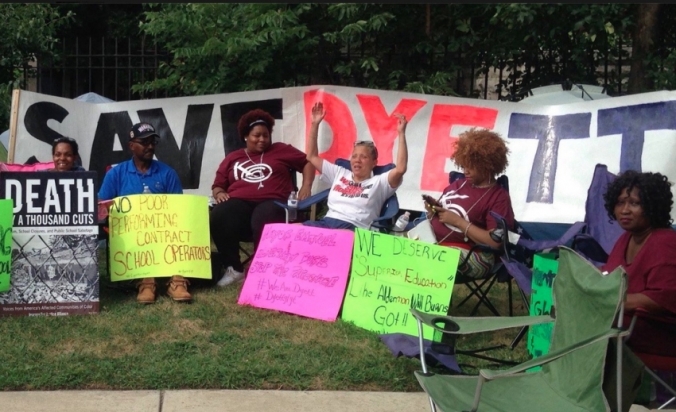
Major media continues to block any news of #FightForDyett hunger strike. This is from In These Times.


dyett_850_519


It a journalistic scandal.
The Chicago print and electronic media continue to block any news of the Dyett high school’s twelve hunger strikers.
Only the progressive, alternative and social media are providing news coverage.
This from In These Times:
As schools across Chicago begin the cleaning and organizing process leading up to the first day of school on September 8, one will stay shuttered. Dyett High School, in on the edge of the Bronzeville neighborhood, won’t be opening its doors this year.
The high school has long been in the process of closing. Chicago Public Schools (CPS) announced in 2012 that Dyett would be “phased out,” meaning after 2012 no new students would be admitted, as a result of low test scores, and the building would be closed when the last class graduated.
Three years later, Dyett’s doors are now closed. But the fight to reopen the school is heating up. On Monday, August 17, 12 parents and neighborhood activists began a hunger strike, under the banner of the Coalition to Revitalize Dyett High School, to demand that CPS make a decision on the future of the school and reopen it as a district-run, open-enrollment, neighborhood school that would allow all students to attend regardless of grades.  
CPS announced last year that it would consider proposals for a new manager and school vision for Dyett. But after months of delays, most recently an August meeting rescheduled for September, and with a long history of mistrust between community groups and the district, community members say they’ve waited long enough.
“The city has sabotaged our community, which we know is undergoing gentrification. Why would they close the only neighborhood high school left for our children?” Irene Robinson, a grandparent with young children that would have gone to Dyett had it not closed, said in a statement.
They are calling for an emergency hearing at the Board of Education—and to ask CPS to make a decision that isn’t “based on political ideology or cronyism.” The coalition’s proposal is for a district-run, green technology school with partners including the Chicago Teachers Union and the Chicago Botanic Gardens. The other two proposals the board will consider to replace Dyett are from an arts education non-profit, Major media continues to block any news of #FightForDyett hunger strike. This is from In These Times. | Fred Klonsky:

The real reasons behind the U.S. teacher shortage - The Washington Post:

The real reasons behind the U.S. teacher shortage - The Washington Post:

The real reasons behind the U.S. teacher shortage


There’s a teacher shortage across the United States — but that’s not exactly news. The U.S. Department of Education maintains an annual list — state by state — showing the subject areas in which there are too few teachers going back to the 1990-91 school year. What’s new is the size of the shortage and the reasons for it.
The official nationwide Teacher Shortage Area list for 2015-16 year (you can see the list here or below) is not a list of job postings but a reference to where states and schools are potentially looking to hire administrators and teachers. And the comparisons within many states tells a disturbing story: growing teacher shortages in key subjects.
For example, in Arizona, in 1990-1991, fewer than 10 schools and no more than 15 districts were listed as having unspecified shortages. For 2015-16, statewide shortages in various disciplines are listed. For example, in middle schools, ESL and BLE teachers are needed, and foreign language, general science, math, reading, special education and art educators are in shortage supply. Then there are countywide geographic shortages, as well.
California, in 1990-91 and 1991-92 school years, had K-12 shortages in bilingual education, life science and physical science. In 1215-16, there are statewide shortages in English/Drama/Humanities, History/Social Science/ Math/Computer Education/ Science/Self-Contained Class/Special Education (including State Special schools).
But the fact that teacher shortages aren’t new doesn’t mean they aren’t important. Exactly how big the shortages are is not known; numbers are inexact, but officials in a number of states say they are concerned the shortages could be bigger than ever.
The reasons why this is happening are important. Teachers always come and go, but in recent years there are some new reasons for the turnover. Polls show that public school teachers today are more disillusioned about their jobs than they have been in many years. One 2013 poll found that teacher satisfaction had declined 23 percentage points since 2008, from 62 percent to 39 percent very satisfied, the lowest level in 25 years. Fifty-one percent of teachers reported feeling under great stress several days a week, an increase of 15 percentage points reporting that level in 1985.
I’ve written several posts about shortages in individual states, detailing how they are resulting amid school reform initiatives that have evaluated teachers by standardized test scores, and/or reduced collective bargaining rights, and/or forced teachers to administer a mountain of standardized tests to students and teach to the test, and/or suffered inadequate funding.
For example, teachers are fleeing Arizona in droves. From the post:
Over the last five years, thousands of teachers have left the state, according to a 2015 report by the Arizona Department of 
The real reasons behind the U.S. teacher shortage - The Washington Post:

African American teachers in New Orleans demand a Congressional Hearing | Educate All Students: Larry Miller's Blog

African American teachers in New Orleans demand a Congressional Hearing | Educate All Students: Larry Miller's Blog:

African American teachers in New Orleans demand a Congressional Hearing 


What is the true story behind the mass firing of 7500 state-certified and tenured public school employees following Katrina? Those fired were overwhelmingly African American. This was a strategic and intentional blow to the Black middle class of New Orleans.
Following is a letter requesting a Congressional hearing on this issue:
New Orleans Public School Employees Will Request a Congressional Hearing on the $750
Million Federal Fund to Restart Schools after Hurricane Katrina
We suggest that an oversight or investigative Congressional hearing is warranted to review the use of $750 million in federal funds to “Restart School Operations” after Hurricane Katrina. Obtaining information from witnesses will be beneficial to various Congressional committees regarding the intended and actual use of federal funds after a natural disaster.
We propose that the initial review focus on the State of Louisiana, which was awarded $445.6 million in Restart funds, and the State of Mississippi, which was awarded $222.5 million. In New Orleans, Louisiana (only) 7500 state-certified public school employees were terminated based on a claim of “no jobs and no money.” However, “the Bay St. Louis-Waveland school district in southwest Mississippi, some of the $13 million it has received in restart money [paid] for the salaries of school psychologists, behavior specialists, and social workers to counsel staff members and students” here.
The fair and equal opportunity for citizens to receive authorized federal assistance after a natural disaster is clearly a non-partisan objective.
The following preliminary information is offered in support of a formal request for a Congressional Hearing to be made on the occasion of the 10th Anniversary of Hurricane Katrina.
Louisiana’s urgent request for federal funds
The damaged school systems not only have damaged physical property, but loss of students, staff, local revenue and basic state aid. The damaged districts are very concerned, not only with securing educational services for the students while the districts are closed, but in providing some type of compensation for their staffs during the period the districts are closed, but in providing some type of compensation for their staffs during the period the districts are closed. In talking with Florida Department of Education about last year’s hurricane issues, we learned that they continued to pay their staffs and requested that the staff either help rebuild the schools, work in a shelter or perform other community work, or deal with their emergency family situations while their home schools were closed. This was done for several reasons, but mainly to assist in retaining staff for when the schools reopened. Of course, they still lost a large percentage of staff members who found other jobs and/or moved away.
In Louisiana, our situation is much more drastic. Several school systems are only able to make one more payroll. After that, their employees will be on unemployment or will need to find other work. These employees are very concerned with their livelihood, health insurance coverage, and just being able to cover basic needs. The districts are very concerned not only for African American teachers in New Orleans demand a Congressional Hearing | Educate All Students: Larry Miller's Blog:

In Chicago, Hunger Striking to Save a School | EduShyster #fightfordyett

In Chicago, Hunger Striking to Save a School | EduShyster:

In Chicago, Hunger Striking to Save a School


Why are Chicago parents on a hunger strike to save a neighborhood school? Because after five years of fighting, they’ve run out of options... 
By Jeanette Taylor-Ramann
IMG_3755What’s happening in Bronzeville isn’t just about Dyett High School. There’s an agenda to push out black and brown low income and working families in the city of Chicago. If you look at the big picture, that’s what this is about. You don’t only have police brutality. You don’t have only have a decrease in public housing in the city and the closing of public schools. The neighborhood school is the last stable institution that we have. When you have good neighborhood schools, they service the neighborhood. They keep kids off the street; they help parents when they’re struggling and having issues in the home. That neighborhood school is a support system for the community, and the powers that be know that. 
This isn’t the life I chose. It chose me.
I’m a forty year-old mother of five, soon to be a grandmother. I was a teen mom, and I’ve been on the Local School Council (LSC) at Irving C. Mollison Elementary since I was 19. I’ve always had to participate in my children’s education. My mother did it for me, and when I became a mother, she pushed me to be responsible. She said *that’s your child. You’ve got to be a part of the school culture.* My grandmother was one of the first teacher’s assistants at Mollison, DYETTmy auntie is a teacher there, my mother was on the PTA. She’s been a clerk at the school for 20 years. This isn’t the life I chose. It chose me.
For almost my entire life—34 years—I’ve lived in Bronzeville. I’ve recently been pushed out because of gentrification. I can’t afford the rent in the neighborhood, so for the last three years I’ve resided in Woodlawn. The transformation in Bronzeville started back in the 1990’s when they knocked down the public housing and began to build up the neighborhood. But what I started to notice was that when they put up replacement housing, it wasn’t for the people who’d lived in the neighborhood for years. So you’re pushing out the people who can’t afford to live there. If you’re not making $50,000 a year or more, you’re not able to afford to live in Bronzeville.
A line in the sand
There are currently 12 people on a hunger strike. Every day more people join us from around the city who’ve decided to go on a fast with us. We have a pastor, a Latino In Chicago, Hunger Striking to Save a School | EduShyster:

Schools Matter: Charters Drive School Resegregation, Duke Study Finds

Schools Matter: Charters Drive School Resegregation, Duke Study Finds:

Charters Drive School Resegregation, Duke Study Finds


We have known for almost a decade that charter schools are more segregated (follow the links in this commentary) than the public schools they are replacing, and we have known much longer that diverse, inclusive classrooms are the most cost effective and just way to improve academic performance for all students

We now have evidence that charter schools have become more segregated over the past 15 years, as all minority or all white charter schools have proliferated.  In North Carolina, for instance, white charters now resemble the white academies that sprang up in the wake of the 1964 Civl Rights Act, just as all black charters have become as common as they were during Jim Crow. 

There is a big difference, however, between the black charters of today and black public schools of the 1950s and 1960s.  Even during Jim Crow, many black schools had black, caring, and professionally-trained teachers who understood the contexts of poverty and racism from which their students came.

With a primary concern for the whole child, those all-black schools were not laser focused on turning children into miniature Amazon workers, who are subjected to behavioral sterilization while producing test scores that build and protect charter school brands. 

Another difference: today's black segregated charters are often staffed with white beginners with little, if any, professional preparation and with even less understanding of the challenges that disadvantaged children bring to school. These beginners represent the Amazon worker paradigm brought to tax-funded discriminatory schools.  

Below is part of a WaPo article that reports on a new Duke study that brings the resegregated charter school phenomenon up to date:


. . . .Setting aside the drama between charters and teachers unions, or complaints that charter schools lead to the privatization of public education, there has been the persistent critique that charters increase inequality by plucking advantaged students out of traditional public schools.

The most recent cautionary tale comes from North Carolina, where professors at Duke have traced a troubling trend of resegregation since the first charters opened in 1997. They contend that North Carolina’s charter schools have become a way for white parents to secede from the 
Schools Matter: Charters Drive School Resegregation, Duke Study Finds:

Alfie Kohn: The ‘mindset’ mindset: What we miss by focusing on kids’ attitudes - The Washington Post

The ‘mindset’ mindset: What we miss by focusing on kids’ attitudes - The Washington Post:

The ‘mindset’ mindset: What we miss by focusing on kids’ attitudes


Carol Dweck is a psychology professor at Stanford University and a renowed researcher in the field of motivation. She has written important works, including the award-winning “Self-Theories: Their Role in Motivation, Personality, and Development,” and has been published in numerous publications, including The Washington PostThe New Yorker and The New York Times. She is famous for her theory of  “mindset,” fixed vs. growth. In the former, students believe their intelligence and abilities are fixed traits; in a growth mindset, they believe that they can develop talents and even intelligence by working hard. The growth mindset has become popular among educators to understand how students achieve and can improve their academic performance. Now, author Alfie Kohn takes a look at the sacred cow of growth mindset. Kohn is the author of 14 books on education, parenting, and human behavior, including, most recently, “The Myth of the Spoiled Child”(Da Capo Press) and “Schooling Beyond Measure” (Heinemann). He can be reached at www.alfiekohn.org and followed on Twitter at @alfiekohn. This first appeared in Salon.

By Alfie Kohn
One of the most popular ideas in education these days can be summarized in a single sentence — a fact that may help to account for its popularity. Here’s the sentence: Kids tend to fare better when they regard intelligence and other abilities not as fixed traits that they either have or lack, but as attributes that can be improved through effort.
In a series of monographs over many years and in a book published in 2000, psychologist Carol Dweck used the label “incremental theory” to describe the self-fulfilling belief that one can become smarter. Rebranding it more catchily as “growth mindset” allowed her to recycle the idea a few years later in a best-selling book for general readers and an on-line “step by step” instructional program called Brainology® that is said to “raise student achievement by helping them develop a growth mindset” ($6,000 for the all-inclusive kit).
By now, in fact, that phrase has approached the status of a cultural meme and is repeated with uncritical enthusiasm by educators and a growing number of parents, managers, and journalists — to the point that one half expects The ‘mindset’ mindset: What we miss by focusing on kids’ attitudes - The Washington Post:

Who are these guys?


Who are these guys?


When Republican candidates went on stage to show off for big donors who want to privatize public education, they offered some really bad ideas and tried to mislead the public on their own records. But that's OK--we're always happy to set the record straight.


The Decline of Play and Rise in Children's Mental Disorders | Psychology Today

The Decline of Play and Rise in Children's Mental Disorders | Psychology Today:

The Decline of Play and Rise in Children's Mental Disorders

Children are more anxious and depressed than ever before. Why?


Rates of depression and anxiety among young people in America have been increasing steadily for the past fifty to seventy years. Today, by at least some estimates, five to eight times as many high school and college students meet the criteria for diagnosis of major depressionand/or an anxiety disorder as was true half a century or more ago. This increased psychopathology is not the result of changed diagnostic criteria; it holds even when the measures and criteria are constant.
The most recent evidence for the sharp generational rise in young people's depression, anxiety, and other mental disorders comes from a just-released study headed by Jean Twenge at San Diego State University.[1] Twenge and her colleagues took advantage of the fact that the MMPI--the Minnesota Multiphasic Personality Inventory, a questionnaire used to assess a variety of mental disorders--has been given to large samples of college students throughout the United States going as far back as 1938, and the MMPI-A (the version used with younger adolescents) has been given to samples of high school students going as far back as 1951. The results are consistent with other studies, using a variety of indices, which also point to dramatic increases in anxiety and depression--in children as well as in adolescents and young adults--over the last five or more decades.
We would like to think of history as progress, but if progress is measured in the mentalhealth and happiness of young people, then we have been going backward at least since the early 1950s. The question I want to address here is why.
The increased psychopathology seems to have nothing to do with realistic dangers and uncertainties in the larger world. The changes do not correlate with economic cycles, wars, or any of the other kinds of world events that people often talk about as affecting children's mental states. Rates of anxiety and depression among children and adolescents were far lower during the Great Depression, during World War II, during the Cold War, and during the turbulent 1960s and early ‘70s than they are today. The changes seem to have much more to do with the way young people view the world than with the way the world actually is.
Decline in Young People's Sense of Personal Control over their Fate
One thing we know about anxiety and depression is that they correlate significantly with people's sense of control or lack of control over their own lives. People who believe that they are in charge of their own fate are less likely to become anxious or depressed than are those who believe that they are victims of circumstances beyond their control. You might think that the sense of personal control would have increased over the last several decades. Real progress has occurred in our ability to prevent and treat diseases; the old prejudices that limited people's options because of racegender, or sexual orientationhave diminished; and the average person is wealthier today than in decades past. Yet, the data indicate that young people's belief that they have control over their own destinies has declined sharply over the decades.
The standard measure of sense of control is a questionnaire, developed by Julien Rotter The Decline of Play and Rise in Children's Mental Disorders | Psychology Today:

The Badass Teachers Association Supports #FightforDyett = Badass Teachers Association

Badass Teachers Association:

The Badass Teachers Association Supports #FightforDyett


BATs we are asking you to do 2 events for the 12 Parents who are on a hunger strike to save Dyett HS. 

EVENT #1 ON MONDAY -->Please take part in the social media event on Monday from 7-8 P.M. EST if you are on twitter #FightforDyett - we want it to trend. Tweet to Rahm, Will Burns, and major media outlets.   If you are NOT on twitter please post a message of solidarity on your Facebook page with this story and share it out - media has blocked out this story so sharing to everyone you know gets the word out -  http://m.youtube.com/watch?v=0odFGDe3TUY&sns=em

EVENT #2 ON TUESDAY--> We are asking all BATs nationwide to join the hunger strikers on a 1 day solidarity hunger strike - please sign up and join here   http://salsa.wiredforchange.com/o/6041/p/dia/action3/common/public/?action_KEY=11586

LASTLY PLEASE PLEASE CALL AND TELL RAHM AND WILL BURNS TO STOP THIS MADNESS AND GIVE OUR HUNGER STRIKERS THE SCHOOLS THEY WANT FOR THEIR CHILDREN!!  
Chicago Mayor) Mayor Rahm Emanuel (312) 744-3300
(Chicago 4th Ward Alderman) Alderman Will Burns at (773) 536-8103


Tweets you can use for the Thunderclap on Monday 7-8 p.m. EST.  Let's get #FightforDyett trending #1!!  

12 Parents on hunger strike to save their school #FightforDyett <-@CBSNews @NBCNews @abcnews @CNN @Cspan  @ajam
 @RevJJackson joins hunger strikers   http://chicago.suntimes.com/news/7/71/888584/jesse-jackson-joins-hunger-strike-parents-seeking-new-dyett-school <-@CBSNews @NBCNews @abcnews @CNN @Cspan  @ajam  #FightforDyett
 Coalition partners and hunger strikers  https://www.youtube.com/watch?v=D8AUSEi--Ss&app=desktop     <-@CBSNews @NBCNews @abcnews @CNN @Cspan  @ajam   #FightforDyett
 Chicago Organizers Lead Hunger Strike for Dyett High School  http://www.reclaimourschools.org/updates/chicago-organizers-lead-hunger-strike-save-dyett-high-school  <-@CBSNews @NBCNews @abcnews @CNN @Cspan  @ajam   #FightforDyett
 12 Parents Launch Hunger Strike!!! Media Alert  http://empathyeducates.org/Journeys-to-and-through/twelve-parents-launch-hunger-strike/  <-@CBSNews @NBCNews @abcnews @CNN @Cspan  @ajam  #FightforDyett
 @RahmEmanuel @Ald4_WillBurns why do black & brown Ps have to plead 4 a community schools?  https://m.youtube.com/watch?v=xSM_KALNKDk  #FightforDyett
 @RahmEmanuel @Ald4_WillBurns ignoring the  #FightforDyett hunger strikers  Hunger Strike: The Fight for Dyett High School in Chicago
@RahmEmanuel @Ald4_WillBurns -> @brothajitu has a ? – Why is the choice 4 black & brown children always privatization?   #FightforDyett
 @RahmEmanuel @Ald4_WillBurns CPS activist say hunger strike only option  https://soundcloud.com/wbez/cps-activists-says-hunger-strike-was-only-option  #FightforDyett
@RahmEmanuel @Ald4_WillBurns  #FightforDyett   Chicago Parents Launch Hunger-Strike for Community Input in School's Future http://therealnews.com/t2/index.php?option=com_content&task=view&id=31&Itemid=74&jumival=14532
 Coalition partners and hunger strikers  https://www.youtube.com/watch?v=D8AUSEi--Ss&app=desktop @ABC7Chicago @wttw @NBCNews #FightforDyett
 12 Parents on hunger strike to save their school #FightforDyett  @ABC7Chicago @wttw @NBCNews #FightforDyett
 @RevJJackson joins hunger strikers   http://chicago.suntimes.com/news/7/71/888584/jesse-jackson-joins-hunger-strike-parents-seeking-new-dyett-school  @ABC7Chicago @wttw @NBCNews #FightforDyett

Map: How student poverty has increased since the Great Recession - The Washington Post

Map: How student poverty has increased since the Great Recession - The Washington Post:

Map: How student poverty has increased since the Great Recession


Not only are more American children poor today than before the Great Recession, but poor kids are increasingly clustered with poor classmates at school, according to an analysis from the nonprofit EdBuild.
Between 2006 and 2013, the number of students in high-poverty school districts — in which more than 20 percent of children live below the federal poverty line — increased from 15.9 million to 24 million, according to EdBuild. That means nearly half of the nation’s 50 million public school students go to class with large numbers of peers who are growing up with poverty and all its difficulties.
The number of children going to class in school districts with even greater student poverty — higher than 40 percent — also increased, from about 1 percent to 4 percent of the national student population.
Such high-poverty districts need more money to help address the issues that their students bring to school, including hunger, homelessness and higher risks for mental health challenges, said Rebecca Sibilia, founder and CEO of EdBuild, a new group that advocates for more equitable school funding systems.
“What we’re seeing is a huge spreading of poverty, but potentially more problematic is a deepening of poverty,” said Sibilia, who has worked at StudentsFirst, the lobbying group founded by former D.C. school chancellor Michelle Rhee. “The needs of high-poverty districts are just compounded compared to a smattering of low-income students that may exist in middle-income areas.”
EdBuild produced an interactive map that shows how poverty levels have changed in each of the nation’s 14,000 school districts. Here’s what poverty levels looked like in 2006:
And in 2013:
As the map makes clear, the Midwest and the South have experienced the most dramatic increase in student poverty. The South enrolls about 35 percent of the nation’s students but accounts for 60 percent of all students Map: How student poverty has increased since the Great Recession - The Washington Post:


Governor Kasich’s education agenda, unmasked - Toledo Blade

Governor Kasich’s education agenda, unmasked - Toledo Blade:

Governor Kasich’s education agenda, unmasked


It was probably an accident. Ohio Gov. John Kasich let his public education mask slip. He ranted when he should have relaxed.
What Mr. Kasich blurted out to a roomful of incoming legislators, assembled in Columbus for an orientation session last November, was enormously revealing. It was prophetic about a secret effort, already begun, to erode local control of Youngstown Schools and any Ohio district like it.
Representative-elect Michele Lepore-Hagan, a newly elected Youngstown Democrat, wanted to talk to the governor about the troubled school district she represented. “And he threw a tablet into the air and said those Youngstown City Schools are in such a mess I want to shut them down and put one great big charter school in there.”
Later a committee, quietly spearheaded by the Kasich administration, would sign off on a plan to change the Youngstown district and others like it in the state. The plan, crafted behind closed doors by the Youngstown City Schools Business Cabinet, could put traditional public schools out of business .
The cabinet included business executives, representatives of the governor’s staff, Ohio Department of Education officials including state Superintendent Richard Ross, higher education leaders, a retired municipal judge, and Youngstown Schools Superintendent Connie Hathorn.
Mr. Hathorn resigned effective June 30. That was enough for the so-called Youngstown plan to become an amendment to another piece of state legislation introduced, approved by committees, and voted out of both the House and Senate in a single day.
Mr. Kasich quickly signed the measure into law. His agenda was clear in November. He told Ms. Lepore-Hagan that a committee had been assembled to discuss the Youngstown problem but she couldn’t participate “because you’ll make it too political. You’ll muddy it all up.”
Instead, Mr. Kasich suggested she talk with state Rep. Sean O’Brien (D., Bazetta), the only lawmaker he would work with on Youngstown Schools. Ms. Lepore-Hagan informed the governor that Mr. O’Brien represents Warren Schools and that she was the elected official in the Youngstown district.
“The people who voted for me send their children to this school and I represent them, these kids,” she said. “It’s my neighborhood, my district.”
The incoming freshman, married to former longtime state Rep. Bob Hagan, said an angry Mr. Kasich
Read more at http://www.toledoblade.com/MarilouJohanek/2015/08/22/Governor-Kasich-s-education-agenda-unmasked.html#Q4dxTHBpvFQ2hOml.99

Benioff takes hands-off approach with donations to S.F. schools - SFGate

Benioff takes hands-off approach with donations to S.F. schools - SFGate:

Benioff takes hands-off approach with donations to S.F. schools


The list of high-tech moguls looking to disrupt, remake, revamp and ultimately “fix” public education is long — from Bill Gates to Steve Jobs to Mark Zuckerberg, not to mention William Hewlett and David Packard, to name a few.
In San Francisco, the big name in education philanthropy is Marc Benioff, but his patience and hands-off approach to change are a departure from many of his peers.
The Salesforce.com founder continues to test that approach, and will announce Monday that his long-term commitment to city schools will include a $6 million grant for this school year.
It’s the third year in a row the CEO and his Salesforce.com Foundation has written a multimillion-dollar check to the school district — and not the last, Benioff said in an interview. This is the third year in a long-term investment program, he said, with a goal of $100 million and the best schools in the country.
Public education in the U.S. is a big liability, and it will take the full weight of society to turn it into a great asset, Benioff said. But people overestimate what they can do in one year, while underestimating what they can do in 10.
Benioff is in it for the 10 years, he said.
“We’ll do anything to make SFUSD a successful school district,” Benioff said. “You can see we’re taking this very seriously.”
Benioff’s nondisruptive, few-strings-attached tech philanthropy is rare in the public school world, where “fixing” often means take-it-or-leave-it funding tied to a giver’s vision. Many have their own ideas about how to fix schools, focusing funds on pet projects to improve teaching, reorganize high schools or push a more modern version of vocational education.
Donor stipulations vary
The Gates Foundation, for example, pushed the small schools movement several years ago, offering districts like Oakland Unified millions of dollars, but only if they opened new schools that limited the number of students enrolled. The effort left the city with too many schools and not enough money to support them after the Gates infusion ran out.
In New Jersey, Zuckerberg donated $100 million to “save” public schools through an imposed reform agenda that focused on charter schools and a union-opposed idea to revamp teacher compensation, a controversial effort that produced questionable results.
“Philanthropy is a long-term game, and not many people get that or have the patience for it,” said Suzanne DiBianca, president of the Salesforce.com Foundation. “You have to shoulder up support in a way that’s much deeper than just throwing Benioff takes hands-off approach with donations to S.F. schools - SFGate: