Latest News and Comment from Education

Tuesday, August 11, 2015

California's Teacher Supply in 15 Charts - Paul Bruno

California's Teacher Supply in 15 Charts - Paul Bruno:

California’s Teacher Supply in 15 Charts


If you follow me on Twitter you probably know that I’ve been sifting through many years of reports from the California Department of Education and the Commission on Teacher Credentialing to learn about California’s supply of teachers. Since I’ve been generating a number of charts, I thought I’d put them all together in one place.
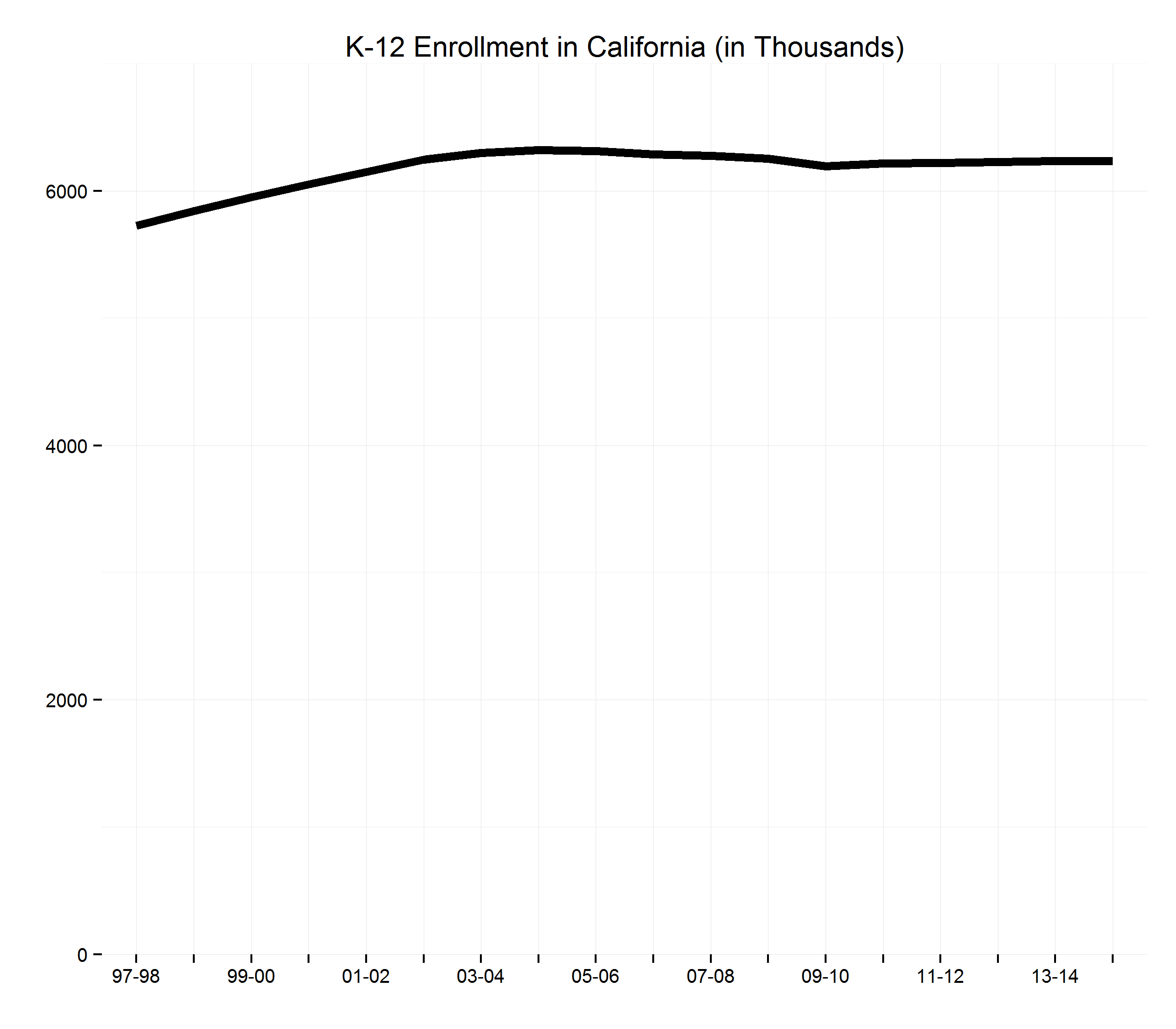
First, for some context, here’s California’s K-12 student enrollment. Between the 1997-98 and 2004-05 school years, student enrollment increased by about 10% and has been roughly flat since. There are now approximately 6.2 million students in California’s K-12 system.
k12enrollmentline
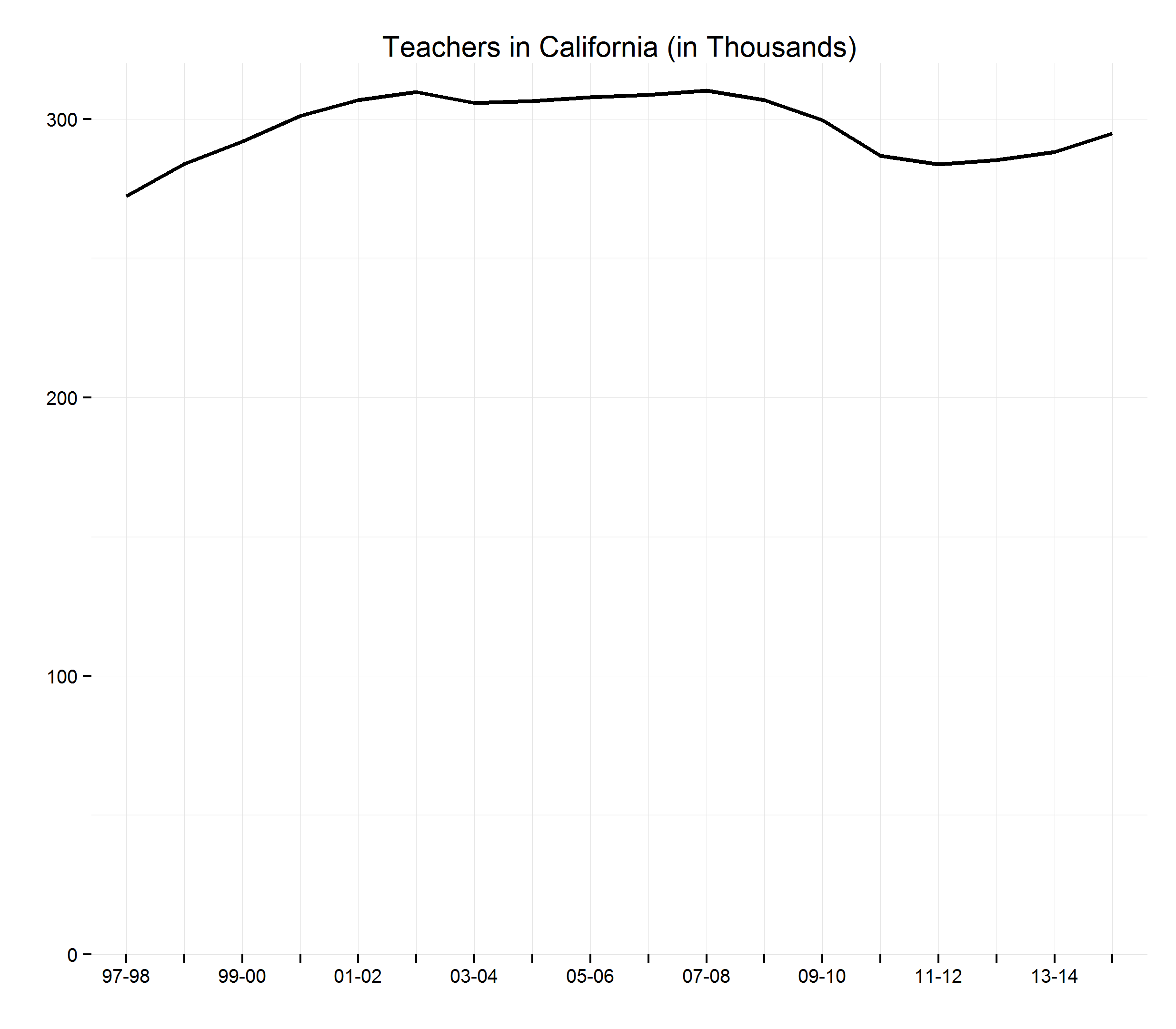
California hired more teachers as enrollment grew, and eventually cut back right around the time of the recession. Last year there were roughly 295,000 teachers in California’s public schools.
teachersinca
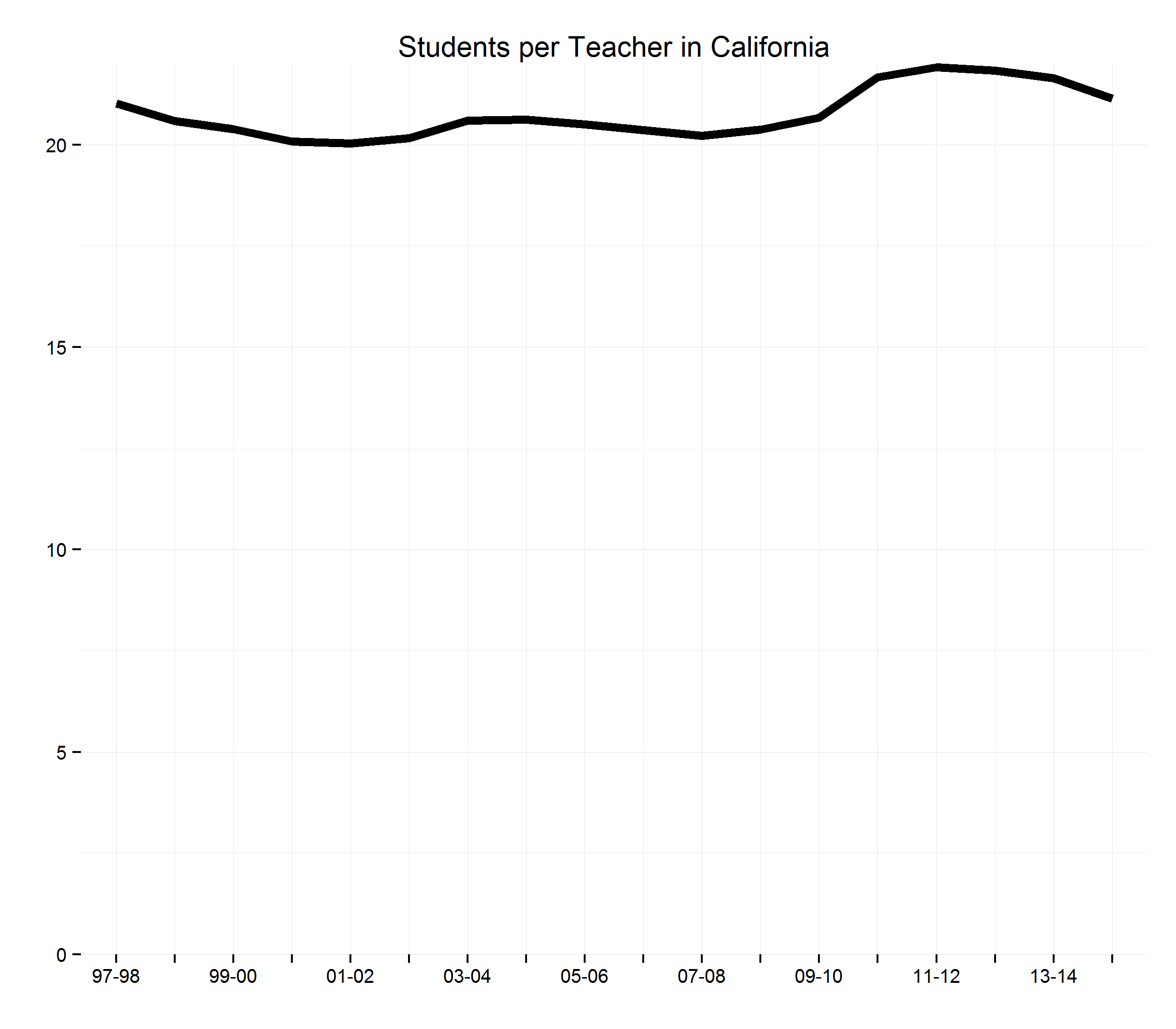
As enrollment and hiring has ebbed and flowed, the ratio of students to teachers in California has oscillated between 20-22.
studentsperteacher
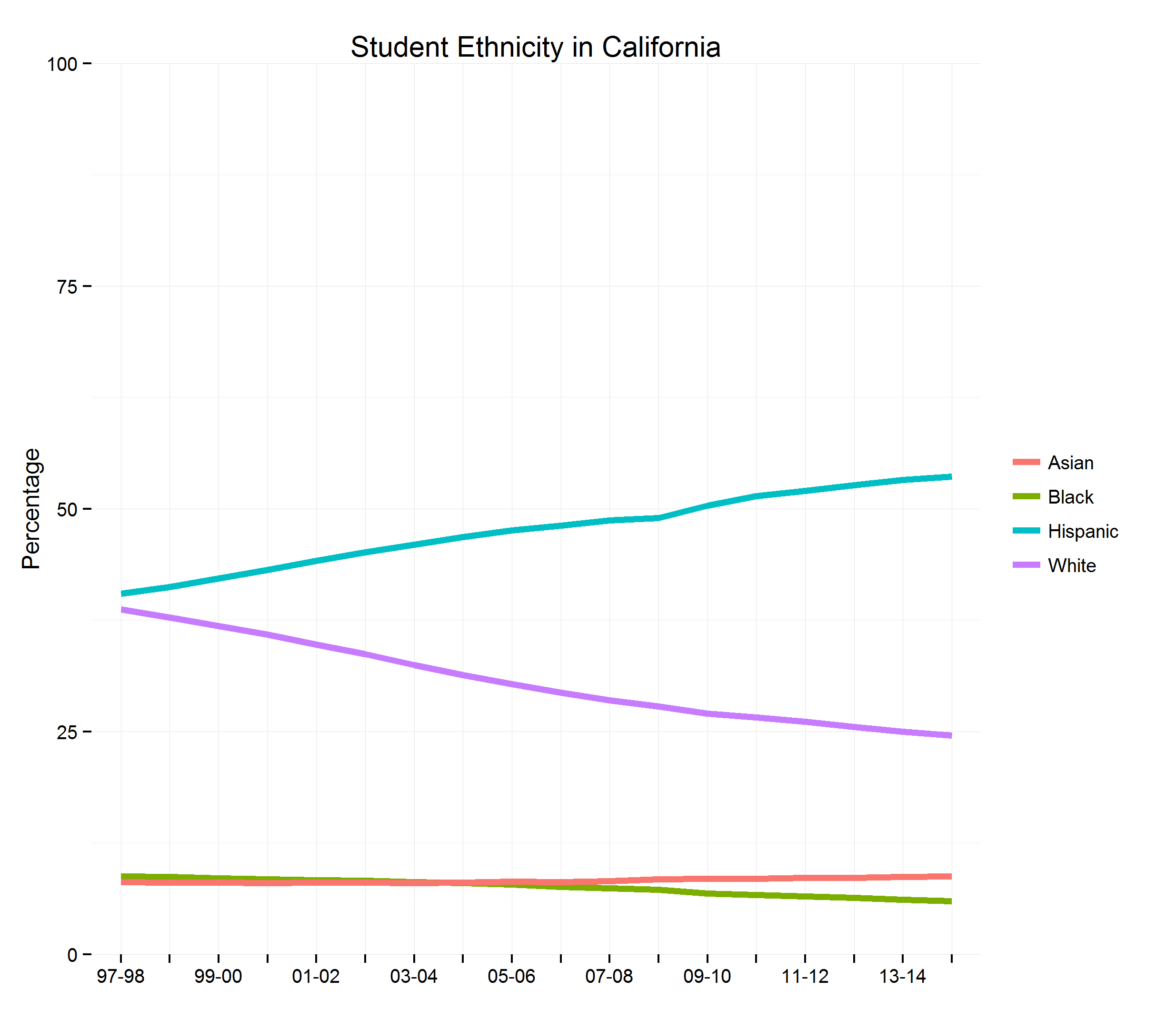
At the same time, student demographics in California have changed substantially, with the proportion of white students steadily falling while Hispanic/Latino students became a majority.
studentethnicity
Teacher demographics in California have changed somewhat as well, with white teachers becoming somewhat less California's Teacher Supply in 15 Charts - Paul Bruno:

CURMUDGUCATION: LA Charter Onslaught

CURMUDGUCATION: LA Charter Onslaught:

LA Charter Onslaught


Last Friday, the LA Times brought the news that "a major charter expansion" is "in the works for LA Unified students."  It might have also noted that the expansion was in the works for parents and taxpayers, but I suppose that's not as powerful as noting that this is For The Children.

But the lede will give you an idea of whence this wind is blowing:

A prominent local education foundation is discussing a major expansion of charter schools in Los Angeles aimed at boosting academic achievement for students at the lowest performing campuses.

The prominent foundation is, of course, the Eli and Edythe Broad Foundation, though apparently the folks at Keck and Walton are in on this, too, and my hat is once again off to folks who have the chutzpah to unilaterally declare themselves the head of a previously-democratic sector of society. Did somebody elect the Broad Foundation to the school board of the LA USD? No? Well, why let that stop them from going ahead and setting policy. I think I may go ahead and declare myself the chief of police here in my town, stop down to City Hall, and let them know what the new policies are going to be.

"People have been demanding better public schools forever and not getting them," said Swati Pandey, a spokeswoman for the foundation."But we say, screw public schools-- let's just replace them with privately owned and operated charters." Ha! Okay, she's only quoted as saying that first part. I filled in the rest for her.

Folks who have attended the meetings about this unelected initiative have shared other tidbits, like a goal to enroll half of all LA students in charters over the next eight years. There also seemed to be a lot of looking at maps of where all the students trapped in failing schools are, and discussing how to get charters operating for those students.

Although they note that "an ambitious expansion of charter schools would be costly and would likely face a political fight," there's no indication of a discussion about the relative expense of supporting and improving those public schools as compared to the expensive charter-launching approach.

There's also no indication that any part of this conversation was held with the actual public school 
CURMUDGUCATION: LA Charter Onslaught:

Remnants of bigotry remain in California Constitution - The Orange County Register

Remnants of bigotry remain in California Constitution - The Orange County Register:

Remnants of bigotry remain in California Constitution


Gov. Jerry Brown rarely speaks about his religious faith. But, while at the Vatican recently, he expounded on how his religion influenced his outlook on life. Invited by Pope Francis – the first Jesuit pontiff – to address world leaders on climate change, Brown – a former Jesuit seminarian – told them, “The formation that I’ve undergone growing up in the Catholic faith, the Catholic religion, puts forth a world that’s orderly, that has purpose and that, ultimately, is a positive.”
Over the years, the Vatican has taken positions on climate change and its disproportionate impact on poorer nations. The pope issued an encyclical to Catholics, declaring that acting on climate change is essential to their faith. In his speech, Brown spoke of nature and “the interconnectedness of all beings,” adding, “Religion teaches people to take care of the poor, and the pope has taken the role to be the modern leader for the planet.”
I, as a former legislator, raised Catholic and a onetime professor at a Jesuit college, found it inspiring to hear Brown’s exposition on faith. Unlike some politicians, who seemingly brandish faith as a weapon against others not sharing similar spiritual foundations, Brown articulated his public service based on a faith in service to others, a mission on behalf of the dispossessed.
Brown’s words on Catholicism, faith and service resonate at a critical juncture in our nation’s history. On June 17, inside a Charleston, S.C., church known for an historic association of faith and politics, a white supremacist murdered the church’s pastor, Clementa Pinckney and eight parishioners, simply because they were black.
The killings reignited debate over the Confederate flag flying outside the South Carolina state Capitol as a symbol of bigotry and racism. During debate, legislators seemingly wrestled with their very faith in voting to finally remove that flag.
The South Carolina vote fueled debate over California’s own symbols of bigotry, including whether a statue of missionary Father Junipero Serra should stand in the U.S. Capitol or whether names of Confederacy leaders and military officers should be removed from their namesake public schools. Last year, California prohibited selling items in the state Capitol that are emblazoned with the Confederate flag.
But why limit discussions of bigotry in the Golden State to school names and statues?
Embedded in the California Constitution are two clauses of a sort that have provoked national debates over whether they are inherently bigoted. Known as “Blaine amendments,” the laws were passed primarily in the late 1800s, stemming from nativist, anti-immigrant, anti-Catholic sentiment. Named for Congressman James Blaine of Maine, they excluded from government funding schools that taught “sectarian” faiths (mainly Catholicism), while allowing funds to the “common schools,” which taught the “common” or “nonsectarian” faith (i.e., nondenominational Protestantism).
New York and Massachusetts were first to enact state versions, corresponding to waves of immigration from Europe and the Catholic Church’s role in aiding immigrants. Although Blaine’s effort to enact a federal constitutional amendment failed, 38 state constitutions retain similar bans on public funding for private sectarian schools.
Some argue that Blaine amendments reflect concerns over the separation of church and state. Others argue they were motivated by bigotry, targeting for special disadvantage the faiths of immigrants, particularly, Catholicism.
Slavery, immigrants and Catholics all significantly shaped our nation. John F. Kennedy was elected president despite “concerns” over his Catholic faith. Discussion over faith, bigotry and symbols – be they statues, flags or words – is timely. If South Carolina could banish a symbol of bigotry, perhaps California might similarly erase laws based on bigotry.
Staff opinion columnist Gloria Romero is an education reformer and former Democratic state senator from Los Angeles.
Email: itsgjromero@gmail.com

Schools Matter: Protest against Eli Broad's charter putsch by Voices Against Privatizing Public Education

Schools Matter: Protest against Eli Broad's charter putsch by Voices Against Privatizing Public Education:

Protest against Eli Broad's charter putsch by Voices Against Privatizing Public Education

The activists comprising Voices Against Privatizing Public Education, whose efforts were recently highlighted on ProfessorDiane Ravitch's blog, are holding a rally/protest in front of the Broad Foundation's headquarters. This is in response to Broad and his fellow reactionaries' announcement of plans to privatize more than half the Los Angeles Unified School District within the next few years. Given the money these plutocrats have dumped into their profitable privatization projects, the Broad/Walton threat to eliminate public education is a clear and present danger. Join the rally/protest, sign the petition, and get involved with turning back the tide of school privatization by helping overturn avaricious billionaire Reed Hasting's 1992 California Charter School Act. For more on Eli Broad and school privatization, see the section entitled "The Neoliberal Emperor of Los Angeles" in this essay. — rds


Join Voices Against Privatizing Public Education's efforts to repeal the charter school law


ENOUGH IS ENOUGH!

Join us in showing your support for public education. Public schools are OUR schools, not Eli Broad's


SAVE OUR PUBLIC SCHOOLS RALLY

Sponsored by Voices Against Privatizing Public Education

PROTEST LOCATION:
Broad Foundation Headquarters (in front of building only)
2121 Avenue of The Stars
Los Angeles, CA

MONDAY, AUGUST 17, 2015 AT NOON


The LA Times announced that the Eli and Edythe Broad Foundation, along with the Walton Family Foundation and the Keck Foundation met to discuss plans to have half of Los Angeles students attending charter schools over the next eight years.

We say no more billionaire and corporate takeover of our public schools!

Charter schools cherry pick students, falsify records, commit enrollment fraud, close down public schools in predominantly low income areas, destroy jobs, bust up unions, appoint private school boards unaccountable to the taxpayers, and segregate student populations based on income and race.

Separate but equal has no place!!

A recent report entitled “Fraud, Waste and Lies: Charter Schools Cheating Communities out of Millions of Dollars” cited hundreds of millions of public education dollars being wasted due to fraud and other abuses in the charter school sector. Read here: http://www.commondreams.org/news/2015/04/29/fraud-waste-and-lies-charter-schools-cheating-communities-out-millions-dollars

The charter school industry is a cancer on our public education system. The only solution is to repeal the charter school laws in California once and for all.

Come to the rally - defend our public schools against the attack by greedy profiteers.

Please show your support for placing a statewide ballot initiative to repeal charter school laws in California by signing petition here:

Please read more at:
For more information about this rally call us at: (415) 282-1908

Make your voices heard and be part of the solution to save our public schools!
Eli Broad, a staunch opponent of academic freedom, intellectuals, and the public commons, is one of the leading reactionary billionaires funding the neoliberal slash and burn campaign against public education.


Teachers. Back to school but not back to Staples. | Fred Klonsky

Teachers. Back to school but not back to Staples. | Fred Klonsky:

Teachers. Back to school but not back to Staples.

STAPLES


By Dennis O’Neil from the Stop Staples NYC crew.
Teachers! We need your help and we need it now! As you may know, the US Postal Service—very like public education itself–is being attacked on many fronts, by privatizers, union-busters, those who would dismantle an essential public service out of greed, ideology and contempt for the everyday people our work serves.
Right now, the biggest assault is the attempted hijacking of the Postal Service by the Staples office supply megachain, with the complicity of top USPS management. Every Staples outlet in the country is opening a little fake post office, staffed not by postal workers but Staples employees: minimum wage, hours held under 25 week to avoid paying benefits, no training and massive turnover, no record check. The result will be shorter hours at real POs, more mishandled mail, fewer postal workers and eventual post office closings.
In response the American Postal Workers Union, strongly backed by the US labor movement, including both the AFT and NEA, has called for a boycott of Staples. Here’s what we are asking you to do:
First and foremost, don’t shop at Staples (or their online subsidiary Quill.com) and tell co-workers, students, parents to boycott them as well. We know this can be an inconvenience; Staples’ ruthless tactics have driven national competitors and local stationary stores alike out of business.
But this month is crucial! What Christmas is for most merchants, August back-to-school business is for Staples. Every sale lost, every blow delivered now stings their management twice as hard, and makes them rethink their role in this program.
Second, let them know about it. Write Staples CEO Ronald L. Sargent at 500 Staples Drive, Framingham, MA 01720 and let him know that you aren’t buying at Staples and won’t until they get their greedy hands off the USPS. You can also send them an email from this url: www.staples.com/sbd/content/help-center/contact-us.html. (And let us know what you did, too. Forward a copy of your note or email to Staples to one of the Facebook Stop Staples groups like STOP STAPLES! Organizers.) Teachers. Back to school but not back to Staples. | Fred Klonsky:

Milestone charter and state school board squabble over CEO credit-card incident | The Lens

Milestone charter and state school board squabble over CEO credit-card incident | The Lens:

Milestone charter and state school board squabble over CEO credit-card incident 


 As part of a continuing spat, Milestone Academy charter school is accusing the Louisiana Department of Education of overstepping its authority, breaching its own policies and possibly violating the state open-meetings law.

The school’s attorney Mike Higgins sent a letter demanding the department “cease and desist” a comprehensive review of the school’s governance for a multitude of reasons.
Higgins’ letter appears to have worked.
At today’s committee meeting of the state Board of Elementary and Secondary Education, members unanimously put off the matter until October, despite the July 31 due date for the report. The delay was recommended by the department, which is led by Superintendent John White, who downplayed the significance of his request.
“Members, it’s just a matter of timing. The audit is not yet finished,” he said at the meeting in Baton Rouge.
The 389-student D-rated school opened its doors in 2003 and was in New Orleans until 2013, when it moved to Jefferson Parish. Because it is chartered directly by BESE, it accepts students regardless of where they live, and it’s able to move across parish boundaries.
The purpose of the audit, according to a letter from the state to the school, is to review the roles and duties of the board, not to track or verify financial matters. The letter said the review would be done by an outside company and would examine “board membership, governance structures, and bylaws.”
The school made news in July when it was revealed the school’s interim CEO, D’Juan Hernandez, had racked up $13,000 in charges on a credit card he opened under false pretenses using the school’s name. Hernandez resigned, and according to a NOLA.com | The Times-Picayune article, paid back the money.
Milestone board members said at the time that they felt pressured by state officials to hire Hernandez. A spokesman for the Milestone charter and state school board squabble over CEO credit-card incident | The Lens:

Pew Survey Confirms Our Suspicions About Teens' Online Behaviors | EdSurge News

Pew Survey Confirms Our Suspicions About Teens' Online Behaviors | EdSurge News:

Pew Survey Confirms Our Suspicions About Teens' Online Behaviors


A FRIEND ONLINE...is a friend indeed? A new Pew survey on “Teens, Technology and Friendships” found that 57 percent of teenagers made a new friend online, most often through social media and gaming. But, as we suspect, social media can be a double-edged sword: 83 percent of teens say it helps them feel more connected, but 88 percent also believe that people share too much information. “Many teens feel pressure to curate positive and well-liked content,” the survey finds, and as a result they tend to think people are “less authentic” on social media.
The report also explores the darker side of social media: about 31 percent of teens have fought over something posted online. Responses are also broken down according to ethnicity; for instance, “Hispanic youth are somewhat more likely to report that they feel worse about their own lives because of social media.”
The report offers a wealth of insights into teens' online behaviors and offers clues into digital citizenship and how “digital natives” are living online. We suggest pairing this report with this personal reflection, “Eleventh Grade Tech Trends,” which went viral last year.

Thompson: 2nd "This American Life" Report on School Integration Just As Great This Week In Education:

This Week In Education: Thompson: 2nd "This American Life" Report on School Integration Just As Great:

Thompson: 2nd "This American Life" Report on School Integration Just As Great


In the second This American Life report on segregation, The Problem We All Live With - Part Two, Chana Joffe-Walt reports that the Hartford, CT school system sought to convince white families it’s in their self-interest to go to integrated schools. Joffe-Walt concludes that “the results have been impressive. It used to be that 11% of Hartford students were in integrated schools. Now it’s nearly half.”
As is the norm with This American Life, the report is nuanced in explaining how tricky the issue is, and every twist of the plot was enlightening. Hartford demonstrates great marketing skills and savvy and persuades enough white parents to participate. It is unclear whether it will be able to continue to increase white participation rates enough to meet the policy’s metrics and thus survive. (This weird numbers game is worthy of Catch 22, but Hartford is not alone; Sarah Garland [whose work was cited by This American Life] documented a similarly bizarre situation that hindered a successful desegregation effort in Louisville, Ky.)
Also, at a key point in Joffe-Walt's report, where we are reminded that not all poor children are being admitted to integrated magnet schools, we are implicitly reminded of the need to do a much better job of improving the toughest schools that serve entire neighborhoods with intense concentrations of generational poverty and where so many children endure extreme trauma. And, that makes the lost opportunities of 2009, when Arne Duncan took over as US Secretary of Education, feel even more like a betrayal. Duncan’s test, sort, reward, and punish policies provided two types of opportunity costs. They shifted attention away from research-based, holistic methods for improving instruction in troubled schools and they were a lost opportunity for encouraging voluntary integration efforts.
At the end of The Problem We All Live With - Part Two, it was explained how the election of President Barack Obama could have assisted in promoting desegregation, and his Race to the Top could have been a vehicle for promoting voluntary integration. Civil rights attorney John Brittain said that when he realized that such efforts were left out of the RttT, it was “like a punch in the gut.”
Then, Joffe-Walt and Hannah-Jones had an opportunity to ask Arne Duncan the questions that so many of us have longed to ask.


Duncan replied that policies to promote integration were left out of the RttT because they were “too toxic.” That, of course, is a perplexing response for teachers and families who have to endure Duncan’s toxic test and punish approach. Duncan said that other vehicles for improving poor schools were funded and, to his credit, Duncan didn't praise the punitive aspects of his policies, as he cited successful win-win policies such as seeking to improve graduation rates and college attendance.
To his shame, Duncan ignored the failure of the vehicle that drove his RttT - an unquestioned belief in uncontrolled competition, tests for teacher evaluations, mass dismissals of educators, and undermining due process, while turning poor children of color into lab rats for their corporate reform experiment.
I wonder if Duncan and the Billionaires Boys Club were even aware in 2009 that their “innovations” were bound to recreate the conditions that were documented in Susan Eaton’s outstandingThis Week In Education: Thompson: 2nd "This American Life" Report on School Integration Just As Great:

Initial leaders chosen to oversee breakup of Clark County School District - Las Vegas Sun News

Initial leaders chosen to oversee breakup of Clark County School District - Las Vegas Sun News:

Initial leaders chosen to oversee breakup of Clark County School District


Lawmakers have appointed the first round of community leaders charged with figuring out how to break up the Clark County School District.
At a meeting of the Legislative Commission on Monday, state Sen. Joe Hardy of Boulder City became the first politician appointed to the committee who will oversee the breakup process. The commission also appointed four members to an advisory board made up of local community leaders. They include Clark County teachers union leader John Vellardita, former CCSD School Board member Stavan Corbett, former CCSD administrator Tom Rodriguez and Hannah Brown of the Urban Chamber of Commerce.
The appointments are the next step in the four-year process of figuring out how to break up the state’s largest school district — also the nation’s fifth largest — into five separate school precincts in time for the 2018-19 school year.
But there is still a long way to go. The remaining eight members of the breakup committee have yet to be appointed by Senate and Assembly leaders, and the community advisory board could grow to dozens of members before the committee holds its first meeting, which could come as early as January.
The whole process began after state legislators passed Assembly Bill 394 earlier this year. The bill, pushed heavily by Republican Assemblymen David Gardner of the western Las Vegas Valley and Stephen Silberkraus of Henderson, initially gave municipalities the option of breaking off from CCSD but was later amended to require that the district be broken up.
It breezed through the Republican-dominated Assembly but passed the Senate mostly on party lines. Critics of the plan say breaking up the district will only deepen the divide between students in high-performing schools in wealthier neighborhoods and those in low-performing schools in the inner city. Proponents say it will give communities more control over schools by taking power out of the hands of school district bureaucrats.
Of course, whatever plan the committee comes up with could end up being thrown out. That’s because any breakup plan has to be approved by lawmakers during the next legislative session in 2017.Initial leaders chosen to oversee breakup of Clark County School District - Las Vegas Sun News:

Former news anchor J.C. Hayward dismissed from Options charter lawsuit - The Washington Post

Former news anchor J.C. Hayward dismissed from Options charter lawsuit - The Washington Post:

Former news anchor J.C. Hayward dismissed from Options charter lawsuit


Longtime television news anchor J.C. Hayward was dismissed from a high-profile charter school lawsuit on Tuesday, releasing her from allegations that she was involved in financial mismanagement at a Washington, D.C. school for troubled teens.
A spokesman for the Office of the Attorney General’s confirmed that Hayward, a former WUSA Channel 9 anchor who once chaired the board of Options Public Charter School, reached a settlement agreement with the city.
The D.C. attorney general filed a lawsuit in October 2013 naming the well-known television personality as one of five people involved in an effort to divert millions of federal tax dollars meant for Options to two for-profit companies that the school’s managers founded and ran. According to the terms of her settlement agreement, Hayward will pay $8,500 to Options, a sum authorities had alleged she received to attend board meetings of one company. Hayward’s lawyer, Jeffrey S. Jacobovitz, noted that the sum had been approved by the board’s outside counsel at the time.
The District’s claims are still pending against the other defendants, including Paul Dalton, Donna Montgomery, and David Cranford — all former managers at the school — and Jeremy Williams, a former D.C. Public Charter School Board official. The Office of the Attorney General said a parallel federal investigation is pending.
Hayward retired from WUSA in January after four decades on the air. She had been on hiatus since late 2013, when she was placed on leave pending an investigation into the Options allegations.
“Ms. Hayward has always disputed these claims from the beginning and has professed her profound commitment to helping at-risk young people in the Metropolitan Washington D.C. area,” Jacobovitz said in a statement on behalf Former news anchor J.C. Hayward dismissed from Options charter lawsuit - The Washington Post:

Mike Klonsky's SmallTalk Blog: In this case, 'autonomy' is just a four-letter word

Mike Klonsky's SmallTalk Blog: In this case, 'autonomy' is just a four-letter word:

In this case, 'autonomy' is just a four-letter word

Rahm and Jackson offering a few principals "autonomy".
Blaine principal, Troy LaRaviere gets into it with Rahm's new CPS’ chief education officer, Janice Jackson after she dutifully defends Forrest Claypool's so-called "principal autonomy" plan, otherwise known as Independent Schools Principal (ISP) program.


I'm a great fan of teacher autonomy. But whenever you hear the word autonomy coming down from one of the world's great top-heavy, command-and-control bureaucracies, you have to ask yourself -- autonomy from whom and for what?


In this case, Claypool and Jackson want to give a gaggle of top principals, a little freedom (mostly what they already have) from their own network chief's bureaucratic oversight and offer them a taste of professional community -- meeting with each other.


It reminds me of the day former CEO Arne Duncan asked us to start a charter school instead of a small neighborhood public school, so that the system wouldn't "fu*k with you". I replied, "But you ARE the system. Why don't you just not fu*k with us?" He looked befuddled but finally relented.


The outspoken LaRaviere, whose school rates among the district's highest, smells something fishy. He's not just after some autonomy for himself FROM the system. He wants to change the system and is forthright about it. He thinks that the Mike Klonsky's SmallTalk Blog: In this case, 'autonomy' is just a four-letter word:

Parents Outraged Over School Bus Fees « CBS Los Angeles

Parents Outraged Over School Bus Fees « CBS Los Angeles:

Parents Outraged Over School Bus Fees


TEMECULA (CBSLA.com) — Some parents are upset that school districts in Southern California are charging for students to ride the bus.

Amber Hughes, who had recently moved to Temecula from Tennessee, suffered sticker shock. She just learned that she will have to pay $1,100 for her two kids to ride the school bus in the Temecula Valley Unified School District.

“Everything is very expensive,” Hughes said. “I didn’t think that transportation was going to be an issue.”

The fees also caught Jennifer Schermerhorn off caught. She moved to Temecula from Ohio last year. “Coming from Ohio where we grew up, it was also included in your parents’ state taxes,” Schermerhorn said.

The school district said the bus fees have been around for years, and the state only provides a small chunk of the millions it costs the district to run its buses.

The Temecula Valley Unified School District released a statement that readsL “To offset some of the costs associated with transporting students, TVUSD charges a fee for bus service, consistent with district’s across the state of California. It is important to note that while bus service is not mandated by the State of California for school district’s to provide, it continues to be a priority for TVUSD, despite the encroachment on the general fund.”

Other school districts in Southern California also have school bus fees. CBS2/KCAL9 found the Newport-Mesa Unified School District charges an annual fee of $180 per child. The Orange Unified School District charges $335. The Corona-Norco Unified School District charges $378. The Menifee Unified School District charges $550. The Capistrano Unified School District charges $575. But students in the Perris Union High School District ride the school bus for free.

“We’re trying to figure out a way to carpool or make it happen, because we just can’t afford $1,100,” Hughes said.

Some school districts offer payment plans and reduced bus fees depending on the family income.Parents Outraged Over School Bus Fees « CBS Los Angeles:


Retaliation Against Charter School Teachers for Joining a Union? | janresseger

Retaliation Against Charter School Teachers for Joining a Union? | janresseger:

Retaliation Against Charter School Teachers for Joining a Union?


Urban Prep, the Chicago charter schools for boys, just fired 17 teachers who had been active leaders in an effort by teachers at Urban Prep’s charter schools to join a union—the Chicago Alliance of Charter Teachers and Staff, known as Chicago ACTS or ChiACTS.  The teachers, students at Urban Prep schools and their parents, and members of the clergy in Chicago have been actively protesting the school’s alleged retaliation for a vote by a majority of teachers at Urban Prep schools to be represented by a union.
According to In These Times, “On June 19, during their biannual semester-end interviews, 17 teachers were informed by school staff that they would not be returning to Chicago’s Urban Prep Academy come fall.  The terminations came just weeks after 61 percent of Urban Prep’s teachers voted to form a union; activists say the firings were a blatant act of anti-union retaliation.”
Catalyst Chicago interviewed Matthias Muschal, recently terminated as an English teacher at Urban Prep’s Bronzeville campus: “Muschal says he was told his dismissal was due to insubordination—specifically because he threw a pizza party for student-athletes and their families without notifying administration.  But he believes the real motive was his active participation in union organizing—Muschal, a six-year veteran at Urban Prep was one of two teachers from the charter network who spoke out in favor of a union drive at a press conference in City Hall in February.”
Catalyst confirms that, “ChiACTS has filed unfair labor practice charges with the National Labor Relations Board (NLRB) over the firings at Urban Prep…”   The Chicago Sun Timesexplains: “A majority of teachers earlier this month voted in favor of being represented by a union.  Although there is not yet a contract, the teachers are being represented by the charter school union, which is asking the Urban Prep board to accept the results and enter into a contract.”  The fired teachers are some of the Urban Prep teachers with the longest tenure—six or eight years—and parents have protested that by firing experienced teachers, the school is denying their sons the stability they desperately need.
Progress Illinois, a publication of the Service Employees International Union, addresses some of the legal issues in the recent firings, quoting Brian Harris, president of Chicago ACTS Local 4343: “On June 3, when 60 percent of the teachers at Urban Prep voted to form a union, they created a situation where the employer legally cannot make significant changes to working Retaliation Against Charter School Teachers for Joining a Union? | janresseger:

This Week In Education: Media: EdWeek Acquires Nonprofit Supplying PBS NewsHour Segments - Who Will Replace Merrow On Air?

This Week In Education: Media: EdWeek Acquires Nonprofit Supplying PBS NewsHour Segments - Who Will Replace Merrow On Air?:

Media: EdWeek Acquires Nonprofit Supplying PBS NewsHour Segments - Who Will Replace Merrow On Air?


Screenshot 2015-08-10 22.55.36
There are lots of exciting angles to the news that Editorial Projects in Education (the nonprofit outfit that runs EdWeek) is acquiring Learning Matters (which is John Merrow's long-running nonprofit education media organization), but the most immediate and fun aspect that I can think of about the deal is speculation over who will replace Merrow as one of the on-air correspondents (who introduces segments, asks questions, nods in response to answers, etc.).
As you may have noticed, Learning Matters -- whose segments often appear on the PBS NewsHour -- has had two correspondents sharing duties over the past few years: Merrow and John ("JT") Tulenko. According to EdWeek, Tulenko will stay on as a correspondent and will like the rest of the Learning Matters team remain in New York City. The second, as-yet-unnamed correspondent will work out of Washington DC (well, Bethesda), which is where EdWeek is located. That's where the fun part comes.
Neither Kathleen Kennedy Manzo nor Virginia "Ginny" Edwards would tell me who the new correspondent might be -- I don't think they quite know themselves -- but here are some guesses at who might be in the running:
It's possible that they'll pick someone already on the EdWeek payroll, especially given that some of the current staffers have broadcast experience and obviously know education fairly well. Ben Herold did some radio when he was in Philadelphia. Arianna Prothero came out of public radio in Miami. It's also possible that there's someone at the NewsHour who's interested enough to move over to EdWeek (since nobody calls it EPE). 
My guess is that they'll look for someone who knows education at least a bit, has some broadcast experience (radio or TV), who's already in DC. That could include someone from the NPR national team, or -- my guess -- WAMU's Kavitha Cardoza (whom I've met socially as well as heard on air). Maybe they'll try and lure WNYC's Yasmeen Kahn down to try out for the job. There's a great young public TV correspondent from Chicago's WTTW, Brandis Friedman, who might be interested and ready or might like where she is. Former KPCC LA education reporter Vanessa Romo just accepted a Spencer Fellowship but that only lasts until May, really, so maybe she's a candidate, too?
Let me know if you have any other, better ideas -- or if my ideas are all wrong.
Other tidbits that I can tell you with greater certainty include that Edwards says she has raised $4.5 million to support the new operation over the next three years, led by a commitment from the Wallace Foundation, and that EdWeek is building a new studio in the Bethesda office to do more video for online and broadcast.  
There's no money changing hands between EdWeek and Merrow, and just one board member from Learning Matters is coming over to EdWeek, which is apparently why it's an acquisition rather than a sale or merger.
Edwards also tells me that there's an MOU with the NewsHour spelling out the collaboration between the two organizations, which have for many years operated on little more than a handshake between Merrow and his counterparts at the NewsHour. Learning Matters without the NewsHour isn't nearly as This Week In Education: Media: EdWeek Acquires Nonprofit Supplying PBS NewsHour Segments - Who Will Replace Merrow On Air?: