Latest News and Comment from Education

Wednesday, April 22, 2015

What if they gave the SBAC and no one took it? Ask the folks at Nathan Hale High School in Seattle | Seattle Education

What if they gave the SBAC and no one took it? Ask the folks at Nathan Hale High School in Seattle | Seattle Education:


What if they gave the SBAC and no one took it? Ask the folks at Nathan Hale High School in Seattle

opt-out-postcard1
It has been confirmed that 100% of the 11th grade students at Nathan Hale High School opted out of the SBAC test this week.
Here is the history in a nutshell. There were informational meetings about the Common Core Standards and the SBAC early in the school year and Wayne Au, PhD was invited to speak on high stakes testing.
There was much discussion and then a resolution was passed by the teachers at Nathan Hale High School:
As I wrote in a previous post:
The Common Core Standards associated Smarter Balanced Assessment Consortium exam, the SBAC, will be implemented in March in the Seattle school district but this afternoon the Nathan Hale High School Senate, which functions as the Building Leadership Team typically made up of teachers, parents, staff and students, voted nearly unanimously not to administer the SBAC tests to 11th graders this year.
The Senate also recently voted not to administer the PSAT test to 10th graders at all in the future.
The reasons for refusing the SBAC for 11th graders included:
1. The SBAC is not required for graduation
2. Colleges will not use the SBAC this year
3. Since NCLB requires all students to pass the tests by 2014, and since few if any schools What if they gave the SBAC and no one took it? Ask the folks at Nathan Hale High School in Seattle | Seattle Education:

Can the Tennessee Achievement School District Move Beyond the Silver Bullets? - Living in Dialogue

Can the Tennessee Achievement School District Move Beyond the Silver Bullets? - Living in Dialogue:

Can the Tennessee Achievement School District Move Beyond the Silver Bullets?


By John Thompson.
Chris Barbic, the Superintendent of the Tennessee Achievement School District (ASD), is back in the news, and he is displaying remarkable candor in describing his assumptions. Barbic also explains how he remains devoted to his “hypothesis” on school improvement.
Coverage of Barbic’s efforts will inform the post mortem of the Race to the Top and the Obama administration’s “turnaround” experiments such as the School Improvement Grants (SIG).  Even if one of Barbic’s “most challenging seasons” turns out to be less disappointing than his previous years, and he pulls out some sort of miraculous transformation of Memphis schools, it seems clear the RttT and the SIG aren’t going to survive. And, most likely, the high-dollar innovations led by Barbic will become classic case studies in how and why reform overreach is so fatal to school improvement.
Two valuable contributions to the “lessons learned” process that we need to undertake are Daarel Burnette’s Chalkbeat Tennessee interview with Barbic, and a series in Governing magazine by John Buntin. Both journalists provide more evidence that Barbic’s intentions are pure, that last year was extremely contentious for the ASD, and that Barbic now faces even bigger challenges dealing with community protests and with three charter operators – most notably YES charter schools – pulling out of Memphis schools.
In the past, Buntin says, the ASD’s effort to takeover neighborhood schools “had generated impassioned protests from some parents and teachers who faced the prospect of losing their jobs if the ASD or a charter operator took over. But none of the protests were well organized or had much of an effect. This year … a different tone has been set.”
Barbic still defends the setting of a seemingly utopian goal, bringing schools ranked in the bottom 5% into the top quarter of schools. It would be difficult enough to make such a transformation using a comprehensive set of science-based policies. But, as Buntin reports, Barbic is attempting to do so based on his theory that, “It’s the school leader. It’s teacher talent. It’s a common vision.” Free educators from administrative constraints and hold them accountable for outcomes, and this educator-driven, instruction-driven model could supposedly overcome the legacies of extreme poverty. Even more strange, Barbic seeks systemic transformation, not just dramatic improvements in individual schools.
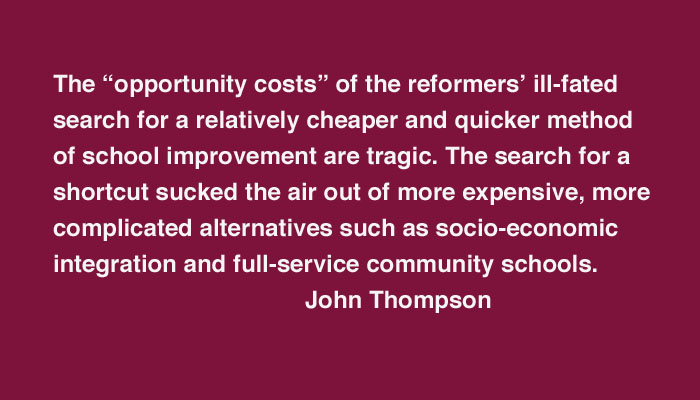
To his credit, Barbic made some startling acknowledgements to Burnette. He now to admits to underestimating “the depth of the generational poverty” and how “what our kids bring into school every day makes it even harder than we initially expected.” He belatedly endorses the more expensive and complex policies that many social scientists and educators have long described as essential to turning around the Can the Tennessee Achievement School District Move Beyond the Silver Bullets? - Living in Dialogue:

HOW OHIO’S POOR-PERFORMING CHARTER SCHOOLS CONTINUE TO COST ALL OHIO KIDS

KYC Analysis: Short Changed Again - The Ohio Charter School Accountability Project:


KYC Analysis: Short Changed Again


HOW OHIO’S POOR-PERFORMING CHARTER SCHOOLS CONTINUE TO COST ALL OHIO KIDS

Key Findings
There is newfound resolve in the Ohio legislature to finally address Ohio’s nationally ridiculed charter school system. While there are reasons for optimism, the one major area that has yet to be addressed is how charters are funded.

Once again, data from the Ohio Department of Education demonstrates the urgent need to address the financial impact of Ohio’s charter schools on local school districts. The data delineates how many children and how much money were transferred from districts to charter schools in the last school year. It shows this:
1. Out of the $774 million that were transferred from districts to charters with state report card grades , 56% – or more than $430 million – went to charter schools that performed worse overall than the district that transferred the money. If you include districts that performed the same, nearly 2 out of every 3 dollars went to charter schools from a district that performed the same or better, at a cost of $504 million.
2. Local taxpayers had to subsidize $180.3 million to cover the money transferred to the same or worse performing charter schools.
3. Districts were more likely to lose money to charters that underperformed on all 8 report card categories and not a single transfer occurred where the charter outperformed the district on all 8 report card grades.
4. When districts and charters were both graded in every category, 97% of the time districts outperformed the charters. Just 1.8% of the time did a charter outperform districts in the majority of the categories.
5. There were 461 school districts – accounting for more than ¾ of all of Ohio school districts – where all the kids attending charter schools were transferred to equal or poorer performing charter schools. That adds up to 19,042 kids and $136.6 million. Meanwhile, every district lost at least some funding to poorer performers, with only 17 districts losing less than half their children to poorer performing charters.
6. In 84 of 88 counties, more than half of children attended poorer performing charters, and in 43 of Ohio’s 88 counties, all the children going to charters attend charters that perform the same or worse than local school districts.
The cost in money and to children for Ohio’s charter school “debacle” is significant. The Ohio Charter School Accountability Project urges the Ohio General Assembly to focus on the funding and quality issues so that, in the words of Greg Harris, State Director of Students First, we can “stop wasting kids’ lives” on these failing charter schools.

Read the full KYC analysis: Short Changed Again

The Day the Music Died | Think.

The Day the Music Died | Think.:

The Day the Music Died 


A long, long time ago
I can still remember how that music used to make me smile
And I knew if I had my chance
That I could make those people dance
And maybe they’d be happy for a while
~American Pie by Don McLean
Dr. Yohuru Williams, an education activist and professor of history at Fairfield University, recently composed a powerful essay, entitled The Day the Music Died. He addressed the Ohio State Board of Education’s quest to eliminate the 5 of 8 minimum school staffing standards, which required that public school districts employ a minimum of 5 educational specialists for every 1,000 students.
Dr. Williams wrote about how Ohio’s governor, in league with his party’s majority in the General Assembly, has been targeting education budgets with deep cuts, precipitating a crisis similar to other states where cuts have forced districts to make impossible choices between hiring nurses, librarians or instructors in the music and the arts.  http://www.huffingtonpost.com/yohuru-williams/the-day-the-music-died_3_b_6142628.html
Former state school board chair, Debe Terhar, admitted as much when she told the board that better state funding of schools would prevent the furor over the 5 of 8 rule. http://s.cleveland.com/4SBjSTG
Why are our public schools being starved to the point of having to make choices about vital services that students need and deserve? That can be answered with a four letter word: ALEC.  http://www.commondreams.org/views/2011/07/14/alec-exposed-starving-public-schools
ALEC is the acronym for the American Legislative Exchange Council, a clandestine organization of corporate members and lawmakers who believe in privatization of public entities, such as our nation’s public school systems. ALEC has a very powerful legislative impact in states like Ohio, where its members control the Statehouse.  http://www.jointhefuture.org/1326-alec-owns-the-ohio-legislature
ALEC’s education bills can be seen in current Ohio policies that mandate more vouchers, charter school expansion, extensive teacher evaluations, TFA teachers and BRIGHT principals, extra online classrooms, Common Core, additional high stakes testing, and obsessive amounts of data collection. http://www.publicschoolshakedown.org/how-alecs-duplicity-undermines-american-public-education-project
Everyone, especially educators, should take the time to learn about ALEC’s education agenda and how it affects public education in the United States.http://www.alecexposed.org/wiki/Privatizing_Public_Education,_Higher_Ed_Policy,_and_Teachers
ALEC uses questionable research and pretentious rhetoric from its think-tanks to impact public perception. To drive its education agenda, it misleads people with nice-sounding words like reform, school choice, accountabilityand local control.
The Buckeye Institute is a “think-tank” tied to ALEC and placed in Ohio to influence public opinion. The Buckeye Institute’s research mimics ALEC’s agenda. An analysis of reports by the Buckeye Institute and legislation promoted by ALEC showed a correlation between the two organizations’ agendas on union issues, healthcare reform, public pensions, crime, and education issues.
Another study claimed that ALEC’s policies, such as lowered income taxes, the elimination of estate taxes, and the The Day the Music Died | Think.:

Susan Sadlowski Garza Makes History as First CTU Member Elected to Chicago City Council

Chicago Teachers Union | Susan Sadlowski Garza Makes History as First CTU Member Elected to Chicago City Council:

Susan Sadlowski Garza Makes History as First CTU Member Elected to Chicago City Council

ILLUSTRATION: Sue and Karen

BY CTU COMMUNICATIONS  |  04/22/2015
CHICAGO—The Chicago Teachers Union (CTU) today congratulates dedicated union member Susan Sadlowski Garza on her victory for alderman of Chicago’s 10th Ward.  Garza, a CTU delegate and area vice president, defeated incumbent alderman John Pope by a margin of 20 votes in the April 7 run-off election. The Union is pleased to have one of its own joining an influx of new aldermen to help bring much needed change and an independent, progressive agenda to the Chicago City Council.
“We are absolutely thrilled that our sister Sue Sadlowski Garza is a new member of the Chicago City Council, which means she can be a watchdog for all citizens,” said CTU President Karen Lewis. “Sue is a warrior like no other, and a vibrant activist who has fiercely advocated for improving the quality of life on the far Southeast Side and who will bring the same passion to the City Council that she’s brought to our battles to preserve fairness and equity in public education.”
Garza is currently a counselor at Jane Addams Elementary and a 20-year veteran of Chicago Public Schools. The daughter of revered union leader Edward Sadlowski, she is a community activist and lifelong 10th Ward resident with an extensive record of public service.  Garza has worked with thousands of families throughout the 10th Ward to create award-winning after school programs such as “Safe-Kids” and “Bully Patrol,” and has been instrumental in the fight against air pollutants on the Southeast Side of Chicago.
Garza was one of three CTU members who ran for alderman in the 2015 Municipal Election, joining Tim Meegan in the 33rd Ward and Tara Stamps in the 37th Ward. Stamps, the daughter of late Chicago community activist Marion Stamps, pushed incumbent 37th Ward alderman Emma Mitts to a run-off in April, while Meegan narrowly missed that mark in the 33rd Ward, but has recently launched efforts to start a new independent political organization in the area.
For nearly a year, each of the CTU candidates and hundreds of community volunteers and fellow members have been circulating petitions and reaching out to thousands of Chicagoans on such issues as an elected school board, crime prevention, pension protection and raising the minimum wage.  The feedback they have received in the community has been tremendously supportive, as Chicagoans are voicing their desire for change on the 5th floor of City Hall and among the mayor’s rubber stamp City Council aldermen.
“All of our candidates are winners and hardworking leaders with a strong vision for the city and its future,” Lewis said. “They represent the strength of the CTU and we’re proud of them all.”Chicago Teachers Union | Susan Sadlowski Garza Makes History as First CTU Member Elected to Chicago City Council:

Mike Klonsky's SmallTalk Blog: Will Duncan Send Troops to Crush the Opt-Out Revolt?

Mike Klonsky's SmallTalk Blog: Will Duncan Send Troops to Crush the Opt-Out Revolt?:

Will Duncan Send Troops to Crush the Opt-Out Revolt?

EWA meeting in Chicago
Duncan said he expected states to make sure districts get enough students take the tests. “We think most states will do that,” Duncan said during a discussion at the Education Writers Association conference in Chicago. “If states don’t do that, then we have an obligation to step in.” -- Interview with EWA writers
What a week! Edu-conferees are flowing in and out of O'Hare at a record pace. First their was AERA. Then EWA. And next comes NPE. Chicago is definitely the epicenter of corporate-style education reform and the revolt against it. The only one of these meetings where Arne Duncan would dare show his face was at theEducation Writers Association (EWA) National Seminar. It was there that he threatened to take action against the growing opt-out movement.


Yes, Duncan is threatening federal intervention  if states fail to put an end to the massive testing boycotts. No one is sure what form that intervention may take. Some fear economic reprisals. But I worry about an Iraq-style invasion.


Arne's army is equipped with these military assault rifles. 
A lot of people may not know this, but the DOE Inspector General's Office has its own well-equipped military wing and Duncan has shown that he's not afraid to call out his troops against community residents. In 2011, his troops made an armed assault on at least one wrongfully-suspected student loan deadbeat.


Duncan has had to apologize for using his own particular racial theories to describe parents who are critical of over-testing as “white suburban moms” who were upset because their kids were doing poorly on new, more rigorous exams linked to Common Core.

“All of a sudden, their child isn’t as brilliant as they thought they were and their school isn’t quite as good as they thought … and that’s pretty scary,” Duncan said.
Duncan claims that annual standardized exams beginning with 3rd-graders are Mike Klonsky's SmallTalk Blog: Will Duncan Send Troops to Crush the Opt-Out Revolt?:


Get rid of 'test, blame, punish': Opposing view

Get rid of 'test, blame, punish': Opposing view:

Get rid of 'test, blame, punish': Opposing view


Educators across the nation are encouraged by the big steps forward Congress is taking to create a new national education law that could reverse many of the damaging policies of No Child Left Behind.
So it is both disheartening and perplexing that the lynchpin of NCLB's "label and punish" regime — annual testing — still has support on Capitol Hill.
Of course teachers understand the value of tests, but proponents of annual testing like to position themselves as the defenders of all-things testing and accountability. What they are actually defending is a one-size-fits-all model — one with a long and abysmal record.
The consequences of high-stakes testing have been devastating for struggling schools in high-poverty areas, where teachers and students spent a scandalous amount of time preparing for and taking bubble tests, where teaching and learning were reduced to skills that can only be measured with these multiple-choice questions and which faced crushing consequences if they failed.
Our schools should not be a system of test, blame and punish. We need flexible, carefully constructed assessments that help teachers evaluate individual student needs and tailor lessons accordingly. But surely, say high-stakes devotees, we need annual testing because we need accountability.
But accountability shouldn't be a one-way street. If we hold students, educators and schools accountable for student test scores, students must also get necessary supports and resources to help them learn. Moving forward, states should be held accountable for "opportunity" data — access to advanced coursework, fully qualified teachers, a richer curriculum, specialized support personnel — and be obligated to develop plans to fill any gaps.
We have a real opportunity with this NCLB rewrite to break the testing fever and build an accountability system grounded in delivering support and intervention to students who need it most. Clinging to the status quo of annual testing won't help get us there. We can and should assess student learning — but only if we give kids a chance to learn first.
Lily Eskelsen García, the 1989 Utah Teacher of the Year, is president of the National Education Association, which represents 3 million educators.Get rid of 'test, blame, punish': Opposing view:

Rauner eyes end of 'fair share' dues for teachers' unions - News - The State Journal-Register - Springfield, IL

Rauner eyes end of 'fair share' dues for teachers' unions - News - The State Journal-Register - Springfield, IL:

Rauner eyes end of 'fair share' dues for teachers' unions


Gov. Bruce Rauner on Wednesday said he wants to end fair share dues for teachers’ unions in the state.
Speaking to the Citizens Club of Springfield, the governor said he thinks his steps to end union dues for state employees who are not members — more commonly known as “fair share” dues — should extend to teachers’ unions, but he would “deal with that later.” Union leaders objected to Rauner’s statement and called it an attack on the working class.
Rauner said he’s heard from union members who tell him to keep up the fight against fair share dues. Illinois Education Association President Cinda Klickna said in a statement the idea that a majority of union members would work against the organizations is ridiculous.
“It is interesting that the only teacher voices the governor seems to hear are those of the tiny number who don't wish to pay their fair share, while he ignores the overwhelming majority of teachers and education support professionals who choose to belong to a union,” she said.
Illinois Federation of Teachers President Dan Montgomery said the governor was wasting his time on an “illegal” plan.
“He’s not really addressing the issues we have in Illinois and he’s trying to blame working people and divert people’s attention from real problems to attacking unions,” Montgomery said. “It’s kind of tiresome at this point and frustrating.”
The Republican governor signed an executive order in February halting fair share dues while simultaneously filing a lawsuit challenging them in court.
Attorney General Lisa Madigan, a Democrat, issued a statement after the signing that said Comptroller Leslie Munger — a Republican appointed by Rauner — was not bound by the order. Munger said she’d “defer to the guidance” of Madigan and declined to hold the fees.
Rauner then instructed individual agencies to hold the fees in escrow. A St. Clair County judge issued an order requiring the agencies to collect the dues on April 10. The governor announced a deal with unions the next day to allow for the collection of dues while the litigation moves forward.
In his address to the Citizens Club, Rauner said unions controlled the schools, causing political conflicts of interest in negotiations.
“We have conflicts of interest in our government that involve (the American Federation of State, County and Municipal Workers, Service Employers International Union) and the teacher’s union,” he said. “If our schools are owned and controlled by the teacher’s union rather than the taxpayers and the families and the kids and the parents, that’s not right for our schools.”Rauner eyes end of 'fair share' dues for teachers' unions - News - The State Journal-Register - Springfield, IL:

Can't Make it to the NPE Conference In Chicago this Weekend? You Can "Virtually" Be There!!!


THE NETWORK FOR PUBLIC EDUCATION NATIONAL CONFERENCE


I know not everyone can make it to Chicago this weekend -- but you can still be part of the action via the Livestream that will broadcast on as many as three channels. All the keynotes and many of the workshops will be available live, starting Saturday at 8:30 am central time at www.schoolhouselive.org. Please tweet with the hashtag ‪#‎NPEChicago‬ and help us trend #1 again like we did twice last year.
LIVE FROM CHICAGO, APRIL 25-26 IN:
THE NETWORK FOR PUBLIC EDUCATION NATIONAL CONFERENCE
CHECK OUT ALL THREE CHANNELS! 

Jeb Bush's shifting words on Common Core | Tampa Bay Times

Jeb Bush's shifting words on Common Core | Tampa Bay Times:

Jeb Bush's shifting words on Common Core


 Jeb Bush says he won’t pander his way to the GOP presidential nomination, but that doesn’t mean he won’t wiggle.

For months now Bush has maintained support for Common Core but added language to the effect that he is simply for higher standards, no matter what they are called. Bush has also stepped up talk that the federal government should not be involved, a line he used in New Hampshire last weekend.
American Bridge, the liberal oppo research group, sees a shift.
UPDATE: And here's the full context of Bush's remarks on Morning Joe: “I think Secretary Duncan and President Obama deserve credit for putting pressure on states to change, particularly the states that haven’t changed at all. They’re providing carrots and sticks, and I think that’s appropriate. But these thing have to happen at the state level for policy changes, so for New Jersey wants to get rid of last in first out you gotta go to the legislature and get it done. Florida did that last year. Indiana did it. Six or seven other states have done it. This is a battle at state capitals to create the openness and then, you let a thousand flowers bloom.


LAUSD board approves teacher deal but projects $559M deficit | 89.3 KPCC

LAUSD board approves teacher deal but projects $559M deficit | 89.3 KPCC:

LAUSD board approves teacher deal but projects $559M deficit 


103906 full
L.A. Unified School Board President Richard Vladovic is joined by United Teachers Los Angeles leaders in a press conference about a new teachers contract. ADOLFO GUZMAN-LOPEZ/KPCC


 The Los Angeles Unified School District board approved a new three-year teachers' agreement on Tuesday, but officials estimated the deal will result in a $559 million deficit over the next two years.

Officials said they're confident additional state funds from an improving economy will pay for the 10 percent raise in the contract. Whether those funds will materialize should be known next month as Sacramento revises its projected budget for the next fiscal year.
But those dollars are not a guarantee, said Board Member Monica Ratliff.
"We're going to have to come up with an alternative plan in case the May Revise (the revised state budget) doesn't work out the way we'd like, and that will probably involve program cuts, layoffs, modifications, and things like that," she said.
The district has already threatened cuts to its preschool program and adult education.
Alex Caputo-Pearl, president of the 31,000-member United Teachers Los Angeles union, said he's working with Superintendent Ramon Cortines to look for additional funds to help pay for the teachers' pay package. He said officials are pushing Sacramento for money that was lost due to massive problems with LAUSD's troubled student data system, known as MiSiS.
"That's tens of millions of dollars," Caputo-Pearl said.
The tentative agreement, struck Friday night, will give teachers, counselors and coaches their raise of 10 percent in increments. They would receive a pay raise of 4 percent retroactive to July 1; 2 percent retroactive to Jan. 1; 2 percent on July 1 this year; and 2 percent on Jan. 1, 2016. In the third year, the agreement calls for a salary reopener that will allow the two sides to negotiate possibly more raises.
The UTLA contract will cost a total of $514 million, LAUSD Chief Financial Officer Megan Reilly said. That is in addition to a three-year, $3.3 billion health care benefits package approved by the board last week.
"Including this additional burden, we are currently projecting a deficit of $140 million in 2015-2016 and a $419 million deficit in 2016-2017," Ratliff said in a statement. "Combined, we are anticipating a deficit of over half a billion dollars. This is not even taking into account our unfunded OPEB (post-employment benefits such as pensions) liability of $11 billion."
She said she and district officials have said LAUSD "does not have excess funds of such amounts lying around the District." The economic feasibility of all of the recent labor agreements depends heavily on Gov. Jerry Brown's revised budget, Ratliff said. 
Other parts of the agreement would create a three-tiered teacher evaluation system, a cap on class sizes for English and math classes in grades 8 and 9, more counselors, and changes to the teacher grievance process that were sought by the union.
“The Board gave direction to the Superintendent and staff today to allow the negotiated Tentative Agreement to be forwarded to UTLA for ratification by the membership," the district said in a statement Tuesday.
The board voted unanimously in closed session to move the contract forward.
At a news conference after the board vote, union leaders and board members stood side by side and said the contract will go a long way toward improving education in LAUSD board approves teacher deal but projects $559M deficit | 89.3 KPCC:

Worry not innumerati-A whole buch of high income families already opted out before the school year started! | School Finance 101

Worry not innumerati-A whole buch of high income families already opted out before the school year started! | School Finance 101:

Worry not innumerati-A whole buch of high income families already opted out before the school year started!


 Pro-Annual Testing of Everyone pundits are all in a tizzy about Opt-Out. In their view, parents who opt out are severely compromising accountability for our public education system. They are eroding the public interest in the most selfish possible way. What seems to irk these pundits as much as anything is the possibility that the recent pattern of opting out appears (empirical question for a later day) to be disproportionately occurring in upper middle income to upper income communities – A group, over which pundits have have little control or possible leverage [little opportunity for punitive policy – which drives them crazy].

So the pundits say, the disproportionate opting out of upper income white children from testing will severely compromise the ability of policy makers to accurately measure achievement gaps between those children and poor and minority children more compliantly sit down, shut up and fill in the bubbles (ok… point and click).
If the affluent families opt out, we really won’t know how far behind those who are less affluent really are?
Do we?
But do we anyway?
This whole line of reasoning is yet another example of the lack of demographic/contextual understanding and related number sense of those making these arguments. The edu-pundit-innumerati strike again!
These same innumerate pundits previously claimed that annual testing of everyone is absolutely necessary for accurately measuring within school and within district achievement gaps among student subgroups, totally failing to understand that few schools and districts – even when everyone is tested – actually have sufficient populations of subgroups for measuring gaps – and further that the approach most often used for measuring gaps is total BS – statistically that is. Actually, measuring within school and within district gaps and using those measures to penalize schools and districts ends up selectively penalizing only those schools for whom the gaps can be measured – integrated schools.
So then, why is this new argument equally statistically and demographically bankrupt? Certainly it would be the case that if those not taking the test were disproportionately of a certain race or of higher income, that average scores would be biased, and likely biased downward for any data aggregation that would/should include these families. So then, of course it’s a problem, right?
Well, yes… and no.
What the edu-pundit-innumerati fail to realize is that there already exist larger shares of disproportionately higher income kids in nearly every state who are already opting out of these assessments by opting into schools that generally don’t give them. Are these kids somehow not an issue of public policy concern, merely because they attend private schools (or homeschooling)?
If parents in Scarsdale, NY or Millburn, NJ opting out of state assessments matters toward our understanding of gaps in educational opportunity across children of the state by income and race, then so too do the unmeasured outcomes of children opting out of the public education system as a whole.
Here are the numbers for children between the ages of 8 and 17 (those who might fall in tested grades) for New Jersey and New York.
In New Jersey, over 110,000 children between the ages of 8 and 17 attend private schools (just under 150,000 when summing enrollments for k-12 private schools).
Slide1
In New York, over 300,000 children attend private schools (just under 350,000 when summing enrollments for k-12 private schools).
Slide2

As opt-out numbers grow, Arne Duncan says feds may have to step in | Chalkbeat

As opt-out numbers grow, Arne Duncan says feds may have to step in | Chalkbeat:

As opt-out numbers grow, Arne Duncan says feds may have to step in


 U.S. Education Secretary Arne Duncan said Tuesday that the federal government is obligated to intervene if states fail to address the rising number of students who are boycotting mandated annual exams.

Duncan’s comments come as an “opt out” advocacy group in New York reports that more than 184,000 students statewide out of about 1.1 million eligible test takers refused to take last week’s English exams. In New York City, nearly 3,100 students out of about 420,000 test takers opted out, according to the group. (Math testing begins Wednesday.)
Last year, 49,000 students statewide did not take the English exams, while just over 1,900 New York City students sat out the tests, state officials have said. State and city officials have not yet released their own opt-out counts this year or verified those of the advocacy group, United to Counter the Core, whose unofficial tally is based on information from district superintendents, school employees, and media reports.
Those estimates suggesting that more than 15 percent of students refused to take the tests have raised questions about the consequences for districts. Federal law requires all students in grades three to eight to take annual tests, and officials have said districts could face sanctions if fewer than 95 percent of students participate. On Tuesday, when asked whether states with many test boycotters would face consequences, Duncan said he expected states to make sure districts get enough students take the tests.
“We think most states will do that,” Duncan said during a discussion at the Education Writers Association conference in Chicago. “If states don’t do that, then we have an obligation to step in.”
Duncan also said that students in some states are tested too much, and acknowledged that the exams are challenging for many students. But he argued that annual standardized exams are essential for tracking student progress and monitoring the score gap between different student groups.
He also said the tests are “just not a traumatic event” for his children, who attend public school in Virginia.
“It’s just part of most kids’ education growing up,” he said. “Sometimes the adults make a big deal and that creates some trauma for the kids.”
A federal education department spokeswoman said last week that the agency could withhold funding from states if some of their districts have too few students take the exams, but that it has not yet done so because states have addressed the issue on their own.
State education department spokesman Jonathan Burman said in an email Tuesday that the “the feds are discussing the possibility of imposing penalties for failing to hit participation rate targets.” He added that the state is also expected to “consider imposing sanctions” on districts that fail to meet the 95 percent threshold, which could include withholding money “in the most egregious cases.” (Opt-out advocates have questioned the state’s interpretation of the testing law, and say that sanctions are only allowed after a district falls below the 95 percent level for three years.)
Meanwhile, Board of Regents Chancellor Merryl Tisch has said she thinks it would be wrong to “punish” districts because of their opt-out numbers.
“I would say to everyone who wants to punish the school districts: hold them to standards, set high expectations, hold them accountable, but punishing them?” she told the Buffalo News last week. “Really, are you kidding me?”As opt-out numbers grow, Arne Duncan says feds may have to step in | Chalkbeat: