Curmudgucation: Excerpts or Whole Books?
-
Curmudgucation: Excerpts or Whole Books?
In a post last week, Timothy Shanahan has some worthwhile points to make
about literacy, reading, and excerpts ve...
Education Privatization Propaganda Worsening
-
By Thomas Ultican 5/4/5026 ‘The 74’ was created by billionaires in 2015 to
accelerate privatizing public education. Lately, they have been buying
establish...
Failure of Social Media Ban for Youth
-
In December 2025, Australia became the first country to ban youth under 16
years old from holding accounts on major social media platforms, a policy
now...
Steyer's Ads are Deceptive
-
The anti Becerra ads funded by Tom Steyer are endless and deceptive.
Becerra is being blamed for Trump era immigration failures. The
failures were...
THREE CHICAGO AREA BOOK EVENTS in MAY
-
Dangerous, Dirty, Violent, and Young by Zayd Dohrn Please come to one of
these gatherings: MAY 21–BOOK PARTY at Haymarket House MAY 22–Reading/Q and
A at C...
A Decision that Reopens Old Wounds
-
There are moments in American history when a legal decision does not feel
like a technical adjustment but like a rupture. This latest Supreme Court
ruling ...
The Testing Ritual and the Steakhouse Reality
-
“This society hasn’t changed one bit. People who don’t fit into the village
are expelled: men who don’t hunt, women who don’t give birth to children.
For a...
Dante Alighieri, May I Introduce Donald J. Trump?
-
Although the Italian poet Dante Alighieri completed “The Divine Comedy ”
more than 800 years ago, the story of the journey through Hell and
Purgatory into ...
Read and Learn from the Past
-
I just finished reading “The Boys in the Light” by Nina Willner. This is a
wonderful World War II story of survival, faith, and brotherhood. I highly
recom...
I Write the Songs
-
As a music educator, I was always interested in having my students create
music, a goal that gets a lot of lip service in the profession (including
being o...
April’s Parent Engagement Resources
-
‘Easy, Positive, and Judgment Free.’ How Families Can Support Their
Children is one of my Ed Week posts. Virtual Parent-Teacher Conferences
That Build Fami...
Problems with the DOE’s AI Guidance
-
April 25, 2026 This one-page summary is also posted as a pdf here. The DOE
deadline for feedback is May 8, 2026 via their survey at
on.nyc.gov/AiFeedbackN...
Rosenberg Fund for Children
-
I went to visit my mom. April 6 – April 11. We went to a lot of doctor’s
appointments. That was hard. But we had a lot of time to chat. She was
happy I vis...
I Want You to March With Me This May Day
-
I invite you to march with me this May Day, then organize to win elections
and protect our right to vote. Together, we can prove the power of
organized peo...
Stop the Charter School Cash Grab
-
NPE celebrates Women's History month by highlighting the accomplishments of
10 inspiring women from Jane Addams to Ida B. Wells to Christa McAuliffe.
The...
Reflections on America, the world, and life
-
I acknowledge that I rarely post here anymore. Folks should remember that I
am approaching my 80th birthday in less than 9 weeks, I am still teaching
ful...
Margie Lopez-Waite Out As CEO Of ASPIRA
-
In a letter sent to parents, students, and staff members, the board of Las
Americas ASPIRA Academy announced that effective yesterday, 3/23/2026,
Margie Lo...
Shutting Down The Site
-
Ten years ago, I ran for a seat on the LAUSD School Board of Education with
the goal to *Change the LAUSD*.
I am proud of the campaign we ran. We achieve...
A colleague looks back at 2025
-
Forwarded this email? Subscribe here for more I get knocked down But I get
up again BETSY WOLF DEC 31READ IN APP I’ve been quiet for most of 2025.
Much of ...
The Company You Keep
-
Even though the filing period for the 2026 elections isn't until April,
let's all pay close attention. The candidates lining up to run will tell
you more a...
This Is What Democracy Looks Like
-
The polls for Prop 50, CA’s ballot initiative that counters MAGA’s illegal
gerry-mandering in Texas, opened Tuesday, November 4, 2025,…
The post This Is ...
Blogoversary #19 — Time to Move on
-
Times have changed. I had a nice long run here, but let’s face it, it ended
a while ago. So I’ve moved. I’m not writing much any more, but when I do it
wil...
Il Papa è Morto
-
Francis brought a distinct pastoral outlook to his papacy. A simple man, he
lived in a small apartment in the guesthouse. He sought to make the church
acce...
Mike Shulman the ARISE UFT Judenrat
-
I was surprised to learn that Mike Shulman has aligned himself with ARISE.
I previously supported him, advocating that the Castle Doctrine could have
bee...
How Do We Fight Trump?
-
Dear Friends, I don’t know when and why it hit me. But I suddenly realized
how serious Trump is about changing the country into something that
horrifies. I...
AIN’T IT AWFUL
-
As the terrible feelings of dread and angst spread across the world the
great majority of the American people feel powerless before the onslaught
of those ...
Vote NO on the UFT Contract. Here is Why:
-
The best reason to vote no on this contract is this: UFT Unity* lied* to us
in 2018. They misrepresented that contract. It was predicated on deals we
wer...
Testimony to the CPS Truancy Task Force
-
I prepared testimony for one of two public hearings held by the Chicago
Public Schools Truancy Task Force, a body mandated by state legislation.
The meetin...
There Is A Teacher Shortage.Not.
-
THERE IS A TEACHER SHORTAGE. And just to be sure you understand, it’s not
that teachers don’t want to teach. It’s not that there aren’t enough
teachers cer...
Book Banning Turns to Dick and Jane
-
Breaking News: Dateline February 4, 2022 - Parents in Dimwitty, Alabama
have asked the Dimwitty Board of Education to ban the children's primer *Fun
with...
Have You Heard Has a New Website
-
TweetHave You Heard has a new website. Visit us at
www.haveyouheardpodcast.com to find our latest episodes and our entire
archive. And be sure to check out...
Follow me at Substack
-
I've moved. Follow me at Substack
I'm now posting regularly at Substack. You can subscribe for free to my new
Edu/Pol blog at michaelklonsky.substack.com
...
I’ve moved.
-
I’m on Substack now. You can continue to receive periodic posts for free.
Or you can read every post and comment for $5 a month, $60 a year.
fredklonsky.su...
Aspiring Teachers Get New Help Paying For College
-
[image: colorful classroom pattern]
*; Credit: shuoshu/Getty Images*
Cory Turner | NPR
New rules kick in today that will help aspiring teachers pay for c...
Tips Akses Situs Judi Qq Tanpa Perlu Takut Nawala
-
Kegiatan berjudi slot melalui situs judi qq online, sekarang sudah
dilakukan oleh banyak penjudi Indonesia. Tentu, Kamu yang sedang membaca
artikel ini a...
The Threat of Integration
-
I have lived in the same house in the Miracle Mile section of Los Angeles
for over 30 years, where up until now I have had little or no interaction
with th...
We fight for a democracy worthy of us all!
-
The nation stands at a crossroads, said NEA President Lily Eskelsen García
in her final keynote address to the 2020 NEA Representative Assembly and
it’s up...
The Passing Of Chaz 1951-2020 Age 69
-
I am the son of Chaz and like to inform you that he passed away this
afternoon from the COVID virus. My father passed in peace beside his loved
ones. We ar...
The Fight For Our Children
-
*The number of suicides among people ages 10 to 24 nationally increased by
56 percent between 2007 and 2017, according to a new federal report showing
the ...
Read to Self: Just a Kid and a Book.
-
Date: Monday, January 5, 2020 Place: My classroom Student: Mrs.Mims, could
we start doing Read to Self again because I got this great book for
Christmas an...
Reminiscences
-
I just finished dumping the rest of my lesson plans. I guess I held on to
the calculus ones for so long because I spent so much time working on them
an...
Just Asking for some Teachers I know.
-
Recently Wisconsin Governor Tony Evers stated, We must … recognize that
part of supporting our kids in the classroom means supporting the educators
who t...
Cara Menang Bermain Judi Bola Online
-
Bermain judi bola online tentu saja memiliki kesenangannya tersendiri baik
itu mendapatkan keuntungan maupun ketika menantikan hasil skor pada sebuah
perta...
A Critique of Standards-Based Grading
-
It first happened to me about ten years ago. I was beginning my third year
of teaching in a new school in Washington, DC. Social studies teachers were
si...
Reduced time for testing? Not so fast.
-
NYSED and Commish Elia continue to say that the NYS Assessments are of
reasonable length, I completely disagree.
Here is what NYSED states are average expe...
The World According to Michelle Rhee
-
The men behind the curtain fashioning the brave new world of corporate run
education in America! Michelle Rhee is the founder of StudentsFirst, The
New T...
Whose Opinions Matter in Education World?
-
It's hard to identify education heroes and sheroes. And perhaps even harder
to pinpoint just whose work is slanted, paid-for and dishonest.
New Local Businesses in Sacramento
-
Starting a new local business in Sacramento is a monumental task, but can
be accomplished with footwork, perseverance and knowledge. One must learn
the loc...
Lesson Plan: Rhyme and Rhythm in Poetry
-
I’ve started a recent unit on poetry with my class. I’m not a poet, and I’m
not a poetry fan (I don’t hate it, but I’m a prose gal), so this makes it
harde...
The Apotheosis of Betsy DeVos
-
Betsy Devos has drawn few headlines in recent months, and that is a good
thing for the Secretary of Education. Her tenure began with Vice President
Mike P...
Education Is a Civic Question
-
In their final post to end Bridging Differences' decade-long run, Deborah
Meier and Harry Boyte urge readers to put the energy, talents, wisdom, and
hard w...
Site News: New Home for Education News & Commentary
-
Quick! Get over there! The daily education news roundup and education
commentaries that you're probably looking for are now being published over
at The Gra...
Should We Be Grateful?
-
In an odd turn of events, and with little explanation, Michigan Governor
Rick Snyder has decided to return the state’s School Reform Office back to
the Dep...
An Open Letter to NC Lawmakers
-
An Open Letter to NC State Lawmakers and NC State Superintendent Mark
Johnson: I am a NC native, voter, and public school teacher. I am
addressing you all ...
The Secret to Fixing Schools (My Next Bestseller)
-
The Secret to Fixing Schools (My next bestseller) Prologue I just finished
watching a fascinating documentary on Netflix entitled, “The Secret”. The
film p...
Farewell, Sleep
-
Today is the official last day of my spring break. I've done a scientific
survey: My natural bedtime is 2 AM, and my natural wake up time is 9:41
AM. Tom...
REPORT: States With the Best and Worst Schools
-
States With the Best (and Worst)Schools
By *Evan Comen, Michael B. Sauter, Samuel Stebbins and Thomas C. Frohlich*
January 20, 2017- http://247wallst.com
...
Test Refusal = People Power
-
In recent months, social media has been ablaze with talk of regular folk
taking action to resist the Trump agenda. Protests are a daily occurrence,
and ev...
Random Musings and Observations. . . .
-
I’ve been gone a while from the blogging scene. Some of my more regular
readers no doubt noticed but did not hassle me about it. Thank you for
that. Sinc...
AB 934: A LEGISLATIVE FIX FOR VERGARA?
-
By Michael Stratford | in the Politco Morning Education Report | via email
05/24/2016 10:00 AM EDT :: Two national education groups are backing a
Califor...
MY NEW BLOG
-
My new blog will consist of fictitious headlines, meant to be a blend of
humor and satire. I apologize ahead of time if any other satirical site has
simila...
Thank you
-
Dear Readers,
Thank you for visiting *The Perimeter Primate*. This blog is being retired
for the time being. Although I no longer post here, I do still s...
I am Retiring
-
I have some news: I am retiring from the PBS NewsHour and Learning Matters.
[[ This is a content summary only. Visit my website for full links, other
conte...
New Beginnings: Kickstarter and EdWeek Teacher
-
Greetings to InterACT readers one and all! If you’ve been following posts
here recently you might recall that I’m moving my blogging activity to
other loca...
Adelaide L. Sanford Charter School
-
*“With Adelaide L. Sanford Charter School closing, Newark families must
move on.”* The Star-Ledger (NJ), 6/25/2013
NEWARK — Bobby and Troy Shanks saw the...
Broken Promises: An Analysis of Charter School Closures From 1999 –
2017
This report provides the first comprehensive examination of charter
failure rates over time—beginning in 1999 and ending in 2017. By following
all charter schools, from the year they opened, we were able to determine
how long they lasted before closing down. We also determined how many
students have been displaced by failing charter schools and where those
closures are most likely to occur.
This digital version of the report contains an animated map that
shows charter closures distributed across 44 U.S. states, the District
of Columbia and Puerto Rico, between 1999–2017. The animated map is
not available in the downloadable pdf, however you can download and
print the report and the executive summary as pdfs by clicking the
buttons below.
Principals Show Bias in Responses to Black parents, New Study Finds
Principals show bias in responses to Black parents, new study finds
Matt Barnum, Chalkbeat
Apr 26, 6:00am EDT
A few years ago, thousands of high school principals across the country received a variation of the same email from a parent asking for “any information you can provide about enrolling.”
When the email was sent by “Emily Walsh” seeking to enroll her son “Greg,” 64% of principals responded. But when an identical message came from “Tamika Washington” with a son named “Jamal,” the response rate fell to 57%.
The emails were actually sent by two political scientists, Zachary Oberfield and Matthew Incantalupo, in an effort to gauge racial bias in public schools. Their findings — that principals are less likely to respond to parents who they may have assumed were Black — illustrate one way that bias plays out in schools nationwide, aligning with past research as well as the experiences of many families.
“We wanted an easy ask,” said Incantalupo, a professor at Yeshiva University. “If they’re throwing down hurdles for something as simple as this, it’s not too much of an inference to say there are probably other ways in which inequality manifests in these schools.”
The new paper, published last month, looks at responses from a nationally representative sample of 3,600 high school principals.
White principals, in particular, showed signs of discrimination: They were 9 percentage points less likely to respond to emails from a parent whose name suggested they were Black. Their behavior shapes national trends, as nearly four in five public school principals are white.
PROOF POINTS: Gifted programs provide little to no academic boost, new study says
National study finds Black students and low-income children don’t reap the small gains achieved by white, Asian and high-income children
Gifted education is often a flash point in school desegregation debates; in large cities, these programs often operate as an essentially separate school system, dominated by white and Asian children. Though gifted programs touch only 3.3 million school children, about 7 percent of the U.S. student population, it’s disturbing that Black and Hispanic children are rarely chosen for them.
Against this political backdrop, a new study raises big questions about whether gifted education benefits the kids who are lucky enough to be in it. Researchers analyzed the records of about 1,300 students, drawn from a nationally representative sample of children across the country, who started kindergarten in 2010 and participated in a gifted program for at least one year during their elementary school years through fifth grade.
The School Finance Indicators Database is a collection of data and
research on K-12 public school funding in the U.S. These resources are
designed for use not only by researchers, but also by parents,
policymakers, journalists, and the general public. Every year, the SFID
team publishes two primary databases, both of which are freely available
to download:
The State Indicators Database is a
user-friendly dataset of roughly 125 state-by-state school funding
measures, many of which are available going back to 1993. These measures
focus on the adequacy and fairness not only of revenue and spending, but
also of how money is spent (e.g., teacher pay competitiveness, staffing
ratios). The dataset is accompanied every year by a report presenting key findings, as well as one-page profiles summarizing the school funding systems of all 50 states and
D.C.
The District Cost Database allows users to
assess the adequacy of spending levels in over 12,000 public school
districts by comparing districts’ actual per-pupil spending with estimates
of adequate spending levels in those districts. The database also includes
a small set of district-level measures, such as test scores and Census
child poverty rates, with which users can compare spending adequacy. The
DCD is published annually (currently available for 2018 only).
The report has a ton of great information about Carol Dweck’s “growth mindset” concept.
I have to say, though, I’m not entirely convinced that a ton of conclusions about who has and does not have a growth mindset can be accurately measured by what they did – which is basically ask just one question:
In PISA 2018, about 600 000 students from 78 countries and economies were surveyed to depict the landscape of growth mindset for 15 year-olds. PISA 2018 asked students whether they agreed (“strongly disagree”, “disagree”, “agree”, or “strongly agree”) with the following statement: “Your intelligence is something about you that you can’t change very much”. Disagreeing with the statement is considered a precursor of a growth mindset, as it is more likely that someone who thinks intelligence can change will challenge him/herself to improve it.
I do like that it highlights several strategies teachers and schools can implement to support the development of a growth mindset among students, which are highlighted in a chart at the end of this post. I’m not sure that they are very helpful, since I would think most teachers make them part of their practice now, but I might be wrong.
I also noted that the report also suggests another strategy to support a growth mindset:
Seeking written feedback from students (e.g. regarding lessons, teachers or resources) for quality assurance
Great news; with more federal AND state funding, no excuse left for NYC Mayor to deny kids the smaller classes they need!
1.Tremendous news! The state finally came through with the additional foundation aid that our schools were promised years ago as a result of the CFE lawsuit, which will mean more than $600 million for NYC schools next year, increasing to an estimated $1.6 billion annually in three years.
This is in addition to the approximately $6 billion our schools will receive in additional federal aid over the next two years. Now the Mayor and the Chancellor have NO excuse not to do the right thing for NYC kids by lowering their class sizes. Smaller classes will be not only more necessary than ever before for health, safety and emotional support, as I said in this article, but should be absolutely required. This is especially critical, given how the state’s highest court in the CFE case said more funding was needed because NYC students were denied their constitutional right to a sound basic education, as evidenced by the fact that their class sizes were too large.
If you haven’t already, please sign our petition to the Mayor and the City Council, urging them to use $1 billion of these funds to lower class size, and $365 million for more school counselors and social workers, for provide our kids with the health and safety precautions and the academic and emotional support they will need next year more than ever before. Also please let me know if you want us to provide a resolution that your CEC, SLT or PTA could pass, urging the Mayor and the Council to do so.
I was born in 1938. I’m in pretty good health, considering my age. But
one of the valves in my heart has a leak. It must be repaired. On April 8,
I am having open heart surgery. The surgeon will break open my breastbone
to reach my heart, then wire it back together. He assures me I will be
fine, but fatigued, when it’s over.
I have tried to take it in stride, but it’s hard not to find it scary.
Terrifying, actually.
It’s a habit in my natal family to try to turn bad news into humor.
My heart is not amused.
When the nurse-practitioner called to review procedures, she asked me
what kind of animal valve I wanted in my heart. Without hesitation, I said
I wanted the valve of a Longhorn steer. My heart really does belong to
Texas.
One of the first people I turned to for advice about a surgeon was
Checker Finn’s wife, Renu Virmani, who is a world-renowned cardiologist.
She assured me that the surgeon recommended by my cardiologist was the
best in New York City. The more I inquired, the better I felt about the
person I chose. When I met him, he relieved my anxieties. At least some of
them.
The blog will continue while I am hospitalized. I have written some in
advance. Some of of my good friends agreed to write special contributions
for me in my absence (most are original and never been previously
published). And I expect to jump in to comment and maybe even post a few
things as soon as the anesthesia wears off.
So please think of me on April 8. I will be grateful for your thoughts,
prayers, and good wishes.
I’m not going away. I will be back with a stronger heart and a passion
for justice. And maybe the heart valve of a lion or a tiger or a
Longhorn.
Now, Good Jobs First has released a new report, showing that students are paying for corporate tax breaks.
Abating Our Future:
How Students Pay for Corporate Tax Breaks Executive Summary
Public school students in the U.S. suffered poorer schools—and local and state taxpayers paid higher taxes—in 2019 due to corporate tax breaks. Thanks to a new government accounting rule, we are able to prove that economic development tax abatements given to corporations cost public school districts at least $2.37 billion in forgone revenue in 2019. That is $273 million — or 13 percent— higher than two years before.
It has become cliche for politicians and policy makers to oppose “for profit” charter schools. It’s also a safe stance, because most people agree they’re a bad idea; for-profit charter schools are not legal in almost all states.
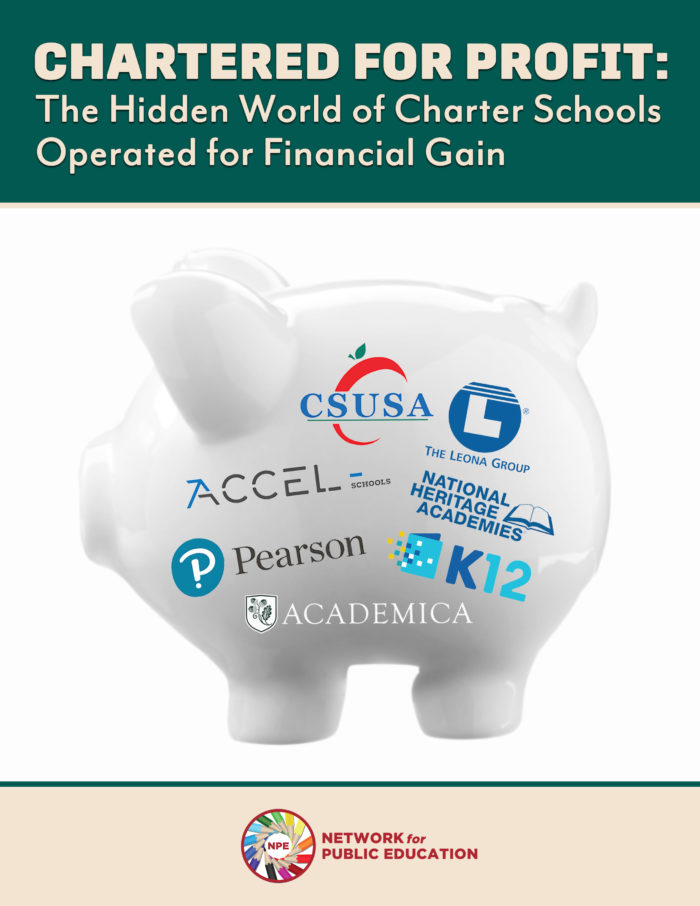
But charter school profiteers have found many loopholes, so that while they may not be able to set up for-profit charters, they can absolutely run charter schools for a profit. That may seem like a distinction without a difference, but the difference is that one is illegal in almost all states, and the other, as outlined in a new report, can be found from coast to coast. The new report, “Chartered for Profit,” from the Network for Public Education examines the size and reach of “the hidden world of charter schools operated for financial gain.” (Full disclosure: I am a member of NPE.)
The National Education Policy Center frequently engages independent scholars to review think tank reports, which are often advocacy reports.
In this report, the NEPC scholars review the latest report from the National Center on Teacher Quality, which was formed about 20 years ago to take down teachers’ colleges. See this post.
NEPC Review: 2020 Teacher Prep Review: Clinical Practice and Classroom Management (October 2020)
NCTQ’s 2020 Teacher Prep Review focuses on two areas of teacher preparation: clinical practice and classroom management. The report uses an approach that is now familiar to readers of NCTQ publications: asserting a set of preferred practices and then applying those criteria to teacher education programs. Although NCTQ reports have been critiqued for their limited use of research and highly questionable research methodology, this report employs the same approaches as earlier NCTQ reports. Rather than analyzing the characteristics of successful programs preparing teachers for a wide range of contexts, the report is based exclusively on adherence to or compliance with NCTQ internal standards that are neither widely accepted nor evidence-based. Thus, the report’s value is diminished and is unlikely to transform teacher preparation
Chartered for Profit: The Hidden World of Charter Schools Operated for
Financial Gain
In this report, we focus on the world of charter schools run for profit,
a world both hidden and misunderstood. We pull back the veil on tactics
and practices designed to reap as many public dollars as possible from
charter schools while hiding behind laws designed to keep profit-making
hidden from the public’s eyes. This report exposes how both large
and small for-profit companies evade state laws that make for-profit
charter schools illegal by the use of related entities and a nonprofit
front. We explain and provide examples of how for-profit owners maximize
their profits through self-dealing, excessive fees, real estate
transactions, and under-serving students who need the most expensive
services.
You can view and read the report by clicking the image below.