Latest News and Comment from Education

Showing posts with label BROWN VS BOARD OF EDUCATION. Show all posts

Wednesday, May 19, 2021

What Does Educational Equity Mean? | janresseger #BLM #BLACKLIVESMATTER

What Does Educational Equity Mean? | janresseger
What Does Educational Equity Mean?


Monday, May 17, 2021, marked the 67th anniversary of the U.S. Supreme Court decision in Brown v. Board of Education, which banned racially segregated schools and unequal access to education. Over more than two decades, NAACP attorneys Charles Hamilton Houston and Thurgood Marshall built up a series of court precedents leading to the 1954 decision in Brown, which declared that educational opportunity, “where the state has undertaken to provide it, is a right which must be made available to all on equal terms.” However, two-thirds of a century later in most places in the United States racial separation and inequity remain the conditions of our children at school.

Among advocates for educational equality, there has, for decades, been an ongoing conversation about the definition of equity. Iris Rotberg, a professor of education policy at George Washington University, recently published a column in which she quotes Thurgood Marshall’s definition all those years ago:  “We sit… not to resolve disputes over educational theory but to enforce our Constitution… I believe the question of education quality must be deemed to be an objective one that looks at what the state provides its children, not what the children are able to do with what they receive.”

Rotberg interprets Marshall’s words: “The government’s responsibility, therefore, is to ensure equal opportunity, not to debate its link to student achievement.”  She is interpreting Marshall’s definition of justice to mean equality of educational inputs and not a comparison of test score outcomes.  She is advocating that states be held accountable for equalizing CONTINUE READING: What Does Educational Equity Mean? | janresseger

A Scholarly Masterpiece: William Frantz Public School | tultican #BLM #BLACKLIVESMATTER

A Scholarly Masterpiece: William Frantz Public School | tultican
A Scholarly Masterpiece: William Frantz Public School


By Thomas Ultican 4/18/2021

My wonderful friend from New Orleans, Mercedes Schneider, said of this meticulously researched book, “Intense, captivating, and horrible in its reality, William Frantz Public School is a story overdue for the telling – a must read for those seeking to understand New Orleans’ history and the lingering impact of White racial superiority upon the Black community and city infrastructure.” I concur. It is a captivating read.

At its 1938 founding, speakers proclaimed the new William Frantz Public School (WFPS) a “protection for democracy” and a “fortification against encroachment of those terrible ‘isms.’” (WFPS page 3)

However, racism did not just encroach; it dominated. WFPS was built to be a White students only school. Sitting on the border between the all white Florida neighborhood and the all Black Desire neighborhood, WFPS only served the White families. Worse still; the authors report,

“The Orleans Parish School Board built no schools between 1941 and 1951. As a result, existing neighborhood schools throughout the city faced overcrowding. The problem was particularly acute in Desire. Due to the severe overcrowding, many Black children attended school for only a fraction of the time as their White peers living in the Florida neighborhood.” (WFPS 9)

With the Brown versus the Board of education decision in 1954, the Supreme Court declared racial segregation as a school enrollment policy unconstitutional. Louisiana segregationists quickly coalesced to become leaders of their state’s CONTINUE READING: A Scholarly Masterpiece: William Frantz Public School | tultican

Monday, May 17, 2021

Historian: Segregation Persists Because Whites Opposed Any and All Efforts to Advance Desegregation | Diane Ravitch's blog

Historian: Segregation Persists Because Whites Opposed Any and All Efforts to Advance Desegregation | Diane Ravitch's blog
Historian: Segregation Persists Because Whites Opposed Any and All Efforts to Advance Desegregation


Today’s is the anniversary of the Brown v. Board of Education of 1954. Much has changed. Barack Obama was elected President twice. But much has not changed. The desegregation of schools that once seemed inevitable stalled, inhibited by white flight from urban districts and housing desegregation.

Historian Matthew D. Lassiter of the University of Michigan argues in this opinion piece in the Washington Post that desegregation failed because of white resistance and pusillanimous federal courts, which turned against desegregation as Republican presidents added conservative justices to the Supreme Court.

Fifty years ago today, the Supreme Court issued the landmark decision of Swann v. Charlotte-Mecklenburg, the most far-reaching school desegregation case since Brown v. Board of Education in 1954. The Swann ruling upheld a lower court-imposed plan to integrate the public schools of metropolitan Charlotte through two-way busing between the segregated White suburbs and the all-Black central city neighborhoods.

During the next few years, busing helped transform the CONTINUE READING: Historian: Segregation Persists Because Whites Opposed Any and All Efforts to Advance Desegregation | Diane Ravitch's blog

Sunday, May 16, 2021

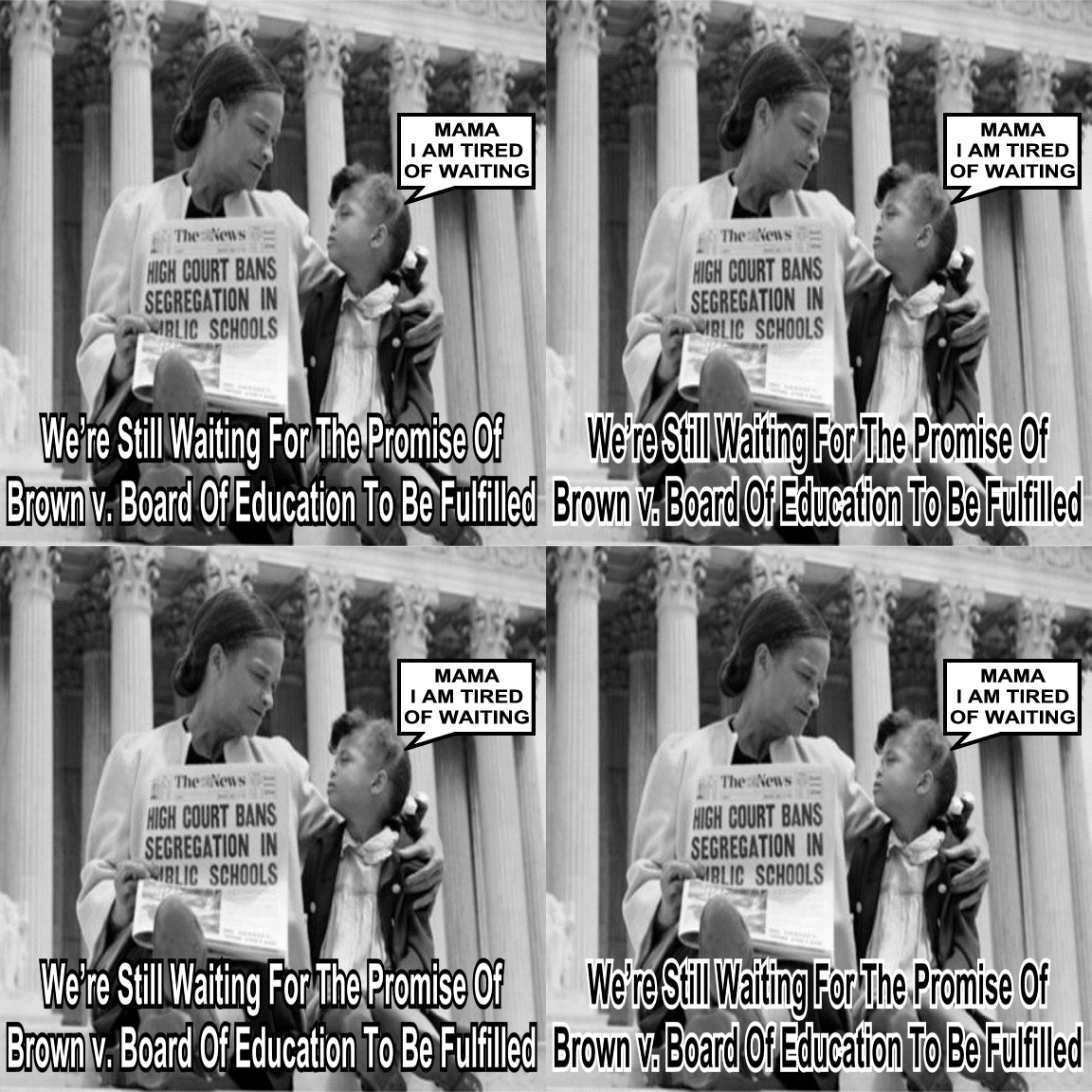
We're Still Waiting For The Promise Of Brown v. Board Of Education To Be Fulfilled | HuffPost

We're Still Waiting For The Promise Of Brown v. Board Of Education To Be Fulfilled | HuffPost
We’re Still Waiting For The Promise Of Brown v. Board Of Education To Be Fulfilled
“When the Supreme Court’s decision finally etched itself upon the country, the social stuff of that imprinting behaved in ways other than intended.”


Our house had a cottonwood tree in the backyard. In the excruciating Texas summer, it bloomed and cotton flew around the house like a summer snow. It caked over the window screens and blocked the wind from coming into the house.

Some of our neighbors had water cooler fans that blew out a cool mist. It made the whole house feel like a swamp and made everyone in the house feel like they were trying to breathe underwater. I hated those fans and was grateful we couldn’t afford one.

We were poor, but not in the ways that mattered. No one went hungry. No one was homeless. There were no drugs. No gangs and no neighborhood blight. The front door to our house was never locked. And everybody owned the home they lived in. My parents purchased our home in the 1950s, and it was a significant accomplishment for them.

When I enrolled in elementary school, all of my teachers were Black and they preached excellence like a well-rehearsed Sunday sermon. By the time I began middle school, in sixth grade, I was a track star, held first chair in the band and was among the top five grade earners.

But all of that changed in 1974, when I was in seventh grade. As part of the mandate issued by the U.S. Supreme Court in the landmark case Brown v. Board of Education of Topeka, Kansas, my classmates and I were among the first group of Dallas students to CONTINUE READING: We're Still Waiting For The Promise Of Brown v. Board Of Education To Be Fulfilled | HuffPost