Latest News and Comment from Education

Monday, April 26, 2021

Math Path – Grumpy Old Teacher

Math Path – Grumpy Old Teacher
Math Path


Several years ago, Grumpy Old Teacher (GOT) took a MOOC provided by Stanford University’s Jo Boaler in which she presented ideas about better maths teaching in schools. That’s not a typo, Dr. Boaler is British and they pronounce the subject with an ‘s’ on the end.

GOT is a math teacher and one of the lessons has stuck with him; the one in which Dr. Boaler described a public high school classroom where students were learning by discovery. Observers and visitors could hear the excited buzz pouring out of the room as they came to find out what was happening.

There was only one problem. Parents and others who said, “This is not how I learned math and so no one else should either!”

Sigh.

It wouldn’t help, GOT supposes, to tell you that this is what the Common Core developers have in mind. By now, the phrase ‘Common Core’ is a ringing bell that causes everyone to drool in response, usually a response that involves a lot of growling, snarling, barking, and snapping at the nearest flesh-bearing CONTINUE READING: Math Path – Grumpy Old Teacher


Podcast: The joy of hassling the Hof(meister)

Podcast: The joy of hassling the Hof(meister)


State Superintendent of Public Instruction Joy Hofmeister is our guest on this week’s episode of Live from the News Dungeon. The state’s top elected education official talks about how she got involved in education, the “fluke” that kicked off her career as a public servant and whether she is considering a run for governor.

Hofmeister also weighs in on the dynamics of the current State Board of Education, plans for expanding summer school this year and the debate over capping class sizes. Meanwhile, our historical nugget segment visits the striking similarities between the challenges facing public education in Oklahoma today and the problems that were cropping up right after statehood.

So listen to our latest episode of Live from the News Dungeon today and remember to tell your friends that they can subscribe on PodBeanSpotifyStitcherGoogle PodcastsAmazon MusicPandora or Apple Podcasts, as well as its connected platforms.

As always, you can listen to this week’s episode embedded right here:

The topics at hand: All things education CONTINUE READING: Podcast: The joy of hassling the Hof(meister)

The Journey of Black Male Teachers in Early Childhood Classrooms - Philly's 7th Ward

The Journey of Black Male Teachers in Early Childhood Classrooms - Philly's 7th Ward
THE JOURNEY OF BLACK MALE TEACHERS IN EARLY CHILDHOOD CLASSROOMS


I am from a place where being home before the streetlights came on meant just that. I am from a neighborhood in Detroit where drugs and guns were more common than schoolbooks. I am from a place where milkcrate basketball hoops brought out the best in us. I am from a place where my past informed my “why” for becoming a Black male teacher. I am a Black male teacher from here to eternity.

On a fall day in 1997, I walked into a classroom with 25 eight-year-old Black children from the same neighborhood in Detroit. Their eyes looked like mine. Their hair looked like mine. Their potential looked like mine. Yet — I was the first Black male teacher they had ever experienced. Those moments as a Black male teacher in the classroom will live forever in my heart. My students taught me lessons about resilience and faith and demonstrated daily that their brilliance was more than a standardized test performance — something deeply rooted in their eternal optimism, despite tremendous odds. Now, years later as a Black male educator, I have found myself talking to a new generation of Black male teachers who teach in early childhood classrooms. I find myself talking as a friend, mentor, advisor, and researcher. Certainly, CONTINUE READING: The Journey of Black Male Teachers in Early Childhood Classrooms - Philly's 7th Ward

Teacher Tom: Creating a "Rat Park" for Our Children

Teacher Tom: Creating a "Rat Park" for Our Children
Creating a "Rat Park" for Our Children


Our school is housed in lower level of the Fremont Baptist Church, a place that in non-plague times also opens its doors to several 12-step groups, one of which met early in the morning as I was getting ready for school. I tried to honor the "anonymous" part of AA and keep to myself, but I nevertheless became friendly with a few of the guys over the years and have taken part in many conversations about addiction.

The 12-step model is based upon the idea that alcohol and drugs (and gambling and sex and other things) are addictive and that any one of us could become an addict were we to systematically abuse them. We treat it like an incurable but controllable chronic disease and the kind of talk therapy offered by groups like AA is generally considered central to subduing addictive behavior. That is the prevailing societal idea, although I'm aware there are some who still consider addiction to be a weakness of character.

Some time ago, I read a fascinating article by Bruce K. Alexander, psychologist and professor emeritus at Simon Fraser University. Much of our current thinking on addiction stems from rat studies in which rats were put in cages with CONTINUE READING: Teacher Tom: Creating a "Rat Park" for Our Children

Russ on Reading: Unsettling the Science of Reading Narrative

Russ on Reading: Unsettling the Science of Reading Narrative
Unsettling the Science of Reading Narrative


Call me crazy, but when I learned I had cancer a few years ago, I did not immediately consult a journalist. Instead I chose to see an oncologist. When COVID broke out, I threw in my lot with Dr. Fauci and other infectious disease scientists, instead of a former reality TV star who suggested I inject bleach. And so, when I want advice on reading instruction, I avoid the journalists, the parent lobbying groups, the reading program sales reps, and the agenda driven pseudo-education organizations, and I look to the experts.

Two such experts, Peter Johnston and Deborah Scanlon of the University at Albany, have recently laid waste to the so called Science of Reading (SOR) in a thoughtful report written for the Literacy Research Association, An Examination of Dyslexia Research and Instruction, with Policy Implications. I strongly recommend reading the entire report, but I would like to share a few takeaways that I think illuminate the current SOR debate. As the title of the report suggests, SOR cannot really be discussed outside of CONTINUE READING: Russ on Reading: Unsettling the Science of Reading Narrative

How the Bad Old Third Grade Guarantee May Be Reborn to Hurt Children in the Post-COVID Era | janresseger

How the Bad Old Third Grade Guarantee May Be Reborn to Hurt Children in the Post-COVID Era | janresseger
How the Bad Old Third Grade Guarantee May Be Reborn to Hurt Children in the Post-COVID Era


On Friday, the Washington Post‘s Valerie Strauss republished an article about learning loss, an article that raises some very serious concerns about what will happen next fall when we can presume that most children will be back in school.

The article is by a former teacher, now an editor at a website called Edutopia.  Steven Merrill writes: “It’s perfectly sensible to worry about academic setbacks during the pandemic… But our obsessive need to measure academic progress and loss to the decimal point—an enterprise that feels at once comfortably scientific and hopelessly subjective—is also woefully out of time with the moment… If there’s a pressing need for measurement, it’s in the reckoning of the social, emotional, and psychological toll of the last 12 months.  Over 500,000 Americans have died.  Some kids will see their friends or favorite teachers in person for the first time in over a year…  Focusing on the social and emotional needs of the child first—on their sense of safety, self-worth, and academic confidence—is not controversial, and saddling students with deficit-based labels has predicable outcomes… (I)f we make school both welcoming and highly engaging… we stand a better chance of honoring the needs of all children and open up the possibility of connecting kids to topics they feel passionate about as we return to school next year.”

We know that Education Secretary Miguel Cardona is requiring states to administer the usual, federally mandated standardized tests for this school year. Cardona says he doesn’t intend for the tests to be used for school accountability, but instead to see which schools and school districts need the most help—a strange justification because the tests were designed for and have always been used for holding schools and teachers and even students accountable. And the punitive policies these tests trigger in schools across the country are well established. What if state legislatures and state departments of education merely use the test scores in this CONTINUE READING: How the Bad Old Third Grade Guarantee May Be Reborn to Hurt Children in the Post-COVID Era | janresseger

We're Not Even At Equality Yet | The Jose Vilson #BLM #BLACKLIVESMATTER #BLACKMINDSMATTER

We're Not Even At Equality Yet | The Jose Vilson
WE’RE NOT EVEN AT EQUALITY YET


A jury of Derek Chauvin’s “peers” found him guilty on all counts of murder: unintentional second-degree murder, third-degree murder, and second-degree manslaughter. Millions reacted to this conviction in their homes, in the streets, on social media, on their own, in the company of others, or perhaps not at all. As the judge read the charges, perhaps many reacted with a sense of excitement, but folks in my circles reacted with a sense of relief and exasperation. George Floyd isn’t back so we’ll never get justice, but accountability was crucial here. Surely, this trial and the conviction would send a signal to the world that we’d find some form of accountability for these agents of the state whenever they performed as judge, jury, and executioner on a person’s life.

Then we found out that a police officer killed Ma’Khia Bryant only 800 miles away from when the conviction came down a short time after.

Therein lies the structural and deeply personal part of this conversation we need to keep having in America. Too many of us believe that simply changing the faces and phenotypes of the people entrusted to keep the social contract is enough. Too few of us see the ruse. In my heart of hearts, I do believe that much of the work we must do to make a better world rest in us doing so collectively, regardless and because of these differences that stratify us. However, the persistent lies and obfuscation we see play out in front of us lead me to believe we need a more urgent conversation than incremental solutions. Concurrently, words like CONTINUE READING: We're Not Even At Equality Yet | The Jose Vilson

Gov. DeSantis Should Veto Florida’s Tragically Flawed So-Called ‘Parents’ Bill of Rights’ | by Bruce Lesley | Voices4Kids | Apr, 2021 | Medium

Gov. DeSantis Should Veto Florida’s Tragically Flawed So-Called ‘Parents’ Bill of Rights’ | by Bruce Lesley | Voices4Kids | Apr, 2021 | Medium
Gov. DeSantis Should Veto Florida’s Tragically Flawed So-Called ‘Parents’ Bill of Rights’


Thanks to the South Florida Sun Sentinel editorial for highlighting significant concerns with a so-called “Parents’ Bill of Rights” (HB 241) that passed the Florida Senate this week and is now on the way to Gov. Ron DeSantis for either his signature or veto.

The Governor should veto this legislation because of its numerous problems and flaws. Instead, the Governor should form a special advisory committee that actually includes children and youth in the discussion about their health, education, and well-being. Kids, after all, might just have something to say about their own lives and future.

At the outset, let’s be clear that nobody disputes that parents and families are fundamental to the upbringing, education, and well-being of children. The U.S. Supreme Court has stated that parents have fundamental rights and responsibilities. For instance, in Troxel vs. Granville (2000), the Supreme Court concluded “the interest of parents in the care, custody, and control of their children” to be “perhaps the oldest of the fundamental liberty interests recognized by this Court.”

There is no doubt that the role of parents in the protection and well-being CONTINUE READING: Gov. DeSantis Should Veto Florida’s Tragically Flawed So-Called ‘Parents’ Bill of Rights’ | by Bruce Lesley | Voices4Kids | Apr, 2021 | Medium

A Closer Look at Teacher Insurgency with Dr. Leo Casey - Trending in Education

A Closer Look at Teacher Insurgency with Dr. Leo Casey - Trending in Education
A Closer Look at Teacher Insurgency with Dr. Leo Casey


Mike welcomes Dr. Leo Casey, the Executive Director of the Albert Shanker Institute who has written a book called The Teacher Insurgency: A Strategic and Organizing Perspective. They begin with Leo’s upbringing by two New York City teachers, how he abandoned his dissertation to teach in Crown Heights, and how he began working with the union when his school shut down.

Leo then began to head the Albert Shanker Institute, a strategic think tank within the American Federation of Teachers which examines labor history, especially for teachers. Leo explains the origins of the 2018 and 2019 teacher strikes: theJanus case, post-2008 austerity, deprofessionalization, and movements like the Women’s March on Washington. Teachers saw both their compensation as well as their position in the classroom undergoing rapid decline.

The first teacher’s strikes were held in West Virginia, which had a history labor movement–both within education and beyond. From here the strikes spread, and ultimately the movement was successful in protecting teachers during COVID-19 times (in this context, MIke mentions Leo’s article on Black Lives Matter and the NBA.)  

Leo notes his concern about both the early retirement of teachers and the paucity in the pipeline for new teachers. Leo also expresses optimism for the Biden-Harris administration, notably President Biden’s support of unions. Leo finishes up by discussing the discourses around how teachers see themselves, and the need for true civics teaching.

If you like what you’re hearing, tell a friend and subscribe wherever you get your podcasts. Visit us at TrendinginEducation.com.


Trending in Education - Palmer Media - https://trendingineducation.com/ on @trendingined


CURMUDGUCATION: ID: Lt. Governor Forms Indoctrination Task Force

CURMUDGUCATION: ID: Lt. Governor Forms Indoctrination Task Force
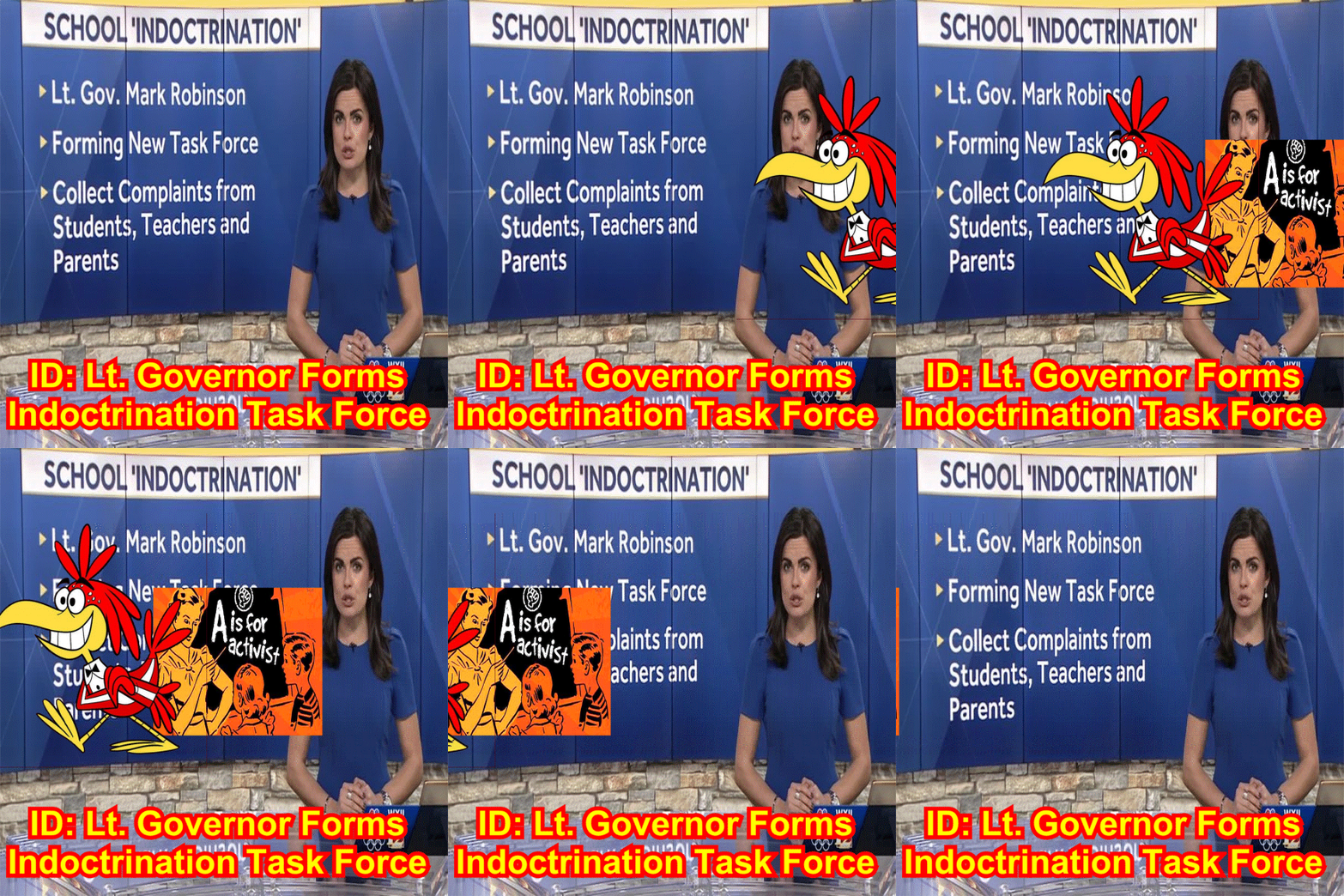
ID: Lt. Governor Forms Indoctrination Task Force


I am not making this up.

Idaho Lt. Governor Janice McGeachin has announced the formation of a Task Force to Examine Indoctrination in Idaho Education. 

You can go to an honest to God state website page where you can turn in an educator who is doing Naughty Indoctrination Things. 

“One of our primary goals with this task force is to give concerned citizens a voice regarding education in Idaho,” said Lt. Gov. McGeachin. “If you, your child, or someone close to you has information regarding problematic teachings on social justice, critical race theory, socialism, communism, or Marxism, please provide us with as much information as you are comfortable sharing.”

So if a teacher you know, or know of, or have heard about through the grapevine, or on a Facebook group, has been involved in "problematic teachings on social justice, critical race theory, socialism, communism, or Marxism," you can turn that teacher in to the state. And while the form calls for your name, McGeachin is quick to reassure the public that they can turn teachers in anonymously.

Again, I feel it necessary to point out once again that I am not making this up or exaggerating for effect (as I occasionally am wont to do). This is the official headline of the official press release from the official Lt. Governor's official office.

Idaho Lt. Governor Assembling Task Force to Examine Indoctrination in Idaho Education Based on Critical Race Theory, Socialism, Communism, and Marxism


In that release, the Lt. Governor notes “As I have traveled CONTINUE READING: CURMUDGUCATION: ID: Lt. Governor Forms Indoctrination Task Force

Sec Cardona, Sen Manchin Sen Murray Roundtable with Students Experiencing Homelessness to Discuss American Rescue Plan Resources + Supporting First-Generation and Low-Income Students | U.S. Department of Education

Secretary Cardona, Senator Manchin, and Senator Murray Held Roundtable with Students Experiencing Homelessness to Discuss American Rescue Plan Resources | U.S. Department of Education
Secretary Cardona, Senator Manchin, and Senator Murray Held Roundtable with Students Experiencing Homelessness to Discuss American Rescue Plan Resources


This afternoon, Secretary Cardona held a virtual roundtable with U.S. Sens. Joe Manchin (WV) and Patty Murray (WA) where they spoke with students who have experienced homelessness. The conversation came on the heels of the Department of Education (ED) announcing plans to distribute $800 million in American Rescue Plan funds to states to support students experiencing homelessness, particularly those disproportionately impacted by the pandemic. ED will distribute $200 million of the total funding to states on Monday.

The students in the roundtable ranged from ages 12-20 and represented seven different states. Event participants shared their personal experiences with the Secretary and the Senators, centering the conversation on lived experiences and how the critical funds in the American Rescue Plan will help other students in similar situations.

Secretary Cardona listened as students shared their stories:

"Among the issues that affect our students' ability to learn is the instability in where they're living, and homelessness is an issue that's critically important. It's hard to learn if you're wondering where you're going to be staying at night, or if there's no stability there and you don't have any support around that you. We need to make sure that our students can learn at high levels and addressing student homelessness is one of those issues that is critically important. All of you are stronger than most students in this country, and you're resilient. You're going to grow. It's our job to make sure we support you because you have so much to offer."

Sen. Joe Manchin discussed the importance of sharing these stories and providing relief for these students.

"It is vital to provide all of our young students with a platform to share their stories and experiences. I'm pleased the Department of Education is committed to helping our children and youth succeed in spite of the challenges they face. We all know, last year has added burdens for us all, especially our children currently experiencing homelessness, but we will get through this together, as we always do, by supporting our fellow Americans in need. Each and every one of you here today embody resilience, strength and determination."

Sen. Patty Murray thanked the students for sharing their experiences and applauded the designated funds in the American Rescue Plan that goes towards helping students who are experiencing homelessness.

"This past year has been so difficult for every student and parent and educator across the country. But what students who are experiencing homelessness have gone through is really unthinkable…So as a mom and a grandmother, my heart truly goes out to each one of you because these are struggles that no kid should have to bear. Please know, I want you to know, we're fighting for you. We hear you. You are not alone. We made sure that there is dedicated support in the American Rescue Plan."


Over the past year, the COVID-19 pandemic demonstrated that pursuing a college education is not just about getting accepted and enrolling in a college. First-generation and low-income college students were burdened with the struggle to pay expensive college fees for a virtual education while being separated from on-campus resources and in-person support from students and faculty. For first-generation and low-income college students, being accepted into a college is a major accomplishment that opens the door to numerous possibilities, such as having higher average salaries and healthier lifestyles. However, there needs to be more support for first-generation and low-income students throughout college, not just to the acceptance letter, for them to enjoy the benefits of obtaining a college degree.

Barriers to Student Success:

Despite the progress, there are still many difficulties for first-generation and low-income college students after they complete their college applications and are admitted to an institution. For instance, first-generation and low-income students:

1. Miss out on financial aid they are eligible for.

According to the National Center for Education Statistics (NCES), only around 65% of high school seniors complete a FAFSA each year, and first-generation and low-income students are less likely to complete an application. By not filling out the FAFSA, first-generation and low-income students are missing out on financial aid that can help them pay for and pursue higher education.

2. Receive inadequate support with understanding financial aid offers.

A study by New America and uAspire found that in financial aid offer letters, many colleges use inconsistent terminology and jargon, do not include information on the cost that the institution is charging, and group different types of financial aid, like grants, Federal Work-Study, and loans together. These practices make it difficult for students to understand and compare aid offers when deciding on which school best suits their financial needs and increases the chance of a student attending a school based on inaccurate financial information. For instance, a student may expect to receive Federal Work-Study as a lump sum grant if it is grouped with grants on the offer letter.

3. Experience greater likelihood of not completing postsecondary education.

First-generation students are more likely to leave postsecondary education without earning a postsecondary credential compared to students whose parents had earned a bachelor’s degree according to a study by the NCES. Similarly, low-income students are more likely to leave a two-year or four-year institution before receiving a degree. Dropping out without completing the degree can have serious financial impacts for students because they may be required to pay back grants and loans for attending college without reaping the benefits of earning their degree.

4. Have a lack of mentors and professional networks.

First-generation college students tend to lack guidance about college and career development from family members and have to build a professional network from scratch, adding pressure to students on top of managing academic coursework.

How We Can Better Support First-Generation and Low-Income Students:

1. Organize mentorship programs during high school and college.

Since first-generation students may lack mentors who can advise them on the college process and career development, schools should organize a mentorship program and make sure all students have a mentor they can trust and ask questions to anytime, such as alumni, faculty members, or even experienced upperclassmen. Mentors can also introduce students to important resources and help them make smart decisions about their future.

2. Provide more informational workshops about financial aid early and regularly.

First-generation and low-income students may not be aware of all the financial aid opportunities that are available to help them afford college. To address this, schools should host informational workshops starting before students apply for college on how to qualify and apply for financial aid. Some topics schools should mention include:

a. Understanding the cost of college
b. How to estimate financial aid and how to complete the FAFSA
c. The types of Federal Aid (including their differences and requirements)
d. Where to find and how to apply for scholarships and grants
e. When to take out loans and how to be a smart borrower (including the types of loans, how much money to borrow, and repayment plans)

3. Standardize and improve transparency of financial aid offer letters

On top of ensuring first-generation and low-income students are aware of the financial aid options available, colleges should make it easier for students to interpret the financial aid offers they are receiving. Colleges should follow standardized templates and terminology, which helps students compare different offer letters. The U.S. Department of Education provided suggested templates for schools to follow, and research from New America suggests that colleges should always include the cost of attendance, distinguish between grants and loans, provide the net price calculation, and state the next steps for the student in the offer letter.

4. Improve accessibility and increase awareness of school resources.

Many colleges already have resources available for first-generation and low-income students, but not all students are aware they exist. Thus, schools should make a greater effort to ensure students know where to find help if they need it. For instance, schools can introduce all campus resources during orientation, provide a list of resources in dorm buildings and classrooms, and list the resources on the school website. Some of these resources may include the career center, alumni center and network, the financial aid office, and any organization that supports first-generation and low-income students. Schools should also not assume every student will receive guidance on essential career development skills, such as how to write a resume and cover letter, and offer accessible presentations on career development skills that every student can attend, such as through the career center or at orientation.

First-generation and low-income students overcome many barriers in the process of applying and being accepted into colleges, but their struggles do not stop there. More can be done to ensure that these students succeed throughout college and obtain their degree, opening the door to more opportunities and a greater chance of financial stability.

Joleen Chiu is an Undergraduate Student at the University of California, Los Angeles studying Mathematics and Economics. She is a current Virtual Student Federal Service intern working  on the Higher Education Financial Decision-Making project under Federal Student Aid.

Sunday, April 25, 2021

CATCH UP WITH CURMUDGUCATION + ICYMI: Car Shopping Edition (4/25)

CURMUDGUCATION: ICYMI: Car Shopping Edition (4/25)


Car Shopping Edition

Only slightly more fun than a root canal. But I needed a new project. In the meantime, here are some good reads from the week.

State of Siege: What the Free State Project Means for New Hampshire’s Public Schools

Have You Heard welcomes Matthew Honglitz-Hetling, author of A Libertarian Walks Into A Bear, a book I just finished, so I was pretty pumped to have the HYH crew interview him. Oh, New Hampshire, my birth state, home of my families of origin--what the hell has happened to you.


Jeff Bryant takes a look at some of the painful, gritty details behind the fraud and waste that cost taxpayers a billion dollars via the federal charter program.


In Ohio, there's a battle between two fundamental ideas about what a school is--a social contract, or a consumer good. Jan Resseger breaks it all down.


Indiana is one of the states rushing headlong toward bigger, broader school vouchers and a dismantling of public education. The blog Live Long and Prosper has the details.


Paul Thomas has been one of the persistent and well-researched opponents of the SOR wave, and here he presents more explanation of why the new edu-fad is misguided and misguiding.


Thomas Ultican provides a guide to just some of the damage done to public education by America's wealthiest oligarchs.


Stephen Merrill at Edutopia explains that yes, learning loss is a thing and no, we shouldn't be making it the centerpiece of education policy.


John Warner in his substack takes a look why education isn't a race, and if it is, it's not a sprint, and maybe some folks should stop freaking out about the great pandemic pause.


Yong Zhao offers some insights into the pitfalls to avoid and the opportunities to embrace when dealing with policies addressing the dreaded learning loss


Look, I'm not generally interested in what big standardized tests have to say about how students are doing, but that's the way some folks like to play, and by the rules of their game, learning loss is not living up to its billing as a world-wrecker. Sarah Schwartz covers a new study for EdWeek.


Shariff El-Mekki offers some thoughts about how teacher preparation could better prepare teachers for today's diverse classrooms.


Maureen Downey at the Atlanta Journal-Constitution looks at a flap in Fulton, where parents are demonstrating against the district's decision to give teachers release time for vaccination. 

How White Americans’ refusal to accept busing has kept schools segregated

Brown v. Board didn't change everything. At the Washington Post, Matthew D. Lassiter looks at the slow steady undoing of desegregation in the US.


Tom Bartlett at the Atlantic looks at the actual data and discovers that maybe the news about a wave of pandemic school shutdown induced suicides may not have been entirely accurate.


Just in case there weren't enough reasons to conclude that this year's Big Standardized Test was a waste of time, now it turns out that New York decided to just go ahead and re-use questions from previous tests. And students noticed. Christina Veiga at Chalkbeat has the story.


Stephen Sawchuck writes for EdWeek, with special appearance by Jose Vilson. 


Well, that turned out to be a long list this week. Here's a nice palate cleanser from McSweeney's


A Search For Common Ground: A Worthwhile Conversation About Education - https://www.forbes.com/sites/petergreene/2021/04/13/a-search-for-common-ground-a-worthwhile-conversation-about-education/?sh=5948b3af4333 by @palan57 on @forbes


VA: Is This The Path To Math Equity
Virginia is working on a new "math path," and conservative news outlets have gone off. The initiative itself is loaded with the usual bureaucratic argle bargle, like Through collaboration with other stakeholders across the Commonwealth, the VMPI state task force will make suggestions for institutional changes that will strengthen the alignment between K-12 and higher education mathematics while e
A Powerful Call To Teach
Sharif El-Mekki is the founder of the Center for Black Educator Development , a group that's doing important work. He blogs at Philly's 7th Ward , and recent post is worth attention. I suspect that El-Mekki and I disagree on some education issues, but his view of the teaching profession is inspiring and powerful. Here's a bit from the post " Why We Need Black Men (And Women) To Answer The Call An
TX: Governor Still Holding On To Education Relief Funds
Texas Democrats have been reduced to tattling to the US Department of Education , as Governor Abbott continues to sit on $17.9 billion-with-a-b in aid that is supposed to be going to public schools. That huge pile of money that has been allocated by Congress through various packages. Texas school districts are trying to get budgets written for next year. But the money is just sitting there. Why?
Chris Evans (And Partners) Create A Useful Civics Tool
So this is how you do it. Chris Evans has entered the world of celebrity education support, and he's done it up right. There's a companion post to this one over at Forbes that explains in a little more detail what the site does; in this post, I want to explain why I think Evans and his partners are setting an example for how the rich and famous can have a positive impact on education. First of al
To Choice Advocates: Some Questions
I have concerns about school choice programs, and I usually express them as complaints, criticism, general snark. This time, I'd like to come at it a little differently. Let me frame these concerns as questions, because maybe there are answers that I'm just not aware of. As is obvious from a multitude of posts, I am skeptical; these questions show exactly what I'm skeptical of. And before I start,
ICYMI: Taxes Are Done Edition (4/18)
Yes, we all got extensions, but I'd rather have them done and gone, and this was a pretty easy year. Now we can move on to other swell things. In the meantime, let me remind you that you, too, can amplify voices in cyberspace. If your thought is "Hey, people should read this," well, then, you know people. Send them some this to read. My Learning Loss Formula: Read, Write, Share Russ Walsh doesn't
New Anglo-Saxon Caucus Has Some Education Thoughts. They Are As Bad As The Rest Of This Damn Fool Platform.
So, led by a team-up of House of Representative winners from Georgia and Arizona, there is now a White Racist Nativist America First Caucus that swears to "follow in President Trump's footsteps and potentially step on toes and sacrifice sacred cows for the good of the American nation" as well as calling for "common respect for the uniquely Anglo-Saxon political traditions." It's as awful as it is