Latest News and Comment from Education

Monday, November 30, 2020

Helping Black Students Shine

Helping Black Students Shine


by Ernie McCray

Lately I’ve been thinking of Black kids, Black students, specifically. Thinking of all the teachable moments out in the universe that I would call on to help them shine if I were in the classroom during these times.

And the first thought that came to mind is I would turn them on to what it means to be Black at this very time.

We’d talk about what we’d all just seen this past NBA season, superstars flying through the air slamming monstrous dunks and shooting rainbow 3’s with “Black Lives Matter” sewn into their jerseys.

We’d talk about the significance embedded in a Black woman taking on the role of Vice-president of the United States, the first of her gender to serve in such a capacity.

We’d talk about how Black voters showed up in large numbers, essentially rescuing a drowning democracy.

All to get them to look at themselves and think of how and where they fit in the scheme of things.

And I’d dive right in there with them as a co-learner, for sure, as we, in our studies, embrace our Blackness and continue the process of overcoming the systemic anti-Blackness colonialism that has plagued our journey for centuries.

I can see us looking into how expressions like “Eeenie meenie miney mo” or call “a spade a spade” or the “black sheep of the family” got popularized; how Black music came to be seen as “urban,” in reference to “thug life” in so many White people’s eyes.

I’d want to know if they had ever been told how “articulate” they are just because they speak grammatically?

We’d wade in the water of other cultures to get more of a sense of who we are, seeing that Native people CONTINUE READING: Helping Black Students Shine

Reopening Whiplash in New York City - The New York Times

Reopening Whiplash in New York City - The New York Times
Reopening Whiplash in New York City
Schools will reopen as abruptly as they closed — but only for some.


Parents, teachers and children had only a few days to get used to the nation’s biggest school district shutting classrooms before Mayor Bill de Blasio announced another plot twist on Sunday: Students in pre-K and elementary school would return to school after all, starting on Dec. 7.

But — and there is always a “but” in the New York City school system — not all younger school students will be able to go back.

(This story gets a bit into the weeds for New Yorkers. For everyone else, it’s most important to know that by prioritizing young and special needs learners, New York City is adopting a model that is becoming more common across the country and world.)

In early November, the mayor set a deadline for parents to decide if their children would return to classrooms this school year. To date, about 335,000 students have opted into hybrid learning — less than a third of the city’s roughly 1.1 million students in public schools.


Of those, about 190,000 are in pre-K or elementary school, or in a specialized district for students with disabilities. They’re the only kids who will be able to attend class starting next week. Middle and high school students will continue all-remote learning.

“I have to say, I’m not actually surprised at all,” said our colleague Eliza Shapiro, who covers the city’s schools. “The mayor was super clear that he wanted to reopen, that he would do it as soon as he could, and the science from the summer and fall has made elementary schools the safest bet.” CONTINUE READING: Reopening Whiplash in New York City - The New York Times

OPINION: What math class and police brutality have in common

OPINION: What math class and police brutality have in common
What math class and police brutality have in common
An obsession with rule-following cuts short Black students’ opportunities


Last May, a 15-year-old Black girl in Michigan known only by her middle name, Grace, was put in juvenile detention for not completing her homework. Teens not turning in their homework is hardly an anomaly. Other teens are scolded, lose marks or, at worst, get detention for this offence. But Grace was incarcerated. The difference? She’s Black.

Grace’s story is just one example of how the American education system and American policing tactics converge.

The education system has a dangerous obsession with rule-following for Black children that cuts short opportunities, just as policing has a dangerous obsession with rule-following for Black people that cuts short lives.

This is particularly evident in math class.

Black students often receive compliments in math class for rule-following. In lower-income schools (which are often predominately Black), students are encouraged to follow math rules and formulae without questioning the teacher or the math itself, leaving them no room to ask questions or screw up.

Teachers are more likely to judge their Black students’ math abilities based on non-academic qualities, such as behavior and physical characteristics. A decade ago, Common Core math was introduced to emphasize understanding over rote learning, but the delivery of standards varies across schools, classrooms and teachers, depending both on who is being assessed and who is doing the assessing.

Related: White and female teachers show racial bias in evaluating second grade writing

In higher-income schools (which are often predominately white), understanding is often prioritized over procedure, and students learn math in more abstract ways, such as understanding why one uses a certain formula, instead of just being told to use it “because that’s the formula.” They also are shown how these abstract concepts contribute to the higher CONTINUE READING: 


Teaching in the Pandemic: ‘This Is Not Sustainable’ - The New York Times

Teaching in the Pandemic: ‘This Is Not Sustainable’ - The New York Times
Teaching in the Pandemic: ‘This Is Not Sustainable’
Teacher burnout could erode instructional quality, stymie working parents and hinder the reopening of the economy.


At Farmington Central Junior High in rural Illinois, classes still start at 8 a.m. But that’s about the only part of the school day that has not changed for Caitlyn Clayton, an eighth-grade English teacher tirelessly toggling between in-person and remote students.

At the start of the school day, Ms. Clayton stands in front of the classroom, reminding her students to properly pull their masks over their noses. Then she delves into a writing lesson, all the while scanning the room for possible virus threats. She stops students from sharing supplies. She keeps her distance when answering their questions. She disinfects the desks between classes.

Then in the afternoon, just as her in-person students head home, Ms. Clayton begins her second day: remote teaching. Sitting in her classroom, she checks in one-on-one via video with eighth graders who have opted for distance learning. To make sure they are not missing out, she spends hours more recording instructional videos that replicate her in-person classroom lessons.


All this fall, as vehement debates have raged over whether to reopen schools for in-person instruction, teachers have been at the center — often vilified for challenging it, sometimes warmly praised for trying to make it work. But the debate has often missed just how thoroughly the coronavirus has upended learning in the country’s 130,000 schools, and glossed over how emotionally and physically draining pandemic teaching has become for the educators themselves.


In more than a dozen interviews, educators described the immense challenges, and exhaustion, they have faced trying to provide normal schooling for students in pandemic conditions that are anything but normal. Some recounted whiplash experiences of having their schools abruptly open and close, sometimes more than once, because of virus risks or quarantine-driven staff shortages, requiring them to repeatedly switch back and forth between in-person and online teaching.

Others described the stress of having to lead back-to-back group CONTINUE READING: Teaching in the Pandemic: ‘This Is Not Sustainable’ - The New York Times

Teacher Tom: Talking to Children About the Pandemic and Everything

Teacher Tom: Talking to Children About the Pandemic and Everything
Talking to Children About the Pandemic and Everything


In a recent interview in The New York Times Magazine, children's book author Mo Willems was asked if he had any advice for parents struggling to talk with their children about difficult things, like the pandemic.

"Probably the most fundamental insight is that even a good childhood is difficult: You're powerless; the furniture is not made your size. But when parents come up to me and ask, "How do you talk to the kid about the pandemic?" they're asking me to be disloyal. They're actually asking about a form of control. "Hey, you have this relationship with kids. Help me control them." (Expletive) you! I'm not on your side."

I would have said it differently, but he puts his finger on a central challenge in the relationship between children and the important adults in their lives. Even those of us who don't believe it's right for adults to control the kids struggle with it. Of course, most of us have learned to not physically and emotionally bully children into obedience, but this drive to control them creeps in nevertheless. Willems' point, I think, is that the moment we begin to strategize about our relationship with a child we are seeking to manufacture a response that satisfies our own emotional needs, to control them for our own ends. None of us like to be manipulated. We rebel when we detect that someone, be it a salesman, guru, or lover, is using their words to steer us. It's the same with children.

When we tell ourselves "But it's for their own good" we set ourselves up as the experts on their bodies and minds, CONTINUE READING: Teacher Tom: Talking to Children About the Pandemic and Everything

Making the Transition from Writing in High School to Writing in College – radical eyes for equity

Making the Transition from Writing in High School to Writing in College – radical eyes for equity
Making the Transition from Writing in High School to Writing in College


Three behaviors have over the course of about 40 years come to constitute a significant percentage of who I am—writing, teaching, and cycling.

Of those three, I have received the most formal education in teaching, completing all three of my degrees (BA, MEd, EdD) in education; in many ways, I am self-taught as a writer and a cyclist even though I would argue that I have developed a level of expertise in all three that are comparable.

Recently, I bought my first gravel bicycle and have been making the small but noticeable transition to gravel riding that has forced me to experiment with decades of cycling knowledge built on road and mountain bicycling in order to ride gravel at a level comparable to road cycling (my first and deepest cycling love).

This, I think, is at the core of all of my personas as writer, teacher, and cycling—behaviors that are all journeys and not aspects of my life that I can (or should) finish.

Even though, as I noted above, teaching is my primary career and what I have the most education in, I am perpetually learning to teach; and I count on my CONTINUE READING: Making the Transition from Writing in High School to Writing in College – radical eyes for equity

CURMUDGUCATION: Donors Choose Monday: Expanding the Library

CURMUDGUCATION: Donors Choose Monday: Expanding the Library
Donors Choose Monday: Expanding the Library


This week's project is exactly the sort of thing that shouldn't be on donors choose. 

Mrs. Gibson is an elementary teacher in South Carolina, and she's looking to expand her classroom library.

My students are living in a low income area where literacy is our focus in order to meet the needs they may not be receiving at home.

My focus is to bring in books that we help them connect with other cultures within the world and the school setting to help them become culturally competent and aware.

A classroom teacher should not have to go begging for books, and yet, here we are. I've made this comparison before--tips should not be a necessary part of a food server's income, but if I refuse to tip as a protest against the system, I'm just being a jerk and the people who get hurt are not the people perpetuating the system. 

So my dream is a world in which South Carolina funds public education properly and Mrs. Gibson and all the teachers like her have the classroom libraries they need. But in the meantime I can either complain about the problem or take a simple step to improve even one small corner of the universe. So I'm giving a tiny little donation to this project, and I encourage you to do the same.

Grassroots Education Network- November 2020 Newsletter - Network For Public Education

Grassroots Education Network- November 2020 Newsletter - Network For Public Education
Grassroots Education Network- November 2020 Newsletter


The NPE Grassroots Education Network is a network of over 155 grassroots organizations nationwide who have joined together to preserve, promote, improve, and strengthen our public schools. If you know of a group that would like to join this powerful network, please go here to sign on. 

If you have any questions about the NPE Grassroots Education Network please contact Marla Kilfoyle, NPE Grassroots Education Network Liaison at marlakilfoyle@networkforpubliceducation.org

Notes from Marla


November saw us on the precipice of a historic election.  With the incoming Biden/Harris administration, we hope that we can finally get someone in the USDOE that stands strong for our public schools, our public schools students, and our public school parents. We need a USDOE secretary rooted in equity and a vision that will get our public schools what they need to serve all of our children and families.  With that being said, NPE and our amazing partners launched the Keep Your Promises this month. We congratulate President-elect, Joe Biden, and Vice President-elect Kamala Harris, on their historic victory. We look forward to working with them as they fulfill their promised commitment to our nation’s public schools. The promises made during the campaign drew support from public education advocates across the nation. With those promises in mind, we listed the top five K-12 priorities that they should keep at the forefront as they govern. In order to do this, we need Pro-Public education leadership in the Department of Education. Let’s make sure that Joe Biden chooses a public education advocate for the next Secretary of Education. We need a leader who rejects corporate reforms, high-stakes testing, and school privatization. It is CONTINUE READING: Grassroots Education Network- November 2020 Newsletter - Network For Public Education


Nobody Should Be Wasting Time Worrying About When to Administer Standardized Tests | janresseger

Nobody Should Be Wasting Time Worrying About When to Administer Standardized Tests | janresseger
Nobody Should Be Wasting Time Worrying About When to Administer Standardized Tests


Parents, children, teachers, principals, and school superintendents are living through a time of unknowns. COVID-19 is raging across the states with many public schools operating only online. Some public schools, which have been able to open in person or on hybrid schedules, have subsequently been forced to close already reopened buildings or specific classrooms as COVID-19 cases arise and everybody quarantines.

In the midst of a chaotic situation with no good and stable solutions for many public schools, suddenly last week everybody started worrying about what to do about this year’s standardized tests. The Washington Post‘s Perry Stein reports that outgoing Secretary of Education, Betsy DeVos postponed the winter administration of the National Assessment of Educational Progress, the one test administered across all the states, the test that tracks school achievement over the decades and is not distorted by high stakes consequences.

Representatives Bobby Scott (D-VA) and Patty Murray (D-WA), the Democratic leaders of the House Education Committee, agreed to delay the NAEP, but said the nation needs some kind of measure of learning loss during the pandemic.  They released a statement declaring that annual state tests mandated under the Every Student Succeeds Act must surely be administered: “Existing achievement gaps are widening for our most vulnerable students, including students from families with low incomes, students with disabilities, English learners, and students of color. In order for our nation to recover and rebuild from the pandemic, we must first understand the magnitude of learning loss that has impacted students across the country. That cannot happen without assessment data.”

While I frequently agree with Representatives Scott and Murray, I think worrying about CONTINUE READING: Nobody Should Be Wasting Time Worrying About When to Administer Standardized Tests | janresseger


Virtual Charter Schools Are Booming, Despite A Checkered Reputation | 89.3 KPCC

Virtual Charter Schools Are Booming, Despite A Checkered Reputation | 89.3 KPCC
Virtual Charter Schools Are Booming, Despite A Checkered Reputation


Parent Mandii Brower vividly remembers what it was like when her kids' school in Yukon, Okla., switched to distance learning in the spring: "It was just like, we never learned with our teachers again. They never checked on things again." She says "school" consisted of just a few short daily assignments.

"I [couldn't] see my kids' education going that way."

So this fall, Brower enrolled her two daughters in Epic Charter Schools, a virtual program that allows students to study online, at their own pace, with pre-recorded lessons and one-on-one teacher support. For Brower, the difference has been night and day. She says Epic "[has] it down pat, and they know how to help families."

Brower wasn't the only parent to give the Oklahoma-based virtual school a try this year. Since last spring, Epic enrollment has grown to be double the size of the state's largest public school district.

In fact, across the country, fully virtual K-12 charter schools have experienced a pandemic-induced "surge," as one sector observer put it. K12 Inc., one of the biggest in the business, has reported a 57% enrollment increase, taking it up to 195,000 students; Connections Academy, another heavy hitter, has reported a 41% jump, and the list goes on.

Virtual charter schools have been around for a couple of decades. In that time, they've been both relatively niche and highly controversial. Free to families but paid for by taxpayers, they enrolled about 300,000 full-time students in the 2017-18 school year, according to the National Education Policy Center. The market has been dominated by publicly-traded corporations, including K12 Inc. and Pearson, which CONTINUE READING: Virtual Charter Schools Are Booming, Despite A Checkered Reputation | 89.3 KPCC

CURMUDGUCATION: The 2020 Edubook Christmas List

CURMUDGUCATION: The 2020 Edubook Christmas List
The 2020 Edubook Christmas List


Time to go hunting for books for the people on your Christmas list, and I have some recommendations for you if there are people on your list who care about public education (and really, everybody should). 

Before we start shopping, let me also direct your attention to Bookshop.org, an online vendor set up to benefit local independent booksellers instead of, say, giving Jeff Mezos his next gazillion dollars. You can also use it to locate a local bookstore and then shop even more directly. 

Now, here's my handful or recommendations for this year.

Black Lives Matter In School

This book does not actually ship for another week, but based on the fact that it's edited by Jesse Hagopian and Denisha Jones, my copy is already on order. 

Know Your Price  

Andre Perry brings a really unique collection of hats to this work, from Brookings scholar to education journalist, and this work is an impressive distillation of it all. At some points, it's a powerful personal reflection on his own experience, and at others, a scholarly look at how Blacks in the US have had value systematically stripped from them in ways that have lasting financial and social consequences. This book is huge help in understanding the how of racism in not just abstract or social ways, but in concrete, practical financial ways. 

Schoolhouse Burning & The Wolf at the Schoolhouse Door

Schoolhouse Burning by Derek Black and A Wolf at the Schoolhouse Door by Jennifer Berkshire and Jack Schneider are two entirely separate books, but they make a perfect pairing. It enhances both to read them back to back.

Black is a legal scholar whose book traces the importance of education in this country as reflected CONTINUE READING: CURMUDGUCATION: The 2020 Edubook Christmas List

In a twist, de Blasio’s latest screw-up is not his worst | JD2718

In a twist, de Blasio’s latest screw-up is not his worst | JD2718
In a twist, de Blasio’s latest screw-up is not his worst


Over the last nine months Bill de Blasio has gotten a lot wrong. Almost every announcement has been late, off-base, and off kilter. He kept schools open when they should have been closed, he canceled break when students and teachers needed it, he announced policies without consulting teachers, families, principals, he came up with half-assed “models,” he insisted schools were opening on time, he announced without notice that opening was delayed a few weeks… His pattern – late, without consultation, lacking details, winging it, and – for the most part – wrong, without careful consideration, without real planning, without forethought.

That makes today’s announcement at least a little different. There were a couple of elements that were not completely wrong.

  • Elementary schools come back 12/7. D75 comes back 12/10.

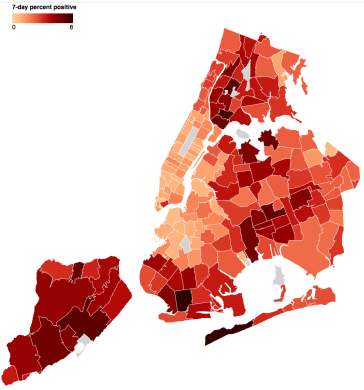
So, those dates are arbitrary. And maybe 3% was a low trigger, maybe not, but all the precents are higher today, and rising. My neighborhood, middle of the pack, is at 4.5%. My school’s neighborhood is over 6%. Announcing return dates now is – I don’t know. Really dumb? But it’s political. He got scolded by the governor and the Times’ education writer, and he’s showing them – full stop. Instead of making the best decisions for our schools, families, teachers, students, he’s showing them. Really dumb.

  • High schools and middle schools are not coming back for now.

Ok, so that is more interesting. Treating different grades differently is something that needed to be CONTINUE READING: In a twist, de Blasio’s latest screw-up is not his worst | JD2718

NYC Educator: The Chancellor Reveals His Re-opening Plan

NYC Educator: The Chancellor Reveals His Re-opening Plan
The Chancellor Reveals His Re-opening Plan


 Dear Colleagues,
 
I hope you had a restful Thanksgiving holiday this year. You’ll need it, because I’m about to arbitrarily and capriciously change my reopening plan, again, with no consultation whatsoever with your union.
 
This has been an eventful and challenging year on many levels. We’ve managed to double the infection rate in the city. Worse, parents are practically burning us in effigy for honoring our agreement to close at 3%. Safety is one thing, but bad publicity is another, and I’m gonna need a new gig once Blaz is term limited next year. I don’t suppose he can just buy another term like Bloomberg did.

Please know that we pay you valuable lip service for the tireless work you have done, and please disregard our efforts to pick your pockets to the tune of a billion dollars we’ve owed you for over a decade now. We’ve given you half, right? That’s better than nothing.
 
Working in partnership, the City and the State, we are releasing plans today to re-open school buildings with enhanced weekly testing for COVID-19 in place for students and staff. To re-open our schools successfully and with sufficient testing support, we’ve decided to ignore the 3% rate we just closed with, because we hate it when we are criticized, and therefore we’re gonna use the state program. That way, hopefully, everyone will just blame Cuomo.
 
·         Students in 3-K, Pre-K and grades K through  5 will return to in-person learning beginning CONTINUE READING: 
NYC Educator: The Chancellor Reveals His Re-opening Plan


A VERY BUSY DAY Larry Ferlazzo's Websites of the Day... The latest news and resources in education since 2007

Larry Ferlazzo's Websites of the Day... | The latest news and resources in education since 2007

“This Is Not Sustainable”: Important NY Times Article About Teachers’ Struggles
Teaching In The Pandemic: ‘This is Not Sustainable is an excellent article that teachers everywhere will say, “Yes, that’s how I’m feeling.” The question is, of course, “Will district and public officials listen?”
Dec. 12th Is The Day Of The Virgin Of Guadalupe – Here Are Teaching & Learning Resources
OpenClipart-Vectors / Pixabay December 12th is a Mexican National Holiday, and an important day for many Mexican-Americans — The Day Of The Virgin Of Guadalupe. You might be interested in The Best Sites For Learning & Teaching About The Day Of The Virgin Of Guadalupe .
Monday’s Must-Read Articles & Must-Watch Videos On School Reopenings
geralt / Pixabay Here are new additions to THE BEST POSTS PREDICTING WHAT SCHOOLS WILL LOOK LIKE IN THE FALL : New York City Will Reopen Elementary Schools and Phase Out Hybrid Learning is from The NY Times. New York City Schools Will Reopen With New COVID-19 Testing Protocol is from NPR.
My Most Popular Tweets Of The Month
PhotoMIX-Company / Pixabay I used to post weekly collections of my best tweets, and used Storify to bring them together. Unfortunately, Storify went under. Fortunately, however, Wakelet was a new tool that was able to import all of a person’s Storifys. So you can see all those previous Twitter “Best” lists here . You might also be interested in MY MOST POPULAR TWEETS IN 2019 – PART TWO and NEW &
A Look Back: “English Language Learners and the Power of Personal Stories”
I thought that new – and veteran – readers might find it interesting if I began sharing my best posts from over the years. You can see the entire collection here . Today, I’ve decided to share an article I wrote for The New York Times Learning Network a several years ago called English Language Learners and the Power of Personal Stories . Here’s an excerpt:
“Teachers Share What They Want Central Offices & Public Officials to Hear”
Teachers Share What They Want Central Offices & Public Officials to Hear is the headline of my latest Education Week Teacher column. Those who make the policy decisions and control the resources often don’t ask educators what they need. Three teachers suggest ways they can be most helpful to the people in the trenches. Here are some excerpts:
This Week’s Resources To Support Teachers Coping With School Closures
Wokandapix / Pixabay I have a number of regular weekly features (see HERE IS A LIST (WITH LINKS) OF ALL MY REGULAR WEEKLY FEATURES ). This is a relatively new addition to that list. Some of these resources will be added to The Best Advice On Teaching K-12 Online (If We Have To Because Of The Coronavirus) – Please Make More Suggestions ! and the best will go to The “Best Of The Best” Resources To
Sunday’s Must-Read Articles On School Reopenings
kaboompics / Pixabay Here are new additions to THE BEST POSTS PREDICTING WHAT SCHOOLS WILL LOOK LIKE IN THE FALL : Plastic Dividers and Masks All Day: What Teaching in a Pandemic Looks Like is from The NY Times. This state is shutting bars and gyms as the coronavirus surges — but not schools is from The Washington Post. ‘Unprecedented learning loss’: U.S. students rack up failures as grading retu
Pearl Harbor Remembrance Day Is On December 7th – Here Are Teaching & Learning Resources
WikiImages / Pixabay Pearl Harbor Remembrance Day is on December 7th here in the United States. You might be interested in The Best Sites For Learning About Pearl Harbor (I’ve just update and revised it).