Latest News and Comment from Education

Saturday, March 28, 2020

Coronavirus and schools: Free meals are (and aren’t) getting to kids - Vox

Coronavirus and schools: Free meals are (and aren’t) getting to kids - Vox

How schools are (and aren’t) providing meals to children during coronavirus
Parents rely on schools for children’s meals. Coronavirus has exposed the vulnerabilities of these programs. 


In an effort to keep children safe from the coronavirus pandemicschools in the United States have shut down. Teachers have had to adapt by going online with classes to keep kids on schedule with their education, and other forms of distance learning — teachers holding office hours by phone, the distribution of learning packets, etc. — are being implemented. Essentially, educators are finding ways to ensure kids don’t need to go to a physical building to get schooled.
But there’s at least one big problem this presents.
Many students around the country rely on schools to provide free or low-cost meals. These meals — which speak to the country’s larger problem of income inequality — are a necessary staple for many families across the country.
On a typical school day, the National School Lunch Program provides low-cost or free lunches to 29.7 million children. In New York City, the Department of Education offers free breakfast, lunch, and after-school meals to public school students during the school year. These low-cost and free options are even more imperative considering the record-shattering unemployment spike in the US.
With the shutdown of physical school, that option is gone and the US is scrambling to address this problem, on top of all the other problems the coronavirus pandemic presents.
During this pandemic, the White House has signaled that states need to take care of themselves without relying on the federal government when it comes to vital medical equipment, with Trump picking fights with Michigan Gov. Gretchen Whitmer and saying New York Gov. Andrew Cuomo is exaggerating his state’s need for ventilators.
On Friday, his administration signaled that state and local officials may, similarly, need to CONTINUE READING: Coronavirus and schools: Free meals are (and aren’t) getting to kids - Vox


The “CA Meals for Kids” app was originally released in 2018 to help users to find the locations of California’s Summer and Afterschool Meal Programs, which are spread throughout the state. These programs provide no-cost meals to children aged eighteen and under. The app is available for free download through Apple’s App Store External link opens in new window or tab.Google’s Play StoreExternal link opens in new window or tab., and Microsoft’s App StoreExternal link opens in new window or tab. web pages.
More information about the app is available on CDE’s CA Meals for Kids Mobile Application support web page.
More information and resources regarding coronavirus (COVID-19) and California's response is available at the CDE’s Coronavirus (COVID-19) web page.

With A Brooklyn Accent: How Hip Hop Differed From Rock and Roll In Its Formative Years

With A Brooklyn Accent: How Hip Hop Differed From Rock and Roll In Its Formative Years

How Hip Hop Differed From Rock and Roll In Its Formative Years


There were significant differences between Hip Hop's emergence as the most popular youth music in the nation, compared to rise of Rock and  Roll, though both began as musical forms in  Black communities. 

First of all, the take off period for hip hop, the time it took from its first commercial dissemination till its conquest of the youth market, was longer than that of Rock and Roll. For Hip Hop, the period was approximately ten years  (1979-1989); for Rock and Roll only three ( 1954-1956).  Both were maligned and resisted, but it took longer for Hip Hop to conquer youth markets, with the major vehicles for doing so being a single Music Show, MTV, along with music radio stations around the nation, rather than variety shows like Steve Allen and Ed Sullivan, and dance shows like American Bandstand, which helped promote Rock and Roll

Secondly, whereas Rock and Roll was a product of a wave of American Prosperity of unprecedented power and length, elevating the incomes of working class Americans, even those from  previously marginalized groups,  to the point where they could produce a teenage market for popular music and creating a wave of optimism that affected almost everyone in the nation, Hip Hop was a product of economic stagnation, urban decay, growing inequality, and the decline of post war optimism and Sixties idealism. The South Bronx of the 70's ("broken glass everywhere, people pissing on the stairs you know they just don't care') would have been- and actually was- unrecognizable to the people who sang doo wop on the corners and in school hallways in Bronx CONTINUE READING: With A Brooklyn Accent: How Hip Hop Differed From Rock and Roll In Its Formative Years

If You’re Going to Write About Science of Reading, Get Your Reading Right – radical eyes for equity

If You’re Going to Write About Science of Reading, Get Your Reading Right – radical eyes for equity

If You’re Going to Write About Science of Reading, Get Your Reading Right


The release of the joint statement (National Education Policy Center and Education Deans for Justice and Equity) on the “science of reading” version of the current Reading War held, I hoped, great promise for at least slowing a very harmful process. I also briefly crossed my fingers that the statement could ease some of the discord and help key figures in the debate find that there is more common ground than disagreement.
However, social media has provided evidence that neither of these outcomes is likely. The advocates of the “science of reading” doubled down on their condescension and general nastiness (a feature of Twitter), and there is this blog post from Daniel WillinghamIf You’re Going to Write About Science of Reading, Get Your Science Right.
I commented several times on the post and even offered a discussion by email. Willingham did respond to my comments and the exchange was civil, but alas, fruitless.
The crux of Willingham’s concerns about the statement seems to be:
I think the statement is pretty confused, as it conflates issues that ought to be considered separately. This statement is meant to be about the science of reading, so much of the confusion arises from a failure to understand or appreciate the nature of science, how basic science applies to applied science, and the scientific literature on reading.
This is a misreading of the policy; I think that misreading is in part prompted by Diane Ravitch’s framing of the statement with “There is no Science of Reading,” which Willingham references in his first paragraph.
To clarify, Ravitch’s framing is misleading, and Willingham has failed to grasp the purpose of the statement, directly identified by NEPC:
All students deserve equitable access to high-quality literacy and reading instruction and opportunities in their schools. This will only be accomplished when policymakers pay heed to an overall body of high-quality research evidence and then make available the resources necessary for schools to provide our children with the needed supports and opportunities to learn. This joint statement from NEPC and the Education Deans for Justice and Equity provides guiding principles for what any federal or state legislation directly or indirectly impacting reading should and should not do.
This statement is a policy statement that raises a long-overdue red flag about CONTINUE READING: If You’re Going to Write About Science of Reading, Get Your Reading Right – radical eyes for equity

Little Rock: Parents and Activists Fight Against Sham of “Restoring Local Control” | Diane Ravitch's blog

Little Rock: Parents and Activists Fight Against Sham of “Restoring Local Control” | Diane Ravitch's blog

Little Rock: Parents and Activists Fight Against Sham of “Restoring Local Control”


In Arkansas, the governor and the legislature does not want the citizens of Little Rock to have democratic control of their public schools. They took over the schools five years ago and were supposed to return it to the people but passed a hoax of a bill.
Max Brantley, veteran journalist in Little Rock, explains how the state intends to clamp down on a new local board and hang on to the reins of power.
The lawsuit, filed on behalf of three plaintiffs by Matthew Campbell, challenges the state Board’s order that prevents the School Board from filing lawsuits; from negotiating with the teachers union on a contract, and from firing the school superintendent.
The plaintiffs are a parent of a child in the district, Heather Speyer-Rainbolt; Jim Ross, a member of the School Board disbanded by the state five years ago on account of low standardized tests scores in a handful of the district’s almost four dozen schools, and Marshall Sladyen, a teacher at Hall High School.


The lawsuit argues that the state’s ability to control the CONTINUE READING: Little Rock: Parents and Activists Fight Against Sham of “Restoring Local Control” | Diane Ravitch's blog

NYC Educator: One Giant Step for Stupidity

NYC Educator: One Giant Step for Stupidity

One Giant Step for Stupidity


Yesterday I marked a student present who had not shown up to class all week. How does that happen? Lately it happens when the DOE puts out guidelines without consulting with the union. It turns out that people who sit in offices all day may have little knowledge of what goes on in classrooms. And yes, if school supervisors sit in offices all day that can apply to them as well.

We got a directive the other day that we must take attendance daily whether or not we hold class.I checked to make sure the source was DOE, and of course it was. That's understandable, of course, if you aren't holding virtual classes. If you're communicating via email or chat or something, the student doesn't have to actually show up to a class meeting. If you are holding class meetings, as I am, that's something else altogether. Nonetheless, those of us holding classes should send an email, a yes/no question, or whatever, and if the student responds, we are to mark that student present.

Now in case this isn't sufficiently absurd, consider this--you may not penalize anyone for not showing up to your virtual class. Therefore, the students who bother to show up and participate have no actual advantage over those who do not. In fact they may be at a disadvantage, as perhaps their performance could negatively impact their grade. Of course there may be circumstances under which a student may not participate. For example, your student may not have an internet-enabled device. That applies to exactly none of my students, as far as I know.

I have one student who I know suffers from depression, and has anxiety over everything that's going on. I understand that completely and I would never penalize this student. I'm not actually looking to penalize anyone anyway. Still, the notion of assessing students who are held harmless for doing nothing is tough to get my head around.

Assessments in the traditional sense are also absurd. I cannot force students to show their faces during live sessions. I had limited success yesterday when I offered  CONTINUE READING

Project Propaganda AKA Project Forever Free | tultican

Project Propaganda AKA Project Forever Free | tultican

Project Propaganda AKA Project Forever Free


By Thomas Ultican 3/28/2020
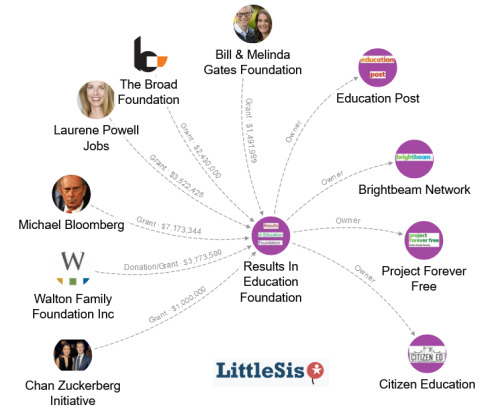
During final months of 2019, the Education Post was reorganized. In 2014, four billionaires spent $5.5 million to establish a new digital media channel in response to the massive and effective push back against their favored education reforms. Actually, it was more than four billionaires. One of those funders was the Walton Family Foundation made up of multiple billionaires. The channel was called Education Post but its official non-profit name was the Results in Education Foundation (RIEF) whose existence seemed to be purposely obscured. Peter Cunningham was listed on tax forms as President of RIEF, but publicly Cunningham was only known as the founding Executive Director of Education Post.
During the first four years of operation, the top contributor to REIF has been Michael Bloomberg. Available tax records show that between 2014 and 2017 he granted it more than $7 million and when added to the sizeable donations by the Waltons, Eli Broad, Laurene Jobs Powell, Bill Gates, and Mark Zuckerberg the total is almost $20 million. Spending since December 31, 2017 is unknown because there is a lag time of almost two years for non-profit taxes to be filed and made public.
Last year, a new organization called Brightbeam was created. It claims to be an umbrella organization for the Education Post and other sites. Brightbeam is the new operating name for RIEF. Two other digital platforms, Citizen Education and Project Forever Free are controlled by Brightbeam and they share some of the same employees. The following LittleSis map shows the new structure of this digital media group dedicated to disrupting public education.
Education Post Reorganized
Billionaire Financed Digital Media Structure Supporting School Privatization
Professor Noliwe Rooks is an accomplished woman of color who is director of American studies at Cornell University and was for ten years the associate director of African American studies at Princeton University. In her recent book, Cutting Schools, she coined the term “segrenomics” – the business of profiting CONTINUE READING: Project Propaganda AKA Project Forever Free | tultican

With Schools Closed, Kids With Disabilities Are More Vulnerable Than Ever | 89.3 KPCC

With Schools Closed, Kids With Disabilities Are More Vulnerable Than Ever | 89.3 KPCC

With Schools Closed, Kids With Disabilities Are More Vulnerable Than Ever


With school closed, Marla Murasko begins her morning getting her 14-year-old son, Jacob, dressed and ready for the day. They have a daily check-in: How are you doing? How are you feeling? Next, they consult the colorful, hourly schedule she has pinned on the fridge.
Jacob, who has Down syndrome, loves routine. So this daily routine is important. Schools in Hopkinton, Mass., are closed until April 6th, so Jacob's morning academic lesson — which according to the schedule starts at 9 a.m. — has been temporarily moved to the basement.
But there's been one big hiccup to all this: What, exactly, to learn during these at-home sessions? Some of Jacob's teachers have sent packets home — one, for a science class, includes a video and a worksheet on wolves — but teachers haven't included any of the modifications, or "accommodations" he normally gets that are designed to adapt the lessons to his learning style. Normally, Jacob is in a general education classroom, with special help. In some subjects, like reading and math, he works with different teachers and sometimes does different lessons.
"It has been very frustrating for us," says Murasko, "he can't look at a five-page worksheet and learn. He needs it very simplified in order for him to learn it. If there's no accommodations or modifications for him, he really can't attend to that lesson plan unless I modify it for him." So Murasko, who insists she is not and has never been a teacher, has had to get creative. She found some worksheets online that CONTINUE READING: With Schools Closed, Kids With Disabilities Are More Vulnerable Than Ever | 89.3 KPCC

Where’s the Silver Lining for Education? | My Island View

Where’s the Silver Lining for Education? | My Island View

Where’s the Silver Lining for Education?


With the cloud of the Corona Virus hanging over us and growing by the hour, it is difficult to see any silver lining. Health and safety are our greatest concerns. The stakes are high and the consequences may be fatal to too many. Anything I discuss here should not in any way diminish the seriousness of our condition. The consequences of our nationwide quarantine however, may be having a profound positive effect on our education system. From an education perspective, there may be a silver lining to one of the darkest clouds to ever cover this country.
In the past, many discussions by several education leaders have sometimes suggested the idea of education reform needing to blow up the current education system in order to affect any real change. In March of 2020 in response to a life-threatening pandemic, our education system, as we have known it for centuries, was blown up. Schools across the nation closed their doors, but required their teachers to try to carry on educating their students using online technology. Overnight, discussions, which were in many cases theoretical about online teaching and learning, became a reality. It was a “ready or not, here we come” event.
Educators, who were trained and programmed to teach face-to-face with students in classrooms with a support staff within a larger school building, found CONTINUE READING: Where’s the Silver Lining for Education? | My Island View

CATCH UP WITH NEWBLACKMAN (IN EXILE)

NewBlackMan (in Exile)


CATCH UP WITH NEWBLACKMAN (IN EXILE)


Black America: The Power in Telling Your Story with Morgan Jerkins

'The lives and stories of women are told through their strength, resilience, beauty, character and so much more. Guest host, Magalie Laguerre-Wilkinson talks with Morgan Jerkins , Author of New York Times bestseller This Will Be My Undoing and Senior Editor of Zora ; a medium Blackpublication for women of color on the power of storytelling. Morgan Jerkins shares her stories as a writer, the Zora
AfroTech — How to Scale Access & Outcomes in Media: Erica Alexander & Tracy Oliver

' Tori Sepand , Program Manager for Inclusive Customer Experience Team with Amazon sits down with Living Single actress, Erica Alexander and writer and showrunner, Tracy Oliver to discuss how can we can scale to create the greatest impact and how that can align our collective power to create opportunity for Black professionals in the entertainment industry.' -- Blavity


Ready for Every Adventure
Award-winning electric bikes stacked with power, range, and comfort.
FRONTLINE: Amazon Empire — The Rise and Reign of Jeff Bezos

' An inside look at how Amazon CEO Jeff Bezos built one of the largest and most influential economic forces in the world — and the cost of Amazon’s convenience.' -- FRONTLINE PBS
Intersectionality Matters with Kimberlé Crenshaw: When They See Her — The Story of Michelle Cusseaux

'December 14th, 2019 marked the fifth anniversary of the Say Her Name campaign, a movement founded to raise awareness of the names and stories of Black women, girls and femmes killed by police, and to provide support to the families affected. The campaign has produced a groundbreaking report expanding the conversation on police violence so that it foregrounds the experiences of Black women and gi
Ebony G. Patterson . . . while the dew is still on the roses . . .

' is organized by Pérez Art Museum Miami . The exhibition is curated by Tobias Ostrander . At the Nasher Museum, this exhibition is supported by The Nancy A. Nasher and David J. Haemisegger Family Fund for Exhibitions; Fox Family Foundation; Katie Thorpe Kerr and Terrance I. R. Kerr; Lisa Lowenthal Pruzan and Jonathan Pruzan; Kelly Braddy Van Winkle and Lance Van Winkle; and Parker & Otis.'
Modern Masculinity: Six Packs, Success and Solitude — Men in the Media

'In this episode of Modern Masculinity , Guardian journalist Iman Amrani looks at how images of men in advertising and the media might be negatively impacting on how they see themselves. While campaigns targeted at women have changed hugely in the past 20 years with campaigns such as Dove's Campaign for Real Beauty changing the images of beauty for women, men's adverts haven't had the same transf

MAR 22

Almeta Ingram-Miller on The Ingramettes And The Power Of Gospel During Crisis

'NPR's Lulu Garcia-Navarro talks with Almeta Ingram-Miller about reforming her late mother's gospel group , the new album Take a Look in the Book and how gospel can provide comfort in times of crisis.' -- Weekend Edition Sunday
'I Always, Always Fight': Octavia Spencer On Demanding More From Hollywood

' Octavia Spencer plays businesswoman Madam C.J. Walker in a new Netflix series Self Made . Walker was born on a plantation in 1867 and built an empire selling hair and makeup products designed for black women.' -- Fresh Air


Electoral College 'Not Carved In Stone:' Author Advocates Rethinking How We Vote

'Jesse Wegman , author of Let the People Pick the President: The Case for Abolishing the Electoral College , says the Electoral College's winner-take-all rule is not mandated by the Constitution: "There's nothing keeping us from 
NewBlackMan (in Exile)