Latest News and Comment from Education

Thursday, February 27, 2020

Bloomberg’s Autocracy In Flower: What His Political Spending Tells Us About His Candidacy – Los Angeles Education Examiner

Bloomberg’s Autocracy In Flower: What His Political Spending Tells Us About His Candidacy – Los Angeles Education Examiner

Bloomberg’s Autocracy In Flower: What His Political Spending Tells Us About His Candidacy


Donations to IECs are not capped and their funds are not, by law, under control of the candidate themselves. Consequently the enormous heaps of resources controlled by IECs fund the negative, nasty, dirty campaigning which has become standard operating procedure in LAUSD board races in this era of Public School Choice and school privatization.
Because funds are not controlled by the candidate, the disconnect provides the candidate plausible deniability regarding communications up to and including slanderous, unethical and misleading broadsides. Spending in such races tends to be very lopsided and indeed in Board District 3 and BD5 IEC spending favors charter-supported candidates 3x-6x : 1
Bloomberg’s donations do follow a clear pattern in the state of California consistent with the bread crumb donation to PLAS’ Franklin.
Another major recipient of Bloomberg’s largesse associated with PLAS is Marshall Tuck who twice lost the race for the state’s superintendency. Villaraigosa, the instigator of PLAS as mentioned above, was prodigiously propped up by more than $3.5m. As were other “strong-mayor” or executive ideologues like Sacramento’s Kevin Johnson, the former husband of Michelle Rhee, poster child for school turnaround orthodoxy.
For over two decades Bloomberg has funded leaders and education initiatives that support his brand of high technological intervention.
School privatization leaders and ideology (PLAS, CCSA), charter-sympathetic school board candidates in LA (current school board members Kelly Gonez and Nick Melvoin) and particularly in Oakland (Martinez, Neighbors, Hodge); and candidates admiring of “strong” (plutocratic/non-CONTINUE READING: Bloomberg’s Autocracy In Flower: What His Political Spending Tells Us About His Candidacy – Los Angeles Education Examiner

Big Education Ape: New York Mayor Michael Bloomberg donates another $350,000 to LAUSD race - LA Daily News -

Human Capital Futures: Racial Capitalism on Blockchain – A Presentation Given at the Unitarian Society of Germantown – Wrench in the Gears

Human Capital Futures: Racial Capitalism on Blockchain – A Presentation Given at the Unitarian Society of Germantown – Wrench in the Gears

Human Capital Futures: Racial Capitalism on Blockchain – A Presentation Given at the Unitarian Society of Germantown


I was grateful to be invited to participate in a day-long conversation about race and technology last week at the Unitarian Society of Germantown in Philadelphia. The morning’s discussion was centered on Clyde Ford’s wonderful memoir Think Black, which touches on family, corporate culture, race, and social engineering. Ford’s father was the first Black software engineer at IBM, and Clyde followed him into the business. You can watch a presentation he gave on the book for C-SPAN here.
Think Black
My role later that day was to paint a picture of next-gen tools of enslavement, the ones finance and technology interests have been refining for quite some time. As my host noted, my talk was meant to help folks recognize the digital slave ship when it comes on shore, because it might not look dangerous at first glance.
Faith-based communities will play a significant role in privatized social-service delivery. The plan is hook them into performance based contracting that requires them to data-mine the people they serve. I am trying to get out in front of this and tell people, especially white liberals, that we all have an obligation to intervene in the structures of racial capitalism. When foundations and politicians knock on the door with “pay for success” plans, people of faith must tell them in no uncertain terms that justice will never be served putting people on Blockchain.

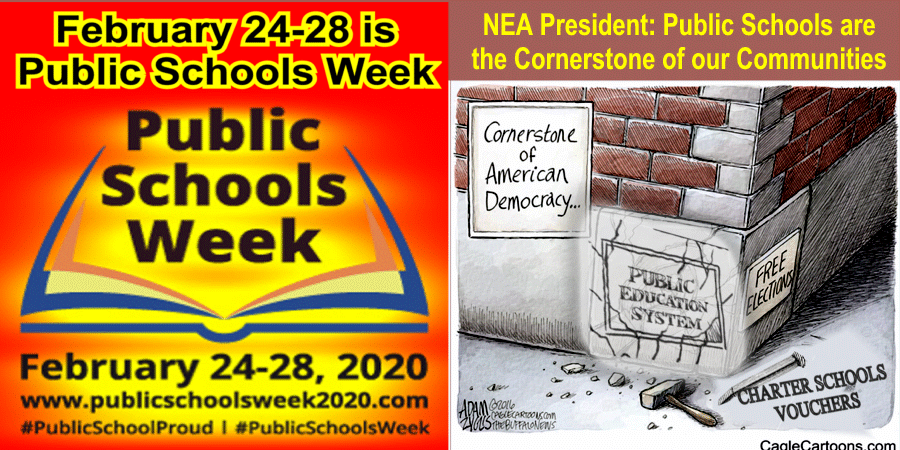
NEA President: Public Schools are the Cornerstone of our Communities

NEA President: Public Schools are the Cornerstone of our Communities

NEA President: Public Schools are the Cornerstone of our Communities


On Wednesday, the Learning First Alliance brought together a panel of educators and parents to discuss the pursuit of excellence in America’s public schools and how lawmakers and communities can support public education. The panel, “Faces of Success,” was moderated by Lily Eskelsen García, president of the National Education Association. The event was part of Public Schools Week 2020, Feb. 24-28, 2020.
“America’s public schools educate the vast majority of our students in the United States, regardless of ability, race, wealth, language, religion, zip code or country of origin,” said Eskelsen García. “Public schools are the cornerstone of our communities. We’re asking our federal lawmakers, state officials and community leaders to recognize the important roles that public schools play in securing our students’ and our nation’s future and asking them to give public schools their full support.”
Eskelsen García began by asking the panelists to identify some of the best ways we can support students and educators in their schools. Here’s how they responded. (Answers edited for brevity)
ElizaBeth Branhampresident of National School Boards Association, said we need to do a better job of telling our story, like during Public Schools Week, so we can advocate for the resources we need. We need to be working together for full funding of IDEA, for example, and finding ways to address the teacher shortage. “It’s CONTINUE READING: NEA President: Public Schools are the Cornerstone of our Communities


NYC Public School Parents: City Council Hearings on Friday, Feb. 28 to feature testimony from elected and education leaders on need to lower class size in NYC public schools

NYC Public School Parents: City Council Hearings on Friday, Feb. 28 to feature testimony from elected and education leaders on need to lower class size in NYC public schools

City Council Hearings on Friday, Feb. 28 to feature testimony from elected and education leaders on need to lower class size in NYC public schools


Media Advisory


FOR IMMEDIATE RELEASE
February 27, 2020

CONTACT:  Leonie Haimson, leoniehaimson@gmail.com; 917-435-9329 

City Council Hearings on Friday, Feb. 28 to feature testimony from elected and education leaders on need to lower class size in NYC public schools
NEW YORK, NY- On Friday, February 28 at 10 AM the NYC Council Education Committee will hold oversight hearings on the class sizes in NYC public schools, which are 10-30% larger on average than in the rest of the state.  This is despite rigorous research showing class size is a key factor in providing equity and a quality education for all students, but particularly disadvantaged children and students of color who make up the majority of students attending NYC public schools.
Among those providing testimony will be representatives from the NYC Department of Education, Board of Regents member Kathleen Cashin, State Senator Robert Jackson, Professors of Education from NYU and Brooklyn College, retired teachers, program providers to NYC schools, high school students, advocates and parent leaders.  A statement will also be read on behalf of education historian and advocate Diane Ravitch.
What: City Council Education Committee oversight hearings on class size  
Where:  Committee room, City Hall
When: Friday, February 28, 2020 at 10 AM

On Private Schools and Discrimination: Response to Hechinger Report Editorial Note – School Finance 101

On Private Schools and Discrimination: Response to Hechinger Report Editorial Note – School Finance 101

On Private Schools and Discrimination: Response to Hechinger Report Editorial Note

Preston C. Green III
I am writing this post to alert my fellow professors about a situation I recently encountered after publishing a piece with the Hechinger Institute. This organization approached Bruce Baker and me to write an op-ed explaining the possible consequences of the Espinoza v. Montana State Department of Revenue case. In this case, the Supreme Court is considering whether states can prohibit parochial schools from participating in a tax-credit scholarship program. It is generally expected that the Court will hold that states cannot act in this manner.
In this op-ed, we explained that states might respond to this potential decision by placing curricular restrictions on participating schools or even refusing to fund private education altogether. We even posited that states might respond to the Court’s expected decision by dramatically reducing their investment in charter schools.
We did not get much pushback for these points in the op-ed. However, Corey DeAngelis, adjunct scholar of the Cato Institute’s Center for Educational Freedom and the Director of School Choice at the Reason Foundation, claimed on Twitter that we were wrong to suggest that parochial school participants in school voucher programs might even consider discrimination on the basis of race. He supported this assertion by citing a Supreme Court case, Runyon v. McCrary. DeAngelis posted a screenshot of the purported holding, which he got from Wikipedia. According to this summation, Runyon held that “[f]ederal law prohibits private schools from discriminating on the basis of race.” On the basis of this “evidence,” DeAngelis demanded that Hechinger correct this alleged error.
I responded on Twitter by posting a screenshot of the pertinent part of the actual case, which included the following statement (italics added):
It is worth noting at the outset some of the questions that these cases do not present. They do CONTINUE READING: On Private Schools and Discrimination: Response to Hechinger Report Editorial Note – School Finance 101


Standards in K-12 Education: A Reader – radical eyes for equity

Standards in K-12 Education: A Reader – radical eyes for equity

Standards in K-12 Education: A Reader


Recently, Gerald Coles confronted the newest round of the Reading War that once again centers phonics instruction. One of Coles’s points is how keeping the education reform gaze on an instructional practice (phonics) allows reform to ignore the more substantial and causal elements surrounding teaching and learning—socio-economic, racial, and gender inequities.
The now four-decades long venture into accountability grounded in standards and high-stakes testing has revealed one paradoxical and often ignored fact: The problems with teaching and learning have almost nothing to do with the presence or quality of high-stakes standards.
Currently, we are seeing a wave of acknowledgements that Common Core now has fallen into that pattern of failure.
The research base on standards has been consistent in showing that the accountability process fails; see below:

The Coronavirus Could Be A Big Moneymaker for EdTech Companies | gadflyonthewallblog

The Coronavirus Could Be A Big Moneymaker for EdTech Companies | gadflyonthewallblog

The Coronavirus Could Be A Big Moneymaker for EdTech Companies


There is a special place in Hell for people who cash in on tragedy.
But that place is reserved for the super rich – and that’s all that matters in Donald Trump’s America.
Federal officials are urging schools to prepare for possible disruptions due to the coronavirus – a disease that originated in China last month and has affected more than 77,000 people worldwide (of which more than 2,600 have died).
Only 14 people have been infected in the U.S., and the Center for Disease Control (CDC) writes on its Website that the “immediate health risk from COVID-19 is considered low” for the average American – especially those who have not traveled recently to Wuhan, the surrounding Hubei Province or elsewhere in mainland China.
However, this is certainly scary news for anyone – especially parents, teachers and students.
In fact, federal officials singled out schools at a press conference on Tuesday about possible responses to the disease if it gets worse on these shores.
“You should ask your children’s schools about their plans for school dismissals or school closures. Ask about plans for teleschool.” CONTINUE READING: The Coronavirus Could Be A Big Moneymaker for EdTech Companies | gadflyonthewallblog

Whatever Happened to Behavioral Objectives? (Second Time Around) | Larry Cuban on School Reform and Classroom Practice

Whatever Happened to Behavioral Objectives? (Second Time Around) | Larry Cuban on School Reform and Classroom Practice

Whatever Happened to Behavioral Objectives? (Second Time Around)


With much interest on the part of school reformers, district administrators, and boards of education in “competency-based learning” or “outcome-based education” (also Common Core curriculum standards), wannabe reformers and school people should  consider  that these “innovations” depend heavily upon the introduction of behavioral objects a century ago.
The links between the past and present are ever-present, especially when it comes to behavioral objectives. I published this post nearly three years ago and in that time, both “competency-based learning” and Common Core standards–using behavioral objectives–have emerged as popular reforms of schooling both in urban and suburban district schools including charters.
At the end of this post, I include comments from Laura Chapman, a veteran teacher, on the original post.
Whateverhappened to behavioral objectives? Not much. They are still around but often go by an alias.
Introduced in the early 20th century, behavioral objectives are like  wallpaper in a favorite room that is stripped and then re-papered with wallpaper of a different hue but closely resembling the discarded debris. In short, the phrase has different names today (e.g., performance objectives,  learner outcomes, competencies-based outcomes) but remains common across the educational domain as well as in business, medicine, and other professional work. They are now a permanent fixture of organizations but not called “behavioral objectives.”
Where Did the Idea Originate?
The efficiency-driven wing of early 20th century progressives, inspired by management innovator Frederick Taylor, educational psychologist Edward CONTINUE READING:  Whatever Happened to Behavioral Objectives? (Second Time Around) | Larry Cuban on School Reform and Classroom Practice

NYC Public School Parents: Bloomberg's education record; important for voters to know!

NYC Public School Parents: Bloomberg's education record; important for voters to know!

Bloomberg's education record; important for voters to know!


The Indypendent just published a piece I wrote, called Michael Bloomberg's Disastrous Public Education Legacy. For those of you who live outside NYC or don't send your kids to public schools, you may be unaware of how destructive and arrogant his policies really were.

If you are interested in learning more, you can check out this article on Bloomberg that Diane Ravitch and I co-authored in The Nation in 2013 when left office.  In 2010,  I  helped edit a whole book about the Bloomberg/Klein regime which you can find on Amazon or Lulu Press here.
Meanwhile, please watch this short video below by Darren Marelli, most of it shot at a press conference where community leaders and elected officials denounced Bloomberg's school closings in 2012.


NYC Public School Parents: Bloomberg's education record; important for voters to know!


Editorial : Yes on Prop. 13 – Los Angeles Education Examiner

Editorial : Yes on Prop. 13 – Los Angeles Education Examiner

Editorial : Yes on Prop. 13


Last week, we wrote about some confusion about what is, and isn’t, on the ballot in the ongoing spring primary ballot that closes next Tuesday.*** But let’s be clear: if you care about public education, you should vote yes on State Measure 13 or Prop 13.
As we noted last week, Prop 13 is a statewide bond measure that will raise $15 bllion to use for immediate costs, to fix crumbling schools, upgrade emergency response equipment and basically make the structures our students learn in more modern and safe.
It has nothing to do with the 1978 ballot proposition that capped property tax rates in California. It has nothing to do with the Schools and Communities First ballot proposition about tax loopholes that will be on the ballot this fall.
Most major newspapers, including the Los Angeles Times, have backed Measure 13 noting that our school campuses aren’t exactly in the best shape. However, the usual coalition of anti-tax groups and conservative newspapers are making the argument that Californians already pay too much for education and that the measure has “sneaky” language that changes the formula for how schools receive state funding and how new CONTINUE READING: Editorial : Yes on Prop. 13 – Los Angeles Education Examiner


Wednesday, February 26, 2020

Carl J. Petersen: LAUSD School Board Candidate Silke Bradford: An ‘F’ on Charter School Oversight (VOTE FOR PARENT PATRICIA CASTELLANOS) #UTLA #LAUSD

LAUSD School Board Candidate Silke Bradford: An ‘F’ on Charter School Oversight

LAUSD School Board Candidate Silke Bradford: An ‘F’ on Charter School Oversight


“Sexual abuse allegations are not something that can shut down a charter…under the law.”
- LAUSD Board District 7 candidate Silke Bradford
The North Valley Military Institute (NVMI) is one of the rare cases where a charter school’s renewal was rejected by the Los Angeles Unified School District’s board. The school then appealed this decision to the Los Angeles County Office of Education. The county staff also recommended that the renewal be denied, but they were overruled by the unelected Board of Education. As a result, they continue to operate on the campus of LAUSD’s Sun Valley High School.
Since LACOE overturned the rejection of the charter renewal the following have been revealed:
  1. NVMI was illegally charging students to attend summer school. If parents could not afford the fees, the school would allow them or their students to work off the debt. In doing so, the school violated minimum wage and other labor laws.
  2. While considering the appeal, the LACOE did not have a copy of the current, verified financial audit. This document is required under the law.
  3. During the time that LACOE was considering the appeal, a lawsuit was pending against the school and the LAUSD alleging that an administrator who lived with NVMI’s Executive Director had sexually abused students.
As LAUSD School Board Member Scott Schmerelson notes, all of these should have disqualified NVMI from being renewed. The fact that it was CONTINUE READING: LAUSD School Board Candidate Silke Bradford: An ‘F’ on Charter School Oversight


Patricia Castellanos for School Board 
@Patricia4LAUSD

Career And Technical Education Deserves A Resurgence. Let’s Not Mess It Up.

Career And Technical Education Deserves A Resurgence. Let’s Not Mess It Up.

Career And Technical Education Deserves A Resurgence. Let’s Not Mess It Up.

Amidst all his slashing of the education budget, Donald Trump has proposed an enormous spending increase for one area—career and technical education.
The Trump budget includes an increase of $900 million in spending on CTE. Of that, $680 million would be directed through the Carl D. Perkins program, the main conduit for moving federal money into high school and post-high school CTE programs, the kinds of programs that produce workers to fill the skilled labor jobs that keep a country functioning. The program is long overdue for a boost; the last twenty years of education reform have emphasized college preparedness over blue-collar work. This may be the rare Trumpian budget item that survives Congress.
CTE has been allowed to languish in some school systems, but the district in which I taught is part of a consortium that has run a seven-district vocational-technical school (the old-fashioned name for CTE) for decades. It has been a vibrant and valuable part of the education system, an important choice within the system that has served many of students well. I taught those students for most of my career; I cannot overstate the value of a good CTE program.

But as with all educational ideas, it is possible to do CTE badly. As folks rush to grab up new CTE money, here are some of the basic CONTINUE READING: Career And Technical Education Deserves A Resurgence. Let’s Not Mess It Up.

Standardized testing problems widespread in these New Orleans-area schools, report finds | Education | nola.com

Standardized testing problems widespread in these New Orleans-area schools, report finds | Education | nola.com

Standardized testing problems widespread in these New Orleans-area schools, report finds


Public schools in Orleans and Jefferson parishes saw widespread irregularities with standardized testing last year, and many schools were forced to void the results of high-stakes exams for reasons ranging from administrative errors to cheating.
An annual Louisiana Department of Education report found that in the 2018-19 school year, 134 tests were voided at 38 of NOLA Public Schools' 78 charter schools, or nearly half of the charters authorized by the district.
In Jefferson Parish, 218 tests were voided at 27 of the district's 84 schools, or nearly a third of all elementary and high schools.
Statewide, 80% of school systems, both small and large, had at least one test voided. In total, 1,497 exams at 299 schools were voided, according to the report. 
The numbers don't surprise David Berliner, a professor of educational leadership at Mary Lou Fulton Teachers College of Arizona State University.
Berliner said testing problems are likely to persist as long as states put such great emphasis on standardized test scores. In Louisiana, as elsewhere, the tests dictate a large part of the state's annual performance scores and corresponding letter grades for schools.
In New Orleans, charter schools can be shut down if enough students fail the standardized tests and the institution gets a failing grade.
"If you’re going to live by the sword, you're going to die by the CONTINUE READING: Standardized testing problems widespread in these New Orleans-area schools, report finds | Education | nola.com

Charter school politics still in play in LA Unified school board elections | EdSource

Charter school politics still in play in LA Unified school board elections | EdSource

Charter school politics still in play in LA Unified school board elections


Pivotal races in Districts 3 and 7 likely to shape how board deals with charter schools.


The majority of Los Angeles Unified school board seats are up for grabs next week, a pivotal election that will shape how the state’s largest school district approaches several key challenges. 
The next school board will have to grapple with budget deficits, enrollment declines and achievement gaps for black, Latino, low-income and other underserved students. However, the biggest issue framing the March 3 primary, with four of seven board seats on the ballot, remains charter schools and how to handle efforts to expand school choice. A new state law giving districts a bigger say on whether or not to approve new charter schools takes effect in July.
Candidates must earn more than 50 percent of the vote in the March 3 primary election to win a seat outright. If no candidate secures a majority of votes in any given race, that would trigger a runoff election in November featuring the top two vote-getters in that race. The next school board will be seated in December. 
While school board elections in California historically have been low-key contests, that is not the case in Los Angeles Unified, where in recent years the stakes in the battle CONTINUE READING: Charter school politics still in play in LA Unified school board elections | EdSource

Tell the House: No more funding for charter entrepreneurs. Fund Title I instead. - Network For Public Education

Tell the House: No more funding for charter entrepreneurs. Fund Title I instead. - Network For Public Education

Tell the House: No more funding for charter entrepreneurs. Fund Title I instead.


Tomorrow February 27, Betsy DeVos defends her budget before the House Appropriations sub-committee led by Rosa DeLauro. This year, DeVos took the funding for the Charter Schools Program out of her budget and put it in a block grant.
Our job is to make sure that the nearly half billion dollars to start up new charter schools is not restored. Nearly one billion dollars of waste on charter schools that never open, or open and close, is enough.
Call the following committee members now. The hearing begins tomorrow at 10:00 am.
Lucille Roybal-Allard–(202) 225-1766
Rosa DeLauro–(202) 225-3661
Barbara Lee–(202) 225-2661
Mark Pocan–(202) 225-2906
Katherine Clark–(202) 225-2836
Lois Frankel–(202) 225-9890
Cheri Bustos–(202) 225-5905
Bonnie Watson-Coleman–(202) 225-5801
Keep your message simple:
My name is (your name). I am calling Representative X to ask that the Charter Schools Program funding not be restored. The Charter Schools Program has wasted nearly a billion dollars that could have gone to our neediest students. The Charter Schools Program should not be funded. The federal government should leave the funding for new charter schools to the state.
If the phone is not answered, or you call after hours, leave a message.
Then send an email to your representative. Click here.


Public Education: a Love Story | Teacher in a strange land

Public Education: a Love Story | Teacher in a strange land

Public Education: a Love Story


This is a very personal story.
There are a thousand reasons to admire and support public education—beginning with the idea itself: a free, high-quality public good, offered to all children, a societal building block. There are community schools, with wraparound services and creative magnet schools to nurture special talents and interests. There are new pilot programs and old-faithful heritage programs and Friday night lights. There are special services for kids with a range of disabilities. No one can be turned away. It’s all good.
When the neighborhood is sinking rapidly, businesses leaving and families fleeing, there is good old Oak Avenue Elementary, its playground and parking lot fenced and gated—but still open. Public schools are often the safest places for children, where they can be warm, fed, and cared for, and read a story. Public education may be messed up and threatened these days, in the land of the free, but its noble genesis and its persistence make it one of our best ideas.
This, however, is MY story, the reason why I will defend public schools until my last breath.
My allegiance to public education came first from my dad, who—ironically—received nearly all of his formal education in a Christian school. Not a Catholic school (they’re two different things, where I come from)—a Betsy DeVos-type, all-white Christian school, in western Michigan.
This was a long time ago—in the 1920s and 1930s. My grandparents, who had five CONTINUE READING: Public Education: a Love Story | Teacher in a strange land