Latest News and Comment from Education

Wednesday, February 12, 2020

John Thompson: Diane Ravitch's Slaying Goliath Documents Decades of Disruption - Living in Dialogue

John Thompson: Diane Ravitch's Slaying Goliath Documents Decades of Disruption - Living in Dialogue
John Thompson: Diane Ravitch’s Slaying Goliath Documents Decades of Disruption


By John Thompson.
Part Two of two.
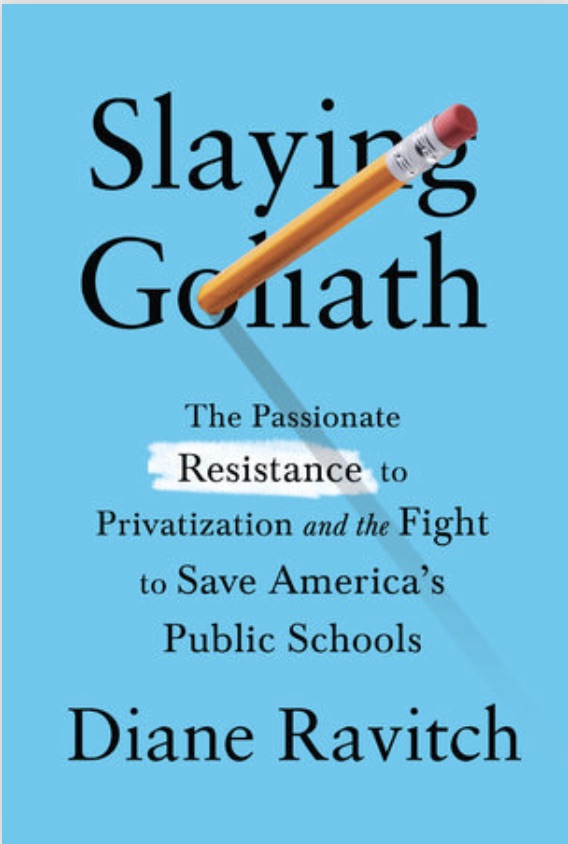
Diane Ravitch’s Slaying Goliath: The Passionate Resistance to Privatization and the Fight to Save America’s Public Schools is the history of the rise and fall of test-driven, competition-driven school reform. As in her two previous, ground-breaking books, Ravitch changes the terms of debate over public education. She previously reframed the battle over the “Billionaires Boys Club” which drove “corporate reform,” and “privatization.” Ravitch now characterizes data-driven, choice driven reformers as “Disrupters,” and the grassroots anti-“Goliath” movement as the “Resisters.” She also tells the stories of that social movement, contrasting it with the faux-movement funded by the Disrupters.
The debacles produced by the Disrupters resulted from high-stakes testing, combined with competition with charters (and vouchers), as well as the hurried, untested, manner that they imposed value-added teacher evaluations; mass closures of schools; Common Core standards; behaviorist methods i.e. “No Excuses;” digital technology known as “personalized learning;” and expensive public relations campaigns that demonized teachers.
This second post will focus on Ravitch’s analysis of the research which predicted the defeat of accountability-driven, charter-driven policies. Perhaps the most striking pattern documented in Slaying Goliath is how they failed in the way that scholars and practitioners anticipated.
Decades of Disruption-driven reform began with the false claim “that American education was failing and the only way to fix it was with standards, tests, competition, and accountability.” As Arne Duncan’s public relations officer and Walton-funded reformer Peter Cunningham said, “We measure what we treasure.”
Ravitch’s response was, “I was taken aback because I could not imagine how to measure what I treasure: my family, my friends, my pets, my colleagues, my work, the art and books I have collected.” And that foreshadows the victory of the Resistance over Goliath. Most educators, patrons, and students agree that children are more than a test score.
No Child Left Behind and the Race to the Top set impossible test score targets. They were based in large part on the weird idea that “no-excuses” behaviorist pedagogies could be quickly “scaled up,” providing poor children of color a ladder to economic equality. Drawing on the tradition of Edward Thorndike and B.F. Skinner, reformers “rigidly prescribed conditioning via punishments and rewards.” Previewing their fatal flaw, Ravitch observes, CONTINUE READING: John Thompson: Diane Ravitch's Slaying Goliath Documents Decades of Disruption - Living in Dialogue

Tuesday, February 11, 2020

Why charter school leaders are now furious at Trump and DeVos - The Washington Post

Why charter school leaders are now furious at Trump and DeVos - The Washington Post

Why charter school leaders are furious at Trump and Betsy DeVos


The charter school world was certain it had faithful supporters in President Trump and Education Secretary Betsy DeVos. After all, the pair made “school choice” their No. 1 education priority. DeVos has spent decades working to expand the charter sector. And Trump and DeVos repeatedly proposed boosting charter school funding, without giving a hint that federal funding of charters would be in danger under their watch.

Now, some leaders in the charter world, including the head of the nation’s largest charter school organization, are furious at them.
On Monday, the Trump administration released its 2021 budget proposal, and there was a gargantuan surprise in the Education Department’s plan for charter school funding.
It calls for the effective elimination of the federal Charter Schools Program (CSP), which has funded the expansion of charter schools since 1994 to the tune of $3.3 billion. Forty percent of operational charter schools — which are publicly funded but privately operated — were created with money from this program.
Instead of maintaining CSP as a discrete program, the administration is proposing it be lumped with nearly 30 other Education Department programs — including support for homeless students, civics education, magnet schools and school safety — into a single $19 billion block grant for states to use as they want on programs most important to them. The administration said it wants to give states more control of how they spend federal money while reducing the federal education footprint. States could use grant funding to expand charter schools, but other priorities would compete with it.
The administration’s main education priority doesn’t even show up in the Education Department’s proposed budget. Instead, it appears as a line item in the Treasury Department as a tax expenditure: $5 billion to give tax breaks for a program called the Education Freedom Scholarships, which would use CONTINUE READING: Why charter school leaders are now furious at Trump and DeVos - The Washington Post

Big Education Ape: Betsy DeVos Personally Saves Philly Student from a Government… Charter School(?) | deutsch29 - http://bigeducationape.blogspot.com/2020/02/betsy-devos-personally-saves-philly.html


FOON RHEE: Kids count, but can adults? • SN&R Extra

Editor's note: Kids count, but can adults? • SN&R Extra

Editor’s note: Kids count, but can adults?


Should taxpayers trust Sac City schools with more money?
Children deserve everything they need for a chance to succeed in school, including well-equipped classrooms, labs and libraries.
But what if the adults in charge are terrible at math—specifically, balancing the budget?
That’s the difficult choice facing voters March 3 on Measure H, Sacramento City Unified School District’s $750 million bond issue to upgrade classrooms, labs, libraries and technology; build career training centers; and to provide music and arts facilities.
To repay the bonds, the measure would cost property owners 5 cents per $100 of assessed value, which the district says will amount to $88 more a year for the typical homeowner and raise $35 million a year.
Measure H requires at least 55% of the vote to pass.
The district says there’s a dire need because most of its schools are more than 50 years old, don’t meet current safety and instructional standards and cost more to  CONTINUE READING: Editor's note: Kids count, but can adults? • SN&R Extra

JEFF BRYANT: How corporations are forcing their way into America’s public schools | Salon.com

How corporations are forcing their way into America’s public schools | Salon.com

How corporations are forcing their way into America’s public schools
A story unfolding in Virginia reveals how big corporations  want to control schools right down to the curriculum


In the expanding effort to privatize the nation's public education system, an ominous, less-understood strain of the movement is the corporate influence in Career and Technical Education (CTE) that is shaping the K-12 curriculum in local communities.
An apt case study of the growing corporate influence behind CTE is in Virginia, where many parents, teachers and local officials are worried that major corporations including AmazonFord and Cisco — rather than educators and local, democratic governance—are deciding what students learn in local schools.
CTE is a rebranding of what has been traditionally called vocational education or voc-ed, the practice of teaching career and workplace skills in an academic setting. While years ago, that may have included courses in woodworking, auto mechanics, or cosmetology, the new, improved version of CTE has greatly expanded course offerings to many more "high-demand" careers, especially in fields that require knowledge of science, technology, engineering, and math (STEM).
Education policy advocates across the political spectrum, from Education Secretary Betsy DeVos to former First Lady Michelle Obama, have praised expansions of CTE programs in schools. Fast-tracking federal funds for CTE programs in schools has become the new bipartisan darling of education policy. CTE lobbyists and advocates have successfully pressed for expanded funding of their programs at federal and state levels. And a 2019 study by the American Enterprise Institute, a right-wing advocacy group based in Washington, D.C., found that since 2004, mentions of CTE in U.S. media outlets "have grown over tenfold, and they have doubled since 2012."
According to a September 2019 analysis from Brookings, "more than 7 million secondary school students and nearly 4 million postsecondary students were enrolled in CTE programming." And a CONTINUE READING: How corporations are forcing their way into America’s public schools | Salon.com

Bill and Melinda Gates have spent billions to shape education policy. Now, they say, they’re ‘skeptical’ of ‘billionaires’ trying to do just that. - The Washington Post

Bill and Melinda Gates have spent billions to shape education policy. Now, they say, they’re ‘skeptical’ of ‘billionaires’ trying to do just that. - The Washington Post

Bill and Melinda Gates have spent billions to shape education policy. Now, they say, they’re ‘skeptical’ of ‘billionaires’ trying to do just that.


You won’t believe what Bill and Melinda Gates are saying makes them “skeptical.”
For years, they have spent a fortune trying to shape public education policy, successfully leveraging public funding to support their projects, but never having the kind of academic success they had hoped for. That never stopped them from continuing to fund pet projects.


Now, in the newly released 2020 annual letter of the Bill & Melinda Gates Foundation, Melinda Gates says that lack of success is no reason to “give up,” and then, she says this:
We certainly understand why many people are skeptical about the idea of billionaire philanthropists designing classroom innovations or setting education policy. Frankly, we are, too. Bill and I have always been clear that our role isn’t to generate ideas ourselves; it’s to support innovation driven by people who have spent their careers working in education: teachers, administrators, researchers, and community leaders.
She seems to be attempting to make a distinction between a billionaire personally “designing classroom innovations or setting education policy” and a billionaire pouring so much money into existing ideas and projects they like that it has the effect of shaping public policy. The couple’s investments in public projects are so huge that public money invariably follows, and, thus, their pet projects get implemented.
But such a distinction is lost on, say, a teacher who is evaluated through a badly flawed assessment system that exists because the Gateses funded it. That teacher doesn’t care whether Bill and Melinda Gates sat down and designed it themselves or, rather, chose to ignore the advice of assessment experts who had warned against it.
In their 2020 annual letter, the two take turns talking about their unprecedented philanthropy in health projects around the world and education reform in the United States. They are among the most generous philanthropists on the planet, spending more on global health than many countries do and more on U.S. education reform by far than any of the other wealthy people who are making K-12 a cause.
Yet over the years, while they have certainly funded worthwhile projects, questions have been raised about the power they have to dictate social policy because of their enormous investments, as well as whether the targets of some of their philanthropy are the most deserving of attention. Why should CONTINUE READING: Bill and Melinda Gates have spent billions to shape education policy. Now, they say, they’re ‘skeptical’ of ‘billionaires’ trying to do just that. - The Washington Post

It's Larry Ferlazzo's Websites of the Day... A VERY BUSY DAY | The latest news and resources in education since 2007

Larry Ferlazzo's Websites of the Day... | The latest news and resources in education since 2007

It's Larry Ferlazzo's Websites of the Day... A VERY BUSY DAY 
The latest news and resources in education since 2007


Atlantic Begins Photo Series On Each State

pinkzebra / Pixabay The Atlantic Magazine recently began publishing a series of photos about each U.S. state. Unfortunately, they also began a metered “Paywall,” so you can only access a few of their articles each month without buying a subscription. They certainly could come in handy when teaching Geography. So far, they’ve done slideshows on: Wyoming Georgia Indiana Hawaii South Carolina
New Simon’s Cat Video For Valentine’s Day – I’ll Be Showing It To My Class!

biancamentil / Pixabay This new Simon’s Cat video for Valentine’s Day joins several others at The Best Sites To Learn About Valentine’s Day . They’re great to show to ELLs, who then have to talk and write about what they saw. I’ll be showing them on Friday!
Classroom Instruction Resources Of The Week

Each week, I publish a post or two containing three or four particularly useful resources on classroom instruction, and you can see them all here. You might also be interested in THE BEST RESOURCES ON CLASSROOM INSTRUCTION IN 2019 – PART TWO. Here are this week’s picks: The Secret To Giving Great Feedback is a new and short TED Talk that offers a simple, but useful, formula to keep in mind when g
Great Video: “My Vote Don’t Count”

Tumisu / Pixabay Thanks to Jenn Binis , I learned about this great video from YelloPain. It would obviously have to be played at a slow-speed for ELLs, but all students could do an analysis of it:
Most Popular Posts Of The Week

I’m making a change in the content of the regular feature. In addition to sharing the top five posts that have received the most “hits” in the preceding seven days (though they may have originally been published on an earlier date), I will also include the top five posts that have actually appeared in the past week. Often, these are different posts. You might also be interested in IT’S THE THIRTE
A Look Back: “Idolizing Just One Person Undermines The Struggle”

I thought that new – and veteran – readers might find it interesting if I began sharing my best posts from over the years. You can see the entire collection here . I originally shared this series of posts in 2010. You might also be interested in The Best Sites To Teach About African-American History . In addition, you might also find these related posts useful: Researchers Find That Science Textb
My New BAM! Radio Show Is On Culturally Responsive Instruction

12 Ways to Make Culturally Responsive Instruction Work in Your Classroom is the topic of my latest ten-minute BAM! Radio show. I’m joined in the conversation by Lisa Stringfellow, Rocio P. del Castillo, Maurice McDavid, and Valentina Gonzalez, who have also all contributed written commentaries to my Education Week Teacher column. I’m adding this show to All My BAM Radio Shows – Linked With Descri
English Language Proficiency Assessments – What’s Happening Here In California & Elsewhere

geralt / Pixabay English Language Learners in the United States are required to regularly take an English Language Proficiency Assessment to….assess their progress towards learning English. Several years ago, the federal government funded two separate state consortia to develop new versions of these tests (you can read many articles about that saga in the second-half of The Best Resources For Lea


Animated Video: “How a Young Girl Survived a Brutal Journey To the U.S. to Find Her Mother”

Free-Photos / Pixabay This New Yorker animated video might provide a powerful language experience for English Language Learners to watch and then write about what they saw, as well as potentially connect to writing about 
Larry Ferlazzo's Websites of the Day... | The latest news and resources in education since 2007