Latest News and Comment from Education

Saturday, October 5, 2019

#AnotherDayAnotherCharterScandal HOW BAD DO YOU HAVE TO BE: Calls mount for investigation of Inspire charter schools - The San Diego Union-Tribune

Calls mount for investigation of Inspire charter schools - The San Diego Union-Tribune

Calls mount for investigation of Inspire charter schools

County superintendents and California’s charter school association have inquired about a state investigation


The California Charter Schools Association has expelled the Inspire home charter school network from its membership and is now calling for a third-party investigation, citing concerns about the network’s operational and governance practices.
At the same time, a group of county superintendents from across the state has asked a state agency to audit Inspire, though the scope of that audit request and the list of superintendents requesting it have not yet been finalized.
Meanwhile, a tiny California school district said it believes an Inspire school it oversees has been violating state law. The district, Winship-Robbins Elementary, said it may shut down the school if it fails to address several concerns that the district has about its finances, academics and organizational practices.
The California Charter Schools Association announced in a statement posted Tuesday on its website that the association and its Member Council have decided to revoke Inspire’s membership. They made that decision based on a review of Inspire that the association had launched in October after hearing concerns from other charter schools.
The association would not elaborate on the concerns raised.
It revoked Inspire’s membership even though Inspire officials cooperated with its review and made changes to address concerns. The association said it believes there are concerns beyond the scope of its own review process.
“Inspire’s team was transparent, cooperative, and willing to make necessary changes to their operational and governance practices,” the association wrote in a statement published Tuesday.
“However, CCSA and the Member Council believe additional examination is needed to strengthen Inspire’s policies and capacity, and ensure all practices meet high standards of excellence.”
In a letter sent to families Wednesday morning, Inspire Deputy Executive Director Kimmi Buzzard blamed the association for not telling Inspire in advance that it might revoke its membership or tell the public about the review of Inspire. Buzzard said Inspire agreed to cooperate with the association’s review under the assurance that the goal would be to assist Inspire, not punish them.
Buzzard also said there were some people on the Member Council who had participated in news stories that were critical about Inspire but who would not recuse themselves from the vote to revoke Inspire’s membership.
Still, Inspire has agreed to have a third-party review, as the association recommended.
“Inspire agreed that the schools could benefit from continued, expert, third party review of our operations and governance structure in light of the many new laws and court decisions altering the charter school landscape,” Buzzard said.
An investigation by The San Diego Union-Tribune in August found that Inspire has grown rapidly in recent years in numbers of schools and students while relying on heavy loan borrowing, consistently posting below-average academic performance and engaging in what several say are questionable organizational practices.
Inspire allots $2,600 or more of public school funds to each student annually to spend on a list of thousands of vendors who sell field trips, academic and extracurricular classes, curriculum and more, including items such as horseback riding lessons and ski passes.
Public scrutiny of Inspire grew after 11 people were criminally indicted in May in relation to another statewide charter network called A3. San Diego County prosecutors accused A3 executives of manipulating enrollment numbers and using charter schools to funnel more than $50 million into their own pockets.
A group of county superintendents and the charter school association have each been in talks with the Fiscal Crisis Management and Assistance Team, a state fiscal agency, about a potential investigation of Inspire, said Michael Fine, the team’s CEO.
The charter association has asked the state fiscal team about a review of Inspire that would result in a report with recommendations. Inspire itself would get to determine the scope of that review, Fine said.
The superintendents have put in a request for an audit, which would be based on a set of allegations and whether the state team believes there is evidence of fraud, misappropriation of public funds or other illegal fiscal practices, Fine said. The superintendents would get to determine the scope in that case.
If the superintendents’ request is finalized, the state team would prioritize their request for an audit over a request for a review by the charter association, Fine said.

Notice of concern

Some school districts have recently launched reviews of their own into the Inspire schools that they oversee, in some cases prompted by the Union-Tribune’s reporting and the A3 indictment.
The superintendent of the Winship-Robbins Elementary School District, Dawn Carl, wrote a “notice of concern” to Inspire dated Aug. 21 about an Inspire school that the district oversees called Feather River Charter School, which used to be called Inspire Charter School North.
Charter schools are public schools run independently of school districts and require a school board’s authorization and oversight to operate.
The Winship-Robbins Elementary School District consists of one school that enrolled 118 students last school year in northern California. It has authorized two Inspire schools: Feather River and Winship Community School.
Carl, who has been superintendent for a little more than a year, said she asked the district’s legal team to launch an in-depth review of Inspire North this summer because of the Union-Tribune’s reporting on Inspire and the A3 indictment.
Carl’s August letter outlined myriad concerns about Feather River, including:
  • About 79 percent of Inspire North students failed to meet state standards in math and about 60 percent failed to do so in English last year.
  • Inspire North changed its name to Feather River Charter this summer without telling Winship-Robbins.
  • The nonprofit corporation that runs Feather River is different than the one named in the school’s founding petition.
  • Feather River students are being served at a place called Inspire Learning Academy without Winship-Robbins’ authorization. The academy is located outside of Winship-Robbins’ county even though Feather River does not qualify for an out-of-county location under state law.
  • Feather River has at least two addresses listed for its location, including one that is the address for a different Inspire school, neither of which are authorized by Winship-Robbins.
  • The school reported that it spent more than $7.2 million, or almost a third of its revenue, on “services and other operating expenditures” last school year even though the school said it does not contract with any entities to provide instructional services, except for special education.
Carl told Inspire officials to immediately stop operating at the Inspire Learning Academy location and the two addresses listed for Inspire North’s school location. It was the Placer County Office of Education that had alerted Winship-Robbins about Inspire Learning Academy.
Carl also said in her letter that Feather River took several actions ⁠— such as changing its name, operating in multiple locations and switching which corporation operates the school ⁠— without notifying Winship-Robbins or requesting a material revision to its charter as required by state law.
Inspire admitted that it failed to file for material revisions and is in the process of addressing the concerns in Carl’s letter, Feather River Principal Jenell Sherman and Winship Community Principal Julie Haycock said in an emailed statement.
“We take responsibility for not filing the appropriate material revisions for the name and governance changes and are working closely with the district staff to rectify this oversight quickly and completely,” the principals said.
The principals said their schools do not operate any facilities anywhere and that Inspire Learning Academy is “completely unaffiliated from us, in spite of the name similarities.”
Winship-Robbins has now requested more than two dozen pieces of documentation or information from Feather River, including proof that all its employees and vendors have cleared criminal background checks; a plan to improve its academic achievement and student enrollment lists that track where students enrolled from and transferred to.
Winship-Robbins originally gave Inspire until Sept. 16 to produce the documentation and to make required changes. Inspire requested a deadline extension, so now it has until Oct. 15 to fulfill the district’s requests, Carl said.
The charter school association and Winship-Robbins are just two of a number of entities that have now raised concerns about Inspire.
The Ventura County Office of Education wrote a notice of violation about Inspire this summer because Inspire was operating unauthorized locations in the county in violation of state law. Inspire disputed that it was illegal but said it has stopped operating at the locations.
Inspire officials tried to open a new school in the Irvine Unified School District this summer but withdrew after the district raised scores of questions about the proposal.
Fresno County’s Westside Elementary School District, which oversees Inspire Charter School Central, said it has requested various documentation from Inspire for an in-depth review that is due to the district by Oct. 1.
Riverside County’s Beaumont Unified School District, which oversees the Inspire school Mission Vista Academy, requested information from the school after reading the Union-Tribune’s reporting, Superintendent Terrence Davis said. It realized that Mission Vista’s enrollment projections exceeded its actual enrollment, a discrepancy the school has since corrected in its financial reports, Davis said.
San Diego County’s Dehesa School District is conducting a special audit of all its charter schools, including two Inspire schools, to scan for potential conflicts of interest, gifting of public funds and more.

Inspire charter schools spread across California as critics warn of performance, financial concerns

Inspire charter schools spread across California as critics warn of performance, financial concerns - The San Diego Union-Tribune - https://www.sandiegouniontribune.com/news/education/story/2019-08-10/inspire-charter-schools-spread-across-california-as-critics-warn-of-performance-financial-concerns by @Kristen_Taketa on @sdut

Shawgi Tell: False and Diversionary Charter School Dichotomies | Dissident Voice

False and Diversionary Charter School Dichotomies | Dissident Voice

False and Diversionary Charter School Dichotomies

There is no shortage of articles, books, reports, blogs, and websites that continually detail the perpetually scandalous and troubled nature of charter schools. Not a day goes by without a report on some sort of infamy, fraud, mismanagement, corruption, or failure in the unaccountable charter school sector.
But even articles and reports that are critical of charter schools often lapse into confused logic and arguments, revealing that the thinking around charter schools remains muddled.
This endless confusion and incoherence repeatedly conceals and renders forgettable the profound significance of the core feature of all charter schools: their inherently privatized nature.
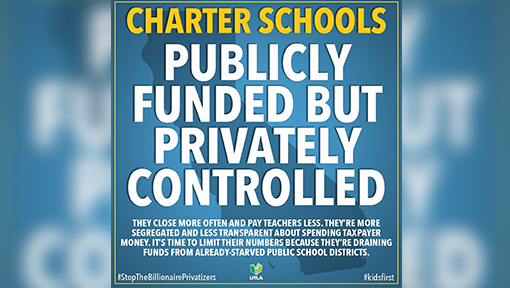
As many have shown, charter schools are not public schools. Among other things, charter schools are not governed by elected officials, cannot levy taxes, reject many students, and have been deemed to be private entities by more than a few courts—all while receiving enormous sums of public money. In addition, thousands of charter schools perform poorly and many close every year, leaving thousands of families feeling abandoned, violated, and angry.
To some extent this damaging incoherence and confusion about charter CONTINUE READING: False and Diversionary Charter School Dichotomies | Dissident Voice

Tennessee: Gov. Lee Packs State Charter Commission with Charter Zealots | Diane Ravitch's blog

Tennessee: Gov. Lee Packs State Charter Commission with Charter Zealots | Diane Ravitch's blog

Tennessee: Gov. Lee Packs State Charter Commission with Charter Zealots


Governor Bill Lee Hayes public schools, even though most children in Tennessee attend them.
He packed the new State Charter School Commission with people who love to hand public money to private corporations to operate schools that choose their students and operate without accountability.
Tennessee is opening the state treasury to out-of-state corporations, entrepreneurs, and grifters. Come get taxpayer dollars to open schools and drain money from the public schools!
Here are the members chosen by the Governor.
The commission consists of CEOs, politicians, charter school board members. 
  • Tom Griscom, of Hamilton County, a former director of White House communications under President Ronald Reagan, long-time aide to the late U.S. Sen. Howard Baker of Tennessee, and former executive editor and publisher of the Times Free Press in Chattanooga
  • David Hanson, of Davidson County, is managing partner of Hillgreen, a private investment firm, and serves on the board for CONTINUE READING: Tennessee: Gov. Lee Packs State Charter Commission with Charter Zealots | Diane Ravitch's blog

School Principals I Have Known | Larry Cuban on School Reform and Classroom Practice

School Principals I Have Known | Larry Cuban on School Reform and Classroom Practice

School Principals I Have Known

Although I have never served as a principal, I have been a student under three elementary and secondary school principals and worked for six high school principals as a teacher. As a district superintendent, I supervised and evaluated nearly 35 elementary and secondary school principals. Since the 1980s, as part of school-based research studies I have completed, I observed at least 20 different principals do this crucial (and often overlooked) job. So from below as a student, above as a superintendent, and next to as a researcher, I have seen principals up close and personal.
I have written in this blog about the core roles that principals must perform (see herehere, and here). In this post, I describe my experiences with one of those six principals I worked—I was going to write “under”–but decided that a better word for my experience with Oliver Deex is “with.” Those years with Deex helped shape me intellectually, grounded me in practical classroom experience, and gave me a perspective on school reform. How common my experience as a teacher was with this unusual man, I do not know.
First, some personal background.
I was the third son of Russian immigrants. I saw that my brothers who had to work during the Great Depression to provide family income and then serve the country in World War II lacked the chances that I had simply because I was born in the 1930s and they were born in the 1920s. Because sheer chance made me the youngest, I did not serve in World War II; because I had polio as a child, I could not serve in the Korean War. So I finished college in Pittsburgh and became a teacher in the mid-1950s, landing a job on Cleveland’s East side. I had been CONTINUE READING: School Principals I Have Known | Larry Cuban on School Reform and Classroom Practice

What Should Teachers Do About E-Cigarettes at School? - Teacher Habits

What Should Teachers Do About E-Cigarettes at School? - Teacher Habits

What Should Teachers Do About E-Cigarettes at School?


E-cigarette prospects have been around for a while, usually as a means for people to quit smoking. But over the past few years, they’ve become somewhat of a trend within youth culture. Teenagers and those who are barely legal have begun vaping tobacco ad nauseum. Some argue this is a good alternative to smoking, but many of these kids never smoked cigarettes in the first place. This, combined with the fact that there isn’t really much known about the long-term effects of vaping, makes it a cause for concern. 
Of course, kids engaging with tobacco is still illegal, and schools have had to stand up to the rise of e-cigarettes and vaping within their student bodies. The disciplinary actions differ; for instance, punishment for a student vaping tobacco may differ from a punishment for vaping THC. However, the majority of educators agree that there should be a way to curb e-cigarette use within their educational environments.
For legitimate action to be taken, educators need to understand where this vaping culture has come from. Doing so will help them discern ways to engage with it. Additionally, is there any research or science behind the effects vaping may have on someone’s brain or body? For  parents and educators, these are the necessary steps to take and questions to ask.

Vaping’s Rising Popularity Among Teens
Though vape culture has received a lot of public backlash in the media, it would seem that it’s more popular among teens now than ever. CONTINUE READING: What Should Teachers Do About E-Cigarettes at School? - Teacher Habits

Greater Test Scores Often Mean Less Authentic Learning | gadflyonthewallblog

Greater Test Scores Often Mean Less Authentic Learning | gadflyonthewallblog

Greater Test Scores Often Mean Less Authentic Learning


The main goal of schooling is no longer learning.
Raising them. Measuring growth. Determining what each score means in terms of future instruction, opportunities, class placement, special education services, funding incentives and punishments, and judging the effectiveness of individual teachers, administrators, buildings and districts.
We’ve become so obsessed with these scores – a set of discrete numbers – that we’ve lost sight of what they always were supposed to be about in the first place – learning.
In fact, properly understood, that’s the mission of the public school system – to promote the acquisition of knowledge and skills. Test scores are just supposed to be tools to help us quantify that learning in meaningful ways.
Somewhere along the line we’ve misconstrued the tool for the goal. And when you do that, it should come as no surprise that you achieve the goal less successfully.
There are two kinds of standardized assessment – aptitude and achievement tests. Both are supposed to measure scholarship and skill – though in different ways.
Aptitude tests are designed to predict how well a student will do in CONTINUE READING: Greater Test Scores Often Mean Less Authentic Learning | gadflyonthewallblog

NYC Educator: Oversized Music Classes

NYC Educator: Oversized Music Classes

Oversized Music Classes


Last week I went to a class size grievance hearing. There was good news and bad news. The good news is the new process seems to have much improved things. It appears involving the superintendents in the process is a good idea. They tell the principals, their subordinates, to fix the problems and a whole lot of them seem to be doing it. In our school, for example, the only remaining oversized classes were in music.

We had exactly 12 oversized classes. Six were in music performing groups like chorus and band. There is evidently some exception for those classes. I'm sure that bands and choruses can use over 34 members, and I know some music teachers who'd argue the same. I'm not expert on exactly how many voices or instruments you need, but they are, and if they say they need more, they do. The DOE has to rely on an exception, though, and I'd argue if they use it they're still in violation. (I'd further argue that the teachers ought to be compensated in some way for teaching such large groups, even if it's a good idea.)

A more difficult argument is that of the "required music" classes. Required music classes can go up to 50. Why? I don't know. I haven't been around long enough to understand how these rules came about. What genius thought that students, who likely didn't want to take a music class at all, would learn better how to appreciate the arts in classes of 50?

Early in my career, I got bounced to JFK High School as an English teacher. It turned out they didn't need an English teacher, so they made me a music teacher. I taught a few guitar classes, and I also taught a few sections of required music. I had a book about jazz history that I'd been reading, and I made it the textbook. I'll tell you, though, it's a bitch teaching 50 kids at a time. Grading is no picnic either.

How on earth can you successfully encourage an appreciation of music in groups of 50? If you think these classes are worthwhile in any way whatsoever, wouldn't you push back on that? Isn't it plainly cynical to load the kids in like sardines and expect any positive outcome whatsoever? A whole lot of people love music already, whether or not they understand it. There has to be a way to build on that appreciation, to deepen and broaden that appreciation. Anyone who tells you the way to do that is by placing them in classes CONTINUE READING: NYC Educator: Oversized Music Classes


Charging a terrified 10-year-old girl as a criminal is a very bad look for state attorney Dennis Ward | The Edvocate Blog

Charging a terrified 10-year-old girl as a criminal is a very bad look for state attorney Dennis Ward | The Edvocate Blog

Charging a terrified 10-year-old girl as a criminal is a very bad look for state attorney Dennis Ward


What the hell is going on? As a parent, I feel very comfortable using this exact wording to ask this question. In the aftermath of the horrific Marjory Stoneman Douglas shooting, we must ask ourselves just how far we will let fear push us. The MSD Safety Act means police and armed staff are in our schools and interacting with our children at unprecedented levels.
DENNIS WARD MONROE STATE ATTYRecent incidents in Monroe and Orange counties are a shocking reminder that increased police presence in our schools can result in escalating common childhood behaviors to criminal charges that, thanks to obsessive data collection, will become part of a child’s permanent record. This is the highest of stakes.
Protecting our kids isn’t just about active-shooter drills and looking out for bad guys. Real everyday protection means police must be trained and devoted to de-escalating situations in schools. Principals, teachers and staff must possess the professionalism and empathy to recognize that all this talk of being violently killed by unknown AR-15 toting assailants is extremely traumatizing for everyone, especially children.
It’s particularly disturbing that Dennis Ward, the State Attorney from Monroe CONTINUE READING: Charging a terrified 10-year-old girl as a criminal is a very bad look for state attorney Dennis Ward | The Edvocate Blog

Seattle Schools Community Forum: What Tracy and Her Pals Think of You and This Blog

Seattle Schools Community Forum: What Tracy and Her Pals Think of You and This Blog

What Tracy and Her Pals Think of You and This Blog


I say this so much but many people do NOT read for content; rather, they pick out bits that suit their personal narrative and think they understand a topic or what others are saying.

I told someone out of state recently about the blog. He said, "So, do you post once a week or so?" That's hilarious.  I normally post five times a week, sometimes twice a day.

Now, Tracy Castro-Gill's little blog is a combo of her professional thoughts (which I had initially said good things about but won't anymore) and deeply personal reflections that are hard to read because it feels like something only close friends should hear about (her upbringing, her body issues and her daughter).  But basically, she gets few comments and near-zero discussion. A blog is interaction (at least to me).

I note that at the Capitol Hill blog post about Director DeWolf, most people are appalled by Castro-Gill's speech and invective.  Almost like that's not how a CONTINUE READING: 
Seattle Schools Community Forum: What Tracy and Her Pals Think of You and This Blog


It’s Not a Flash Drive: Vaping News Teachers and Parents Can Use | deutsch29

It’s Not a Flash Drive: Vaping News Teachers and Parents Can Use | deutsch29

It’s Not a Flash Drive: Vaping News Teachers and Parents Can Use

I began my teaching career in 1991. When I think about my contemporary classroom experience and consider my professional world decades ago, I find myself often thinking, “Well, I didn’t see that coming.”
Case in point: Vaping.
Twenty-eight years ago, I never would have imagined that my classroom responsibilities would include actively watching for students to try to inhale concentrated nictotine vapor (laced with other chemicals) using a device at best the size of my index finger– and which easily resembles a flash drive.
This is Juul, the latest in electronic cigarettes. The device operates on a rechargeable battery; it heats up a pod of “juice” that turns into a vapor, ready for inhaling.
IMG_1579
“Juul Starter Kit”/ juul.com
Juul devices can recharge using a computer USB, and since the Juul already resembles a flash drive, it takes a careful eye to discern when a student who is working at a school computer station might also be using that opportunity to charge a Juul.
Vaping in class is as easy as bending over one’s bookbag to ostensibly search for a pencil, or seeming to wipe one’s face with one’s sleeve, or appearing to wipe one’s nose with a tissue.
Chemical inhaled, chemical exhaled. Snap of a finger. Blink of an eye.
What a win for the tobacco industry! Since there is no smoke, only a vapor, imagine how much more teens will use this device, stealthily, in plain sight, in a CONTINUE READING: It’s Not a Flash Drive: Vaping News Teachers and Parents Can Use | deutsch29

The 2020 California Teachers of the Year - Year 2019 (CA Dept of Education)

The 2020 California Teachers of the Year - Year 2019 (CA Dept of Education)

State Superintendent Tony Thurmond Announces 2020 California Teachers of the Year

SACRAMENTO—State Superintendent of Public Instruction Tony Thurmond today named five extraordinary educators as the 2020 California Teachers of the Year. Thurmond, who began his career as a social services worker, said he is pleased to honor five outstanding and talented teachers who have made a great impact in their schools and communities.
“These five incredible teachers receive this prestigious honor for their focus, drive, and determination to teach young people in California,” he said. “They are not only wonderful representatives for our state, but they also make profound differences in the lives of their students and their communities by employing innovative strategies to increase academic success and narrow the achievement gap among a broad range of students.”
Presented by California Casualty and supported by the California Teachers of the Year Foundation, the California Teachers of the Year Program began in 1972 to honor outstanding teachers and encourage new teachers to enter the profession.
The 2020 California Teachers of the Year are:
Sean Bui, who is a ninth through twelfth grade English language development and business law teacher at Cupertino High School in Cupertino, Fremont Union High School District, Santa Clara County. Thurmond also nominated Bui as California’s representative for the National Teacher of the Year competition. Bui will compete against other state nominees, and the 2020 National Teacher of the Year will be announced in the spring.
Brenda Barreras, who is a kindergarten teacher at Good Hope Elementary School in Perris, Perris Elementary School District, Riverside County.
Mandy Kelly, who is a sixth grade multiple-subject teacher at Trabuco Mesa Elementary School in Rancho Santa Margarita, Saddleback Valley Unified School District, Orange County.
Guy Myers, who is a ninth through twelfth grade drama and musical theatre teacher at John Burroughs High School in Burbank, Burbank Unified School District, Los Angeles County.
Katya Robinson, who is a kindergarten through third grade special education teacher at West Sonoma County Consortium School in Sebastopol, West Sonoma County High School District, Sonoma County.
Thurmond said these teachers will be great ambassadors for the profession. Thurmond recently launched a Teacher Shortage workgroup at the California Department of Education (CDE) and said, “It is important to motivate and inspire other educators, champion the positive contributions of the teaching profession, and highlight the rewards of being a teacher.”
“Great teachers are the core of a great educational system. Yes, teaching changes lives of individual students, but beyond that, teachers show us all that all children can achieve, no matter who they are,” he said.
Visit the Teach California website for more information.
County offices of education nominate California Teachers of the Year applicants through their county-level competitions. CDE selection committees review applications; conduct site visits to evaluate teachers' rapport with students, classroom environments, presentation skills, and teaching techniques; and interview the teachers. The State Superintendent then selects the five California Teachers of the Year and the National Teacher of the Year nominee.
The 2020 California Teachers of the Year and finalists will be honored by the CDE at a gala to be announced at a later date.
For more information on the award program, please visit the CDE's California Teachers of the Year web page.
# # # #
Tony Thurmond — State Superintendent of Public Instruction
Communications Division, Room 5602, 916-319-0818, Fax 916-319-0100
Last Reviewed: Friday, October 4, 2019


The 2020 California Teachers of the Year - Year 2019 (CA Dept of Education)

THIS WEEK Education Research Report

Education Research Report


THIS WEEK 
Education Research Report


Rewarding teamwork is key to improving primary children's spelling

Pupils do better in spelling tests if teachers reward them for team - rather than individual - performance, according to new findings published in the peer-reviewed journal Educational Psychology . The study, based on 1,000 primary students, highlights how academic achievements can be improved by incentives when used effectively. The researchers found that children of all abilities who competed i
An effective program reducing dating violence among students

A program developed to encourage healthy relationships and reduce dating violence was effective among early middle school students, according to results of a study published in the American Journal of Public Health by researchers at The University of Texas Health Science Center at Houston (UTHealth). The intervention program, named Me & You: Building Healthy Relationships, was one of the first cr
How schools influence e-cigarette use, outlines prevention strategies

When e-cigarettes hit the U.S. market in 2007, they were promoted to adult smokers as a safer, healthier alternative to traditional, combustible cigarettes. The unintended consequence of vaping devices and e-cigarettes, however, is a new generation of vapers -- teenagers -- becoming addicted to nicotine. "In just one year, from 2017 to 2018, the number of high school students using e-cigarettes n
Study: Better sleep habits lead to better college grades

Two MIT professors have found a strong relationship between students' grades and how much sleep they're getting. What time students go to bed and the consistency of their sleep habits also make a big difference. And no, getting a good night's sleep just before a big test is not good enough -- it takes several nights in a row of good sleep to make a difference. Those are among the conclusions from

OCT 02

Timing Parenting Tips Boosts their Effectiveness for Children

The challenges of the workweek make it difficult for parents to make effective use of tips sent by text on weekdays. "Point out the first letter in your child's name in magazines, on signs and at the store. Have your child try. Make it a game. Who can find the most?" That tip is an example of parenting advice offered by an educational program that sends text messages to parents of preschoolers. T
More Segregation in Early Childhood than in K–12 Education

Complete report Children’s first learning experiences set the tone for the rest of their lives, in school and beyond. That’s why early childhood education (ECE)—which enrolls nearly half of infants and toddlers and three-quarters of preschoolers—has become a focus for public investment designed to promote educational equity and give children a strong start. But little attention has been paid to t
Teacher Preparation Experiences and Early Teaching Effectiveness

A new report finds both differences in how teachers prepare for certification in the field and that certain experiences are related to improving student test scores in the classroom. The findings provide a detailed look into current teacher preparation practices and identify potential avenues for improving them. The Institute of Education Sciences released a report today (September 30th) entitled
Support for Using Student Data to Inform Teachers’ Instruction

A new report finds an intensive approach to help teachers use data to adjust instruction did not improve students’ achievement, perhaps because the approach did not change teachers’ use of data or reported classroom practices. The Institute of Education Sciences released a report yesterday (September 30) entitled Evaluation of . This report from the National Center for Education Evaluation (NCEE
Demographic and Enrollment Characteristics, Financial Aid, and Price of Attendance of Low-Income Undergraduates in 2015–16

In 2015–16, the average out-of-pocket net price faced by full-time, very low-income independent students ranged from $10,100 at public less-than-4-year institutions to $24,800 at private nonprofit 4-year institutions. To put these prices in context, in 2015, a very low-income family of two living in the 48 contiguous states or DC had an annual income below $7,965, and a very low-income family of

SEP 27

Do Kids Fall Behind in Math Because There Isn’t Enough Grade-Level Material, or Because There’s Too Much? It’s Both

Complete report New Classrooms Innovation Partners W alk into almost any classroom in America, and you’ll find at least some students who’ve fallen behind the academic standards for their grade — meaning they’re at risk of not learning everything they’ll need to be ready for college and the lives they want to lead. Helping these students get back on the path to grade-level proficiency is one of t
Automatic Enrollment Increases Contributions to Supplement Retirement Programs by K-12 and University Employees

This study examines the impact of the adoption of automatic enrollment provisions by schools and universities in the state of South Dakota for its supplemental retirement saving plan (SRP). In South Dakota, educational personnel are also covered by a defined benefit pension plan and by Social Security. Thus, career public employees in South Dakota can expect a life time annuity from these two pro
The School to Prison Pipeline: Long-Run Impacts of School Suspensions on Adult Crime

. Schools face important policy tradeoffs in monitoring and managing student behavior. Strict discipline policies may stigmatize suspended students and expose them to the criminal justice system at a young age. On the other hand, strict discipline acts as a deterrent and limits harmful spillovers of misbehavior onto other students. This paper estimates the net impact of school discipline on stude
Breaking Down Barriers: Understanding Hispanic High School Students’ Perceptions on the Transition to College

. Hispanic students make up roughly 18 percent of all college students and are one of the largest minority groups on U.S. campuses. However, Hispanic students tend to meet ACT College Readiness Benchmarks at lower rates, on average, than their non-Hispanic White counterparts. In addition, Hispanic students may face added barriers in navigating the landscape of the college application process, le
SEPTEMBER 2019 Using Chronic Absence Data to Improve Conditions for Learning

Reducing chronic absence goes hand in hand with cultivating positive conditions for learning. When schools provide engaging, supportive, welcoming and culturally responsive environments, families are inclined to help their children get to school, and students are motivated to attend, even when there are hurdles to getting there. Likewise, when students attend class consistently, positive conditio
Mathematics Anxiety in the Transition From Elementary School to Junior High

Mathematics anxiety negatively impacts cognitive processing, performance, expectations, motivation, and future choices. However, research has not examined patterns in students’ mathematics anxiety levels over time. The current study addresses this gap by exploring group-based trajectories in mathematics anxiety during the transition to junior high school. Five trajectories are described: consiste

SEP 26

Kids in poor, urban schools learn just as much as others

Schools serving disadvantaged and minority children teach as much to their students as those serving more advantaged kids, according to a new nationwide study. The results may seem surprising, given that student test scores are normally higher in suburban and wealthier school districts than they are in urban districts serving mostly disadvantaged and minority children. But those test scores speak

SEP 25

Great Recession -School Spending Cuts = Sizable Learning Losses for Students in Hardest Hit Areas

Substantial school spending cuts triggered by the Great Recession were associated with sizable losses in academic achievement for students living in counties most affected by the economic downturn, according to a new study published today in AERA Open , a peer-reviewed journal of the American Educational Research Association. The estimated declines in student math and English language arts achiev
The Value-Added Estimates and Evaluation Ratings of Teachers with a Graduate Degree

This study uses teacher value added and evaluation rating data from North Carolina public schools to estimate the signaling and human capital effects of graduate degrees. These analyses consider the effects of graduate degrees, overall, and the effects of graduate degrees inside and outside teachers’ area(s) of teaching. Analysis shows that those with a graduate degree in their area of teaching h
The more time spent watching television and playing video games was associated with poorer academic performance

Screen time overall wasn't associated with the academic performance of children and adolescents in this observational study. Called a systematic review and meta-analysis, this research consisted of a review of 58 studies from 23 countries (involving 480,000 participants ages 4 to 18) and a meta-analysis that combined the results of 30 of those studies involving 106,000 participants. The studies e
Over 2.2 Million Students in Class of 2019 Took SAT, Largest Group Ever

Over 2.2 million students in the class of 2019 took the SAT, an increase of 4% over the class of 2018, according to the 2019 [Opens in New Window] SAT Suite of Assessments Program Results . The class of 2019 was the first to take the full SAT Suite of Assessments: SAT, PSAT/NMSQT, PSAT 10, and PSAT 8/9. State Results The Growing, Changing SAT Population Almost a million students in the class of 2
What Adults Without Degrees Say About Pursuing Additional Education and Training

Çomplete report Roughly half of American adults without a college degree (46 percent) said they need additional education to advance in their careers, according to new survey data from the Strada Education Network and Gallup. Employers were the first-choice providers for this group, with 33 percent saying they are most likely to participate in additional education and training from employers. Com
New Report Looks at School Choice in the United States

Over time, enrollment in traditional public schools and public charter schools increased, as did the number of homeschooled students, while enrollment in private schools decreased. School Choice in the United States: 2019 uses recent data from multiple National Center for Education Statistics surveys to describe the landscape of school choice in the United States. The report discusses the changes
Helping smooth the transition to kindergarten

The schools and districts profiled in the four communities in this report have taken different steps to help smooth the transition to kindergarten for children and families, with a particular emphasis on promoting equity by focusing on better serving children from low-income families. Because of the historic divide between early learning and the formal K–12 school system, it will require years of
Using Local, State, and Federal Dollars to Improve Pre-K to K Transitions

When early learning experiences are connected from birth through third grade (B–3rd), children and their families can more seamlessly transition between ECE programs and grade levels. Smoothing transitions requires careful planning, effective policies and practices, and funding. The transition between pre-K and kindergarten is a particularly important one. There are a number of federal and state


Community Colleges Apprenticeship Programs

Apprenticeship is a proven education and employment model that combines structured on-the-job learning with related technical or classroom instruction to prepare individuals for specific occupations. Apprentices are paid, have access 


Education Research Report