Latest News and Comment from Education

Saturday, September 14, 2019

CURMUDGUCATION: Dammit, Chan-Zuckerberg! Not Elmo, Too! (And Not Philanthropy, Either.)

CURMUDGUCATION: Dammit, Chan-Zuckerberg! Not Elmo, Too! (And Not Philanthropy, Either.)

Dammit, Chan-Zuckerberg! Not Elmo, Too! (And Not Philanthropy, Either.)


If you haven't been paying particularly close attention, you may have missed the Chan-Zuckerberg Initiative slowly inserting its hyper-wealthy proboscis into a hundred different corners of modern life, using its not-quite-philanthropy LLC model to follow in the Gatesian footprints of wealthy technocrats who want to appoint themselves the unelected heads of oh-so-many sectors.

One of those sectors is, of course, education. Their latest bold new initiative is being trumpeted in People, where it is getting exactly the fluffy uncritical reception one might expect, which is too bad, because there's plenty to be critical of.

The tech mogul, 35, and pediatrician’s philanthropic organization, the Chan Zuckerberg Initiative, is working in conjunction with The Primary School and Sesame Workshop to help fund a “new curriculum” that aims to “integrate social emotional learning into early childhood literacy lessons,” according to a press release.


The Primary School is out in Palo Alto, "expanding the boundaries of traditional education." It is the elementary school that Chan co-founded in 2016 to bring together issues in education and pediatrics. They have all sorts of business style leadership positions like "director of talent" and "director of strategic initiatives" and the teaching staff seems to be made of a few "lead teachers" and a whole lot of "associate teachers." Their CEO comes from the NewSchool Venture Fund and Aspire. Their "director of innovation and learning" spent two whole years in Teach for America. The school's principal once founded a charter school and stayed with it CONTINUE READING: CURMUDGUCATION: Dammit, Chan-Zuckerberg! Not Elmo, Too! (And Not Philanthropy, Either.)


Laura Chapman: The New Line on Private Charters as Spelled Out by the D.C. Establishment | Diane Ravitch's blog

Laura Chapman: The New Line on Private Charters as Spelled Out by the D.C. Establishment | Diane Ravitch's blog

Laura Chapman: The New Line on Private Charters as Spelled Out by the D.C. Establishment


Laura Chapman, our loyal reader and diligent researcher, writes:
If you want to get past the Dintersmith rhetoric, carefully contrived to make an appealing plausible story (with some help from Frameworks Institute.org), you need to look at the website Education 2020 (ED 2020) to see the underling incoherence (hot air) in Dintersmith’s project, and who is supporting it.
About Education 2020: “We (partners) have come together to advocate for a shared vision to advance a comprehensive education agenda that promotes universal inclusion and access to ongoing learning opportunities for everyone living in America. We call on all 2020 Presidential candidates to develop comprehensive education proposals aligned to this shared vision.”
Our coalition members (partners) include: Alliance for Excellent Education, American Federation of Teachers, Autism Society-, Center for American Progress, Children’s Defense Fund, Community Change Action, Institute for Educational Leadership, Learning Policy Institute, National Association for the Advancement of Colored People, National Center for Learning Disabilities, National Disability Rights Network, National Education Association, National Public Education Support Fund, National Women’s Law Center, Reach Higher-, Save the Children Action Network, Save the Children-, Teach Plus-, The Consortium for Citizens with Disabilities Education Task Force, The Education Trust-, The Institute for College Access & Success, The Partnership for the Future of Learning, The United State of Women, UnidosUS-, Young Invincibles-, ZERO TO THREE.
Education 2020 offers a “Briefing Book” for this promotional activity aided by Dintersmith’s article. The briefing Book includes brief “policy pitches” offered by each of the partners, presented in alphabetical order. These policy pitches are brief, and they do not add up to CONTINUE READING: Laura Chapman: The New Line on Private Charters as Spelled Out by the D.C. Establishment | Diane Ravitch's blog

2019 Medley #18: A Blogoversary | Live Long and Prosper

2019 Medley #18: A Blogoversary | Live Long and Prosper

2019 Medley #18: A Blogoversary


2019, BLOGOVERSARY #13
Today, the 14th of September marks the thirteenth year that I’ve kept this blog. I’m too stubborn to give it up…and I still feel the need to vent about what’s happening in the realm of public education
…my mission, when I began here, was to have a place to vent. It still works for that despite the depressing political and educational landscape. And who knows, maybe last year’s “Teachers’ Spring” will catch on and the teachers in Indiana will rise up. So I’ll keep going…just in case someone is listening.
Off-Topic
Most of the time I focus on education. Now and then, I’ll venture into national politics, music or baseball.
Yesterday, September 13, for example, was the birthday of Roald Dahl, a horrible man who wrote delightful books which I read to dozens, if not hundreds of second and third graders during my years in the classroom. Check out this thoughtful article about reading Dahl’s work, Problematic Favorites: Re-reading Roald Dahl. Also, see my own discussion about Dahl…in the section titled “Facing Racism” in this post from 2017.
I also regularly blog about the birthdays of famous composers Mozart or Beethoven, as well as baseball heroes like Jackie Robinson.
For the most part, however, I’ve posted about public education in America.
Changes
Much has changed in the state of public education since I began this blog in 2006…not much of it for the better (I haven’t given up hope, however). Some examples…

Shawgi Tell: Many Teachers Keep Leaving Charter Schools | Dissident Voice

Many Teachers Keep Leaving Charter Schools | Dissident Voice

Many Teachers Keep Leaving Charter Schools


Yet another academic study shows what many have documented for years: the teacher turnover rate in charter schools remains much higher than the teacher turnover rate in public schools.1 High teacher turnover rates has been a longstanding problem for privately-operated nonprofit and for-profit charter schools across the country. Here is a typical example:
Average [teacher] attrition across the charter school sector in Massachusetts has hovered around 30 percent for the last decade. That is more than double the rate at traditional districts in the state, which have been averaging about 12 percent over the last 10 years.  (Jung, 2019, para. 5, emphasis added)2
Charter school teachers also leave the profession of teaching at higher rates than public school teachers.
This revolving door of teachers (“charter churn”) is one of many reasons that the quality of education is lower in privately-operated charter schools than public schools.
Students need a large number of qualified professional teachers who work together regularly for extended periods and develop collegiality, continuity, stability, and common understandings. An environment in which teachers are coming and going frequently is not good for students. Too many different teachers in a short period of time is destabilizing for students and lowers the level of education. Continuity, stability, and high-quality teaching and learning are impossible under such conditions.
A main reason that privately-operated nonprofit and for-profit charter schools lose so many teachers so frequently is poor working conditions. Generally speaking, conditions in public schools are better than conditions in privately-operated charter schools. Overall, teachers in public schools tend to make CONTINUE READING: Many Teachers Keep Leaving Charter Schools | Dissident Voice

So What? The Importance of Knowing about “Success” and “Failure” in American Schools (Part 2) | Larry Cuban on School Reform and Classroom Practice

So What? The Importance of Knowing about “Success” and “Failure” in American Schools (Part 2) | Larry Cuban on School Reform and Classroom Practice

So What? The Importance of Knowing about “Success” and “Failure” in American Schools (Part 2)


No one interested in school reform from either the political right, center, or left can come to grips with changing tax-supported public schools without fully understanding the centrality of the age-graded school organization and its “grammar of schooling.” For within that organization and the rules, norms, and social beliefs that govern daily life are definitions of “success” and “failure” that dominate both teacher and student actions six or more hours a day, five days a week, and 36 weeks a year.And have done so for nearly two centuries.
This excerpt comes from the final chapter of my forthcoming book: Chasing Success and Confronting Failure in America Schools.”
David Tyack and I defined the phrase “grammar of schooling” in this way.
By the ‘grammar’ of schooling we mean the regular structures and rules that organize the work of instruction. Here we have in mind, for example, standardized organizational practices in dividing time and space, classifying students and allocating them to classrooms, and splintering knowledge into “subjects”. Continuity in the grammar of instruction has frustrated generations of reformers who have sought to change these standardized organizational forms. [i]
What is the connection between a “grammar of schooling” and linguistic grammar? Both have structures and rules that are seldom made explicit. Both operate in regular patterns. Neither has to be consciously specified to run CONTINUE READING: So What? The Importance of Knowing about “Success” and “Failure” in American Schools (Part 2) | Larry Cuban on School Reform and Classroom Practice

Sacramento City Unified school budget rejected. More cuts needed | The Sacramento Bee

Sacramento City Unified school budget rejected. More cuts needed | The Sacramento Bee

Sacramento City Unified school budget rejected again. Immediate cuts recommended

The Sacramento City Unified School District announced on Friday that their budget was rejected by county school officials again.
In a letter to the district, Sacramento County Superintendent of Schools David Gordon said that while the district will meet its minimum reserve requirements in the next two years, it will fall short by $27 million in the 2021-2022 budget year.
The district will be in a negative fund balance of $14.8 million by June 30, 2022, according to the county’s letter to the district.

While the county noted that the district made considerable progress towards fixing its budget crisis, the cuts are “not enough” to remove the structural deficit, and that the district and its bargaining units — namely the Sacramento City Teachers Association — must make more progress.

“We again encourage the district and its bargaining units to immediately accelerate the negotiations process so that all possible savings to the budget can be realized,” Gordon stated in his letter to the district.
Gordon said that the “openly hostile” relationship between the teachers union and the district prevented the district from making progress.
In recent months, the district and the union were at odds on how to lower the amount spent on health insurance coverage. The teachers union wants to divert the money to the classrooms, and the district says putting health insurance negotiations on the table is one of the remaining ways to save money.
“The latest rejected SCUSD budget simply points to the sustained fiscal mismanagement that plagues the District,” read a statement from the teachers union. “Revenues into the district are at an all-time high, but still the district continues to flounder. Curbing bureaucratic bloat doesn’t CONTINUE READING: Sacramento City Unified school budget rejected. More cuts needed | The Sacramento Bee

Steven Singer: Inside Bill Gates’ Hubris: Propaganda to Make America Neoliberal Again | Common Dreams Views

Inside Bill Gates’ Hubris: Propaganda to Make America Neoliberal Again | Common Dreams Views

Inside Bill Gates’ Hubris: Propaganda to Make America Neoliberal Again
New Gates documentary is a cry for oligarchy in an age of idiocracy; a love letter to neoliberalism in a time of neofascism.

Once upon a time, the world was run by rich men.
And all was good.
But then the world was conquered by other rich men.
And that is something the first group of rich men could not allow.
The three-part documentary goes live on Sept. 20. But the film's aims are clear from the trailer.
It's a vanity project about Bill Gates, the second richest man in the world.
By examining his mind and motivations, director and executive producer Davis Guggenheim will show us how Gates deserves his billionaire status and that we should allow him to use his philanthrocapitalist ventures to rule the world.


After all, shouldn't the best and richest among us make all the decisions?
Gates is the perfect poster child for old style neoliberalism.
It's a cry for oligarchy in an age of idiocracy, a love letter to neoliberalism in a time of neofascism.
But instead of showing the world why we need to return to democratic principlesstrengthen the common good and empower the people to govern themselves, some would rather continue the same plutocracy just with a different set of plutocrats at the wheel.
In the days of Obama, the Bushes and Clinton, it wasn't membership in the same CONTINUE READING: Inside Bill Gates’ Hubris: Propaganda to Make America Neoliberal Again | Common Dreams Views

CURMUDGUCATION: DeVos Saying The Quiet Parts Out Loud

CURMUDGUCATION: DeVos Saying The Quiet Parts Out Loud

DeVos Saying The Quiet Parts Out Loud

Betsy DeVos will be kicking off her "Back To School" tour next week. And it will start by announcing loudly and clearly what her preferred goal for education is. No reading between the lines will be necessary.

The announcement notes that she will head to Milwaukee, "home of the first-ever education freedom program that allowed parents, no matter their income, to select the school that was the best fit for their child."

On Monday, September 16, 2019, Secretary DeVos will visit St. Marcus Lutheran School, a school that serves 900 students, nearly all of whom benefit from the Milwaukee Parental Choice Program. While there, she will tour the school, host a roundtable focused on the importance of education freedom with parents, students and educators, and deliver keynote remarks.

And what sort  of school is St. Marcus Lutheran School? The website lays it out. No excuses. Discipline and love. Relentless high expectations. Oh, and this part--

St. Marcus School is driven by its mission to disciple children for Christ, now and for all eternity, and to train them in excellence for their roles in their family, church, community, workplace and country.

Still unclear? This should help:

Our core values are Christ First, Biblical Discipleship, Sacrificial Love, and Radical Expectations.

Years ago, before she knew she's have a gummint job or that she'd have to start being more,  um, diplomatic, DeVos and the Mr. were quite clear about their goals-- advance God's kingdom. Talk to a CONTINUE READING: 
CURMUDGUCATION: DeVos Saying The Quiet Parts Out Loud


Seattle Schools Community Forum: Gun Control Now

Seattle Schools Community Forum: Gun Control Now

Gun Control Now


Moms Demand Action is a group doing great work.

To note from the New York Times - 

‘Simply Unacceptable’: Executives Demand Senate Action on Gun Violence


In a direct and urgent call to address gun violence in America, the chief executives of some of the nation’s best-known companies sent a letter to Senate leaders on Thursday, urging an expansion of background checks to all firearms sales and stronger “red flag” laws. 

“Doing nothing about America’s gun violence crisis is simply unacceptable and it is time to stand with the American public on gun safety,” the heads of nearly 150 companies, including Levi Strauss, Twitter and Uber, say in the letter, which was shared with The New York Times.

The letter — which urges the Republican-controlled Senate to enact bills already introduced in the Democrat-led House of Representatives — is the most concerted effort by the business community to enter the gun debate, one of the most polarizing issues in the nation and one that was long considered off limits.
Who didn't sign?

Mark Zuckerberg of Facebook did not sign, although he told colleagues and peers that he agreed with stricter background CONTINUE READING: Seattle Schools Community Forum: Gun Control Now

DC Education Activists in Studio – Education Town Hall Forum

DC Education Activists in Studio – Education Town Hall Forum

DC EDUCATION ACTIVISTS IN STUDIO

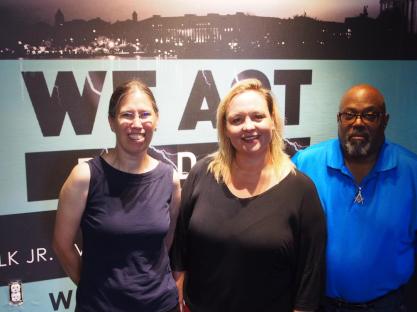
On Education Town Hall on Thursday September 12, we enjoyed hearing in studio from two activists in DC education—in the first half, a parent activist working on issues of sexual misconduct in our publicly funded schools and, in the second half, an activist addressing the inequity of after school opportunities for DC school kids.
Segment One, top of the hour
Segment Two, 36:20 —


Documenting and Reporting Sexual Misconduct

The first half of the show featured DCPS parent and Ward 6 Public School Parents Organization officer Danica Petroshius, who discussed her work in getting attention for the issue of sexual misconduct in our publicly funded schools, in the wake of reporting in June 2019 that an employee for a popular DC aftercare provider allegedly sexually abused a child at Capitol Hill Montessori.
Petroshius noted that right now in DC, there is little tracking of sexual misconduct in schools; very little publicly revealed; and compliance with laws for background checks is not thorough. She also noted that city education leaders have responded to queries about all of that in a piecemeal fashion. She noted that to ensure justice, the following needs to happen:
—All schools must comply with reporting requirements for sexual misconduct (all adults are mandated reporters);
—Comprehensive training for all adults in schools;
—Clear policies on victim support;
—Better data collection and dissemination; and
—Clear communication to the public about incidents
For more information, see the following:
Abuse Complaints (WUSA report)
Secret List (Coalition Request)
Sexual Assault Policy (EducationDC)
Petroshius also gave a plug for another school volunteer group she is part of” The Story of Our Schools, which works with students to complete research into their own schools and then present it to their school community in a permanent museum-quality exhibit. For more information, and to learn about their upcoming fundraiser, see Story of Our Schools.

First Segment 9-12-19
Valerie, Danica Petroshius,Thomas


Serve Your City

In studio for the second half, Maurice Cook, founder and executive director of local nonprofit CONTINUE READING: DC Education Activists in Studio – Education Town Hall Forum

Educators, Parents Derail Charter Industry Scheme to Defy Will of Voters

Educators, Parents Derail Charter Industry Scheme to Defy Will of Voters

Educators, Parents Derail Charter Industry Scheme to Defy Will of Voters

In November 2016, Massachusetts voters rejected Question 2, a ballot referendum financed by the charter school industry to raise the cap on charter school expansion. The vote, 62 percent to 38 percent, wasn’t close, sending a clear signal across the state that public education wasn’t for sale.
To the surprise of … well, no one, school privatization advocates didn’t get the message. Charter school CEOs and their allies licked their wounds and regrouped. An opportunity soon presented itself in New Bedford, Mass., where a 2018 proposal to expand one charter school soon morphed into a transparent scheme to pry open the door to a statewide expansion.
“It was an attempted end run around the will of voters,” said Merrie Najimy, president of the Massachusetts Teachers Association. “But our members and the alliances were at the ready.”
Educators and parents launched an unrelenting campaign against a proposal they believed was tantamount to extortion. By May 2019, the plan had stalled in the legislature and charter school advocates soon abandoned the effort.
The proposal—a deal brokered behind closed doors—was dangerous on many fronts. Most alarming to public school activists was the plan to carve out an attendance zone for the Alma Del Mar charter school, making it the first neighborhood charter school in the state. Students in the proposed zone would, by default, become charter school students.
“In what world is it acceptable to tell a child they have to go to a privately-run charter school?” asked State Representative Chris Hendricks.
Alma Del Mar would have been the first neighborhood charter school, but most CONTINUE READING: Educators, Parents Derail Charter Industry Scheme to Defy Will of Voters

THIS WEEK Education Research Report

Education Research Report


THIS WEEK 
Education Research Report


Millions more American children are attending school with students of other races, even as many urban schools remain deeply segregated

The number of children attending U.S. public schools with students of other races has nearly doubled over the past quarter century, a little-noticed surge that reflects the nation’s shifting demographics, a Washington Post analysis has found. At the same time, children in most big cities and many suburbs remain locked in deeply segregated districts, with black students more likely to be enrolled
'Nudging' Helps STEM Students at 2-Year Colleges

The purpose of this implementation report is to help community college leaders, foundations, and public education policymakers understand the impact that nudges have on student success, especially for students from populations that typically have low rates of college completion. The promising results of the NTSS initiative reflect the opportunities that nudging offers, and they have important imp

SEP 11

2019 State of Computer Science Education

The Computer Science Teachers Association. along with Code.org and the Expanding Computing Education Pathways (ECEP) Alliance , a National Science Foundation Broadening Participation in Computing funded Alliance, has released the report. The report describes the policy trends and momentum over the past 12 months and contains: an analysis of national and state trends in AP CS by gender and race,
More Than One in Four Students Attend Schools with High or Extreme Levels of Chronic Absence

This report describes how chronic absence and conditions for learning are interconnected issues that can have an impact on a child's educational success. The report identifies specific conditions for learning that can improve school experiences for students and staff and help reduce absenteeism and improve academic outcomes. It includes brief case studies from the state of Georgia and the Clevela
Education at a Glance 2019

Education at a Gla nce is the authoritative source for information on the state of education around the world. It provides data on the structure, finances and performance of education systems across OECD countries and a number of partner economies. More than 100 charts and tables in this publication – as well as links to much more available on the educational database – provides key information o
Adolescents with high levels of physical activity perform better in school over two years

Adolescents with higher levels of physical activity performed better in school during transition from primary school to lower secondary school than their physically inactive peers, a new study from Finland shows. However, the researchers, from the University of Jyväskylä, found that increased physical activity did not necessarily result in improved academic performance. Previous cross-sectional s
Time spent using social media associated with mental health problems among adolescents

Adolescents who spend more than three hours a day using social media may be at higher risk for mental health problems. This observational study included a nationally representative sample of nearly 6,600 U.S. adolescents (ages 12-15) who reported time spent on social media during a typical day and who reported information about mental health problems. After accounting for factors including a hist

SEP 10

Education Policy Responses to the Opioid Crisis

The opioid crisis is a top priority issue we continue to hear about and research. While most of the policy action taken related to the crisis has been in the health sector, state education leaders are looking for ways to address the direct and indirect implications on students through policy action. explores the connection between education policy and the opioid crisis, provides examples of rece
Career and Technical Education by Locale

Public high school graduates from towns and rural areas earn more credits in career and technical education (CTE) than do graduates from cities and suburban areas. The National Center for Education Statistics Data Point, Career and Technical Education Coursetaking in 2013, by Locale , examines CTE coursetaking among public school graduates from city, suburban, town, and rural high schools. In six

SEP 09

Strong student-adult relationships lower suicide attempts in high schools

High schools where students are more connected to peers and adult staff, and share strong relationships with the same adults, have lower rates of suicide attempts, according to a new study published by the Journal of Child Psychology and Psychiatry. The study, "Peer-adult network structure and suicide attempts in 38 high schools: implications for network-informed suicide prevention," surveyed 10,
How Much Should We Rely on Student Test Achievement as a Measure of Success?

The use of test scores as a performance measure in high-stakes educational accountability has become increasingly popular since the enactment of the No Child Left Behind Act of 2001 (NCLB), which imposed sanctions such as the threat of losing federal funds unless a state implemented a school accountability system that measures student progress continuously. Since then, many in the education commu
Postsecondary Education and Employment Pathways of High School Graduates

A new REL Midwest study examined the postsecondary education and employment pathways of Minnesota public high school graduates. The study examined differences in postsecondary pathways, college certificate and degree attainment, and employment outcomes for students with different characteristics and from rural and nonrural high schools. Key findings include: Within one year of graduation, 92 perc

SEP 06

Analyzing Youth Civic Writing Within the 2016 Letters to the Next President Project

This article investigates the civic writing practices of more than 11,000 students writing letters to the next president in the lead up to the 2016 U.S. election. The authors analyze how letter topics are associated with socioeconomic factors and reveal that 43 topics—including ones prevalent among students such as immigration, guns, and school costs—were significantly associated with socioeconom
Teachers are not being provided with the knowledge and evidence to make their teaching truly effective.

Complete report Scientists know a lot about effective learning and teaching. In the past several decades, cognitive psychologists and other learning researchers have performed thousands of studies on effective learning and teaching practices. In some cases, research findings have gone against conventional wisdom or common practice. For example, varied practice (in terms of the variety of problems
Research on the Leadership of Black Women Principals: Implications for Black Students

This exploratory review considers research on Black women principals for the period 1993 to 2017, using 57 research reports obtained from dissertations, journal articles, and a book chapter. This exploration is of particular significance given the continuous disenfranchisement and subsequent underachievement of Black children in U.S. schools and the importance of black women principals in address

SEP 05

Students who do not date are not social misfits

Prior research identified four distinct dating trajectories from 6th to 12th grade: Low , Increasing , High Middle School , and Frequent . In a new study published in the Journal of School Health , researchers found that adolescents who were not in a romantic relationship had good social skills and low depression, and fared better or equal to peers who dated. The study included 594 10th graders.
Exposure to multiple languages may make it easier to learn one

Learning a new language is a multi-step, often multi-year process: Listen to new sounds, read new word structures, speak in different patterns or inflections. But the chances of picking up that new language -- even unintentionally -- may be better if you're exposed to a variety of languages, not just your native tongue. A new study from the University of Washington finds that, based on brain acti
Financial education programs, income-based repayment plans promote prosperity

Young adults with student loans who participate in financial education programs become better financial managers who are able to build their personal wealth after college, researchers at the University of Illinois found in a recent study. Social work professor Min Zhan and graduate student Gaurav Sinha analyzed data on 1,924 young adults in the U.S. to explore which factors helped those with stud
Students in 'active learning' classrooms learn more than they think

For decades, there has been evidence that active learning - classroom techniques designed to get students to participate in the learning process - produces better educational outcomes for students at virtually all levels. And a new Harvard study suggests it may be important to let students know it. The study, published September 4 in the Proceedings of the National Academy of Sciences , shows tha
States’ Intervention in School Districts’ Finances

In recent years, state takeovers of local school districts have become both increasingly common and prominent. Districts including Newark, Detroit, and Harrisburg are among those that have met this fate. Each of these takeovers—as well as many state interventions of a more limited nature in districts across the country—occurs pursuant to state law. In fact, each state has one or more laws that al
Females show more sustained performance during test-taking than males

Females tend to perform worse than males on math and science tests, but they perform better on verbal reading tests. Here, by analyzing performance during a cognitive test, we provide evidence that females are better able to sustain their performance during a test across all of these topics, including math and science (study 1). This finding suggests that longer cognitive tests decrease the gende
In National Ranking of School Systems, New Jersey takes the top spot

The third and final installment of “Quality Counts 2019” offers a comprehensive report card on the nation’s K-12 system, including A-F grades and rankings for each of the states based on a wide range of academic, school finance, and socioeconomic factors. The report, based on analysis by the Education Week Research Center, sums up how well the nation and the states do on assuring bright prospects
Preparing Students for Learning, Work and Life Through STEAM Education

This Policy Brief explores new pathways to guide future practice, research and policy work to support access to STEAM education for all students.

SEP 04


School district secessions in the South have deepened racial segregation between school systems

Since 2000, school district secessions in the South have increasingly sorted white and black students, and white and Hispanic students, into separate school systems, weakening the potential to improve school integration, 


Education Research Report