Latest News and Comment from Education

Sunday, March 31, 2019

LA Times Value-Added Reporters: Where Are They Now | VAMboozled!

LA Times Value-Added Reporters: Where Are They Now | VAMboozled!

LA Times Value-Added Reporters: Where Are They Now 

In two of my older posts (here and here), I wrote about the Los Angeles Times and its controversial move to solicit Los Angeles Unified School District (LAUSD) students’ test scores via an open-records request, calculate LAUSD teachers’ value-added scores themselves, and then publish thousands of LAUSD teachers’ value-added scores along with their “effectiveness” classifications on their Los Angeles Teacher Ratings website. They did this, repeatedly, since 2010, and they did this all despite the major research-based issues surrounding teachers’ value-added estimates (that hopefully followers of this blog know at least somewhat well).
This is also of frustration for me since the authors of the initial articles (Jason Strong and Jason Felch) contacted me back in 2011 regarding whether what they were doing was appropriate, valid, and fair. Despite about one hour’s worth of strong warnings against doing so, Felch and Song CONTINUE READING: LA Times Value-Added Reporters: Where Are They Now | VAMboozled!


Have Charters Already Gamed Gavin Newsom's Schools Task Force? | Capital & Main

Have Charters Already Gamed Gavin Newsom's Schools Task Force? | Capital & Main

Have Charters Already Gamed Gavin Newsom’s Schools Task Force?
Rather than senior researchers, public finance experts and classroom learning specialists, seven of the governor’s 11 appointees appeared to have been recruited from the charter-industrial complex.


“Learning Curves” is a weekly roundup of news items, profiles and dish about the intersection of education and inequality. Send tips, feedback and announcements of upcoming events to  braden@capitalandmain.com, @BillRaden.


No sooner did author-academic Diane Ravitch expose this month the charter leaningsof Governor Gavin Newsom’s task force studying the fiscal impacts of charters than California schools superintendent and panel chair Tony Thurmond found a Twitter blowtorch pointed his way. With seven of the task force’s 11 appointees appearing to be recruited from the charter-industrial complex, had the findings already been gamed? Judge the task force and him by results, Thurmond reasoned, promising that the panel would deliver recommendations for a charter code overhaul. His message was even more explicit a week later when he pointed out the gaping inequity of laissez-faire ed reform: “You cannot open enough charter schools or new schools to serve every single student in our state,” he told CalMatters. “If you take the competition approach, it means some students — a lot of students — will be left behind.”
Governor Newsom did come through on Senate Bill 126, signing into law long overdue charter transparency and public disclosure requirements that had been repeatedly vetoed by Jerry Brown. Just don’t expect Newsom’s signature on any more of the raft of reformswending their way through committee rooms — at least not before the summer recess. Newsom has already indicated that he’s taking a timeout on charter reform until Thurmond’s task force releases its recommendations in July. Something that is expected: plenty of pushback by the California Charter Schools Association. In the face of collapsing national CONTINUE READING: Have Charters Already Gamed Gavin Newsom's Schools Task Force? | Capital & Main


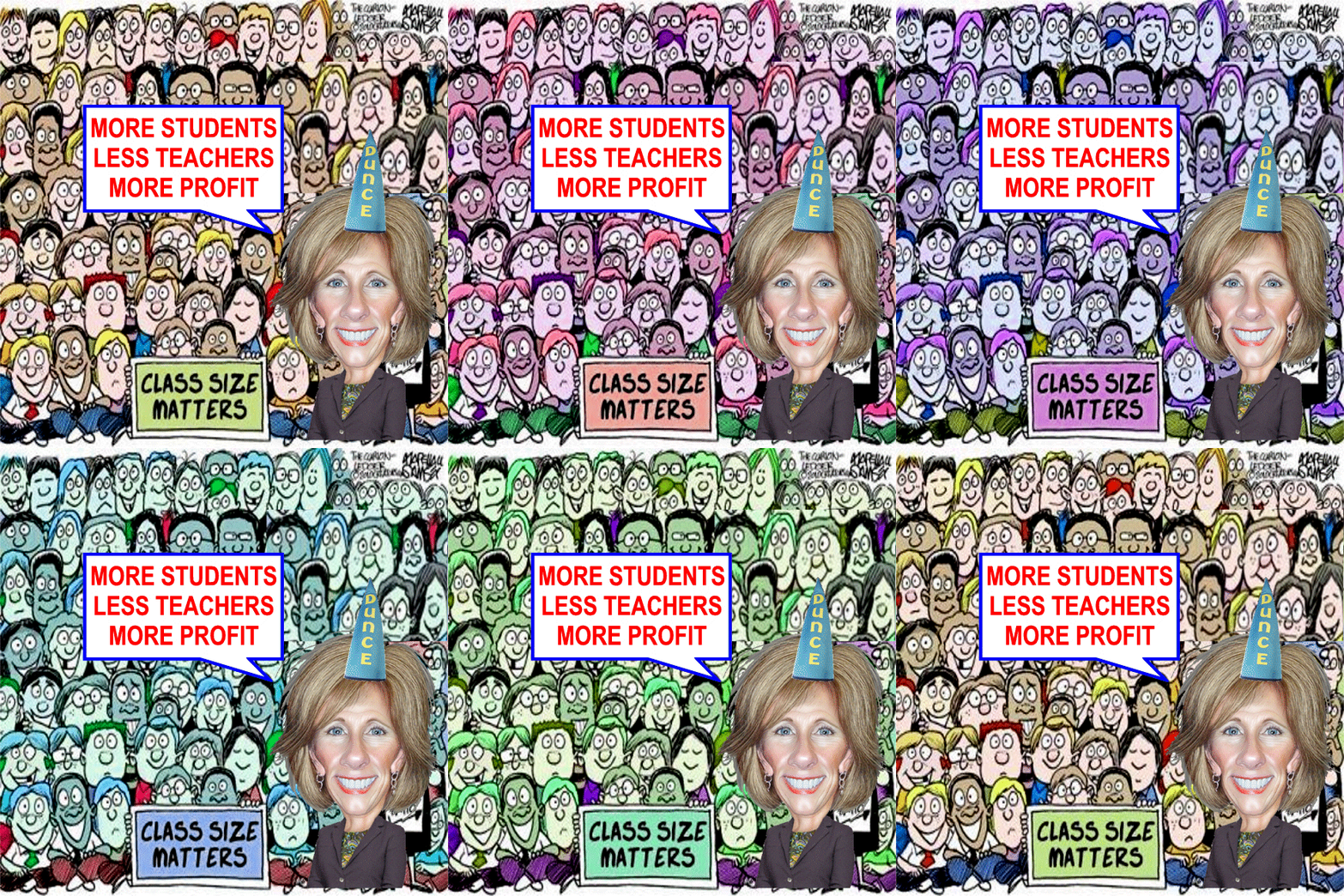
Mitchell Robinson: The Stunning Hypocrisy of Betsy DeVos: Class Size Edition | Eclectablog

The Stunning Hypocrisy of Betsy DeVos: Class Size Edition | Eclectablog

The Stunning Hypocrisy of Betsy DeVos: Class Size Edition


In light of Betsy DeVos’ comments on the benefits of large class sizes and hiring fewer teachers – “In fact, students may be better served by being in larger classes, if by hiring fewer teachers, a district or state can better compensate those who have demonstrated high ability and outstanding results…” – I wanted to share the following statistics from the school Betsy attended as a young woman, Holland Christian School
Average class size:
High school, 19.5
Middle school, 23.2
Elementary school, 17.3
Teacher to Student Ratio, 1 : 12.5

From Holland to Detroit

By way of comparison, the teachers’ contract in the Detroit Public Schools Community District (the school system that Ms. DeVos suggested should simply be dissolved) stipulates the following class sizes:
• In grades K-3, the class size is supposed to range from 17-25 students.
• In grades 4-5, the maximum is 30.
• And in grades 6-12, the max is 35 students.
Across the district, 14 out of the district’s 115 schools have oversize classes — many of them with multiple classes that are too large. According to fall class data provided by the CONTINUE READING: The Stunning Hypocrisy of Betsy DeVos: Class Size Edition | Eclectablog


UC Berkeley Chancellor says Kopp Monologue is Free Speech | Cloaking Inequity

UC Berkeley Chancellor says Kopp Monologue is Free Speech | Cloaking Inequity

UC BERKELEY CHANCELLOR SAYS KOPP MONOLOGUE IS FREE SPEECH


Wendy Kopp, who infamously created Teach For America to temporarily place teachers in classrooms in her Princeton undergraduate thesis, has been invited to give the 2019 graduation address at UC Berkeley. I recieved the following note protesting the invitation from Jane Nylund to Carol T. Christ, UC Berkeley Chancellor.
As a public school advocate, and a product of California public schools (father and grandmother both attended UC Berkeley), I was outraged and saddened to find that UC Berkeley had extended an invitation to Wendy Kopp, founder of Teach For America, to be featured as the commencement speaker at UC Berkeley this year.
Oakland and other urban school districts have, for years, suffered under the constant threat of privatization. Teach for America is just one of many cogs in the privatization machine; there are many others, but TFA’s influence is not just felt at the school site level, but has also infiltrated higher levels of administration (such as the Oakland mayor’s office), as well as TFA acting as lobbyists for legislation favoring privately managed charter schools and ed reform groups.
TFA has a potent mixture of idealism and practicality; the concept of having the opportunity to “teach” in a high needs district such as Oakland is tantalizing for many young people eager to give something back to the community. According to TFArecruiting manager Jessica Rossoni, whose credentials included a stint at the Daily Californian, “UC Berkeley is one of the largest contributors to the organization in its number of students who join TFA, according to Rossoni. She said UC Berkeley students apply in high rates because of UC Berkeley’s values of equity and students’ desires to tie those values to a career.” Notice that she doesn’t mention the type of career. Could be anything but teaching, and usually is. But, here’s what TFA is really about:
1) Installing low-paid, unqualified, uncertified, non-union teaching labor into the most challenging schools. Leafy suburban schools would never accept a core group of teachers that enter their schools in significant numbers with only 5 weeks of experience. Charter schools actively employ non-union TFA teaching labor; charters’ teacher retention record is abysmal, typically 2 years. Not surprising, since this corresponds with the 2-year TFA teaching commitment.
2) Creating  a “teacher pipeline” to fill teaching positions is secondary to TFA’s true mission mentioned above. Despite TFA’sassertions, there isn’t a teacher shortage; that narrative is trotted out by TFA and is accepted as gospel by the ed reform echo chamber; teachers as a whole are woefully underpaid and unsupported, particularly in high needs districts (was everyone at UCBerkeley asleep during the Oakland strike?). TFA solves none of this; its existence exacerbates the problem by undermining the professionalism, credentials, and experience of authentic teachers committed to the job as a profession, and not just a career stepping stone or resume padding on the part of corps members.
3) TFA charges school districts a fee for hiring TFA members. This fee causes a significant burden for cash-strapped districts already grappling with expenses associated with supporting high needs students. There is no guarantee that these teachers will remain with the district, and in fact, collectively, TFA has a poor track record of teacher retention within the host district in which they serve. This disruptive model of teacher churn caused in part by hiring TFA is damaging to our students, who deserve highly-trained, certified teachers with a long-term commitment to the profession.
4) TFA is a privatization group that is actively supported by the Walton Family Foundation.  Why UC Berkeley would ever align itself with the worst of corporate school privatization supporters completely escapes rational thought. UC Berkeley is one of the most important assets and symbols of public education in California. Support for groups like TFA flies in the face of the core values that UC Berkeley represents. Its mission to serve public students and to serve in the public interest will forever be tainted by this ill-advised invitation to a group that undermines all we value as democratically represented public institutions.
Read here for the unflinching reality of what TFA truly represents, and ask yourself if this narrative aligns with the values of UCBerkeley. I was disheartened to note that UC Berkeley has been a part of what has become the education misery in Oakland and elsewhere by supplying a large pool of students as corps members. Again, while the Berkeley students may find this kind of service admirable, this model is actively undermining the teaching profession. Not surprising that it is our mostly black and brown students that are suffering the consequences because of it. There is nothing admirable or equitable about that.
While I understand that this decision was based in part by student input, it is sometimes advisable for other adults in the room to step up and explain the symbolism behind this TFA invitation. This generation of college students hasn’t been around long enough to understand what has happened regarding school privatization in this country, but someone (besides TFAer Ms. Rossoni) needs to explain it to them. The students’ wish to give back to their community has been hijacked by the very people like the Waltons that want publicly supported institutions like UC Berkeley to go away. The irony is not lost on those of us who have witnessed this calamity for far too long. Please do the right thing and rescind your decision to Ms. Kopp, offer her your sincerest apologies, and find someone like Diane Ravitch or Jitu Brown, both true champions of authentic public education in this country. Thank you for your consideration. .
Regards,

Jane Nylund
Here is the response from Carol T. Christ, UC Berkeley Chancellor.
Dear Ms. Nylund,
Thank you for taking the time to alert us to your concerns about Wendy Kopp being selected as the 2019 commencement speaker.  The University of California, Berkeley has a commencement speaker selection process in place which includes the involvement of the student group, the Californians, the Associated Students of the University of California, and the Chancellor’s office.  Please see the attached flow chart for more detail on the selection process.
We are highly committed to this process and we do not disinvite speakers when groups or individuals come forward who do not support the speaker’s beliefs or body of work.  While we understand the concerns put forth by those who have written, we must adhere to both our process as well as to the tenets of free speech.
Sincerely,
Carolyn
While I believe it is important that we protect constitutional free speech, I also believe that educational leaders must promote dialogues rather than monologues when discussing controversial topis— this approach allows the power of ideas to prevail. As an educational leader, I have participated in Cambridge-style debates, attend workgroups at the American Enterpise Institute (until they couldn’t handle my free speech) and even participated in a mock trial at the Libertarians Freedom Fest. So for me, it’s malpractice for educational leaders to allow monologues instead of dialogues when there are controversial topics at hand. So, here’s what I opined and suggested.
Carolyn, At least now you can’t say you weren’t made aware of the peer reviewed research and criticism about Teach For America for sending unqualified teachers to temporarily teach primarily Brown and Black children in California. You’ve been apprised. You should also reference that the California legislature is debating banning TFA in California schools via AB 221 because the [vast majority] of TFA only stopover in California schools on their way to Berkeley etc. The California NAACP and California LULAC, our state’s largest and oldest civil rights organizations, are supporting the bill. So are the teacher associations of California. Now you also know this also… Furthermore, free speech on campus should not be a one-sided, unbalanced public debate as Berkeley has purposely set up in this instance. Show some scholarly leadership. Create a balanced debate on your campus— that’s free speech.
In my view, we often shortchange our academic communities and stifle the exchance of ideas that free speech was meant to promote. Promoters of controversial ideas as “free speech” should be ready and willing to defend and promote a platform for dialogue instead of monologue.

Please Facebook Like, Tweet, etc below and/or reblog to share this discussion with others.
Check out and follow my YouTube channel here.
Twitter: @ProfessorJVH
Click here for Vitae.

Larry Ferlazzo's Websites of the Day... | The latest news and resources in education since 2007

Larry Ferlazzo's Websites of the Day... | The latest news and resources in education since 2007


Larry Ferlazzo's Websites of the Day...


Here’s My Short Unit On Folktales – Including Student Handouts

Merio / Pixabay I’ve previously shared posts about specific writing units I do with ELLs (and non-ELLs) that have shared detailed instructions and student-handouts: * On writing a story (see A Look Back: “Here’s My Entire ELL Beginners Seven-Week Unit On Writing A Story (Including Hand-outs & Links)” * On writing about a growth mindset (see Student Written Growth Mindset Stories ) * On students w

YESTERDAY

New National Geographic Video: “Rainforests 101”

nile / Pixabay I’m adding this video to The Best Sites For Learning About Brazil:
SEL Weekly Update

I’ve recently begun this weekly post where I’ll be sharing resources I’m adding to The Best Social Emotional Learning (SEL) Resources or other related “Best” lists. You might also be interested in The Best Social Emotional Learning Resources Of 2018 – So Far. Finally, check out “Best” Lists Of The Week: Social Emotional Learning Resources . Here are this week’s picks: Research scholars to air pro
Earth Day Is Coming Up – Here Is Everything You Wanted To Know About The Environment, But Were Afraid To Ask

Earth Day is on April 22nd. You might be interested in: The Best Earth Day Sites The Best Sites To Introduce Environmental Issues Into The Classroom The Best Online Carbon Calculators The Best Sites To Learn About Climate Change The Best Resources For World Biodiversity Day (& Endangered Species Day) The Best Sites To Learn About “Earth Hour” The Best Resources For Teaching & Learning About World
Ed Tech Digest

Six years ago, in another somewhat futile attempt to reduce the backlog of resources I want to share, I began this occasional “Ed Tech Digest” post where I share three or four links I think are particularly useful and related to…ed tech, including some Web 2.0 apps. You might also be interested in The Best Ed Tech Resources Of 2018 – So Far , as well as checking out all my edtech resources . You

MAR 29

Video: “What’s the origin of April Fools’ Day?”

Alexas_Fotos / Pixabay I’m adding this new video from USA Today to The Best Sites For Learning About St. Patrick’s Day (and April Fool’s Day) :
“Memr.tv” Is A Fun Tool For English Language Learners (& Everybody Else)

satyatiwari / Pixabay I’ve often shared in the past about how I have English Language Learners go to sites that have short and often silly movie clips available for users to create funny closed-captions about what the characters might be saying. You can see links to all those free and easy tools at The Best Places To Create Funny Subtitles For Silent Movies . Today, reader Tommy shared a new one
Do You Teach English In Algeria & Want To Answer Some Questions About What’s Happening There Now?

3dman_eu / Pixabay Several years ago, I began a new regular interview series . There are always lots of “hot spots” around the world — places where there are natural disasters, political upheavals, etc. And English teachers can be found in most of those places. If you are an EFL/ESL teacher in one of those areas, please let me know. I haven’t done this interviews in writing for quite awhile, but

MAR 28

Great Student-Created Vocabulary Videos!

PDPics / Pixabay The New York Times Learning Network has just announced the winners of their 2019 Vocabulary Video Contest , and they’re great! I’ve embedded one of them below. My ELL students have been creating these for years. In fact, the Learning Network used some of them as models to kick-off their first contest! You can see a zillion of them at The Best Resources For Learning To Use The Vid
Earth Hour 2019 Takes Place On March 30th – Here Are Related Resources

qimono / Pixabay Millions of people around the world will be turning off their lights on March 30th at 8:30 PM local time in a global environmental movement. You might be interested in The Best Sites To Learn About “Earth Hour”
Pins Of The Week

I’m fairly active on Pinterest and, in fact, have curated 17,000 resources there that I haven’t shared on this blog. I thought readers might find it useful if I began sharing a handful of my most recent “pins” each week (I’m not sure if you can see them through an RSS Reader – you might have to click through to the original post). You might also be interested in My Seven Most Popular Pins In 2018
Most Popular Posts Of The Week

I’m making a change in the content of the regular feature. In addition to sharing the top five posts that have received the most “hits” in the preceding seven days (though they may have originally been published on an earlier date), I will also include the top five posts that have actually appeared in the past week. Often, these are different posts. You might also be interested in IT’S THE TWELFT
New Infographic: “A Minute on the Internet in 2019”

fancycrave1 / Pixabay There are annual versions of these kinds of infographics (you can find many of them at The Best Sites To Learn About The Internet ). Here’s the latest one from Statista: You will find more infographics at Statista
New TED-Ed Video & Lesson On Frida Kahlo

HeteroSapiens / Pixabay TED-Ed’s newest lesson is on Frida Kahlo. I’m adding it to The Best Sites To Learn About Diego Rivera & Frida Kahlo .

MAR 27

“What Are Effective Ways to Use Tech in Science Classes?”

What Are Effective Ways to Use Tech in Science Classes? is the new question-of-the-week at my Education Week Teacher column. Feel free to leave responses in the comments section there or here….
New PBS NewsHour Video: “How the way we talk about suicide can prevent it from happening again”

Free-Photos / Pixabay Here’s how the PBS NewsHour describes this segment: Two members of the Marjory Stoneman Douglas community have died by apparent suicide. One of them was a survivor of last year’s mass shooting who reportedly struggled with post-traumatic stress disorder. Dr. Kelly Posner Gerstenhaber of the Columbia Lighthouse Project and Ryan Petty, whose daughter was killed at Parkland, jo
Video: Saturday Night Live Takes On The Marshmallow Test

allybally4b / Pixabay I’ve shared many posts about the famous Marshmallow Test and its implications for schools (see Best Posts About Helping Students Develop Their Capacity For Self-Control ). Actress Sandra Oh is hosting Saturday Night Live this week, and SNL decided to spoof The Marshmallow Test in a promo for the show:

MAR 26

New Video From L.A. Times: “Do you know what a charter school is?”

Wokandapix / Pixabay The L.A. Times has just produced this decent video explaining charter schools. I’m adding it to The Best Posts & Articles Analyzing Charter Schools .
“Don’t Treat Parent-Teacher Conferences ‘Like Trips to the Dentist'”

Don’t Treat Parent-Teacher Conferences ‘Like Trips to the Dentist’ is the headline of my latest Education Week Teacher column. In it, Beth Brady, Carol Pelletier Radford, Rich Czyz, Robert Ward, Jennifer Abrams, and Barbara R. Blackburn share their thoughts on teachers meeting with parents. I’m adding it to The Best Resources On Parent/Teacher Conferences . Here are excerpts from the post:
Another Study Finds That Poverty Causes Cognitive Challenges, Not The Other Way Around

There has been a lot of recent research showing that that the stress of poverty limits the amount of “cognitive bandwidth” that people may have – in other words, poverty causes less self-control, for example, than the other way around (see The Best Resources Showing Social Emotional Learning Isn’t Enough ). A new study finds that being saddled with debt can have the same negative impact (see Debt
Just Sent-Out Free Monthly Email Newsletter

geralt / Pixabay I’ve just mailed out the April issue of my very simple free monthly email newsletter . It has over 3,000 subscribers, and you can subscribe here . Of course, you can also join the eighteen thousand others who subscribe to this blog daily. Here Are 8 Ways You Can Subscribe For Free…

MAR 25

“The Student’s Role in Parent-Teacher Conferences”

The Student’s Role in Parent-Teacher Conferences is the headline of my latest Education Week Teacher column. In it, Jenny Edwards, Dr. Beth Gotcher, Sherri Wilson, Katy Ridnouer, Ryan Huels, Tara Brown, and Sarah Thomas share their reflections on parent-teacher conferences. Here are some excerpts:
Two Fun Rube Goldberg-Like Videos

Here are two new additions to The Best Resources For Learning About Rube Goldberg Machines : this ends fantastically pic.twitter.com/zNKCi4gbZl — megan YELI MVP brown (@thatgirlondeck) March 16, 2019
My Latest BAM! Radio Show Is On Using Tech In English Classes

Ways to use Tech Effectively in English Classes is the topic of my latest ten-minute BAM! Radio Show. I’m joined in the conversation by Jenny Vo, Jennifer Casa-Todd, and Maggie Verdoia, who have also all contributed written commentaries to my Ed Week Teacher column. You can also now listen to the show on Google Play and Stitcher , in addition to iTunes. I’m adding this show to All My BAM Radio Sh

MAR 24

“Strategies for Effective Parent-Teacher Conferences”

Strategies for Effective Parent-Teacher Conferences is the headline of my latest Education Week Teacher column. It highlights suggestions from Luz Santana, Leticia Skae, Mandi White, Tara Dale, Sanée Bell, PJ Caposey, and Sarah Kirby-Gonzalez about increasing the effectiveness of parent-teacher conferences. Here are some excerpts:
Kenyan Science Teacher Wins This Year’s Global Teacher Prize

TeroVesalainen / Pixabay Peter Tabichi, a science teacher from Kenya, has just been awarded The Global Teacher Prize. You can learn more about it at The NY Times article, Kenyan Teacher Who Aids Poor Wins $1 Million Global Prize . I’ve embedded some videos about him below, including his teaching a sample lesson. First, though, here are links to posts about previous winners: ART TEACHER IN THE U.K
Around The Web In ESL/EFL/ELL

BiljaST / Pixabay Five years ago I began this regular feature where I share a few posts and resources from around the Web related to ESL/EFL or to language in general that have caught my attention. You might also be interested in The Best Resources, Articles & Blog Posts For Teachers Of ELLs In 2018 – So Far and THE BEST RESOURCES, ARTICLES & BLOG POSTS FOR TEACHERS OF ELLS IN 2018 – PART TWO . A
This Week’s “Round-Up” Of Useful Posts & Articles On Ed Policy Issues

Here are some recent useful posts and articles on educational policy issues (You might also be interested in THE BEST ARTICLES, VIDEOS & POSTS ON EDUCATION POLICY IN 2018 – PART TWO ):’ Statisticians’ Call To Arms: Reject Significance And Embrace Uncertainty! is from NPR. I’m adding it to The Best Resources For Understanding How To Interpret Education Research . “How Much Should I Care?” Five que
Classroom Instruction Resources Of The Week

Each week, I publish a post or two containing three or four particularly useful resources on classroom instruction, and you can see them all here. You might also be interested in THE BEST RESOURCES ON CLASS INSTRUCTION IN 2018 – PART TWO. Here are this week’s picks: Common Core Problem Based Curriculum Maps is from Emergent Math. I’m adding it to The Best Apps, Online Tools & Other Resources For
Ed Tech Digest

Six years ago, in another somewhat futile attempt to reduce the backlog of resources I want to share, I began this occasional “Ed Tech Digest” post where I share three or four links I think are particularly useful and related to…ed tech, including some Web 2.0 apps. You might also be interested in The Best Ed Tech Resources Of 2018 – So Far , as well as checking out all my edtech resources . You


“Listen To Discern” Offers Useful Information Literacy Resources

john-i / Pixabay This week, NPR ran a story about what it characterized as a successful informational literacy program in Ukraine called “Listen and Discern” (see Students In Ukraine Learn How To Spot Fake Stories, Propaganda And 
Larry Ferlazzo's Websites of the Day... | The latest news and resources in education since 2007