Latest News and Comment from Education

Saturday, March 2, 2019

Texas: Calling All Parents Whose Children Have Been Subjected to Rigged Tests | Diane Ravitch's blog

Texas: Calling All Parents Whose Children Have Been Subjected to Rigged Tests | Diane Ravitch's blog

Texas: Calling All Parents Whose Children Have Been Subjected to Rigged Tests

exans Advocating for Meaningful Student Assessment (TAMSA) [aka Moms Against Drunk Testing] needs your help to fight abusive testing. We learned recently that the state tests (STAAR) is set two grade levels above where children are. Third-graders are tested on fifth-grade material and vocabulary, fifth-graders on seventh-grade material and vocabulary, etc. The tests are rigged to fail the kids. This is madness with no purpose other than to make kids and schools look bad so that the state has a rationale for closing public schools and opening charter schools.
URGENT: TAMSA needs your voice!
The Texas Monthly article got the attention of the House Public Education Committee. The committee is meeting Tuesday, March 5, 2019 on issues related to STAAR. Several assessment bills are on the agenda.
If you have a child that has been adversely affected by the STAAR test and are willing to testify in Austin, please email boardmember@tamsatx.org.
Texas: Calling All Parents Whose Children Have Been Subjected to Rigged Tests | Diane Ravitch's blog

The Oakland Teachers Strike Isn’t Just a Walk Out—It’s a Direct Challenge to Neoliberalism

The Oakland Teachers Strike Isn’t Just a Walk Out—It’s a Direct Challenge to Neoliberalism

The Oakland Teachers Strike Isn’t Just a Walk Out—It’s a Direct Challenge to Neoliberalism


Though at first glance, the Oakland teachers’ strike, now in its seventh day, may seem simply yet another in the wave of teacher walkouts this year, it in fact represents a watershed in resistance to neoliberal economic policy. The strike in Oakland simultaneously mirrors and advances popular resistance across the country to austerity and “accumulation by dispossession”—the capitalist elite’s conscious transfer of wealth and power from us to them.  
In one regard Oakland teachers’ demands—increased pay, investments in student services, smaller class sizes and an end to school closures—echo those in this year’s strike wave, a growing social movement led by teachers, with massive support of parents and community members, to save public schools from destruction by wealthy elites who have carried out a project attempting to “marketize” the education sector. This project includes an array of policies including the use of standardized testing which yields data to be bought and sold, the creation of charter schools controlled by networks of billionaire funders and the outsourcing of educational services.
Yet press briefings by the Oakland Education Association (OEA)—the union representing the teachers—and a website created by a community supporter, show an extraordinary shift: a fusion of attention to racial and gender justice alongside labor's mission to defend the dignity of work and workers. “It’s really, really exciting—a movement that is connecting the dots” observed Pauline Lipman, whose research on the racial significance of neoliberal school reform in Chicago helped inform the Chicago Teachers Union’s (CTU) widely-adopted template for union demands: “The Schools Chicago’s Students Deserve.”
The Oakland school district, like the Chicago Public Schools and urban school systems CONTINUE READING: The Oakland Teachers Strike Isn’t Just a Walk Out—It’s a Direct Challenge to Neoliberalism

Where Is America's Blackest City?

Where Is America's Blackest City?

Where Is America's Blackest City?

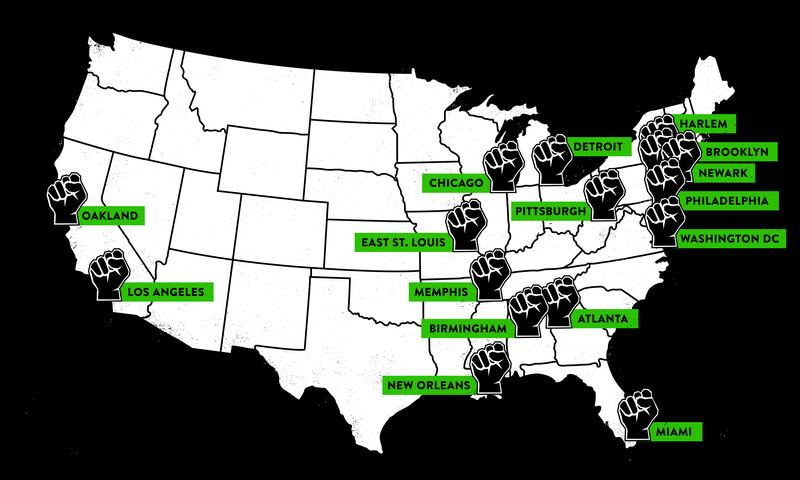
America's Blackest CityFor Black History Month, we asked writers to explain why they think their hometown, current residence or notable place deserves the title of America’s Blackest City by defining a city’s history, music, cuisine, notable figures, and cultural touchstone/unique black fact.

How do you define the blackness of a city? For Black History Month, we challenged writers to explain why they think their city deserves the title of blackest city in America. And man, did they rep their cities hard. So now, we’re asking you, our readers, to vote for who made the strongest case. Here’s a recap:

Harlem

From Harlem’s very pores drips blackness. Moreover, black humanity. Harlem is all of us: good, bad, indifferent. It is attitude, energy, spit game, furs, ice, poverty, violence, chuuuuch, hair braiding, check cashing, queerness, black doctors and numbers runners, mosques, funeral parlors and dibi, collard greens, chicken and waffles. It houses The Rucker tournament where streetball reigns supreme. A Harriet Tubman statue with roots in the ground. It is the roots of Dapper Dan and Dame Dash. CONTINUE READING: Where Is America's Blackest City?


'Norma Rae' and When Race Is Used to Weaken Unions - The Atlantic

'Norma Rae' and When Race Is Used to Weaken Unions - The Atlantic

What Norma Rae Understood About Unions and Racial Solidarity
Forty years ago, the Sally Field–starring drama was keenly aware of how corporations often attempt to sow division between black and white workers.


The most enduring image of the film Norma Rae, which was released 40 years ago, is surely Sally Field’s titular character silently standing on a table, holding up a cardboard sign with the word union scrawled on it. One by one, her fellow factory workers shut off their deafening textile machines in solidarity. The climactic scene suggests triumph and inspiration, but by this point in the movie, Norma Rae has already been fired from her job. It’s important to remember why.
In the film, a labor organizer from New York named Reuben Warshowsky (played by Ron Leibman) arrives in North Carolina hoping to unionize the workers at a local factory. Inspired by the cause and frustrated in her job, Norma Rae joins Reuben in handing out leaflets and rallying coworkers to sign union cards. Although Reuben assures Norma Rae that she can’t be fired for promoting unionization, she loses her job while trying to expose management’s attempts to thwart the effort. The bosses’ tactic: posting an inflammatory letteron the factory bulletin board in a bid to drive a wedge between white workers and black workers.
Norma Rae was based on a true account. In 1973, The New York Times ran a profile of Crystal Lee Jordan, a mill worker from Roanoke Rapids, North Carolina, who joined the Textile Workers Union of America—and who really did stand on a table, sign in hand. Although Martin Ritt, the director, confessed that his primary interest was in Jordan’s personal tale and that he “couldn’t have cared less about labor unions,” the real story behind Norma Rae was one of solidarity. Intended or not, the film has as much to say about the forces that threatened to destroy the U.S. labor movement through racial division as it does the individuals who helped make the movement possible. CONTINUE READING: 'Norma Rae' and When Race Is Used to Weaken Unions - The Atlantic


Do I still really want to be a teacher?

Do I still really want to be a teacher?


After this week I have to wonder, for lots of reasons.
th_(1).jpg
Let me start by acknowledging that the leadership of the school where I work and my fellow educators are quite supportive of me, and after yesterday’s deadline to notify me if I were not being brought back, I have in theory the guarantee of continued employment for the forthcoming school year.  And yet I have my doubts, would prefer to move to an independent school, but am having trouble even getting interviews.
The school at which I work is dysfunctional in many ways, despite some very good people.  Because of our location we have trouble getting substitutes, and as a result most teachers have to give up at least one planning period a week to cover classes.  We get paid for that, but only $15/class, and often there is no learning going on during such a period.
But this week became a real problem, and not just because we again had disruption because of weather.  On Tuesday, one of my students chose to push a long-term substitute to the floor.  On Wednesday I was assaulted twice by students I do not teach.  None of the students is up for expulsion, even though the school system code of conduct says the punishment for an assault on a school system employee is expulsion.  So far the young lady who push the sub to the floor got 3 days of in-school suspension (not part of her permanent record) and punishment for the two boys who attacked me is still somewhat in the air.  One was in inschool for one day, but that was because he came into my room without permission.  The other was out of school suspension for one day for previous behavior (which may have included his cursing me out when I told him to get out of the hall and go to class), a suspension of which he was aware when he shoved a door into me the day before he went out on suspension. 

Teaching Math at MetWest (Part 3) | Larry Cuban on School Reform and Classroom Practice

Teaching Math at MetWest (Part 3) | Larry Cuban on School Reform and Classroom Practice

Teaching Math at MetWest (Part 3)


After walking into the classroom, I sit down at a table with another student and wave hello to the young teacher. On the whiteboard are the objectives for the day:
Geometry
*Do Intro task now
*$$$$$$$
*exit ticket
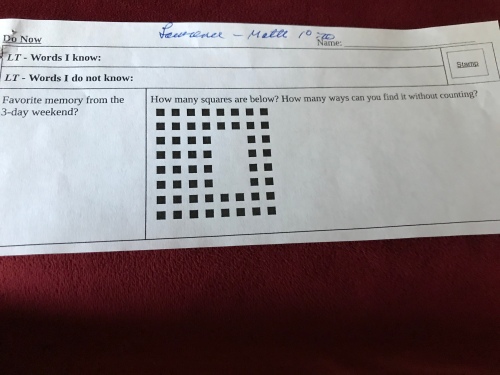
Lawrence Teng, wearing chinos and a plaid shirt is a first-year teacher and graduate of the University of Michigan. One semester at MetWest under his belt, he passes out the Introductory task–a slip of paper with three tasks for students to do–as students enter the classroom (LT refers to Learning Target). The 19 sophomores and juniors get immediately to work on the tasks.
IMG_2396.jpg
A slide on the whiteboard replicates the square with empty space on the slip of paper students begin working on.
The large classroom has a slowly whirling ceiling fan. Tables sitting two to three students each face the whiteboard and the teacher who is working in the front of the room with his laptop and document camera sitting on some cabinets (his desk is in the rear of the room). Lawrence uses the laptop to flash images onto the whiteboard. The room has a clock and phone.
After about five minutes, Lawrence (in this school, students call teachers by their first name) asks the students to stop. He then turns to the question on the slip. “Anyone has any memories from weekend.” One student responds about what his family did. No other responses. Then teacher asks about the squares and how to find answer without counting them. He calls on Bruce who says his answer. Lawrence asks Bruce to come to front of the class to explain his strategy in CONTINUE READING: Teaching Math at MetWest (Part 3) | Larry Cuban on School Reform and Classroom Practice

The Reality Check: OAKLAND TEACHERS FIGHT FOR PUBLIC EDUCATION

The Reality Check: OAKLAND TEACHERS FIGHT FOR PUBLIC EDUCATION

OAKLAND TEACHERS FIGHT FOR PUBLIC EDUCATION


OAKLAND TEACHERS FIGHT FOR PUBLIC EDUCATION

By David Bacon
Truthout Photoessay, 2/26/19
https://truthout.org/articles/photo-essay-oakland-teachers-fight-for-public-education/


Teachers and students carry a banner from their school, Oakland Technical High School.


Students and parents have come out en masse to join the marches and picket lines of the ongoing teachers strike in Oakland, California. All say that they are trying to save the city's public school system.

"This is a strike to save our district," said Heath Madom, who's taught 10th grade English for three years at Oakland Technical High School, which is referred to as "Tech" by educators and pupils. "Our Tech community is committed to saving public education. Twenty-four schools are on the chopping block. We could become like New Orleans, with no public schools and all charters, if this keeps going."

Like other teacher strikes around the country, the Oakland conflict is fueled both by a determination to protect the public school system itself and by the crisis in funding that has led to huge classes and deteriorating conditions in the schools themselves. According to Madom and the Oakland Education Association, only 5 percent of the district's 37,000 students have passed through their schools' doors over the last three days - evidence of vehement parent and community support. 

Parents, students and teachers all condemn the rise in class sizes. "My class is a catch-all, because all students have to take it, so class size is a huge issue," said Rho Seidelman, who's taught ethnic studies at Tech for three years. "There's no tracking, which is great, because we have students from all backgrounds and previous schools. But it's hard to build community among the students when there are so many. The contract says 32 is the limit, and I routinely have at least 33. Research shows that the best learning environment is in a class of 18, where students can really learn and build community. When students are absent and my class size goes down to 28 or 26, I'm really happy."

Madom says most classes at Tech have 35-40 students, and the school, built for 1,800, has a student body of 2,000. "We only have two part-time nurses for 2,000 students, and they don't have the time or resources to deal with all their medical problems. We have a beautiful library, but haven't had a librarian for years. Our counselors CONTINUE READING: The Reality Check: OAKLAND TEACHERS FIGHT FOR PUBLIC EDUCATION


SBE Agenda for March 2019 - State Board of Education (CA Dept of Education)

SBE Agenda for March 2019 - State Board of Education (CA Dept of Education)

SBE Agenda for March 2019
Agenda for the California State Board of Education (SBE) meeting on March 13-14, 2019.


State Board Members

  • Ilene W. Straus, Vice President
  • Sue Burr
  • Linda Darling-Hammond
  • Feliza I. Ortiz-Licon
  • Patricia A. Rucker
  • Niki Sandoval
  • Ting L. Sun
  • Gema Q. Cardenas, Student Member


Secretary & Executive Officer

  • Hon. Tony Thurmond


Executive Director

  • Karen Stapf Walters
Schedule of MeetingLocation
Wednesday, March 13, 20198:30 a.m. Pacific Time ±
STATE BOARD OF EDUCATION

Public Session.  Public Session, adjourn to Closed Session – IF NECESSARY.
California Department of Education1430 N Street, Room 1101

Sacramento, California 95814

916-319-0827
Please see the detailed agenda for more information about the items to be considered and acted upon. The public is welcome.


Schedule of MeetingLocation
Thursday, March 14, 20198:30 a.m. Pacific Time ±
STATE BOARD OF EDUCATION
The Closed Session will take place at approximately 8:30 a.m. (The Public may not attend.)
California Department of Education1430 N Street, Room 1101
Sacramento, California 95814
916-319-0827
The Closed Session (1) may commence earlier than 8:30 a.m.; (2) may begin at 8:30 a.m., be recessed, and then be reconvened later in the day; or (3) may commence later than 8:30 a.m.

CLOSED SESSION AGENDA

Conference with Legal Counsel – Existing Litigation: Under Government Code sections 11126(e)(1) and (e)(2)(A), the State Board of Education hereby provides public notice that some or all of the pending litigation follows will be considered and acted upon in closed session:
  • California Parents for the Equalization of Educational Materials, et. al v. Tom Torlakson in his official capacity and members of the State Board of Education, in their official capacity, et. al, United States District Court (No. Dist. CA), Case No. 4:17-cv-00635
  • California School Boards Association, San Jose Unified School District v. California State Board of Education, State Department of Education, Promise Academy, Real Party in Interest, Sacramento County Superior Court, Case No. 34-2018-80002834
  • Cruz et al. v. State of California, State Board of Education, State Department of Education, Tom Torlakson et al., Alameda County Superior Court, Case No. RG14727139
  • Devon Torrey-Love v. State of California, Department of Education, State Board of Education, Tom Torlakson, Department of Public Health, Dr. Karen Smith, Director of the Department of Public Health, Placer County Superior Court, Case No. CV-0039311
  • Ella T et al. v. State of California, State Board of Education, State Department of Education, Tom Torlakson et al., Los Angeles County Superior Court, Case No. BC685730.
  • Emma C., et al. v. Delaine Eastin, et al., United States District Court (No.Dist.CA), Case No. C-96-4179
  • Options for Youth, Burbank, Inc., San Gabriel, Inc. Upland, Inc. and Victor Valley, Notice of Appeal Before the Education Audit Appeals Panel, EAAP Case Nos. 06-18, 06-19- 07-07, 07-08 OAH Nos. L2006100966, L2006110025, L20070706022, L2007060728, Los Angeles County Superior Court, Case No. BC 347454

ALL TIMES ARE APPROXIMATE AND ARE PROVIDED FOR CONVENIENCE ONLY
ALL ITEMS MAY BE HEARD IN A DIFFERENT ORDER THAN HOW THEY ARE LISTED ON THE AGENDA ON ANY DAY OF THE NOTICED MEETING
THE ORDER OF BUSINESS MAY BE CHANGED WITHOUT NOTICE
Time is set aside for individuals desiring to speak on any topic not otherwise on the agenda. Please see the detailed agenda for the Public Session. In all cases, the presiding officer reserves the right to impose time limits on presentations as may be necessary to ensure that the agenda is completed.
REASONABLE ACCOMMODATION FOR ANY INDIVIDUAL WITH A DISABILITY
Pursuant to the Rehabilitation Act of 1973 and the Americans with Disabilities Act of 1990, any individual with a disability or any other individual who requires reasonable accommodation to attend or participate in a meeting or function of the California State Board of Education (SBE), may request assistance by contacting the SBE office at 1430 N Street, Room 5111, Sacramento, CA 95814; by telephone at 916-319-0827; or by facsimile at 916-319-0175.
CALIFORNIA STATE BOARD OF EDUCATION

FULL BOARD AGENDA
Public Session, Day 1

Wednesday, March 13, 2019 – 8:30 a.m. Pacific Time ±
California Department of Education
1430 N Street, Room 1101
Sacramento, California 95814

Friday, March 1, 2019

Jackie Goldberg: A Chance to Reclaim our Public Schools #TEAMGoldberg #REDFORED

Jackie Goldberg: A Chance to Reclaim our Public Schools

Jackie Goldberg: A Chance to Reclaim our Public Schools


Jackie has a long history as a public servant with a passionate voice in defense of public education.
- Network for Public Education Action


When Ref Rodriguez pleaded guilty to felony charges related to campaign finance violations last July and was forced to resign from his Los Angeles Unified School District (LAUSD) Board seat, he left the residents of Board District 5 without representation. When supporters of the California Charter School Association (CCSA) used bigotry to block Scott Schmerelson’s resolution to appoint Jackie Goldberg to fill the seat until a special election could be held, they ensured that this lack of representation continued. During this time, a charter school closed without notice, the police were called to question a kindergarten student, the School Board voted to make it easier for child abusers to enter the classroom, the LAUSD kept classes in session during the strike despite an admission that they could not guarantee the safety of certain students and the District signed a possibly illegal lobbying contract with a former state assemblyman surrounded by scandal.
The person who eventually wins the special election for the LAUSD Board District 5 seat will walk into a Board Room enveloped in turmoil. This is largely due to the fact that one of Rodriguez’ last moves in office was to work behind closed doors to install Austin Beutner as Superintendent despite his lack of professional experience and his connections to shady characters like David Pecker of the National Enquirer. In addition to his poor handling of the teachers’ strike, Beutner has attempted to usurp power from his bosses on the CONTINUE READING:  Jackie Goldberg: A Chance to Reclaim our Public Schools


Oakland: District and Teachers Reach Agreement | Diane Ravitch's blog #Unite4OaklandKids #WeAreOEA #WeAreCTA #strikeready #REDFORED

Oakland: District and Teachers Reach Agreement | Diane Ravitch's blog

Oakland: District and Teachers Reach Agreement 

This press release came from the Oakland Unified School district. It does not mention  mention any agreement on the teachers’ demand to call a halt to privatization, which sucked nearly $60 million out of the budget last year.


OUSD and OEA Come to Historic Agreement to End Teachers’ Strike


Oakland – Oakland Unified School District (OUSD) is proud to announce that it has reached an agreement with the Oakland Education Association (OEA) on a new contract that provides a total compensation increase of 14% – an 11% on-going salary increase with a one-time 3% bonus for educators. It also reduces class sizes and maintains the fiscal solvency of the school district. This is a big win for our teachers, students and community.

“Today marks a sea change for OUSD as we take a major step in support of our teachers and students,” said Superintendent Kyla Johnson-Trammell. “Our teachers are the core of everything we do as a school district, and we are pleased to have reached a tentative agreement that shows them how valuable they are. The contract will help ensure more teachers stay in Oakland and that more come to teach in our classrooms and support our students.”
This seven day long strike was difficult for the entire community as it threw much of the city into uncertain waters and disrupted many lives. But it also showed our teachers how appreciated they are by our students, families and all of Oakland. Since the strike began, the bargaining teams for OUSD and OEA have worked long hours – sometimes overnight – trying to find common ground and it’s the result of this dedication of both teams that we finally have a tentative agreement in place.
“We are thrilled we were able to work with our colleagues on the OEA team to craft a solution that both honors our teachers and allows us to remain financially stable,” said Board of Education President, Aimee Eng. “This contract is a compromise made by people who worked together to focus more of our energy and resources in the classroom. This agreement does exactly that. Of course, we must thank State Superintendent of Public Instruction, Tony Thurmond and State Assembly Member, Rob Bonta for the critical roles they played in helping us reach an agreement.”
“I personally agree with so much of what the teachers have been saying,” said Johnson-Trammell. “We cannot fix decades of chronic underinvestment in education with a single contract, but this is an important first step. We look forward to working together, directing the passion and energy that we saw during the strike into a collective effort to increase state funding and build the schools our students deserve. In this, we are united.”
Now we hope that all of us can focus on healing. Strikes are intense, emotional times, but now we will walk back into our schools, stand shoulder-to-shoulder and work together on behalf of our students. We will have to be intentional and conscious about how we rebuild trust and relationships that may have been damaged during the strike.
“I want to thank everyone in OUSD – from custodians to principals to front office staff, along with central office staff – who stepped up to keep our schools open and our students safe during the strike. I know it wasn’t easy,” said Johnson-Trammell. “I also want to acknowledge the conviction of our families in supporting our teachers from day one. On Monday, March 4, we look forward to everyone being together again in the classroom and engaged in teaching and learning.”
Friday, March 1, 2019
Contact: John Sasaki
Communications Director
 510-214-2080


A Roadmap to Reducing Child Poverty : Health and Medicine Division

A Roadmap to Reducing Child Poverty : Health and Medicine Division

A Roadmap to Reducing Child Poverty


This new consensus study report from the Board on Children, Youth, and Families concludes that poverty causes negative outcomes for children, especially if it occurs in early childhood or persists through a large part of childhood. More than 9.6 million U.S. children live in families with annual incomes below the poverty line and studies estimate that child poverty costs the nation between $800 billion and $1.1 trillion annually in terms of lost adult productivity, the increased costs of crime, and increased health expenditures. The consensus study report identifies packages of policies and programs that could reduce child poverty by half within 10 years, at a cost far lower than costs the United States currently bears.
READ THE REPORT ONLINE FOR FREE: A Roadmap to Reducing Child Poverty : Health and Medicine Division


OPINION DUNCAN: ‘It Is Clear to Me That Mayoral Control Is by Far the Better Approach’ Than Elected School Boards | Chicago Sun-Times

Chicago schools have led nation in academic growth — under an appointed board | Chicago Sun-Times

DUNCAN: ‘It Is Clear to Me That Mayoral Control Is by Far the Better Approach’ Than Elected School Boards 


OPINION  Chicago schools have led nation in academic growth — under an appointed board

Polls suggest that a majority of Chicagoans favor an elected school board or some hybrid version of elected and appointed members.
Both candidates for mayor, Lori Lightfoot and Toni Preckwinkle, also have expressed a preference for one of these alternatives instead of a board fully appointed by the mayor.
I’d like to make the case that abandoning mayoral control would be a mistake, one with significant consequences for students.
OPINION
Arne Duncan join a roundtable discussion panel with representatives of Chicago area colleges and universities on how small high schools can enhance their academic curriculum by partnering with higher education institutions
Arne Duncan | Sun-Times file photo
Those who favor an elected or hybrid school board seem to want greater representation and accountability. When decisions like school closings are on the docket, people want to feel that their concerns are being considered. And when a school district chief commits fraud, or questions arise about how special education is being handled, we want accountability.
I not only understand those emotions and objectives, I share them. That said, it is clear to me that mayoral control is by far the better approach — not just for true accountability, but as means to accomplish what we all really want — schools that serve our children well.
First, concerns about the role of money and politics infiltrating our schools are real — more than $17 million was spent on recent school board elections in Los Angeles, and turnout for school board elections tends to be less than 10 percent. That may be why Chicago has never had an elected school board — it has always used some version of an appointment process.

The result of the appointment process is more accountability, not less. There is no question that Chicagoans know exactly who to blame or thank for school performance. Voters understand that whomever they elect will pick a school team they judge capable of overseeing the third-largest district in the country — a complex and critical undertaking that requires significant financial and CONTINUE READING: Chicago schools have led nation in academic growth — under an appointed board | Chicago Sun-Times