Latest News and Comment from Education

Wednesday, April 12, 2017

DeVos announces Education Department hires - The Washington Post

DeVos announces Education Department hires - The Washington Post:

DeVos announces Education Department hires


Education Secretary Betsy DeVos on Wednesday announced the names of personnel who will serve in key leadership positions at the Education Department, a move that comes after she spent the first two months of her tenure operating with a skeletal beachhead team.
Serving as chief of staff is Josh Venable, who worked on former Florida governor Jeb Bush’s 2016 presidential campaign and for Bush’s Foundation for Excellence in Education. DeVos served on the board of the foundation, which sought to export the Florida model of education reform to other parts of the country.
DeVos’s senior counselor is Robert Eitel, who has been working on the beachhead team while on leave from his job as general counsel for Bridgepoint Education, an operator of a for-profit college that was recently investigated by the department. The Education Department’s inspector general determined in February that Bridgepoint owes the department a $300,000 fine for miscalculating the refund of federal aid provided to students, according to a regulatory filing. The company can appeal the inspector general’s audit, but department officials have said Eitel will have no role in the matter because he has recused himself from all matters related to the company.
Company spokeswoman Marianne Perez said he has had no input on company business and no work-related communications with employees during his time at the department.
James Manning, a longtime Education Department employee who helmed Trump’s transition effort at the agency, is senior adviser to the undersecretary and — for now — acting undersecretary. Traditionally, the undersecretary leads the department’s work on higher education issues. Manning was a special assistant to President Ronald Reagan and later served in George W. Bush’s education department as acting head of civil rights and postsecondary education. More recently, during the Obama administration, he was acting chief operating DeVos announces Education Department hires - The Washington Post:

Organize! | Deborah Meier on Education

Organize! | Deborah Meier on Education:

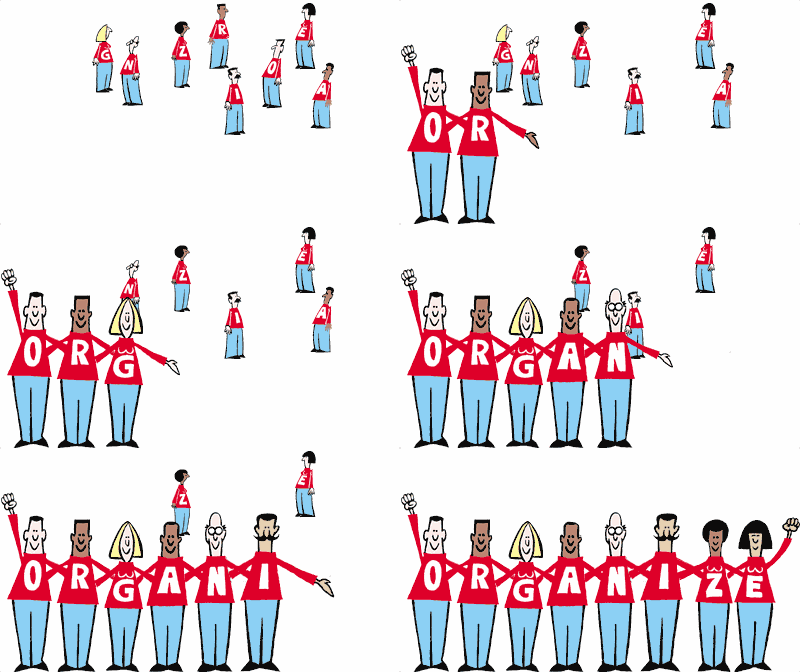
Organize!

Image result for Organize! animated gif

I wish we had our own form of ALEC (The American Legislative Exchange Council, the right wing billionaire funded group dedicated to influencing state and national policy), a collective of organizations whose efforts overlap in the fight to save democracy. It is great to have “too many” allies, but not if they are crippled by overlapping marches, competing agendas, etc. I have no idea how that could work, and probably in the absence of a godfather with billions to give out (which would destroy its purpose). So, we will probably all simply have to dole out our support to them all, or pick one or two…? Some are regional, some are specific to a particular effort.
My daughter, Becky, is flooded with responsibilities to a half dozen regional causes that she can’t resist. They include anti-fracking, alternative banking, and now a collective one called The Four Freedoms Campaign. They have gathered many agencies and citizens to join together to support each other as crises develop. They are sponsoring a citizen training day where they will offer workshops on a variety of ways to respond to the current crisis. This work is mostly in western Massachusetts, centering in Pittsfield but also spills over to NY state.
Then! I just got off the phone with Harry Boyte, with who I share the Bridging Differences blog on Education Week. We got into a heated argument and resolved it about whether the metaphor of war used in political battles, especially when real power is at stake, is counter-productive. There was a moment there where it sounded Organize! | Deborah Meier on Education:


 Image result for Organize!

CURMUDGUCATION: PA: Charter Reform Sort of Revisited

CURMUDGUCATION: PA: Charter Reform Sort of Revisited:

PA: Charter Reform Sort of Revisited
Pennsylvania charter law is rather a mess. In April of 2016,  State Auditor General Eugene DePasquale issued a blistering report, dubbing PA charter law the "worst in the nation." There have been occasional legislative attempts to address the issue, but these bills have often confused "reform" with "give charters more freedom and opportunities to suck up public tax dollars."


Harrisburg has a history of using charter reform as a fig leaf to cover up charter giveaways. Early egregious attempts included a bill that would have taken a swipe at cyberschool funding but also would have made all sorts of folks authorizers of charter schools, making it infinitely easier to launch one in PA. There was an attempt to fix things, sort of,  back in 2015-2016 with proposed HB 530, a bill that public school organizations like the school board association declared a non-starter because it loosened accountability on charters, allowed the state charter appeal board to overrule local districts, and didn't address the out-of-control costs of charters in Pennsylvania. The reasons to oppose the bill were many. The bill passed both the house and senate, but was ultimately a victim of the Great Budget Snafu of 2016 and was last seen disappearing into the rules committee in June of 2016

Now it's back.

Representative Mike Reese has revamped HB 530 into HB 97. Reese represents District 59 and has an actual BS in Education, though he went on for an MBA.

Here's his version of what HB 97 does. Highlights include:
CURMUDGUCATION: PA: Charter Reform Sort of Revisited:

Is repeating third grade — again and again — good for kids? - The Hechinger Report

Is repeating third grade — again and again — good for kids? - The Hechinger Report:

Is repeating third grade — again and again — good for kids?
A state makes students repeat third grade, sometimes more than once, to help them learn to read

Thousands of Mississippi’s third graders will sit in front of computers later this month to take the statewide reading test, but the eyes of teachers and administrators at Finch Elementary School will be intensely focused on a dozen students at this Wilkinson County school.
These 12 students are among about 2,300 across the state who were held back in third grade this school year — out of 39,000 third graders who took the test — because they were unable to pass the statewide standardized reading test last year. Efforts to push students like these 2,300 into literacy represent the central thrust of Mississippi’s controversial Literacy-Based Promotion Act, the Third Grade Gate.
Legislation signed by Mississippi Gov. Phil Bryant four years ago mandated both that schools hold back students who can’t pass the reading proficiency test and that schools take measures to make sure students get additional services when they are held back. At Finch, those measures took the form of one-on-one instruction, tutoring, daily monitoring, a new third-grade teacher and smaller third-grade classes.


But kids who repeated third grade still have a hurdle to overcome before they move on to fourth grade. The law says that when third graders sit to take the test again — scheduled throughout the state April 17 to 25 — those youngsters who were held back last year can be held back a second time if they can’t pass the test this go-round. That shouldn’t happen if there is any value to Bryant’s idea that holding students back for a year and giving them extra help will improve their literacy — Bryant has said he benefitted greatly when he had to repeat third grade. If many of those students fail a second time, however, the state’s new initiative could be a huge waste of money.
Last year was the first year that retained students were forced to take the third-grade test again. But state officials didn’t track how many of those students passed the test or how many were forced to go through third grade a third time, according to Kymyona Burk, Is repeating third grade — again and again — good for kids? - The Hechinger Report:


The biggest loss in education is the loss of teachers’ voices | Eclectablog

The biggest loss in education is the loss of teachers’ voices | Eclectablog:

The biggest loss in education is the loss of teachers’ voices


I received the note below from a former student who is now a teacher. For obvious reasons, I won’t identify her or where she teaches, but–shockingly–her story is becoming all too common…
We had a union meeting yesterday where they warned us that the governor is going after the certificates of teachers that opted out their kids (of the state tests). The governor says it breaks our contract agreeing to protect and follow educational laws. Is this legal? Teachers are being targeted and warned to be extremely careful, especially on public media. I was just curious on your thoughts.
This theme of administrators and elected officials threatening teachers if they speak out publicly against tests, the Common Core State Standards, or other education policies seems to be growing stronger and louder recently, with reports of similar stories popping up in New MexicoLouisianaNew YorkArizonaMissouri, and Michigan.
In Rochester, NY, an email from an administrator to the city’s principals asked them to keep a list of teachers who might have shared information on testing for possible disciplinary action:
An email sent from a high-level Rochester City School District official to principals is causing concern among teachers.
Chief of Schools Beverly Burrell-Moore sent the email Monday afternoon to principals she supervises. The email asks them to share names of teachers who have encouraged parents to refuse to allow their children to take state exams.
“Per your building, please identify teachers who have sent letters or made phone calls to parents encouraging them to opt out their children from the NYS Assessments. Also, identify teachers who you have evidence as utilizing their classrooms as ‘political soap boxes.’ I need this updated information no later than Tuesday morning for follow-up,” the email states.
Audrey Amrein Beardsley, a professor of education at Arizona State University, and the author of one of my favorite education blogs on the web, VAMBOOZLED, reports:
“New Mexico now requires teachers to sign a contractual document that they are not to ‘diminish the significance or importance of the tests” or they could lose their jobs. Teachers are not to speak negatively about the tests or say anything negatively about these tests in 
The biggest loss in education is the loss of teachers’ voices | Eclectablog:

Teacher Shortage as "Shock Doctrine" Part II | BustED Pencils

Teacher Shortage as "Shock Doctrine" Part II | BustED Pencils:

Teacher Shortage as "Shock Doctrine" Part II

Since writing a letter to my teacher education colleagues and then posting it to my blog some things have happened.  I shared it with some legislators.  One remarked, “he’s right but….”
Great. I’m right. But that’s not enough to stop the crazy train?
That tells me that this issue will only get legs when public school supporters realize that warm bodies—not teachers—are about to be foisted upon our most vulnerable communities. Parents, teachers and children need to communicate directly with their legislators.
Short recap and background: In Wisconsin we have decided that the teacher shortage is a human capital issue and not a case of “battered spouse syndrome.”  The leadership group (literally called the Leadership Group) was formed to address the shortage and put forward a proposal to strip appropriate license developmental ranges and content area expertise and allow for an “emergency” license that can be renewed indefinitely without completing a certification track.
Since the release of the document referenced above, I have remained firm that nothing in the document will do a damn thing about the teacher “shortage.” The policy driver reaffirms the manufactured crisis—shock doctrine—and simply seeks to fill classrooms with humanTeacher Shortage as "Shock Doctrine" Part II | BustED Pencils: 

Mike Klonsky's SmallTalk Blog: Duncan's latest donut. He claims that kids drop out because school is 'too easy'

Mike Klonsky's SmallTalk Blog: Duncan's latest donut. He claims that kids drop out because school is 'too easy':

Duncan's latest donut. He claims that kids drop out because school is 'too easy'

"Everybody has a plan until they get punched in the mouth." -- Mike Tyson
In yesterday's Tribune op-ed piece, Arne Duncan jumps in behind Rahm Emanuel's call to make every kid "have a plan" and to make it more difficult for Chicago's predominantly students of color, to graduate from high school.

Neither Duncan nor the mayor are talking about increased school funding or a more rigorous curriculum, a term that is itself problematic, or anything to do with teaching/learning. Instead they want to use bureaucratic powers to force students to get letters, proving that they've been accepted into college, a job, the military or some other program before receiving a diploma. They both are assuming of course that there are jobs and affordable college seats waiting to accept them. That's quite an assumption in these times.

I'm not sure what that would mean for students who want to travel to Europe or Africa, write a novel, paint a masterpiece or drive a cab.

As Dewey once said: "Education is not preparation for life; education is life itself" (that's John Dewy, Arne. Not the admiral or Huey and Louie's brother). Duncan does allow for a "gap year" before college or military adventures in Syria (he himself avoided military service) but what about a gap two years? Or even a lifetime?

All this amounts to simply another top-down, unfunded mandate, reminiscent of Rahm's imposed longer school-day/school-year. Now, as budget realities set in, the mayor is threatening to shorten the school year by three or four weeks. I wonder who's going to keep track of and verify all those college acceptance and internship letters when they can't even afford to keep the schools open?

In his op-ed Duncan claims that students, "don't drop out because school is too hard. They drop out because it is too easy". This statement, coming from a non-educator who somehow was put Mike Klonsky's SmallTalk Blog: Duncan's latest donut. He claims that kids drop out because school is 'too easy':


We Were Warned: The DeVos Family: Meet the Super-Wealthy Right-Wingers Working With the Religious Right to Kill Public Education | Alternet

The DeVos Family: Meet the Super-Wealthy Right-Wingers Working With the Religious Right to Kill Public Education | Alternet:

The DeVos Family: Meet the Super-Wealthy Right-Wingers Working With the Religious Right to Kill Public Education
By now you've surely heard of the Kochs. Meanwhile, the powerful, wealthy DeVos family has remained largely under the radar, while leading a stealth assault on America's schools.


Since the 2010 elections, voucher bills have popped up in legislatures around the nation. From Pennsylvania to Indiana to Florida, state governments across the country have introduced bills that would take money from public schools and use it to send students to private and religious institutions.
Vouchers have always been a staple of the right-wing agenda. Like previous efforts, this most recent push for vouchers is led by a network of conservative think tanks, PACs, Religious Right groups and wealthy conservative donors. But "school choice," as they euphemistically paint vouchers, is merely a means to an end. Their ultimate goal is the total elimination of our public education system.
The decades-long campaign to end public education is propelled by the super-wealthy, right-wing DeVos family. Betsy Prince DeVos is the sister of Erik Prince, founder of the notorious private military contractor Blackwater USA (now Xe), and wife of Dick DeVos, son of the co-founder of Amway, the multi-tiered home products business.
By now, you've surely heard of the Koch brothers, whose behind-the-scenes financing of right-wing causes has been widely documented in the past year. The DeVoses have remained largely under the radar, despite the fact that their stealth assault on America's schools has the potential to do away with public education as we know it.
Right-Wing Privatization Forces
The conservative policy institutes founded beginning in the 1970s get hundreds of millions of dollars from wealthy families and foundations to develop and promote free market fundamentalism. More specifically, their goals include privatizing social security, reducing government regulations, thwarting environmental policy, dismantling unions -- and eliminating public schools.
Whatever they may say about giving poor students a leg up, their real priority is nothing short of the total dismantling of our public educational institutions, and they've admitted as much. Cato Institute founder Ed Crane and other conservative think tank leaders have signed the Public Proclamation to Separate School and State, which reads in part that signing on, "Announces to the world your commitment to end involvement by local, state, and federal government from education."
But Americans don't want their schools dismantled. So privatization advocates have recognized that it's not politically viable to openly push for full privatization and have resigned themselves to incrementally dismantling public school systems. The think tanks’ weapon of choice is school vouchers.
Vouchers are funded with public school dollars but are used to pay for students to attend private and parochial (religious-affiliated) schools. The idea was introduced in the 1950s by the high priest of free-market fundamentalism, Milton Friedman, who also made the real goal of the voucher movement clear: “Vouchers are not an end in themselves; they are a means to make a transition from a government to a free-market system." The quote is in a 1995 Cato Institute briefing paper titled “Public Schools: Make Them Private.”
Joseph Bast, president of Heartland Institute, stated in 1997, “Like most other conservatives and libertarians, we see vouchers as a major step toward the complete privatization of schooling. In fact, after careful study, we have come to the conclusion that they are the only way to dismantle the current socialist regime.” Bast added, “Government schools will diminish in enrollment and thus in number as parents shift their loyalty and vouchers to superior-performing private schools.”
But Bast's lofty goals have not panned out. That's because, quite simply, voucher programs do not work.

Governor Jeb Bush to deliver keynote address at AFC’s annual Summit - American Federation for Children

Governor Jeb Bush to deliver keynote address at AFC’s annual Summit - American Federation for Children:
Governor Jeb Bush to deliver keynote address at AFC’s annual Summit 


The American Federation for Children, the nation’s voice for educational choice, is pleased to announce that school choice champion and former Florida Governor Jeb Bush will deliver a keynote address at its annual National Policy Summit – Monday, May 22, and Tuesday, May 23, in Indianapolis, Indiana.

“Governor Bush has been at the forefront of the educational choice movement, and we are thrilled he will be joining us in Indianapolis for this year’s Summit,” said Bill Oberndorf, Chairman of the American Federation for Children. “His bold and visionary leadership has been instrumental in our efforts to give millions of families across the country educational freedom, and hearing his insights on the state of our education revolution will be a highlight at this year’s event.”


"Betsy's Boy"

 "Betsy's Boy"
(You're not a kid anymore)
When people ask of me
What would you like to be
Now that your not a kid anymore
(You're not a kid anymore)
I know just what to say
I answer right away
There's just one thing
I've been wishing for...
I want to be Betsy's Boy
That's the most important thing to me...
And if I was Betsy's Boy
If I was Betsy's Boy
What a faithful, thankful boy I'd be
Each night I sit at home
Hoping that she will phone
But I know Betsy has someone else
(You're not a kid anymore)
Still in my heart I pray
There soon will come the day
When I will have her all to myself...
I want to be Betsy's Boy
That's the most important thing to me...
And if I was Betsy's Boy
If I was Betsy's Boy
What a faithful, thankful boy I'd be
I want to be Betsy's Boy

 Be My Baby


What you need to know about immigration enforcement in schools | MLive.com

What you need to know about immigration enforcement in schools | MLive.com:

What you need to know about immigration enforcement in schools

Image result for What you need to know about immigration enforcement in schools


Image result for What you need to know about immigration enforcement in schools

Success Academy wrong to suspend special needs kid for 45 days - NY Daily News

Success Academy wrong to suspend special needs kid for 45 days - NY Daily News:

Success Academy marks big failure by suspending special needs student for 45 days

Based on the facts of the case, Success Academy’s decision to suspend a student with a disability for 45 days cannot be condoned.
Even if the child had no special needs, the child has a right to an education and a 45-day suspension seems excessive.
Whatever punitive or remedial rationale for the suspension could reasonably be accomplished in much less time.
Moreover, children with special needs have specific due process rights prior to lengthy suspensions that do not appear to have been followed here.
A “manifestation determination review” must be held to assure that the behavior does not arise from the child’s disability, as the parent alleges.
It would simply be unfair to punish a child for behavior not within his control. In short, this appears to be a classic “push-out” situation.
Aside from these Draconian measures, the matter raises questions about whether the child’s special needs wereSuccess Academy wrong to suspend special needs kid for 45 days - NY Daily News:


New Study: Why Teachers Created a New Genre: The “I Quit” Letters | Diane Ravitch's blog

New Study: Why Teachers Created a New Genre: The “I Quit” Letters | Diane Ravitch's blog:
New Study: Why Teachers Created a New Genre: The “I Quit” Letters


There is a photograph circulating on Twitter of a teacher recruitment fair in Michigan, in a large room with many tables staffed and ready for recruits. But the room is empty. It is a sad picture, dramatizing the effect of the current policy atmosphere on the profession.
Please note that the empty job fair was held in Michigan. That is Betsy DeVos’s home state. Apparently in her dream school of the future, computers will replace teachers. That has long been the gospel of Jeb Bush. If you harass teachers enough, they will go away and everyone can go digital.
A new study was just released by two professors at Michigan State University analyzing what they call a new genre: the teacher resignation letter.
I have posted many resignation letters on this site. They are usually anguished, sometimes angry, always sorrowful. They come from people who had a calling to teach, but could not stand the demands on them by administrators nor the frequency of high-stakes testing. Working in a climate that requires compliance and subservience, one that expects you to abandon your professional ethics, is not appealing for most professionals.
I have posted many such letters. The one that got the most overwhelming response was written by North Carolina teacher Kris Neilsen. It was published October 27, 2012, and received 165,000 views. Nearly 900 people commented on it. It went worldwide.
Here is the report on the teacher resignation letter as a genre:
In a trio of studies, Michigan State University education expert Alyssa Hadley Dunn and colleagues examined the relatively new phenomenon of teachers posting their resignation letters online. Their findings, which come as many teachers are signing next year’s contracts, suggest educators at all grade and experience levels are frustrated and disheartened by a nationwide focus on standardized tests, scripted curriculum and punitive teacher-evaluation systems.
Teacher turnover costs more than $2.2 billion in the U.S. each year and has been shown to decrease student achievement in the form of reading and math test scores.


“The reasons teachers are leaving the profession has little to do with the reasons most frequently touted by education reformers, such as pay or New Study: Why Teachers Created a New Genre: The “I Quit” Letters | Diane Ravitch's blog:
 Image result for I Quit

For-Profit School Chain Camelot Suffers Setback Following Abuse Allegations - ProPublica

For-Profit School Chain Camelot Suffers Setback Following Abuse Allegations - ProPublica:

For-Profit School Chain Camelot Suffers Setback Following Abuse Allegations

After our reporting on alleged physical abuse of students at alternative schools run by Camelot Education, a Georgia school district delayed awarding a $6.4 million contract to the company.

Image result for Camelot Under Siege

This story was co-published with Slate.
The Muscogee County School Board in Columbus, Georgia, dealt another blow to embattled Camelot Education when it voted Monday night to delay for three months a decision on whether to hire the company to run its alternative education programs.
The delay in awarding the $6.4 million annual contract comes in the wake of a recent report by ProPublica and Slate that more than a dozen Camelot students were allegedly shoved, beaten or thrown by staff members — incidents almost always referred to as “slamming.” The for-profit Camelot runs alternative programs across the country for more than 3,000 students, most of whom have emotional or behavioral difficulties or have fallen far behind academically.
"The abuse allegations were one of many red flags for me,” said Muscogee school board member Frank Myers, one of five board members who supported postponement, while three were opposed. If the district is going to privatize such an important service, he said, “You ought to have an outfit that has a pristine record.”
The board bucked the wishes of school district officials, including Superintendent of Education David Lewis, who pushed to hire Camelot. “There was no transparency,” Myers said. “They wanted us to rush this thing.”
Instead, a community advisory council will be created, and additional public hearings will be held. The council is expected to report back within three months.
Efforts to reach Lewis were unsuccessful. Camelot spokesman Kirk Dorn said in an email that the company often encounters delays when it enters new partnerships. The company expects to meet with the community later this month “and will continue to ensure that those who still have questions get answers,” Dorn said. “We know from experience that the more a community learns about how we help students succeed the more reassured they become that we will be an asset.”
Camelot has faced recent setbacks in other states as well. On March 9, the day after the report was published, the Houston school board voted unanimously not to renew its For-Profit School Chain Camelot Suffers Setback Following Abuse Allegations - ProPublica:

Where Corporal Punishment Is Still Used In Schools, Its Roots Run Deep : NPR Ed : NPR

Where Corporal Punishment Is Still Used In Schools, Its Roots Run Deep : NPR Ed : NPR:

Where Corporal Punishment Is Still Used In Schools, Its Roots Run Deep

Image result for spare the rod spoil the child

Robbinsville High School sits in a small gap in the Smoky Mountains of North Carolina. Green slopes dotted with cattle hug in around the school before they rise into a thick cover of pine trees.
David Matheson is the principal here. And he's the only high school principal in the state who still performs corporal punishment. At Robbinsville, corporal punishment takes the form of paddling - a few licks on the backside Matheson delivers with a long wooden paddle.
North Carolina state law describes corporal punishment, as "The intentional infliction of physical pain upon the body of a student as a disciplinary measure."
Robbinsville High School's policy allows students to request a paddling in place of in-school-suspension, or ISS. Last year, 22 students chose it.
"Most kids will tell you that they choose the paddling so they don't miss class," Matheson says.
One of those students is Allison Collins. She's a senior now and says she chose to be paddled her sophomore year after her phone went off in class. She describes it as, "My first time ever being in trouble."


Collins went to the assistant principal's office where she was told she had a day of in-school-suspension. Collins told Principal Matheson she'd rather take a paddling and so he called her father to get permission.
"And my dad was like, 'Just paddle her,'" she says. "Because down here in the mountains, we do it the old-school way."
That's the policy here. Principal Matheson paddles a student only if he gets permission from their parent. And, he says, very few parents opt out. Matheson grew up here and went to school with a lot of his students' parents. "It's something that the family decides," he adds.
Nationwide, it's not unusual for parents to support the use of corporal punishment as a form of discipline. Recent surveys show about 75 percent of Americans believe it's sometimes necessary to spank a child.
"I think it goes back to traditional values," says Cheri Where Corporal Punishment Is Still Used In Schools, Its Roots Run Deep : NPR Ed : NPR: