Latest News and Comment from Education

Monday, November 21, 2016

Spotlight on the "Doggedly Determined" Education Voters of Pennsylvania | Schott Foundation for Public Education

Spotlight on the "Doggedly Determined" Education Voters of Pennsylvania | Schott Foundation for Public Education:

Spotlight on the "Doggedly Determined" Education Voters of Pennsylvania


In honor of #GivingTuesday on November 29th, the Schott Foundation has reached out to some of our grantee partners to get the low-down on what they do, who they’re doing it for, and the challenges that they handle like rockstars every day.
In 2006, as a part of the Schott Foundation’s Opportunity to Learn Campaign, Education Voters of Pennsylvania was formed to mobilize the public will necessary to ensure that all children have the opportunity to learn and can benefit from and contribute to our country’s vast social, economic and civic opportunities.
Today, we’re catching up with Susan Spicka, Executive Director.
WHO: Education Voters of Pennsylvania (EVPA)
WHERE: Pennsylvania
WHAT: Pro-public education
THEIR FICTIONAL CHARACTER OF CHOICE: The Little Engine That Could
SF: Tell us about the organization – how did it get started, and why?
SS: Education Voters of Pennsylvania is an affiliate of The Schott Foundation for Public Education, and a non-profit, non-partisan organization. We were established in 2007 to promote a pro-public education agenda with elected leaders, state lawmakers and the public.
What’s the mission of EVPA?
Our mission is to build public demand and pressure for quality schools and an opportunity to learn for all students, regardless of their ZIP code. We make sure that public conversation is focused on the need for adequate funding for public schools and equal opportunities for all students in Pennsylvania.
What are the core activities that you engage in?
EVPA engages parents and community members throughout Pennsylvania through public events, social and print media and advocacy trainings. We then educate and train supporters and create opportunities for action. We play a unique role in bringing together and raising up diverse voices that support great public schools for all children.
What challenges do you face?
We have a polarized state government and a legislature that has failed for decades to prioritize adequate state funding for public schools, most specifically for schools that educate the most vulnerable children in the Commonwealth. In addition, Pennsylvania’s schools are among the most segregated in the nation, and Black and Hispanic students are far less likely than their white peers to have access to essential and critical resources and learning opportunities.
Our advocates throughout the Commonwealth of Pennsylvania play a critical role in advocating for sound education policies and holding lawmakers accountable for their votes. Our work is time and labor intensive, and we need additional resources in order to reach more communities, train more citizen leaders and keep the heat on more policymakers.
How would you describe the people you advocate for?
We advocate for young children in Pennsylvania who lack access to quality Pre-K programs and for poor and minority students who face a deep deprivation of resources in their underfunded public K-12 schools.
“Seeing the impact of our policy wins on Pennsylvania’s children is the most fulfilling part of our work.”
For young children, the single most important thing we can do to put them on the road to academic success is to expand quality Pre-K opportunities. Pennsylvania’s K-12 public school students need access to educational opportunities, including small class sizes, a rich curriculum, up-to-date resources and technology and quality teachers in order to be successful in school today and prepared for college or a career after graduation.

What’s the most fulfilling part of your work with EVPA? 
Seeing the impact of our policy wins on Pennsylvania’s children is the most fulfilling part of our work.
Statewide, we were leading advocates for a new and fair funding formula that has directed more than $400 million in increased state funding to public schools over the past two years. This formula prioritizes funding for schools that educate Pennsylvania’s most educationally vulnerable students and has increased resources available to students in our most underfunded schools.
We also contributed significantly to achieving the implementation of a soda tax in Philadelphia, which will enable 2,000 additional children in Philadelphia to attend Pre-K programs this year. Over the next five years more than 4,500 additional Pre-K seats will be added. This funding will also be used to implement 25 community schools in the School District of Philadelphia.
So – compare EVPA to a fictional character.
Education Voters of PA is like the Little Engine That Could. We are a small organization that knows its mission and is doggedly determined to achieve our goal. We are not daunted by challenges and have the courage and strength to do whatever it will take to ensure that all of Pennsylvania’s public school students will have the opportunity to attend a quality public school that provides them with an opportunity to learn.
Thanks, Susan!
#GivingTuesday is a chance for all to support incredible work happening around the country.
Don’t forget to 
keep EVPA in mind on November 29th!
Check out EVPA’s website, and follow them on Facebook and Twitter to keep up-to-date!


 Spotlight on the "Doggedly Determined" Education Voters of Pennsylvania | Schott Foundation for Public Education:
Some fight back news that came across my desk. | Fred Klonsky

Some fight back news that came across my desk. | Fred Klonsky:

Some fight back news that came across my desk.

15136018_10154177871707399_836643418143565797_n


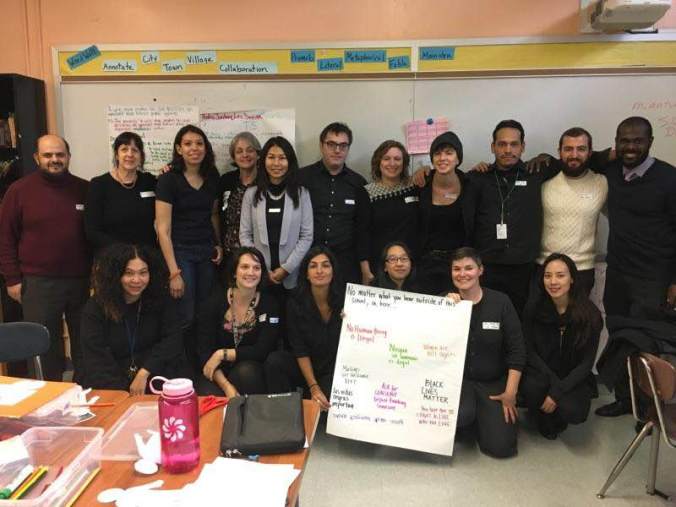
Brooklyn’s International High School at Prospect Staff participating in the UFT Day of Action against racism, homophobia and misogyny.
TUES, 12:30PM: Rep. Guzzardi introduces bill to prevent IL dollars from building Trump’s border wall
Calls on Gov. Rauner to stand against Trump’s agenda of hate
WHO: State Rep. Will Guzzardi (39th District)
WHAT: Rep. Guzzardi will announce the introduction of HB6628, new legislation that would divest Illinois’ pension funds from any company that participates in building a border wall with Mexico.
“On Election Day, the people of Illinois sent a clear message: we stand for justice, for inclusiveness, for basic decency toward all people, regardless of the color of their skin or the country of their birth,” Rep. Guzzardi said. “We won’t invest our taxpayer dollars in building walls and scapegoating immigrants. Those aren’t Illinois values.”
WHERE: James R. Thompson Center, 100 W Randolph St, Chicago, Blue Room
WHEN: Tuesday, Nov. 22, 2016, 12:30PM
Elected officials join parents, teachers and principals to deliver more than 1,300 petition signatures to DePaul University to demand that it directs all proceeds from the sale of the new South Loop basketball stadium’s naming rights  to CPS. DePaul, a private university, received more than $55 million in public tax increment financing support for the construction of the arena. Last week, DePaul announced it had sold the naming rights to the stadium to Wintrust Bank for a profit of a currently unknown sum.
“DePaul has benefited from millions in subsidies in taxpayer dollars at the expense of our public schools and other public institutions that were already starved for resources,” said Wozniak. “It’s time for DePaul to do the right thing and help ensure our schools have the resources they need to educate Chicago kids. DePaul’s board of trustees should give alumni like me something to be proud of, and move to direct all profits from the naming rights sale to CPS.” Some fight back news that came across my desk. | Fred Klonsky:


CURMUDGUCATION: MI: State Tells Students To Get Lost (If you can read this, don't thank Gov. Snyder)

CURMUDGUCATION: MI: State Tells Students To Get Lost (If you can read this, don't thank Gov. Snyder):

MI: State Tells Students To Get Lost (If you can read this, don't thank Gov. Snyder)

Last September, seven Detroit school children filed suit against the state of Michigan for depriving those children of an actual education. The state's defense is... well, not encouraging.


Let's dispense with the obvious first. While I don't have a lot of background on the case, I'm going to guess that the seven school children didn't save their lunch money and then put in a call to California law firm Public Counsel. Nor do I think these seven precocious urchins said, "Perhaps you could use our situation to establish a heretofore unestablished constitutional right to an education in the US, using our case to break new grounds in jurisprudence. Can we be done in time to watch Spongebob?" One actual fun note though-- while most of the plaintiffs are public school students, one is a student from a now-defunct charter. At any rate, I guess this is how important lawsuits are filed these days.

Here's what one plaintiff, Jamarria Hall, has to say:

I have friends who can’t read, but it’s not because they aren’t smart, it’s because the State has failed them. I feel like Governor Snyder doesn’t care about me or my friends. We stood up for ourselves and wrote letters asking him to fix our school. But he never gave us a response.

And here's what the class action lawsuit has to say:

Decades of State disinvestment in and deliberate indifference to the Detroit schools have denied 
CURMUDGUCATION: MI: State Tells Students To Get Lost (If you can read this, don't thank Gov. Snyder):


People Power Trounces Big, Dark Money, as Charter Expansion Suffers Decisive Defeat - Network For Public Education

People Power Trounces Big, Dark Money, as Charter Expansion Suffers Decisive Defeat - Network For Public Education:

People Power Trounces Big, Dark Money, as Charter Expansion Suffers Decisive Defeat

screen-shot-2016-11-17-at-5-02-06-pm

A bright spot in an extremely dark election landscape came from Massachusetts voters, who soundly defeated a ballot question to lift restrictions on charter school expansion last week. Question 2 would have allowed 12 new or expanded charters a year, every year, forever, eventually allowing billions of dollars to go from district schools to charters.
The question’s defeat was a victory for public schools and for the power of educating the public about charter schools. The Save Our Public Schools campaign’s message, disseminated by an army of teachers, parents, grandparents and students, proved more compelling than the false narrative carried on a huge wave of out-of-state dark money, the most ever spent on a Massachusetts ballot initiative. The margin of defeat was a decisive 62 to 38 percent.
The yes side, backed by Wall Street, hedge funders and other wealthy backers of “education reform,” spent twice as much as the no side on TV ads. The “No on 2” team, in contrast, invested in building a grass roots movement that made more than 1.5 million voter contacts in doors knocked and phone calls made, as well as many other one-to-one conversations with family, friends and neighbors. All told, the yes side spent $24 million to the no side’s $14.5 million.
Massachusetts voters were subjected to an onslaught of confusing and contradictory TV ads. Yes on 2 ads tried to counter No on 2’s central message, that charters were already siphoning hundreds of millions of precious education dollars away from traditional district schools, which educate 96% of the Commonwealth’s students. Their ads claimed that public schools were not being harmed, that charters actually brought more money (the logic being that charters are “public” schools, so the state’s inadequate reimbursement formula added to the overall education funding pie). But anyone connected with an actual public school could see shrinking resources and cuts to things like art, music, science, transportation, and librarians.
I canvassed every weekend from the summer through the fall and saw that the confusion created an opportunity to appeal to voters’ common sense. How could it be possible to create a new, publicly funded, privately managed school system and not take resources away from existing schools? Add to that the fact that a bipartisan state commission concluded we are already underfunding our schools by at least $1 billion a year, and the picture starts to come into focus.
And consider that first 100, then 150 and finally 214 Massachusetts school committees passed resolutions opposing Question 2 and the People Power Trounces Big, Dark Money, as Charter Expansion Suffers Decisive Defeat - Network For Public Education:


President of nation's largest teachers union: "We have every reason to fear" Trump | Bloglander

President of nation's largest teachers union: "We have every reason to fear" Trump | Bloglander:

President of nation's largest teachers union: "We have every reason to fear" Trump

NEA president Lily Eskelsen Garcia celebrating American Education Week at Rogers High School on Wednesday - PHOTO COURTESY OF NEA PUBLIC RELATIONS


On Wednesday, the head of the National Education Association, Lily Eskelsen Garcia, visited Spokane for the first time. 

The NEA is the nation's largest teachers union. Garcia, a former Utah teacher of the year, has been NEA president since 2014. She came to Spokane Wednesday for an event at Rogers that honored cafeteria workers who call themselves the "Lunch Bunch." By the end of the school day, seemingly half the Rogers students were cheering the Lunch Bunch on as the workers stepped into giant limousine. 

I caught up with Garcia while this was going on and asked her some questions about national and local education issues. She weighed in on the charter school debate, what makes Roger High School special, and why she's fearful of what a Donald Trump presidency will mean for public education. 

Read some of the highlights from the conversation below. The Inlander  edited her responses for length. 

InlanderSo this is your first time in Spokane? It is! I actually went to Queen Anne High School in Seattle, so I know Washington. But I've never actually been to Spokane. 

This school happens to be the school that an [education support professional] named Debby Chandler works at. Debby Chandler works here in the office, and she was elected nationally to be the president of the council of ESPs. So you have a national leader at this school, and she brags about this school all the time. She brags that, you know, five years or so ago, the graduation rate at Rogers was 47 percent, and last year it was 84 percent. 

Something good is happening here. And they're hooking it all towards really humanizing education. The relationships amongst the students themselves, the faculty and the students, the community and the students, they're taking great pride in this building itself. And it's making a difference.

Do you see Rogers as being one of the models for how a school can turn it around?
Absolutely. We do consider what's happening here a model for the nation. 

And how are they doing this? It's not a product that this district bought. It's not more test prep. It really is giving people the time to feel like they're family ... what they've discovered here, the magic — the secret sauce — is, you know, we can actually just do stuff that we want to, like this pep rally. Let's get everybody in the hall and let's clap for these people that are never recognized, the lunch ladies, and let's get a limo. The kids loved that. They loved planning it. They loved deciding who was gonna be recognized. And when it comes from — it sounds like a cliche — when it comes from the roots, when it comes from the community, then there's joy to it. You're not doing it because someone told you to.

There's been a battle in this state over charter schools. Do you think there is a way for charter schools to work? That is such a good question ... I mean, that is the question. 

I'll give you a good example: In Milwaukee right now, three of our members, teachers who were English language learners as students and they're teaching in inner-city Milwaukee, a very poor Latino community. And they said, you know, we see our school system treating the English language learner kids coming in the way we were treated, like we had a disability, like there was something wrong with us that we spoke Spanish as our major language. They said "we want to try something totally different." And they started the ALBA School, the Academy of Language and Fine Arts.

It's part of the Milwaukee public school system. It's not some for-profit chain, and everything is wrapped around culture, literature, poetry, art, music, dance, food. How do we get the parents involved? You still have your ABC's, you still have your times tables, but it's bilingual and they wrap it around Latino culture. 

How different is that than a for-profit franchise charter chain that's copyrighted so they're not inviting anybody to come in and learn from them? Or some little charter that basically said, "We are the charter school of excellence and we only accept excellent students who pass our test." 

Some of these charter schools are not part of the school district. They may have a school in the boundaries, but they have absolutely nothing to do with the school district and improving the school district, and yet they're taking the tax dollars and are sometimes highly subsidized by foundations and receive a lot more money for what they're doing. 

And so you have to constantly ask yourself, if these are your limited public schools dollars, where is the best place to put them? We believe it's in a school like Rogers. We believe it's in the services and supports that these kids need. You could open up a charter school across the street, but the question would be, at what expense to Rogers High School?

Have you had a chance to learn about any of the charter schools in Spokane?No. 

There's two — one in this neighborhood. In Spokane, there hasn't been too many issues so far, but is your point that some of these issues are inevitable if charters keep popping up?Let's take New Orleans. In New Orleans, what they did is they have no public schools left. None. And that was by design. When Katrina hit, it hit everybody's schools ... They rebuilt and modernized all the white suburb public schools. They ended up better than before and they bulldozed the public schools in the black neighborhoods. And then they just said 'Alright, come one come all, open up charter schools and let's see how you do.' And a lot of them have done very poorly. 

One of the questions that I think everyone is having after the election is what Trump's presidency is going to mean for education. What's your take? What are you anticipating?We could not be morePresident of nation's largest teachers union: "We have every reason to fear" Trump | Bloglander:

ALLIANCES BETWEEN SOCIAL JUSTICE ACTIVISTS IN COMMUNITIES OF COLOR AND TEACHERS UNIONS

Policy Briefs | New Jersey City University:

DEVELOPING AND SUSTAINING MUTUALLY RESPECTFUL ALLIANCES BETWEEN SOCIAL JUSTICE ACTIVISTS IN COMMUNITIES OF COLOR AND TRANSFORMED TEACHERS UNIONS


SUMMARY
Currently teachers unions and education activists in communities of color in cities are often at odds about reforms that are enacted in the name of equalizing educational opportunity. Yet, each group has resources the other lacks and they share many common aims. Working together they might achieve considerably more than either can alone, especially if differences of tactics or substance turn them into foes rather than allies. This first Brief of the Urban Education and Teacher Unionism Policy Project explains the Policy Project’s mission: supporting activists working to improve schools for poor youth of color to benefit from working with transformed teachers unions as allies and supporting teachers unions to develop mutually respectful alliances with school and community activists from historically marginalized groups struggling for social justice and equality. The Policy Project bases its work on the assumption that creating and sustaining these alliances requires that teachers unions change how they operate and conceive of what it means to defend their members’ interests and all parties grapple with the differing and sometimes contradictory pressures on social justice groups and unions. Lois Weiner, Director of the Policy Project, explains the Project’s aims and purpose and how Briefs can further those objectives. Sally Lee, Executive Director of Teachers Unite, a grassroots membership organization of teachers working to end the school to prison pipeline and democratize New York City, comments about the challenges for activists who work with teachers unions, suggesting how the Policy Project and Briefs can be of use. The Brief ends with a short bibliography of materials that inform the Policy Project’s unique mission and vision.
Policy Briefs | New Jersey City University:

Mike Klonsky's SmallTalk Blog: Corporate ed reformers throw in with Trump

Mike Klonsky's SmallTalk Blog: Corporate ed reformers throw in with Trump:

Corporate ed reformers throw in with Trump

Ivanka Trump visits Eva Moskowitz' Success Academy Charter School. 
It looks like they've dropped their phony rhetoric about charter schools being "the civil rights issue of our time." Following the Democrat's devastating loss to Trump, one by one, the corporate reformers and champions of privately-run charters are jumping the Dems' ship and throwing in behind the racist, anti-immigrant Trump education movement.

For some, the move is nothing new. Former D.C. chancellor, Arne Duncan fave, and Waiting for Superman star Michelle Rhee for example, turned to selling her talents to the far right as soon as voters ran her and Mayor Fenty out of town. She went to work advising FL Gov. Rick Scott on school privatization and union-busting matters.

Now that she's stepped down from leadership of her anti-union ed group, Students First,  she's considering leaving her new position with a national fertilizer company if Trump offers her the job as his secretary of education. Her problem is that she's a proponent of Common Core. Trump isn't. But either of them can easily accommodate the other's position since Rhee sees Common Core's value mainly in its testing provisions, enabling teachers to be evaluated, hired and fired on the basis of student test scores. There should be a basis for unity with Trump there somewhere.

And her scandal-ridden past, including her connection with D.C. test-cheating scandalshouldn't bother the Trump transition team too much considering the rest of his recent Mike Klonsky's SmallTalk Blog: Corporate ed reformers throw in with Trump:


The Day the SUPERs Came to the Ohio Statehouse - Network For Public Education

The Day the SUPERs Came to the Ohio Statehouse - Network For Public Education:

The Day the SUPERs Came to the Ohio Statehouse


The Ohio Legislature’s ALEC (American Legislative Exchange Council) majority has been actively pushing legislation geared towards privatizing Ohio public schools for quite a while, drastically reducing state funding while diverting taxpayer dollars away from local public school districts to charter schools and other for-profit education companies. Gov. John Kasich, an ALEC alumnus, strategically took control of the state Board of Education by appointing many advocates of “school choice” to the Board, and he continues to micro-manage the school privatization agenda from the governor’s office.
Ohio parents, educators, and other public education advocates have been speaking out against the many pieces of the privatization movement, such as high-stakes testing, ever-expanding vouchers, and unaccountable charter schools. Public Education Partners (PEP), a non-profit organization dedicated to the support of publicly accountable schools for all, was formed as a statewide umbrella structure to help unite the growing numbers of advocacy groups that believe in public education and fight to protect it.
Public Education Partners and other public education groups encourage local grassroots activists to educate and engage others in this ongoing struggle to preserve traditional public education. PEP uses its social media presence, education summits, rallies, and other events to empower Ohioans to lobby their legislators and the state school board to ask them to listen to local educational leaders before passing educational rules and policies.
Advocates are also encouraged to attend local school board meetings to speak with school district leaders to get them involved in actions that will create public awareness about their great loss of local tax dollars for the benefit of for-profit education companies. School leaders are asked to come together as anThe Day the SUPERs Came to the Ohio Statehouse - Network For Public Education:

Trumplandia 2016 (Prelude): What Mainstream Media Hath Wrought | the becoming radical

Trumplandia 2016 (Prelude): What Mainstream Media Hath Wrought | the becoming radical:

Trumplandia 2016 (Prelude): What Mainstream Media Hath Wrought

Image result for Trumplandia


The election of Barack Obama prompted a rash claim that the U.S. was officially post-racial. As a cruel commentary on that misinterpretation of the first black president, the era of Donald Trump has coincided with the Oxford Dictionary naming “post-truth” the word of the year.
Part of being “post-truth” includes that which shall not be named.
For example, “[a]n Alabama police officer has been fired for sharing racist memes, including one about Michelle Obama,” reports Lindsey Bever of the Washington Post. But the police department’s explanation for the firing is important to analyze:
Bryant, the city manager, said statements that are “deemed to be biased or racially insensitive or derogatory” can affect the community’s trust in the police department and, when that happens, “we have to take action to correct it.”
Not racist, not racism, but “racially insensitive.”
While Bever does use “racist” in the lede, later she explains:
Since Donald Trump was elected president, a wave of racially and religiously motivated acts of intimidation, violence and harassment have swept across the country — from a middle school in Michigan and a high school in Pennsylvanian to universities in Texas and elsewhere.
Not a wave of racism, but “racially motivated acts.”
And while this article and the incidences Bever details are mostly about how racists and racism have been confronted and with consequences (multiple firings of public officials), the piece still reflects the tendency in the U.S. for mainstream media to avoid or tiptoe around directly naming racists and racism.
Tressie McMillan Cottom, Ph.D., an assistant professor of sociology at Virginia Commonwealth University and faculty associate with Harvard University’s Berkman Klein Center for Internet & Society, explains in a detailed blog post:
I said over two years ago that media style guides precluded major newspapers from calling something racist.
Then I asked around and professional media people told me that there isn’t a style convention on this matter so much as an informal culture. The general rule, I was told, is to never call anything racist and certainly to never call anyone racist. At best, they might quote someone calling something or someone racist.
The implication is that there is no such thing as objectively racist. Racism, according to many mainstream media producers and gatekeepers, can only be subjective.
While, again, Bever’s journalism is relatively bold in this context identified by Cottom, the authority figure in the article represents well a fundamental problem in the U.S. with naming racists and racism.
For example, in 2014, when high school students dressed in black faceTrumplandia 2016 (Prelude): What Mainstream Media Hath Wrought | the becoming radical:

Teachers told their students everything would be OK after the election. Now, they're not so sure - LA Times

Teachers told their students everything would be OK after the election. Now, they're not so sure - LA Times:

Teachers told their students everything would be OK after the election. Now, they're not so sure

For months leading up to the presidential election, elementary school teacher Ingrid Villeda tried to instill in her students a certain faith in democracy.
The 18-year veteran of L.A. Unified’s schools looked for simple ways to decode the ugly back-and-forths on TV. She taught her fifth-graders about the virtues of a democratic nation in which ordinary citizens study the candidates’ policy positions and then choose their leaders. She wore suffragette white on election day and told them the story of how women fought for and won the right to vote.
Within the walls of Villeda’s school, 93rd Street Elementary, where roughly three-quarters of the students are Latino, Donald J. Trump and his vow to deport millions of immigrants living in the country illegally seemed far away and fictional. That is, until the morning after the election, when Villeda’s students ran to her in the schoolyard, the sleepless night written on their faces.
“People really don’t like us?” asked a girl from Mexico. “What are we going to do about that?”
Recalling this moment in a phone conversation, Villeda began to cry. “They’re looking at me to be able to stand in front of them and say, ‘You’re OK; we’re going to be fine.’ ”
For students and teachers in the nation’s second-largest school system, the repercussions of America’s choice for president are likely to be both profound and lasting. In L.A. Unified, 74% of the roughly 600,000 students are Latino, and many have relatives and acquaintances who are living in the U.S. without legal permission.
Children are coming to school shrouded in anxiety, asking teachers to interpret the day’s headlines for them, examining each bit of news for its potential threat.
“Am I safe?” many want to know, voicing new concerns about immigration raids or hate-inspired attacks against religious and ethnic minorities as well as LGBT people.
“All week long they’ve been kind of like zombies, numb from shock, and so have a lot of educators,” said Martha Infante, 46, a social-studies teacher at Los Angeles Academy Middle School. The day after the election, she said, was the most difficult day of her career.Teachers told their students everything would be OK after the election. Now, they're not so sure - LA Times:
Image result for trump  latino children

From Policy To Personnel: Pence's Possible Influence On Education | StateImpact Indiana

From Policy To Personnel: Pence's Possible Influence On Education | StateImpact Indiana:
From Policy To Personnel: Pence’s Possible Influence On Education


President-elect Donald Trump is continuing to name his choices for top cabinet positions, with 60 days until he assumes the Oval Office. One role that’s still up in the air: Secretary of Education.
Sure, there are rumors who it could be, including former Indiana superintendent Tony Bennet and U.S. Rep. Luke Messer, but there’s no official announcement yet.
As it stands, Trump doesn’t have much of a record on education for us to look at. But Vice President-elect and Indiana Gov. Mike Pence, who now heads the transition, does. A lengthy one.
“I suspect that vice president-elect Pence is going to have enormous weigh over the transition process,” says Mike Casserly, executive director of Council of Great City Schools, which represents over 60 urban school systems. “The policies and positions and philosophies that he has espoused in Indiana are not unique to the Trump positions.”
So, what can Pence’s record tell us about where education could go under a Trump administration, a new education department and new person at its head? Let’s take a look.

Hoosiers Could Land Top Education Job

A handful of people with ties to Indiana education and Pence have are rumored to be possible education secretary picks: former superintendent Tony Bennett, former Gov. Mitch Daniels, and U.S. Rep. Luke Messer.
Messer, who represents Indiana’s 6th district, is a member of the House Committee on Education and the Workforce.
He’s been a critic of President Barack Obama’s guidance that schools should allow transgender students to use the bathroom of their choice. He supports school choice, letting families use state- or federally-funded vouchers to send children to private or charter schools.
“I don’t know if I’m being considered,” Messer said, in a statement sent by a spokesperson. “But I am excited about President-elect Trump’s bold education proposals and eager to do whatever I can to help make those proposals a reality for American families.”
Bennett and Daniels are champions of school choice and founded Indiana’s school choice voucher program in 2011. It’s now the largest voucher program of any state in the country, serving 33,000 students.
Trump is expected to appoint the Secretary of Education soon, but Casserly, of Council of Great City Schools, says it’s still early in the transition process.
“Frankly, at this point, it’s probably not worth a whole lot of time trying to speculate which person it might be,” Casserly says.

What Do State Superintendents Want From An Education Secretary?

But we know someone new is coming. So, what do top state education officials want in the country’s top education official?
Well, we asked.
“We’d like to see someone who has state experience and has actually had to interact with school districts,” says Chris Minnich, director of Council of Chief State School Officers. “Our education system is a very complicated system.”
CSSO represents all state superintendents of education. Minnich says, regardless of who comes into office, an education secretary will have to oversee the rollout of a brand new federal education law – the Every Student Succeeds Act, a rewrite of No Child Left Behind.
That law returns many education policy decisions to local states. Indiana officials are in the midst of drafting a new education plan under that law.
“We’re at a really critical time for states to step up and lead,” Minnich says. “We want a secretary that, in that context, that is ready to help states lead, but not be over prescriptive to them about what they should do.”
Many of Trump’s outlined education policies – ending Common Corea $20 billion school choice program – are in line with Pence’s beliefs. Choice has now become a defining element of Trump’s vision for education.
Minnich says it makes sense that Pence will have a influence over who becomes the next education secretary.
“Indiana’s going to be heavily involved, as you know, in a lot of these picks because of Gov. Pence,” Minnich says. “Gov. Pence will be heavily involved in that process.”From Policy To Personnel: Pence's Possible Influence On Education | StateImpact Indiana:

Hoosier School Heist TV is Doug Martin's channel featuring videos of his book tour across Indiana speaking on the corporate takeover of public education. Order Hoosier School Heist at http://hoosierschoolheist.com/.
Follow Hoosier School Heist on Facebook: https://www.facebook.com/HoosierSchoolHeist
Tweet with Doug Martin at: https://twitter.com/DougMartinED

State says literacy not a right in Detroit

State says literacy not a right in Detroit:

State says literacy not a right in Detroit


Attorneys for Gov. Rick Snyder say no fundamental right to literacy exists for Detroit schoolchildren who are suing the state over the quality of their education.
The governor’s lawyers are asking a federal judge to reject what they call an “attempt to destroy the American tradition of democratic control of schools.”
Timothy J. Haynes, an assistant attorney general, made those statements in a 62-page motion to dismiss a lawsuit filed against Snyder and state education leaders in September by seven Detroit children who allege decades of state disinvestment and deliberate indifference to the city schools have denied them access to literacy.
The motion was filed last week in U.S. District Court in Detroit.
Haynes says claims laid out by plaintiffs — including deplorable building conditions, lack of books, classrooms without teachers, insufficient desks, buildings plagued by vermin, unsafe facilities and extreme temperatures — go far beyond mere access to education.
“(They) ask this court to serve as a ‘super’ Legislature tasked with determining and dictating educational policy in every school district and school building throughout the United States where an illiterate child may be found,” the response says.
“Such a path would effectively supersede democratic control by voters and the judgment of parents, allowing state and federal courts to peer over the shoulders of teachers and administrators and substitute court judgment for the professional judgment of educators.”
The Detroit schoolchildren, represented by a California public interest law firm, sued state officials Sept. 13 in what legal observers say is an unprecedented attempt to establish that literacy is a U.S. constitutional right.
The suit claims the state has functionally excluded Detroit children from the state’s educational system. It seeks class-action status and several guarantees of equal access to literacy, screening, intervention, a statewide accountability system and other measures.
Attorneys representing the students say the filing highlights shocking problems in some Detroit schools and is the first of its kind in the nation that seeks to secure students’ legal right to literacy under the 14th Amendment.
The state is asking U.S. District Judge Stephen Murphy III to dismiss the case, saying the U.S. Supreme Court and Michigan courts do recognize the importance of literacy, but reject claims it is a legal right.
“But as important as literacy may be, the United States Supreme Court has unambiguously rejected the claim that public education is a fundamental right under the Constitution. Literacy is a component or particular outcome of education, not a right granted to individuals by the Constitution,” Haynes says.
In his motion, Haynes denies the state of Michigan has been responsible for the operation of the schools in Detroit since 1999, which is alleged in the lawsuit, and says the state does not operate or control public schools in Detroit.
“Contrary to plaintiffs’ assertions, the ‘state’ never ran any of the schools, although emergency managers have been appointed to supplant local authority, where necessary,” Haynes says.
DPS has been under the control of a state-appointed emergency financial manager since 2009. Emergency Manager Steven Rhodes is scheduled to step down on Dec. 31 and a newly elected Board of Education begins its work on Jan. 1.
Kathryn Eidmann, staff attorney for Public Counsel, which is representing the schoolchildren, said the state’s response was disappointing and did not come as a surprise.
What Eidmann says she found interesting was: the 62-page motion ignored the grim reality Detroit schoolchildren face every day inside classrooms.
“There is no mention about the fact that hardly any of the students have access to teachers or books. These are schools where no state officials or state lawyer would send their child,” she said.
DPS has struggled for years with declining enrollment, comparatively low test scores and spending scandals that have left students without needed supplies.
A $617 million aid package approved by lawmakers this summer relieved the district of nearly a half-billion dollar debt and provided $150 million in startup funding for a new, debt-free Detroit Public Schools Community District.
The plaintiffs are students at four of the lowest-performing schools at the Detroit Public School Community District: Hamilton Academy; Medicine and Community Health Academy at Cody; Osborn Collegiate Academy of Mathematics, Science and Technology; and Osborn Evergreen Academy of Design and Alternative Energy.
One plaintiff is a former student at Experiencia Preparatory Academy, a privately operated charter school that closed in June.
The lawsuit is asking the court to order the state to provide relief that includes “appropriate, evidence-based literacy” instruction at all grade levels and to address physical school conditions that impair access to literacy.
Murphy is expected to hear motions from both Public Counsel and the state in February to decide whether the case moves forward.