Latest News and Comment from Education

Sunday, September 25, 2016

Michigan: Third Grade Flunk Club Rears Its Ugly Head. Again - Teacher in a Strange Land

There is No Such Thing as Social Promotion - Teacher in a Strange Land - Education Week Teacher:

There is No Such Thing as Social Promotion

Image result for 3rd grade reading billImage result for 3rd grade reading bill


Alternate title: Third Grade Flunk Club Rears Its Ugly Head. Again.
It seems that the promoters of "kids who fail have to be smacked upside the head with their shortcomings" have hit on a recycled tactical meme every educator is familiar with: using "social promotion" as a boogeyman to drive home the point that some kids just don't deserve to move ahead to a new grade. With their peers and friends.
It's hard to keep track of which states require retention as punishment (let's call it what it is--this has nothing to do with "accountability") for non-readers. The latest good data I could find says at least 16 states require public failure for students who are not reading at grade level, determined by a standardized test--with several combinations of out clauses.
In some states, parents can refuse retention. In others, teachers or principals can stop the flunk train, for "good cause." Some states allow alternative assessments, others let students with IEPs off the hook. It's a muddle.
An ugly, pointless muddle. But it's "for their own good," right?
After five years of threatening to pass a 3rd grade reading bill, then retreating to deal with other damaging legislation, Michigan joined the Third Grade Flunk club last week. The final showdown was over whether a reading teacher-principal combination could prevent automatic failure. Answer: no.
By far the best analysis of this bill came from attorney Nick Krieger (who thinks it's unconstitutional). Here's his conclusion, but the whole piece is brilliant, relevant and worth a read:
HB 4822 would burden Michigan's public schools with new and complex responsibilities.  It would increase costs for local school districts.  It would send the false message that Michigan's reading teachers are "failing."  It would largely reject the notion that children learn to read in different ways and at different rates.  And it would probably violate the state constitution.  Education experts, not politicians, should be making decisions about elementary-school reading proficiency. 
Nobody in ed-world denies that learning to read is critical to success in school and life. Google "third grade reading" and you will pull up millions--literally--of blue-ribbon reports and advocacy articles on how we have to get kids reading, the sooner the better. Tick-tock.
Somewhere in the first two paragraphs, the writer will probably assert that before third grade, kids learn to read, but after third grade, they read to learn. It's the second-most used cliché, right after "social promotion."
Here's the irony: We have now let "data" rather than compassion and professionalism run the very arbitrary grading system that automatically sorts children by age, achievement, effort, and even character. We're still relying on Frederick Winslow Taylor's theories on "efficiency," when sorting students by age, then dividing them into tracks (based on teachers' opinions) was socially acceptable.  All of these practices are so familiar that they feel natural--scientifically precise, even reasonable. But they're not.
Nothing is ever neat and tidy in education --especially learning. Kids learn at different rates. Their ultimate achievement is genuinely unpredictable. In the flood of anger over this new law, parents are sharing stories about their child who was a non-reader at age 8, but is currently working as an engineer--or spoke no English when the family emigrated when she was in kindergarten, but graduated at the top of her high school class. Imagine what labeling them failures would have done.
In addition, the schools that will have to bear the significant costs of retaining more children--upwards of $10,000 per--are often the very places where that money could be put to better use: free after-school tutoring or backpacks full of books to keep, for starters.
What's most frustrating is that legislators and wrong-headed commenters are buying the "social promotion" myth when, to quote David Berliner: It seems like legislators are absolutely ignorant of the research, and the research is amazingly consistent that holding kids back is detrimental.
Consider this: high-achieving Finnish children begin formal schooling, including reading instruction, at age seven. A single year before 17 or more states start separating out and labeling weak readers.
So--I spoke with my representative in the Michigan House (who serves on the Education Committee) explaining why I thought this bill was a disaster. He thanked me, noting that he was a meat cutter and not a teacher. I asked about ALEC, the "model-legislation" source for this bill.
Oh no, he said. "It didn't come from ALEC, it came from Florida. They came and did a presentation for us. The year after they first retained third graders, the fourth grade scores went way up." I paused--surely he understood why, if you take all the struggling readers out of the class, scores would go up. But no.
There is no such thing as social promotion. We should be teaching the kids we get, with their strengths and weaknesses. We should have the resources to provide extra help for those who need it. And we should stop playing political games with their self-concept. There is No Such Thing as Social Promotion - Teacher in a Strange Land - Education Week Teacher:
Image result for grade retention

Big Education Ape: Gov. Rick Snyder takes Michigan Down a Hole on 3rd grade reading bill that could hold back struggling students | MLive.com - http://bigeducationape.blogspot.com/2016/09/gov-rick-snyder-takes-michigan-down.html

Big Education Ape: Classrooms with rats instead of teachers: Is Detroit denying children of color their right to an education? - LA Times - http://bigeducationape.blogspot.com/2016/09/classrooms-with-rats-instead-of.html

ALEC is Excited About the New Testing Provisions in the Every Student Succeeds Act (ESSA), so is iNACOL | Seattle Education

ALEC is Excited About the New Testing Provisions in the Every Student Succeeds Act (ESSA), so is iNACOL | Seattle Education:

ALEC is Excited About the New Testing Provisions in the Every Student Succeeds Act (ESSA), so is iNACOL

ALEC3
Personally, whenever a bill in Washington D.C. is praised for its bipartisan nature – I get worried. The common ground discovered by Democrats and Republicans, usually comes at our expense.
The Every Student Succeeds Act  of 2015 (ESSA) is being sold to educators, parents, and the public as being somehow better than No Child Left Behind (NCLB).
You may remember NCLB as the law which declared every student in the United States would be proficient in math and reading by the year 2014 – because ridiculous mandates make things happen.
To the surprise of no one, 2014 came and went and proficiency wasn’t achieved.
In short, the ESSA is better than the last federal education law that was an absolute failure. But why let some inconvenient facts get in the way of a perfectly good marketing strategy?
This may explain why the rollout of the ESSA was so short on specifics, but all about celebrating the historic bipartisanship which went into its passage.
Peak bipartisanship was reached this summer when the NEA made Patty Murray and Lamar Alexander co-recipients of their friend of public education award for getting the ESSA job done. Similar bills had failed in 2007, 2011, and 2013.
Personally, whenever a bill in Washington D.C. is praised for its bipartisan nature – I get worried. The common ground discovered by Democrats and Republicans, usually comes ALEC is Excited About the New Testing Provisions in the Every Student Succeeds Act (ESSA), so is iNACOL | Seattle Education:
Image result for alec exposed

Big Education Ape: Cognitive Dissidence: ALEC Aims to Privatize All Schools - http://bigeducationape.blogspot.com/2016/09/cognitive-dissidence-alec-aims-to.html


Big Education Ape: Mike Pence Has Pushed Hard for School Privatization With Lousy Results - BillMoyers.com - http://bigeducationape.blogspot.com/2016/08/mike-pence-has-pushed-hard-for-school.html

CURMUDGUCATION: ICYMI: Readings from the week (9/25)

CURMUDGUCATION: ICYMI: Readings from the week (9/25):

ICYMI: Readings from the week (9/25)


As always, remember to share and spread the word. Everyone can be an amplifier. 

Don't Believe the Charter School Hype

Charles Pierce is one mainstream journalist who has taken up the cause of public ed and given reformsters some serious grief. Here's his take on the charter push in Massachusetts 

Preaching to the Educhoir

William Ferriter reminds us why preaching to the educhoir is not a waste of time.

A Righteous Anger

Opposing charters is not enough-- not when public schools are screwing up.

Drowning in Systematic Injustice

Rev. William Barber speaks up about the unrest in Charlotte. As always, there is real fire in his words. 

Finance Is Ruining America

Alana Semuels at the Atlantic looks at how hedge funders and other financial wizards are spreading poevrty and screwing up the US economy

This Was the Summer of Charter School Discontent

Daniel Katz runs down the set-backs, disappointment and general shenanigans of the charter industry over the past few months.

M-Stepping Those Results Right Into the Trash Can

Looking at your child's test results in Michigan (though even if you're not in Michigan, some of these issues are very recognizable).

It's not about Race

An exceptional look at race, culture and history, from the Anglo-Saxons to African-Americans


CURMUDGUCATION: ICYMI: Readings from the week (9/25):


Big Education Ape: Catch up with CURMUDGUCATION: The Gates Plan for College + The Word Charters Leave Out - http://bigeducationape.blogspot.com/2016/09/catch-up-with-curmudgucation-gates-plan.html


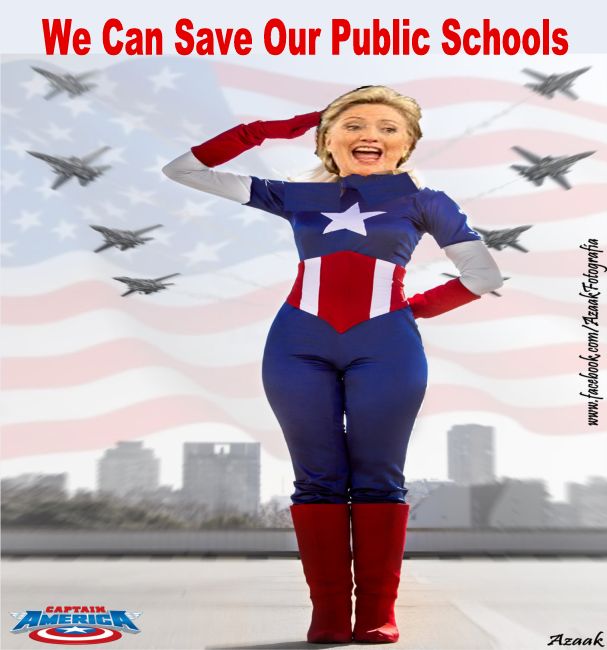
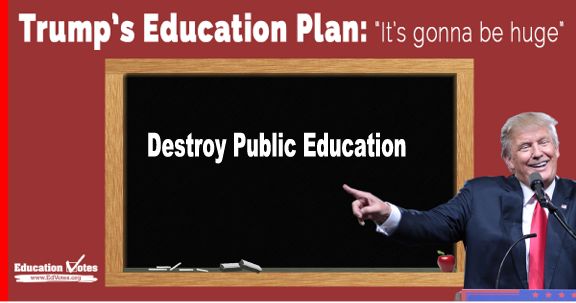
Clinton's plan to Save Public Education / Trump's Plan to Destroy It | 89.3 KPCC

Hillary Clinton's plan for America's students | 89.3 KPCC:

Clinton's plan to Save Public Education / Trump's Plan to Destroy It


Hillary Clinton's plan for America's students

Image result for big education ape hillary clinton education

For nearly as long as she's been in the public eye, Hillary Clinton has counted the well-being of children among her defining causes — from the bestselling 1996 book (and enduring cliche) It Takes A Village to her advocacy for the State Child Health Insurance Program. This presidential campaign has been no exception, except if anything, she's been working even harder to draw connections between investments in education and economic growth. Here's a rundown of her positions from cradle to college.
Early Childhood
Clinton has made childcare and early childhood education a key plank of her campaign, including:
She also has proposals to lower the cost of childcare for families, and particularly for parents who are also college students.
She hasn't talked a lot about how she would pay for these proposals, which theCommittee for a Responsible Federal Budget estimates could cost up to half a trillion dollars.
Higher Education
"Free college" was a major rallying cry for Clinton's primary opponent, Vermont Senator Bernie Sanders. At the Democratic Convention, Sanders gave a speech endorsing Clinton, in which he said:
" ... We have come together on a proposal that will revolutionize higher education in America. It will guarantee that the children of any family [in] this country with an annual income of $125,000 a year or less — 83 percent of our population — will be able to go to a public college or university tuition-free. That proposal also substantially reduces student debt."
Clinton has also proposed a three-month moratorium on all student debt payments. If you're an entrepreneur, the freeze could be extended up to three years. And she's backed universal free community college.
Taken together, the CRFB estimates these proposals could cost another half- trillion dollars if phased in over four years.
K-12 Schools
Clinton talks less about the details of her K-12 education proposals than she does about either higher ed or early childhood — maybe because there's a wider range of opinions among Democrats about the best ways to improve public education.
On her website, she calls for "a campaign to elevate and modernize the teaching profession." On the stump, she's said, "I respect teachers and educators – and I want to give them the support they need to do the job we ask."
Clinton's platform calls for:
It's also worth noting that, at the Democratic National Convention where Clinton was nominated, the party adopted significant changes to its education platform:
  • Support for the right of parents to opt their children out of standardized tests.
  • Opposition to "high stakes standardized tests" used to close schools, withhold funding, or to evaluate teachers.
  • Moderated support for charter schools, insisting that they be "democratically governed" and that they not displace neighborhood schools.
All of these changes were perceived as union-friendly and cut somewhat against the grain of President Obama's education policy. In particular, his Race to the Top initiative explicitly encouraged states to use test scores in teacher evaluations, an approach that's been extremely unpopular with teachers' unions and has also drawn the ire of measurement experts at the American Statistical Association.
It's unclear how these party positions might translate into policy under a Clinton administration.
What we do know is that she was endorsed relatively early, last July, by the American Federation of Teachers. Both Randi Weingarten, head of the AFT, and Lily Eskelsen-Garcia, the head of the other large education union, the National Education Association, have been full-throated Clinton surrogates.
Copyright 2016 NPR. To see more, visit http://www.npr.org/. Hillary Clinton's plan for America's students | 89.3 KPCC:

Image result for big education ape trump education


 "I'm a tremendous believer in education."

So begins a campaign ad for Republican presidential nominee Donald J. Trump.
But what does that mean?
What does Trump believe about how we should fund and fix our schools, train and pay our teachers, and, most importantly, educate every child whether they're rich or poor, fluent in English or anything but, learning disabled or two grades ahead?
To these questions the candidate has offered few clear answers.
"Donald Trump's policy positions are performance art." That criticism comes not from the left but from Rick Hess, who studies education policy at the right-leaningAmerican Enterprise Institute. And, Hess says, "it is an immense mistake to take any of it all that seriously."
Hoping to flesh out Trump's education ideas ahead of tomorrow's big presidential debate, we asked his campaign for help. They never got back to us.
We also reached out to the two men who, as reported by Education Week, have been named to the candidate's presidential transition team for education. Both said they could not talk without permission from the Trump campaign, permission that was not granted.
And so, in trying to get a picture of his education platform, we're left mostly with the candidate's own words.
Let's start with the rest of that campaign ad:
Local Control
"I'm a tremendous believer in education. But education has to be at a local level," Trump says from his leather office chair, looking directly into the camera. "We cannot have the bureaucrats in Washington telling you how to manage your child's education."
This is a common theme for Trump: Washington needs to butt out of our schools.
"There's no failed policy more in need of urgent change than our government-run education monopoly," he said earlier this month at a campaign stop in Cleveland.
In this story line, schools are the business of the local community — of the district — and the U.S. Department of Education is Public Enemy No. 1, pushing down onerous rules that make life harder for educators, students and parents.
While this may sound more like a feeling than a policy position, stay tuned:
On Oct. 18, 2015, Trump told "Fox News Sunday" host Chris Wallace that, if elected President, he would consider cutting the Education Department entirely.
That would be a profound policy shift from past presidents and one worth reckoning with briefly here.
It's not clear if Trump, in cutting the Department, would also cut the services that it provides, but, since his conversation with Wallace was in the context of broader spending cuts it's reasonable to assume he would.
Those services include providing roughly $15 billion in Title I funds to help schools that educate at-risk students, more than $12 billion for students with special needs, and some $29 billion in Pell Grants to help low-income students pay for college (all according to 2016 Congressional appropriations).
Common Core
On February 10, 2016, Trump tweeted: "I have been consistent in my opposition to Common Core. Get rid of Common Core — keep education local!"
In that campaign ad on his website, Trump is even more colorful: "Common Core is a total disaster. We can't let it continue."
The Common Core are learning standards in math and English language arts that were developed through a collaboration between the National Governors Association and the Council of Chief State School Officers. According to the Core's website, they're being used in 42 states and the District of Columbia.
Trump's loathing for the Core needs unpacking — because you have to understand how the standards were created to understand how schools can be "rid of" them.
The Core were adopted by states at the state level. There was no top-down vote from Congress, no presidential signature. Yes, President Obama and his Education Department dangled money in front of states who agreed to do many things, including adopt rigorous new standards. But Washington could not, and did not, force the Core on states. As such, if states want to repeal the standards, they can and have. But a President Trump ... couldn't.
Besides, if he tried, it might feel an awful lot like "the bureaucrats in Washington telling you how to manage your child's education."
School Choice
Earlier this month, in Cleveland, Trump unveiled perhaps the most specific education proposal of his campaign.
"As president, I will establish the national goal of providing school choice to every American child living in poverty," Trump said. "If we can put a man on the moon, dig out the Panama Canal and win two world wars, then I have no doubt that we as a nation can provide school choice to every disadvantaged child in America."
The plan would involve a $20 billion government investment, "reprioritizing existing federal dollars." The money would go to states as block grants and follow disadvantaged students wherever they go: to a traditional public school in their neighborhood or elsewhere, a charter school or even a private school.
While Trump made clear the $20 billion would not be new money, he did not say where he would find that much old money to reprioritize.
This idea, known as portability, is popular in conservative circles because, it is assumed, the competition that comes with choice would force struggling public schools to improve or close. But it worries many student advocates because, they say, it would also drain money from the schools that need it most and send taxpayer dollars to well-resourced private schools.
Higher Education
As with K-12, Trump has said little in detail about planned policies for higher education.
In May, a senior Trump policy advisor, Sam Clovis, did tell Inside Higher Ed that a Trump administration would work to get the government out of the student loan business and restore lending to private banks. The debt issue has gotten a fair amount of attention, as we've covered herehere and here, among other stories.
"We think it (student loans) should be marketplace and market driven," Clovis told Inside Higher Ed. He also said Trump rejects President Obama's proposals to make community college free for new high school graduates.
Would a push to privatize student lending work?
"I just don't think that's realistic," says Eric Hanushek, a Senior Fellow at theHoover Institution, a conservative-leaning think tank at Stanford University. The government has historically played a key lending role and is likely to continue, Hanushek says. "Private lenders are not about to enter into that market sufficiently to make loans to all students. It would be wise not to get the government out of student loans altogether."
The basic mechanics of implementing that kind of public-to-private switch, saysDeborah Seymour with the American Council on Education, "would require such a complicated plan that making that happen might take longer than he's probably currently projecting."
Hanushek adds that many of Trump's statements on education and other topics "are vague, and you could interpret them in many ways."
Child Care
Finally, Trump's take on childcare. The pitch, on his website, tells us what most parents know all-too-well: "Raising a child is now the single greatest expense for most American families — even exceeding the cost of housing in much of the country."
What would President Trump do about that?
He's proposed making all childcare costs tax-deductible for kids up to 13 years old — and for up to four children per household. Deductions would be limited to a state's average childcare cost and to families earning less than $500,000 a year.
Returning to a common theme for Trump — choice — the proposal would cover "a variety of different kinds of childcare—institutional, private, nursery school, afterschool care, and enrichment activities."
Trump's proposal, which he unveiled earlier this month, would also provide six weeks of unemployment benefits to all new mothers. While states cap those benefits, the proposal would be an improvement for many new moms and a big change from current federal policy (which pays them nothing). That said, the plan did raise eyebrows for one word conspicuously missing: Dads.
A lot to digest — but still surprisingly few classroom specifics.
Both candidates, Eric Hanushek says, have largely side-stepped specifics about K-12 education. Clinton talks about universal pre-K and Trump a little about student loans, he says, "but there's this gaping hole in the middle called K-12 education." It's troubling, Hanushek says, as education is "second only to national security" in national importance.
Copyright 2016 NPR. To see more, visit http://www.npr.org/.Donald Trump's plan for America's schools


Diane Ravitch's blog | A site to discuss better education for all

Diane Ravitch's blog | A site to discuss better education for all:

Diane Ravitch's blog | A site to discuss better education for all

Image result for big education ape Diane Ravitch


Leonie Haimson: How DFER Hijacked Public Education
This post was written in 2014, but it remains relevant today. DFER (Democrats for Education Reform) raises large sums of money from hedge fund managers to promote charter schools. The free market has been very good to hedge fund managers, and they think that public schools should compete in a free market too. They are not in the game to make money, but to promote their ideology of free-market com
The Tyranny of Philanthrocapitalism
Antonio Olmedo writes here about the new undemocratic, unaccountable Philanthrocapitalism, as embodied by the Gates Foundation: In 2008, in their Ode to philanthrocapitalism, Bishop and Green claimed that philanthrocapitalists are “hyperagents who have the capacity to do some essential things far better than anyone else”. Apparently, the fact that they “do not face elections every few years, like
Massachusetts: Billionaires Ready to Pour Up to $18 Million into Charter Referendum
Jonathan Pelto reports on the big money that will flow into the Massachusetts referendum on expanding charters. Most of it will flow from the coffers of hedge fund managers, who never showed any prior interest in improving public schools but get excited by the opportunity to privatize them. He writes: A group of billionaires and corporate executives are using a front group called Great Schools Ma
California: Charter Schools Fight for Access to Bond Funds
The Bond Buyer reports that charter schools in California are seeking access to bonds for school construction, putting them into direct competition with public schools for the same money. Public schools have the advantage of stability and longevity; charter schools come and go with frequency. Public schools have higher bond rating than charter schools. Caprice Young, quoted in the article below,
Laura Chapman Explains the Flaws of SLOs (Student Learning Objectives)
Our valued reader Laura Chapman had a long career as a teacher, curriculum developer, and consultant in the arts. It is always a pleasure to post one of her careful essays. A teacher from Hawaii recently wrote to ask if she could read 
 Click on picture to Listen to Diane Ravitch
Diane Ravitch's blog | A site to discuss better education for all:

Schools Matter: How Unions Came to Support ESSA

Schools Matter: How Unions Came to Support ESSA:

Schools Matter: How Unions Came to Support ESSA


We know that much of the rationale for the NEA/AFT/NPE support of ESSA comes from the need to support the Clinton agenda, which is, of course, the Gates agenda, the Broad agenda, etc.  

But long before Hillary became Wall Street's most recent neolib darling, however, there were other reasons for AFT/NEA support for corporate education support that had to do, specifically, with The Union Reform Network's (TURN's) corporate cancer that is metastasizing inside the "teachers' unions."  

The pages below are from this document written by an associate prof and a doctoral student at Rutgers, who were paid by the Gates Foundation for their propaganda.  Of course, look for the stars on the Acknowlegement page to see who else is thanked.

If you have any inkling that the TURN cancer is spreading in your state or town, please contact me.  I am doing some research that is not sponsored by the Gates Foundation.  It is not sponsored at all.
Schools Matter: How Unions Came to Support ESSA:


The Tyranny of Philanthrocapitalism | Diane Ravitch's blog

The Tyranny of Philanthrocapitalism | Diane Ravitch's blog:
The Tyranny of Philanthrocapitalism


Antonio Olmedo writes here about the new undemocratic, unaccountable Philanthrocapitalism, as embodied by the Gates Foundation:

In 2008, in their Ode to philanthrocapitalism, Bishop and Green claimed that philanthrocapitalists are “hyperagents who have the capacity to do some essential things far better than anyone else”. Apparently, the fact that they “do not face elections every few years, like politicians, or suffer the tyranny of shareholder demands for ever-increasing quarterly profits, like CEOs of most private companies” or that they do not have to devote “vast amounts of time and resources to raising money, like most heads of NGOs”, situates them in a privileged position to “think long term”, to go “against conventional wisdom”, to take up ideas “too risky for government” and to deploy “substantial resources quickly when the situation demands it”. These new super agents can solve the problems of the world, and do it fast, cleanly, and absolutely.
Behind Bishop and Green’s philanthrocapitalim, Bill Gates’ creative capitalism, and David Cameron’s Big Society, which are closely related conceptions, is a new relation of ‘giving’ and enacting policy. This relation is based on a more direct involvement of givers in policy communities, that is a more ‘hands on’ approach to the use of donations. In previous writings we have referred to this new political landscape as philanthropic governance, that is the ways in which, through their philanthropic action, these actors are able to modify meanings, mobilise assets, generate new policy technologies and exert pressure on, or even decide, the direction of policy in specific contexts.
Democratic deficit
The problem here, or the problem for some of us, is that the claims and practices of new philanthropy are premised on the residualisation of established methods and traditions of democracy. They see no need to respond to or be accountable for their philanthropic investments to anyone else but themselves. This is what Horne indicates when he claimed that new philanthropists operate in a ‘para-political sphere’[1] within which they can develop their own policy agenda untrammelled by the vicissitudes of politics. What we are facing here is more than just givers who ‘vote with their dollars’[2]. As Parmar puts it: “the foundation-state relationship, therefore, is not a conspiracy – it may be quite secretive and operate behind the scenes, but it is not criminal enterprise. It is, however, strongly undemocratic, because it privileges the right people, usually those with the right social backgrounds and/or attitudes”. The direct involvement of new philanthropists in the para-political sphere enables “some individuals to act as their own private governments, whose power can be used to challenge that of the state and force it to re-examine its priorities and policies”
Gambling with children’s future
Essentially this is a simplification of policy, a cutting out of the messy compromises, dissensus and accommodations that attend ‘normal’ policymaking. But perhaps change is less simple than it seems initially from the perspective of great wealth! In a recent public letter from of Sue Desmond-Hellmann, CEO of the Bill and Melinda Gates Foundation, there is a frank recognition that single-mindedness and a deliberate circumvention of traditional policy actors may not actually be constructive or effective in getting change done.
“… we’re facing the fact that it is a real struggle to make system-wide change.The Tyranny of Philanthrocapitalism | Diane Ravitch's blog: