Latest News and Comment from Education

Wednesday, September 14, 2016

“O say can you see… ?” – Are our children being well educated or merely indoctrinated and trained? | Reclaim Reform

“O say can you see… ?” – Are our children being well educated or merely indoctrinated and trained? | Reclaim Reform:

“O say can you see… ?” – Are our children being well educated or merely indoctrinated and trained?

national-anthem-001


 “O say can you see… ?”

Are our children in school being indoctrinated rather than well educated? Merely job trained for control and obedience?
“It took 117 years from the time ‘The Star Spangled Banner’ was written in 1814 until it was legally enshrined as the American national anthem in 1931.”
This occurred under President Herbert Hoover (R), he of Great Depression infamy, who also claimed he was a conservative progressive and a reformer while he openly opposed anti-lynching laws, lynchings of blacks in primarily Southern states that might vote for him. He waved the flag, jingoed some jingoisms and put a band-aid on unregulated corporate economic greed. He set himself up for re-election and lost.
“By the time Key wrote these words, the British military included a regiment of former slaves called the Colonial Marines, whom the British had encouraged to escape and then trained and armed.
In fact, just weeks before on August 24, 1814, the Colonial Marines had participated in the Battle of Bladensburg outside Washington, D.C. The Bladensburg fight was a quick, embarrassing defeat for American troops — something Key knew because he’d witnessed it close up as a volunteer aide to an U.S. general. The British forces, including the Colonial Marines, had then continued to Washington the same day, infamously occupying and torching the White House.”
The White House was captured and burned by Black Americans who were freed and recruited by our enemy, the British. How many textbooks today even mention this stark “O say can you see… ?” – Are our children being well educated or merely indoctrinated and trained? | Reclaim Reform:

Wall Street’s new way of making money from public education — and why it’s a problem - The Washington Post

Wall Street’s new way of making money from public education — and why it’s a problem - The Washington Post:

Wall Street’s new way of making money from public education — and why it’s a problem


Within the 2015 Every Student Succeeds Act, the K-12 education law that replaced No Child Left Behind, is a provision that provides for the use of federal funds by states and school districts for something known as “Pay for Success.”  The Obama administration has actually been funding Pay for Success programs in education and other areas for years, and Congress likes the concept. It is going to become a big thing in public education over the next few years. So what is it exactly?
According to the Corporation for National & Community Service:
Pay for Success (PFS) has emerged as a new approach for government to partner with the private sector to fund proven community-based solutions. PFS is an innovative contracting and financing model that leverages philanthropic and private dollars to fund services up front, with the government, or other entity, paying after they generate results. This strategy has gained strong bi-partisan support in Congress, as a strategy for increasing return on taxpayer dollars while improving the quality of services provided in our communities.
If it sounds as if it’s a way for the private sector to make money off investments in public education, that’s because it is. Supporters say it is a great way to get private entities to invest in schools that need resources. Critics say it is more likely to help the private entities earn a lot of money than do much for children.Wall Street’s new way of making money from public education — and why it’s a problem - The Washington Post:

New Career & College Transition Division Director - Year 2016 (CA Dept of Education)

New Career & College Transition Division Director - Year 2016 (CA Dept of Education):

State Schools Superintendent Tom Torlakson Appoints Donna Wyatt as Director of Career and College Transition Division

Image result for Donna Wyatt ca cte


SACRAMENTO—State Superintendent of Public Instruction Tom Torlakson announced today the appointment of Donna Wyatt as the new Career and College Transition Division Director at the California Department of Education (CDE). She began her assignment September 6.
“Donna has devoted her professional career to helping students identify their passions and professional callings and providing those students the skills and direction needed to succeed,” Torlakson said. “She will be a tremendous resource for all of our schools. I couldn’t be more thrilled to have her join us in this important role.”
A long-time educator, Wyatt has more than 25 years of experience teaching, developing, and administering Career Technical Education (CTE) programs. Since July 2011, she has worked as the manager of Curriculum and Instruction Career Technical Education (CTE) for the Oakland Unified School District’s Linked Learning office, working with teachers to create CTE curriculum and build out career pathway courses that help connect students with internships and mentorships in a wide variety of fields such as engineering, manufacturing, and media arts.
In her role at Oakland Unified, Wyatt developed an externship program to connect pathway teachers with industry partners. After being placed with a variety of local industry hosts, including the FBI San Francisco and Alameda County Public Health, teachers build curriculum based on their externship experiences, effectively integrating core classes and CTE.
Wyatt has also taught at UC Berkeley Extension as an adjunct professor in the CTE Teacher Preparation and Credential program.
Wyatt began her career as a nurse. After taking time off for the birth of her son, she shifted her professional focus to education, joining the Colton Redlands Yucaipa Regional Occupation Program as a health science teacher. In 2000, she co-founded the HEART Academy at Redlands High School, which connects health occupation students with community internships.
A native of Long Beach, Wyatt holds a bachelor’s degree in vocational education from California State University, San Bernardino, and a master’s degree in educational leadership from California State University, East Bay.
In her new role, Wyatt will oversee efforts to support local educational agencies to improve performance in secondary education, adult education, CTE, workforce development, and distance learning programs. She replaces former Career and College Transition Division Director Russell Weikle, who retired in May.
CTE has undergone a renaissance in California with record investments in hands-on learning, internships, and classes to prepare students for 21st century careers. Currently, more than 776,000 students in the state participate in CTE courses. California’s Career Technical Education Incentive Grant program is the largest of its kind in the nation. Established in the 2015-16 state budget, the program will provide $900 million over the next three years to support and develop 21st century career and college readiness programs throughout the state.
For additional information, visit CDE's Career and College Transition Division Web page.

Image result for cte
Tom Torlakson — State Superintendent of Public Instruction
Communications Division, Room 5206, 916-319-0818, Fax 916-319-0100
New Career & College Transition Division Director - Year 2016 (CA Dept of Education):

Obama administration goes ahead with $71 million grant for Ohio’s scandal-ridden charter sector — but calls it ‘high risk’ - The Washington Post

Obama administration goes ahead with $71 million grant for Ohio’s scandal-ridden charter sector — but calls it ‘high risk’ - The Washington Post:

Obama administration goes ahead with $71 million grant for Ohio’s scandal-ridden charter sector — but calls it ‘high risk’


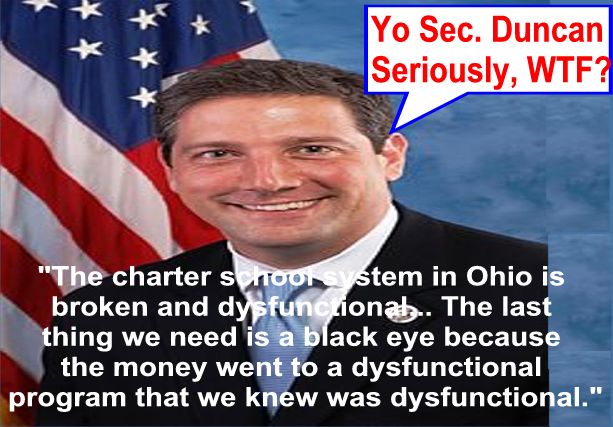
In October, the U.S. Education Department announced $157 million in charter school grants, including a recommended $71 million to Ohio, despite the fact that its charter sector has long been, at best, a mess.
At the time, many in the education world wondered why the department had given any money to Ohio, given that a newspaper had done an analysis revealing that the state’s charter sector had misspent tax dollars more than any other, including school districts, court systems, public universities, hospitals and local governments.
When asked, federal officials admitted that they hadn’t quite realized just how scandal-ridden Ohio’s charter sector was, and decided that it would investigate. In June, Ohio Sen. Sherrod Brown (D)  asked the Education Department to review its grant-making process and said that if the grant was to be given, tough restrictions should be put in place, including an independent monitor.
Then, on Sept. 14, the department said it would go ahead and release the grant with restrictions. According to a letter (see below) sent by the U.S. Education Department to  Ohio Superintendent of Public Instruction Paolo DeMaria, federal officials have completed a 10-month review and have decided to place the grant on “high risk status” but release the money to the state with unprecedented “high risk special conditions”  in place.  Steps the Ohio Department of Education must take, according to the letter, include:
* Hire an independent monitor to oversee all of the conditions placed on the grant.
* Submit documentation to the U.S. Education Department for approval of all withdrawals from the grant account.
* Submit budgets to the federal department for approval a few times a year, as well as semiannual financial reports related to the grant’s use, with those reports being made public.
* Form an advisory committee of parents, teachers and community members to oversee the grant’s implementation.
The letter says in part:
We support innovative models in the public school sector, including public charter schools that meet the highest standards in quality, accountability and transparency. Charters that are serving students well should be supported, and, as with all schools, those that are not meeting their obligations to students should be held accountable.
Held accountable? By getting $71 million in federal funds and having to prove they aren’t misusing it?


Keeping Up | Deborah Meier on Education

Keeping Up | Deborah Meier on Education:

Keeping Up

Image result for Deborah Meier
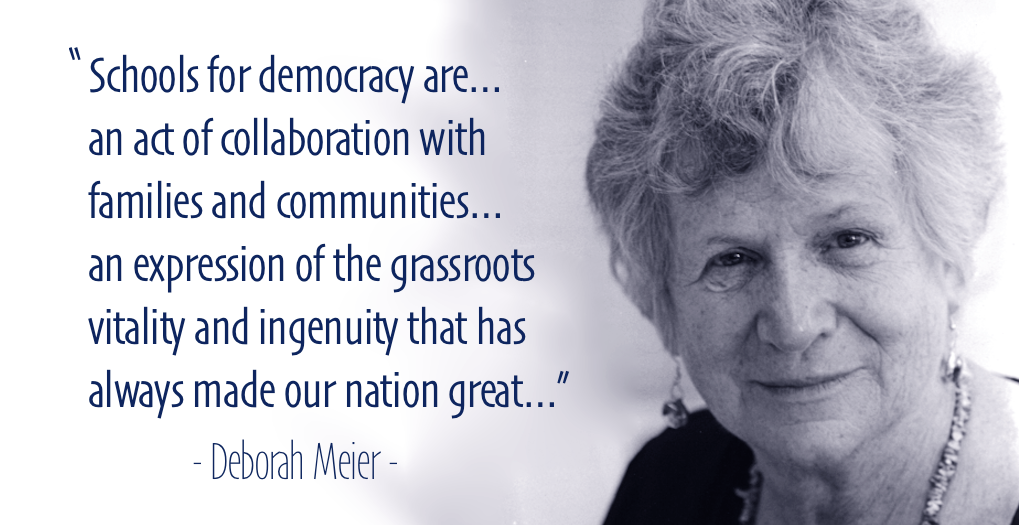
Dear friends…and readers all,
I meant to do better in keeping up with my blog. However, this past year has been a difficult one in terms of basic health issues. First, I had a heart valve replacement and now complications from macular degeneration has caused me to be totally blind in the left eye—which also frequently causes pain too.
Otherwise I live in a lucky bubble. My kids and grandkids are all working at something that is either very satisfying or tolerable. And in good health. I am up here in beautiful Columbia County—swimming once or twice a day, at dawn and sunset, when the sun’s rays don’t bother me. I am catching up on piles of stuff I saved to write about. I shall never get to it all, but it is good for thinking about even if I don’t get to write about it all. Writing does help me clarify my own position on things, and this is a time in my life when I am very interested in reexamining my own history and ideas. I am working on a book (when my sight allows) with my friend Emily Gasoi about our school teaching experiences and what has driven us both, including differences in our histories which we account for in part by the differences in our ages (considerable).
I am also trying to find out more about schools that have tried to be internal democracies and how they fared, as well as how they defined democracy ideally and “in practice.”
I am also hoping someone will do a study of what the small school movement in New York City  did and did not accomplish—particularly the self-starters before the Klein regime—those who designed their own schools with their colleagues and sometimes Keeping Up | Deborah Meier on Education:


School choice, metro Detroit's new white flight | MLive.com

School choice, metro Detroit's new white flight | MLive.com:

School choice, metro Detroit's new white flight

Image result for white flight
By Chastity Pratt Dawsey and Mike Wilkinson | Bridge Magazine
When the high school in Eastpointe recently welcomed the football team from Lakeview High, it was a homecoming of sorts.
That's because nearly 700 students from Eastpointe actually attend school in Lakeview, a public school district five miles away in St. Clair Shores. As it happens, many of the students who left Eastpointe for Lakeview are white.
So it was that on a cool September evening, most students and fans on the home team's side of the football field were African American, while many of their white neighbors filled the Lakeview side. It was a sight that saddened Jennifer Ward, head of the band boosters.
A lifelong Eastpointe resident, Ward, who is white, graduated from the high school in 1988, when almost everyone in the district looked like her. Eastpointe was called East Detroit back then, but residents soon changed its name to distance this blue-collar city in Macomb County from the crime-soaked image of its neighbor to the south. The only vestige of its old name is in its schools, which are still called East Detroit Public Schools.
Ward said she thinks half of those who left East Detroit schools choose other districts for racial reasons. Others, she said, probably did so because the Lakeview schools have better test scores, more funding and better facilities. She admits there is likely no way to know for sure. But she also believes that when neighbors don't go to school together, they don't get to know each other as well as those who do.
"East Detroit is diverse. It's the real world," Ward said. "Everybody should go to school where they live."
The white flight seen in Eastpointe is playing out in districts across metro Detroit and around the state. In the past 20 years, as African Americans have moved out of Detroit and into the suburbs, white parents have, whether by chance or design, used the state's schools of choice program to move their children to less diverse, more white traditional public schools. At the same time, some black families have chosen historically white suburban school districts to send their children, while others are choosing charter schools that are strikingly more segregated and black.
As a result, school districts across parts of the state are ending up more racially segregated than the communities from where they draw students.
Such is the case in Eastpointe.
Consider: The East Detroit school district is only 19 percent white, even though 40 percent of school-age children living there are white. And the flood of East Detroit students to Lakeview, which is 80 percent white, has produced yet another shift: the loss of students prompted East Detroit to solicit students from other cities, mostly Detroit.
"School choice has accelerated segregation by race, by class, by ability, by special education status and by language," said Gary Miron, an education professor at Western Michigan University who has reported widely (and often critically) on Michigan's school choice policies.
But defenders of school choice say the policies produce more good than harm by empowering parents – black and white – whose local schools are failing their children.
Gary Naeyaert, executive director of the Great Lakes Education Project, is one of the staunchest defenders of school choice in Michigan. He acknowledges that choice can financially harm the districts that are losing students.
But he and others contend that education policy should err on the side of School choice, metro Detroit's new white flight | MLive.com:

New requirements on public meetings, notices and records :: SI&A Cabinet Report

New requirements on public meetings, notices and records :: SI&A Cabinet Report :: The Essential Resource for Superintendents and the Cabinet:

New requirements on public meetings, notices and records


(Calif.) Legislation signed late last week will require school districts to provide new notice to property owners about parcel taxes, and give new flexibility in posting public meeting information and responding to records requests.
AB 2257 by Assemblyman Brian Maienschein, R-San Diego, will allow local government agencies–including school districts–to fulfill existing public meeting notification requirements using the Internet beginning in January, 2019.
The author noted in a statement earlier this summer, that the Ralph M. Brown Act was originally adopted in 1953 and needs to be updated to account for the many changes in technology. AB 2257, among other things, will better ensure that public meeting notices will be posted in a consistent, visible location on an agency’s homepage.
The bill makes clear that the online meeting notice must provide a prominent, direct link to the current agenda. Local officials must be careful that the agenda be posted in an open format that meets all of the following requirements:
  • Retrievable, downloadable, indexable and electronically searchable by commonly used Internet search applications;
  •  Platform independent and machine readable; and
  • Available to the public free of charge and without any restriction that would impede the reuse or redistribution of the agenda.
AB 2476 by Assemblyman Tom Daly, D-Anaheim, will require local government agencies–school districts included–to provide non-resident property owners notice about a coming parcel tax vote within 30 days of a measure being placed on the ballot.
The legislation, the author said in a statement, provides more fairness to the process where an out-of-area landowner can potentially face a significant tax increase in the case of an apartment building.
“One East Bay city has a parcel tax of $96 for single-family residential parcels and $72 per multi-family residential parcel,” he said. “If a building has, for example, 100 multi-family units that translates to a parcel tax of over seven thousand dollars. Property owners deserve to know whether they may be facing such a tax.”
The new notices must, among other things, have enough detail to allow each property owner to calculate the amount of the tax to be levied against the owner's property. The method and frequency for collecting the proposed parcel tax must be described and the duration of time the parcel tax will be imposed, as well as the date of the election.
Finally, AB 2853 by Assemblyman Mike Gatto, D-Glendale, gives local government agencies more flexibility when it comes to responding to requests made under the California Public Records Act. Specifically this bill would allow an agency to simply post a response to a records request to its website.
Gatto explained in a statement that his bill seeks to close a loop-hole in the public records law that some private companies have exploited in recent years. He said that school districts especially have been targeted by companies that make record requests for detailed student demographic and academic information sometimes going back years–and then selling the information to data brokers who in turn use the information for marketing purposes.
Under existing law, government agencies are required to respond to public records requests within ten days and make a reasonable effort to otherwise make the information available “promptly.”
Gatto said his bill will allow local agencies the option of using their homepage as the distribution point, making the process more efficient and cost-effective.
“This bill would simply authorize a public agency to direct a requested to those online records, rather than physically retrieving the records and making disclosure determinations for each new request,” he said. “This solution would also be easier for most requesters, though perhaps not satisfactory to private businesses seeking someone to assemble marketable information.”New requirements on public meetings, notices and records :: SI&A Cabinet Report :: The Essential Resource for Superintendents and the Cabinet:
Image result for AB-709 Charter schools.


A&A: The Brown Act and Charter Schools

The Brown Act and Charter Schools
Q: A local public charter school has elected eight people to their Board of Directors this year. This is a public charter school. It is also a 501.c.3 non-profit corporation. The board of directors is self-selecting, self-electing.
Each time a person was elected to the board, either as an interim officer (Treasurer) or as a new board member, the process was listed under Action Items on the Agenda. The word “election” has never been used. The Action Item that resulted in a board member being elected is always listed this way: “Nominations Committee recommendation”
At times, the Secretary even records the number of votes in favor or against, but still, no mention of an election.
Is it legal to hold all these elections, without having listed them as elections?
A: The first issue that needs to be addressed is whether the charter school you refer to is subject to the Brown Act.  Below are some of the factors you might want to look at to determine whether it is.  However, even if the meetings of the charter school’s board of directors are governed by the Brown Act, the Brown Act does not address the organization or composition of legislative bodies nor does it address the election/nomination of its members, and I am not aware of any other California statutes that might apply.  Such organizational issues are typically governed by the internal rules of the governing body itself.  You might want to ask the board for a copy of its bylaws to see if they address the specific issue of director elections.
Applicability of Brown Act to Public Charter Schools:
Whether a charter school is subject to the Brown Act depends on whether the school was “created by” an elected legislative body–or receives funds from a government agency and whose governing body includes a member of the legislative body–for the purposes of the Brown Act.
A body that governs a private (often non-profit) entity may be subject to the Brown Act if it is “created by” an elected legislative body to perform governmental functions, or receive funds from a local agency and has a member appointed by the local agency.  The applicable provision of the Brown Act is Government Code section 54952(c), which defines “legislative body” to mean, among other things:
(c) (1) A board, commission, committee, or other multimember body that governs a private corporation, limited liability company, or other entity that either:
(A) Is created by the elected legislative body in order to exercise authority that may lawfully be delegated by the elected governing body to a private corporation, limited liability company, or other entity.
(B) Receives funds from a local agency and the membership of whose governing body includes a member of the legislative body of the local agency appointed to that governing body as a full voting member by the legislative body of the local agency.
(2) Notwithstanding subparagraph (B) of paragraph (1), no board, commission, committee, or other multimember body that governs a private corporation, limited liability company, or other entity that receives funds from a local agency and, as of February 9, 1996, has a member of the legislative body of the local agency as a full voting member of the governing body of that private corporation, limited liability company, or other entity shall be relieved from the public meeting requirements
of this chapter by virtue of a change in status of the full voting member to a nonvoting member.
You should be able to determine whether the public charter school is receiving funding from a local agency (for instance, by the school district) by reviewing its financial statements.  You should be able to determine if a local agency has the right to appoint a member of the board of directors by reviewing the charter school’s bylaws and/or articles of incorporation.  (The articles of incorporation, if they exist, are also available from the California Secretary of State.)  If both of those conditions exist, the public charter school is subject to the Brown Act and subject to its open meetings requirements.
As to whether the public charter school was “created by” an elected legislative body, this can be more difficult to determine.  California case law indicates that, for example, if a city creates a special local assessment district, collects assessments from local property owners, and provides by ordinance that the programs paid for with those funds
will be governed by a non-profit association, the non-profit corporation set up to govern those programs will be subject to the Brown Act.  (This example comes from a case called Epstein v. Hollywood Entertainment District II Business Improvement Dist., 87 Cal. App. 4th 862 (2001).) You should look for some kind of direct involvement by the city or another local government agency, such as the school district, in the creation of the charter school, such as an ordinance that calls for its creation.  In addition, the articles of incorporation and/or bylaws of the charter school may provide evidence that the city, or other government entity, was responsible for its creation.https://firstamendmentcoalition.org/2009/06/aa-the-brown-act-and-charter-schools/

“Does Governor Jerry Brown Want His Legacy to Be the Privatization of California’s Public Schools?” | Diane Ravitch's blog

“Does Governor Jerry Brown Want His Legacy to Be the Privatization of California’s Public Schools?” | Diane Ravitch's blog:

“Does Governor Jerry Brown Want His Legacy to Be the Privatization of California’s Public Schools?”


Joel Warner writes an investigative article about the fight to bring transparency to California’s charter schools.
He describes the problems that many charter schools have encountered–or created–because of their lack of transparency. He might have added that they are not only non-transparent, they are also unaccountable in their use of public funds:
Since these charters are exempt from most school district laws, there’s nothing on the books compelling them to abide by California’s open-meeting and open-records rules. And these days, California is being singled out for lax oversight of its booming charter school industry. “I came away appalled,” says Carol Burris, executive director of the New York-based Network for Public Education, after a recent fact-finding trip to the state for a four-part series she’s writing on the state of charters in California. “I was really taken aback by how unregulated charters are in the state.”
Part of the problem, says Burris, is Governor Brown’s pro-charter stance; last year he vetoed a bill that would have banned for-profit charter schools in the state, a restriction that even many charter school advocates support. Another factor, says Burris, is that the California Charter Schools Association, which did not respond to a request for comment for this article, has become a powerful lobbying force against many reforms, thanks to major funding from deep-pocketed charter advocates.
Charter critics contend that the absence of regulations contributes to the scandals that have plagued California’s charter schools, including:

Charter operators who were found guilty of misusing hundreds of thousands of dollars in public funds.
A charter principal who moonlighted as an NBA scout on his school’s dime.
A charter teacher who claimed her boss told her to fly to Nigeria and marry her brother-in-law to make him a U.S. citizen.
Last year, a report by the Center for Popular Democracy, the Alliance of Californians for Community Empowerment Institute and Public Advocates Inc. concluded that charter school fraud and mismanagement had already cost California taxpayers more than $81 million. And last month, the American Civil Liberties Union of Southern California and Public Advocates reported that more than 250 California charter schools – one-fifth of the state’s total – violated state law by excluding low-performing and other potentially undesirable students. In both reports, authors concluded that because of minimal oversight, such misconduct findings are likely to be “just the tip of the iceberg.”
Such troubles don’t just generate headlines; they impact students, says Sarah Vigrass, a longtime K-8 teacher at California Virtual Academies (CAVA), the state’s largest online charter school. In July, K12 Inc., the Virginia-based for-profit that manages CAVA, agreed to a $168.5 million settlement with California in the wake of a state Attorney General probe and a Mercury News investigation into whether the company had manipulated its success rates and attendance records. According to Vigrass, over the years she’s seen K12 reduce the quality and quantity of education materials it provides to its students – but she and her colleagues have no way of knowing why that might be happening.
Julian Vasquez Heilig, a professor at California State University, chair of the California NAACP education committee, and a board member of NPE, says in the article about Governor Jerry Brown:
Image result for 'Kids Not Profits'


“Does he want his legacy to be the anti-democratic privatization of our public schools?”
“Does Governor Jerry Brown Want His Legacy to Be the Privatization of California’s Public Schools?” | Diane Ravitch's blog:


 Esquire Blogger: Charter Schools are a Vehicle for Graft and Profit


Charles Pierce is an incisive blogger for Esquire. Whenever he writes about schools, he is right on. In this post, he warns people in Massachusetts against a Question 2, which would expand the number of charters by 12 a year forever. Pierce knows that hedge fund managers and billionaires the funding this campaign, and the proposal is deliberately deceptive, appealing to people to improve their pu
Eric Sheninger: Governor Christie’s Guide to Destroying a Great Public School System
Eric Shininger is a principal in New Jersey. He comes from a family of educators. He is appalled by Governor Chris Christie’s continual attacks on educators who have dedicated their lives to children. He explains he essentials of Christie’s agenda to destroy public education in the Garden State. He writes: “Let’s look at some of the ridiculous decisions Governor Christie has made to derail a grea


New York: Former Chair of State Board of Regents Endorses Vouchers and More Charters
Merryl Tisch stepped down as chair of the New York State Board of Regents at the end of her term in the spring of this year. She recently gave an interview where she expressed her support for nonpublic education. Her view was similar to the plan put forward later by Donald Trump: The public should pay for 

Killing Emmett Till Academy. | Fred Klonsky

Killing Emmett Till Academy. | Fred Klonsky:

Killing Emmett Till Academy.

extralarge-1

Alderman Cardenas, Sadlowski Garza and Arena are on the Council’s Finance Committee trying to get TIF surpluses into cash-strapped Chicago schools. 
Tenth Ward Alderman Susan Sadlowski Garza said the obvious: “If we don’t educate our kids, we got nothing,” She said there are CPS classrooms in her ward with 42 students, as well as a kindergarten class with 39 5-year-olds.
“I really believe we have to put education first,” Garza said.
But this is Rahm’s Chicago and the Finance Committee of the City Council was debating an ordinance submitted by Alderman George Cardenas and amended by Alderman John Arena that would move surplus TIF money to cash-strapped CPS schools.
In typical Chicago Council style, Machine Alderman Eddie Burke, who chairs the Finance Committee, delayed the vote until there was no time for a vote.
Democracy, Chicago style.
Unhappy parents were escorted out.
Chicago Public School elementary school Emmett Till Academy has a budget cut for this school year of $664,132, down 17% from last school year although enrollment is only down 7%.
That’s a loss of $1941 per student based on the school’s projected enrollmentKilling Emmett Till Academy. | Fred Klonsky: 

Documentary Examines 35 Years of Higher Ed Defunding | The Texas Tribune

Documentary Examines 35 Years of Higher Ed Defunding | The Texas Tribune:

Documentary Examines 35 Years of Higher Ed Defunding

Image result for "Starving the Beast

Are public universities nationwide regarded as a public good, or have politicians maneuvered them into becoming business-oriented models where students are the consumers? 
That's the central question of "Starving the Beast," a documentary by Austin-based filmmaker Steve Mims that premiered Tuesday night at Austin's Violet Crown Cinema.
The film looks into how Texas officials perceive higher education as a commodity, linking the decrease in state funding — and coinciding increase in tuition and fees — to massive reductions in government spending, an idea introduced by think tanks that have pushed for education reform in Texas and four other states.
“Over time, the burden of the cost is being shifted from the state over to the students,” Mims said in an interview prior to the premiere. “We started shooting interviews from the [House Select Committee on Transparency in State Agency Operations], and as we started to do interviews with people we realized the story was bigger than UT-Austin and Texas A&M.”
In February, all seven schools of the University of Texas System won approval by the Board of Regents to raise tuition $304 per semester by fall 2017. In 2015, the Texas A&M University System announced it would bump tuition by an additional 2.2 percent for all its university campuses, beginning with the 2016-17 school term.
The documentary suggests the burden of budget shortfall has shifted to students through public reform as government works to expand the private sector. It claims that conservative groups such as the Texas Public Policy Foundation have sought to scale back funding for teachers and college programs. The film argues that conservative think tanks want students in a free market to bear the costs of their own education, disregarding higher education as a public good.
"One of the most controversial elements of reform is looking at whether a professor of a university is a money maker or a money loser," Mims said. "Are we spending money teaching frivolous things, and are people getting degrees where they’re not going to be able to get a job? People try to address it by reforming it."
The "seven breakthrough solutions," a set of changes for Texas public universities proposed by former UT-Austin McCombs School of Business teacher Jeff Sandefer and supported by former Gov. Rick Perry and the TPPF, called for the splitting of research and teacher budgets in 2011.
Former UT president Bill Powers did not support the reforms, arguing on the film he did not want to "get involved in a street fight." As a result of Powers' rejection of the reforms, the film narrates how Documentary Examines 35 Years of Higher Ed Defunding | The Texas Tribune:


One out of five children have mental illness, and schools often don't help | PBS NewsHour

One out of five children have mental illness, and schools often don't help | PBS NewsHour:

One out of five children have mental illness, and schools often don’t help

One out of five children have a mental illness, and many schools do not adequately manage their needs.Photo by Alan Levine/Flickr.

SPARTANBURG, S.C. — On a hot summer day last month, Sydney, 15, and Laney, 8, were enjoying their last two weeks of freedom before school started. The sisters tried to do flips over a high bar at a local playground.
“You’ve got to pull your hips into the bar, like you’ve got to kick up like that,” explained their mother, Selena.
“I tried to kick! I did this — you told me not to stick out,” said Laney indignantly.
Both girls have been diagnosed with mental illnesses — Sydney with bipolar disorder and Laney with a similar illness called disruptive mood dysregulation disorder. The family asked that their last name not be used to protect the girls’ privacy.
School has been a real challenge for them. That’s not unusual for the 1 in 5 children with a mental illness. They often suffer anxiety, difficulty focusing and social challenges. Half of them drop out of high school, in part because many schools don’t manage to meet their needs.
Selena has spent the past eight years trying to get the girls the resources to help them succeed. Like a lot of parents of kids with mental health issues, she’s had to be her children’s biggest advocate.
“It’s definitely a journey. It wasn’t easy,” she said, even though she’s a school guidance counselor herself.
“I used to cry the night before, because I didn’t want to go to school.”
Sydney describes class as “boring, distracting. It’s hard to pay attention. It’s overwhelming.” She struggles to focus or process information, which makes her so anxious and depressed that she often has to leave school in the middle of the day.
She wants to be a rock star like Courtney Love. Every so often she pretends to take drag from a bubble gum cigarette. But she’s an extremely sensitive kid, and school has been a painful experience.
“I used to cry the night before, because I didn’t want to go to school,” she said.
Laney on the other hand is a ball of chaotic energy. At school, she often gets frustrated and acts out. Sometimes, she is sent home.
Schools do not all screen students for mental health issues, and the practice varies One out of five children have mental illness, and schools often don't help | PBS NewsHour: