Latest News and Comment from Education

Monday, November 30, 2015

Marie Corfield: NJ Legislature looks at full day K this week

Marie Corfield: NJ Legislature looks at full day K this week:

NJ Legislature looks at full day K this week


Camden resident and public education activist, Sue Altman, is guest posting today to call attention to an important bill up for a vote this week in the NJ Assembly:


Two important education related bills are up for floor votes in the NJ State Assembly this week. One bill will establish a task force to look at whether full day K should be mandated statewide

Is full day Kindergarten a good thing? On one hand, some parents say that not all little ones can handle being in school for a full, seven-hour day, and they would rather provide enrichment on their own; on the other hand, there are many families who might want and need full day school as soon as possible.

And, importantly, there are worries from parents and others that the mandatory kindergarten would just turn into hours upon hours of sedentary test prep and heavy academic work for our littlest, wiggliest students, who should be spending their days outside, playing and exploring the world. Test prep for little kids is an absolutely terrible thought— surely there is no test prep in kindergarten… right?

Sadly, there is. Given the stakes attached to tests in later grades, it is unsurprising the test prep starts early. The following is an excerpt from a public testimony submitted by Ms. Phyllis Doerr, a Kindergarten teacher in Newark, NJ, from the Study Commission on the Use of Student Assessments in New Jersey.

The antics of the little ones in her class are at once a testament to the wonderful imaginations of 5-year olds, but also a sad illustration of why high-stakes testing affects all students, even when testing is not done in the grade itself. In New Jersey, there is a moratorium on grade span testing in grades K-2, but the long shadow of testing still 
Marie Corfield: NJ Legislature looks at full day K this week:

A Message From Lily - Lily's Blackboard

A Message From Lily - Lily's Blackboard:

A Message From Lily


Open mouth. Insert foot. That’s what I did.
You may have seen video of me addressing the Campaign for America’s Future in October, where I mentioned my frustration with those who believe there’s a single fix for public schools. I related an encounter with one such person, and I said I should have used the opportunity to give him the rundown of everything today’s public schools do.
In my speech, I attempted to give the full litany of our responsibilities in a playful way. I had in mind those commercials we’ve all seen for prescription drugs in which a lengthy list of possible side effects is stated at warp speed, while smiling people go on a hike or enjoy a candlelight dinner.
Epic fail. In my attempt to be clever and funny, I stepped on a word in one phrase, and I created another phrase that I believed was funny, but was insulting. I apologize.
It started out well enough: “We serve kids a hot meal. We put Band-Aids on boo-boos.” I sped up my delivery for effect, speaking much more quickly than I normally do. And that’s when I went into a skid.
“We diversify our curriculum of instruction to meet the personal and individual needs of all our students – the blind, the hearing impaired, the physically challenged, the gifted and talented, the chronically [tardy] and the medically annoying.”
I meant to say “the chronically tardy,” but that’s not what came out.  I was making the point that we adapt daily lesson plans and schedules to meet the needs of students who, often through no fault of their own, are never on time. Tardiness can be a huge factor in poor academic performance. Sometimes, students are tardy because of physical or mobility issues; other times, tardiness is a symptom of deeper issues at home. You know how embarrassed and out of place you feel when you walk in late to an important work meeting? Well, imagine how a child feels when she is consistently late for school, her “job.”  As educators, we have to devise ways to keep chronically tardy students on track, or else they will fall hopelessly behind and feel marginalized.
As to the second phrase, I did say “medically annoying.” I apologize for my choice of words. Let me be clear: I was not referring to students who are ill or medically fragile. I was referring to the student who, for example, has an argument with his girlfriend and now is having a very bad day, and doing everything humanly possible to annoy the teacher. What we do in our classrooms and how we adjust must take these students into consideration, too.
I realize that my words have taken on a life of their own. But those who know me and my work know that my entire career – beginning with my years as a lunch lady and then as a teacher in Utah – has been devoted to ensuring that all students, regardless of their ZIP code, have the support and tools they need. That means that much of what happens in today’s schools goes well beyond lessons in reading, writing and arithmetic.
This has been a teachable moment for me, and I hope students will learn from my error, too. We all should be more careful before we speak, slow down and make sure our points are well articulated and fully understood.
The bottom line is, I screwed up and I apologize. Please judge me by my heart, not by my mistakes.A Message From Lily - Lily's Blackboard:

Revolutionary Civics for All. | BustED Pencils

Revolutionary Civics for All. | BustED Pencils:

Revolutionary Civics for All.

BustED Pencils
“It’s so important for students to feel their role as the office of a citizen!” Isidore Starr
The quote above illustrates beautifully what we are throwing away when we mandate theregurgitation of rote knowledge about government.
However, come to Wisconsin and share in the ignorance that is unintelligent legislation without deliberation. Because starting next year, every high school senior will be required to demonstrate that they have wasted time cramming trivial information about American government into their heads just long enough to hopefully pass the new mandatory high stakes civics test.
I obviously have a strong sense of injustice regarding this legislative hijacking of public education.  In fact I have stated in the past and have no intention of changing direction—my son and daughter will not take this test.  We are opting out.  
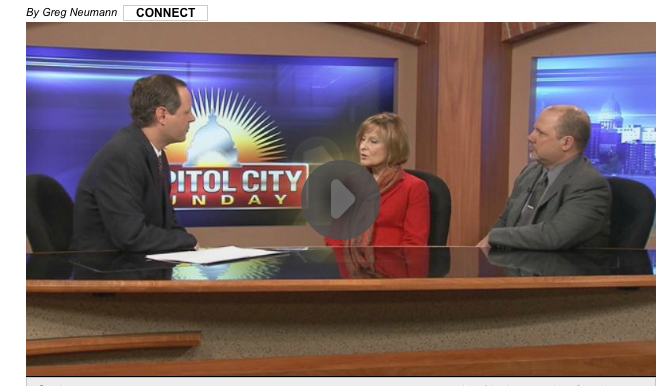
Unless…… Unless all state legislators in Wisconsin pass the same useless test.  In fact, Representative Terese Berceau and I appeared on Greg Neumann’s Capital City Sundayshow to offer a critique regarding this new test.
Check it out!
capsunday

So what would we do instead?
How about something revolutionary?  How about actually inspiring students to critically dissect their government and the glorified American heritage that masquerades as history instruction?
How about this?
Revolutionary Civics for All. | BustED Pencils:


How schools would be judged under ‘Every Student Succeeds,’ the new No Child Left Behind - The Washington Post

How schools would be judged under ‘Every Student Succeeds,’ the new No Child Left Behind - The Washington Post:

How schools would be judged under ‘Every Student Succeeds,’ the new No Child Left Behind

Sen. Lamar Alexander (R-Tenn.) and Sen. Patty Murray (D-Wash.) listen to testimony during a hearing looking at ways to fix the No Child Left Behind law. (Susan Walsh/AP)


Federal lawmakers on Monday released the final text of a compromise bill to rewrite No Child Left Behind, including closely watched language outlining how the nation’s K-12 schools would be judged — and how struggling schools would be improved — if the legislation passes.
The bill, dubbed the Every Student Succeeds Act, would largely shift authority from the federal government to states and districts, giving local officials far more power to define what it means for a school to be successful and to decide how and when to intervene in schools that persistently fail to live up to expectations.
It attempts to thread the needle between conservatives who want to shrink the federal government’s footprint in education and civil rights advocates who worry that some states, left to their own devices, will obfuscate or ignore the poor performance of schools serving low-income and minority students.
Specifically, under the Every Student Succeeds Act:
  • The testing regime remains in place. States would still be required, as they are now, to test students annually in math and reading in grades 3 through 8 and once in high school, and publicly report the scores according to race, income, ethnicity, disability and whether students are English-language learners.
  • States get to set their own academic goals. Where No Child Left Behind set forth one goal for the nation — 100 percent proficiency in math and reading by 2014 — the new bill would require each state to set and measure progress toward its own academic goals.
  • Test scores still matter, but how much is up to the states. States would be charged with designing systems for judging schools. Each system would have to include measures of academic progress, including test scores, graduation rates and (for non-native English speakers) English language acquisition. But it would also have to include a measure of school climate, such as student engagement or access to advanced courses. All of the academic indicators together must count for “much” more than the non-academic factor, but the definition of “much” is not clear.
  • What should be done in schools that are struggling will be up to states and districts. Under No Child Left Behind, a school could get dinged if just one of its subgroups failed to meet annual testing goals, and the federal government exercised a lot of say in what happened in persistently failing schools. Under the new bill, it’s likely that fewer schools will be required to be marked for interventions, and it’s up to states and, in many cases, districts to decide what to do to improve those schools. Schools marked for the most intensive interventions would be those among the lowest-performing 5 percent in the state, those in which fewer than two-thirds of students graduate on time, and those in which a subgroup of students “consistently underperforms.” It’s up to each state to determine how long a group of students would have to lag before the school would be required to take action.
  • What happens if lots of kids opt out of testing? Again, it’s up to the state. Under No Child Left Behind, a school automatically got a black eye if it failed to test at least 95 percent of its eligible students. The aim was to ensure that principals and teachers weren’t discouraging low performers from showing up on test day in order to boost scores. The new bill maintains the 95 percent requirement, but states can decide how participation rates should figure into their overall school rating system.

Seattle Schools Community Forum: Revised ESEA - Please Let Our Congressional Reps Know Your Concerns

Seattle Schools Community Forum: Revised ESEA - Please Let Our Congressional Reps Know Your Concerns:

Revised ESEA - Please Let Our Congressional Reps Know Your Concerns


The vote on the next version of No Child Left Behind is coming up for a vote this week, first in the Senate and then, next week, in the House.  

There are several issues that have come to my attention via Diane Ravitch and the Network of Public Education.

Here's a link to all the Washington State representatives and senators.  E-mail is great but there is also great value in calling their offices and registering your vote.  (I interned for an Arizona senator once and my job was taking phone calls from constituents on issues of the day.  They registered every single call.)

However you do it, PLEASE contact our congressional reps on this vote.  When you do, please note to them that this is a much better bill than the original.
First, there is an issue for Special Education


Special education advocate Bev Johns has written here warning about the impact of Social Impact Bonds on special education services.

What are Social Impact Bonds (SIBs)?

Also known as Pay for Success programs in which Wall Street investors, often using funding from private philanthropies, invest in social programs which once were funded directly by the 
Seattle Schools Community Forum: Revised ESEA - Please Let Our Congressional Reps Know Your Concerns:

CURMUDGUCATION: CBE & The Data Bottleneck

CURMUDGUCATION: CBE & The Data Bottleneck:

CBE & The Data Bottleneck


Can you tell I've been doing a lot of reading about Competency Based Education lately?

While some proponents like to point to more human-friendly versions of CBE such as a personalized district in rural Alaska, the more common picture of CBE is of a huge data-mining monstrosity. And while CBE has been rolling steadily at us under various aliases for a few decades now, it is computer technology that has made it look like both achievable and profitable.

In fact, CBE on the ground really does look like one more variation of the old and failed teaching machines, an intent to convert the entire ed system to the failed model of Rocketship Academy or the very failed model of on-line schooling.

You don't have to dig very far for hints about where CBE is headed. One of the flagship groups leading the charge is iNACOL -- which stands for "International Association for K-12 Online Learning." You can find their logo on works like the report presented by CompetencyWorks (what the hell is it with these guys and smooshedtogether group names?) entitled Re-Engineering Information Technology, a report all about how to redesign your IT systems to accommodate CBE.

Like many CBE fans, these guys are wrestling with the challenge of collecting tons of data, crunching it, making it transparent to students and teachers, and using it to make quick decisions about what should happen next in the student's education.

I'm hearing and reading the stories from teachers on the ground, in classrooms that are in part or in full running CBE, and they all seem to be about getting data through the bottleneck. Teachers who spend hours plugging test/quiz/worksheet scores into their platform. Teachers who maintain data walls on steroids so that students can walk into the room and first thing in the morning see where they are on the standards matrix and task completion matrix. Teachers who are directed to keep 
CURMUDGUCATION: CBE & The Data Bottleneck:


¿Cómo se dice ‘hardest-to-teach?’ A look at what Clinton said about charter schools. - The Washington Post

¿Cómo se dice ‘hardest-to-teach?’ A look at what Clinton said about charter schools. - The Washington Post:

¿Cómo se dice ‘hardest-to-teach?’ A look at what Clinton said about charter schools.


Hillary Clinton recently made some comments about charter schools that upset charter school advocates. She said, to be exact:
“Most charter schools — I don’t want to say every one — but most charter schools, they don’t take the hardest-to-teach kids, or, if they do, they don’t keep them. And so the public schools are often in a no-win situation, because they do, thankfully, take everybody, and then they don’t get the resources or the help and support that they need to be able to take care of every child’s education.”
Clinton, the former secretary of state who is the front-runner in the race for the 2016 Democratic presidential nomination, became a target for her comments from charter supporters who, as blogger and public education advocate Jennifer Berkshire noted, did not respond her actual words.
So what does “hardest to teach” mean? It could include students with the most severe disabilities, which traditional public schools enroll in bigger percentages than charters on average. It could mean English Language Learners, students with long disciplinary records, or any number of things. Berkshire, who worked for six years editing a newspaper for the American Federation of Teachers in Massachusetts and who now writes the livelyEduShyster blog, decided to do something others had not done in reaction to Clinton’s statements: look at the data around this issue. Here’s a version of a post she wrote about charter schools in Boston. I am republishing it with permission, and you can see the original here. Berkshire is funny, so be aware that some of what she writes is sarcastic (such as the comment about Boston’s friendly driving customs.)
By Jennifer Berkshire
¿Cómo se dice “hardest-to-teach?”
In Massachusetts, “hardest-to-teach” often translates into “students-who-don’t-yet-speak-English,” of whom we happen to have a great many. You see, ever since the Mayflower touched down at Plimoth Rock, groaning with Thanksgiving “fixins,” the Bay State and its cities have served as a gateway for wave upon wave of immigrants who come here to enjoy, among other attractions, our friendly driving customs. In fact, at last count there were 84 different languages spoken in the Boston Public Schools. EIGHTY FOUR. I’ve written before about the underrepresentation of said students, beginning with “Pssst: Los Escuelos Charteros Have a Secret!” But a recent study shows that I’ve been substantially underrepresenting this underrepresentation.
Who is being served?
The study, conducted by the Massachusetts Association of School Committees, digs deep into state data collected between 2009 and 2014 in order to answer the question, “Who is being served?” The study turned up serious disparities between charters and their sending districts when it comes to students with disabilities (a subject for another post), but it’s to those English Language Learner numbers in Boston specifically that we turn our ¿Cómo se dice ‘hardest-to-teach?’ A look at what Clinton said about charter schools. - The Washington Post:

This Is Not A Review: José Vilson’s reflections on “More Than a Score” | I AM AN EDUCATOR

This Is Not A Review: José Vilson’s reflections on “More Than a Score” | I AM AN EDUCATOR:

This Is Not A Review: José Vilson’s reflections on “More Than a Score”

VideoPicMTAS
VideoPicMTAS
This video for the book More Than a Score features interviews with several of the book’s contributing authors.

This video for the book More Than a Score features interviews with several of the book’s contributing authors.
José Vilson teaches middle school math in the Inwood/Washington Heights neighborhood of New York, NY. His book, This Is Not A Test: A New Narrative on Race, Class, and Education,stormed the heavily guarded gates of the education reform debate, battered them down, and made people sit up straight and listen to a social justice teacher about what our children and schools need.
Below is José’s important reflection on the book I edited,More Than a Score: The New Uprising Against High-Stakes Testing–and his thoughts on the movement that so many of us are building to defend and transform public education.

A Not-Review of More Than A Score [Edu-Activated]

In the spring of 2014, a few books dedicated to the “Education Spring” revolt came out from various publishers, one of which was mine, and the other was More Than A Score, a collection of stories edited by Jesse Hagopian from numerous dissidents from across the nation. [Full disclosure: Haymarket Books came out with both of our books). As I consider many of them colleagues in this work (and some of them friends), I was happy that so many of them got to tell their story.
So why a review from me almost a year later? Simple. As any of the activists in this volume can tell you, these stories are still relevant to the work of moving the profession forward.I read these This Is Not A Review: José Vilson’s reflections on “More Than a Score” | I AM AN EDUCATOR


Thanksgiving Leftovers: Julian Vasquez Heilig is a Jive Turkey | Cloaking Inequity

Thanksgiving Leftovers: Julian Vasquez Heilig is a Jive Turkey | Cloaking Inequity:

Thanksgiving Leftovers: Julian Vasquez Heilig is a Jive Turkey


Recently I was accused of whitewashing because I gave a lecture at the University of Minnesota. The top down, private-control and privatization reformers are getting more creative (or less creative).  Here is a blog written by Kenneth Eban at the Citizen Ed (top down, private-control and privatization) website.
Today I was inspired to create a new verb: “Alllivesmattering.”
I define it as the act of ignoring a real issue or social problem by critiquing the very movement addressing and solving the issue.
For example, the critique of #BlackLivesMatter, a national movement to address the government sanctioned police killings of African Americans across the country, produced the counterproductive #AllLivesMatter.
So why did I feel this was important to write about today?
It’s because I went to a weird education conversation led by guest speaker Dr. Julian Hellig Vasquez and hosted by my alma mater, the University of Minnesota-Twin Cities. It was supposed to be about community-based approaches to reforming schools. I was intrigued. As an education advocate and as someone looking work with local communities to find solutions to close our opportunity gap, these conversations are everything.
Now, I’ll cut to the chase: I was sorely disappointed.
The entire talk discussion was centered on what is wrong with the education reform movement, not the schools.  So instead of illuminating and educating people on the issues that face public education, Vasquez spent his time sharing endless criticisms of education reform. He focused only on analyzing the reform movement instead of addressing the problem that drives the movement in the first place (these schools that aren’t educating kids).
In essence, he alllivesmattered education.
Listening to Vasquez you would get the idea that public education is under attack, but the system itself is fine. You would think that what needs to be addressed is the education reform movement, not the achievement gap.
He talked a lot about how bad standardized testing is, and how Teach For America needs to be fought, but there was no focus on how we Thanksgiving Leftovers: Julian Vasquez Heilig is a Jive Turkey | Cloaking Inequity:

Randi Weingarten: Why we support the Every Student Succeeds Act — Medium

Why we support the Every Student Succeeds Act — Medium:

Why we support the Every Student Succeeds Act


Susan Bowles, a kindergarten teacher in Gainesville, Fla., was fed up with all of the testing she was required to give her 5-year-old students.
As an act of civil disobedience, for which she was willing to take the consequences, she refused to administer one of the several tests for kindergartners — the Florida Assessments for Instruction in Reading — which her kids had to take on a computer three times a year. In a letter to parents that went viral, she wrote, “I am not opposed to assessments and am for accountability in schools. But enough is enough. I keep asking, when will the insanity stop? When will someone speak up?”
She noted that she understood her defiance could mean she would get fired. Actually, a few months later, Susan was named Alachua County, Fla., teacher of the year.
Susan spoke for thousands of educators, parents, students and others who have had it with the testing obsession that has taken over public education — a strategy that began with No Child Left Behind, expanded with Race to the Top, and has limited classroom instruction, narrowed the curriculum and been used to unfairly evaluate teachers.
Speaking of consequences — and we have seen many, like teacher demoralization, a growing teacher shortage, and student and parent anxiety — it’s no wonder the most recent Phi Delta Kappa-Gallup poll shows that the public is fed up with the overuse and misuse of testing.
In New York state alone, 20 percent of students opted out of high-stakes standardized tests. And it’s not like the test-and-punish policies of the last 15 years have helped with performance. In the last decade, National Assessment Why we support the Every Student Succeeds Act — Medium:

The Urban Education Catastrophe Left Untouched by Anti-Testing Activism - LA Progressive

The Urban Education Catastrophe Left Untouched by Anti-Testing Activism - LA Progressive:

The Urban Education Catastrophe Left Untouched by Anti-Testing Activism

Anti-Testing Activism


When it comes to its stated objectives—reducing educational disparities by race and class—test-based school reform embodied in No Child Left Behind and Race to the Top has failed miserably.

Education activist movements organized in resistance to excessive testing have not persuaded parents in poor communities and communities of color that test resistance speaks to their needs

By every conceivable index of economic status and educational achievement, American society is MORE unequal than it was at the onset of No Child Left Behind in 2001. But the education activist movements organized in resistance to excessive testing have, in their own way, also failed because they have not persuaded parents in poor communities and communities of color that test resistance speaks to their needs, or provided a credible alternative to school closings and charters.
Anti-testing activism MAY—and the jury is still out on that—have preserved public education in middle class class and affluent communities, but has been unable to prevent low and moderate income communities from being perceived as low-hanging fruit for tech companies, charter profiteers, and ambitious politicians.
Public education is virtually dead in New Orleans, Detroit, and Camden and is on life support in Newark, Buffalo, and a score of middle-sized cities. Opt Out has granted schools in middle class communities—at least in some parts of the country—precious breathing room, but the nightmare of school closings, corporate takeovers, and scripted learning in the name of “school turnaround” strategies persists in virtually every city in the nation, coupled with the proliferation of unregulated charters.
To be fair, leaders of every major anti-testing group have pointed out the corruption and hypocrisy involved in National Education initiatives spawned with egalitarian rhetoric, but with rare The Urban Education Catastrophe Left Untouched by Anti-Testing Activism - LA Progressive:

Standardized Tests Every Day: the Competency Based Education Scam | gadflyonthewallblog

Standardized Tests Every Day: the Competency Based Education Scam | gadflyonthewallblog:

Standardized Tests Every Day: the Competency Based Education Scam

rocketship-charter-schools


IN THE NOT TOO DISTANT FUTURE:
Welcome to class, children.
Please put your hands down, and sit at your assigned seat in the computer lab.
Yes, your cubicle partitions should be firmly in place. You will be penalized if your eyes wander into your neighbors testing… I mean learning area.
Now log on to your Pearson Competency Based Education (CBE) platform.
Johnny, are you reading a book? Put that away!
Are we all logged on? Good.
Now complete your latest learning module. Some of you are on module three, others on module ten. Yes, Dara, I know you’re still on module one. You’ll all be happy to know each module is fully aligned with Common Core State Standards. In fact, each module is named after a specific standard. Once you’ve mastered say Module One “Citing Textual Evidence to Determine Analysis” you will move on to the next module, say “Determining Theme or Central Idea for Analysis.”
Johnny, didn’t I tell you to put away that book? There is no reading in school. You’re to read the passages provided by the good people at Pearson. No, you won’t get a whole story. Most of the passages are non-fiction. But I think there is a fun passage about a pineapple coming up in your module today. Isn’t that nice?
Laquan, you haven’t put on your headphones and started your module yet? You’ve been on module three for the past week. How can you learn at your own rate if you never progress beyond module three?
What’s that? Your mother wrote me a note? Let me see that.
Huh. So she wants to know how come you never get beyond module three. You should be able to answer that question for her, yourself, Laquan. (At least you could get that one right.)

Books, books and more great books! | Deborah Meier on Education

Books, books and more great books! | Deborah Meier on Education:

Books, books and more great books!

Dear friends and colleagues,
I regularly like to promote some favorite books of mine here.
This time let me introduce you to a few of quite a lot of interesting books that have been published lately about schooling and a few that I just recently read but were published some time ago.
Two are close to home and include a chapter by me!
Meier
Teaching in Themes, edited by Deborah Meier, Matthew Knoester and Katherine Clunis D’Andrea
Glover
The Teacher You Want To Be, edited by Ellin Keene and Matt Glover.
Then…
kahlenberg
Public School Choice vs Private School Vouchers, edited by Richard Kahlenberg was published in 2003 but it’s definitely worth reading as we move toward voucherization.
FearlessTeaching 2015.qxp_Layout 1
Enter a caption
Fearless Teaching, by Stuart Grauer. Accounts of very different approaches to schooling and teaching. You know, for sure, that he’s a teacher by what and how he put this book together.
Michie
We Don’t Need Another Hero, by Gregory Michie.  Exactly my point. Chapter 13 is entitled, “Race to the Top of What? “  Maybe democracy?
democraticschools
You might follow it up with an oldie (2007), Democratic Schools edited by Michael Apple and James Beane—which includes an essay by me and Paul Schwarz.
SBM-front2
Schooling Beyond Measure, by Alfie Kohn is a new and precious collection of his current topic I enjoy thinking about.
TakingBackChildhood216x326
Taking Back Childhood, by Nancy Carlsson-Paige has been reissued. It first came out in 2008 and remains a classic—especially designed for parents.
Diamond
Teaching Kindergarten by Julie Diamond, Betsy Grob and Fretta Reitzes,  A collection of essays by folks who know what they are talking about, including a Mission Hill teacher (Kathy Clunis DAndrea) and a forward by Vivian Paley and Prologue by Ruth Charney.
kindergarten
While you’re at it read Kinderarten by Julie Diamond about a year of learning—for both Julie and her students.
Martin
Making Space for Active Learning: the art and practice of teaching edited by Anne Martin and Ellen Schwartz with a foreword by Helen Featherstone.  Those names should be enough to  catch your attention and each essay is by a teacher I know and admire.
delorenzo
Sketches in Democracy by Lisa DeLorenzo.  He is a music teacher and this book is a treasure; about the role of music in our school lives—or what it can be.
ochsborn
Squandering America’s Future, by Susan Ochsborn is a telling story about the historic changes in the way we view children and how it’s hurting us today.
ENOUGH!  I’ll get back to this because I have a bunch of other books on the chair besides me that I want everyone to read. Books, books and more great books! | Deborah Meier on Education:

Final No Child Left Behind rewrite is public at last — all 1,059 pages — just days before Congress votes - The Washington Post

Final No Child Left Behind rewrite is public at last — all 1,059 pages — just days before Congress votes - The Washington Post:

Final No Child Left Behind rewrite is public at last — all 1,059 pages — just days before Congress votes

Sen. Lamar Alexander (R-Tenn.), chairman of the Senate Health, Education, Labor and Pensions Committee, left, and Rep. John Kline (R-Minn.), chairman of the House Education and the Workforce Committee, confer on Nov. 18. (Jacquelyn Martin/AP)


The final rewrite of the federal No Child Left Behind education law is now available to the public online — just a few days before the House is set to vote on it, with the Senate following soon after. If you are interested in telling your legislators what you think of it, you can find the legislation below and here as well.
No Child Left Behind, the current version of the Elementary and Secondary Education Act of 1965, became law in 2002 as the chief education initiative of then-President George W. Bush, with bipartisan support. NCLB was supposed to be rewritten in 2007, but Congress failed to do that, and dramatic problems with NCLB became apparent as years went on. In 2012, the Obama administration began to issue waivers to states exempting them from the most onerous parts of NCLB — such as the impossible requirement that virtually all students score proficient in math and reading by 2014 — but the waivers were handed only to states that agreed to implement reforms approved by the Education Department.
The administration’s involvement in local education concerns became an issue itself, helping to propel Congress to finally try to rewrite the law to stop the Education Department from being a “national school board,” as Sen. Lamar Alexander (R-Tenn.), one of the architects of the new legislation, put it.
The NCLB rewrite drastically cuts the power of the U.S. education secretary, a move widely seen as a rebuke to Education Secretary Arne Duncan, and gives more education decision-making back to the states. The legislation was approved by a conference committee of House and Senate lawmakers on Nov. 19 on a vote of 38 to 1, with the lone dissent being Sen. Rand Paul of Kentucky, who is running for the 2016 Republican presidential nomination and who objected by proxy. Paul opposes any federal involvement in local public schools.
The bill maintains the current federal mandate on public school districts to give standardized tests to students in the third through eighth grades and once in high school for accountability purposes, but it leaves it to the states to decide how to deal with the lowest-performing schools.
The House is set to vote on the bill on Thursday, and the Senate next week. It is expected to pass, but there is always the chance that conservatives in the House will be unhappy enough with continuing federal involvement and other issues to try to persuade some moderates to go along with them and block it. We’ll see.
Here it is:
Valerie Strauss covers education and runs The Answer Sheet blog.

No Art Left Behind | PopularResistance.Org

No Art Left Behind | PopularResistance.Org:

No Art Left Behind

Screen Shot 2015-11-30 at 11.35.27 AM


Above Photo: From LivingInDialogue.com.
In the past 13 years of No Child Left Behind and Race to the Top test-driven education policies, art has been pushed to the margins in our schools. Students have lost countless hours for creating art, music and dance that expresses themselves. But artistic expression is like the seedling that forces its way through cracks in the asphalt. This blog series will explore how students and teachers use art to express themselves.
The series was inspired by a Facebook post authored by artist and kindergarten teacher Susan DuFresne. She wrote:
Art is healing and meditative for children and teachers. It is inspiring and allows a different kind of space for free and creative expression. Art builds self-confidence in a way that children need. It develops listening skills and an ability to work from part-to-whole. It develops trust in one’s teacher.
Art develops executive functioning skills, impulse control, delayed gratification skills, planning and organizing skills, fine motor skills, and visual spatial skills. Art develops meta-cognition skills, problem-solving and critical thinking skills. Art increases experiences of joy in all children and during the process of a shared joyful Art experience, our immune systems get the same kind of boost as a hug provides. Shared Art experience creates a strong sense of community. Art creates a sense of peace and satisfaction. Art creates children who think outside the box and can help students stand up for themselves and others. Art develops empathy. Art helps us learn about our world sometimes in a way nothing else could replace. Art can be full-on play! Art can create wonder and Art can answer wonderings. Art can be fiction or non-fiction. Art can come from within or from a power outside of oneself. #Art can incite emotion. Art can be visual music with rhythm and a melody of pattern. Art can engage all of our senses. Art can be science. Art is math. Art is visual poetry. Art can be social studies. Art can incite social justice! Art can be dangerous to the elite! Art can disrupt and disturb oppression. Art can heal depression and trauma. Art is worth doing for the sake of Art alone, but Art does all these things!In a series of blog posts by students, parents, and teachers we will explore, create, and persuade through creative alternatives offered to test and punish schooling.
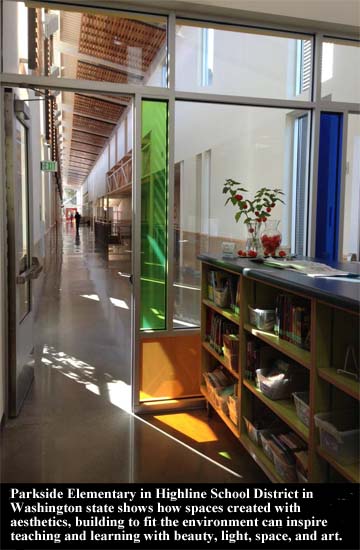
In a recent blog post by Adam Rosenblatt, he said: “Beauty is why we teach and how we learn.”highline4
What do we mean when we say “art”. Here we mean to include all of the “arts” – the humanities – and free creative play. We will explore examples of each, for in each there is true beauty.  Our vision of schools in their design of environment and pedagogy must prioritize beauty.
First, we recommend closing the chapter on the dark ages of NCLB test and punish policies, creatively resisting through an education  Renaissance – believing in a value system that would lift all children up rather than test and punish them – creating safe spaces and aesthetically rich environments through No Art Left Behind.
Art is a creative process, and in harmony with this process, we begin by giving space to authentic voices, to diverse and multicultural values through providing creative space for authentic examples in hopes of community-based policies that will build the power to resist colonization of our public schools.
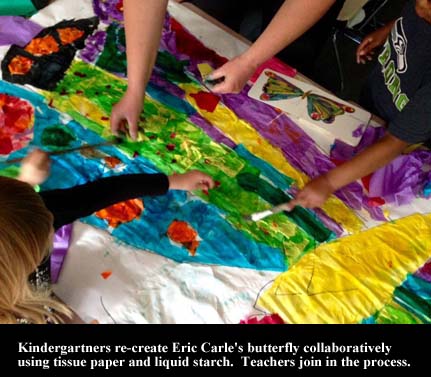
ericcarle2
In our blog post series, we will paint a picture of what creative community schools of beauty can bring in contrast to reformers vision of overcrowded, stark institutions. We will expose and create an alternative vision based a a completely  different purpose for educating our youth, a vision that is designed by artist teachers, parents, and students – a vision inclusive of diverse cultures that would shape social and community values through artful resistance leading to empowerment. Our values will determine our future.
As we value the voices in the margins, we will include diverse voices. Together, we challenge the din of propaganda – the chorus of the elite.  In the end, as Robert L. Peters points out: “Design creates culture. Culture shapes values. Values determine the future.”
How have the test and punish policies of the past decade marginalized your voice, your values, your culture?  What is the purpose of public education? Whose voices should determine the policies of public education? What policies do you want to see left behind/included?
optoutbus2
We are gathering the diverse and authentic voices of children, our young adults, parents, community members, administrators, teachers, and professors of education. Are you interested in writing for our blog series? Please contact us atlifesabeach48@msn.com, and Anthony_cody@hotmail.com
Please visit and like the No Art Left Behind Facebook page.