Latest News and Comment from Education

Sunday, November 22, 2015

Dumb and Dumber: Killing the Superintendent of Public Instruction. | BustED Pencils

Dumb and Dumber: Killing the Superintendent of Public Instruction. | BustED Pencils:

Dumb and Dumber: Killing the Superintendent of Public Instruction. 


Under an elected Superintendent of Public Instruction, Wisconsin public schools are now subject to:
  1. Act 10-Banning the human right of collective bargaining.
  2. An almost unlimited increase in the use of voucher money to fund private education.
  3. For profit Charter School expansion.
  4. Accelerated Accountability to fuel the “failing Public schools” narrative.
  5. Using student test scores to evaluate teachers (This practice has been dismissed as “junk science”).
  6. Legalized public school take overs.
  7. The ability to dismiss the authority of locally elected school boards in “failing” districts.
  8. Excessive cuts to public school spending.
Anything I missed?
This is why I’m so confused over Wisconsin republicans’ desire to either eliminate the Dumb and Dumber: Killing the Superintendent of Public Instruction. | BustED Pencils:

Seattle Schools Community Forum: FYI - Act Now for Washington Students? Astroturf Group

Seattle Schools Community Forum: FYI - Act Now for Washington Students? Astroturf Group:

FYI - Act Now for Washington Students? Astroturf Group


I may have mentioned it but to clarify, this "new" group, Act for Washington Students, is an astro-turf, Gates-funded group made up of DFER, League of Education Voters and Stand for Children.  You don't get more ed-form and Gates-guided than those three.

From their Facebook page,


Act Now is a coalition of parents, students and educators who are asking the Washington State Legislature to keep our schools open.

I always have to be suspicious of any Facebook group whose "About" section is limited and vague. This particular one is also not honest because those three groups are the organizers and yet there is no mention of them. There is no website or any other information if you Google their name.

I perceive that the outcry across the state for charters is not as great as they 
Seattle Schools Community Forum: FYI - Act Now for Washington Students? Astroturf Group:


Just Like Michelle Rhee's Students first only BETTER


Astroturf lobbying refers to political organizations or campaigns that appear to be made up of grassroots activists but are actually organized and run by corporate interests seeking to further their own agendas. Such groups are often typified by innocent-sounding names that have been chosen specifically to disguise the group's true backers

Just Like Michelle Rhee's
 Students first Astroturf lobbying (only Better) 
Other Astroturf lobbying groups


Just Like Michelle Rhee's
 Students first Astroturf lobbying (only Better) 

Educators Challenge Pearson’s Corporate Take-Over | PopularResistance.Org

Educators Challenge Pearson’s Corporate Take-Over | PopularResistance.Org:

Educators Challenge Pearson's Corporate Take-Over
1pears


Minneapolis, MN - On Saturday afternoon (Nov. 21) as the National Council of Teachers of English (NCTE) gathered in Minneapolis, Minnesota for their annual convention, the floor of Exhibit Hall erupted in protest. Dozens of teachers and education professors occupied the space for over 30 mins to protest British-based publishing giant Pearson’s influence on public education in America.


The protest came out of the Commission on Social Justice in Teacher Education Programs within NCTE’s Conference on English Education. Assistant Professor Dr. Noah Golden of Chapman University in California is one of the Commission’s three co-chairs.
“Companies like Pearson drive educational policy and implementation throughout the K-12 and teacher education worlds,” he said when asked to comment on the protest. “This is often harmful, inserting a profit motive instead of what is in the best interest of students, families, communities, and teachers. We need a public dialogue and greater equity in education rather than high-stakes tests inserted into public policy by for-profit entities. A focus on these tests, whether in the K-12 realm or teacher education, is a means of masking inequalities and disinvestment in particular communities. Simply put, Pearson and similar companies drive our focus from the conversations we need to be having about meaningful teaching, learning, and assessment. We on the Conference on English Education (CEE– an organization within NCTE) Commission on Social Justice in Teacher Education programs want to be part of an organization that names and works against policy that is not in the interest of our children and their teachers.”


Tweets from the protest captured the essence of what the educators were protesting.


How Small a Part Research Plays in Making and Implementing Educational Policy | Larry Cuban on School Reform and Classroom Practice

How Small a Part Research Plays in Making and Implementing Educational Policy | Larry Cuban on School Reform and Classroom Practice:

How Small a Part Research Plays in Making and Implementing Educational Policy


Beliefs, opinions, and politics matter more in making policy decisions than applying research findings to schools and classrooms. A recent Canadian study (1905-8719-1-PB ) confirmed what amounts to a fact in U.S. policymaking. Candadian researchers looked at provincial policy elites (in U.S., they would be state-level decision-makers) and district officials (school board members and superintendents) and found across Canada what is very evident in U.S. districts as well: politics and beliefs trump use of research in adopting policies aimed at improving practice (see here and here).
As one would expect in academic circles, the language of applying research findings to educational policies has expanded. Canadian researchers Gerald Galway and Bruce Sheppard note that new phrases have entered the vocabulary: “knowledge transfer, evidence-informed policy, data-driven decision-making and knowledge brokering, to name a few. Knowledge mobilization (KM) has been touted as a useful all-encompassing term because it conveys the notion of direction instead of random interaction and it ’embodies the idea that the use of knowledge is a social process, not just an intellectual task’ ” (p. 9). Whatever phrase is used in Canada or the U.S., the pattern of applying research findings to forming, adopting, and implementing policies remains similar on both sides of the border.

Implementation is part of the program | @ THE CHALKFACE

Implementation is part of the program | @ THE CHALKFACE:

Implementation is part of the program


In an effort to increase test scores in math and reading in so-called “struggling” schools, numerous intervention programs are purchased on our behalf. So many programs are layered on top of each other that it becomes nearly impossible to carefully consider them all.
Although relatively expensive, the cheapest and most efficient interventions tend to be school licenses for personalized learning software. Use of these programs make leadership think they’re actually doing something. Additionally, usage and performance data, accessible from any computer, can give central office personal an easy way to track schools, and something on which to hold them accountable when they fail.
When my students’ usage for a particular software program is not up to snuff, I hear about it. Then, if my students do not meet certain benchmarks, it can be easily attributed to the low number of minutes using the software. If only I could use the program with “fidelity,” we’d be much better off.
Companies don’t understand, however, that implementation is also part of their program. Don’t always blame the teacher for infidelity. Maybe it’s also that the program sucks. Seriously. If my usage is low, what I’m typically told to do is use it more. Why can’t you use it more, what’s the problem? But my feelings about the program are not considered. Just use it more, all right?
My Kindergarten students don’t enjoy using personalized learning software, and I don’t enjoy having them Implementation is part of the program | @ THE CHALKFACE:

Marie Corfield: Hey NJ! #EdReform Big Brother is watching your kids!

Marie Corfield: Hey NJ! #EdReform Big Brother is watching your kids!:

Hey NJ! #EdReform Big Brother is watching your kids!


The first time I heard then NJDOE Commissioner Chris Cerf speak at the NJEA Convention he spoke about all the student data the state was collecting. He was giddy with excitement over it; frothing over how it will 'transform' education... Into what exactly? My first thoughts were that Big Brother had indeed landed. 


So, where is all this fabulousness and wonderfulness that Cerf and other 'reformers' literally drool over? Because the only 'transformations' I've seen are the vast numbers of students refusing to take the PARCC and SBAC, massive public school closings, the expansion of segregationist charter schools, and the beaucoup bucks 'reformers', for-profit education services companies and 'non-profit' charter operators are raking in as a result.

But this is how America operates. We're a capitalist society. Money—not people—runs this country. And those with a lot of it and who want more of it have finally managed to crack the code of the last hold out against corporate takeover: public education. And they've got their sites (sic) set on our kids.

Right now it's being used to evaluate students, teachers and schools. It's also an ad hominem judgment on communities of low income and color. But who knows what the future will bring and how this data will be used? It's one thing for the government to have Marie Corfield: Hey NJ! #EdReform Big Brother is watching your kids!:

BustED Pencils Trending News: Less; Squashed; Ass Backwards | BustED Pencils

BustED Pencils Trending News: Less; Squashed; Ass Backwards | BustED Pencils:
BustED Pencils Trending News: Less; Squashed; Ass Backwards

newsboy_bustedpencils-logo_full color

“Less school, (way) more play”

5 Reasons Finland Has More Effective Schools Than The U.S.

BustEDstretch

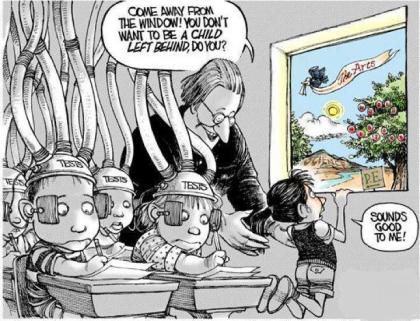
Freedom and creativity in the classroom squashed by drilling and excessive state Standards testing.

Burnt out: teachers overwhelmed and resigning

BustEDstretch

If this isn’t ass backwards

IEPs Must Be Aligned to Grade-Level Standards, Says New Federal Guidance

Get BustED Pencils Trending News to come right to your in-box!
Enter your email under “SUBSCRIBE” on our Home or Trending News page at bustedpencils.com

CURMUDGUCATION: OH: Raking in Consultant Money

CURMUDGUCATION: OH: Raking in Consultant Money:

OH: Raking in Consultant Money


Education reform has spawned a variety of new money-making opportunities, including a burgeoning field of education consultants.

That's because one of the new steady drumbeats is that superintendents, principals, and most especially teachers-- in short, all the people who have devoted their professional lives to education-- don't know what they're doing and possess no expertise in education whatsoever. No, for real expertise, we must call in the High Priests of Reformsterdom.

That takes us to Cleveland, Ohio. I love Cleveland; I did my student teacher at a Cleveland Heights middle school while living in apartment at the corner of East 9th and Superior, and those, indeed, were the days. But Cleveland schools have a long history of difficulty. Back in the day, Ohio schools had to submit all tax increases to voter referendum; Cleveland voters routinely said no, and Cleveland schools repeatedly shut down around October when they ran out of money.

Now, in the reform era, Cleveland schools have embraced charters and privatization with a plan that stops just short of saying, "We don't know what the hell we're doing or how to run a school district, so we're just going to open it up to anybody who thinks they can run a school or has an opinion about how to run a school. Except for teachers and professional educators-- they can continue to shut the 
CURMUDGUCATION: OH: Raking in Consultant Money:


ICYMI: Some weekend eduwebs reading


Here's some edureading for the weekend. 

Five Cynical Observationa about Teacher Leadership

I mean to include Nancy Flanagan's insightful list about how teacher leadership isn't happening last week, and then, somehow, I didn't. But here it is. These days Flanagan is one of the consistently rewarding bloggers for Ed Week-- save your limited freebie reads for her.

Educators Release Updates VAM Score for Secretary Duncan

Educators for Shared Responsibility have come up with a VAM formula for evaluating Education Secretaries. Not entirely a joke. 

Classroom Surveillance and Testing

At the 21st Century Principal, John Robinson makes the striking observation that our classroom data collection bears a striking resemblance to the tools of surveillance and, well, spying. 

Drinking Charter Kool-Aid? Here Is Evidence.

Dr. Julian Vasquez Heilig has provided an essential resource. You may not read through it all today, but you'll want to bookmark it somewhere. Here's a very thorough listing of legitimate peer-reviewed research on the effectiveness of charter schools. Handling of special populations, segregation, competition, creaming-- it's all here, and all the real deal. You will want to keep this resource handy.

Stop, Start, Continue

Not always a fan of things I find at Edutopia, but this is a short simple piece focused on three things teachers should stop doing, three things we should start doing, and three things to continue doing. A good piece for sparking a little mental focus.


http://curmudgucation.blogspot.com/2015/11/icymi-some-weekend-eduwebs-reading.html

Sunday posts, pics and tweets. | Fred Klonsky

Sunday posts, pics and tweets. | Fred Klonsky:

Sunday posts, pics and tweets.

Screen Shot 2015-11-22 at 7.26.56 AM


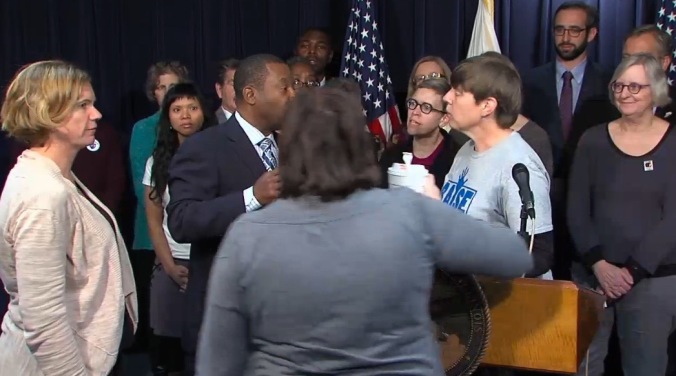
Illinois School Board President James Meeks attempts to disrupt a press conference of parent groups, educators and public officials, protesting the expansion of charter school funding in Illinois. Meeks secretly applied for a federal grant for start-up money for 48 charter schools which would then be maintained by local funding. 24 of the charters would be in Chicago and 24 would be downstate.
.
Laquan McDonald was more than another young African-American male who had the misfortune of crossing the path of a brutal Chicago cop. Mary Sunday posts, pics and tweets. | Fred Klonsky:
00massweb2-articleLarge
I posted this picture of Massachusetts Teachers Association, Barbara Madeloni, in my Sunday Posts today. But I am posting it again because I noticed something about it that is strange. Illinois IEA members: Can you see what is odd about this photo? Barbara is campaigning. She is meeting with members in a member’s home explaining why she should be re-elected. She is talking with them about her ideas and seeking their votes. 35 years as an IEA member and I have never seen that. https://preaprez.wordpress.com/

Mark Kirk has gone AWOL on ESEA and Pay for Success.

Bev Johns
On Monday and Tuesday please call the offices of our U.S. Senator Mark Kirk urging him to act on removing/modifying the Goldman Sachs Pay for Success part of S. 1177, the reauthorization of the Elementary andSecondary Education Act (ESEA which used to be called No Child Left Behind).
 Sen. Kirk, despite weeks of contacts on Pay for Success, apparently has done nothing, even though he was a Member of the Conference Committee between the U.S. House and the U.S. Senate on ESEA.
I received a telephone message on Thursday from Sen. Kirk’s Washington, D.C. office saying nothing could be done by Sen. Kirk.
The actual language of S. 1177, based on concepts approved by the https://preaprez.wordpress.com/

Chaz's School Daze: Why The NYU Study On The Closed Schools, When Replaced By Small Schools, Is Fatally Flawed.

Chaz's School Daze: Why The NYU Study On The Closed Schools, When Replaced By Small Schools, Is Fatally Flawed.:

Why The NYU Study On The Closed Schools, When Replaced By Small Schools, Is Fatally Flawed.


This week, NYU released a study showing that students fared better with the closing of the many large comprehensive high schools and replaced by the Bloomberg small schools. The basis for the study's conclusion was the increased graduation rate from the small schools when compared to the closed schools.  However, the study is fatally flawed since the graduation rate is a bogus parameter and easily manipulated by the school Principal to allow students to graduate academically unprepared for college and career.  Let's look at how schools manipulate the graduation rate.

First, a little history.  During the 2002-08 time period the study looked at 29 closed high schools and the results for future students who instead went to the Bloomberg small schools which showed a 15% increase in the graduation rate.  However, the study admits that students who fled these closing schools did worse then the ones who stayed and graduated,  Moreover, these students who fled were academically behind their peers in the new schools they transferred to.

Credit Recovery:
During the time period the study covered there was an explosion of credit recovery courses that artificially increased a struggling student's credit accumulation.  Even the State finally saw the abuse of the credit recovery system and required the City to put an end to it in 2012.  The primary beneficiaries were the Bloomberg small schools who needed to have a high graduation rate to show how successful they were.  Therefore, they gave struggling students loads of "credit recovery" courses, many of them were bogus.  You can read some of the stories, HereHere, and Here.

Principal Pressure:
The Bloomberg small schools were notorious in hiring "newbie teachers"  and since these teachers lacked tenure, they were pressured to pass along the school's struggling students.  Teachers who failed too many of their students were discontinued due to scholarship issues and were banned from working at the DOE.  This message resonated loud and clear with the inexperienced staff and resulted in high graduation rates despite these students academically unable to succeed in college or careers.

Student Selection: 
To ensure the Bloomberg small schools would succeed they opened with some very significant advantages like excluding many Chaz's School Daze: Why The NYU Study On The Closed Schools, When Replaced By Small Schools, Is Fatally Flawed.:

Education Reformers and their obsession with Standardized Testing - Even the NY Times can’t get the story right! - Wait What?

Education Reformers and their obsession with Standardized Testing - Even the NY Times can’t get the story right! - Wait What?:

Education Reformers and their obsession with Standardized Testing – Even the NY Times can’t get the story right!


Fellow education blogger Diane Ravitch, the nation’s premier public education advocate, opened the New York Times this morning and noted that even the New York Times has been “snowed” by the Corporate Education Reform Industry and their false narrative that the solution to the challenges facing public education in the United States is to have more standardized testing.
Diane Ravitch writes;
News flash! There is a national test that enables us to compare reading and math scores for every state! It is called NAEP. It reports scores by race, ELLs, poverty, gender, disability status, achievement gaps. This is apparently unknown to the Néw York Times and the Secretary of Education, who has said repeatedly that we need Common Core tests to compare states.
The New York Times, America’s newspaper of record, has a story todayabout Massachusetts’ decision to abandon PARCC, even though its State Commissioner Mitchell Chrster is chairman of the board of PARCC. True or Memorex? Time will tell.
But the story has a serious problem: the opening sentence.
“It has been one of the most stubborn problems in education: With 50 states, 50 standards and 50 tests, how could anyone really know what American students were learning, or how well?”
Later the story has this sentence:
“The state’s rejection of that test sounded the bell on common assessments, signaling that the future will now look much like the 
Education Reformers and their obsession with Standardized Testing - Even the NY Times can’t get the story right! - Wait What?:

A Not-Review of More Than A Score [Edu-Activated] | The Jose Vilson

A Not-Review of More Than A Score [Edu-Activated] | The Jose Vilson:

A Not-Review of More Than A Score [Edu-Activated]

MTaS-Fb


In the spring of 2014, a few books dedicated to the “Education Spring” revolt came out from various publishers, one of which was mine, and the other was More Than A Score, a collection of stories edited by Jesse Hagopian from numerous dissidents from across the nation. [Full disclosure: Haymarket Books came out with both of our books). As I consider many of them colleagues in this work (and some of them friends), I was happy that so many of them got to tell their story.
So why a review from me almost a year later? Simple. As any of the activists in this volume can tell you, these stories are still relevant to the work of moving the profession forward.I read these chapters in the authors’ voices. I was intrigued by Rosie Frascella and Emily Giles’ story of co-leading the charge to have her entire Brooklyn-based school opt out of unnecessary exams, much to the chagrin of NYCDOE and the United Federation of Teachers. I was enthralled by Barbara Madeloni’s vision for a new education system, including racial dynamics as part of her call to activate. I recalled Karen Lewis’ ascension to the leader of Chicago edu-resistance, envisioning how they organized for better schools and not just a better contract for teachers. Stephanie Rivera’s chapter on becoming a future student reads as a precursor to the ways she’s currently managing the school system as a rookie teacher.
John Kuhn’s tale of resistance in perhaps the most reform-friendly state in the nation rang of hope. I laughed aloud at the chapter co-written by Cauldierre McKay, Aaron Regunberg, and Tim Shea of the Providence Student Union, who resisted their state’s education reforms through creativity and art, two ideals that their legislators sought to reduce by overtesting their students. Folks like Helen Gym, Nikhil Goyal, Brian Jones, Malcolm London, Mary Cathryn Ricker, and Jia Lee also turned in chapters worth having in your back pocket.
But my favorite was easily Jesse Hagopian’s, which was the real beginning of the book. He sets the A Not-Review of More Than A Score [Edu-Activated] | The Jose Vilson:

Ask #SpeakerRyan and #SenatorAlexander About ‘Guardrails’ in #ESEA » Missouri Education Watchdog

Ask #SpeakerRyan and #SenatorAlexander About ‘Guardrails’ in #ESEA » Missouri Education Watchdog:

Ask #SpeakerRyan and #SenatorAlexander About ‘Guardrails’ in #ESEA

challenging standards


If it quacks like a duck it’s still a duck.  Federal involvement is still present in the rewrite from the Conference Committee and should be opposed by those concerned about Common Core State Standards.  Carrots and sticks still rule the day and authentic state direction/development must be approved by the Federal Government.
From Negotiators Come to Agreement on Revising No Child Left Behind Law and the language which explains McCluskey’s tweet:
But the secretary of education cannot dictate how states rate schools or what weight they give to measures like test scores in such ratings. The agreement also prohibits the education secretary from mandating academic standards such as the Common Core, guidelines that have prompted enormous political backlash.States are required only to set “challenging” academic standards that will prepare students to enter universities or career and technical colleges.

Just like the 15% of standards states were allowed to insert in Common Core State Standards, states will be allowed 49% of accountability measures to determine an effective school.  From House, Senate ESEA Compromise Sails Through Conference Committee:
And it goes further on accountability than either the House or Senate bills to overhaul the ESEA. Academic factors—such as test scores, graduation rates, and English-language proficiency—would have to make up at least 51 percent of a school’s rating.
The other 49 percent would be up to states, and could include things like parent engagement, teacher engagement, college readiness, and school climate. (You can find accountability language here. The agreement is still being written into legislation, but there aren’t substantive changes to this proposal. We’ll flesh out with further details as we get a better understanding of the implications here and how “guardrails” would work.)

“Guardrails” = Requirements and Requirements = Mandates and Mandates = Carrots & Sticks.  Can’t wait for those further details of the implicationsof the guardrails.Ask #SpeakerRyan and #SenatorAlexander About ‘Guardrails’ in #ESEA » Missouri Education Watchdog:

The Progressive Magazine: A School Crisis | Cloaking Inequity

The Progressive Magazine: A School Crisis | Cloaking Inequity:

The Progressive Magazine: A School Crisis


Politicians in Puerto Rico are seeking to solve decades of fiscal mismanagement by adopting the same education reforms that are hurting children and starving school districts in the mainland United States. The disaster capitalism coming to the azure waters of Puerto Rico is very similar to the school privatization and private-control education reform causing an uproar in Chicago and Detroit.
A day strike by thousands of teachers across the island of Puerto Rico on Tuesday demonstrated the intensity of their concern about the new regime.
In October, Senator Eduardo Bhatia fast-tracked Project 1456 in the Puerto Rican Senate. School closure requirements in 1456 are the first notable parallel with the Detroit and Chicago school privatization playbook. In Chicago, 50 schools (primarily in African-American neighborhoods) were recently closed under the pretext that they were under-enrolled. A University of Chicago study showed that after neighborhood school closure, students were shuffled to a new set of low-performing schools— often charter schools.
In Michigan, the state created the Education Achievement Authority (EAA), an education board similar to the one proposed in Project 1456. Michigan is different from other states because the vast majority of its charter schools are already run by for-profit companies. The Detroit News reports that the EAA and the for-profit charters have been plagued by low performance and corruption.
Since 2014, the Puerto Rican government has closed 135 schools— about 10% of the schools on the island. The results of these school closings are class sizes as large as 40 students. The new law requires the closure of 400 more public schools—30% of the remaining public schools on the island. Additionally, Project 1456 requires that the government turn at least 15% of schools into Lider (charter schools) every three years under the auspices of private control and the education authority.
While a debate rages on the quality of charter schools in the United States, most peer-reviewed literature demonstrates that charters typically The Progressive Magazine: A School Crisis | Cloaking Inequity:

Patty Murray’s ESEA Re-Write Leaves No Assessment Behind | Seattle Education

Patty Murray’s ESEA Re-Write Leaves No Assessment Behind | Seattle Education:

Patty Murray’s ESEA Re-Write Leaves No Assessment Behind

nclb


Being somewhat naive, I had hoped No Child Left Behind (NCLB) would die quietly, without notice.
Regrettably, a few somebodies were paying attention. After all, way too much money was on the line to let this colossal failure slip gently into the night. So, like so many bad federal policies backed by powerful lobbyists–NCLB could not die.
Of course, the first hurdle to reauthorization was the name. No Child Left Behind has become so toxic and synonymous with failed education policy, something had to be done.
The difficult route would have been to rewrite the bill and put as many federal dollars as possible directly into the classroom.
Dollars to fund things like: smaller class size, librarians, counselors, nurses, art, music, an aid for every student with an IEP, money to build new schools, an aid for every English Language learner, competitive teacher salaries, money for full school days, paper, pencils, band instruments, full time PE teachers, tutors for struggling students, money to rebuild crumbling schools, full time cafeteria workers, recess monitors, after school enrichment programs, (add your school’s need here).
Patty Murray’s solution: a radical rebranding –which tones down the rhetoric of failure, and adds a just a hint of smaller class size.
Now NCLB has been renamed the Every Child Achieves Act of 2015. To make it even more confusing, the reauthorization is referred to as the ESEA, going back to the original bill — the Elementary and Secondary Education Act of 1965.
The ESEA is being sold as somehow “fixing” the problems of NCLB.
Sorry, I just don’t see it.
Sure, the idiotic 100% proficiency clause for reading and math is gone — which, after Washington State lost its NCLB waiver, labeled almost every school in our state a failure.
Let’s not forget: this epic fail of federal policy ALSO provided many parents an emperor has no clothes moment regarding high stakes testing AND added fuel to this year’s Patty Murray’s ESEA Re-Write Leaves No Assessment Behind | Seattle Education: