Latest News and Comment from Education

Wednesday, June 10, 2015

A Celebration of Civil Disobedience | Vicki Cobb

A Celebration of Civil Disobedience | Vicki Cobb:

A Celebration of Civil Disobedience

2015-06-10-1433949055-2966878-LeonieHaimsonandme.jpg


Recently, I went to a dinner that celebrated a small but growing movement of civil disobedience. Its purpose was to bestow the annual "Skinny" Awards, by Class Size Matters , an organization founded by Leonie Haimson, to support one crucial element of quality public education -- reducing class size for optimal instruction.
The word "Skinny" as Leonie explained it, was in contrast to the influence of the big (fat) money in education that is behind the so-called education "reform" movement that is siphoning public funding into charter schools, vouchers, and high-stakes testing, disrupting and destroying the public school infrastructure that is one of the pillars of our democratic society.
This year the awards went to the leaders of the "opt out" movement in the metropolitan New York City area where parents are taking a stand by opting out of having their children take the high stakes tests. This is a direct challenge to the state governments because if more than 5 percent of their students don't take the test, the state may not receive the federal money tied to the tests. This year, there were more than 200,000 students opting out (up from 60,000 last year) and the movement is gaining momentum and going national. This is a grass-roots uprising by parents that cuts across every demographic. It has the feel of the political activism that led to the trade union movement for workers' rights a hundred years ago.
It is the only through such civil disobedience that those who would impose the values and strategies of big business on the education of children (because there is money to be made in education) can be deterred from turning schools into factories to produce compliant students whom, they claim, will now be "college and career ready." These politicians and billionaires may know how to make money. But the behavior needed to make money is NOT what education is about. Capitalism has its limits and the opt-out movement says that it stops at the classroom door.
So why am I, a children's book author, supporting this activism? It is because I know all too well how corporations long ago slammed the classroom door on the kind of books I and my colleagues write for children as their textbooks took over as the primary reading material for most public school children. Make no mistake. No one picks up a textbook and reads it for pleasure, inspiration, or enlightenment. Teachers use it because it is mandated; administrators buy it because it "covers" the curriculum and because it is "easier" to use than the bewildering array of beautifully written and produced trade books by many voices on the same curriculum subjects. The problem? Such reading material might just waste precious time during the school year by making people stop and think. Besides, there isn't enough money to buy it in classroom sets or stock classroom libraries.
If you think I'm being too critical of the textbook, read this Edutopia article, "A Textbook Example of What's Wrong with Education" (It may surprise you to know, that the first time many students come across my writing is when they take the standardized test. I wrote a post about that here.) Children's nonfiction authors care about connecting content to their readers. But we authors don't have the numbers needed to make people sit up and reevaluate what American public education has become. Maybe that is why, in the spirit of the times, six years ago, I organized a group of authors to fight for a place for our books in the classroom. We are a very small group but I realized that the only way to speak truth to power is collectively. 

So corporations that first got their foot in the classroom door with textbooks, now have taken over the school year with test prep, high-stakes testing, and accountability paperwork on the part of teachers. They have sapped the authority and A Celebration of Civil Disobedience | Vicki Cobb:

The Public’s Choice - The Crucial VoiceThe Crucial Voice

The Public’s Choice - The Crucial VoiceThe Crucial Voice:

The Public’s Choice


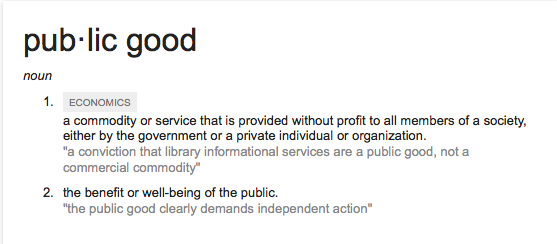
Parents, educators, and politicians moved forward with the illusion of reform based on individual “choice” without considering the public good.
If public education is a public good, what choice does the public have in deciding its direction?
If public education is a public good, what choice does the public have in deciding how it is provided?


We put choice into education law without really having a conversation about our choices.
The Power of the Word
In Understanding the Psychology of the American Idea of Choice, researchers noted that Americans respond more strongly to the word “choice” than people from other countries. They found that when we think about our lives framed in terms of choices, it …
  • “reduces our support for public policies that promote greater equality,…
  • leads us to feel less concerned about the growing gap between the wealthy and the poor,…
  • leads us to feel less empathy towards others who have experienced negative life events,…
  • [shifts] attitudes in favor of policies that promote individual freedom.”
At the heart of the issue of “choice” is our strongly embedded love of freedom. There’s nothing wrong with that, except, these findings may very well have been used against us. Overall, researchers found the effects that the word “choice” has on us seems “to bode poorly for solving social problems that require cooperation.”
Public education of children is a cooperative effort.
Choice Laws
The education law of the land, No Child Left Behind, is aThe Public’s Choice - The Crucial VoiceThe Crucial Voice:

Teachers For Social Justice: CPS-Sponsored "Community Forum" on the future of Dyett HS

Teachers For Social Justice: CPS-Sponsored "Community Forum" on the future of Dyett HS:

CPS-Sponsored "Community Forum" on the future of Dyett HS

Wednesday, June 17
6:00 - 8:00 PM
King College Prep HS
4445 S. Drexel
Chicago
(Candlelight Vigil to follow immediately after!)


Support Bronzeville's Struggle for Dyett HS!

As many of you know, TSJ is part of the struggle to revitalize Walter Dyett HS, which the Board of Education voted (in 2012) to close by this month (see attached Dyett chronology for more). However, due to sustained community pressure, CPS agreed not to close it and to accept proposals. The Coalition to Revitalize Dyett HS, of which TSJ is a member, submitted one this April (see summary here), as did two other groups. June 17, CPS is holding a "community forum" as part of the proposal process. Below is the info from the Coalition, including its call for a candelight vigil immediate following the hearing.


TSJers, wear your TSJ t-shirt (if you have one!), we want all to see and understand that the support for the Coalition's proposal is from both within and without the community.

Further Background
The effort to reclaim Dyett HS is part of the larger education justice work in Chicago, including the campaign organized by the Grassroots Education Movement (GEM) for an Elected Representative School Board, and for 50 Sustainable Community Schools (click formore info). We are also supporting the CTU's contract demands for "a just Chicago," and were with CTU yesterday, rocking Chicago's downtown, Tuesday June 9!

Dyett HS will be one of those 50 sustainable community schools, but it's not won yet. Bronzeville residents worked for over four years to develop a "village" of schools, controlled by the community, but the Mayor, CPS, and allies refused to accept that plan and instead instigated the proposal process. Also, if the Obama Library comes to Washington Park (accelerating Bronzeville gentrification), it will be next door to the HS.

At the June 17 CPS-scheduled "community forum," the Coalition and the two other groups will present their plans followed by community testimony. Whether you live in Bronzeville or outside, you can come to the forum, support the community's long-developed plan, and speak out FOR public education and AGAINST education privatization.

The Coalition is holding a candlelight vigil immediately after the forum, demanding 50 sustainable community schools, of which Dyett will be the first.Teachers For Social Justice: CPS-Sponsored "Community Forum" on the future of Dyett HS:

NEA President Lily Eskelsen García meets with Secretary Hillary Clinton

NEA - NEA President Lily Eskelsen García meets with Secretary Hillary Clinton:

NEA President Lily Eskelsen García meets with Secretary Hillary Clinton


 WASHINGTON - June 08, 2015 -

Today, NEA president Lily Eskelsen García met with Secretary Hillary Clinton as part of the Association’s recommendation process for the 2016 presidential campaign. NEA, the largest union in the country with nearly 3 million members, launched in earnest its recommendation process earlier this year. All viable presidential candidates from both political parties were invited to participate in NEA’s presidential recommendation process. Further below are excerpts from Secretary Hillary Clinton.
“Secretary Clinton and I had a frank and robust conversation about what is at stake in this upcoming election,” said NEA President Lily Eskelsen García. “Recommending a candidate for president of the United States is a civic responsibility that educators take seriously. We know the stakes are high, and going through the process to pick the right candidate that represents the values of educators, students, and their families is critically important.”
“Educators are going to ask the tough questions that get to the heart of the issues that they, their students and families are facing every day. They see what is happening in their schools and communities. They know that all students deserve the support, tools, and time to learn. But are politicians willing to commit to the success of every student regardless of his or her zip code? That is the key question that educators will ask over and over again. Because when all students succeed, we not only create strong public schools, we are building a stronger America.”
Secretary Hillary Clinton:
“My campaign is about making the economy work for everyday Americans; to rebuild the middle class so it means something again. I’m excited about what we can do. I don’t see this campaign as much as about me as about us. It starts with listening to each other.”
“What we can do together to deal with the issues we know are at the real core of making it possible to look at every little boy and girl and say ‘yes, you will have the best chances we can give you.’”
“Education is not just how well you do on a test. We know about a lot of different learning modes ant not every child learns the same way. We have funneled our kids into a particular educational model that I don’t think will ever produce the looked for results.”
“I would like to see us get back to looking at individual children, looking at age appropriate learning experiences, looking at enriching the classroom experience, using tests that are not done for the sake of getting a score but for actually diagnosing the needs of kids and helping those kids do better year after year.”NEA - NEA President Lily Eskelsen García meets with Secretary Hillary Clinton:
Follow us @NEAMedia
The National Education Association (www.nea.org) is the nation's largest professional employee organization, representing more than 3 million elementary and secondary teachers, higher education faculty, education support professionals, school administrators, retired educators and students preparing to become teachers.

CURMUDGUCATION: Pearson Wants To Check Your Glasses

CURMUDGUCATION: Pearson Wants To Check Your Glasses:

Pearson Wants To Check Your Glasses


You just can't make this stuff up.

Pearson VUE is the division of the massive corporation that actually delivers tests to a computer screen near you. They are, for instance, the folks who handle the actually administration of the GED, but they also handle nursing exams and many financial industry clients.

But you don't stay on top of that industry without being on top of things. So here's a new policy that came out in a February circular from Pearson VUE:

Pearson VUE upholds a high level of security for safeguarding the testing programs offered by our exam sponsors. To maintain this high level, we are continually evaluating our technology and processes to ensure that we are adequately addressing existing and emerging security threats. New technology advancements in eyewear, such as Google Glass, camera glasses and spy glasses,and the availability of this technology have been identified as security risks. 

As a result, we conducted a pilot to improve our processes to visually inspect candidate eyeglasses during the admissions process and created specific training on how to identify eyeglasses with built-
CURMUDGUCATION: Pearson Wants To Check Your Glasses:


Walker's Education Fairy Tale


Yesterday, Presidential Candidate and Occasional Governor Scott Walker took to the pages of the Des Moines Register to pat himself on the back. His arm was not the only thing getting twisted.

Walker opens with one of the standards of the anti-teacher movement-- the story of a fine young teacher who won a first-year-teacher-of-the-year award and was then furloughed at the end of the year.

Why would they get rid of a new teacher like Sampson — especially in Milwaukee, which was one of the most troubled urban school districts in the nation? Well, under the old union contracts, the last hired was first fired.

In 2011, we changed that broken system in Wisconsin. Today, the requirements for seniority and tenure are gone. Schools can hire based on merit and pay based on performance. That means they can keep the best and the brightest in the classroom 

Sigh. First of all, as the husband of an excellent teacher who has just been furloughed because she's the one of the least senior teachers at her district, I think I have a good grasp of just how much that royally sucks. (A lot, is the answer. It sucks with the suckage of a thousand black holes.) But there are three things wrong with Walker's "solution."

First, Sampson (and my wife) didn't lose her job because she was last hired. She lost her job because the state failed to adequately fund her school district, so they decided they'd solve the problem by cutting teaching staff. 

Second, the whole empty two-part premise of Walker's solution is the existence of an instrument for measuring which teachers are best and brightest-- and that administrators will use it. But we have no such instrument. VAM and its various forms have been debunked long after the cows came home, ate supper, and turned in for the night. Walker's tiny stack of lost-their-job youngsters is a molehill next to the mountain of tales about excellent teachers whose ratings were crappy.

But of course the efficacy of the measuring stick only matters if someone picks it up. In Walker's universe, teachers can be fired for any reason and paid whatever you feel like paying them. Which  
Walker's Education Fairy Tale

empathyeducates - New Orleans RSD Compared to Traditional Schools

empathyeducates - New Orleans RSD Compared to Traditional Schools:


New Orleans RSD Compared to Traditional Schools

By Michael Deshotels | Originally Published at Lousiana Educator. May 21, 2015
The national news media has been reporting for several years now that the “portfolio” of charter schools created to run the state takeover schools in New Orleans have produced an amazing turnaround of those schools in the ten years since hurricane Katrina demolished the public schools in New Orleans. We see claims that most of the takeover schools are no longer failing and that the graduation rate has improved dramatically, and that the improved performance of the RSD students has greatly exceeded that of more traditional schools across Louisiana and across the nation. The charter school proponents seem to be claiming that poverty can no longer be used as an excuse for poor academic performance. They believe, or would have us believe, that the New Orleans RSD has found the secret to closing the achievement gap between impoverished, at-risk minority students and more advantaged middle class students.
This report is an attempt to simply examine the relevant data that can be used to measure academic success of the New Orleans Recovery District. It will attempt to measure how the RSD compares to traditional public schools. What does the data tell us? Is it Reform Success or Reform Hype?

Is the Comparison Really Complicated?

Some education researchers on this topic have agonized over the fact that the Louisiana school rating system has changed so much in recent years that it is difficult to compare apples to apples. Also, the RSD has closed and renamed so many schools in New Orleans that it is almost impossible to trace the progress of any particular school. The test scores of RSD students on the Louisiana LEAP and iLEAP tests seem to have significantly improved, but so have the scores for the students in traditional schools throughout Louisiana. So, is there a still a method that will really compare the RSD schools to the traditional schools in Louisiana and possibly to other schools across the nation?
Unfortunately for comparison of student performance, the state test results in Louisiana have been manipulated so that they no longer measure the same level of proficiency as they did ten years ago. There appears to have been significant grade inflation of test results over the past ten years that have nothing to do with improvement in student achievement. Some of the grade inflation has come from familiarity of educators and students with the state test, so that students can score higher without significantly improving their math and reading skills. The rest of the grade inflation comes from a general lowering of the raw cut scores documented in this blog for the rating of “Basic” which in Louisiana is considered to be grade level performance. Not only have the state test results been manipulated by lowering many of the raw cut scores, the ratio of difficult to easy questions on the test can be changed from year to year also changing apparent performance.
So how much inflation has occurred in the state testing? The testing inflation can be estimated by comparing the average test results of Louisiana students as measured by the National Assessment of Education Progress (NAEP) with the results of the state designed LEAP and iLEAP tests. In the last ten years, analysis shows that according to state tests, approximately 11 percent more students statewide were deemed to be on grade level (scored basic or above) than ten years ago. But at the same time, the NAEP test shows that only 3 percent more students advanced to basic. That difference and the simultaneous softening in the Louisiana formula for assigning grades to schools (bonus points for subgroups) have resulted in more and more schools appearing to have made dramatic progress in the last ten years. That dramatic “faux progress” includes the New Orleans RSD charter schools.
Graduation rates have improved statewide, and ACT scores are up slightly across the state. So how can we use these statistics to compare the RSD to the rest of the state and to schools nationwide?
There are three simple criteria that may be used to compare student performance between the RSD, state traditional schools, and schools in other states.
The answer to comparison of student performance in Louisiana is really quite simple and does not require complex calculations. First a little history:
The narrative by the charter school proponents is that prior to Hurricane Katrina, the school system in New Orleans was failing miserably. There was graft and corruption by school managers, and most students were empathyeducates - New Orleans RSD Compared to Traditional Schools:

Don’t Fall For The Corporate PET | History, Journalism and Commentary

Don’t Fall For The Corporate PET | History, Journalism and Commentary:

DON’T FALL FOR THE CORPORATE PET


image

One of the biggest players in the long-term agenda to demoralize teachers and defund, dismantle and privatize public education in Tennessee is the Professional Educators of Tennessee, or PET, which might come as a shock to some of their members. After all, PET bills itself as an innocuous member-run business: a “non-union, professional educators’ organization” that “offers a premium package of benefits including exceptional legal protection and liability coverage.” In the past, organizations like PET what have been called “yellow unions”: organizations that claim to represent the interests of workers while actually advancing the company’s agenda. PET is just one example of a growing number of public sector yellow unions that are spreading across the United States. This is  important because, typically, the greatest fightback to the corporate takeover of public schools has come from teachers who are organized in their schools, in their communities, and at the ballot box. Not only do these so-called “independent teachers associations” share deep institutional and ideological connections with the corporate education reform movement, but by siphoning members and resources away from teacher unions they are intentionally undermining the largest and most politically organized opposition to the corporate reformers and their privatization agenda. 
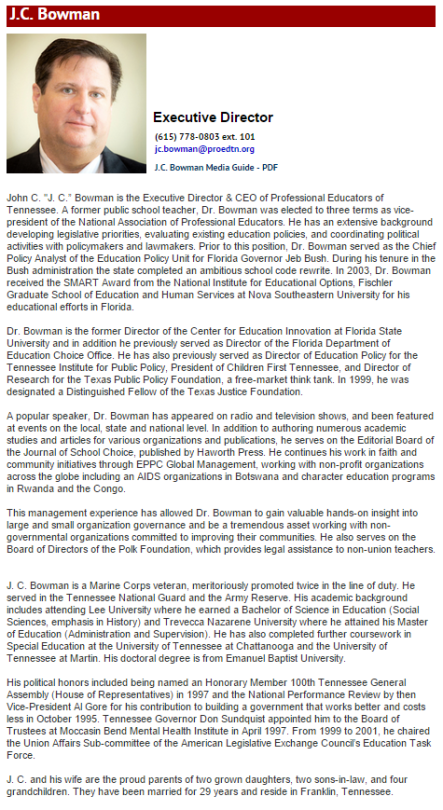
To expose just how yellow of a union PET actually is, we need only look as far as the profile of J.C. Bowmen, PET’s Executive Director, which is publicly posted on the organization’s website. As we shall see, the interconnection of the privatization agenda to the growth of “independent teacher associations” sets the stage for Bowman’s  career trajectory, from working for a Texas free-market think tank to the head of the Florida voucher program to the Executive Director of the Professional Educators of Tennessee.


AMERICAN LEGISLATIVE EXCHANGE COUNCIL (ALEC)

Bowman’s PET profile explicitly states that he served as the chair of the “Union Affairs Sub-Committee of the American Legislative Exchange Council’s Education Task Force” from 1999 to 2001. According to The Center for Media and Democracy, ALEC is “a pay-to-play operation where corporations buy a seat and a vote on ‘task forces’ to advance their legislative wish lists and can get a tax break for donations, effectively passing these lobbying costs on to taxpayers.” For example, both Tennessee State Rep. Harry Brooks and Tennessee State Senator Dolores Gresham are members of the ALEC Education Task Force and both were the primary sponsors of the ALEC model legislation that legalized the virtual charter school, K12 Inc. In fact, the vast majority of Senate Republicans in Tennessee are members of ALEC, spending tens-of-thousands of tax-payer dollars every year to fly around the country and schmooze with corporate leaders at their catered functions and then returning to Tennessee to fight for ALEC’s extremist corporate agenda, such as defeating the expansion of Medicaid and introducing the legislation that ALEC provides them, like the recently passed IEP voucher bill.
Outside of bought-and-paid-for politicians, the primary drivers of ALEC’s agenda are a nationally coordinated web of privately financed “free market think tanks,” called the State Policy Network (SPN), which are dedicated to promoting “market-oriented solutions to state and local public policy issues.” Through the SPN, right-wing think tanks are connected with other extremist right-wing organizations, like the Association of American Educators, and extremist right-wing politicians, like Jeb Bush, to collectively push model privatization legislation (one such example can be seen in the agenda for Don’t Fall For The Corporate PET | History, Journalism and Commentary:

Accountability Needs Narrative More Than Numbers - On California - Education Week

Accountability Needs Narrative More Than Numbers - On California - Education Week:

Accountability Needs Narrative More Than Numbers 


LCBV4.jpg


Numbers don't gain leverage over schools unless they lead to knowledgeable action.  Data that schools can respond to are often contained in the story or narrative that a school tells about itself.  Sometimes these stories are accurate, sometimes they are aspirational, and sometimes they are romantic fantasies.  Regardless, the convergence of narrative and numbers builds local capacity for improvement.
 "At the local level, the key is to get information that people will act on and more importantly will tell a story about your school," says University of Oregon professor David Conley who has advised the California State School Board.  The numerical data that educators need are likely to be different than the data the state collects for the dashboard reports that are replacing single-number indicators.
Take attendance information, for example.  Keeping track of attendance is one of California's eight state indicators, but average attendance levels don't tell a school how to improve.  A more actionable place to start is the names of students who are chronically absent.  "If a student is piling up absences in the first ten weeks of the 9th grade, it's pretty clear that they won't graduate," Conley said in a recent interview.
So, a school needs more fine-grained numbers and rapid feedback about attendance.  It needs to connect those numbers with its narrative about school improvement.  A statement such as, "we support 9th graders in their transition to high school and closely monitor their progress" links action and outcomes.  Action on attendance and other process variables strongly influences outcomes, such as graduation rates, dropouts, and the success of career and technical education students in workplace experience.
 "Not everything is a number," notes Jon Snyder, executive director of the Stanford Center for Opportunity Policy in Education (SCOPE), which is designing and advocating for multiple measure accountability systems.
The merger of numbers and narrative is emerging in several California school districts as a product Accountability Needs Narrative More Than Numbers - On California - Education Week:

Scott Walker's op-ed on K-12 education: Act 10 'changed that broken system' | State-and-regional | wiscnews.com

Scott Walker's op-ed on K-12 education: Act 10 'changed that broken system' | State-and-regional | wiscnews.com:

Scott Walker's op-ed on K-12 education: Act 10 'changed that broken system'


Gov. Scott Walker said in an opinion column this week that changes to Wisconsin's education landscape under his governorship are types of "reforms" that could be pushed across the country.
In an op-ed published in the Des Moines Register on Tuesday, likely 2016 presidential hopeful Walker touted changes to tenure and seniority among public school teaching ranks as a result of Act 10, the 2011 legislation that significantly limited collective bargaining rights. He also praised the expansion of school vouchers in the state over the last few years.
"Now, more than ever, we need to push big, bold reforms to improve our schools. If we can do it in Wisconsin, there is no reason we can’t push positive education reforms across the country," he wrote.
Walker said the changes that removed public school teachers unions' ability to bargain over how staff is laid off  "changed that broken system in Wisconsin."
Walker also laid out elements of what could be an education platform in his probable presidential bid. He said he would move money out of Washington D.C. and give it to states and schools, but was not more specific about how that would be done.
He also underscored his consistent support for school choice by saying "we should expand the options for families in the District of Scott Walker's op-ed on K-12 education: Act 10 'changed that broken system' | State-and-regional | wiscnews.com:

As Congress debates No Child Left Behind: Who should decide which schools are failing kids? - The Washington Post

As Congress debates No Child Left Behind: Who should decide which schools are failing kids? - The Washington Post:

As Congress debates No Child Left Behind: Who should decide which schools are failing kids?


From Rand Paul on the right to Elizabeth Warren on the left, members of the Senate education committee pushed aside their policy disagreements earlier this spring when they voted unanimously in favor of a bipartisan revision to the widely reviled No Child Left Behind law.
But key differences remain to be resolved in both chambers of Congress before the rebranded “Every Child Achieves Act” can make it into law. Among the stickiest: how and whether Congress should define which schools are failing to serve students well and need intervention.
It is an issue that has not only divided the parties but also pitted two traditional Democratic allies — civil rights groups and the National Education Association, the nation’s largest teachers union — against each other.
Now the Congressional Tri-Caucus has sided with dozens of civil rights groups and the Obama administration. In a letter to the Senate on Wednesday, more than 80 members of the Tri-Caucus said they cannot support the bill without key changes, including a requirement that states take action at schools that are failing to serve subgroups of children, such as those who are low-income, African American or English learners, or those who have disabilities.
Specifically, the Tri-Caucus — made up of the Congressional Black Caucus, the Congressional Hispanic Caucus and the Congressional Asian Pacific American Caucus — wants the federal government to compel states to act when a school fails to meet testing targets for subgroups of students two years in a row.
That type of change is anathema to many Republicans, who see it as a federal overreach, and to the NEA, which likens it to a return to the test-centric and overly punitive provisions of No Child Left Behind. But members of the Tri-Caucus say that the requirement is key to ensuring that states do not overlook the nation’s neediest children.
Rep. Robert C. “Bobby” Scott (Va.), the ranking Democrat of the House education committee, said he and his colleagues are seeking a new law that “honors the civil rights legacy of the law and fulfills the needs of all of America’s children.”
The 2002 No Child Left Behind law was so unpopular in part because of its rigid definition of a “failing” school — any school in which one subgroup of students, such as African American children or those with disabilities, failed to meet test score targets set by the federal government. Schools that were As Congress debates No Child Left Behind: Who should decide which schools are failing kids? - The Washington Post:

Ohio Charter Schools' Terrible, Horrible, No Good, Very Bad Week | The Progressive

Ohio Charter Schools' Terrible, Horrible, No Good, Very Bad Week | The Progressive:

Ohio Charter Schools' Terrible, Horrible, No Good, Very Bad Week


Talk about a rough week. Take a look at the news stories coming out about charter schools this week.
On Saturday, the Akron Beacon Journal (again) led the way on enterprise reporting on this topic by publishing an analysis of 4,263 audits done last year by the Auditor of State revealed that 
"No sector — not local governments, school districts, court systems, public universities or hospitals — misspends tax dollars like charter schools in Ohio."
Yikes.
Among the findings:
  • While charters only accounted for 400 of 5,800 audits, they accounted for 70% of the misspent money
  • $25 million in misspent money remains unpaid
  • For every $1 misspent found by private auditors, public auditors found $102
The misspending is probably worse than what the audits turned up because so many charters were next to impossible to audit, according to the Beacon Journal.
Then came a Columbus Dispatch editorial (historically, no friend of the charter critic) that called out charter school sponsors for wanting to hide their expenditures to oversee the sector, except in limited cases -- an argument not much different from one I made about the same time.
Later that same day, the Dispatch revealed that the troubled North Side Imagine charter school might be shut down because its board just up and quit. This is the same school that was found last year toy be spending an exorbitant amount of money leasing the property from a subsidiary of Imagine Schools -- a practice that was found to be illegal in Missouri. Imagine Schools, Inc. run schools in 11 states and are no stranger to controversy.
Meanwhile, the same day, the Dayton Daily News reported that three former Dayton-area charter school officials were convicted of bribery and conspiracy charges in connection with their operation of the Arise! Academy. 
They all face at least 15 years in federal prison for steering lucrative contracts to each other. 
Yesterday, the Plain Dealer reported that 3 charters have been put on notice that the state's looking to close them, including another 2 Imagine schools. That's not all.
"All three are failing to manage their budgets properly, ODE also said in the letters, and the Villaview and Cleveland Community School partnership could face ethics charges."
As a follow-up, this morning, WKYC-TV in Cleveland reported that not 3, but 4 charters -- including another Imagine school in Canton -- would be suspended for failing to meet performance requirements.
And finally, yesterday, the Beacon Journal told the tale of how private auditors sent out by the State Auditor's office failed to catch more than $1.3 million that had been outright taken from one area charter school, calling into question whether private auditing firms should even be used as a substitute for public auditors.
What did the private firm miss? Try this:
"It was an abrupt turnabout: A private accounting firm had given the charter school a clean bill of financial health, finding “no material weakness” despite missing information later discovered by the state. Among the state’s discoveries were employee contracts that lacked signatures, a cruise boat company had charged the school for too many attendees for a training session (nothing in the audit suggested training on cruise boats might be inappropriate) and half of the receipts were missing."
These stories all have been told before, though not as rapid-fire and in as quick succession. What they indicate is pretty clear: We desperately need real, substantive charter school reform. Now. The Ohio Senate is currently considering SB 148, which would be a meaningful improvement on the current situation. However, it still doesn't make it easier for the state to shut down poor performing charters, nor does it fix a funding system that far too often forces local property taxpayers to subsidize the state funding losses to woefully underperforming charter schools.
To be clear, there are a few quite exemplary charter schools out there. And I want to see them thrive in more places around this state. So this is in no way directed at the Breakthrough Schools, or DECA or Columbus
- See more at: http://www.progressive.org/news/2015/06/188170/ohio-charter-schools-terrible-horrible-no-good-very-bad-week#sthash.YH1tdAF6.dpuf


Ritz Roundup: A Superintendent’s Run For Governor & Other Links | StateImpact Indiana

Ritz Roundup: A Superintendent’s Run For Governor & Other Links | StateImpact Indiana:

Ritz Roundup: A Superintendent’s Run For Governor & Other Links


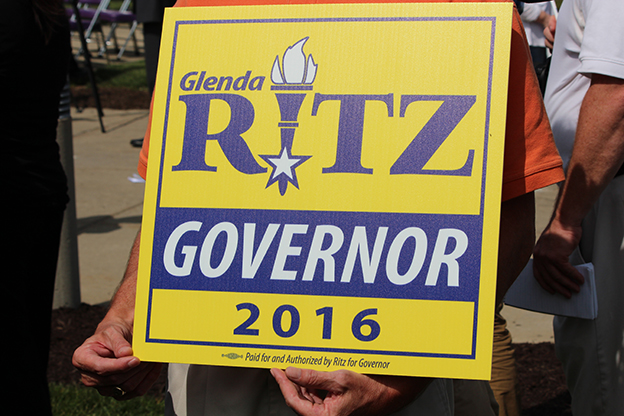
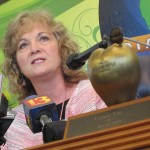
As we reported last week, state superintendent Glenda Ritz is running for governor.
The announcement didn’t come as a surprise, but it did raise questions about theeducator’s experience outside school policy and her ability to appeal to voters on those other topics.
A supporter holds his sign supporting state superintendent Glenda Ritz during her announcement she will run for governor in 2016. (Photo Credit: Rachel Morello/StateImpact Indiana)
Ritz has two years under her belt as Indiana’s schools chief – the 2015-16 school year marks her third at the helm. A lot has happened since she took office: Indiana left the Common Core and wrotenew academic standards, the ISTEP+changed (and will soon change again), and schools will soon be graded under anew A-F accountability model.
As you might expect, we’ve done a lot of reporting about Ritz’s involvement in those and other school-related subjects, as well as her responses to big news that happened outside Hoosier classrooms. So as she makes her run for the state’s top post, refresh yourself and get caught up on where the politician stands.
On testing
On accountability 
  • In the 2012 race vs. Tony Bennett, Ritz alludes to A-F overhaul, saying under her leadership “there would be no A-F grading system for schools, school districts or universities as currently designed.” In May, the previous SBOE and Ritz approved new rules for the A-F system that incorporates a student’s growth from on year to another in the schools letter grade.
  • One of the accomplishments Ritz touts as her finest on the job isdeploying outreach coordinators throughout the state to help struggling schools get up to speed.
On pulling out of the Common Core
  • A newly-inaugurated superintendent Ritz got to work quickly, voicing her support for a pause and review of Common Core State Standards when they came into question in early 2013. The official made it clear she was not advocating for getting rid of the standards.
  • When the pause went into effect, the superintendent championed “adaptive assessments” as a good alternative for Indiana, to replace the ISTEP+: “An adaptive model has a huge bank of questions,” Ritz said. “If you get an answer wrong in reading, it gives you an easier reading level question.”
On working with her opponents
On spending
 Ritz Roundup: A Superintendent’s Run For Governor & Other Links | StateImpact Indiana: