Latest News and Comment from Education

Saturday, March 6, 2010

Firing all the teachers was justified - CNN.com

Firing all the teachers was justified - CNN.com
San Diego, California (CNN) -- In most high schools in America, they teach Shakespeare. But at Central Falls High School in Rhode Island, they're acting out a Shakespearean drama.

Only instead of the famous line from Henry VI -- let's kill all the lawyers -- what we have is: "Let's fire all the teachers."

That's exactly what Central Falls School District Superintendent Frances Gallo did in February. In a move that was bold but also justified, Gallo fired 77 teachers at Central Falls High School in Rhode Island, along with the school's principal, three assistant principals and other administrators. In all, the district said, 93 people were let go in the purge. The school board later stood by Gallo and approved the action
The mass firings, which take effect at the end of this school year, came after the district failed to reach an agreement with the local teachers' union on a plan that would have required teachers to spend more time with students to improve test scores -- with only a small increase in pay.

Consistent with federal guidelines designed to improve theeducational system, Gallo asked teachers to work a longer school day of seven hours and tutor students weekly for one hour outside school time. She proposed teachers have lunch with students often, meet for 90 minutes every week to discuss education and set aside two weeks during summer break for paid professional development.

Think of it as asking teachers to go back and fix what they didn't do right the first time.

Central Falls High School is one of the lowest-performingschools in Rhode Island. It operates in a community where the median income is $22,000, according to census statistics. Of the school's 800 students, 65 percent are Latino and most of them consider English a second language. Half the student body is failing every subject, with 55 percent meeting requirements in reading and only 7 percent in math.

"No thanks," said the teachers. "You're fired," said Gallo.

Upon hearing this story, my first thought was how do we get this woman out of Rhode Island -- and down to Washington to clean house by demanding results from the politicians?

Apologists for the public schools and other defenders of the status quo will hear those statistics, and say: "Well, how do you expect educators to reach and teach a population like that?"

Easy. I expect teachers to do it by putting aside the excuses, setting higher expectations, adhering to better standards, giving into common sense reforms and doing their jobs in a school that serves a vulnerable population that is especially in need of a quality education -- but also, and here's the good news, in many cases, extra motivated to get one.

Forget that poor-kids-can't-learn nonsense. It wasn't true 100 years ago and it's not true now. Besides, there is no ideal student population.

Readers' Forum: Must help California's community colleges - ContraCostaTimes.com

Readers' Forum: Must help California's community colleges - ContraCostaTimes.com

greg enholm | From the community
By Greg Enholm
Guest Commentary

YOUR FRONT page Feb. 25 article "College enrollment dips" highlights critically important issues challenging public education now. With substantial budget cuts at all levels, every level of education struggles to continue providing a solid education for students.
Contra Costa County's three community colleges (Contra Costa in San Pablo, Diablo Valley in Pleasant Hill and Los Medanos in Pittsburg) and campuses (Brentwood and San Ramon) have experienced 5 percent reductions in their funding.
Classes have been canceled and hundreds of students are told they cannot be admitted.
Budget cuts for the University of California have shifted students from UC to the California State University system. But CSU tuition increased dramatically so many students who wanted to attend CSU now want to attend community college for two years first. Community colleges are being deluged with students just when many newly unemployed workers want to learn new skills.
The time to stop denying any student access to California's community colleges is now while the solution is manageable. All Californians benefit when students learn new skills at, or prepare for university at, our community colleges.
A 2006 study concluded Contra Costa community colleges contribute substantially to both their students' knowledge and subsequent earnings ($200 higher lifetime earnings for every credit earned) and to the local economy ($2.50 for
every $1 of taxpayer financial support). About $3.5 billion in increased income was created by these colleges' students being better educated with new skills.
If America could afford to invest $180 billion (yes, billion not million) to save the insurance giant AIG International at $600 for each of 315 million Americans, how much would it cost to allow all students access to community colleges?
The U.S. House of Representatives has already passed "Student Aid and Fiscal Responsibility Act HR-3321," which would help and it is awaiting Senate action.
What happens to students denied entry to our affordable and efficient community colleges? Let's not find out!
Make your opinion known! E-mail your U.S. senators by going tohttp://boxer.senate.gov/en/contact/policycomments.cfm and http://feinstein.senate.gov/public/index.cfm.
Or call Sen. Barbara Boxer at (415) 403-0100 and Sen. Dianne Feinstein at (415) 393-0707. Call Rep. John Garamendi at (925) 932-8899 or Rep. Jerry McNerney at (925) 737-0727 or Rep. George Miller at (925) 602-1880.
Greg Enholm is a high school math teacher. He can be reached at gbenholm@gmail.com.

Opinion: Walters: Did governor snooker Legislature? - San Jose Mercury News

Opinion: Walters: Did governor snooker Legislature? - San Jose Mercury News

Opinion: Walters: Did governor snooker Legislature?

Updated: 03/05/2010 04:35:48 PM PST

It's not often that California's educational establishment — led by the very powerful California Teachers Association — loses a Capitol battle, especially when it's pitted against its archenemies in the school reform movement.
That's what made the approval in January of two major education reform measures, targeting low-performing schools and empowering parents to force school site change, so striking.
Reformers, led by Gov. Arnold Schwarzenegger and EdVoice, an advocacy group financed by a few wealthy civic leaders, and the CTA-led establishment have been jousting for years over whether schools must have more money to get better, or could and should be improved without extra funds.
The reform faction, however, gained a powerful ally in President Barack Obama, who offered $4.35 billion to states that met his Race to the Top criteria.
Obama's education secretary, Arne Duncan, singled out California as he pressed states to adopt reforms that unions dislike, such as increasing charter schools and using student test data for teacher evaluations.
It put Democratic legislators, who usually march to the CTA drumbeat, in a bind. If they refused to do what Schwarzenegger and Obama demanded, they'd look like obstructionists who were sacrificing children's education by ignoring as much as $700 million from the feds, even though it's scarcely 1 percent of school spending. But if they enacted the reforms, they'd be alienating
powerful allies.
As the deadline for applications loomed, the Legislature passed the two bills, somewhat watered down from the original versions but still opposed by big education groups. Republicans embraced them overwhelmingly, and Democrats were divided. Sen. Gloria Romero, D-Los Angeles, the EdVoice candidate for state schools superintendent, carried one.
"In the past, parents had no power to bring about change in their children's schools, but that will now change," Schwarzenegger crowed during his State of the State address. "Parents will now have the means to get rid of incompetent principals and take other necessary steps to improve their children's education."

As We See It: No fee lunch - Santa Cruz Sentinel

As We See It: No fee lunch - Santa Cruz Sentinel


After a raucous start Thursday morning outside UC Santa Cruz, demonstrations over California's funding for schools were mostly peaceful and reasonable.
Most of the heat Thursday was generated at university campuses, where a 32 percent hike in fees and budget cuts have infuriated many students. Protesters' argument against increases in tuition is that a public university education is becoming unaffordable to poorer families. This in turn would mean California's economic future is in doubt, since a highly educated work force would seem essential to future job creation.
Fees at UC campuses will be above $11,000 next year; at Cal State campuses fees will be $4,827.
California taxpayers who have experienced wage cuts and furloughs, not to mention job losses, may be wondering why they should be subsidizing higher education.
So, are the fee hikes unjust?
That would depend on who's paying the tab.
But in a San Jose Mercury News story published in Thursday's Sentinel, reporter Lisa M. Kreiger found that protesters may not realize state public university educations for the poor are being subsidized by middle-class families, who don't qualify for government aid readily available to lower-income families. Poorer students often pay no tuition at all in the new model of California public higher education, which Kreiger describes as "high tuition, high aid." Without substantial new taxes for Californians, this model will probably stick. Meanwhile,
the state's contributions to higher education as a percentage of the general fund are about half of what they were in 1984. That's why fees are rising.
The nonpartisan state Legislative Analyst's Office says fees are not the sole culprit, because they subsidize higher education for needy students. Reducing fees would reduce access.
That's probably little solace to hard-pressed families trying to keep up with drastic fee hikes, but it does put the current situation in context.
Legislative analyst Steve Bollard's solution is that UC and CSU systems create a formal fee policy, much like one in place from 1986-96 that specified increases should be gradual, moderate -- and predictable. By determining increases at least 10 months in advance and never jumping by more than 10 percent in a year, families who don't qualify for aid can budget for college costs.
The volatility of the state's budget has meant wealthier families are on the hook for ensuring that poorer students also have access to a UC or CSU education. That doesn't make it right, but protesters should do their homework to find out what's behind fee hikes.


Thousands rally in San Diego, California against education cuts

Thousands rally in San Diego, California against education cuts

Thousands rally in San Diego, California against education cuts

By a WSWS reporting team 
6 March 2010
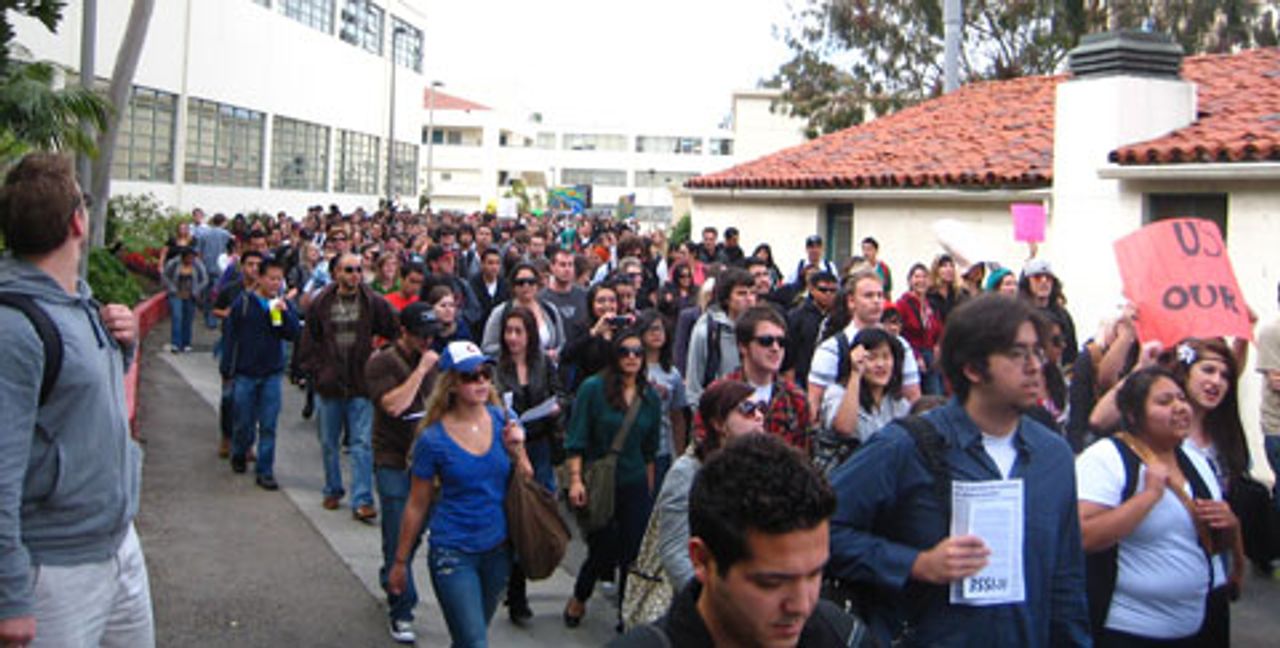
About 1,000 students and faculty gathered at a March 4 rally against education cuts at San Diego State University in California. A similar number of people demonstrated at the University of California, San Diego. A subsequent demonstration in downtown San Diego drew several thousand.
The events in San Diego were among the largest demonstrations in the state. Tens of thousands of students, parents and workers demonstrated throughout the country against school closings, tuition hikes, and teacher layoffs. (See, “Students and staff protest against education cuts in US”)
Among the main speakers at the San Diego rallies were members of the International Students for Social Equality, the student organization of the Socialist Equality Party. The ISSE, which helped organize the demonstration at SDSU, called for a break with the Democratic Party and for a socialist movement to defend education.
Despite their size, the San Diego rallies went largely unreported in the media. If their numbers were mentioned, they were generally reported as “hundreds.” This was part of what appeared to be a general attempt by the media to downplay the significance of the demonstrations.
The first speaker at the SDSU rally was Priscilla Diaz, a straight-A high school student who was denied admittance to SDSU because of budget cuts. The university cut its total enrollment by 4,500 this year, and expects to cut another 11,000 over the next two years.
The other speakers included representatives of the March 4 UCSD educational committee as well as various other student groups on campus. These groups, to the extent that they had any explicit political perspective, 

Scenes From the Demonstrations Over Education Cuts - Bay Area Blog - NYTimes.com

Scenes From the Demonstrations Over Education Cuts - Bay Area Blog - NYTimes.com

Scenes From the Demonstrations Over Education Cuts

In the Bay Area on Thursday, it was hard to go anywhere without running into people marching or a teacher handing out flyers, all part of the national protest over education cuts, as we wrote in a continually updated blog post.
Public schools like Oakland Technical High School held disaster drills, as described by Oakland North, and people marched from the Mission Districtin San Francisco to the Civic Center, where the day concluded with a rally, as described by Mission Local.
In Sacramento, about 1,000 people used “drums, bullhorns, and scores of young voices to try to get their message across,” as Jesse McKinley wrote in The New York Times.
About 150 people were arrested for being part of a blockage of an interstate in Oakland on Thursday afternoon, according to Oakland Local. The freeway 

Fear Of Failure Growing In California's Schools - News Story - KTVU San Francisco

Fear Of Failure Growing In California's Schools - News Story - KTVU San Francisco

Fear Of Failure Growing In California's Schools

The cuts made already are blamed for pushing California's once-esteemed education system to the bottom ranks of all states.
San Francisco's school district is sending 900 employees pink slips this month, and almost half of them are teachers.
At International Studies Academy, more than one-third of the staff are on the 'to go' list and ten of them are teachers.
"I don't know how we're going to be able to absorb that kind of hit," said Matt Livingston, the principal of International Studies Academy.
Livingston added he's had a lot of sleepless nights thinking about larger class sizes and fewer resources for his 500 sixth to twelfth graders.
"That's going to be a combination of teachers, counselors, possibly more. We're going to feel it," said Livingston.
Third year teacher Chris Cary said he took a $25,000 dollar a year pay cut to become a teacher and sees the old promise of a great California education being broken.
"If you don't invest in education what is the economy of this state gong to look like in ten, 15 years when those kids become the prime productive earners of the California economy," said Cary.
More than 40 percent of the state's general fund budget goes to kindergarten through 12 schools. Add colleges and universities and the figure reaches 52 per cent.
But Sacramento cut general fund spending on the total budget by $20 billion in the past year.
San Francisco School Superintendent Carlos Garcia said K-through-12 schools took the biggest hit.

California's education charade | Sasha Abramsky | Comment is free | guardian.co.uk

California's education charade | Sasha Abramsky |Comment is free |guardian.co.uk

California's education charade

Anti-tax revolts have led to a huge gap between well-resourced schools for the wealthy and starved-for-cash schools for the poorsasha
Education protests, California
Protesters opposing cuts in education funding march in downtown Los Angeles, California. Photograph: Paul Buck/EPA
Over the next two weeks, more than 5,000 Los Angeles school employees – teachers and other personnel – will receive lay-off notices informing them that they might not have jobs come the start of the next academic year. Not all of them will ultimately lose their salaries, but many likely will. The reason? In addition to the hundreds of millions of dollars the city budget is short by, the school district, which has separate revenue streams, is also in the red by a staggering $640m.
The layoffs aren't just impacting Los Angeles. Around California, the education system is in crisis. Schools in the San Diego area face the loss of hundreds of teachers. In northern towns like Elk Grove, hit particularly hard by the housing bust, about one-sixth of school employees will receive lay-off notices. Even a university town like Davis, which prides itself on having one of the best public school systems in the state, is feeling the pain. Davis, a small town of fewer than 70,000 residents, recently announced that more than 100 teachers would lose their jobs.
With property tax revenues shrinking and state contributions to plug funding gaps on the decline, California's schools are haemorrhaging teachers and non-academic staff, cutting back on virtually every non-mandatory aspect of education – music, arts, science and so on – cleaning facilities less often, reducing special education programmes, and more. Many districts are all-but eliminating the presence of school nurses, counsellors, and psychologists. Teachers are being hit with pay cuts. The length of the school year is being trimmed. I'll stop there, but you can be sure that the list goes on.
What's insane about this is that everyone knows California's heading in the wrong direction here, yet the financial crisis is so vast, and the options for raising taxes so limited at this point because of the toxic politics around the issue, that nobody can see light at the end of this particular tunnel.
By most measures, California already performs poorly when it comes to educating its 6 million-plus public school students. It spends far less per kid than the national average – thus largely negating the arguments of conservatives who say that California's schooling crisis is all to do with overpaid, over-benefited teachers – it has higher student-teacher ratios, it has below-average test scores for maths and reading, and it has higher than average high school drop-out rates.

March 4 Day of Action Ripples Through California and Beyond | Labor Notes

March 4 Day of Action Ripples Through California and Beyond | Labor Notes

Walkouts, student strikes, and marches shook every level of California’s embattled public education system on March 4. University of California students blocked access to campus entrances at Berkeley and Santa Cruz in the morning. In the afternoon, college students joined forces with K-12 students and teachers in downtown Oakland, San Francisco, San Diego, and Los Angeles.
The rallies numbered in the thousands—some estimate the gathering in front of San Francisco's Civic Center at 20,000. In Oakland and Davis, hundreds of marchers confronted police after taking their protests onto the freeways.
The call for action against crippling state budget cuts—$17 billion in two years to the state’s education fund—and the UC administration’s crisis of priorities was taken up on every UC and state college campus—and echoed by students, teachers, and campus union activists in 32 states.
A major target is Governor Arnold Schwarzenegger and state legislators who ready their 

Why did California fail Race to the Top test?

Why did California fail Race to the Top test?:

"Why didn't California win a finalist position in the federal Race to the Top program?

The U.S. Department of Education announced Thursday that 15 states and the District of Columbia were finalists for the first round of funding from Race to the Top, a competition worth $4.3 billion in federal dollars. Despite a hard-fought victory to pass important educational reforms through the Legislature, California was glaringly absent from the list."

This is unsettling news. States that seemingly hadn't made reforms at all - like Kentucky, which doesn't permit charter schools, and New York, where the state Legislature failed to repeal a charter school cap - were among the finalists.
Not California. What happened?
We won't know for sure until April, when the feds will explain their reasons for rejecting California's application. But if we had to hazard a guess, it would be that the Race to the Top officials chose to pay more attention to the education squabbling in California than they did to our application.
Fortunately, there are some state legislators who remain passionately dedicated to reform, and Gov. Arnold Schwarzenegger is too. State Sen. Gloria Romero, D-Los Angeles, who authored some of the hardest-fought reforms, insists that the state will still compete for the second round of Race to the Top funding. That application is due in

Read more: http://www.sfgate.com/cgi-bin/article.cgi?f=/c/a/2010/03/05/ED1E1CBI13.DTL#ixzz0hP2RUG9I

03.05.2010 - Wendy Brown: Without quality public education, there is no future for democracy

03.05.2010 - Wendy Brown: Without quality public education, there is no future for democracy

Wendy Brown: Without quality public education, there is no future for democracy

05 March 2010
UC Berkeley professor of political science Wendy Brown was among the more than 200 Berkeley faculty members who traveled to Sacramento on March 4. A co-chair of the Berkeley Faculty Association, she gave the following address on the capitol steps during the "Educate the State" rally.
Not long ago, California public education was an international beacon of excellence. Through much of the 20th century, Californians were committed to quality public elementary and secondary schools and an accessible multi-tiered system of higher education — from guaranteed access to community college for every high school graduate, to great research universities and professional schools.
Wendy Brown, professor of political scienceWendy Brown, professor of political science
After decades of demonstrating that this was possible — that there could be affordable mass access to high-quality education — California begin to unravel its own accomplishment. The 1978 passage of Prop 13 marked the beginning of this unraveling, pitching our elementary and secondary schools into the downward decline that today finds teachers facing overcrowded classrooms, insufficient books and supplies, inadequate compensation and lay-offs, and throwing a spectacularly successful higher education system into the mud.
This devastation of our public education and the rest of our public sector is not the consequence of our state being poor. Certainly we have suffered from the recession, the financial meltdown, the collapse in housing wealth, unemployment and the foreclosure crisis. But California still generates nearly one sixth of U.S. Gross Domestic Product, and were it a nation unto itself, our GDP would place us among the top 10 nations in the world.
California, rich in resources, rich in human talent, rich in industries, and very rich in the rich, can afford a first rate education system. But our quagmired political system (minority rule), anti-tax political culture, upsidedown state budget priorities, and the configuring of higher education itself on the model of a business — these have demoted public education to the status of a failing discount store.
Indeed, there is more at stake here than the loss of a great system of education, than the madness of permitting oil wealth, real estate wealth, Silicon Valley wealth, banking wealth, Hollywood wealth, agribusiness wealth and prisons to grow ever larger while starving our schools. There is more at stake than the madness of cutting the fuel to the economic engine that generated so much innovation and capacity in California during the last century. It is also the case that there can be no democracy without an educated citizenry.
Without quality public education, we the people cannot know, handle, let alone check the powers

Peter Robinson: The Golden State's Me Generation - WSJ.com

Peter Robinson: The Golden State's Me Generation - WSJ.com

During the "Strike and Day of Action to Defend Education" on Thursday, tens of thousands of students, teachers, professors and administrators marched in California and some 30 other states to protest cuts in education spending. David Patterson, a librarian at Cañada College, a community college in Redwood City, proved typical.
Asked beforehand to explain his participation, he employed the vocabulary of idealism that appeared on every placard and sounded from every bullhorn. "I'm hoping that students . . . feel connected to Montgomery, to Selma . . . to the sit-ins, to Freedom Riders, to the farmworkers' struggle" of the 1960s and '70s, Mr. Patterson wrote on the Socialist Worker Web site. "Now that's an education: To see your fight against oppression connected to a long line of others' fights."
The demonstrations did offer a certain sort of instruction, though not of the kind Mr. Patterson and his fellow protesters had in mind. They demonstrated the entitlement mentality and self-absorption that has come to dominate much of higher education.
Associated Press
An unidentified demonstrator pleads with police blocking their access to the Interstate 80 as students demonstrate at the UC Davis campus in Davis, Calif. on Thursday, March 4, 2010.
If you went searching for the proximate cause of the "Strike and Day of Action to Defend Education," you wouldn't find it in any pattern of oppression. You'd find it in a couple of acts of desperation last year. First, Gov. Arnold Schwarzenegger, facing the worst budget crisis in state history, cut about $600 million in overall funding for 10-campus University of California and the 23-campus California State University. Then the U.C. regents and C.S.U. trustees, facing budget crises of their own, reduced programs, furloughed workers, and raised tuition.
Students and faculty erupted throughout California, but nowhere with quite the indignation displayed at the state's oldest and most prestigious public institution of higher learning, U.C. Berkeley. Addressing students last 

Thousands protest California education cuts - Los Angeles Times

Thousands protest California education cuts - Los Angeles Times

Thousands protest California education cuts

Rallies and walkouts are largely peaceful, but 150 are arrested in Oakland as a freeway is blocked. The demonstrations are part of a nationwide 'Day of Action for Public Education.'

March 05, 2010|By Carla Rivera and Nicole Santa Cruz and Larry Gordon
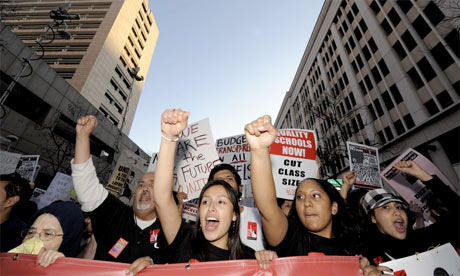
A day of passionate protest against education funding cuts attracted thousands of demonstrators Thursday to mostly peaceful rallies, walkouts and teach-ins at universities and high schools throughout California and the nation. In Oakland, however, about 150 protesters were arrested after they blocked a freeway, snarling rush-hour traffic.
From Los Angeles to New York and from San Diego to Humboldt in Northern California, students, faculty and parents at many schools decried higher student fees, reduced class offerings and teacher layoffs in what leaders described as a "Day of Action for Public Education." Labor unions and student government groups were the main organizers.