Latest News and Comment from Education

Showing posts with label UNION BUSTING / TEACHER BASHING. Show all posts

Monday, May 17, 2021

CURMUDGUCATION: Covid and the Good Guys

CURMUDGUCATION: Covid and the Good Guys
Covid and the Good Guys


You can set this Twitter comment next to a quote from Rep. Virginia Foxx, who said that Weingarten "is attempting to rewrite history by framing her union as part of the 'solution.'"

Both are a fine example of how far off the rails the re-opening school debate has gone (if we can characterize a bunch of people hollering at each other a debate). Notice that the outpouring about Weingarten's call to re-open school buildings in the fall is not talking about whether that's a good idea or not. No, what we're now arguing about is who should get to call themselves a good guy. 

One of the narratives pushed and pushed hard for the last fifteen months has been the Narrative of the Evil Unions, who have somehow been behind the whole school closing thing even though many many parents have balked at sending students back and many private schools have stayed closed and it's not even particularly clear exactly how and where this union pressure has been exerted. Nor have I ever, ever understood what the villains' motivation was supposed to be in this story--if teachers are intent on shutting down schools, why is that, exactly? But anyway-- the Narrative of the Evil Unions has never flagged, and people who are invested in it will be damned if they're going to see the unions wiggle CONTINUE READING: CURMUDGUCATION: Covid and the Good Guys

Thursday, April 15, 2021

Revisiting California's Battle of Hastings - LA Progressive

Revisiting California's Battle of Hastings - LA Progressive
Revisiting California’s Battle of Hastings


Courtesy of re:publica/flickr.

The 2005 Sacking of the Netflix CEO as State Education Board Chief Looks Different Now

After long days supervising my children in their struggles with the miseries of distance learning and hybrid school, I try to relax by watching Netflix. As I do, I often find myself thinking about a state legislative hearing from 2005, and how different California education might be if it had gone differently.

The hearing, in a committee of the State Senate, was supposed to be routine. I, an L.A. Times reporter at the time, didn’t even bother to cover it. The subject was reappointment of the president of the State Board of Education. The president, Reed Hastings, was thought to be a shoo-in.

After all, Hastings, a tech entrepreneur and Democratic donor from Santa Cruz, had put together a successful ballot measure to make it easier to pass school bonds, launching a new era of school construction statewide after decades of neglect. He’d supported the state’s accountability system for schools, and backed the establishment of public charter schools in disadvantaged neighborhoods. Hastings also had bipartisan support—he’d been appointed four years earlier by a Democrat, Gov. Gray Davis, and was nominated for re-appointment by Gov. Arnold Schwarzenegger, a Republican.

But the hearing went sideways. Some education groups didn’t like charter schools, or his blunt interest in transforming education systems. Hastings himself suggested that he was felled by CONTINUE READING: Revisiting California's Battle of Hastings - LA Progressive


Sunday, March 7, 2021

Charlie Brown, Lucy, and the football | Live Long and Prosper

Charlie Brown, Lucy, and the football | Live Long and Prosper
Charlie Brown, Lucy, and the football


After a decade of bashing public schools and public school teachers, Indiana “reformers” ought to be pleased with the results. The state’s teacher shortage is likely to continue because of low salaries, constant disrespect of professionals and their organizations, and the punishment of public schools unable to solve the social and economic problems of the state.


Just 1 in 6 Indiana college students who study education become teachers, report finds

Indiana schools have struggled to fill vacancies in recent years as a strong economy created jobs in other industries. Teacher pay in Indiana lags behind that of neighboring states and behind salaries of other professional careers — a problem that has attracted attention from politicians and advocates on both sides of the aisle.

Promised a raise by Governor Holcomb (see herehere, and here), teachers are still waiting while the Governor continues to mark time. The lack of salary increases is contributing to the problem.

A little over a year ago Holcomb approved pay raises for state employees of 2%-6%. He excluded teachers, of course, instead deferring to the Teacher Compensation Commission whose recommendations for an increase to an average of $60,000 he then proceeded to ignore.

Yes, the pandemic has caused economic problems for the state, but the Governor CONTINUE READING: Charlie Brown, Lucy, and the football | Live Long and Prosper


Friday, February 19, 2021

Blaming Teachers Unions for Problems Reopening Schools Is Wrong: Reopening Must Be Done Safely | janresseger #openonlywhensafe

Blaming Teachers Unions for Problems Reopening Schools Is Wrong: Reopening Must Be Done Safely | janresseger
Blaming Teachers Unions for Problems Reopening Schools Is Wrong: Reopening Must Be Done Safely


Right now, after nearly a year since life shut down for COVID-19, things feel like a chaotic mess. Children in lots of places are not in school but are instead learning remotely at home.  Unemployment is endemic. Families face unimaginable financial pressures, and if parents are working, the pressures of managing children out of school have been overwhelming. Some parents have felt obligated to quit work to supervise children learning at home, or if parents themselves are working from home, they may be struggling to manage kids learning remotely while the parents try to do their jobs.

As far as reopening schools full-time, the new Biden administration seems confused. The Washington Post‘s Cleve Wootson and Laura Meckler report: “As the country approaches the one-year mark of the pandemic’s isolation and restrictions, the Biden administration is struggling to give precise, consistent answers to two key questions: when will the pandemic truly be behind us? And short of that, when can children safely return to school? Biden himself has blamed miscommunications for some of the inconsistency, but his administration… is also grappling with the fact that science and data don’t produce answers as tidy or linear as campaign promises… For months, Biden has raised expectations that children would soon return to school… and his press secretary, Jen Psaki, recently suggested that the White House considers schools to be open if students are in school at least one day a week. But at a CNN town hall meeting Tuesday evening in Milwaukee, he clarified that he wants students back in school five days a week—while also specifying that his priority is students in grades K-8… It was an attempt to add clarity to an increasingly murky issue at the intersection of safety, education and politics.”

Education policy and politics over the past two decades have outrageously but consistently blamed educators themselves for the so-called “failure” of American public education. No CONTINUE READING: Blaming Teachers Unions for Problems Reopening Schools Is Wrong: Reopening Must Be Done Safely | janresseger

Choosing Democracy: Bretón Vs. the Sacramento Teachers

Choosing Democracy: Bretón Vs. the Sacramento Teachers
Bretón Vs. the Sacramento Teachers


Sacramento Bee opinionnaire  Marcos Bretón offers up one of his frequent attacks on the Sacramento teachers’ union in today’s Bee https://www.sacbee.com/opinion/article249152435.html.

It is the usual anti union diatribe filled with paragraphs cut and pasted from prior columns.  He purposes to deal with the issue of opening schools in Sacramento.  If you ignore all the hyperbole, you get down to the dividing issue – when should Sacramento City Unified re open schools.

There is substantive agreement between the district administration and the union except for one issue. 

Should teachers be given vaccines prior to returning to work.  That is the issue.

Bretón has one side; the union argues teachers should have vaccines first.  That's all.  The remainder in innuendo and name calling. 

Below  is an alternate view- with data citations. 


Re: Opening schools

David Dayen, The American Prospect  Feb.15, 2021

Last Friday the Centers for Disease Control and Prevention finally released a long-awaited set of guidelines for how to safely reopen schools. It really says what the data has said for a while: schools are generally safe when community transmission is low, less safe when transmission is high, and only really safe when following mitigation guidelines, which include masking, social distancing, frequent hand washing and things like not coughing out loud without covering your mouth, sanitation, ventilation, quarantine and isolation for the sick, and contact tracing.

Many observers have put the lack of school reopening on teachers and particularly teachers unions, but the polling shows a different story, which plays directly into the above paragraph. If you ask parents whether they want to return their kids to in-person instruction, you see a significant disparity cut by race and class. In general terms, whiter, richer parents are more likely to want to return their kids to school; poorer parents and parents of color do not. And the difference is that, for the whiter and richer parents, their communities have not been as ravaged by COVID, and their schools can actually undertake the mitigation measures.


Black and Latino communities have seen a disproportionate level of death and suffering during the pandemic. Whether community transmission is high right now or not in their area, the accumulated impact makes it feel high. (In truth, community transmission has been high pretty much everywhere in the country since late fall, and only now is coming CONTINUE READING: Choosing Democracy: Bretón Vs. the Sacramento Teachers


Wednesday, February 17, 2021

I’m a Teacher, and I’m Losing My Patience, Too | Eclectablog

I’m a Teacher, and I’m Losing My Patience, Too | Eclectablog
I’m a Teacher, and I’m Losing My Patience, Too


In spite of most of the US public being supportive of public education, our schools, and our children’s teachers, a small but vocal minority has been growing increasingly rambunctious about reopening schools. Recently, Dr. Ben Linas, a physician in Brookline, MA, added his apparently cranky voice to this debate, penning a piece for Vox titled, “I’m an epidemiologist and a father. Here’s why I’m losing patience with our teachers’ unions”.

According to Linas, “we have accumulated a massive amount of data about how to keep schools open safely,” and he points to evidence from Scotland, Singapore, and France to suggest that schools can be reopened, even without teachers receiving vaccines–a step he doesn’t believe is necessary to safely open up schools again. He goes on to say that while masks are a good idea, social distancing isn’t really a big deal…

One sticking point, for example, has been the union’s early and continued insistence that desks remain at least 6 feet apart at all times. This requirement mathematically determines whether there is enough space for learners in the building. Distancing is absolutely critical to Covid-19 mitigation, but there is no magical threshold that makes 6 feet the “safe” distance and 5 feet “dangerous.”

Curiously, Dr. Linas doesn’t include any “data” from Sweden. And there may be a reason… CONTINUE READING: I’m a Teacher, and I’m Losing My Patience, Too | Eclectablog

Friday, January 1, 2021

CURMUDGUCATION: Another Round Of Teacher Bashing

CURMUDGUCATION: Another Round Of Teacher Bashing
Another Round Of Teacher Bashing


Remember back in the spring (approximately ten years ago in 2020 time), when teachers were hailed as heroes for their tenacity and adaptability? Actually, if you're teacher, what you probably remember is hearing that for what often comes next. And sure enough, here we are.

The attitude bubbles up in lots of outlets, sometimes snide and subvocalized, and sometimes right up in your face. A perfect example of the in-your-faciness would be this piece from the very right-tilted Foundation for Economic Education. FEE never met a union that it liked, and the subheading of this article perfectly summarizes the unfortunately-not-unpopular idea they're selling about unions and teachers:

Their willingness to put children last and fight to keep schools closed has proven once and for all that teachers’ unions do not, in fact, have kids’ best interests at heart.

The argument is composed of just a few simple parts.

First, the assertion that it's settled science ("one of the first things we learned" says FEE) that Covid doesn't kill kids and that kids don't transmit it. But there's nothing settled about that science. Here's the CDC in August of this year:

Children are at risk for severe COVID-19. Public health authorities and clinicians should continue to track pediatric SARS-CoV-2 infections. Reinforcement of prevention efforts is essential in CONTINUE READING: CURMUDGUCATION: Another Round Of Teacher Bashing


Friday, December 11, 2020

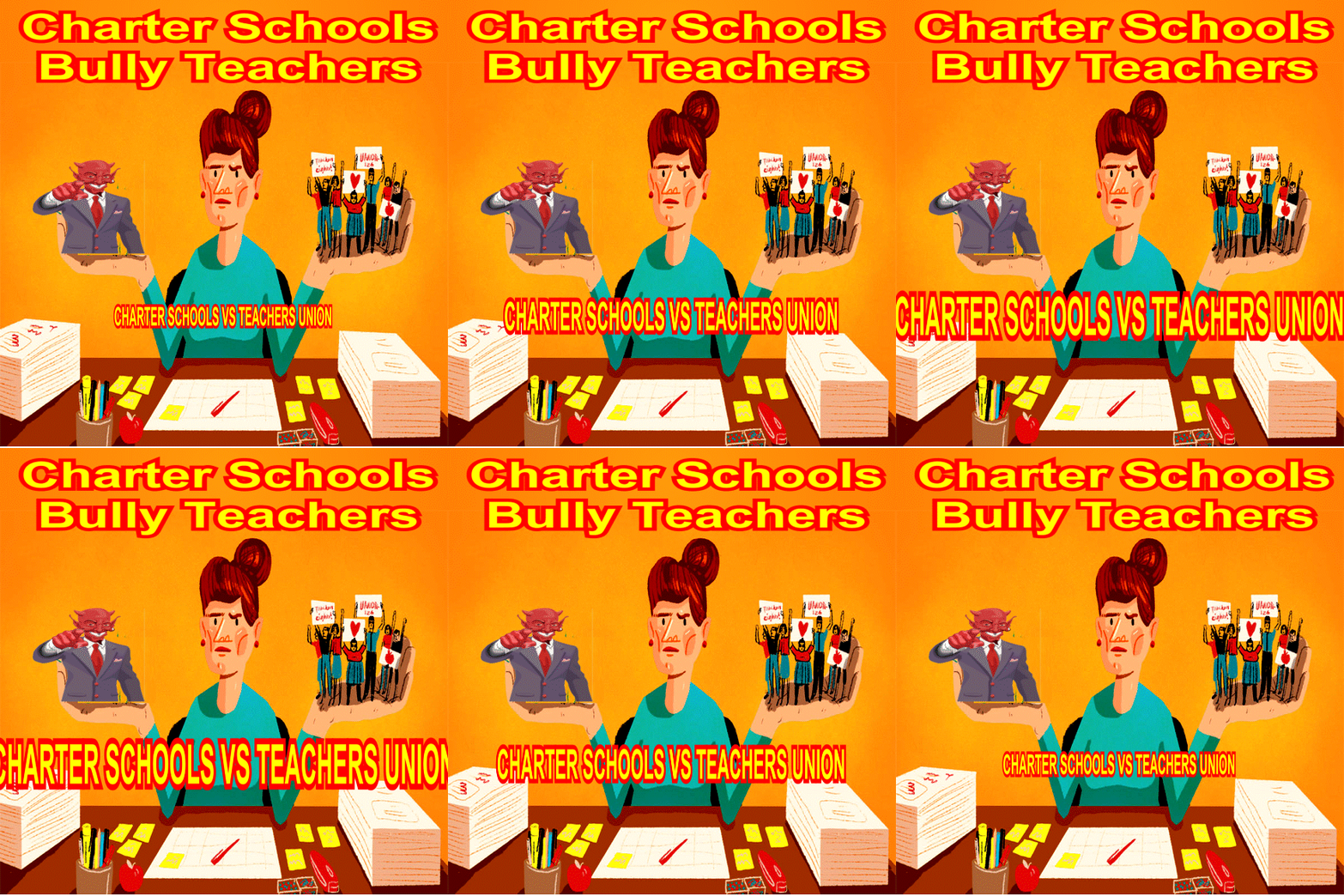
Shawgi Tell: Charter Schools Bully Teachers | Dissident Voice

Charter Schools Bully Teachers | Dissident Voice
Charter Schools Bully Teachers


It is no accident that fewer than three percent of the nation’s roughly 7,300 charter schools are operated by teachers and that 90% of charter schools do not have a teachers union. So much for the narrative that charter schools started nearly 30 years ago to empower teachers. Some states even allow charter schools to hire teachers with no teaching certification. In addition, most charter school teachers are paid less than their public school counterparts and usually have fewer years of teaching experience. Charter school teachers also tend to work longer days and years than public school teachers.

As deregulated “free-market” schools, charter schools, which are more segregated than public schools, see teachers unions as undermining the free, flexible, and autonomous nature of charter schools. Privately-operated charter schools prefer to treat teachers as non-unionized at-will employees, just like employees in most private businesses. Such employees can be hired and fired at any time for any reason; there is no due process. Charter schools do not want to be “bogged down” by any “restrictions.” They wish to do as they please. In exchange for this liberty, charter schools claim they will deliver CONTINUE READING: Charter Schools Bully Teachers | Dissident Voice

Monday, November 23, 2020

NYC Educator: A Lesson for Those Who'd Vilify Teachers

NYC Educator: A Lesson for Those Who'd Vilify Teachers
A Lesson for Those Who'd Vilify Teachers


It's always edifying to get the libertarian point of view, and it's not at all surprising to find it in the pages of the NY Post. Writer Matt Welch sheds copious crocodile tears over how schools are failing poor children. You know who they are. They're the kids UFT teachers wake up every single day to help and serve. Meanwhile libertarians fight to make sure they don't get health care, because that would be the end of western civilization. 

Welch is horrified that school buildings are closing. Why? For one thing, it's clearly inconvenient for him to care for his children:

I would have reacted sooner to the news that New York City is planning to shut down its public-school system, perhaps sometime this week. But there is a small kindergarten class in my house today, and I have a bunch of parent-teacher Zoom meetings scheduled for the middle school that my eldest has attended all of seven days this year.

So it's November now, and evidently Welch will be burdened with caring for his child even more than seven days over the next few months. Obviously, that's intolerable for a guy who needs to sit around and think of Very Important Stuff for Reason magazine. But his outrage doesn't end there:

Over the past month, the New York City school system has randomly tested more than 71,000 students and 42,000 staff, from 3,000-plus schools. Only 189 came back positive.

I'm thinking the libertarian press hasn't got time to research this stuff to thoroughly, and relies on publications like the NY Times (which Welch quotes). For some reason, the Times has a reputation as liberal, but for decades I've felt they hate teachers and everything we stand for. They have a history of hiring reporters who can't help but editorialize in news articles, and who never, ever talk to working teachers.

In fact, there has not been random testing in New York City. There's been voluntary testing, and every teacher in New CONTINUE READING: NYC Educator: A Lesson for Those Who'd Vilify Teachers

Saturday, October 17, 2020

CURMUDGUCATION: Today in Teacher Depreciation

CURMUDGUCATION: Today in Teacher Depreciation

Today in Teacher Depreciation


When you're in the work, the general noise from the chorus of teacher devaluators can become a faint background buzz. And then something happens, and you're reminded suddenly, "Oh, yeah. That's a thing." 
Happened twice to me on Twitter in the past 24 hours. First, there was the noise surrounding the Trump thing on the teevee last night, including this little punch from Mercedes Schlapp, a senior advisor for the Trump/Pence campaign
This is obviously supposed to be an insult, but I live in western Pennsylvania, right up the road from Pittsburgh, where the international airport includes a whole display/play area devoted to one of Pittsburgh's most beloved sons, Fred Rogers (she spelled his name wrong). Mr. Rogers is a national treasure and one of the few icons who hasn't been outed as some sort of secretly terrible monster. 
Why would anybody treat him as an insult punchline? Because they respect strength and cruelty and in Mr. Rogers, they see the twin "weaknesses" of being kind and gentle and of communicating with CONTINUE READING: CURMUDGUCATION: Today in Teacher Depreciation

Friday, October 16, 2020

THINGS YOU WON'T READ IN THE TEACHER BASHING SAC BEE: Who's donating to the Oakland Unified school board elections?

Who's donating to the Oakland Unified school board elections?

Charter school supporters spend big on Oakland school board races
Four political committees, including two pro-charter groups, a local education policy organization, and the teachers’ union are supporting opposing slates in contentious school board races.

Hundreds of thousands of dollars are being spent on advertising to support opposing slates of Oakland school board candidates this year, with pro-charter-school organizations, the teachers’ union, and others picking different sides. Wealthy individuals including former New York City mayor Michael Bloomberg, Silicon Valley businessman Arthur Rock, and oil company heiress Stacy Schusterman are among the billionaires who have given money to committees spending money on school board races here.
Critics question whether a few local groups backed by wealthy donors are having an outsized influence on voters. But supporters of these groups point out that local community members are driving the groups’ endorsements, even if the biggest contributions are mostly coming from a few wealthy individuals who live outside of Oakland. Some candidates, meanwhile, say the debate over who’s spending what, and where the money is coming from, distracts from more pertinent education issues in Oakland.
With 17 candidates running for four open seats on the Oakland Unified School District board, it’s a pivotal moment that will reshape the school system’s governing body and influence the direction of the district. On top of their regular duties, when the new school board is seated in January, members will likely oversee the reopening of school buildings and the implementation of a police-free school safety plan. And if Measure Y passes in November, the board will also manage a $735 million facilities bond for campus upgrades.

Billionaire donors support Oakland charter school groups 

Power2Families is the newest political action committee to get involved in local school board races. Hae-Sin Thomas, who stepped down as the CEO of the Education for Change charter school network this summer, said she was motivated to start Power2Families after hearing negative rhetoric from some school board candidates and community members towards charter schools. Many OUSD parents, teachers, and some of the current board candidates favor a moratorium on new charter schools, arguing that charters have worsened the financial stability of the district.
“This came about in fear of potentially having school board candidates who could really negatively impact the futures of 16,000 children across the city,” Thomas said, referring to the number of students enrolled in charter schools across Oakland. More than 16,000 students attended one of the 45 charter schools in the city last year, about 32% of Oakland public school students. There are about 80 public schools operated by OUSD in Oakland. “We made a decision to go out and ask some funders whether they would consider funding a CONTINUE READING: Who's donating to the Oakland Unified school board elections?
Big Education Ape: Choosing Democracy: The Sacramento Bee Misinforms About School Budgets - https://bigeducationape.blogspot.com/2020/10/choosing-democracy-sacramento-bee.html

Big Education Ape: It's Time for A Leadership Change at SCUSD - https://bigeducationape.blogspot.com/2020/09/its-time-for-leadership-change-at-scusd.html

Big Education Ape: WHO IS FUNDING SACRAMENTO BEE'S ATTACKS ON TEACHERS - EDUCATION LAB - https://bigeducationape.blogspot.com/2020/10/who-is-funding-sacramento-bees-attacks.html


Saturday, October 10, 2020

MARK WEBER: New Jersey’s Shrinking Pool of Teacher Candidates | New Jersey Policy Perspective

 New Jersey’s Shrinking Pool of Teacher Candidates | New Jersey Policy Perspective

 New Jersey’s Shrinking Pool of Teacher Candidates


To read a PDF version of the full report, click here.


Executive Summary

Maintaining a high-quality teaching workforce is critically important for the future of public education in New Jersey. Federal data, however, show cause for concern: New Jersey is producing far fewer teacher candidates than a decade ago. In fact, the number of candidates completing teacher preparation programs has dropped 49 percent between 2009 and 2018. These declines, which are part of national and regional trends, cut across both gender and race. The dwindling number of teacher candidates creates instability in the teaching profession and jeopardizes the ability of students to learn.[1]

While reasons for the decline in teacher candidates are complex, we know that New Jersey’s teachers are paid considerably less than other college-educated workers, even when controlling for age and time worked.[2] Of particular concern is that the evidence suggests fewer college graduates see teaching as a viable career option with adequate compensation. New Jersey must aggressively address these problems if it wishes to retain its status as having one of the best education systems in the nation.

To stem the decline in teacher candidates, New Jersey should work to make the teaching profession more attractive by raising teacher pay, shoring up benefits, and increasing the respect and appreciation shown to New Jersey’s educators.

This report explores enrollment and completion data in teacher preparation programs, gives context around state policy changes affecting education professionals, reviews the level of teacher demand in the state, and examines the change in demographics within the profession over the past ten years.

Background

This past September, NJPP published an analysis of the New Jersey teaching corps entitled, New Jersey’s Teacher Workforce, 2019.[3] Among its findings:

  • While factors outside of school are the strongest influences on student achievement, teacher quality is the most significant in-school influence.
  • The research on teacher quality suggests that qualified people become teachers based, in part, on how well teaching pays compared to other jobs.
  • Despite the importance of teachers, there is a significant gap in wages between New Jersey teachers and other college-educated workers in the state, even when accounting for differences in time worked.
  • Pensions and health benefits do not fully close the pay gap between teachers and college-educated workers in other professions.
  • New Jersey’s teaching workforce is mostly white and female; there is little evidence of a trend toward a more diverse teaching workforce.
  • New Jersey’s teacher workforce is aging, suggesting a new wave of retirements in the next several years.

These findings are similar to other analyses, which show a significant pay gap for teachers compared to other college-educated workers.[4] Critics suggest, however, that these studies are flawed in that they don’t fully account for differences in benefits and other non-pecuniary compensation, unmeasured differences in talent between workers, and other factors. Teachers, they argue, are actually well-compensated, even in today’s tightening labor market.

To test these criticisms, this report examines whether more or fewer workers are becoming teachers. If teacher pay and benefits have kept pace with compensation in other sectors, we would expect to see workers respond in kind, and continue to enter the profession at previous rates. Because compensation levels influence workers’ decisions to go into teaching those workers would judge the benefits that teachers receive as adequate to close the teacher pay gap and continue to enroll in programs to prepare to become educators.[5]

The data, however, tell a different story. Fewer workers in New Jersey are electing to enter teacher preparation programs, a clear indication that teaching is not as attractive a career option as it once was.

Findings

Teacher Preparation Programs: Enrollment & Completion CONTINUE READING:  New Jersey’s Shrinking Pool of Teacher Candidates | New Jersey Policy Perspective

Wednesday, September 16, 2020

Distance Learning Impasse Could Plunge Sacramento City Schools Further Into Fiscal Crisis, County Superintendent Says - capradio.org

Distance Learning Impasse Could Plunge Sacramento City Schools Further Into Fiscal Crisis, County Superintendent Says - capradio.org

Distance Learning Impasse Could Plunge Sacramento City Schools Further Into Fiscal Crisis, County Superintendent Says


Almost all of Sacramento County’s thirteen school districts have a distance learning plan in place during the pandemic — agreed to by both teachers and administrators — and are in solid financial shape. 
But there is one outlier: the Sacramento City Unified School District. 
That’s according to Dave Gordon, the Sacramento County Superintendent of Schools, who provides fiscal oversight and other guidance to schools from Elk Grove to Elverta. 
In a recent interview, Gordon told CapRadio that the impasse between SCUSD and its labor partner, Sacramento City Teachers Association (SCTA), could compromise the district’s ability to comply with education laws,  and be a roadblock to  reimbursement 
In a recent letter to California State Superintendent of Public Instruction, Tony Thurmond, the district expressed concern about teachers’ schedules that vary from the district, and that some are “either less than the required instructional minutes or lack the daily live instruction requirement under the law.”  
The district confirmed to CapRadio that it faces financial penalties if it does not adequately track attendance and the amount of learning — live or independent study — that takes place among its 42,000 students. 
CapRadio interviewed county Superintendent Gordon about the impact of the deadlocked negotiations over distance learning in SCUSD, and about the district’s long term fiscal viability. Below is a transcript of the interview, edited for length and clarity. 
What is your role over Sacramento school districts?
We do fiscal oversight of all of the school districts. We don't oversee their instructional practices, but if asked, we would give guidance. 
So the situation right now at Sacramento City Unified appears that the district is providing a set of directions and the teachers are providing, in some or many cases, different directions than the district. And the district really needs to function as one organization — not as a teacher-run organization and a district-run organization. So what seems to be going on now is not appropriate [and] not legal, most likely. And you can imagine the chaos that this is creating.
Can you tell me more about that? That that situation is not legal? What do you mean by that?
Well, the district is authorized to run its affairs and report to the state and account to the state CONTINUE READING: Distance Learning Impasse Could Plunge Sacramento City Schools Further Into Fiscal Crisis, County Superintendent Says - capradio.org

Thursday, September 10, 2020

Choosing Democracy: Why Can't They Just Get Along ? Union Teachers v SCUSD Administration

Choosing Democracy: Why Can't They Just Get Along ? Union Teachers v SCUSD Administration

Why Can't They Just Get Along ? 
Union Teachers v SCUSD Administration


 Many in Sacramento are frustrated and angry about the continuing conflict between the Sacramento City Teachers Assoc, and the SCUSD Superintendent and Board of Education.  Families are being disrupted and children are having their school schedules scrambled.

So, what is going on ? 

To find the District view, read the Sacramento Bee and particularly Marcos Breton.  He opines regularly.

I wanted to hear the teachers' side. So,  at a meeting of the Communities Priority Coalition, I asked David Fisher, President of SCTA to explain the issues.  I got an explanation I could understand.  Here it is.


At its heart, our dispute can be boiled down to one major difference. It's not a dispute about the length of teachers' workday, or teacher pay, it's about providing the best instruction to address student needs and foster a love of learning. In a brick and mortar setting, teachers have the ability to use their professional expertise and judgement to provide an education based on the individual needs of their students. Rather than extend that respect for the professional judgement of teachers to the distance learning setting, SCUSD administrators, with no direct experience teaching in a distance learning environment, are trying to impose a rigid, overly scripted learning model that devalues teachers' professional judgement. It's a choice of quality, rather than simply quantity.

Other districts have been more respectful to the experience of teachers. Here is what one assistant superintendent from Folsom Cordova Unified who "placed his full faith in the teachers" had to say: "Teachers are the educational experts. They went through a lot of training, a lot of college, and a lot of credentialing classes on how to engage kids and help them with their learning."

There's no reason such a respect for teachers should not apply in Sac City as well.


We are moving forward teaching every day to the best of our abilities based on the needs of our students but we want the learning experience to be much better than it was in the Spring.

Last Spring the District unilaterally implemented their proposal without any input from educators at all. It was unclear what the expectations were and was inconsistent at best.

We want this fall to be much better with much clearer expectations based on input from those who are charged with implementing the instruction. That is why we pushed so hard for training that the District only finally agreed to a few hours before the day began.

That is also why our current proposal including our schedules were developed by hundreds of teachers from every school site and segment. We considered our experience in the Spring, expert recommendations by the American Association or Pediatricians and the W.H.O, we reviewed research on sleep patterns of teenagers, as well as looked at what other Districts were doing and what was working and what wasn't.

The teachers on our bargaining team believe their ethical obligation requires them to teach in the manner that is in the best interest of students.  In addition we have received feedback from hundreds of parents, teachers and community members who prefer our more flexible, comprehensive proposal.

As far as the schedules, we are in agreement with our District that the total instructional minutes are the same as recommended by the CDE and the same that most districts also have. While there is some variance in other districts around required live screen time, most other districts give teachers the same discretion they have in a brick and mortar setting to divide their instructional minutes between whole group, small group and independent practice.

For example Folsom Cordova has no minimum required synchronous minutes and leaves it up to the discretion of the individual teachers based on student needs.
https://www.fcusd.org/Page/39750

San Juan requires 45-65 synchronous minutes at elementary level.

https://www.sanjuan.edu/site/default.aspx?PageType=3&ModuleInstanceID=79679&ViewID=9fc4dc78-f943-4224-8465-6c780e58f4df&RenderLoc=0&FlexDataID=55014&PageID=50114

Our proposal requires a much higher minimum of (110 1-3) and 120 synchronous minutes at the elementary level (4-12) and gives the teachers flexibility to increase the minutes for those students who need extra support.

As far as standards and assessments, all teachers will continue to use standards to guide their instruction and will assess students appropriately just like they always have.

It's also important to emphasize that the decision to propose our schedules was not made by me or only a handful of leaders, it was a unanimous Decision of our 85 member bargaining team and by hundreds of school site representatives elected by their peers at each school.

I could not unilaterally make that decision nor change that decision even if I wanted to. And for some additional context, after discussion with other local association leaders, they all said they would never sign on to our District's overly rigid proposal as written. Natomas even went so far as to take a strike vote to make sure they got an acceptable plan and Folsom Cordova didn't have an agreement until about two weeks into their school year.

All that being said our teachers are committed to, and will continue to teach our hearts out to the best of our abilities with or without the trust or respect of our district leadership. And instead of ignoring the disparities in the schools we proposed multiple options for meeting the needs of students that are unable to connect during the live screen time instruction. Unfortunately the District has rejected those ideas.

David Fisher
President SCTA
Phone: 916-452-4591
Fax: 916-452-4675
Choosing Democracy: Why Can't They Just Get Along ? Union Teachers v SCUSD Administration