Latest News and Comment from Education

Showing posts with label REOPEN SCHOOLS GUIDELINES. Show all posts

Friday, May 14, 2021

SPI Visits San Diego County Schools - Year 2021 (CA Dept of Education)

SPI Visits San Diego County Schools - Year 2021 (CA Dept of Education)
State Superintendent Tony Thurmond Visits San Diego County Schools Open for In-Person Learning that Utilize Strong Safety Measures and Social-Emotional Supports


SACRAMENTO—State Superintendent of Public Instruction Tony Thurmond raised his hand and joined elementary students for class today on two campuses in San Diego County that have stayed open for safe, in-person learning by implementing comprehensive safety measures and offering wide-ranging, whole-child supports for students and families.

State Superintendent Thurmond visited Castle Park Elementary and Joseph Casillas Elementary, both located in Chula Vista, an area among the hardest hit by the pandemic. The schools are two out of 49 schools in the Chula Vista Elementary School District (CVESD), which serves nearly 30,000 students, with 68 percent identified as Hispanic and 36 percent as English learners. CVESD is the largest transitional kindergarten through sixth grade school district in California and is approximately five miles from the border of Mexico.

“These schools are a model for the state and nation in how we support students while recovering from this pandemic and preparing for a full return to in-person learning,” Thurmond said. “Through inspiring investments in school-based mental health support, comprehensive safety measures such as rapid COVID testing, and engaging instruction individualized to student needs, families should feel confident that schools like these are the safest, best places for their children.”

Throughout the day, Thurmond witnessed examples of whole-child support, with layers of physical safety measures combined with onsite mental health support, learning acceleration, and proactive family engagement strategies put in place to serve students and families. In addition, Thurmond learned about CVESD’s series developed for parents to provide ways to support their children’s social-emotional wellness at home as well as resources to enhance classroom practices, such as restorative circles, social-emotional lessons, and mindfulness.

CVESD has 53 school psychologists who support district schools, including charter schools. Every site has access to a school psychologist. In addition, as part of its reopening plans, CVESD is funding part-time mental health support professionals at each of its 41 non-charter school sites from April 12 to June 15, 2021. Highlights include:

  • A minimum of two days of counseling support will be provided at each of the non-charter district schools.
  • Key support responsibilities: High visibility at ingress/egress, readily available for crisis intervention (triage), 1:1 counseling.
  • Site-based social workers/counselors will provide support at 11 sites.
  • District social workers will provide support at nine sites.
  • Partner organization South Bay Community Services (SBCS) will provide mental health support providers at the remaining 21 sites.
  • SBCS’s Community Assessment Team will provide an additional one to two days of case management support to CVESD’s 10 highest unduplicated student sites to connect families with case management and wraparound services (e.g., family counseling, outside therapy, etc.).

CVESD Superintendent Francisco Escobedo, Ed.D., said it is more important than ever to attend to students’ social and emotional needs.

“We believe in educating the whole child through rigorous academic instruction but also with behavioral and social-emotional learning and support,” Dr. Escobedo said. “It was amazing to share with the State Superintendent how our schools are implementing safety measures, dealing with learning loss, dealing with the trauma that our students experienced—and how we are mitigating the effects. We are deploying what we call a strengths-based focus on trauma, where our counselors, social workers, principals, and teachers are utilizing social-emotional constructs, teaching emotional self-regulation, to empower students and parents to overcome the rigors and challenges they had to go through during the pandemic.”

Among the safety measures implemented by the district, CVESD is one of 79 school districts in California that are now offering free rapid antigen testing that can provide COVID-19 test results in as little as 15 minutes. This antigen testing, made available because of a partnership with the County of San Diego, the State of California, and Primary Health and facilitated by Thurmond and the California Department of Education, is available to all staff and students throughout the school district. In addition, CVESD is hosting family vaccination clinics on a weekly basis.

School districts that are interested in enrolling in the state’s rapid antigen testing program are asked to complete this no-commitment interest formExternal link opens in new window or tab.. For questions on rapid COVID testing, email RapidTesting@cde.ca.gov.

Note to editors and reporters: For photos and footage of the State Superintendent’s visit to Chula Vista schools, please contact Anthony Millican, CVESD Director of Communications, at Anthony.Millican@cvesd.org.

# # # #

Tony Thurmond — State Superintendent of Public Instruction
Communications Division, Room 5602, 916-319-0818, Fax 916-319-0100


Sunday, May 9, 2021

Seattle Schools Community Forum: Reopening School Buildings

Seattle Schools Community Forum: Reopening School Buildings
Reopening School Buildings


I am interested in your thoughts about school building reopenings.

1) How has it been for your child to be back in their school buildings, even in a limited way?

2) Do you see safety protocols being enforced?

3) Do expect/want school buildings to be fully reopened on a regular school schedule in the fall?

Here’s an article from The Atlantic that says that right now, some of the concern over COVID appears to be performative, either thru habit or fear or both. 

https://www.theatlantic.com/politics/archive/2021/05/liberals-covid-19-science-denial-lockdown/618780/

Alex Goldstein, a progressive PR consultant who was a senior adviser to Representative Ayanna Pressley’s 2018 campaign, told me. “Either you believe that you have a responsibility to take action to protect a person you don’t know OR you believe you have no responsibility to anybody who isn’t in your immediate family.”

My take is the former because I choose to live in a society. On a day-to-day basis, sure, my family comes first for me. But we do live in a society.

 I don’t have a problem being outdoors and not wearing a mask (and by that I CONTINUE READING: Seattle Schools Community Forum: Reopening School Buildings

Friday, April 9, 2021

AFT, NEA protest new anti-virus school reopening guidelines – People's World

AFT, NEA protest new anti-virus school reopening guidelines – People's World
AFT, NEA protest new anti-virus school reopening guidelines


WASHINGTON—The nation’s two big teachers unions are protesting Biden administration guidance which says students returning to reopened schools can sit only three feet from each other, not six, but only after schools take other measures to combat potential community spread of the coronavirus.

One protest came in a formal letter from Teachers (AFT) President Randi Weingarten to both Biden Education Secretary Michael Cardona and Dr. Rochelle Walensky, director of the Centers for Disease Control. AFT also voiced its concerns in a meeting with Education Department officials. Weingarten is a New York City civics teacher.

The other came in a long statement from the National Education Association, the nation’s largest union, and its president, Becky Pringle, a Philadelphia science teacher. NEA has 3.2 million members.

Both questioned whether three feet was too little space within classrooms, as CDC now recommends. CDC says the space—physical distancing—should remain six feet elsewhere, including in school cafeterias, at sports events, in assemblies, hallways and school lobbies.

Neither Walensky nor Cardona immediately responded on their agencies’ websites. Cardona is on a CONTINUE READING: AFT, NEA protest new anti-virus school reopening guidelines – People's World

U.S. Department of Education Releases "COVID-19 Handbook, Volume 2: Roadmap to Reopening Safely and Meeting All Students' Needs" | U.S. Department of Education

U.S. Department of Education Releases "COVID-19 Handbook, Volume 2: Roadmap to Reopening Safely and Meeting All Students' Needs" | U.S. Department of Education
U.S. Department of Education Releases "COVID-19 Handbook, Volume 2: Roadmap to Reopening Safely and Meeting All Students' Needs"


Today, the U.S. Department of Education (Department) released the COVID-19 Handbook, Volume 2: Roadmap to Reopening Safely and Meeting All Students' Needs to provide additional strategies for safely reopening all of America's schools and to promote educational equity by addressing opportunity gaps that have been exacerbated by the pandemic.

Building off of Volume 1: Strategies for Safely Reopening Elementary and Secondary Schools, which focused on health and safety measures that schools can use to successfully implement the Centers for Disease Control and Prevention's (CDC) K-12 Operational Strategy, Volume 2 of the Handbook focuses on research-based strategies to address the social, emotional, mental-health, and academic impacts of the pandemic on students, educators, and staff, such as how to address any potential anxiety or depression some may face as a result of the COVID-19 pandemic and nearly a year of remote learning.

"There is simply no substitute for in-person learning," said U.S. Secretary of Education Miguel Cardona. "But as schools reopen their doors, we must also make sure that we are meeting students' social, emotional, physical, mental-health, and academic needs, and addressing gaps that existed before—and were exacerbated by—the pandemic. This is an opportunity for us to not only reopen our schools safely, but to make sure our education systems are truly serving all our nation's students."

Today's release is part of the Biden-Harris Administration's broader effort to provide states, districts, schools, and communities with the resources and support they need to return to in-person learning safely and quickly, and achieve the President's goal of reopening a majority of K-8 schools within the first 100 days of the Administration. Volume 2 identifies strategies states, districts, schools, and communities can use when implementing funding they have received from the American Rescue Plan, which invests $130 billion in safely reopening schools, sustaining their safe in-person operation, and addressing the impact of COVID-19.

Volume 2 also aims to meet President Biden's call for communities and the country to "build back better." As states and districts continue to reopen schools safely, the Department is encouraging communities to implement strategies that address the social, emotional, and mental-health needs of students, including the disproportionate toll COVID-19 has had on underserved communities, and address inequities in our education system that predate and have been made worse by the pandemic.

In February, the Department released Volume 1 of the COVID-19 Handbook, which provides educators and staff with practical examples, roadmaps, and tools to implement the CDC's K-12 operational strategy for in-person learning, including the recommended five key mitigation measures (universal and correct use of masksphysical distancinghandwashing and respiratory etiquette; maintaining clean and healthy facilities, including through ventilation; and contact tracing in combination with isolation and quarantine).

Since the release of Volume 1, the Department and CDC have met with educators; state and local elected officials, including governors, mayors, and legislative leaders in every state and territory; chief state school officers; state boards of education; and stakeholder organizations across the country about how to safely reopen schools. Volume 2 includes many strategies and resources informed by these conversations and recommended by education, civil rights, and research organizations.

As part of the launch of Volume 2, Secretary Cardona will hold a virtual roundtable with a diverse group of students and parents today, Friday, April 9, to discuss how the COVID-19 pandemic has affected their education and their lives, and how the tools and resources in Volume 2 of the handbook can help assist schools and communities in addressing student needs.

Strategies described in Volume 2 can be supported by funding under the American Rescue Plan. Each section provides strategies and considerations for meeting the needs of underserved students. The sections include:

  • Providing school meals regardless of educational setting.
  • Meeting the social, emotional, and mental-health needs of students.
  • Providing all students with access to a safe and inclusive learning environment.
  • Accelerating learning through in-classroom instructional approaches, tutoring, and expanded learning time.
  • Supporting equitable access and effective use of technology for teaching and learning.
  • Using data about students' opportunities to learn to help target resources and support.
  • Addressing resource inequities.
  • Stabilizing a diverse and qualified educator workforce.
  • Supporting educator and staff well-being.

The Department will continue to provide support and resources to schools and communities as they work to return to in-person instruction safely. Later this month, the Department will launch its "Safer Schools and Campuses Best Practices Clearinghouse," which is open for submissions from states, schools, districts, and individuals nationwide. Once launched, the Clearinghouse will highlight lessons learned and best practices that can help schools and districts identify opportunities to utilize American Rescue Plan funds to meet their unique needs.

Wednesday, April 7, 2021

SSPI Issues Statement Regarding Reopening CA + SFSP Mandatory Training is Now Available - Year 2021 (CA Dept of Education)

SSPI Issues Statement Regarding Reopening CA - Year 2021 (CA Dept of Education)
State Superintendent Tony Thurmond Issues Statement in Response to Governor’s Goal to Fully Reopen California as Early as June 15


SACRAMENTO—State Superintendent of Public Instruction Tony Thurmond today issued the following statement in response to plans announced by Governor Gavin Newsom to fully reopen California’s economy by June 15 if vaccine supply remains sufficient and hospitalization rates stay low. Under these conditions outlined todayExternal link opens in new window or tab., the Governor stated that schools should plan to conduct full-time, in-person instruction in the fall, in compliance with Cal/OSHA emergency temporary standards and public health guidelines.

“I share Governor Newsom’s optimism that as conditions continue to improve—and as all Californians continue common sense measures such as continuing to wear a mask and getting vaccinated—there is a clear pathway to a safe and full return to in-person teaching and learning this fall.

“To support school districts as they continue to welcome more and more students back to campuses, the California Department of Education (CDE) has spent recent weeks connecting school leaders to the best strategies and resources to implement the layered safety measures public health experts encourage—such as rapid COVID-19 testing and proper ventilation—that will facilitate a safe and sustainable return to in-person learning for students, school staff, teachers, and their families.

“We must prepare for the possibility that there will be some families who cannot or may choose not to send their students back to school campuses this fall, and schools may need the flexibility to offer some form of remote learning. I look forward to engaging with the Governor’s Office and lawmakers on next steps that are designed to ensure we are meeting the health, safety, and learning needs of every California student.

“While we are encouraged by the improving conditions, we must also continue to proceed with caution and with a continued focus on science and safety. There are still many unknowns about the COVID-19 variants that public health officials are monitoring and have observed spreading among some youth. Additionally, I am heartened by the early research on vaccine effectiveness in adolescents and am hopeful more of our youth will be able to get vaccinated in the months ahead.

“Returning to in-person instruction must include an urgent focus on addressing opportunity gaps experienced most among students who were already at a disadvantage before the pandemic disrupted learning. I have convened state leaders, equity groups, superintendents, school employee groups, and other partners to better understand and identify ways we can support the immediate and long-term academic needs of our students, as well as strategies for prioritizing relationships, addressing trauma, and supporting social emotional wellness. At my direction, this working group will be making recommendations to school districts as they finalize plans for this critical next phase of public education.”

# # # #

Tony Thurmond — State Superintendent of Public Instruction
Communications Division, Room 5602, 916-319-0818, Fax 916-319-0100


SFSP Mandatory Training is Now Available - Nutrition (CA Dept of Education) - https://www.cde.ca.gov/ls/nu/sfspmandtrainavail2021.asp


The California Department of Education Nutrition Services Division (NSD) Community Nutrition Programs Unit (CNPU) is pleased to announce that the 2021 Summer Food Service Program (SFSP) annual online Mandatory Training is now available.

Title 7, Code of Federal Regulations, sections 225.7(a) and 225.15(d)(1), requires all participating sponsors to annually attend state agency training and to train all administrative staff and site staff before they undertake their responsibilities. This training requirement must be met by all current, new, or returning SFSP sponsors by the SFSP Application deadline of May 15th or 30 days prior to the first day of service (in the case of new or inactive sponsors), whichever comes first.

The 2021 Mandatory Training is a two-part training consisting of 11 independent courses and a separate Mandatory Training Assessment.

SFSP Mandatory Training Courses Part 1

Sponsors will be required to designate a supervisory personnel staff member or authorized representative responsible for the food service to complete the 11 individual online trainings which cover SFSP regulations, how to run a successful summer program, and best practices for operating meal sites. This training is based on the U.S. Department of Agriculture Food and Nutrition Service 2016 SFSP Administration Guide. Please note that the Administration Guide has not been updated to include current information on program thresholds and policy rescissions. To review current policy and regulations, please visit the CDE Summer Food Management Bulletin web page.

In addition to the 11 training courses, sponsors are required to review and follow - all existing and new regulations and policies pertaining to their program operations, which are located on the following web pages:

The required course work for the SFSP Mandatory Training is available on the SFSP Information web page under the training tab. The course list is as follows:

Certificates of completion will be available to print after successfully completing each course. Sponsors are also welcome to record their certificates of completion through screen captures. Please note that you must select Submit after printing or capturing your certificate of completion. If you do not submit the survey, we may receive incomplete data with which to verify completion of courses. Sponsors will be required to upload their designated supervisory personnel staff member or authorized representative’s certificates of completion for each of these trainings into their Child Nutrition Information and Payment System (CNIPS)External link opens in new window or tab. Application Packet. Please submit certificates under the Meal Pattern checklist item for consistency. After successfully viewing and submitting all required certificates of completion, CNPU analysts will verify course completions and provide sponsors access to the second training component: the SFSP Mandatory Training Assessment. Sponsors are encouraged to notify their assigned CNPU analyst of course completion only after all 11 courses have been completed.

To review how to submit checklist items, please review the job aid instructions included in the CNIPSExternal link opens in new window or tab.. These can be found on the Download Forms page, Form ID SFSP Job Aid 2 Application Packet. Checklist item instructions begin on page 45, Checklist Summary. Please submit your certificates under the Meal Pattern checklist item for consistency.

Mandatory Training Assessment Part 2

The SFSP Mandatory Training Assessment consists of 30 scored questions based on the content covered in the 11 courses. All questions must be answered. A score of 80 percent or more must be achieved to move on to the final certificate of completion. Sponsors that do not meet this minimum score will be notified to return to their course material and to take the assessment again until a passing score is achieved.

For your convenience, A 2021 Mandatory Training—Step by Step “How To” guide on completing the training is available on the SFSP CNIPSExternal link opens in new window or tab. Download Forms section as Form ID SFSP Job Aid 8.

Contact Information

For questions regarding this subject, please contact the NSD CNPU by email at SFSP@cde.ca.gov.

Questions:   Nutrition Services Division | 800-952-5609

Friday, March 26, 2021

WATCH THE VIDEO: Biden demands resumption of in-person learning in “school reopening summit” - World Socialist Web Site

Biden demands resumption of in-person learning in “school reopening summit” - World Socialist Web Site
Biden demands resumption of in-person learning in “school reopening summit”


On Wednesday, the US Department of Education hosted a “National Safe School Reopening Summit,” bringing together figures from the Biden administration, the Centers for Disease Control and Prevention (CDC), and handpicked school district superintendents, union officials, teachers and students to advance the ruling class campaign to reopen schools before the pandemic is contained.

The three-and-a-half hour event, chaired by Education Secretary Miguel Cardona, had an Orwellian and highly contradictory character, in which the various speakers distorted science and sought to sugarcoat the reckless drive to reopen schools. Everyone at the summit participated remotely, with only one occupant visible on each screen, in stark contrast to the packed classrooms into which educators and students are being sent.

The current state of the pandemic and the horrific experiences of mass death and suffering over the past year were glossed over with vague references to “trauma,” while every speaker referred to school reopenings as “safe” and “scientifically based.” The entire event was designed to suppress science and chloroform educators and the broader population into accepting the reopening of schools. CONTINUE READING: Biden demands resumption of in-person learning in “school reopening summit” - World Socialist Web Site

Strategies for Safe In-Person Learning - Year 2021 (CA Dept of Education)

Strategies for Safe In-Person Learning - Year 2021 (CA Dept of Education)
State Superintendent Tony Thurmond Joins Educators and Experts to Discuss Strategies for Sustaining Safe In-Person Learning


SACRAMENTO—State Superintendent of Public Instruction Tony Thurmond hosted a statewide webinar today for school leaders and other educational stakeholders designed to help schools successfully navigate the challenges of not only returning students to the classroom, but safely keeping them there for the long-term.

The webinar, “How to Keep Classrooms Safe for All: Lessons and Successes from California Schools,” featured school superintendents, health experts, and leaders in the field presenting on successful strategies for sustaining safe in-person learning in the months ahead, including available state resources for ventilation upgrades, implementing robust COVID-19 testing, and more.

“We’re at a pivotal moment for our schools. With vaccination rates increasing, and COVID-19 cases declining, it’s encouraging to see more and more classrooms welcoming students and educators back to in-person instruction,” Thurmond said. “There are many schools that are still figuring out how to make this transition, and we’re all learning this together. I am proud to continue connecting our schools with the science, support, and strategies needed to not only open classrooms, but keep them safe moving forward.”

Thursday’s virtual event was an opportunity for school districts across California to gain a deeper understanding of how phased, multi-layered safety measures applied effectively and consistently—masking, distancing, proper ventilation, COVID-19 testing, and more—can keep students, staff, and school communities safe during the pandemic. Participants heard from schools in Napa County, for example, where students have had options for in-person learning since the fall.

One critical issue is the importance of proper ventilation at schools to help reduce the risk of transmission. Schools have new resources through Assembly Bill 841, which created the “School Reopening Ventilation and Energy Efficiency Verification and Repair Program.” The bill directed upwards of $600 million in energy efficiency funding to test, adjust, and repair heating, air conditioning, and ventilation (HVAC) systems in public schools over the next three years. Even prior to the pandemic, poor ventilation in schools posed a significant health risk to students. UC Davis researchers recently found 85 percent of California classrooms lack proper ventilation.

Another strategy to sustain in-person learning is robust COVID-19 testing. Earlier this month, the California Department of Education (CDE) announced a plan to deploy millions of COVID-19 antigen tests at no cost to select California school districts. Many of the tests will be delivered to school districts in regions hardest hit by the pandemic and serve greater numbers of high-risk students and families, such as households in poverty, farmworkers, and communities of color.

“Being able to quickly identify who is positive and who is not will be critically important for day-to-day operations on a school campus and will help protect not only students, but teachers and support staff,” Thurmond said.

Today’s webinar included the following speakers:

  • Dr. Barbara Nemko, County Superintendent, Napa County Office of Education
  • Dr. Rosanna Mucetti, District Superintendent, Napa Valley Unified
  • Chris Ruch, Director of Training at the National Energy Management Institute
  • Natalie Lee, Deputy Director of the California Energy Commission’s Renewable Energy Division
  • Paula Villescaz, Assistant Secretary, California Health and Human Services
The webinar “How to Keep Classrooms Safe for All: Lessons and Successes from California Schools” can be viewed at any time on the CDE’s Facebook pageExternal link opens in new window or tab..

# # # #

Tony Thurmond — State Superintendent of Public Instruction
Communications Division, Room 5602, 916-319-0818, Fax 916-319-0100

Thursday, March 25, 2021

VIDEO: Secretary of Education on push to reopen schools ‘this spring’ -MSNBC

Secretary of Education on push to reopen schools ‘this spring’


“I want to make sure that we have opportunities for all students to reengage in in-person learning—this spring,” says Biden’s new Secretary of Education Miguel Cardona. 


Wednesday, March 24, 2021

NANCY BAILEY: Covid-19 School Contradictions, Confusion, and Mistrust

Covid-19 School Contradictions, Confusion, and Mistrust


Covid-19 is a strange phenomenon without any proven how-to guides. Recommendations and contradictions surrounding Covid-19 and schools have raised uncertainty. When there’s a lack of clarity, people become suspicious of what they’re told, and they wonder what and who to believe.

Parents and Teachers Can’t Agree

Many parents believe schools are safe, few children get sick, Covid-19 is not real or not as bad as it’s made to sound, and teachers’ unions are remiss for their caution about in-person learning.

On the other hand, persons of color are hesitant to send their children back to school.

According to Mother Jones:

The pandemic has dealt a disproportionately heavy blow to Black Americans. According to CDC data published in September, Black youth accounted for 29 percent of COVID-19 deaths among people under 21, twice the percentage for white youth. The federal agency also found Black children under 18 at a significantly higher risk of hospitalization—almost four times higher than white children and teens.

Mixed Messages From the CDC, Pediatricians and Dr. Fauci

Parents who blame teachers for schools not fully opening, do so partly due to a sloppy push to make schools sound safe from the CDC, pediatricians, and Dr. Fauci.

Many claims ignore problems with school infrastructure and how schools work, while CONTINUE READING: Covid-19 School Contradictions, Confusion, and Mistrust

Monday, March 22, 2021

Teachers' Unions Uncertain on C.D.C.'s New 3-Feet Limit - The New York Times

Teachers' Unions Uncertain on C.D.C.'s New 3-Feet Limit - The New York Times
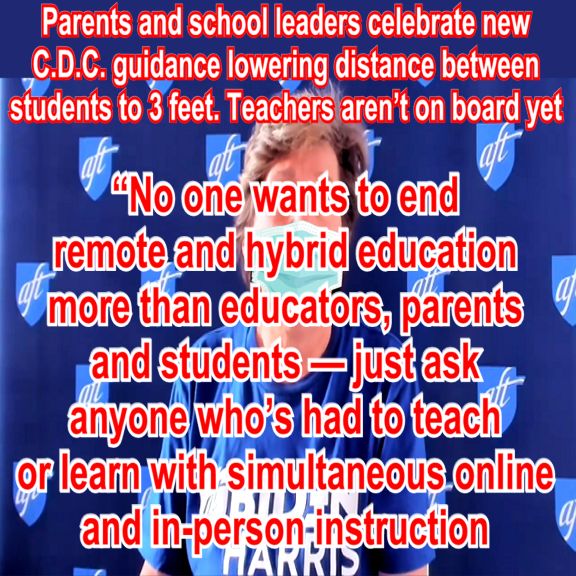
Parents and school leaders celebrate new C.D.C. guidance lowering distance between students to 3 feet. Teachers aren’t on board yet.


Proponents of fully reopening schools got a major boost on Friday when the Centers for Disease Control and Prevention announced that elementary school students and some middle and high school students could be spaced three feet apart in classrooms.

The previous guidance of keeping most students six feet apart had in many school districts become a big obstacle to welcoming students back for full-time instruction because it severely limited capacity. Many experts now say a growing body of research shows that six feet is not much more protective than three, as long as other safety measures are in place, like mask wearing.

Public health experts, parents and school officials cheered the new recommendation. Teachers’ unions, which have used the six-foot guidance to oppose bringing children back for normal schedules, did not.

EDUCATION BRIEFING: The pandemic is upending education. Get the latest news and tips.

Randi Weingarten, president of the American Federation of Teachers, the nation’s second-largest educators’ union, said in a statement that she would “reserve judgment” on the new guidelines pending further review of research on how the virus behaves in schools, especially those in cities or that are under-resourced. Becky Pringle, president of the largest teachers’ union, the National Education Association, raised similar concerns.

Nevertheless, the new guidance seemed to be having an immediate impact in some places. New York City, the nation’s largest school district, announced on Friday that it would give families another chance to select in-person instruction for their children. The city said that elementary schools, prekindergarten programs and CONTINUE READING: Teachers' Unions Uncertain on C.D.C.'s New 3-Feet Limit - The New York Times

New CDC Guidelines to Reopen Schools Could be Dangerous - Institute for New Economic Thinking #tbats #openonlywhensafe #edchat #K12 #learning #edleadership #edtech #engchat #literacy #edreform

Institute for New Economic Thinking
New CDC Guidelines to Reopen Schools Could be Dangerous
School re-opening push based on outdated science is poorly timed in face of coronavirus resurgence


The scale of disaster visited on the world by the COVID-19 pandemic defies any easy summary. But it is safe to say that the question of keeping schools open is among the most fateful decisions facing public authorities. As the pandemic stretches into its second year, it is now becoming among the most contentious.

In the U.S., after some hesitation, the Biden administration seems to be encouraging rapid opening of schools, despite high levels of community transmission in many places, before robust mitigations are completely in place. Many Republican governors and officials also demand the step, including former President Trump in his recent CPAC address. Languishing under lockdowns and zoom or hybrid classes, many exhausted parents, anxious employers, and bored students seem receptive, though polls show widespread reservations about whether premature reopening might trigger new waves of infections. In recent days, more and more states have moved to mandate full in-person classroom instruction within a few weeks.

Accompanying these decisions are organized efforts to recycle earlier studies of school safety[1] designed to reassure skeptics that reopening schools to full-time instruction is really safe, even as new variants of COVID-19 spread that are more contagious and possibly more dangerous than earlier forms. Even the Center for Disease Control is joining this rush to CONTINUE READING: Institute for New Economic Thinking

Sunday, March 21, 2021

AFT president responds to new CDC physical distancing guidelines - The Highland County Press

AFT president responds to new CDC physical distancing guidelines - The Highland County Press
AFT president responds to new CDC physical distancing guidelines


American Federation of Teachers President Randi Weingarten issued the following statement Friday after the Centers for Disease Control and Prevention altered its physical distancing guidelines for school classrooms:

“No one wants to end remote and hybrid education more than educators, parents and students — just ask anyone who’s had to teach or learn with simultaneous online and in-person instruction.

“While we hope the CDC is right and these new studies convince the community that the most enduring safety standard of this pandemic — the six-foot rule — can be jettisoned if we all wear masks, we will reserve judgement until we review them, especially as they apply in districts with high community spread and older buildings with ventilation challenges.

“Kids need to be in school, and the AFT has advocated consistently for safely reopening in-person learning since last April, but we are concerned this change has been driven by a lack of physical space rather than the hard science on aerosol exposure and transmission.

“Until today, the literature on reducing distancing has been inconclusive at best and misleading at worst. The studies so far have often approached distancing in a vacuum, without measuring the effect of changes to other mitigation strategies, including masking.

“The good news is we’re making progress — the latest data show 80 percent of schools are now offering some in-person CONTINUE READING: 
AFT president responds to new CDC physical distancing guidelines - The Highland County Press

Ed Notes Online: New CDC Guidelines to Reopen Schools, Based on Outdated, Cherry-Picked, and Misinterpreted Data, Put Students, Teachers, and Communities at Risk

Ed Notes Online: New CDC Guidelines to Reopen Schools, Based on Outdated, Cherry-Picked, and Misinterpreted Data, Put Students, Teachers, and Communities at Risk
New CDC Guidelines to Reopen Schools, Based on Outdated, Cherry-Picked, and Misinterpreted Data, Put Students, Teachers, and Communities at Risk


I haven't been a hard liner on keeping schools closed and am trying to listen to science. If we were still at the original COVID I'd say let's go with the low rates for kids and teacher vax but variants are still a wild card and children seem to be susceptible. But consider the article and comments below including long-term lung scarring from even people with mild cases. Every single person I know who had it even a year ago complains of some shortness of breath or being more tired. I may never leave my house again. 

As usual the UFT and AFT are waffling. Do we think the CDC is suddenly not politicized under Biden who has promised to get schools open and viola, distances shrink from 6 to 3 feet.


Naked Capitalism - 

 New CDC Guidelines to Reopen Schools, Based on Outdated, Cherry-Picked, and Misinterpreted Data, Put Students, Teachers, and Communities at Risk


Posted on March 20, 2021 by 

Yves here. Biden repeatedly promised to “follow the science” in developing Covid policies. But as has become the norm in American medicine, the science has instead been distorted in the interest of profits and political expedience. This post provides a devastating takedown of the Biden plan to reopen schools with little in the way of additional protections for teachers and students, particularly more ventilation (how about the simple expedient of opening windows?). It explains why Covid cases among children have been severely undercounted and where population-wide surveys were made, children were vastly more likely to introduce Covid into a household than adults. It also shreds the CDC’s astonishing assertion that distancing as little as three feet would be OK.

On the one hand, parents and children are suffering due to the lack of in-person instruction. Keeping schools closed is politically risky for Team Dem, particularly since it is seen as a staunch ally of the (formerly) powerful teachers CONTINUE READING: Ed Notes Online: New CDC Guidelines to Reopen Schools, Based on Outdated, Cherry-Picked, and Misinterpreted Data, Put Students, Teachers, and Communities at Risk