Broken Promises: An Analysis of Charter School Closures From 1999 –
2017
This report provides the first comprehensive examination of charter
failure rates over time—beginning in 1999 and ending in 2017. By following
all charter schools, from the year they opened, we were able to determine
how long they lasted before closing down. We also determined how many
students have been displaced by failing charter schools and where those
closures are most likely to occur.
This digital version of the report contains an animated map that
shows charter closures distributed across 44 U.S. states, the District
of Columbia and Puerto Rico, between 1999–2017. The animated map is
not available in the downloadable pdf, however you can download and
print the report and the executive summary as pdfs by clicking the
buttons below.
Principals Show Bias in Responses to Black parents, New Study Finds
Principals show bias in responses to Black parents, new study finds
Matt Barnum, Chalkbeat
Apr 26, 6:00am EDT
A few years ago, thousands of high school principals across the country received a variation of the same email from a parent asking for “any information you can provide about enrolling.”
When the email was sent by “Emily Walsh” seeking to enroll her son “Greg,” 64% of principals responded. But when an identical message came from “Tamika Washington” with a son named “Jamal,” the response rate fell to 57%.
The emails were actually sent by two political scientists, Zachary Oberfield and Matthew Incantalupo, in an effort to gauge racial bias in public schools. Their findings — that principals are less likely to respond to parents who they may have assumed were Black — illustrate one way that bias plays out in schools nationwide, aligning with past research as well as the experiences of many families.
“We wanted an easy ask,” said Incantalupo, a professor at Yeshiva University. “If they’re throwing down hurdles for something as simple as this, it’s not too much of an inference to say there are probably other ways in which inequality manifests in these schools.”
The new paper, published last month, looks at responses from a nationally representative sample of 3,600 high school principals.
White principals, in particular, showed signs of discrimination: They were 9 percentage points less likely to respond to emails from a parent whose name suggested they were Black. Their behavior shapes national trends, as nearly four in five public school principals are white.
PROOF POINTS: Gifted programs provide little to no academic boost, new study says
National study finds Black students and low-income children don’t reap the small gains achieved by white, Asian and high-income children
Gifted education is often a flash point in school desegregation debates; in large cities, these programs often operate as an essentially separate school system, dominated by white and Asian children. Though gifted programs touch only 3.3 million school children, about 7 percent of the U.S. student population, it’s disturbing that Black and Hispanic children are rarely chosen for them.
Against this political backdrop, a new study raises big questions about whether gifted education benefits the kids who are lucky enough to be in it. Researchers analyzed the records of about 1,300 students, drawn from a nationally representative sample of children across the country, who started kindergarten in 2010 and participated in a gifted program for at least one year during their elementary school years through fifth grade.
The School Finance Indicators Database is a collection of data and
research on K-12 public school funding in the U.S. These resources are
designed for use not only by researchers, but also by parents,
policymakers, journalists, and the general public. Every year, the SFID
team publishes two primary databases, both of which are freely available
to download:
The State Indicators Database is a
user-friendly dataset of roughly 125 state-by-state school funding
measures, many of which are available going back to 1993. These measures
focus on the adequacy and fairness not only of revenue and spending, but
also of how money is spent (e.g., teacher pay competitiveness, staffing
ratios). The dataset is accompanied every year by a report presenting key findings, as well as one-page profiles summarizing the school funding systems of all 50 states and
D.C.
The District Cost Database allows users to
assess the adequacy of spending levels in over 12,000 public school
districts by comparing districts’ actual per-pupil spending with estimates
of adequate spending levels in those districts. The database also includes
a small set of district-level measures, such as test scores and Census
child poverty rates, with which users can compare spending adequacy. The
DCD is published annually (currently available for 2018 only).
The report has a ton of great information about Carol Dweck’s “growth mindset” concept.
I have to say, though, I’m not entirely convinced that a ton of conclusions about who has and does not have a growth mindset can be accurately measured by what they did – which is basically ask just one question:
In PISA 2018, about 600 000 students from 78 countries and economies were surveyed to depict the landscape of growth mindset for 15 year-olds. PISA 2018 asked students whether they agreed (“strongly disagree”, “disagree”, “agree”, or “strongly agree”) with the following statement: “Your intelligence is something about you that you can’t change very much”. Disagreeing with the statement is considered a precursor of a growth mindset, as it is more likely that someone who thinks intelligence can change will challenge him/herself to improve it.
I do like that it highlights several strategies teachers and schools can implement to support the development of a growth mindset among students, which are highlighted in a chart at the end of this post. I’m not sure that they are very helpful, since I would think most teachers make them part of their practice now, but I might be wrong.
I also noted that the report also suggests another strategy to support a growth mindset:
Seeking written feedback from students (e.g. regarding lessons, teachers or resources) for quality assurance
Great news; with more federal AND state funding, no excuse left for NYC Mayor to deny kids the smaller classes they need!
1.Tremendous news! The state finally came through with the additional foundation aid that our schools were promised years ago as a result of the CFE lawsuit, which will mean more than $600 million for NYC schools next year, increasing to an estimated $1.6 billion annually in three years.
This is in addition to the approximately $6 billion our schools will receive in additional federal aid over the next two years. Now the Mayor and the Chancellor have NO excuse not to do the right thing for NYC kids by lowering their class sizes. Smaller classes will be not only more necessary than ever before for health, safety and emotional support, as I said in this article, but should be absolutely required. This is especially critical, given how the state’s highest court in the CFE case said more funding was needed because NYC students were denied their constitutional right to a sound basic education, as evidenced by the fact that their class sizes were too large.
If you haven’t already, please sign our petition to the Mayor and the City Council, urging them to use $1 billion of these funds to lower class size, and $365 million for more school counselors and social workers, for provide our kids with the health and safety precautions and the academic and emotional support they will need next year more than ever before. Also please let me know if you want us to provide a resolution that your CEC, SLT or PTA could pass, urging the Mayor and the Council to do so.
I was born in 1938. I’m in pretty good health, considering my age. But
one of the valves in my heart has a leak. It must be repaired. On April 8,
I am having open heart surgery. The surgeon will break open my breastbone
to reach my heart, then wire it back together. He assures me I will be
fine, but fatigued, when it’s over.
I have tried to take it in stride, but it’s hard not to find it scary.
Terrifying, actually.
It’s a habit in my natal family to try to turn bad news into humor.
My heart is not amused.
When the nurse-practitioner called to review procedures, she asked me
what kind of animal valve I wanted in my heart. Without hesitation, I said
I wanted the valve of a Longhorn steer. My heart really does belong to
Texas.
One of the first people I turned to for advice about a surgeon was
Checker Finn’s wife, Renu Virmani, who is a world-renowned cardiologist.
She assured me that the surgeon recommended by my cardiologist was the
best in New York City. The more I inquired, the better I felt about the
person I chose. When I met him, he relieved my anxieties. At least some of
them.
The blog will continue while I am hospitalized. I have written some in
advance. Some of of my good friends agreed to write special contributions
for me in my absence (most are original and never been previously
published). And I expect to jump in to comment and maybe even post a few
things as soon as the anesthesia wears off.
So please think of me on April 8. I will be grateful for your thoughts,
prayers, and good wishes.
I’m not going away. I will be back with a stronger heart and a passion
for justice. And maybe the heart valve of a lion or a tiger or a
Longhorn.
Now, Good Jobs First has released a new report, showing that students are paying for corporate tax breaks.
Abating Our Future:
How Students Pay for Corporate Tax Breaks Executive Summary
Public school students in the U.S. suffered poorer schools—and local and state taxpayers paid higher taxes—in 2019 due to corporate tax breaks. Thanks to a new government accounting rule, we are able to prove that economic development tax abatements given to corporations cost public school districts at least $2.37 billion in forgone revenue in 2019. That is $273 million — or 13 percent— higher than two years before.
It has become cliche for politicians and policy makers to oppose “for profit” charter schools. It’s also a safe stance, because most people agree they’re a bad idea; for-profit charter schools are not legal in almost all states.
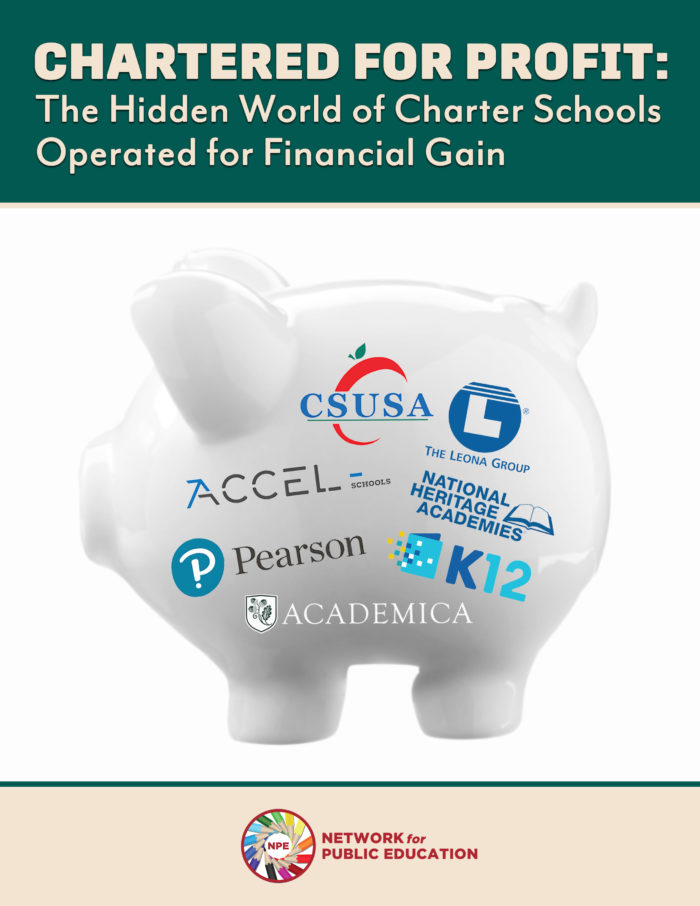
But charter school profiteers have found many loopholes, so that while they may not be able to set up for-profit charters, they can absolutely run charter schools for a profit. That may seem like a distinction without a difference, but the difference is that one is illegal in almost all states, and the other, as outlined in a new report, can be found from coast to coast. The new report, “Chartered for Profit,” from the Network for Public Education examines the size and reach of “the hidden world of charter schools operated for financial gain.” (Full disclosure: I am a member of NPE.)
The National Education Policy Center frequently engages independent scholars to review think tank reports, which are often advocacy reports.
In this report, the NEPC scholars review the latest report from the National Center on Teacher Quality, which was formed about 20 years ago to take down teachers’ colleges. See this post.
NEPC Review: 2020 Teacher Prep Review: Clinical Practice and Classroom Management (October 2020)
NCTQ’s 2020 Teacher Prep Review focuses on two areas of teacher preparation: clinical practice and classroom management. The report uses an approach that is now familiar to readers of NCTQ publications: asserting a set of preferred practices and then applying those criteria to teacher education programs. Although NCTQ reports have been critiqued for their limited use of research and highly questionable research methodology, this report employs the same approaches as earlier NCTQ reports. Rather than analyzing the characteristics of successful programs preparing teachers for a wide range of contexts, the report is based exclusively on adherence to or compliance with NCTQ internal standards that are neither widely accepted nor evidence-based. Thus, the report’s value is diminished and is unlikely to transform teacher preparation
Chartered for Profit: The Hidden World of Charter Schools Operated for
Financial Gain
In this report, we focus on the world of charter schools run for profit,
a world both hidden and misunderstood. We pull back the veil on tactics
and practices designed to reap as many public dollars as possible from
charter schools while hiding behind laws designed to keep profit-making
hidden from the public’s eyes. This report exposes how both large
and small for-profit companies evade state laws that make for-profit
charter schools illegal by the use of related entities and a nonprofit
front. We explain and provide examples of how for-profit owners maximize
their profits through self-dealing, excessive fees, real estate
transactions, and under-serving students who need the most expensive
services.
You can view and read the report by clicking the image below.