Latest News and Comment from Education

Showing posts with label EDUCATION. Show all posts

Monday, May 3, 2021

can’t-miss UK/NAACP Education & Civil Rights Initiative VIRTUAL CONFERENCE | Cloaking Inequity

can’t-miss UK/NAACP Education & Civil Rights Initiative VIRTUAL CONFERENCE | Cloaking Inequity
CAN’T-MISS UK/NAACP EDUCATION & CIVIL RIGHTS INITIATIVE VIRTUAL CONFERENCE


Talk with National Leaders and Experts! Register now for this can’t-miss virtual conference hosted by the University of Kentucky’s Education & Civil Rights Initiative May 7-8, 2021 Register here by Thursday, May 6, for Education & Civil Rights for the New Decade!
Explore some of the most pressing issues of our time in this two-day, virtual conference. You’ll have the opportunity to take part in multiple tracks hosted by expert community partners.
The conference is provided through a partnership between the Education and Civil Rights Initiative at the University of Kentucky College of Education, the UK Rosenberg College of Law, the NAACP, and the Kentucky Community and Technical College System. The conference is free and open to all, through the generous support of WesBanco. View Agenda & Register

You won’t want to miss featured speakers and panel events such as:

Friday, May 7 Conference Keynote 10:45 – 11:15 a.m. EST
Derrick Johnson, President and CEO of the NAACP, will open the conference. President Johnson formerly served as vice chairman of the NAACP National Board of Directors, as well as state president for the Mississippi State Conference of the NAACP. A longstanding member and leader of the NAACP, Mr. Johnson has helped guide the Association through a period of re-envisioning and reinvigoration.

Saturday, May 8, 10-11 a.m. EST Opening Keynote
Dr. Gloria Ladson-Billings will open the second day of the conference. As the former Kellner Family Distinguished Professor of Urban Education in the Department of Curriculum and Instruction at the University of Wisconsin, Madison, Dr. Ladson-Billings is known for her work in the fields of culturally relevant pedagogy and critical race theory.

Saturday, May 8, 5:45-6:45 p.m. EST Closing Keynote
Raymond Pierce, CEO of the Southern Education Foundation, will close the conference with a keynote. In his work with the Southern Education Foundation (SEF), Pierce leads the organization’s historic mission of advancing educational opportunities for African American and low-income students in the southern states. Since joining SEF in January 2018, Pierce has focused the organization on policy research, education legislation and leadership development. SEF has also launched a workforce development initiative and is expanding its efforts to strengthen parental engagement in support of improving student learning.


Saturday, May 8, 11 a.m.-12:15 p.m. EST
Plenary: A Conversation with National Education Leaders


Dr. Walter Bumphus,
 President and CEO of the American Association of Community Colleges
Dr. Norma CantĆŗ, Commissioner of the U.S. Commission on Civil Rights and Professor of Law and Education at the University of Texas-Austin
Dr. Belle Wheelan, President of the Southern Association of Colleges and Schools Commission on Colleges.
Thank you to our KCTCS partners for making this plenary possible.Register by Thursday, May 6 to reserve your spot! Conference tracks will include:

 ● Law & Justice*

● K-12 Education*

● Community Organization

● Post-Secondary

● Financial Literacy

*Continuing education credit is available upon request. Law and Justice continuing education credit is pending CLE approval.Housed in the Department of Educational Policy Studies and Evaluation, the Education and Civil Rights Initiative is a research collaboration with the NAACP, the nation’s largest and most preeminent civil rights organization. The focus of this collaboration is to ensure that every child in America experiences equitable access to education. Learn more about the initiative on our website.

Thursday, April 15, 2021

Covid-19 changed education in America — permanently - POLITICO

Covid-19 changed education in America — permanently - POLITICO
Covid-19 changed education in America — permanently
It’s been a school year like no other. Here’s what we learned.


There was a moment last spring when every parent and employer in America suddenly realized how deeply their lives and livelihoods depended on an institution too often in the background and taken for granted: the nation’s schools.

With almost no notice, adults and children found themselves in the middle of a massive national experiment in new ways of teaching and learning, and new ways of dividing responsibilities between home, school and work.

A year later, it’s clear that the Covid-19 pandemic has changed education in America in lasting ways, and glimpses of that transformed system are already emerging. School districts are developing permanent virtual options in the expectation that after the pandemic, some families will stick with remote learning — even for elementary school kids. Hundreds of colleges have, for the first time, admitted a freshman class without requiring SAT or ACT scores, potentially opening admissions to the most selective colleges to more low-income students. And thousands of educators across the country, from preschool to college, are finding new ways to spark their students’ creativity, harness technology and provide the services they need to succeed.

The pandemic has unleashed a wave of innovation in education that has accelerated change and prompted blue-sky thinking throughout the system. What if more schools could enhance learning and nutrition by offering their students not just a free breakfast and lunch, but dinner and a snack? What if schools delivered books during the summer? What if high school art students had access to graphic design and architecture software?

It’s not all upside, of course; the pandemic has been a tragedy for many CONTINUE READING: Covid-19 changed education in America — permanently - POLITICO

Monday, March 29, 2021

The History of the Future of Education (Audrey Watters) | Larry Cuban on School Reform and Classroom Practice

The History of the Future of Education (Audrey Watters) | Larry Cuban on School Reform and Classroom Practice
The History of the Future of Education (Audrey Watters)


From Audrey Watters’s self-description:

I am an education writer, an independent scholar, a serial dropout, a rabble-rouser, and ed-tech’s Cassandra.

“It’s a long story,” I often say. You can catch snippets of it, if you pay attention. I’ve got a CV if you care about such formalities. And I wrote an FAQ if that helps.

I love science fiction, tattoos, and, some days, computer technologies. I loathe mushy foods and romantic comedies. I’m not ashamed to admit I like ABBA and dislike Tolkien. I am somewhat ashamed to admit I’ve not finished Ulysses, and I’ve never even started Infinite Jest. I prefer cake to pie, unless we’re talking pastry projectiles. I pick fights on the Internet. I’m a high school dropout and a PhD dropout. I have a Master’s degree in Folklore and was once considered the academic expert on political pie-throwing. I was (I am?) a widow. I’m a mom. I have a hard stare that I like to imagine is much like Paddington Bear’s and a smirk much like the Cheshire Cat’s. I am not afraid.

I travel as much as I possibly can. “Home,” at least according to my driver’s license, is Seattle, Washington.

My essays have appeared in multiple places, but mostly I write on my blog Hack Education. I’ve published four collections of my public talks, The Monsters CONTINUE READING: The History of the Future of Education (Audrey Watters) | Larry Cuban on School Reform and Classroom Practice

Friday, February 19, 2021

YONG ZHAO: New article: The changes we need: Education post COVID-19 - Education in the Age of Globalization

Education in the Age of Globalization » Blog Archive » New article: The changes we need: Education post COVID-19
New article: The changes we need: Education post COVID-19


Just published in Journal of Educational Change: The changes we need: Education post COVID-19

Yong Zhao and Jim Watterston

Accepted: 28 January 2021

Download the PDF here

Abstract

The COVID-19 pandemic has caused both unprecedented disruptions and massive changes to education. However, as schools return, these changes may disappear. Moreover, not all of the changes are necessarily the changes we want in education. In this paper, we argue that the pandemic has created a unique opportunity for educational changes that have been proposed before COVID-19 but were never fully realized. We identify three big changes that education should make post COVID: curriculum that is developmental, personalized, and evolving; pedagogy that is student-centered, inquiry-based, authentic, and purposeful; and delivery of instruction that capitalizes on the strengths of both synchronous and asynchronous learning.

Download the PDF here


Thursday, December 24, 2020

NANCY BAILEY: Education’s “Better Angels of Our Nature” During a Pandemic

Education’s “Better Angels of Our Nature” During a Pandemic


We are not enemies but friends. We must not be enemies. Though passion may have strained, it must not break our bonds of affection. The mystic chords of memory will swell when again touched, as surely they will be, by the better angels of our nature.

~President Abraham Lincoln from his First Inaugural Address in 1861.

What did Abraham Lincoln mean by the better angels of our nature? William Shakespeare apparently first coined the term. By the time President Lincoln spoke of it, the country was deeply divided.

…“our better angels” was a figure of speech familiar to many citizens of the United States. The phrase would have called forth the notions of enlightened, calm, and virtuous judgment—the best guides to sensible and honorable conduct in any person or nation.

During this perilous time for the country and education, and during this season meant for coming together and caring for each other, as this year comes to a close, we should look to the better angels of our nature when it comes to schools.

Teachers

Americans must make sound decisions based on science when it comes to opening CONTINUE READING: Education’s “Better Angels of Our Nature” During a Pandemic

Sunday, December 20, 2020

Democracy and Education | tultican

Democracy and Education | tultican
Democracy and Education


By Thomas Ultican 12/19/2020

Democracy and free universal public education are foundational American ideologies. They have engendered world renowned success for our experiment in government “by the people”. Two new books – Schoolhouse Burning by Derek Black and A Wolf at the Schoolhouse Door by Jack Schneider and Jennifer Berkshire – demonstrate that these principles which were integral to the American experiment are shockingly under serious attack by wealthy elites.

After his father Fred died in 1967, Charles Koch took a disparate set of assets – a cattle ranch, a minority share in an oil refinery and a gas gathering business – and stitched them together. Today it is the second largest privately held corporation in the world. In the excellent 2019 book, Kochland, Christopher Leonard states, “Koch would eventually build one of the largest lobbying and political influence machines in US history.”

Both the introduction to A Wolf at the Schoolhouse Door and the “Through History’s Eyes” chapter of Schoolhouse Burning mention the same quote from Charles Koch. In 2018, the Koch network held its annual three day gathering near Palm Springs, California. It was a 700-person confab of some of the richest people in America. Black wrote,

“Charles Koch told the audience that ‘we’ve made more progress in the last five years than I had in the last 50…. The capabilities we have now can take us to a whole new level…. We want to increase the effectiveness of the network … by an order of magnitude. If we do that, we can change CONTINUE READING: Democracy and Education | tultican


Wednesday, December 16, 2020

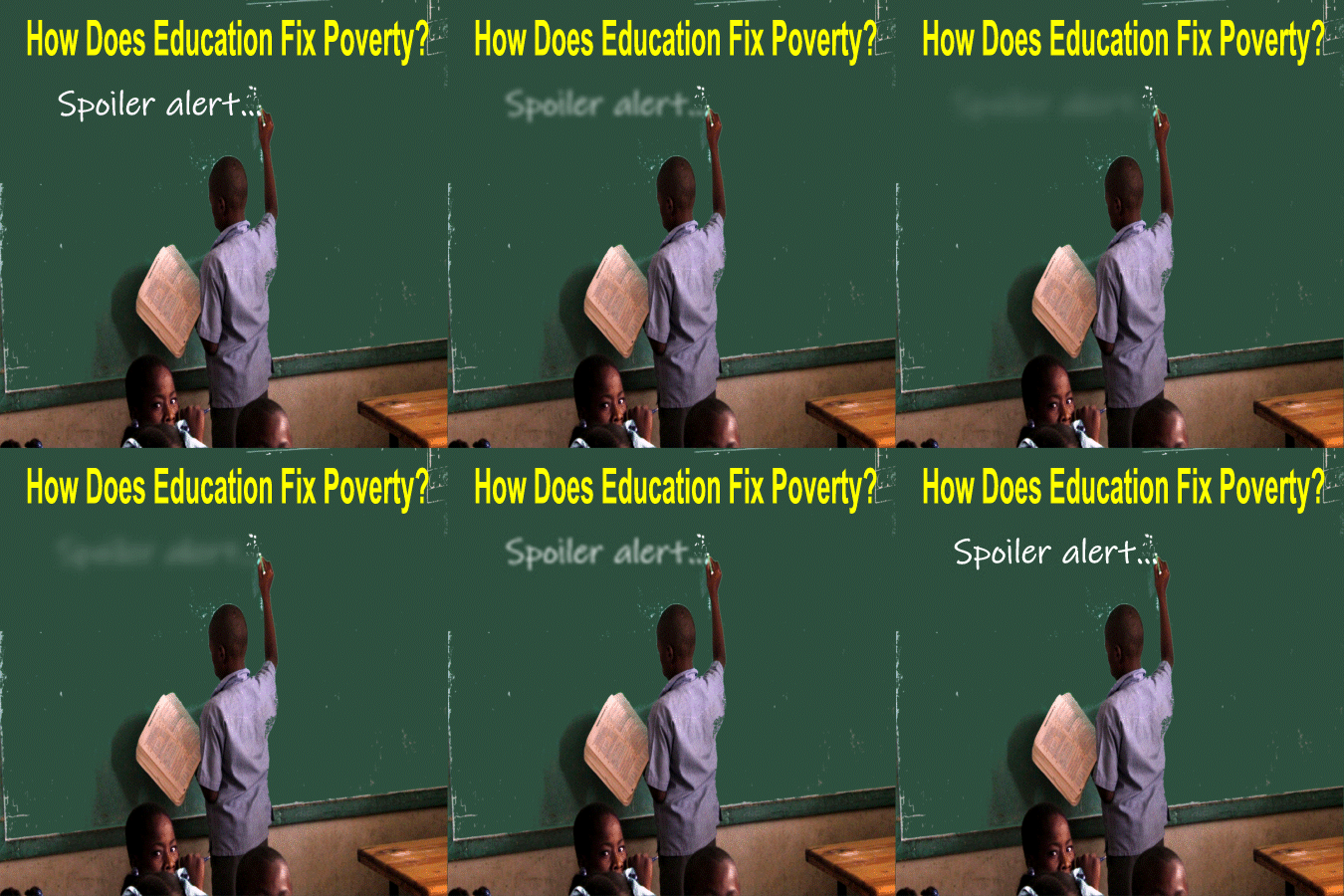
CURMUDGUCATION: How Does Education Fix Poverty? Spoiler alert...

CURMUDGUCATION: How Does Education Fix Poverty? Spoiler alert...
How Does Education Fix Poverty? Spoiler alert...


The idea that we can educate poverty away has been a popular one with policymakers and politicians for years now. Here's just one example, from Janet Yellen, former Fed Chair and, possibly, future Treasury Secretary, back in 2017:

Yellen spoke to a conference on community development today, where she says that providing children with the opportunity to learn important skills earlier is essential to ending this generational cycle of poverty.

“This research underscores the value of starting young to develop basic work habits and skills,” she said. “These habits and skills help prepare people for work, help them enter the labor market sooner, meet with more success over time and be in a position to develop the more specialized skills and obtain the academic credentials that are strongly correlated with higher and steadier earnings.”

You can find this kind of idea echoed at the international level or when plugging particular edu-programs-- education ends the "cycle of poverty" or "lifts the economy."

Now, I am not an economists (though there are so many economists that pretend to be education experts that it would serve them right if I got in their lane), so I may be missing something here. Feel free to sort me out in the comments.

But it seems to me that two things are being conflated here. One is that education can help an CONTINUE READING: CURMUDGUCATION: How Does Education Fix Poverty? Spoiler alert...


Monday, December 14, 2020

City Council candidate education briefing | Class Size Matters | A clearinghouse for information on class size & the proven benefits of smaller classes

City Council candidate education briefing | Class Size Matters City Council candidate education briefing | A clearinghouse for information on class size & the proven benefits of smaller classes
City Council candidate education briefing


On Dec. 9, 2020, Class Size Matter and NYC Kids PAC held an online briefing for City Council candidates and campaign staff.  About 85 or so candidates  participated.  The presentation, which covered a range of issues from the education budget, class size and school overcrowding, to charter schools, testing and Mayoral control, is available  below.  A recording of the Zoom session is here.

Download (PPTX, 903KB)