Five Great Questions For "Evidence-Based" Programs
-
At EdWeek, Larry Ferlazzo ran a guest post by Rene Grimes that focused on
the "science of math" and the programs that are supposed to be based on it.
Bet...
Cognitive Resonance: Why is Claude for Teachers?
-
Cognitive Resonance: Why is Claude for Teachers?
*Anthropic bumbles its way into education*
[image: Why?]
Everything about AI right now is weird.
I took...
SCHOOL FUNDING IS NO FUN — BUT IS IT FAIR?
-
*SCHOOL FUNDING IS NO FUN — BUT IS IT FAIR?**How "Reform" Became a Polite
Word for Pulling the Rug Out From Under Public Education*
Welcome to the gre...
The REPULSICANS
-
Admit it: The DUMBOCRATS is a fitting and appropriate moniker for one of
the two mainstream capitalist political parties in the US—one of the
greatest war-...
Celebrating our power this Labor Day
-
Every Labor Day, I stop to reflect on the history of our union and what
lessons we can apply to continue to build a movement that meets the
aspirations of ...
That Feeling of Understanding
-
Years ago, a friend involved in the business of "up cycling" wound up with
a collection of junk with which even he couldn't figure out what to do, so
he...
He Is Truly "Unhinged"
-
Since yesterday, Donald J. Trump has been posting on social media at a
frantic pace, showing AI images of himself with President George Washington
on ...
Labor Day. Happy Birthday to Me.
-
So—I just had a birthday. A big, round-number birthday. All my life, my
birthday has taken place in and around Labor Day weekend, and—fairly
often—happened...
To the Holiday Workers on Standby
-
I was fortunate enough to have Labor Day off. It was for me a relaxing day.
I spent most of it quietly at home, doing nothing particularly taxing,
which I ...
Around The Web In ESL/EFL/ELL
-
Ten years ago I began this regular feature where I share a few posts and
resources from around the Web related to ESL/EFL or to language in general
that ...
Educators Resist
-
View this email in your browser
[image: Logo]
*TL;DR*
*What We’ve Done*
Understanding that voting in November in numbers that cannot be ignored is
...
Day 1 for the New Congress
-
If Dems don't do this, they will have failed us entirely.
[image or embed]
— unpersoned.bsky.social (@unpersoned.bsky.social) September 5, 2026 at
5:5...
Why Does Teacher Pay Matter?
-
A recent story on America’s growing teacher shortage indicates a real
problem – nearly half a million teaching positions unfilled or filled with
temporary ...
SPI Celebrates 1 Million CalKIDS Accounts
-
California State Superintendent of Public Instruction Tony Thurmond
celebrates 1 million CalKIDS accounts, highlights financial literacy in
Monterey County.
DOE presentation on their AI guidance
-
The following slides were presented to the AI Moratorium Coalition steering
commitee on Sept. 1, 2026. The last slide has bullet points made up of
response...
The Light She Left Behind
-
“Those we love don’t go away, they sit beside us every day.” — Liane
Moriarty, Big Little Lies Forgive us if we are a little sad here in
Tennessee. We lost...
The Great and Irreplaceable Dolly Parton
-
If the state of the world has you down, here’s a reprieve, two interviews
with the great Dolly Parton. The first is my extended interview with her,
13 yea...
Who Wants a Raise?
-
Everyone. And if you are a UFTer (and not a retiree), you are getting one.
But get this. A new paraprofessional is getting a raise of $803/year. Man,
do th...
SQ 844: How is this better?
-
In plain terms, the new language gives the Legislature the authority to
establish both the amount and methodology for distributing ad valorem
reimbursement...
Time to change our Nation’s Diaper
-
It’s time to change our nation’s diaper. Our national identity now reeks
due to our inability to clean out the mess caused by the Orange Turd.
Corruption i...
May’s Parent Engagement Resources
-
San Diego Unified Created a System to ‘Empower’ Parents. It Unraveled is
from The Voice of San Diego. Why Those Disengaged Parents in Your School
Deserve a...
Reflections on America, the world, and life
-
I acknowledge that I rarely post here anymore. Folks should remember that I
am approaching my 80th birthday in less than 9 weeks, I am still teaching
ful...
Il Papa è Morto
-
Francis brought a distinct pastoral outlook to his papacy. A simple man, he
lived in a small apartment in the guesthouse. He sought to make the church
acce...
Whose Opinions Matter in Education World?
-
It's hard to identify education heroes and sheroes. And perhaps even harder
to pinpoint just whose work is slanted, paid-for and dishonest.
I am Retiring
-
I have some news: I am retiring from the PBS NewsHour and Learning Matters.
[[ This is a content summary only. Visit my website for full links, other
conte...
David Labaree on Schooling, History, and Writing: When Is School the Answer to Social Problems?
This post is a lecture I gave at University of Luxembourg in 2011, which was published in a book, edited by Daniel Tröhler and Ragnhild Barbu, Education Systems in Historical, Cultural, and Sociological Perspectives. To save you the trouble of buying the book on Amazon for $200, I’m reproducing it here. This piece draws on material from my 2010 book, Someone Has to Fail.
Schools have long been asked to solve myriad social problems, but
WHEN IS SCHOOL AN ANSWER TO WHAT SOCIAL PROBLEMS?
Lessons from the Early American Republic
In modern societies, we ask schools to fix an enormous variety of social problems, both large and small. We ask them to reduce social inequality and increase social mobility. We ask them to provide the economy with job skills that will increase productivity, enhance economic growth, and strengthen the nation. We ask them to promote democracy, improve health, save the environment, and empty our prisons. And at the same time we also assign schools smaller missions, such as improving driver safety, reducing tooth decay, fighting obesity, and deterring teenage pregnancy.
We ask schools to solve all of these problems even though they have demonstrated time and time again that they are unable to do so. Increasing educational attainment has proven to have no effect on the rates of social equality and social mobility, and its impact on economic growth has proven at best to be indirect and limited and at worst counterproductive. So why do we keep turning to schools for answers they cannot provide? One reason is that they are available. Schools are publicly controlled, located in every community, and willing if not able to take on new public missions. Another is that asking schools to fix problems is a lot easier than trying to address the problem directly through the political system.
Like most of America, I’ve been glued to the Derek Chauvin trial, watching the evening highlights, nail-biting Tweets–Why is this taking so long? —and cable news analyses. Have we moved forward as a society? Are we, if not woke, at least emerging with new awareness, from centuries of abusive and racist behavior?
The district has followed through…adding hate symbols to the list of items banned in school dress codes, expanding its reach in hiring to target more diverse job candidates and creating an online reporting system for incidents of harassment and discrimination.
Students see the district’s unwillingness to acknowledge the specific pain or concerns of Black students, or students in other groups, as evidence that leaders haven’t or don’t CONTINUE READING: No Justice, No Excellence | Teacher in a strange land
In the mid-1800’s, an Italian Jesuit gave rise to the phrase “social justice.” But today, its use as a political wedge leaves its meaning unclear to many. It’s meaning is based on Italian theologian “Thomas Aquinas’ idea that, in addition to doing the right thing, we should strive to do what is necessary for the betterment of others.” Five Principles of Social Justice, Kent State.
As viewed through its religious origin, social justice is based on moral uprightness (rectitude).
Social Justice: Born from Revolution
When economic inequality produced economic distress, the resultant turmoil of the French Revolution birthed the social justice concept. Over time, its meaning began to vary based on “political orientation, religious background, and political and social philosophy.” Therefore, speaking in general terms, social justice is the concept “that people have equal rights and opportunities; everyone … deserves an even playing field.” Tricia Christensen
America’s Declaration of Independence proclaimed that “all men are created equal.” But that declaration is merely the foundation for the promise of America.
“… the Declaration of Independence … was a call for the right to statehood rather than individual liberties, says Stanford historian Jack Rakove. Only after the American Revolution did people interpret it as a promise for individual equality.”Stanford News
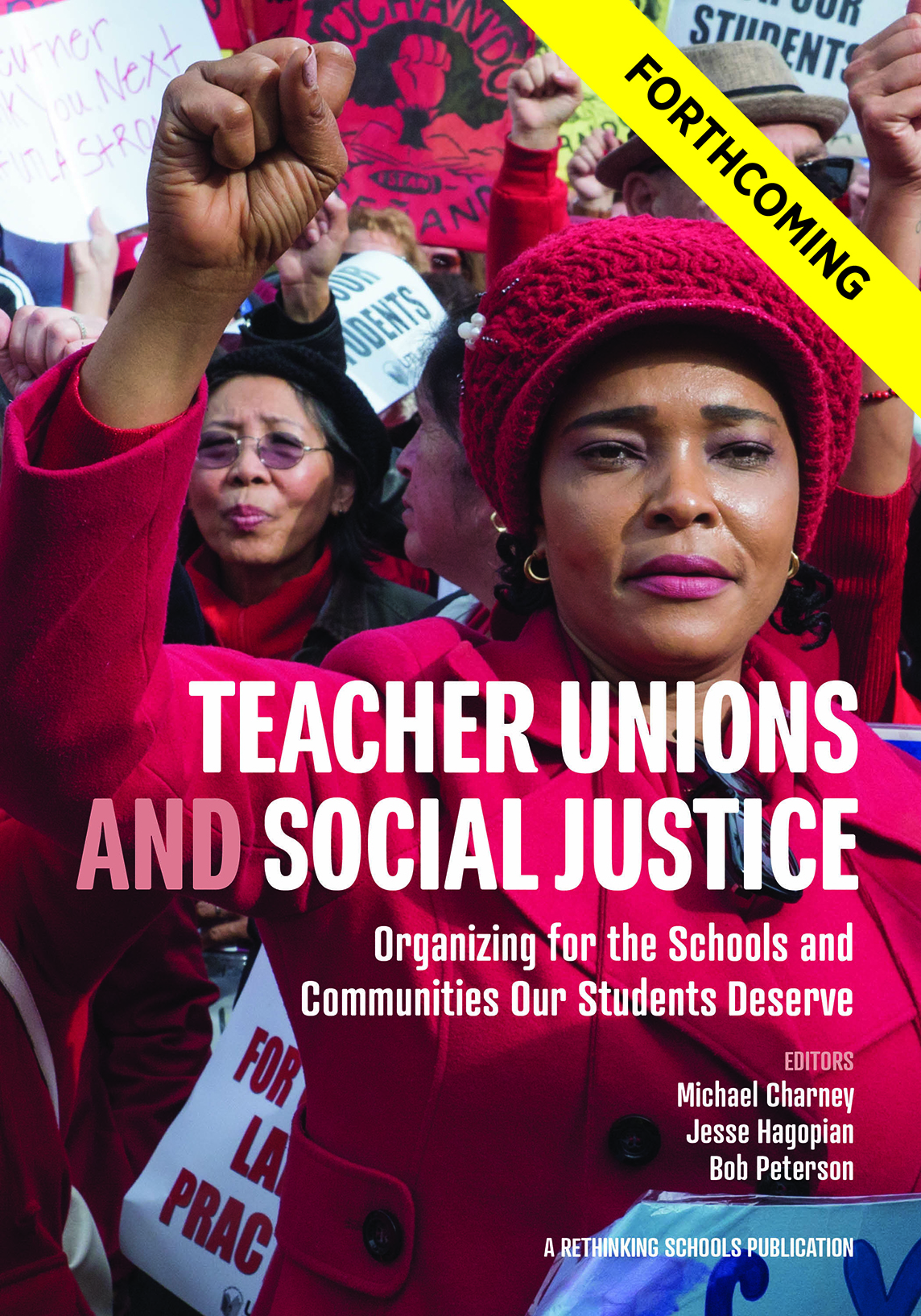
“Teacher Unions and Social Justice”–A New Book To Spur Rebellion From Rethinking Schools, With an Online Book Launch and Discussion January 21 at 6:00 pm – 7:15 pm CST
Register here today for the book launch event. You can order the book here.
When the epic story is told about how we finally built a society on true democracy and uprooted the last vestiges of systemic exploitation and oppression, there will undoubtedly be an important chapter about how organized workers in unions used their power to shut down segments of the economy and joined together with mass social movements in the streets to demand a better world. This is the power of social justice unionism and we desperately need to revive this tradition of struggle if we are going to achieve victories against white supremacy, undo record levels of wealth inequity, and challenge every other form of oppression in our society.
This beautiful new book includes lessons on reorganizing the labor movement and fusing it with social movements from many of the leading practitioners around the country. With historical lessons and first hand accounts from some of the most powerful educator strikes in the country, this book a contribution to arming educators with the understanding of their own power to change the world.
Included in the volume are the stories of how educator union organizers joined with parents and students around the country to build the movement to refuse to take or give high-stakes standardized tests; how union educators took up the struggle for Black lives by founding the Black Lives Matter at School movement; how they launched a strike in Los Angeles that included demands for immigrant rights and an end to the practice of police searching the belongings of mostly Black, Indigenous, and students of color in school; how educators in Chicago joined with parents and community organizers to win an anti racist reparations curriculum that would teach students the history of police torture in the city; how educators in Republican controlled states launched a wave of strikes that brought millions of more dollars to the school system; how educators have fought for and won community schools that provide wrap around services to students; how rank-and-file educators have built union caucuses that have helped to transform their local unions from a business model of unionism into a social justice union; and so much more.
On Thursday, January 21, the book’s editors will be joined by leading social justice union organizers Arlene Inouye and Michelle Gunderson to launch the book–and hopefully a new era of union power in the struggle for schools and society our children deserve (details about the book launch are below).
In solidarity,
Jesse Hagopian
Join Teacher Unions and Social Justice co-editors Jesse Hagopian, Michael Charney, and Bob Peterson along with contributors Michelle Gunderson and Arlene Inouye for the launch of a new Rethinking Schools book on the promise of social justice teacher unionism.
Editors and contributors will participate in a 75-minute conversation about building alliances with the community, the role of bargaining for the common good, the important roles of rank-and-file union caucuses, and how teachers can organize for racial and economic justice in our schools.
Arlene Inouye is UTLA secretary and co-chair of its bargaining team. She has been a speech and language specialist for 18 years in the Los Angeles Unified School District.
Michelle Gunderson is an educator and union activist from Chicago. She serves as a trustee for the Chicago Teachers Union and is the former co-chair of the Caucus of Rank and File Educators.
Bob Peterson is a founding editor of Rethinking Schools, a former president of the Milwaukee Teachers’ Education Association, and currently serves on the Milwaukee Board of School Directors. He is co-editor of several books, including The New Teacher Book, Rethinking Elementary Education, and Rethinking Columbus.
Michael Charney taught social studies in the Cleveland Public Schools for more than 30 years. He served as vice president of the Cleveland Teachers Union, where he led efforts to motivate teachers and paraprofessionals to change their schools.
The event is hosted by Rethinking Schools.
Participants will need access to Zoom. Register for the Zoom link, a free copy of the book’s introduction, and a 20% Rethinking Schools book/magazine discount code. The book is now available for pre-order. The estimated ship date is Feb 1, 2021.
EDUCATORS, SOCIAL JUSTICE IS ABOUT CONSISTENT ACTION, NOT SIMPLY WHEN IT’S TRENDING ON SOCIAL MEDIA
Since the murder of Trayvon Martin in 2012, activists and stakeholders of the Black community have done the yeoman’s work of highlighting all murders of Black people at the hands of the state (police) and domestic terrorists (vigilante white citizens).
Sadly, the murders of Trayvon Martin, Oscar Grant, Sandra Bland, Atatiana Jefferson, Eric Garner, Breonna Taylor, Tamir Rice were tragic, however no murder quite caught the attention of America than that of George Floyd. Maybe it was how he was murdered or that much of America was on quarantine when it happened. No matter the reason, Mr. Floyd’s murder captivated an audience of Americans that couldn’t perceive any American being killed like he was, or who simply believed that Black people spent years lying on the police.
Last year, Los Angeles County supervisors called on a panel of judges, prosecutors, public defenders and youth advocates to reimagine a juvenile justice system and report back.
Now, the results are in, and the 150-member group is calling for an entirely new approach: Instead of surveillance and incarceration, teams of counselors, mediators and community members would help respond to crises and guide youth who commit crimes toward restorative justice and job opportunities.
Under the plan expected to be heard by the Board of Supervisors in the next month, the county’s two remaining juvenile halls and its six detention camps would be shut down, with most young people instead housed in “Safe and Secure Healing Centers.” Only those found to have committed the most serious and violent offenses would be held in locked facilities, but they would be reconstructed with a less prison-like and more therapeutic design.
As a result, the juvenile probation department would end its troubled tenure overseeing thousands of young people, replaced by a system driven by a “care first, jail last” philosophy local leaders have said they are committed to enacting.
Kent Mendoza of the Anti-Recidivism Coalition. Image courtesy of the Division of Youth Diversion and Development.
At an initial cost of $75 million, a new youth development department would be charged with diverting many more youth out of the justice system altogether and would oversee community-led “Youth Engagement and Support” teams to provide crisis response and community supervision.
Should the plan proceed, the jobs of more than 3,400 probation employees who now oversee roughly 530 young people ages 12 to 17 in the county’s juvenile detention facilities and another 4,600 who live at home under department supervision CONTINUE READING: Weighing a Transformative Model for Youth Justice - LA Progressive
Join BLM at School educators, students and parents around the country on Wed, Oct. 14th in a national webinar & an eight minuet & 46 second free write/draw to “reimagine everything”
Celebrate George Floyd’s Birthday on Wednesday, Oct. 14th!
Join BLM at School educators, students and parents around the country in a national webinar and an eight minuet and 46 second free write/draw to “reimagine everything.”
Please read the blow information about how you can participate!
Dear Educators and Supporters,
On Wednesday, October 14th at 5 pm PDT/8 pm EDT, Black Lives Matter at School, WA State NAACP Youth Council, and National Educators United (NEU) are hosting an event in honor of Justice for George Day and the BLM at School Year of Purpose.
In addition, Black Lives Matter at School is calling on educators and families to facilitate a eight minuet and 46 second (the amount of time that officer Derek Chauvin keeled on George Floyd’s neck) timed activity with youth asking them to write or draw about the future they want to live in. Please see this graphic for more information.
Event Details:
Join Black Lives Matter at School, the WA State NAACP Youth Council, and National Educators United on October 14th at 5 pm PDT/8 pm EDT for a town hall to celebrate George Floyd’s birthday. We’ll have educators, students, and activists speaking from Minneapolis, Louisville, Seattle and around the country.
The Uprising for Black lives has prompted the Black Lives Matter at School movement to expand its annual Week of Action the first week of February to a “Year of Purpose”. We ask educators to participate in intentional days of action throughout the school year uplifting different intersectional themes vital to making Black lives matter in schools, communities, and our world.
“Justice for George” is a day to remember him and call for the defunding of the police and the redirecting of those funds towards social programs and education. In addition, we ask educators to reflect on their own work in relationship to antiracist pedagogy and abolitionist practice, persistently challenging themselves to center Black lives in their classrooms.
When you register for the webinar, you will receive an email with the zoom link immediately. If you don’t see it, check promotions or spam. If you still can’t find it, email: nationaleducatorsunited@gmail.com.
The Radical Imagination of Black Educators: Past and Future Directions for the Education Justice Movement
This fall we find ourselves in a confluence of crises: the economic crisis hurting households across the country, the dangers of re-opening during COVID-19, police brutality on the streets and in schools, massive dislocation of families due to climate wildfires, and now Trump’s White House is trying to punish educators for teaching about the history of racial injustice and white supremacy that continues in our country.
On September 30th, Black educators and advocates discussed how we can navigate the present moment and also reimagine the future of teaching and learning. What can we learn from the liberation struggles of the past to inform and inspire our current work? What are students, parents, educators, and community members doing right now that we should support and defend?
Speakers:
Karen “kg” Marshall, Kids Rethink New Orleans Schools (Rethink)
Dr. Richard Benson, Spelman College historian of Black Education
Dr. Khalilah Harris, Center for American Progress, #WeBuildEDU
Ruth Bader Ginsburg and the case of the 13-year-old girl strip-searched at school
The late Supreme Court Justice Ruth Bader Ginsburg left a deep mark on the world of education, opening doors for women, upholding the separation of church and state, supporting school desegregation and taking other stands to widen opportunity.
Perhaps her best-known education-related case came in the 1966 majority opinion she wrote that barred the Virginia Military Academy from excluding girls.
The state of Virginia argued to the court at the time that women could not handle tough military training, and it set up a separate program at Mary Baldwin College that Ginsburg wrote in the opinion was a “pale” imitation of the VMI program. That violated the Equal Protection Clause of the Fourteenth Amendment, she wrote.
But another case served to underscore the humanity with which she approached her decisions and why many court watchers say it is so important for the Supreme Court to include a diverse group of justices with different experiences and points of view.
The case was Safford Unified School District v. Redding, in which the court in 2009 ruled that the strip search of a 13-year-old girl at her school in Arizona was unconstitutional. Justice David Souter wrote the opinion for the majority, which included Ginsburg, who also wrote her own opinion explaining why she agreed with parts of the majority but dissented from another.
The girl, Savana Redding, was in math class at Safford Middle School when Assistant Principal Kerry Wilson escorted her to his office and told her she had been accused of giving out pain medication — both prescription and over-the-counter — to other students. The accuser was a student who had been caught with some of the medication. Redding, who had no history of disciplinary problems at the school, denied it.
Will Trump Nominate a Far Right Ideologue to Replace RBG? Will the Republican Senators Confirm the Nominee? How Should President Biden Respond?
On Thursday, September 17th, the National Constitution Center presented the Liberty Medal to Supreme Court Associate Justice Ruth Bader Ginsburg, “for her efforts to advance liberty and equality for all.” (Watch the ceremony here).
The next day, Friday evening, for many of us during Rosh Hashanah services, we learned of the passing of Justice Ginsburg.
Six years ago I had the great pleasure of listening to Justice Ginsburg at the New York Historical Society (Listen to her comments here – about an hour).
Ruth Bader was a Brooklyn girl, a graduate of James Madison High School, the school at which I taught for over three decades. Madison has a Law Institute, lawyers work with the students on projects, the students visit the courts, and, each year Justice Ginsburg hosted a visit from students at the Supreme Court. She impacted the lives of untold numbers of students.
Like RBG, I grew up in Brooklyn in a time when young people like us- the children and grandchildren of once despised immigrants- had hope that the country would finally welcome us and that we could change it for the better. People like Carol King, who went to the same high school as RBG, used music as their vehicle of expression; people like Bernie Sanders( also a Madison grad) found their mission in electoral politics; Ruth Bader Ginsburg transformed the nation through the practice of law Although I went to different high schools than they did, I was swept up in the optimism of post war America and saw no contradiction between my own dreams of upward mobility and my vision of the US as a more just society. Today, as dreams of upward mobility fade in an increasingly unequal society, and racism and white supremacy have returned to haunt us in the ugliest forms, we should take the time to honor Justice Ginsberg for devoting her life to bringing out the best in this country, and the best in all of us. We may no longer have Justice Ginsburg as a daily presence, but we have to work extra hard to keep her dreams and her legacy alive If we don't do this, we may see the US become a place that people of conscience have to leave, rather than a place which dreamers from all over the world see as a place to fulfill their destiny