Latest News and Comment from Education

Showing posts with label SCHOOLS SPREAD COVID. Show all posts

Wednesday, March 17, 2021

Three Feet or Six? Distancing Guideline for Schools Stirs Debate - The New York Times

Three Feet or Six? Distancing Guideline for Schools Stirs Debate - The New York Times
Three Feet or Six? Distancing Guideline for Schools Stirs Debate
Some public health officials say it’s time for the C.D.C. to loosen its social distancing guidelines for classrooms, but the idea has detractors.


The Centers for Disease Control and Prevention is clear and consistent in its social distancing recommendation: To reduce the risk of contracting the coronavirus, people should remain at least six feet away from others who are not in their households. The guideline holds whether you are eating in a restaurant, lifting weights at a gym or learning long division in a fourth-grade classroom.

The guideline has been especially consequential for schools, many of which have not fully reopened because they do not have enough space to keep students six feet apart.

Now, spurred by a better understanding of how the virus spreads and a growing concern about the harms of keeping children out of school, some public health experts are calling on the agency to reduce the recommended distance in schools from six feet to three.
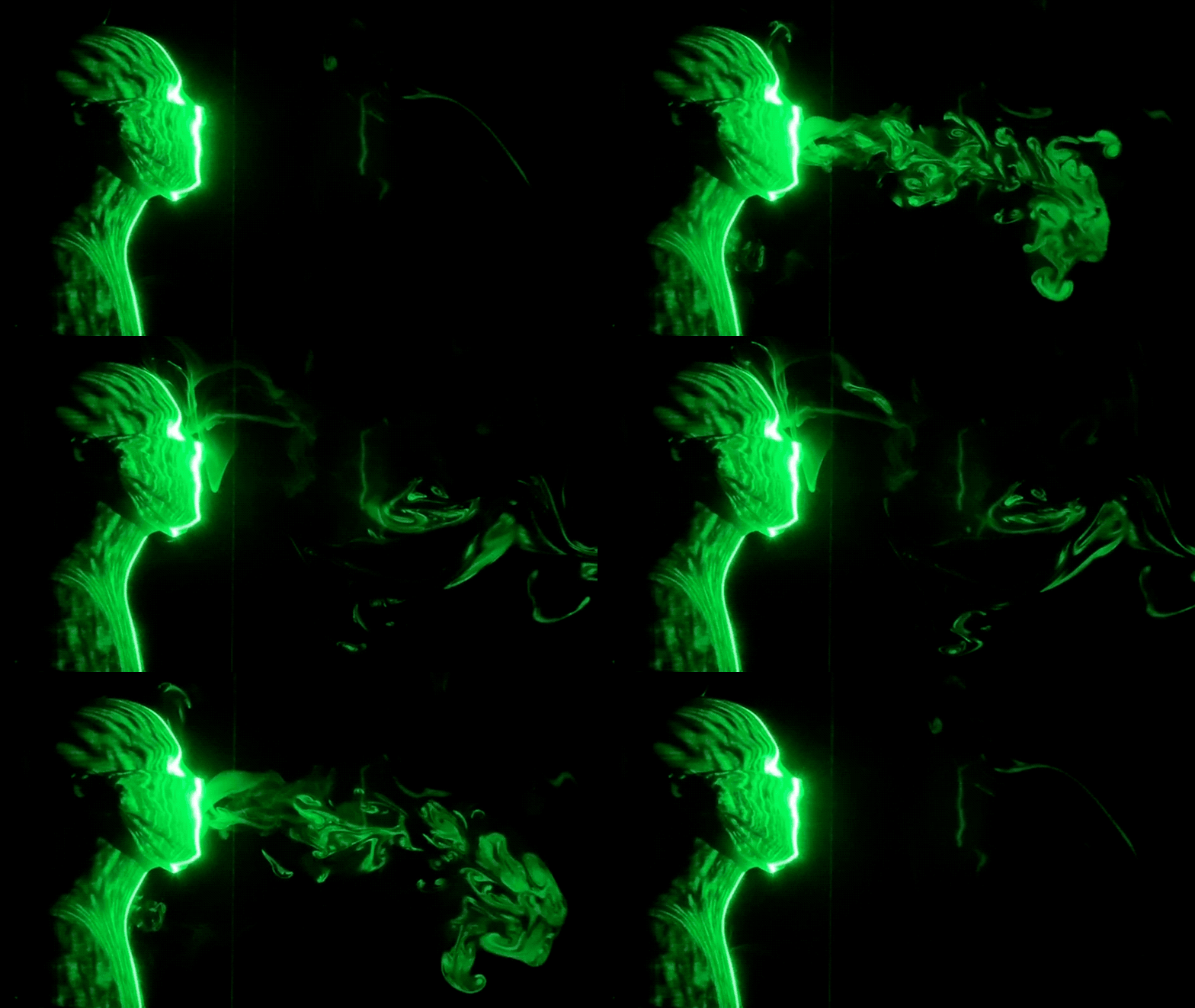
“It never struck me that six feet was particularly sensical in the context of mitigation,” said Dr. Ashish Jha, dean of the Brown University School of Public Health. “I wish the C.D.C. would just come out and say this is not a major issue.”

On Sunday, Dr. Anthony S. Fauci, the director of the National Institute of Allergy and Infectious Diseases, said on CNN that the C.D.C. was reviewing the matter.

The idea remains contentious, in part because few studies have directly compared different distancing strategies. But the issue also boils down to a devilishly difficult and often personal question: How safe is safe enough?

“There’s no magic threshold for any distance,” said Dr. Benjamin Linas, a specialist in infectious diseases at Boston University. “There’s risk at six feet, there’s risk at three feet, there’s risk at nine feet. There’s risk always.” He added, “The question is just how much of a risk? And what do you give up in exchange?”

The origins of six feet CONTINUE READING: Three Feet or Six? Distancing Guideline for Schools Stirs Debate - The New York Times

Thursday, January 7, 2021

CURMUDGUCATION: In Seattle, A Tough Back To School Choice

CURMUDGUCATION: In Seattle, A Tough Back To School Choice
In Seattle, A Tough Back To School Choice


Seattle's school board made a decision, just a few weeks ago, to re-open face-to-face school for pre-K, kindergarten, some special ed, and 1st grade students. It's a good example of the kinds of re-opening challenges that parents and teachers are facing, the kind of thing that is being pushed out as a "plan" by a major district.

Parents received an e-mail inviting them to complete a "survey" and commit themselves to either continuing at-home instruction via computer, or sending their child back for in-person learning on March 1st.

The e-mail was sent out January 5th. The decision must be made by January 10th. 

The e-mail includes a link to a FAQ page that is not, well, as helpful as it might be. For one thing, the tone is perhaps not unpleasant, but certainly brusque. For instance, on the matter of the deadline.

Can I change my decision after March 1?

The decision a family makes by January 10 will continue through the end of the CONTINUE READING: 
CURMUDGUCATION: In Seattle, A Tough Back To School Choice

Tuesday, January 5, 2021

Matt Barnum: Do schools spread COVID? It depends on the community, new studies suggest - Chalkbeat

Do schools spread COVID? It depends on the community, new studies suggest - Chalkbeat
Do schools spread COVID? It may depend on how bad things already are around them


Opening school buildings doesn’t increase the spread of COVID-19 in places where cases or hospitalizations from the virus are rare, according to two new studies.

Reopening schools in areas with higher caseloads, though, does spread the virus, one found, while the other couldn’t rule out that possibility. It remains unclear exactly at what point school reopening becomes more risky.

The papers are the most rigorous efforts yet to understand the link between schools and COVID spread in the U.S. It’s research that could guide school officials and health officials grappling with whether to reopen or keep open school buildings. But there aren’t simple answers for places with higher numbers, at a moment when some counties are seeing COVID cases peak.

“It appears that, when hospitalizations rates are low, it is safe to reopen schools in person,” said Douglas Harris, a professor at Tulane University who co-authored one of the studies, which examined national data. “This is important given the side effects of closure for students, such as limiting access to essential services, social isolation, and learning loss.”

At the same time, his co-author Engy Zieden warned that these conclusions don’t apply everywhere. “Given the recent spike in hospitalizations in recent months, policymakers should be cautious,” she said. “It may not be safe to reopen schools where the virus is already widespread.”

The national study, released Monday, examined whether opening schools increased COVID hospitalization rates in surrounding communities. The answer was no, up to a CONTINUE READING: Do schools spread COVID? It depends on the community, new studies suggest - Chalkbeat